THE EFFECTS OF SURFACE TREATMENTS AND BONDING AGENTS ON THE BONDING OF METAL
INDIRECT LABORATORY COMPOSITE MATERIALS
1
Zeynep Özbek Karadeniz,
1
Now Private Practice, Istanbul,
2
Department of Prosthodontics, Faculty of Dentistry, Istanbul University, Istanbul,
ARTICLE INFO ABSTRACT
Background:
between the base metal Co
chemical treatment and the combination of both treatments on a metal framework. Materials and Methods:
with retention beads and the other half was grind. All test specimens were divided into 5 groups; control, sandblasted, sandblasted and Metal primer II (GC Co., Tokyo, Japan), sandblast
photo primer (Shofu, Kyoto, Japan), Rocatectribochemical silica coating system (3M ESPE, Seefeld, Germany) are used for each group. Then; Gradia opaque and Gradia indirect laboratory composites (GC Co., Tokyo, Japan) were applied to all groups
cycling (TC) after the application of Gradia. Shear bond strength of each specimen was tested in an universal testing machine and fractured specimens were examined with SEM.
Results:
with TC or without TC (1.37 MPa, 1.19 MPa), the highest bond strength was obtained in group that used Metal primer II with TC (21,45 MPa).
Conclusion:
and then used metal primer for bonding.
Copyright © 2018, Zeynep Özbek Karadeniz et al. This unrestricted use, distribution, and reproduction in any medium,
INTRODUCTION
Indirect laboratory composite materials have been
as an alternative veneering material to porcelain as well as conventional acrylic resins. The advantages of veneering composite materials include easy handling, excellent aesthetics, hardness similar to that of the natural tooth enamel and ability to be readily repaired (Barzilay
Moreover, the ability of these resins to be used as pontics for resin bonded fixed partial restorations, overlay material for removable partial prosthesis, veneered crowns and other types of fixed partial dentures can be included
1992)..However, the disadvantage is the relatively low bond strength of veneering composite to metal framework
al., 1991; Mukai et al., 1995). Several methods have been explored in an attempt to maximize the bonding of resin composite to metal. These are; can be classified as macro, micromechanical, chemical, or a combination of these (Cobb
al., 2000).
*Corresponding author: Değer Öngül,
Department of Prosthodontics, Faculty of Dentistry, Istanbul University, Istanbul, Turkey.
ISSN: 0975-833X
Article History:
Received 17th January, 2018
Received in revised form
28th February, 2018
Accepted 29th March, 2018
Published online 30th April, 2018
Citation: Zeynep Özbek Karadeniz, Sabire İşler,
bonding of metal-indirect laboratory composite materials
Key words:
Indirect composite, Shear bond strength, Surface treatment, Thermocycling.
RESEARCH ARTICLE
THE EFFECTS OF SURFACE TREATMENTS AND BONDING AGENTS ON THE BONDING OF METAL
INDIRECT LABORATORY COMPOSITE MATERIALS
Özbek Karadeniz,
2Sabire İşler,
2Şeyma Alpkılıç and
2,Now Private Practice, Istanbul, Turkey
Department of Prosthodontics, Faculty of Dentistry, Istanbul University, Istanbul,
ABSTRACT
Background: The aim of this in-vitro experimental study was to evaluate the shear bond strength between the base metal Co-Cr alloy and laboratory-cured composite with mechanic retention, chemical treatment and the combination of both treatments on a metal framework.
Materials and Methods: 200 alloy discs (Co-Cr) were prepared, half of the specimens were prepared with retention beads and the other half was grind. All test specimens were divided into 5 groups; control, sandblasted, sandblasted and Metal primer II (GC Co., Tokyo, Japan), sandblast
photo primer (Shofu, Kyoto, Japan), Rocatectribochemical silica coating system (3M ESPE, Seefeld, Germany) are used for each group. Then; Gradia opaque and Gradia indirect laboratory composites (GC Co., Tokyo, Japan) were applied to all groups. Half of the specimens are subjected to thermal cycling (TC) after the application of Gradia. Shear bond strength of each specimen was tested in an universal testing machine and fractured specimens were examined with SEM.
Results: While the lowest bond strength was obtained in with both control groups of retention beads with TC or without TC (1.37 MPa, 1.19 MPa), the highest bond strength was obtained in group that used Metal primer II with TC (21,45 MPa).
Conclusion: Indirect laboratory composites shows higher shear bond strengths when first sandblasted and then used metal primer for bonding.
This is an open access article distributed under the Creative Commons medium, provided the original work is properly cited.
Indirect laboratory composite materials have been introduced as an alternative veneering material to porcelain as well as conventional acrylic resins. The advantages of veneering composite materials include easy handling, excellent aesthetics, hardness similar to that of the natural tooth enamel ty to be readily repaired (Barzilay et al., 1988). Moreover, the ability of these resins to be used as pontics for resin bonded fixed partial restorations, overlay material for removable partial prosthesis, veneered crowns and other types (Kolodney et al.,
.However, the disadvantage is the relatively low bond strength of veneering composite to metal framework (Rose et
Several methods have been the bonding of resin composite to metal. These are; can be classified as macro, micromechanical, chemical, or a combination of these (Cobb et
Department of Prosthodontics, Faculty of Dentistry, Istanbul
Traditionally, the bonding between laboratory
resin composite and metal is based on macromechanical retention (Leinfelder et al.,
produced a bulkier framework that was difficult to opaque because of pooling around the beads, which results in decrease of retention. Electrolytic etching technique developed by Livaditis et al., 1982; and this
some nickel-chromium and cobalt successfully etched (Lauferet al
alumina powder has also been used to clean the alloy surfaces and to achieve both micro retentive topography and increased surface area. It results in a highly activated surface, which can be shown by the increased wettability of this material (
al., 1994; Tanaka et al., 1986).
have also been studied to enhance the bond strength of the composite resins to different metal surfaces (
1997; Yoshida et al., 1999).
adhesive agents is the simplicity of their application on the sandblasted alloy surface without the need for any other specific media (Seimeniset al
carboxylic acid functional monomer also used in most of these adhesive opaque resins and promoters was effective in bonding composite resin in base dental alloys
International Journal of Current Research
Vol. 10, Issue, 04, pp.67696-67701, April, 2018
Şeyma Alpkılıç and Değer Öngül, 2018. “The effects of surface treatments and bonding agents on
indirect laboratory composite materials”, International Journal of Current Research, 10, (04), 67696-67701
THE EFFECTS OF SURFACE TREATMENTS AND BONDING AGENTS ON THE BONDING OF
METAL-INDIRECT LABORATORY COMPOSITE MATERIALS
,*
Değer Öngül
Department of Prosthodontics, Faculty of Dentistry, Istanbul University, Istanbul, Turkey
vitro experimental study was to evaluate the shear bond strength cured composite with mechanic retention, chemical treatment and the combination of both treatments on a metal framework.
Cr) were prepared, half of the specimens were prepared with retention beads and the other half was grind. All test specimens were divided into 5 groups; control, sandblasted, sandblasted and Metal primer II (GC Co., Tokyo, Japan), sandblasted and Metal photo primer (Shofu, Kyoto, Japan), Rocatectribochemical silica coating system (3M ESPE, Seefeld, Germany) are used for each group. Then; Gradia opaque and Gradia indirect laboratory composites . Half of the specimens are subjected to thermal cycling (TC) after the application of Gradia. Shear bond strength of each specimen was tested in an universal testing machine and fractured specimens were examined with SEM.
rength was obtained in with both control groups of retention beads with TC or without TC (1.37 MPa, 1.19 MPa), the highest bond strength was obtained in group that
igher shear bond strengths when first sandblasted
Commons Attribution License, which permits
Traditionally, the bonding between laboratory-polymerized resin composite and metal is based on macromechanical 1994). However this process produced a bulkier framework that was difficult to opaque because of pooling around the beads, which results in decrease of retention. Electrolytic etching technique developed by technique is sensitive and only chromium and cobalt- chromium alloys can be
et al., 1988). Sandblasting with alumina powder has also been used to clean the alloy surfaces and to achieve both micro retentive topography and increased surface area. It results in a highly activated surface, which can be shown by the increased wettability of this material (Kern et
Various adhesive metal primers have also been studied to enhance the bond strength of the composite resins to different metal surfaces (Yoshida et al., ., 1999). The main advantage of these adhesive agents is the simplicity of their application on the sandblasted alloy surface without the need for any other
et al., 2006). The phosphoric and carboxylic acid functional monomer also used in most of these adhesive opaque resins and promoters was effective in bonding composite resin in base dental alloys (Almilhatti et al., 2003; OF CURRENT RESEARCH
Watanabeet al., 1999). The aim of this study was to analyses the shear bond strength between the base metal Co-Cr alloy and laboratory-cured composite with mechanic retention, chemical treatment and the combination of both treatments on a metal framework. The effect of thermal cycles on the durability of the bond was also be investigated.
MATERIALS AND METHODS
The shear bond strength test procedures were performed according to ISO 10477. The materials used in this study are summarized in Table 1. Two-hundred autopolymerising acrylic resin (GC Pattern Resin LS, GC Europe) rivet-shaped patterns were formed in an addition silicone (Elite Double, Zhermack, Italy) mould with the following dimensions: disk 3 mm thick and 7 mm in diameter, pin 6 mm long and 3 mm in diameter. Then retention beads (GC Retention Beads II SSS, GC Europe) were sprayed onto the adhesive layer. All acrylic resin specimens were invested under vacuum with phosphate-bonded investment (Bellavest SH, Bego, Germany). After burnout at the temperatures specified by manufacturer, the specimens were centrifugally casted in Co-Cr alloy (Wironit, Bego, Germany) according to the manufacturer’s instructions.
The remaining parts of the investment were removed by sandblasting (Basic Classic; Renfert GmbH, Hilzingen, Germany) with 110 μ malu minium oxide (Korox 110, Bego, Bremen, Germany). The alloy patterns were randomly divided into two major groups; with retention beads (G1) and without retention beads (G2). All the metal disks without retention beads were first polished with No. 600 SiC abrasive paper to create a flat surface and then ultrasonically cleaned for 10 minute in a distilled water bath (Whaledent Biosonic, NY, USA) and air dried and randomly divided into five subgroups of 20 specimens. G1C and G2C were control group, the metal specimens were left untreated. For G1S and G2S were the sandblasted group; the metal specimens were airborne- particle abraded using 110 μm Al2O3 particles (Bego, Bremen,
Germany). Airborne-particle abrasion was performed for 10 seconds at 2.5 Atm air pressure, at a 10-mm nozzle metal surface distance. For G1P and G2P group, after sandblasting the metal surface was treated with primer (Metal primer II, GC Corporation, Japan) with a single brush application, which was allowed to dry for 1 min. For G1PP and G2PP, after sandblasting the metal surface was treated with primer (Metal photo primer, Shofu, Japan) with a single brush application, which was allowed to dry for 1 min. For G1R and G2R; Airborne-particle abrasion was performed initially with 110 μm Al2O3 particles (Rocatec Pre; 3M ESPE, Seefeld,
Germany) for 10 seconds to clean the surface. A second airborne-particle abrasion treatment was performed for 13 seconds using a special alumina powder (110 μm) with added silica particles (Rocatec Plus; 3M ESPE, Seefeld, Germany) to form a silica surface layer. Airborne-particle abrasion was performed at 2.8 Atm air pressure, at a distance of 10 cm. And then, silane-coupling agent (3M ESPE Sil; 3M ESPE, Seefeld, Germany) was applied and allowed to dry for 5 min. After
surface preparation, polymerization procedures were
performed according to the manufacturer’s instructions. A thin layer of Gradiaopaquer (GC Co., Tokyo, Japan) was applied and light-cured for 10s each with GC Steplight SL-1 (GC Co., Tokyo, Japan). The veneer composite Gradia (GC Co., Tokyo, Japan) was layered in three steps with a total thickness of 3 mm, and every layer was light-cured for 10s with GC Steplight SL-1 (GC Co., Tokyo, Japan) and post-curing was performed
for 3 min with GC Labolight LV-III (GC Co., Tokyo, Japan). Half of the specimens were performed thermal cycling (TC) between 5°C and 55°C (±2) for 5000 cycles with a dwell time of 30 seconds in each bath, according to ISO 10477. All specimens were then submitted to shear bond strength test (Autograph AG-IS 5K-N SHIMADZU, Kyoto, Japon) at a crosshead speed of 1 mm/min until failure. The shear bond strength (SBS) values were obtained in Newton (N) and converted into MPa. The shear bond strengths were calculated according to the formula: B = F / S, (B: shear bond strength (MPa), F: load at fracture (N), and S: bonded surfaces area (mm2). Fracture surfaces were evaluated with a scanning electron microscope (SEM) (Quanta 450FEG, USA). During evaluation of the study data, NCSS (Number Cruncher Statistical System) 2007 Statistical Software (Utah, USA) was used. As the parameters showed compatibility to normal distribution, the One-Way ANOVA was used in intergroup comparisons of parameters, while the Post Hoc Tukey HSD test was used in comparisons of sub-groups. The results were evaluated at the significance level of P˂0,01.
RESULTS
Shear-bonding resistance test evaluation
While the lowest bond strength was obtained in G2 a/b (1.37 MPa, 1.19 MPa), the highest bond strength was obtained in G1P b (21,45 MPa). There is no statistically significant differences between the groups G1P, G1PP and G1R3 with no thermal cycle application (TC). (P˂0,01). There are no statistically significant differences between the groups G2P and G2R, G2PP and G2R with no TC. On the other hand, G2P showed statistically higher values than G2PP (P˂0,01). G2C and G1C with TC were significantly lower than all of the other groups with TC. On the other hand, G2P with TC showed statistically higher values than all of the other groups (P˂0,01). Except G1R without TC, all the groups with retention beads showed significantly higher values than the without retention beads groups. Except G2R, all the groups with retention beads showed significantly higher values than the without retention beads groups.
Fracture interface evaluation
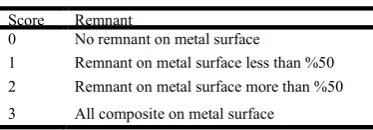
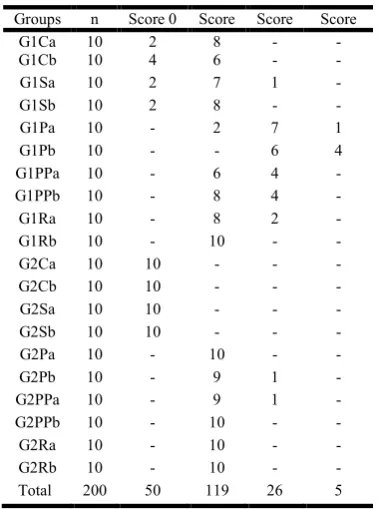
Fracture surfaces were evaluated with a scanning electron microscope (SEM) (Quanta 450FEG, USA). Fracture surfaces were evaluated under ×160 and ×300 magnification to determine the nature of the failure (cohesive, adhesive, or combination) and the interfaces involved and were scored using the modified adhesive remnant index (Table III). The results were evaluated statistically. As the parameters showed compatibility to normal distribution, the One-Way ANOVA was used in intergroup comparisons of parameters, while the Post Hoc Tukey HSD test was used in comparisons of sub-groups, and the Student t test in comparisons of pair groups The results were evaluated at the significance level of P˂0,01. According to the evaluation to modified ARI, on the 119 specimen, remmant found less then %50 on the metal surfaces (Table 4).
Scanning Electron Microscope Evaluation
Table 1. The materials used in this study
Material Component Manufacturer
Wironit Co-Cr metal %64 Co, %28.65Cr, %5 Mo Bego, Bremen, Germany
Gradia İndirect composite
bis-(methacryloyloxy)-propoxycarbonylaminohexane-triazine-trionemonomer, Aluminoborosilikat Silica %75
[image:3.595.55.544.280.644.2]GC Corporation, Tokyo, Japan
Table 2. Mean Shear Bond Strength (MPa) and standard deviation of the all group
(a)Thermal Cycling (-) (b)Thermal Cycling (+)
G1 G2 G1 G2
Control (C) 8,18±2,15 1,37±1,2 5,11±1,85 1,19±1,13
Sandb. (S) 9,1±1,43 5,61±0,88 11,72±1,71 4,7±0,6
Metal primer (P) 18,13±2,88 15,1±1,11 21,45±3,01 17,25±1,45
Photo primer (PP) 16,16±2,29 12,14±2,78 17,91±2,49 13,44±1,44
Rocatec (R) 15,95±1,62 14,69±3,01 15,26±1,54 12,56±2,31
F 44,85 90,26 81,27 166,46
p 0,0001** 0,0001** 0,0001** 0,0001**
F:Oneway ANOVA Test and Post Hoc Tukey HSD test was used. **P˂0,01
Fig. 1. Scanning electron microscope images with the magnification ×160. White arrows show the retention bead, orange arrows show the opaque layer of composite
Table 3. Classification of the remnant index
Score Remnant
0 No remnant on metal surface
1 Remnant on metal surface less than %50
2 Remnant on metal surface more than %50
[image:3.595.203.390.705.770.2]Table 4. Evaluation of composite remnant on metal surface according to Modified ARI
Groups n Score 0 Score Score Score
G1Ca 10 2 8 - -
G1Cb 10 4 6 - -
G1Sa 10 2 7 1 -
G1Sb 10 2 8 - -
G1Pa 10 - 2 7 1
G1Pb 10 - - 6 4
G1PPa 10 - 6 4 -
G1PPb 10 - 8 4 -
G1Ra 10 - 8 2 -
G1Rb 10 - 10 - -
G2Ca 10 10 - - -
G2Cb 10 10 - - -
G2Sa 10 10 - - -
G2Sb 10 10 - - -
G2Pa 10 - 10 - -
G2Pb 10 - 9 1 -
G2PPa 10 - 9 1 -
G2PPb 10 - 10 - -
G2Ra 10 - 10 - -
G2Rb 10 - 10 - -
Total 200 50 119 26 5
DISCUSSION
The metal-composite bond strengths measured by shear test were evaluated in present study according to the minimum value of 5,5 MPa specified in ISO 10477 Standard. Excluding the group (G1C/G2C) that was subjected to sandpaper application, the groups that were subjected to sandpaper, sandblasting and thermal cycling, in all other groups (G1P/G2P; G1PP/G2PP; G1R/G2R; with or without TC the bond strength was above the value of 5 MPa. Matsumura et al., 2001; argues that the shear bond strength for clinical use of metal-composite restorations must exceed 10MPa value. The bond strength in all groups on which metal primer and tribochemical silica coating were applied was above the values specified in ISO 10477.
In present study, it was found that the joint use of sandblasting-primer and tribochemical silica coating application on metal surface increased the metal-composite bond more than individual use of the sandblasting application. Sandblasting with aluminium oxide increases the amount of aluminium and oxygen on the metal surface and reduces the initial amount of elements (Ohkubo et al., 2000). According to Kern et al., 1994; aluminium particles used in sandblasting reveal metal oxides on metal surface and thus provide formation of a passive film layer bonded to functional monomers of metal primers, and so increase the metal-composite bond strength. In present study, after thermal cycling, a reduction in the bond strength was observed on the samples, which were only subjected to the sandblasting surface treatment. Also, in the study carried out by Yanagida et al., 2000; is stated that in the metal-composite bond strength, thermal cycling leads to a reduction in bond on the surface subjected to sandblasting and that a chemical bond must be provided in order to increase the bond strength after sandblasting. In all groups on which thermal cycling was not applied; G1Ca/G2Ca, G1Sa/G2Sa, G1Pa/G2Pa, G1PPa/G2PPa, the efficiency of the use of
retention beads increased the metal-composite bond strength. Although only in the group with retention beads within the group G1Ra/G2Ra an increase in number was observed in bond-strength, no significant difference was observed in statistical terms. In this case, we could say that use of retention
beads increases the metal-composite bond strength
independently from other surface treatments. There is an opinion that a micro leakage will occur in the interface between the mechanical retention otained by the individual use of retention beads and metal-composite resin in time (Kourtis, 1997). The chemical bond to the metal surface of the opaque layer limits the micro leakage occurred between polymerizing shrinkage and metal-composite due to nonconformity of thermal expansion (Imbery et al., 1993; Tanoue et al., 1998). The chemical bond requires a precise technique and any possible contamination, which may occur in the interface, reduces the metal-composite bond (Yoshida et al., 2001). In present study, it was found out that the application of metal primer and tribochemical silica coating on metal surface with retention beads resulted an increase in the metal-composite bond strength (G1P,G1PP and G1R with TC). The obtained bond strength value was considerably above the bond strengths given in ISO 10477 and suggested by Matsumura for clinical use of metal-composite restorations (Matsumura et al., 2001). Similar to the results of current study, the previous studies (Matsumura et al., 2001; Taira et al., 1995; Yoshida et al.,
2001). are also of the opinion that metal primer creates a bond with oxide layer on metal alloy surface and thus increases the metal-composite bond strength. In the study in which 3 different indirect laboratory composites (Solidex, Artglass, Signum) as metal photo primer and veneer material were applied on Ni-Cr alloy surface with retention beads in 150μ diameter, and the samples were subjected to 5000 thermal cycling, respectively bond strength values of 12.61MPa, 14.9MPa and 16.55MPa were obtained (Seimeniset al., 2006). These results are lower than those values obtained in group G1PP with TC in present study (17.94MPa). This difference might be caused by the use of different alloy and indirect composite material in present study.
Although higher bond strength was obtained in the group in which Metal primer II (G1Pa) was applied among those groups in which metal primer and tribochemical silica coating with retention beads were applied, but not subjected to thermal cycling (G1P,G1PP,G1R); no significant difference between them was found. The bond strength obtained in these groups are considerably above those bond strengths given in ISO 10477 and suggested by Matsumura et al., 2001 for clinical use of metal-composite restorations. The highest bond strength in groups not subjected to thermal cycling was obtained in the group subjected to Metal primer II (G1Pa) application. No statistically significant difference was observed between the Group G2PP and G2R. Yoon et al., 2007; applied 2 different composite resins (Sinfony and Gradia) on sandpapered Cp-Ti/Co-Cr alloy surface and examined the shear bond strength. In the study, 2 different primers were used as Metal primer II and Rocatec. 17.70MPa (Metal primer II) and 16.61 MPa (Rocatec) bond strengths were obtained. These values are similar to the values of the groups G2Pa and G2R5a in present
study (15.1MPa, 14.69MPa). Seimenis et al., 2006;
silica coating (G1Ra/G2Rb) was applied. This situation may prove that a stable metal-composite bond, which withstands humidity and temperature changes, is formed (Kim et al., 2003; Luthy et al., 1990) However, thermal cycling treatment increased the metal-composite bond strength in groups G1Pb/G2Pb in which Metal Primer II was used, independently from the use of retention beads. Double bonds of MEPS in Metal Primer II become polymerized with double bonds of UDMA in the interface and form a single copolymer structure. It is considered that thermal cycling in limited numbers restricts its own effect and even in some cases, increases the bond strength a little, and this increase may be related to relief of polymerization stresses of composite material (Kern et al.,
1994; Schneider et al., 1997). Also, there is an opinion that the increase in metal-composite bond strength after thermal cycling may be related to improvement in the monomer variation degree of polymer material due to temperature rise (Knobloch et al., 1999; Moulin et al., 1999; Tanoue et al.,
2000).
After polymerization, polymerization of some monomers could not be completed. The missing polymerization may be completed with heat during thermal cycling and it may lead to an increase in the bond strength. Yoon et al., 2007; stated that; although Metal primer II showed higher bond strength than Rocatec, differently from in present study, no statistically significant difference was observed between them. Similarly to current study, the highest bond strength among Metal primer II, Metal photo primer and silica coating treatments applied on metal surface obtained with Metal primer II (32.3MPa) in the study conducted by Kurtz et al., 2005; and no significant difference was found between Metal photo primer (24.2MPa) and silica coating (26.2MPa). Higher bond strengths were derived from in present study, and it is thought that it is due to the different alloy selection and the change in the sample size. In present study as a result of examination of metal and composite bond surfaces after shear bond strength test, it was observed that the most frequently encountered type of failure is mixed-type failure where both adhesive and cohesive cracks are seen together.
In the SEM examinations of metal and composite surfaces after shear bond strength test, on samples with retention (G1Sa, G2Sb), the opaque deposits were observed between retention beads, their tips had a clean surface. And on sandblasted samples, a completely clean metal surface was observed. All these findings supports that use of retention beads increases the metal composite bond strength, independently from the use of primer. And in groups G1Pa and G2Pb in which the highest bond strength was reached, composite and opaque deposits were observed on the tips of the retention beads. While appearance of a typical sandblasted metal surface was perceived on sandblasted metal surfaces, also resin layers separated from composite through adhesive and cohesive cracks on the surface were seen. In the areas where there are cohesive cracks in resin, the fillers inside the composite structure were spotted clearly. Differences between the effects of the use of Metal Photo Primer, Rocatec and Metal Primer II on metal-composite bond strength may be related to difference of some physical properties like their chemical contents, physical structures, viscosity and wettability. In addition, it could be said that affinities of these three different surface treatments on sandblasted Co-Cr metal alloy surface and bonding performances are different.
Conclusion
Use of metal primer agents is a low-priced, option with a simple and short application procedure which does not require any special apparatus or technical precision, and it is successful in the increase of metal-composite bonding and which is appropriate for clinical use. As a result of in this present study study, it is recommended to use techniques, which combine the chemical and mechanical retention for a reliable bond between metal and composite.
Conflict of interest: The authors declare that they have no
conflict of interest.
Acknowledgement: The present work was supported by the
Scientific Research project of Istanbul University, Project no. 15982.
REFERENCES
Almilhatti, HJ., Giampaolo, ET., Vergani, CE, et al., 2003. Shear bond strength of aesthetic materials bonded to Ni-Cr alloy. J Dent, 31:205-211.
Barzilay, I., Michael, LM., Lyndon, BC. and Gerald, NG. 1988. Mechanical and chemical retention of laboratory cured composite to metal surfaces. J Prosthet Dent, 59:131-136.
Cobb, DS., Vargas, MA., Fridrich, TA., et al., 2000. Metal surface treatment: characterization and effect on composite-to-metal bond strength. Oper Dent, 25:427-433. Imbery, TA., Evans, DB. and Koeppen, RG. 1993. A new
method of attaching cast gold occlusal surfaces to acrylic resin denture teeth. Quintessence Int, 24(1);29-33. Kern, M. and Thompson, VP. 1994. Effects of sandblasting
and silica-coating procedures on pure titanium. J Dent. 22:300-306.
Kim, JY., Pfeiffer, P. and Niedermeier, W. 2003. Effect of laboratory procedures and thermocycling on the shear bond strength of resin-metal bonding systems. J Prosthet Dent, 90(2);184-189.
Knobloch, L A., Kerby, RE., Seghi, R. and Van Putten, M. 1999. Two-body wear resistance and degree of conversion of laboratory-processed composite materials. Int J Prosthodont, 12(5);432-438.
Kolodney, H., Puckett, AD. and Brown, K. 1992. Shear strength of laboratory-processed composite resins bonded to a silane-coated nickel-chromium-beryllium alloy. J Prosthet Dent, 67: 419-422.
Kourtis, SG. 1997. Bond strengths of resin-to-metal bonding systems. J Prosthet Dent, 78(2);136-145.
Kurtz, KS., Ikuya, W., Chikahiro, O. and David, S. 2005. Bond strength of prosthetic composite to primedandsilicoated cast titanium. Int Chin J Dent, 5;12-16.
Laufer, BZ., Nicholls, JI. and Townsend, JD. 1988. SiOx-C Coating: A composite-to-metal bonding mechanism. J Prosthet Dent, 60:320-327.
Leinfelder, KF. 1994. Resin to metal bonding: overcoming esthetic problems. J Am Dent Assoc, 125:292-294.
Livaditis, GJ. and Thompson, VP. 1982. Etched castings: An improved retentive mechanism for resin-bonded retainer. J Prosthet Dent, 47:52-58.
Matsumura, H., Yanagida, H., Tanoue, N., Atsuta, M. and Shimoe, S. 2001. Shear bond strength of resin composite veneering material to gold alloy with varying metal surface preparations. J Prosthet Dent, 86(3);315-319.
Moulin, P., Picard, B. and Degrange, M. 1999. Water resistance of resin-bonded joints with time related to alloy surface treatment. J Dent, 27(1);79-87.
Mukai, M., Fukui, H. and Hasegawa, J. 1995. Relationship between sandblasting and composite resin-alloy bond strength by a silica coating. J Prosthet Dent, 74:151-155. Ohkubo, C., Watanabe, I., Hosoi, T. and Okabe, T. 2000.
Shear bond strengths of polymethyl methacrylate to cast titanium and cobalt-chromium frameworks using five metal primers. J Prosthet Dent, 83(1);50-57.
Rose, MJ., Moore, BK., Charles, JG. and Carlos, AMV. 1991. Microleakage and shear bond strength of resin and porcelain veneers bonded to cast alloys. J Prosthet Dent. 65:221-228.
Schneider, W., Powers, J M. and Pierpont, H P. 1992. Bond strength of composites to etched and silica-coated porcelain fusing alloys. Dental materials, 8(3);211-215.
Seimenis, I., Sarafianou, A. and Papadopoulou, H. 2006. Papadopoulos T. Shear bond strength of three veneering resins to a Ni-Cr alloy using two bonding procedures. J Oral Rehabil, 2006; 33:600-608.
Taira, Y., Matsumura, H., Yoshida, K., Tanaka, T. and Atsuta, M. 1995. Adhesive bonding of titanium with a metacrilate-phosphate primer and self-curing adhesives resins. J Oral Rehabil, 22:409–412.
Tanaka, T., Fujiyama, E., Shimizu, H., Takaki, A. and Atsuta, M. 1986. Surface treatment of nonprecious alloys for adhesion-fixed partial dentures. J Prosthet Dent, 1986:55:456-462.
Tanoue, N., Matsumura, H. and Atsuta, M. Comparative evaluation of secondary heat treatment and a high intensity light source for the improvement of properties of prosthetic composites. J Oral Rehabil, 2000:27(4);288-293.
Tanoue, N., Matsumura, H. and Atsuta, M. Curing depth of four composite veneering materials polymerized with different laboratory photo-curing units. J Oral Rehabil, 1998:25(5);348-352.
Watanabe, I., Kurtz, KS., Kabcenell, JL. and Okabe, T. 1999. Effect of sandblasting and silicoating on bond strength of polymer-glass composite to cast titanium. J Prosthet Dent,
82:462-467.
Yanagida, H., Tanoue, N., Ide, T. and Matsumura, H. 2000. Evaluation of two dual-functional primers and a tribochemical surface modification system applied to the bonding of an indirect composite resin to metals.
Odontology, 97(2);103-108.
Yoon, SH., Pae, A., Lee, SH. and Lee, H. Comparative study of shear bond strength between cp-Ti/Co-Cr alloy and
composite resins. J Korean AcadProsthodont,
2007:45(6):805-814.
Yoshida, K., Kamada, K. and Atsuta, M. Adhesive primers for bonding cobalt-chromium alloy to resin. J Oral Rehabil, 1999; 26:475-478.
Yoshida, K., Kamada, K., Taira, Y. and Atsuta, M. Effect of three adhesive primers on the bond strengths of four light-activated opaque resins to noble alloy. J Oral Rehabil, 2001:28(2);168-173.
Yoshida, K., Taira, Y., Sawase, T. and Atsuta, M. 1997. Effects of adhesive primers on bond strength of self-curing resin to cobalt-chromium alloy. J Prosthet Dent, 77:617-620.