doi:10.4236/ica.2011.22018 Published Online May 2011 (http://www.SciRP.org/journal/ica)
The Time-Optimal Problems for Controlled Fuzzy
R-Solutions
Andrej V. Plotnikov, Tatyana A. Komleva, Irina V. Molchanyuk
Odessa State Academy of Civil Engineering and Architecture, Odessa, Ukraine E-mail: [email protected], [email protected], [email protected]
Received April 21, 2011; revised May 12, 2011; accepted May 15, 2011
Abstract
In the present paper, we show the some properties of the fuzzy R-solution of the control linear fuzzy differ-ential inclusions and research the time-optimal problems for it.
Keywords:Fuzzy Differential Inclusions, Control Problems, Time-Optimal Problems, Fuzzy R-Solution
1. Introduction
The first research of the differential equations with set- valued right-hand side has been fulfilled by A. Marchaud [1,2] and S. C. Zaremba [3]. In the early sixties, T. Wazewski [4,5], A. F. Filippov [6] had been obtained fundamental results about existence and properties of solutions of the differential equations with set-valued right-hand side (differential inclusions). Connection de-riving between differential inclusions and optimum con-trol problems was one of the most important outcomes of these papers. These outcomes became impulse for de-velopment of the theory of differential inclusions [7-9].
Considering of the differential inclusions required to study properties of set-valued maps, i.e. an elaboration the whole tool of mathematical analysis for set-valued maps [7,10,11].
In work [12] annotate of an R-solution for differential inclusion is introduced as an absolutely continuous set- valued maps. Various problems for the R-solution theory were considered in [8,13]. The basic idea for a develop-ment of an equation for R-solutions (integral funnels) is contained in [14].
In the eighties the last century the control theory in the conditions of uncertainty began to be formed. The con-trol differential equations with set of initial conditions [15-17], control set differential equations [18-21] and the control differential inclusions [21-32] are used in the given theory for exposition of dynamic processes.
In recent years, the fuzzy set theory introduced by Zadeh [33] has emerged as an interesting and fascinating branch of pure and applied sciences. The applications of fuzzy set theory can be found in many branches of
re-gional, physical, mathematical, differential equations, and engineering sciences. Recently there have been new advances in the theory of fuzzy differential equations [34-47] and inclusions [48-53] as well as in the theory of control fuzzy differential equations [54-57] and inclu-sions [57-59].
In this article we consider the some properties of the fuzzy R-solution of the control linear fuzzy differential inclusions and research the time-optimal problems for it.
2. The Fundamental Definitions and
Designations
Let comp R
n
conv R
n
be a set of all nonempty (convex) compact subsets from the space Rn,
0
, min r , r
r
h A B S A B S B A
be Hausdorff distance between sets A and B, Sr
Ais r-neighborhood of set A.
Let En be the set of all u R: n
0,1such that u satisfies the following conditions:
1) u is normal, that is, there exists an 0
n
x R such that u x
0 1;2) u is fuzzy convex, that is,
1
min
,
u x y u x u y
n
for any x y, R and 0 1; 3) u is upper semicontinuous, 4)
u 0 cl x
Rn:u x
0
n
is compact. If , then is called a fuzzy number, and is said to be a fuzzy number space. For
uE u En
u
xRn:u x
.
Then from (1) - (4), it follows that the -level set for all 0 1
u conv R
n .
Let be the fuzzy mapping defined by
x 0 if and .0
x
0 1: n n
D E E
Define
by the relation
0,
0 1
, sup ,
D u v h u v
,
where h is the Hausdorff metric defined in comp R
n. Then D is a metric in En.
Further we know that [60]:
1)
En,D is a complete metric space,
D u w
2) ,vw
D u v
, for all ,
, ,n
u v wE 3) D u, v D u v
, for all , n andu vE R
.
Definition 1. [36] A mapping : 0,
nF T E is measurable if for all
0,1 the set-valued map
: 0, n
F T conv R defined by F
t F t
is Lebesgue measurable.Definition 2. [36] A mapping : 0,
nF T E is said to be integrably bounded if there is an integrable function
such that
h t x t
h t
for every x t
F0
t .Definition 3. [36] The integral of a fuzzy mapping
: 0, n
F T E
T T
is defined levelwise by
0 0
d d
F t t F t t
. The set
0d
T
F t t
of all
0 d
T
f t t
such that : 0,
nf T R is a measurable selection for F: 0,
T conv R
n for all
0,1.Definition 4. [36] A measurable and integrably bounded mapping F: 0,
T En is said to be integra- ble over
0,T if
0
d n
T
F t tE
.Note that if F: 0,
T En is measurable and inte-grably bounded, then F is integrable. Further if
: 0, nF T E is continuous, then it is integrable. Now we consider following control differential equa-tions with the fuzzy parameter
, , ,
, 0 0,x f t x w v x x (1) where x means d
d x
t ; tR is the time;
n
xR
k
is the state; is the control; is the fuzzy parameter;
m
wR v V E
k n
: n m
f RR R
monv R
R R .
Let be the measurable set-va- lued map.
:
W R c
Definition 5. The set of all measurable single- valued branches of the set-valued map is the set of the admissible controls.
LW
W
Further we consider following control fuzzy
differen-tial inclusions
, ,
, 0 0, xF t x w x xn
(2) where F R: RnRm E is the fuzzy map such that F t x w
, ,
f t x w V
, , ,
.Obviously, the control fuzzy differential inclusion (2) turns into the ordinary fuzzy differential inclusion
, , 0 0,x t x x x (3) if the control w
LW is fixed and
t x, F
t x w t, ,
.
If right-hand side of the fuzzy differential inclusion (3) satisfies some conditions (for example look [12]) then the fuzzy differential inclusions (3) has the fuzzy R-so- lution.
Let X t
denotes the fuzzy R-solution of the differ-ential inclusion (3), then X t w
,
denotes the fuzzy R-solution of the control differential inclusion (2) for the fixed w
LW.Definition 6. The set Y T
X
T w,
:w LW
be called the attainable set of the fuzzy system (2).3. The Some Properties of the Fuzzy
R-Solution
Further in the given paper, we consider following control linear fuzzy differential inclusions
, , 0 0,xA t x G t w x x (4) where A t
is
n n
dimensional matrix-valued function; G R: Rm En is the fuzzy map.
In this section, we consider the some properties of the fuzzy R-solution of the control fuzzy differential inclu-sion (4).
Let the following condition is true. Condition A:
A1. A
is measurable on
0,T ;A2. The norm A t
of the matrix A t
is inte-grable on
0,T ;A3. The set-valued map :
0,
mW t T conv R is measurable on
0,T ;A4. The fuzzy map : 0,
m nG T R E satisfies the conditions
1) measurable in t; 2) continuous in w;
A5. There exist v
L2
0,T and l
L2
0,Tsuch that
, 0
, ,
,
h W t v t D G t w l t almost everywhere on
0,T and all w W t
.A6. The set Q t
, ( ) :w t
w LW
G t is
com-pact and convex for almost every t 0,T
, i.e.
nQ t conv E .
Then for every there exists the fuzzy R-solution
w LW
,X w such that 1) the fuzzy map X
,w has form
1
0
0
, ,
t
d X t w t x t
s G s w s s, where t
0,T ; is Cauchy matrix of the differ-ential equation
t
xA tn x E w t X(, )
;
1) for every t
0,T ;2) the fuzzy map X
,w is the absolutely continuous fuzzy map on
0,T .Proof. 1. Show that X t w
,
is the fuzzy R-solution of the fuzzy system (4). We have
1 0 0 1 0 0 1 0 0 , , d( , d
t
t
t
, d
X t w t x t s G s w s s
t x t s G s w s s
t x t s G s w s s
for all
0,1
w, t0 and w
LW. Since
,X t
is the R-solution of the control differential inclusion
( ,
,
0 0xA t xG t w t x t x
(see [30]), we obtain that X t w
, is fuzzy R-solution of the control fuzzy differential inclusion (4).2. By [36] and Condition A we have that
, nX t w E for all t0 and w
LW.
,X t w
3. From [30] we have that is the abso-lutely continuous set-valued map on
0,T for all
0,1 , i.e. X t w
,
is the absolutely continuous fuzzy map on
0,T . The theorem is proved.Theorem 2.Let the condition A is true.
Then the attainable set Y T
is compact and convex. Proof. It is easy to check that
1
0
0
d
T
Y T T x T
s Q s sand
1
0 0
d
T
Y T T x T s Q s s
,where Q t
: 0,
T conv conv R
n
for all
0,1
T
. From [20,21,30,57] we obtain that
1
0
d n
T s Q s s conv conv R
for all
0,1 , i.e. Y T
conv E
n . This ends the proof. We obtained the basic properties of the fuzzy R-solu-tion of systems (4). Now, we consider the some fuzzy control problems.
4. Time-Optimal Problems
Consider the following time-optimal problem: it is nec-essary to find the minimal time T and the control
*
w LW such that the fuzzy R-solution of system (4) satisfies one of the conditions:
*
, k
X T w S , (5)
*
, k
X T w S , (6)
*
, k
X T w S , (7) where SkEn is the fuzzy terminal set.
It is obvious that optimum time and optimum controls for these problems will be different.
Theorem 3. (necessary optimal condition for the time-optimal problem (4), (5)). Let the condition A is true and the pair
*
,
T w is optimality of the control problem (4), (5).
Then there exists the vector-function , which is the solution of the system
, 0
1
T
A t T S
such that
1)
1 1
*
, , max , ,
w W t
C G t w t C G t w t
almost everywhere on
0,T ;2)
,1 1
*
, , k ,
CX T w T C S T
where
,
max
1 1
, , n n np P
C P p p R
nPconv R . Proof. Let *
w is the optimal control and
* , X w is the optimal fuzzy R-solution of the problem (4), (5), i.e.1) X T w
, *
Y T
; 2)
*
, k .
X T w S From 1) and 2) we have
1
1
max , k ,
X Y T
C X C S
(8)
for all S1
0 .Consequently
1 1
1 0
max min , k , 0.
S X Y T
p C X C S
1 0
From X T w
, *
Sk 1 we have 1*
1
, , , k ,
q T CX T w C S
for all
From 1 we have that the function
1 0 S . Theorem an
,
q Tve is continuous on RS1
0 .If q T
,
0 for all S1
0 then we ha
0
0
min 0
S
q T q T
. Hence there exists1
, T
su equently
0
for all i.e.
It contradicts that is optimal time.
ch that q0
0. Cons we have
1
1
*
, , ,
CX w C S
k
1 0 S ,
, *
1
1k
X w S
.
T
If, p0
1 10 1 , , ,X Y T
k
C X
C X C S
1
max min , k
S C S
1
and X T w
, *
Xce there exists
, than we have a contradiction. Hen S1
0 such that
*
,w ,
1
1max , ,
X Y T
C X T C X
1
1
*
, , k ,
CX T w C S .
Consequently
0C T
1 1 * 1 1 0, d ,
max , d ,
T
T w LW
s G s w s s
C T s G s w s s
Then we have
1 1 * 1 1 , ,max , ,
w W t
C T s G s w s
C T s G s w
for almost every s
0,T . If
1 1 T T T t t T t , than the theorem 3 is proved.Theorem 4. (necessary optimal condition for the tim .Let the condition A is tr
system
e-optimal problem (4), (6))
*
ue and the pair T w, is optimality of the control problem (4), (6).
Then there exist the vector-function
, which is the solution of the
, 0
1
T
A t T S
d
0,1 such that 1)
*
( )
, , max , ,
w W t
C G t w t C G t w t
almost everywhere on
0,T ; all2) for
0,1
*
, , k ,
CX T w T C S T
and
*
, , k ,
CX T w T C S T
.
This changes
theorem is proved analogous theorem 5 with little of condition (8):
for all
0,1
max , k , 0
X Y T
C X C S
for all S1
0 and there exist
0,1 andn
R
such that
max , k , 0
X Y T
C X C S
.
Theorem 5. (necessary optimal condition for the time-optimal problem (4), (7)). Let the condition A is true and the pair
T w, *
is optimality of the control problem (4), (7).Then there exist the vector-function
, which is the solution of the system
,T
A t
T S1
0
and
0,1 such that 1)
*
( )
, , max , ,
w W t
C G t w t C G t w t
almost everywhere on
0,T ; all2) for
0,1
, *
,
,
k
CX T w T C S T and
*
, , k ,
CX T w T C S T
.
Also little ch
this theorem is proved analogous theorem 5 with anges of condition (8):
for all
0,1
kX Y T
C X C S
,max , , 0
for all S1
0 and there exist
0,1 andn
max , k , 0
X Y T
C X C S
.
Example. Consider the following control linear fuzzy differential inclusions
, 0 0,
x x w F x (9) where
x is the state; w W
1,1
is the control;1
FE is the fuzzy set, where
0, 0, 5
2 1, 0, 5
3, 1 1
1, 5
f
f
f
f
1
f
2 , 5
0,
f
f
.
Consider the following time-optimal problem: it is necessary to find the minimal time an the control
W such that the fuzzy R-s ion f system (9) satisfies of the condition (5), where t e fuzzy terminal
such, that
T
olut h
d o
*
w L
set SkE1
0, 1, 75
4 7, 1, 75 2
1, 2 3
4
x
x x
x x
x 13, 3 x 3, 25
0, 3, 25 x
.
The control and time will be optimum pair fo e given pr set
* 1
w t
r th
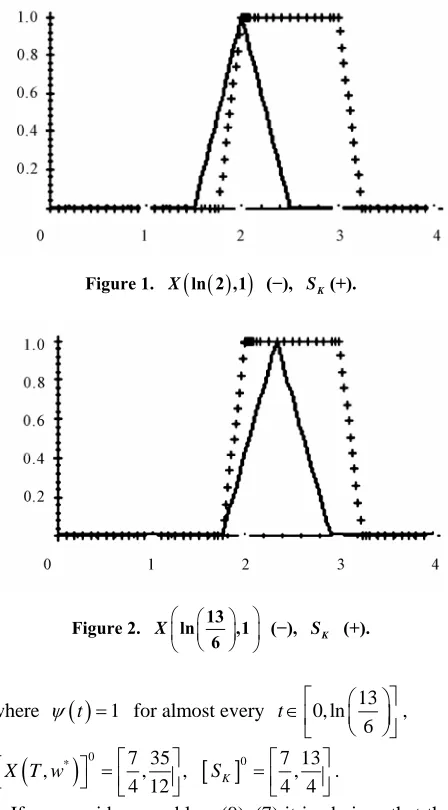
ln 2
T
oblem. Fuzzy
*
[image:5.595.313.537.78.483.2], X T w Figure 1.
inal set are shown in Obviously, this optimal pair satisfies to conditions of th
and fuzzy term SK
e theorem 3:
1)
w t*
, t
C W
,
t
for almost every
0, ln 2
t ;
2)
for almost every
e consider the time-optimal problem (9), (6 hen
1 1
*
, , k ,
CX T w T C S T
,
where
t 1 t 0, ln 2
,
1*
X T w, 2
,.
SK 1 2, 3If w ) t
the control w t*
1 and time ln 13 6T
will op-
timum pair. Fuzzy set
be
, *
X T w and fuzzy terminal set
K
S
co
are shown in Figure 2. This optimal pair satisfies to nditions of the theorem 4:
1)
w t*
, t
C W
,
t
for almost every 130, ln 6 t
;
2) C X T w
, *
0,
T
C
Sk 0,
T ,
ln 2 ,1
X (−), SK
Figure 1. (+).
13
ln ,1
6
[image:5.595.108.239.324.395.2]X (−), SK
Figure 2. (+).
where for almost every 0, ln 13 6 t
t 1 ,
0* 7 35
, , ,
4
0 7 13
12
X T w
4, . 4
K
S
If we consider a problem (9), (7) it is obvious that the olution does not exist.
5. Conclusions
In the last decades, a nu ber of works de ted to prob-le
works fall into a subdivision of theory, namely, the theory of process
tainty and fuzzy conditions. This is s
m vo
ms of optimal control of set-valued trajectories (fuzzy trajectories, trajectory bundles or an ensemble of
trajec-ories) appeared; these t
the optimal control ontrol under uncer c
to describe behavior of objects. The rea-so
the necessary conditions of opti-m
. Marchaud, “Sur les Champs de Demicones et
Equa-erentilles du Premier Ordre,” Bulletin de tique de France, Vol. 63, 1934, pp
, No. 4, 1967, pp. equations that describe the behavior of the object are simplified and one should estimate the consequences of such a simplification. Therefore, if is possible to divide the articles devoted to this direction into two types char-acterized by the following distinctive features:
1) there exists an incomplete or fuzzy information on the initial data;
2) the equations describing the behavior of the object to be controlled are assumed to be inexact, for example, they can contain some parameters whose exact values and laws of variation are unknown but the domain of their values is fuzzy.
In the second case, fuzzy differential inclusions are frequently used
n is that, first this approach is most obvious and, sec-ond, theory of fuzzy and ordinary differential inclusions is well found and is rapidly developed at the present time.
In the present paper,
al of control for a system of the latter form of equations with the fuzzy R-solutions are formulated and proved.
6. References
[1] A
tions Differentielles du Premier Order,” Bulletin de la Société Mathématique de France, Vol. 62, 1934, pp. 1-38.
] A. Marchaund, “Sur les Champs des Deme-Droites et
[2 les
Equations Diff
Société Mathéma
la
. 1-38.
[3] S.C. Zaremba, “Sur une Extension de la Notion d’Equa- tion Differentielle,” Reports of the Paris Academy of Sciences, Vol. 199, 1934, pp. 1278-1280.
[4] T. Wazewski, “Systemes de Commande et Equations au Contingent,” Bulletin de l’Academie Polonaise des Sciences. Serie des Sciences Mathematiques, Astronomiques et Physiques, No. 9, 1961, pp. 151-155.
[5] T. Wazewski, “Sur une Condition Equivalente e L’Equation au Contingent,” Bulletin de l’Academie Polonaise des Sci-ences. Serie des Sciences Mathematiques, Astronomiques et Physiques, No. 9, 1961, pp. 865-867.
[6] A. F. Filippov, “Classical Solutions of Differential Equa- tions with Multi-Valued Right-Hand Side,” SIAM Journal on Control and Optimization, Vol. 5
609-621. doi:10.1137/0305040
[7] J.-P. Aubin and A. Cellina, “Differential Inclusions. Set-Valued Maps and Viability Theory.” Springer-Verlag, Berlin-Heidelberg-New York-Tokyo, 1984.
the Theory of Differen-tial Inclusions,” Graduate Studies in Mathematics, Vol.
6.
[8] V. A. Plotnikov, A. V. Plotnikov and A. N. Vityuk, “Dif- ferential Equations with Multivalued Right-Hand Sides,”
Asymptotics Methods, AstroPrint, Odessa, 1999. [9] G. V. Smirnov, “Introduction to
41, American Mathematical Society, Providence, 2002.
[10] J.-P. Aubin, “Mutational Equations in Metric Spaces,”
Set-Valued Analysis, Vol. 1, No. 1, 1993, pp. 3-4
doi:10.1007/BF01039289
[11] J.-P. Aubin and H. Frankovska, “Set-Valued Analysis,”
Birkhauser, Systems and Control: Fundations and Appli-
pike Systems,” Nauka i Tekhnika,
ntial Inclusion,” Matematicheskie Zametki,
rad University, Leningrad, 1980.
Stability of Motion. Lyapunov Methods
cations, 1990.
[12] A. I. Panasyuk, “Quasidifferential Equations in a Metric Space,” Differentsial’nye Uravneniya, Vol. 21, No. 8, 1985, pp. 1344-1353.
[13] A. I. Panasyuk and V. I. Panasyuk, “Asymptotic Turn Optimization of Control
Minsk, 1986.
[14] A. A. Tolstonogov, “On an Equation of an Integral Fun-nel of a Differe
Vol. 32, No. 6, 1982, pp. 841-852.
[15] D. A. Ovsyannikov, “Mathematical Methods for the Con- trol of Beams,” Lening
[16] V. I. Zubov, “Dynamics of Controlled Systems,” Vyssh Shkola, Moscow, 1982.
[17] V. I. Zubov, “
and Their Application,” Vyssh Shkola, Moscow, 1984.
[18] A. V. Arsirii and A. V. Plotnikov, “Systems of Control over Set-Valued Trajectories with Terminal Quality Cri- terion,” Ukrainian Mathematical Journal, Vol. 61, No. 8, 2009, pp. 1349-1356. doi:10.1007/s11253-010-0280-3
[19] N. D. Phu and T. T. Tung, “Some Results on Sheaf-So- lutions of Sheaf Set Control Problems,” Nonlinear Analy- sis, Vol. 67, No. 5, 2007, pp. 1309-1315.
doi:10.1016/j.na.2006.07.018
[20] A. V. Plotnikov, “Controlled Quasidifferential Equations and Some of Their Properties,” Differential Equations, Vol. 34, No. 10, 1998, pp. 1332-1336.
[21] V. A. Plotnikov and A. V. Plotnikov, “Multivalued Dif-
nt Conditions for Optima-
7/BF02366480
ferential Equations and Optimal Control,” Applications of Mathematics in Engineering and Economics,Heron Press, Sofia, 2001, pp. 60-67.
[22] G. N. Konstantinov, “Sufficie
lity of a Minimax Control Problem of an Ensemble of Trajectories,” Soviet Doklady Mathematics, Vol. 36, No. 3, 1988, pp. 460-463.
[23] S. Otakulov, “On the Approximation of the Time-Opti- mality Problem for Controlled Differential Inclusions,”
Cybernetics and Systems Analysis, Vol. 30, No. 3, 1994, pp. 458-462. doi:10.100
908040152
[24] S. Otakulov, “On a Difference Approximation of a Con- trol System with Delay,” Automation and Remote Control, Vol. 69, No. 4, 2008, pp. 690-699.
doi:10.1134/S0005117
ttainability Set of
Control of Pencils of [25] A. V. Plotnikov, “Linear Control Systems with Multi-
valued Trajectories,” Kibernetika, No. 4, 1987, pp. 130- 131.
[26] A. V. Plotnikov, “Compactness of the A
a Nonlinear Differential Inclusion that Contains a Con-trol,” Kibernetika, No. 6, 1990, pp. 116-118.
cal Journal, Vol. 33, Trajectories,” Siberian Mathemati
No. 2, 1992, pp. 351-354.doi:10.1007/BF00971112
[28] A. V. Plotnikov, “Two Control Problems under Uncer- tainty Conditions,” Cybernetics and Systems Analysis, Vol. 29, No. 4, 1993, pp. 567-573.
doi:10.1007/BF01125871
[29] A. V. Plotnikov, “Necessary Optimality Conditions for a Nonlinear Problems of Control of Trajectory Bundles,”
Cybernetics and Systems Analysis, Vol. 36, No. 5, 2000, pp. 729-733. doi:10.1023/A:1009432907531
[30] A. V. Plotnikov, “Linear Problems of Optimal Control of Multiple-Valued Trajectories,” Cybernetics and Systems Analysis, Vol. 38, No. 5, 2002, pp. 772-782.
doi:10.1023/A:1021899111846
[31] A. V. Plotnikov and T. A. Komleva, “Some Properties of Trajectory Bunches of a Controlled Bilinear Inclusion,”
Ukrainian Mathematical Journal, Vol. 56, No. 4, 2004, pp. 586-600. doi:10.1007/s11253-005-0114-x
[32] A. V. Plotnikov and L. I. Plotnikova, “Two Problems of Encounter under Conditions of Uncertainty,” Journal of Applied Mathematics and Mechanics, Vol. 55, No. 5, 1991, pp. 618-625.
doi:10.1016/0021-8928(91)90108-7
[33] L. A. Zadeh, “Fuzzy Sets,” Information and Control, No. 8, 1965, pp. 338-353.
doi:10.1016/S0019-9958(65)90241-X
[34] B. Bede and S. G. Gal, “Solutions of Fuzzy Differential Equations Based on Generalized Differentiability,”
Communications in Mathematical Analysis, Vol. 9, No. 2, 2010, pp. 22-41.
[35] M. H. Chen, D. H. Li and X. P. Xue, “Periodic Problems of First Order Uncertain Dynamical Systems,” Fuzzy Sets and Systems, Vol. 162, No. 1, 2011, pp. 67-78.
doi:10.1016/j.fss.2010.09.011
[36] O. Kaleva, “Fuzzy Differential Equations,” Fuzzy Sets and Systems, Vol. 24, No. 3, 1987, pp. 301-317.
doi:10.1016/0165-0114(87)90029-7
[37] O. Kaleva, “A Note on Fuzzy Differential Equations,”
Nonlinear Analysis, Vol. 64, No. 5, 2006, pp. 895-900.
doi:10.1016/j.na.2005.01.003
[38] T. A. Komleva, “The Full Averaging of Linea Differential Equations with
r Fuzzy 2pi-Periodic Right-Hand
fic
Re-al, Vol. 60, No. 10, 2008, Side,” Journal of Advanced Research in Dynamical and Control Systems, Institute of Advanced Scienti search, USA, Vol. 3, No. 1, 2011, pp. 12-25.
[39] T. A. Komleva, A. V. Plotnikov and N. V. Skripnik, “Differential Equations with Set-Valued Solutions,”
Ukrainian Mathematical Journ
pp. 1540-1556. doi:10.1007/s11253-009-0150-z
[40] V. Lakshmikantham, T. Gnana Bhaskar and D. J Vasundhara, “Theory of Set Differential Equations in Metric Spaces,” Cambridge Scientific Publishers, Cam- bridge, 2006.
[41] V. Lakshmikantham and R. N. Mohapatra, “Theory of Fuzzy Differential Equations and Inclusions,” Series in Mathematical Analysis and Applications, Vol. 6, Taylor & Francis, Ltd., London, 2003.
[42] J. Y. Park and H. K. Han, “Existence and Uniqueness Theorem for a Solution of Fuzzy Differential Equations,”
International Journal of Mathematics and Mathematical Sciences, Vol. 22, No. 2, 1999, pp. 271-279.
doi:10.1155/S0161171299222715
[43] J. Y. Park and H. K. Han, “Fuzzy Differential Equations,”
Fuzzy Sets and Systems, Vol. 110, No. 1, 2000, pp. 69-77.
doi:10.1016/S0165-0114(98)00150-X
[44] A. V. Plotnikov and T. A. Komleva, “The Full Averaging
k, “Differential Equa-
e Problem,” Fuzzy
of Linear Fuzzy Differential Equations,” Journal of Ad- vanced Research in Differential Equations, Institute of Advanced Scientific Research, USA, Vol. 2, No. 3, 2010, pp. 21-34.
[45] A. V. Plotnikov and N. V. Skripni
tions with ‘Clear’ and Fuzzy Multivalued Right-Hand Sides,” Asymptotics Methods, AstroPrint, Odessa, 2009. [46] S. Seikkala, “On the Fuzzy Initial Valu
Sets and Systems, Vol. 24, No. 3, 1987, pp. 319-330.
doi:10.1016/0165-0114(87)90030-3
[47] D. Vorobiev and S. Seikkala, “Towards the Theory of Fuzzy Differential Equations,” Fuzzy Sets and Systems, Vol. 125, No. 2, 2002, pp. 231-237.
doi:10.1016/S0165-0114(00)00131-7
[48] J.-P. Aubin, “Fuzzy Differential Inclusions,” Problems of Control and Information Theory, Vol. 19, No. 1, 1990, pp.
zy
ics, Vol. 40, No. 3,
ics, Vol. 54, No. 1,
(90)90080-T
55-67.
[49] V. A. Baidosov, “Differential Inclusions with Fuz Right-Hand Side,” Soviet Mathemat
1990, pp. 567-569.
[50] V. A. Baidosov, “Fuzzy Differential Inclusions,” Journal of Applied Mathematics and Mechan
1990, pp. 8-13.doi:10.1016/0021-8928
f Uncertain, Fuzziness Knowledge-Based Sys-
[51] E. Hullermeier, “An Approach to Modelling and Simula- tion of Uncertain Dynamical Systems,” International Journal o
tems, Vol. 5, No. 2, 1997, pp. 117-137.
doi:10.1142/S0218488597000117
[52] A. V. Plotnikov, T. A. Komleva and L. I. Plotnikova,
-34.
ization, Vol. 2, “The Partial Averaging of Differential Inclusions with Fuzzy Right-Hand Side,” Journal Advanced Research in Dynamical & Control Systems, Institute of Advanced Scientific Research, USA, Vol. 2, No. 2, 2010, pp. 26 [53] A. V. Plotnikov, T. A. Komleva and L. I. Plotnikova, “On
the Averaging of Differential Inclusions with Fuzzy Right-Hand Side When the Average of the Right-Hand Side Is Absent,” Iranian Journal of Optim
No. 3, 2010, pp. 506-517.
[54] T. E. Dabbous, “Adaptive Control of Nonlinear Systems Using Fuzzy Systems,” Journal of Industrial and Mana- gement Optimization, Vol. 6, No. 4, 2010, pp. 861-880.
doi:10.3934/jimo.2010.6.861
[55] A. V. Plotnikov and T. A. Komleva, “Linear Problems of Optimal Control of Fuzzy Maps,” Intelligent Information Management, Vol. 1, No. 3, 2009, pp. 139-144.
doi:10.4236/iim.2009.13020
n with the Control
Plotnikov, “Linear Control Fuzzy Linear Problem,” Internatioal Journal of Industrial Mathematics, Vol. 1, No. 3, 2009, pp. 197-207.
[57] A. V. Plotnikov and T. A. Komleva, “Fuzzy Quasidiffer-ential Equations in Connectio
lems,” International Journal of Open Problems in Com- puter Science and Mathematics, Vol. 3, No. 4, 2010, pp. 439-454.
[58] I. V. Molchanyuk and A. V.
Systems with a Fuzzy Parameter,” Nonlinear Oscillator, Vol. 9, No. 1, 2006, pp. 59-64.
doi:10.1007/s11072-006-0025-2
[59] A. V. Plotnikov, T. A. Komleva and I. V. Molchanyuk, “Linear Control Problems of the Fuzzy Maps,” Journal of Software Engineering & Applications, Scientific Re- search Publishing, Inc., USA, Vol. 3, No. 3, 2010, pp. 191-197.
doi:10.4236/jsea.2010.33024
[60] M. L. Puri and D. A. Ralescu, “Fuzzy Random Vari- ables,” Journal of Mathematical Analysis and Applica- tions, No. 114, 1986, pp. 409-422.