VERSE: Event and Relation Extraction in the BioNLP 2016 Shared Task
Jake Lever and Steven JM Jones
Canada’s Michael Smith Genome Sciences Centre 570 W 7th Ave, Vancouver
BC, V5Z 4S6, Canada
{jlever,sjones}@bcgsc.ca
Abstract
We present the Vancouver Event and Re-lation System for Extraction (VERSE)1as
a competing system for three subtasks of the BioNLP Shared Task 2016. VERSE performs full event extraction including entity, relation and modification extrac-tion using a feature-based approach. It achieved the highest F1-score in the Bac-teria Biotope (BB3) event subtask and the third highest F1-score in the Seed Devel-opment (SeeDev) binary subtask.
1 Introduction
Extracting knowledge from biomedical literature is a huge challenge in the natural language parsing field and has many applications including knowl-edge base construction and question-answering systems. Event extraction systems focus on this problem by identifying specific events and rela-tions discussed in raw text.
Events are described using three key concepts, entities, relations and modifications. Entities are spans of text that describe a specific concept (e.g. a gene). Relations describe a specific association between two (or potentially more) entities. To-gether entities and relations describe an event or set of events (such as complex gene regulation). Modifications are changes made to events such as speculation.
The BioNLP Shared Tasks have encouraged re-search into new techniques for a variety of impor-tant NLP challenges. Occurring in 2009, 2011 and 2013, the competitions were split into several sub-tasks (Kim et al., 2009; Kim et al., 2011; N´edellec et al., 2013). These subtasks provided annotated texts (commonly abstracts from PubMed) of enti-ties, relations and events in a particular biomedical
1http://www.github.com/jakelever/VERSE
domain. Research groups were then challenged to generate new tools to better predict new relations and events in test data.
The BioNLP 2016 Shared Task contains three separate parts, the Bacteria Biotope subtask (BB3), the Seed Development subtask (SeeDev) and the Genia Event subtask (GE4). The BB3 and SeeDev subtasks have separate parts that spe-cialise in entity recognition and relation extrac-tion. The GE4 subtask focuses on full event ex-traction of NFkB related gene events.
Previous systems for relation and event extrac-tion have taken two main approaches: rule-based and feature-based. Rule-based methods learn spe-cific patterns that fit different events, for instance, the word ”expression” following a gene name gen-erally implies an expression event for that gene. The pattern-based tool BioSem (Bui et al., 2013) in particular performed well in the Genia Event subtask of the BioNLP’13 Shared Task. Feature-based approaches translate the textual content into feature vectors that can be analysed with a tra-ditional classification algorithm. Support vector machines (SVMs) have been very popular with successful relation extraction tools such as TEES (Bj¨orne and Salakoski, 2013).
Text Parsing Entity Extractor
Relation Extractor
Modification
Extractor Filtering
Entity Evaluation
Relation Evaluation
Modification Evaluation
Optimising for F1-score Sentence parsing,
tokenization, parts-of-speech and
lemmas
Remove entities without relations, invalid
relations and modifications on removed entities Extract using multi-class SVM or logistic regression
[image:2.595.75.525.75.191.2]Stochastic parameter optimisation
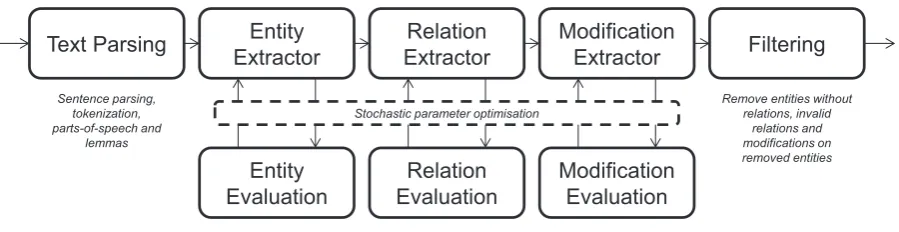
Figure 1: Overview of VERSE pipeline
2 Pipeline
VERSE breaks event extraction into five steps out-lined in the pipeline shown in Figure 1. Firstly the input data is passed through a text processing tool that splits and tags text and associates the parsed results with the provided annotations. This parsed data is then passed through three separate classi-fications steps for entities, relations and modifica-tions. Finally, the results are filtered to make sure that all relations and modifications fit the expected types for the given task.
2.1 Text processing
VERSE can accept input in the standard BioNLP-ST format or the PubAnnotation JSON format (Kim and Wang, 2012). Both formats are stand-off, as they contain the text and annotations sepa-rately. The annotations describe entities in the text as spans of text and relations and modifications of these entities.
The input files for the shared subtasks are initially processed using the Stanford CoreNLP toolset. The texts are split into sentences and tok-enized. Parts-of-speech and lemmas are identified and a dependency parse is generated for each sen-tence. CoreNLP also returns the exact positions of each token. Using this data, an interval tree is created to identify intersections of text with enti-ties described in the associated annotation. The specific sentence and locations of each associated word are then stored for each entity. Relations and modifications described in the associated an-notations are also loaded, retaining information on which entities are involved.
The entities in the BB3 and SeeDev subtasks are generally sets of full words but can be non-contiguous. Entities are stored as a set of associ-ated words rather than a span of words. The GE4
task also contains entities that contain only partial words, for example, ”PTEN” is tagged as an en-tity within ”PTEN-deficient”. A list of common prefixes and suffixes from the GE4 task is used to separate these words into two words so that the ex-ample would become ”PTEN deficient”. Further-more, any annotation that divides a word that con-tains a hyphen or forward slash causes the word to be separate into two separate words.
For easier interoperability, the text parsing code was developed in Jython (Developers, 2008) (a version of Python that can load Java libraries, specifically the Stanford CoreNLP toolset). This Jython implementation is then able to export eas-ily processed Python data structures. Due to in-compatibility between Jython and various numer-ical libraries, a separate Python-only implementa-tion loads the generated data structures for further processing and classification.
2.2 Candidate generation
Lives_In Argument 1 Argument 2
No vibrio vulnificus waterways Yes vibrio vulnificus estuaries
No waterways vibrio vulnificus No waterways waterways No estuaries vibrio vulnificus No estuaries estuaries
Lives_In Argument 1 (Bacteria)
Argument 2 (Habitat)
No vibrio vulnificus waterways Yes vibrio vulnificus estuaries
(a) Ignoring argument types (b) Filtering using argument types
“Vibrio vulnificus is a very harmful bacteria. Their presence in estuaries
[image:3.595.314.493.138.196.2]has been described in recent publications on waterways.” Lives In
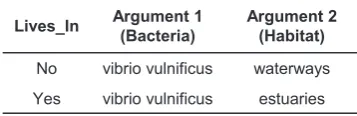
Figure 2: Relation candidate generation for the example text which contains a single Lives In relation (between bacteria and habitat). The bacteria entity is shown in bold and the habitat entities are underlined. Relation example generation creates pairs of entities that will be vectorised for classification. (a) shows all pairs matching without filtering for specific entity types (b) shows filtering for entity types of bacteria and habitat for a potential Lives In relation
2.2.1 Entity extraction
Entity extraction aims to classify individual or sets of words as a certain type of entity, given a set of training cases. Entities may contain non-contiguous words. The set of all possible com-binations of words that could compose an entity is too large for the classification system. Hence VERSE filters for only combinations of words that are identified as entities in the training set.
2.2.2 Relation extraction
VERSE can predict relations between two entities, also known as binary relations. Candidates for each possible relation are generated for every pair of entities that are within a fixed sentence range. Hence when using the default sentence range of 0, only pairs of entities within the same sentence are analysed. VERSE can optionally filter pairs of en-tities using the expected types for a set of relations as shown in Figure 2.
Each candidate is linked with the locations of the two entities. If the two entities are already an-notated to be in a relation, then they are labelled with the corresponding class. Otherwise, the bi-nary relation candidate is annotated with the neg-ative class.
2.2.3 Modification extraction
VERSE supports modification of entities in the form of event modification but currently does not support modification of individual relations. A modification candidate is created for all entities that form the base of an event. These entities are often known as the triggers of the event. In the JSON format, these entities traditionally have IDs that start with “E”. If a modification exists in the training set for that entity, the appropriate class is associated with it. Individual binary classifiers are generated for each modification type. This allows an event to be classified with more than one mod-ification.
2.3 Classification
2.3.1 Feature selection
VERSE implements optional feature selection us-ing a chi-squared test on individual parameters against the class variable. The highest ranking fea-tures are then filtered based on the percentage of features desired.
2.3.2 Classifier parameters
Classification uses either a support vector machine (SVM) or logistic regression. When using the SVM, the linear kernel is used due to lower time complexity. The multi-class classification uses a one-vs-one approach. The additional parameters of the SVM that are optimised are the penalty pa-rameter C, class weighting approach and whether to use the shrinking heuristic. The class weighting is important as the negative samples greatly out-number the positive samples for most problems.
2.3.3 Stochastic parameter optimisation VERSE allows adjustment of the various param-eters including the set of features to generate, the classifier to use and the associated classification parameters. The optimisation strategy involves initially seeding 100 random parameter sets. After this initial set, the top 100 previous parameter sets are identified each iteration and one is randomly selected. This parameter set is then tweaked as follows. With a probability of 0.05, an individ-ual parameter is changed. In order to avoid local maxima, an entirely new parameter set is gener-ated with a probability of 0.1. For the subtasks, a 500 node cluster using Intel X5650s was used for optimisation runs.
The optimal parameters are determined for the entity extraction, relation extraction and each pos-sible modification individually. In order to balance precision and recall equally at each stage, the F1-score is used.
2.4 Filtering
Final filtering is used to remove any predictions that do not fit into the task specification. Firstly all relations are checked to see that the types of the arguments are appropriate. Any entities that are not included in relations are removed. Finally, any modifications that do not have appropriate ar-guments or were associated with removed entities are also trimmed.
Feature Name Target
unigrams Entire Sentence
unigrams & parts-of-speech Entire Sentence
bigrams Entire Sentence
skipgrams Entire Sentence
path edges type Dependency Path
unigrams Dependency Path
bigrams Dependency Path
unigrams Each Entity
unigrams & parts-of-speech Each Entity nearby path edge types Each Entity
lemmas Each Entity
entity types Each Entity
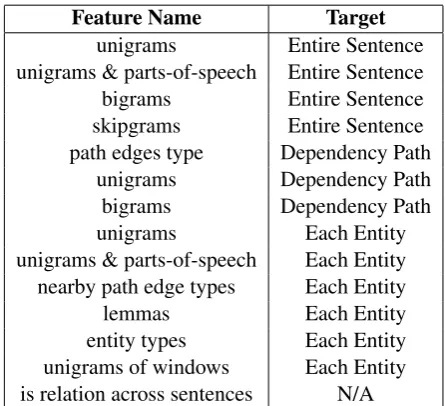
[image:4.595.305.528.64.267.2]unigrams of windows Each Entity is relation across sentences N/A Table 1: Overview of the various features that VERSE can use for classification
2.5 Evaluation
An evaluation system was created that generates recall, precision, and associated F1-scores for en-tities, relations and modifications. The system works conservatively and requires exact matches. It should be noted that our internal evaluation sys-tem gave similar but not exactly matching results to the online evaluation system for the BB3 and SeeDev subtasks.
K-fold cross-validation is used in association with this evaluation system to assess the success of the system. The entity, relation and modifica-tion extractors are trained separately. For the BB3 and SeeDev subtasks, two-fold cross-validation is used, using the provided split of training and de-velopment sets as the training sets for the first and second fold respectively. For the GE4 task, five-fold cross-validation is used. The average F1-score of the multiple folds is used as the metric of success.
3 Features
compound
compound
nsubjpass
nmod:from
nmod:in auxpass
compound
nsubjpass nmod:in
nmod:from
compound
case
case
“Coxiella burnetti is studied in samples from freshwater lakes.”
(a)
(b)
samples studied
burnetti
Coxiella
freshwater
lakes from
in is
Coxiella burnetti studied
samples lakes
freshwater
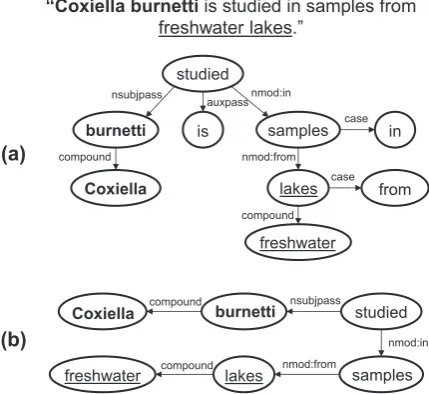
Figure 3: Dependency parsing of the shown sen-tence provides (a) the dependency graph of the full sentence which is then reduced to (b) the de-pendency path between the two multi-word terms. This is achieved by finding the subgraph which contains all entity nodes and the minimum num-ber of additional nodes.
3.1 Full sentence features
N-grams features (unigrams and bigrams) use a bag-of-words approach to count the word occur-rences across the whole sentence. The words are transformed to lowercase but notably are not fil-tered for stop words. A version combining the in-dividual words with part-of-speech information is also used. A bag-of-words vector is also gener-ated for lemmas of all words in the sentence. Skip-gram-like features are generated using two words separated by a fixed window of words are also used to generate features. Hence the terms ”reg-ulation of EGFR” and ”reg”reg-ulation with EGFR” would match the same features of ”regulation * EGFR”.
3.2 Dependency path features
The dependency path is the shortest path between the two entities in a dependency parse graph and has been shown to be important for relation ex-traction (Bunescu and Mooney, 2005). Features generated from the set of edges and nodes of the dependency graph include a unigrams and bigrams representation. The specific edge types in the de-pendency path are also captured with a bag-of-words vector. In order to give specific informa-tion about the locainforma-tion of the entity in the
depdency path, the types of the edges leaving the en-tity nodes are recorded separately for each enen-tity.
[image:5.595.74.289.71.268.2]Interestingly an entity may span multiple nodes in the dependency graph. An example of a de-pendency path with the multi-word entities ”cox-iella burnetii” and ”freshwater lakes” is shown in Figure 3. In this case, the minimal subgraph that connects all entity nodes in the graph is calcu-lated. This problem was transformed into a mini-mal spanning tree problem as follows and solved using the NetworkX Python package (Hagberg et al., 2008). The shortest paths through the graph were found for all pairs of entity nodes (nodes as-sociated with the multi-word entities). The path distance between each pair was totalled and used to generate a new graph containing only the entity nodes. The minimal spanning tree was calculated and the associated edges recovered to generate the minimal subgraph. This approach would allow for a dependency path-like approach for relations be-tween more than two entities.
3.3 Entity features
The individual entities are also used to generate specific features. Three different vectorised ver-sions use a unigrams approach, a unigrams ap-proach with parts-of-speech information and lem-mas respectively. A one-hot vector approach is used to represent the type of each entity. Unigrams of words around each entity within a certain win-dow size are also generated.
3.4 Multi-sentence and single entity features VERSE is also capable of generating features for relations between two entities that are in differ-ent sdiffer-entences. In this case, all sdiffer-entence features are generated for both sentences together and no changes are made to the entity features.
The dependency path features are treated dif-ferently. The dependency path for each entity is created as the path from the entity to the root of the dependency graph, generally the main verb of the sentence. This then creates two separate paths, one per sentence and the features are generated in similar ways using these paths. Finally, a simple binary feature is generated for relation candidates that span multiple sentences.
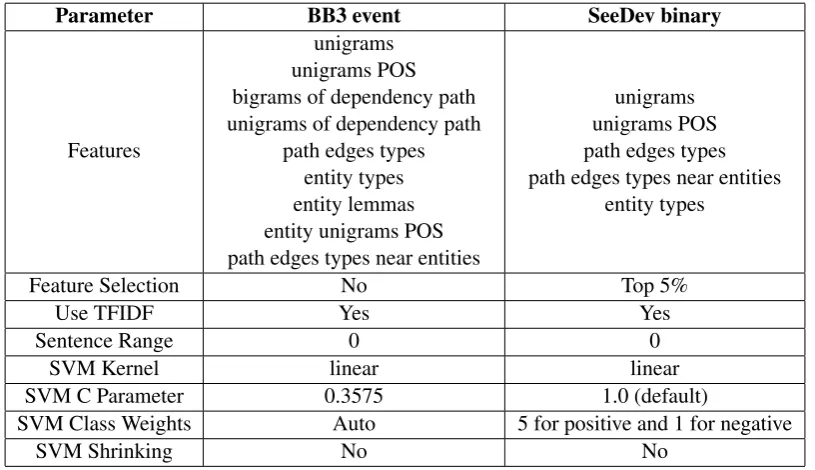
Parameter BB3 event SeeDev binary
Features
unigrams unigrams POS bigrams of dependency path unigrams of dependency path
path edges types entity types entity lemmas entity unigrams POS path edges types near entities
unigrams unigrams POS path edges types path edges types near entities
entity types
Feature Selection No Top 5%
Use TFIDF Yes Yes
Sentence Range 0 0
SVM Kernel linear linear
SVM C Parameter 0.3575 1.0 (default)
SVM Class Weights Auto 5 for positive and 1 for negative
[image:6.595.96.504.65.300.2]SVM Shrinking No No
Table 2: Parameters used for BB3 and SeeDev subtasks
4 Results and discussion
The VERSE tool as described was applied to three subtasks: the BB3 event subtask, the SeeDev bi-nary subtask and the GE4 subtask.
4.1 Datasets
The BB3 event dataset provided by the BioNLP-ST 16 organizers contains a total of 146 docu-ments (with 61, 34 and 51 docudocu-ments in the train-ing, development and test sets respectively). These documents are annotated with entities of the fol-lowing types and associated total counts: bacte-ria (932), habitat (1,861) and geographical (110). Only a single relation type (Lives In) is annotated which must be between a bacteria and habitat or a bacteria and a geographical entity.
The dataset for the SeeDev binary subtask con-tains 20 documents with a total of 7,082 annotated entities and 3,575 relations. There are 16 entity types and 22 relation types.
The GE4 dataset focuses on NFkB gene regu-lation and contains 20 documents. After filtering for duplicates and cleanup, it contains 13,012 an-notated entities of 15 types. These entities are in 7,232 relations of 5 different types. It also contains 81 negation and 121 speculation modifications for events. Coreference data is also provided but was not used.
4.2 Cross-validated results
Both BB3 event and SeeDev binary subtasks re-quired only relation extraction. VERSE was trained through cross-validation using the param-eter optimising strategy and the optimal parame-ters are outlined in Table 2. Both tasks were split into training and development sets by the competi-tion organisers. The training set contained roughly twice as many annotations as the development set. We used this existing split for the two-fold cross-validation. A linear kernel SVM was found to per-form the best in both tasks. For both subtasks, re-lation candidates were generated ignoring the ar-gument types as shown in Figure 2.
The classifiers for the two tasks use two very different sizes of feature vectors. The BB3 pa-rameter set has a significant amount of repeated unigrams data, with unigrams for the dependency path and whole sentence with and without parts of speech. This parameter set also does not use feature selection, meaning that the feature vec-tors are very large (14,862 features). Meanwhile, the SeeDev parameters use feature selection to se-lect the top 5% of features which reduces the fea-ture vector from 7,140 feafea-tures down to only 357. This size difference is very interesting and war-rants further exploration of feature selection for other tasks.
Ta-Fold 1 Ta-Fold 2 Average
Recall 0.552 0.610 0.581
Precision 0.469 0.582 0.526
[image:7.595.316.511.65.122.2]F1-score 0.507 0.596 0.552
Table 3: Cross-validated results of BB3 event sub-task using optimal parameters in Table 2
Fold 1 Fold 2 Average
Recall 0.363 0.386 0.375
Precision 0.261 0.246 0.254
[image:7.595.87.275.66.122.2]F1-score 0.303 0.301 0.302
Table 4: Cross-validated results of SeeDev binary subtask using optimal parameters in Table 2
bles 3 and 4 show the optimal cross-validated results that were found with these parameters. Notably, the F1-scores for the two folds of the SeeDev dataset are very similar, which is surpris-ing given that the datasets are different sizes.
For the GE4 subtask, the cross-validation based optimisation strategy was used to find parameters for the entity, relation and modification extractions independently. Due to the larger dataset, filtering was applied to the argument types of relation can-didates as shown in Figure 2. Table 5 outlines the resulting F1-scores from the five-fold cross-validations. As these extractors are trained sepa-rately, their performance in the full pipeline would be expected to be worse. This is explained as any errors during entity extraction are passed onto re-lation and modification extraction.
4.3 Competition results
[image:7.595.316.515.167.226.2]The official results for the BB3 and SeeDev tasks are shown in Table 6. VERSE performed well in both tasks and was ranked first for the BB3 event subtask and third for the SeeDev binary subtask. The worse performance for the SeeDev dataset may be explained by the added complexity of many additional relation and entity types.
Table 7 shows the final results for the test set
Entities Relations Mods
Recall 0.703 0.695 0.374
Precision 0.897 0.736 0.212
F1-score 0.786 0.715 0.266
Table 5: Averaged cross-validated F1-score results of GE4 event subtask with entities, relations and modifications trained separately
BB3 event SeeDev binary
Recall 0.615 0.458
Precision 0.510 0.273
F1-score 0.558 0.342
Table 6: Final reported results for the BB3 event and SeeDev binary subtasks
Entities Relations Mods
Recall 0.71 0.23 0.11
Precision 0.94 0.60 0.38
[image:7.595.88.278.167.224.2]F1-score 0.81 0.33 0.17
Table 7: Final reported results for GE4 subtask split into entity, relations and modifications results
for the Genia Event subtask using the online eval-uation tool. As expected, the F1-scores of the rela-tion and modificarela-tion extracrela-tion are lower for the full pipeline compared to the cross-validated re-sults. Nevertheless, the performance is very rea-sonable given the more challenging dataset.
4.4 Multi-sentence analysis
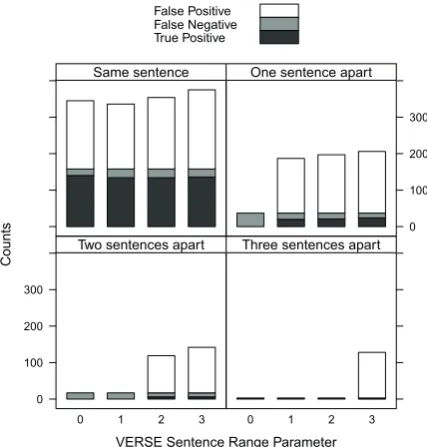
29% of relations span sentence boundaries in the BB3 event dataset and 4% in the SeeDev dataset. Most relation extraction systems do not attempt to predict these multi-sentence relations. Given the higher proportion in the BB3 set, we use this dataset for further analysis of VERSE’s ability to predict relations that span sentence boundaries. It should be noted that some of these relations may be artifacts due to false identification of sentence boundaries by the CoreNLP pipeline.
Using the optimal parameters for the BB3 prob-lem, we analysed prediction results using differ-ent values for the sdiffer-entence range parameter. The performance, shown in Figure 4, is similar for re-lations within the same sentence using different sentence range parameters. However, as the dis-tance of the relation increases, the classifier pre-dicts larger ratios of false positives to true posi-tives. With sentence range = 3, the overall F1-score for the development set has dropped to 0.326 from 0.438 when sentence range = 1.
[image:7.595.85.280.658.714.2]VERSE Sentence Range Parameter
C
o
u
n
ts
0 100 200 300
0 1 2 3
Two sentences apart
0 1 2 3
Three sentences apart Same sentence
0 100 200 300
One sentence apart
[image:8.595.75.289.65.289.2]True Positive False Negative False Positive
Figure 4: Analysis of performance on binary rela-tions that cross sentence boundaries. The classifier was trained on the BB3 event training set and eval-uated using the corresponding development set.
5 Conclusion
We have presented VERSE, a full event extraction system that performed very well in the BioNLP 2016 Shared Task. The VERSE system builds upon the success of previous systems, particu-larly TEES, in several important ways. It gives full control of the specific semantic features used to build the classifier. In combination with the stochastic optimisation strategy, this control has been shown to be important given the differing parameter sets found to be optimal for the differ-ent subtasks. Secondly, VERSE allows for feature selection which is important in reducing the size of the large sparse feature vectors and avoid over-fitting. Lastly, VERSE can predict relations that span sentence boundaries, which is certain to be an important avenue of research for future rela-tion extracrela-tion tasks. We hope that this tool will become a valuable asset in the biomedical text-mining community.
Acknowledgments
This research was supported by a Vanier Canada Graduate Scholarship. The authors would like to thank ComputeCanada for computational re-sources used in this project.
References
Jari Bj¨orne and Tapio Salakoski. 2013. TEES 2.1: Au-tomated annotation scheme learning in the BioNLP
2013 Shared Task. InProceedings of the BioNLP
Shared Task 2013 Workshop, pages 16–25.
Quoc-Chinh Bui, David Campos, Erik van Mulligen, and Jan Kors. 2013. A fast rule-based approach for biomedical event extraction. InProceedings of the BioNLP Shared Task 2013 Workshop, pages 104– 108. Association for Computational Linguistics. Razvan C Bunescu and Raymond J Mooney. 2005. A
shortest path dependency kernel for relation
extrac-tion. In Proceedings of the conference on human
language technology and empirical methods in nat-ural language processing, pages 724–731. Associa-tion for ComputaAssocia-tional Linguistics.
Jython Developers. 2008. Jython implementation of the high-level, dynamic, object-oriented language python written in 100% pure Java. Technical report, Technical report (1997-2016), http://www. jython. org/(accessed May 2016).
Aric A. Hagberg, Daniel A. Schult, and Pieter J. Swart. 2008. Exploring network structure, dynamics, and
function using NetworkX. InProceedings of the 7th
Python in Science Conference (SciPy2008), pages 11–15, Pasadena, CA USA, August.
Jin-Dong Kim and Yue Wang. 2012. PubAnnota-tion: a persistent and sharable corpus and
annota-tion repository. InProceedings of the 2012
Work-shop on Biomedical Natural Language Processing, pages 202–205. Association for Computational Lin-guistics.
Jin-Dong Kim, Tomoko Ohta, Sampo Pyysalo, Yoshi-nobu Kano, and Jun’ichi Tsujii. 2009. Overview of BioNLP’09 shared task on event extraction. In
Proceedings of the Workshop on Current Trends in Biomedical Natural Language Processing: Shared Task, pages 1–9. Association for Computational Lin-guistics.
Jin-Dong Kim, Sampo Pyysalo, Tomoko Ohta, Robert Bossy, Ngan Nguyen, and Jun’ichi Tsujii. 2011.
Overview of BioNLP shared task 2011. In
Proceed-ings of the BioNLP Shared Task 2011 Workshop, pages 1–6. Association for Computational Linguis-tics.
Claire N´edellec, Robert Bossy, Jin-Dong Kim, Jung-Jae Kim, Tomoko Ohta, Sampo Pyysalo, and Pierre Zweigenbaum. 2013. Overview of BioNLP shared
task 2013. In Proceedings of the BioNLP Shared
Task 2013 Workshop, pages 1–7.
F. Pedregosa, G. Varoquaux, A. Gramfort, V. Michel, B. Thirion, O. Grisel, M. Blondel, P. Pretten-hofer, R. Weiss, V. Dubourg, J. Vanderplas, A. Pas-sos, D. Cournapeau, M. Brucher, M. Perrot, and E. Duchesnay. 2011. Scikit-learn: Machine
learn-ing in Python. Journal of Machine Learning