Types and Records for Predication
Aarne Ranta
Department of Computer Science and Engineering, University of Gothenburg [email protected]
Abstract
This paper studies the use of records and dependent types in GF (Grammatical Framework) to build a grammar for pred-ication with an unlimited number of sub-categories, also covering extraction and coordination. The grammar is imple-mented for Chinese, English, Finnish, and Swedish, sharing the maximum of code to identify similarities and differences be-tween the languages. Equipped with a probabilistic model and a large lexicon, the grammar has also been tested in wide-coverage machine translation. The first evaluations show improvements in parsing speed, coverage, and robustness in com-parison to earlier GF grammars. The study confirms that dependent types, records, and functors are useful in both engineer-ing and theoretical perspectives.
1 Introduction
Predicationis the basic level of syntax. In logic, it means building atomic formulas by predicates. In linguistics, it means building sentences by verbs. Categorial grammars (Bar-Hillel, 1953; Lambek, 1958) adapt logical predication to natural lan-guage. Thus for instance transitive verbs are cat-egorized as (n\s/n), which is the logical type n→n→swith the information that one argument comes before the verb and the other one after. But most approaches to syntax and semantics, includ-ing (Montague, 1974), introduce predicate cate-gories as primitives rather than as function types. Thus transitive verbs are a category of its own, re-lated to logic via a semantic rule. This gives more expressive power, as it permits predicates with dif-ferent syntactic properties and variable word order (e.g. inversion in questions). A drawback is that
a grammar may need a large number of categories and rules. In GPSG (Gazdar et al., 1985), and later in HPSG (Pollard and Sag, 1994), this is solved by introducing a feature called subcat for verbs. Verbs taking different arguments differ in the sub-cat feature but share otherwise the characteristic of being verbs.
In this paper, we will study the syntax and se-mantics of predication in GF, Grammatical Frame-work (Ranta, 2011). We will generalize both over subcategories (as in GPSG and HPSG), and over languages (as customary in GF). We use depen-dent types to control the application of verbs to legitimate arguments, andrecords to control the placement of arguments in sentences. The record structure is inspired by thetopological model of syntax in (Diderichsen, 1962).
The approach is designed to apply to all lan-guages in the GF Resource Grammar Library (RGL, (Ranta, 2009)), factoring out their typolog-ical differences in a modular way. We have tested the grammar with four languages from three fam-ilies: Chinese, English, Finnish, and Swedish. As the implementation reuses old RGL code for all parts but predication, it can be ported to new lan-guages with just a few pages of new GF code. We have also tested it in wide coverage tasks, with a probabilistic tree model and a lexicon of 60,000 lemmas.
We will start with an introduction to the abstrac-tion mechanisms of GF and conclude with a sum-mary of some recent research. Section 2 places GF on the map of grammar formalisms. Section 3 works out an example showing how abstract syn-tax can be shared between languages. Section 4 shows how parts of concrete syntax can be shared as well. Section 5 gives the full picture of predi-cation with dependent types and records, also ad-dressing extraction, coordination, and semantics. Section 6 gives preliminary evaluation. Section 7 concludes.
2 GF: an executive summary
GF belongs to a subfamily of categorial grammars inspired by (Curry, 1961). These grammars make a distinction betweentectogrammar, which spec-ifies the syntacticstructures(tree-like representa-tions), and phenogrammar, which relates these structures to linear representations, such as se-quences of characters, words, or phonemes. Other formalisms in this family include ACG (de Groote, 2001) and Lambda grammars (Muskens, 2001).
GF inherits its name from LF,Logical Frame-works, which are type theories used for defin-ing logics (Harper et al., 1993). GF builds on the LF called ALF, Another Logical Framework (Magnusson, 1994), which implements Martin-L¨of’s higher-level type theory (first introduced in the preface of (Martin-L¨of, 1984); see Chap-ter 8 of (Ranta, 1994) for more details). Before GF was introduced as an independent formalism in 1998, GF-like applications were built as plug-ins to ALF (Ranta, 1997). The idea was that the LF defines the tectogrammar, and the plug-in de-fines the phenogrammar. The intended application was natural language interfaces to formal proof systems, in the style of (Coscoy et al., 1995).
GF was born via two additions to the natural language interface idea. The first one was multi-linguality: one and the same tectogrammar can be given multiple phenogrammars. The second addition wasparsing: the phenogrammar, which was initially justlinearization(generating strings from type theoretical formulas), was reversed to rules that parse natural language into type theory. The result was a method for translation, which combines parsing the source language with lin-earization into the target language. This idea was indeed suggested in (Curry, 1961), and applied before GF in the Rosetta project (Landsbergen, 1982), which used Montague’s analysis trees as tectogrammar.
GF can be seen as a formalization and gener-alization of Montague grammar. Formgener-alization, because it introduces a formal notation for the linearization rules that in Montague’s work were expressed informally. Generalization, because of multilinguality and also because the type system for analysis trees has dependent types.
Following the terminology of programming lan-guage theory, the tectogrammar is in GF called theabstract syntaxwhereas the phenogrammar is called the concrete syntax. As in compilers and
logical frameworks, the abstract syntax encodes the structure relevant forsemantics, whereas the concrete syntax defines “syntactic sugar”.
The resulting system turned out to be equiv-alent to parallel multiple context-free gram-mars (Seki et al., 1991) and therefore parsable in polynomial time (Ljungl¨of, 2004). Compre-hensive grammars have been written for 29 lan-guages, and later work has optimized GF pars-ing and also added probabilistic disambiguation and robustness, resulting in state-of-the-art perfor-mance in wide-coverage deep parsing (Angelov, 2011; Angelov and Ljungl¨of, 2014).
3 Example: subject-verb-object sentences
Let us start with an important special case of predi-cation: the subject-verb-object structure. The sim-plest possible rule is
fun PredTV : NP -> TV -> NP -> S
that is, afunctionthat takes a subject NP, a tran-sitive verb TV, and an object NP, and returns a sentence S. This function builds abstract syntax trees. Concrete syntax defineslinearization rules, which convert trees into strings. The above rule can give rise to different word orders, such as SVO (as in English), SOV (as in Hindi), and VSO (as in Arabic):
lin PredTV s v o = s ++ v ++ o lin PredTV s v o = s ++ o ++ v lin PredTV s v o = v ++ s ++ o
where++means concatenation.
The above rule builds a sentence in one step. A more flexible approach is to do it in two steps:
complementation, forming a VP (verb phrase) from the verb and the object, and predication
proper that provides the subject. The abstract syn-tax is
fun Compl : TV -> NP -> VP fun Pred : NP -> VP -> S
These functions are easy to linearize for the SVO and SOV orders:
lin Compl v o = v ++ o -- SVO lin Compl v o = o ++ v -- SOV lin Pred s vp = s ++ vp -- both
lin Compl v o = {verb = v ; obj = o} lin Pred s vp = vp.verb ++ s ++ vp.obj
The dot (.) meansprojection, picking the value of a field in a record.
Records enable the abstract syntax to abstract away not only from word order, but also from whether a language uses discontinuous con-stituents. VP in VSO languages is one example. Once we enable discontinuous constituents, they turn out useful almost everywhere, as they enable us to delay the decision about linear order. It can then be varied even inside a single language, if it depends on syntactic context (as e.g. in German; cf. (M¨uller, 2004) for a survey).
The next thing to abstract away from is inflec-tionandagreement. Given the lexicon
fun We, She : NP fun Love : TV
we can build the abstract syntax tree
Pred We (Compl Love She)
to represent we love her. If we swap the subject and the object, we get
Pred She (Compl Love We)
for she loves us. Now, these two sentences are built from the same abstract syntax objects, but no single word is shared between them! This is because the noun phrasesinflectforcaseand the verbagreesto the subject.
In contrast to English, Chinese just reorders the words:
women ai ta- “we love her” ta ai women- “she loves us”
Thus the above rules for SVO languages work as they are for Chinese. But in English, we must in-clude case and agreement asfeaturesin the con-crete syntax. Thus the linearization of an NP is a record that includes atableproducing the case forms, and agreement as aninherent feature:
lin She = { s = table {
Nom => "she" ; Acc => "her" } ;
a = {n = Sg ; p = P3} ; }
The agreement feature (fielda) is itself a record, with a number and a gender. In other languages, case and agreement can of course have different sets of values.
Verbs likewise include tables that inflect them for different agreement features:
lin Love = { s = table {
{n = Sg ; p = P3} => "loves" ; _ => "love"
} }
We can now define English linearization:
lin Compl v o =
{s = table {a => v.s ! a ++ o.s ! Acc}} lin Pred s vp =
{s = s.s ! Nom ++ vp.s ! np.a}
using the same type of records for VP as for TV, and a one-string record for S. The Compl rule passes the agreement feature to the verb of the VP, and selects the Acc form of the object (with! de-notingselectionfrom a table). ThePredrule se-lects theNomform of the subject, and attaches to this the VP form selected fornp.a, i.e. the agree-ment feature of the subject.
4 Generalized concrete syntax
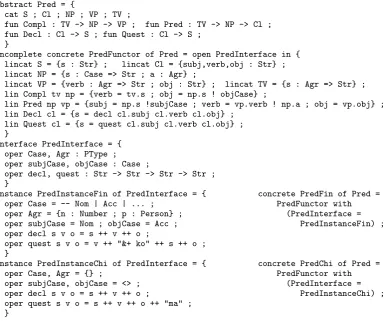
To see the full power of GF, we now take a look at its type and module system. Figure 1 shows a complete set of grammar modules implementing transitive verb predication for Finnish and Chinese with a maximum of shared code.
The first module in Figure 1 is the abstract syn-tax Pred, where the fun rules are preceded by a set of cat rules defining the categories of the grammar, i.e. the basic types. Pred defines five categories: S, Cl, NP, VP, and TV. S is the top-level category of sentences, whereas Cl (clause) is the intermediate category of predications, which can be used as sentences in many ways—here, as declaratives and as questions.
The concrete syntax has correspondinglincat
rules, which equip each category with a lineariza-tion type, i.e. the type of the values returned when linearizing trees of that category. The mod-ulePredFunctorin Figure 1 contains four such rules. Inlincat NP, the typeCase => Stris the type of tables that produce a string as a func-tion of a case, and Agris the type of agreement features.
When a GF grammar is compiled, eachlinrule is type checked with respect to thelincats of the categories involved, to guarantee that, for every
funf :C1→ ··· →Cn→C
we have
abstract Pred = {
cat S ; Cl ; NP ; VP ; TV ;
fun Compl : TV -> NP -> VP ; fun Pred : TV -> NP -> Cl ; fun Decl : Cl -> S ; fun Quest : Cl -> S ;
}
incomplete concrete PredFunctor of Pred = open PredInterface in { lincat S = {s : Str} ; lincat Cl = {subj,verb,obj : Str} ; lincat NP = {s : Case => Str ; a : Agr} ;
lincat VP = {verb : Agr => Str ; obj : Str} ; lincat TV = {s : Agr => Str} ; lin Compl tv np = {verb = tv.s ; obj = np.s ! objCase} ;
lin Pred np vp = {subj = np.s !subjCase ; verb = vp.verb ! np.a ; obj = vp.obj} ; lin Decl cl = {s = decl cl.subj cl.verb cl.obj} ;
lin Quest cl = {s = quest cl.subj cl.verb cl.obj} ; }
interface PredInterface = { oper Case, Agr : PType ; oper subjCase, objCase : Case ;
oper decl, quest : Str -> Str -> Str -> Str ; }
instance PredInstanceFin of PredInterface = { concrete PredFin of Pred = oper Case = -- Nom | Acc | ... ; PredFunctor with oper Agr = {n : Number ; p : Person} ; (PredInterface = oper subjCase = Nom ; objCase = Acc ; PredInstanceFin) ; oper decl s v o = s ++ v ++ o ;
oper quest s v o = v ++ "&+ ko" ++ s ++ o ; }
instance PredInstanceChi of PredInterface = { concrete PredChi of Pred = oper Case, Agr = {} ; PredFunctor with oper subjCase, objCase = <> ; (PredInterface = oper decl s v o = s ++ v ++ o ; PredInstanceChi) ; oper quest s v o = s ++ v ++ o ++ "ma" ;
[image:4.595.77.465.62.383.2]}
Figure 1: Functorized grammar for transitive verb predication.
whereA∗ is the linearization type ofA. Thus lin-earization is a homomorphism. It is actually an instance of denotational semantics, where the
lincats are the domains of possible denota-tions.
Much of the strength of GF comes from us-ing different linearization types for different lan-guages. Thus English needs case and agreement, Finnish needs many more cases (in the full gram-mar), Chinese needs mostly only strings, and so on. However, it is both useful and illuminating to unify the types. The way to do this is by the use offunctors, also known as aparametrized mod-ules.
PredFunctorin Figure 1 is an example; func-tors are marked with the keywordincomplete. A functor depends on aninterface, which declares a set of parameters (PredInterface in Figure 1). A concrete module is produced by giving aninstanceto the interface (PredInstanceFin
andPredInstanceChi).
The rules in PredFunctorin Figure 1 are de-signed to work for both languages, by varying the definitions of the constants in PredInterface.
And more languages can be added to use it. Con-sider for example the definition of NP. The expe-rience from the RGL shows that, if a language has case and agreement, its NPs inflect for case and have inherent agreement. The limiting case of Chinese can be treated by using the unit type ({} i.e. the record type with no fields) for both features. This would not be so elegant for Chinese alone, but makes sense in the code sharing context. Discontinuity now appears as another useful generalization. With the lincat definition in
PredFunctor, we can share theComplrule in all of the languages discussed so far. In clauses (Cl), we continue on similar lines: we keep the subject, the verb, and the object on separate fields. Notice thatverbinClis a plain string, since the value of Agr gets fixed when the subject is added.
orders of Finnish (Karttunen and Kay, 1985). By using an abstract syntax in combination with unordered records, parameters, and functors for the concrete syntax, we follow a kind of a “prin-ciples and parameters” approach to language vari-ation (Chomsky, 1981). The actual parameter set for the whole RGL is of course larger than the one shown here.
Mathematically, it is possible to treatall differ-ences in concrete syntax by parameters, simply by declaring a new parameter for everylincatand
linrule! But this is both vacuous as a theory and an unnecessary detour in practice. It is more il-luminating to keep the functor simple and the set of parameters small. If the functor does not work for a new language, it usually makes more sense to
overrideit than to grow the parameter list, and GF provides a mechanism for this. Opposite to “prin-ciples and parameters”, this is “a model in which language-particular rules take over the work of pa-rameter settings” (Newmeyer, 2004). A combina-tion of the two models enables language compari-son by measuring the amount of overrides.
5 The full predication system
So far we have only dealt with one kind of verbs, TV. But we need more: intransitive, ditransitive, sentence-complement, etc. The general verb cate-gory is a dependent type, which varies over argu-ment type lists:
cat V (x : Args)
The listx : Argscorresponds to the subcat fea-ture in GPSG and HPSG. Verb phrases and clauses have the same dependencies. Syntactically, a phrase depending on x : Argshas “holes” for every argument in the listx. Semantically, it is a function over the denotations of its arguments (see Section 5.3 below).
5.1 The code
Figure 2 shows the essentials of the resulting grammar, and we will now explain this code. The full code is available at the GF web site.
1. Argument lists and dependent categories. The argument of a verb can be an adjectival phrase (AP,become old), a clause (Cl,say that we go), a common noun (CN,become a president), a noun phrase (NP, love her), a question (QCl, wonder who goes), or a verb phrase (VP,want to go). The definition allows an arbitrary list of arguments.
For example, NP+QCl is used in verbs such asask (someone whether something).
What about PP (prepositional phrase) comple-ments? The best approach in a multilingual set-ting is to treat them as NP complements with des-ignated cases. Thus in Figure 2.5, the lineariza-tion type of VP has fields of type complCase. This covers cases and prepositions, often in com-bination. For instance, the German verb lieben (“love”) takes a plain accusative argument, fol-gen (“love”) a plain dative, and warten (“wait”) the prepositionauf with the accusative. From the abstract syntax point of view, all of them are NP-complement verbs. Cases and prepositions, and thereby transitivity, are defined in concrete syntax. The category Cl, clause, is the discontinuous structure of sentences before word order is deter-mined. Its instanceCl (c np O)corresponds to the slash categories S/NP and S/PP in GPSG. Similarly, VP (c np O) corresponds to VP/NP
and VP/PP, Adv (c np O) to Adv/NP (preposi-tions), and so on.
2. Initial formation of verb phases. A VP is formed from a V by fixing its tense and polarity. In the resulting VP, theverbdepends only on the agreement features of the expected subject. The complement case comes from the verb’s lexical entry, but the other fields—such as the objects— are left empty. This makes the VP usable in both complementation and slash operations (where the subject is added before some complement).
VPs can also be formed from adverbials, ad-jectival phrases, and common nouns, by adding a copula. Thuswas inresults from applyingUseAdv
to the preposition (i.e.Adv/NP)in, and expands to a VP withComplNP(was in France) and to a slash clause withPredVP(she was in).
3.Complementation, VP slash formation, re-flexivization. TheComplfunctions in Figure 2.3 provide each verb phrase with its “first” comple-ment. The Slash functions provide the “last” complement, leaving a “gap” in the middle. For instance,SlashClprovides the slash clause used in the question whom did you tell that we sleep. TheReflrules fill argument places with reflexive pronouns.
termi-1.Argument lists and some dependent categories
cat Arg ; Args -- arguments and argument lists fun ap, cl, cn, np, qcl, vp : Arg -- AP, Cl, CN, NP, QCl, VP argument fun O : Args -- no arguments
fun c : Arg -> Args -> Args -- one more argument
cat V (x : Args) -- verb in the lexicon cat VP (x : Args) -- verb phrase
cat Cl (x : Args) -- clause
cat AP (x : Args) -- adjectival phrase cat CN (x : Args) -- common noun phrase cat Adv (x : Args) -- adverbial phrase
2.Initial formation of verb phases
fun UseV : (x : Args) -> Temp -> Pol -> V x -> VP x -- loved (X)
fun UseAP : (x : Args) -> Temp -> Pol -> AP x -> VP x -- was married to (X) fun UseCN : (x : Args) -> Temp -> Pol -> CN x -> VP x -- was a son of (X) fun UseAdv : (x : Args) -> Temp -> Pol -> Adv x -> VP x -- was in (X)
3.Complementation, VP slash formation, reflexivization
fun ComplNP : (x : Args) -> VP (c np x) -> NP -> VP x -- love her fun ComplCl : (x : Args) -> VP (c cl x) -> Cl x -> VP x -- say that we go fun SlashNP : (x : Args) -> VP (c np (c np x)) -> NP -> VP (c np x) -- show (X) to him fun SlashCl : (x : Args) -> VP (c np (c cl x)) -> Cl x -> VP (c np x) -- tell (X) that.. fun ReflVP : (x : Args) -> VP (c np x) -> VP x -- love herself fun ReflVP2 : (x : Args) -> VP (c np (c np x)) -> VP (c np x) -- show (X) to herself
4.NP-VP predication, slash termination, and adverbial modification
fun PredVP : (x : Args) -> NP -> VP x -> Cl x -- she loves (X) fun SlashTerm : (x : Args) -> Cl (c np x) -> NP -> Cl x -- she loves + X
5.The functorial linearization type of VP
lincat VP = {
verb : Agr => Str * Str * Str ; -- finite: would,have,gone inf : VVType => Str ; -- infinitive: (not) (to) go imp : ImpType => Str ; -- imperative: go
c1 : ComplCase ; -- case of first complement c2 : ComplCase ; -- case of second complement vvtype : VVType ; -- type of VP complement adj : Agr => Str ; -- adjective complement obj1 : Agr => Str ; -- first complement obj2 : Agr => Str ; -- second complement
objagr : {a : Agr ; objCtr : Bool} ; -- agreement used in object control adv1 : Str ; -- pre-verb adverb
adv2 : Str ; -- post-verb adverb
ext : Str ; -- extraposed element e.g. that-clause }
6.Some functorial linearization rules
lin ComplNP x vp np = vp ** {obj1 = \\a => appComplCase vp.c1 np} lin ComplCl x vp cl = vp ** {ext = that_Compl ++ declSubordCl cl} lin SlashNP2 x vp np = vp ** {obj2 = \\a => appComplCase vp.c2 np} lin SlashCl x vp cl = vp ** {ext = that_Compl ++ declSubordCl cl}
7.Some interface parameters
[image:6.595.69.506.94.579.2]oper Agr, ComplCase : PType -- agreement, complement case oper appComplCase : ComplCase -> NP -> Str -- apply complement case to NP oper declSubordCl : Cl -> Str -- subordinate question word order
nation” rule.
5. The functorial linearization type of VP. This record type contains the string-valued fields that can appear in different orders, as well as the inherent features that are needed when comple-ments are added. The corresponding record forCl
has similar fields with constant strings, plus a sub-ject field.
6. Some functorial linearization rules. The verb-phrase expanding rules typically work with
record updates, where the old VP is left un-changed except for a few fields that get new val-ues. GF uses the symbol** for record updates. Notice that ComplCl and SlashCl have exactly the same linearization rules; the difference comes from the argument listxin the abstract syntax.
7. Some interface parameters. The code in Figure 2.5 and 2.6 is shared by different lan-guages, but it depends on an interface that declares parameters, some of which are shown here.
5.2 More constructions
Extraction. The formation of questions and rel-atives is straighforward. Sentential (yes/no) ques-tions, formed byQuestClin Figure 3.1, don’t in many languages need any changes in the clause, but just a different ordering in final linearization. Wh questions typically put one interrogative (IP) in the focus, which may be in the beginning of the sentence even though the corresponding argument place in declaratives is later. Thefocus field in
QClis used for this purpose. It carries a Boolean feature saying whether the field is occupied. If its value is True, the next IP is put into the “normal” argument place, as inwho loves whom.
Coordination. The VP conjunction rules in Figure 3.2 take care of both intransitive VPs (she walks and runs) and of verb phrases with argu-ments (she loves and hates us). Similarly, Cl con-juction covers both complete sentences and slash clauses (she loves and we hate him). Some VP coordination instances may be ungrammatical, in particular with inverted word orders. Thus she is tired and wants to sleep works as a declarative, but the question is not so good: ?is she tired and wants to sleep. Preventing this would need a much more complex rules. Since the goal of our gram-mar is not to define grammaticality (as in formal language theory), but to analyse and translate ex-isting texts, we opted for a simple system in this case (but did not need to do so elsewhere).
5.3 Semantics
The abstract syntax has straightforward denota-tional semantics: each type in the Args list of a category adds an argument to the type of denota-tions. For instance, the basic VP denotation type is
Ent -> Prop, and the type for an arbitrary sub-category ofVP xis
(x : Args) -> Den x (Ent -> Prop)
where Den is a type family defined recursively overArgs,
Den : Args -> Type -> Type Den O t = t
Den (c np xs) t = Ent -> Den xs t Den (c cl xs) t = Prop -> Den xs t
and so on for all values ofArg. The second ar-gumenttvaries over the basic denotation types of VP, AP, Adv, and CN.
Montague-style semantics is readily available for all rules operating on these categories. As a logical framework, GF has the expressive power needed for defining semantics (Ranta, 2004). The types can moreover be extended to express selec-tional restrictions, where verb arguments are re-stricted todomains of individuals. Here is a type system that adds a domain argument to NP and VP:
cat NP (d : Dom)
cat VP (d : Dom)(x : Args)
fun PredVP : (d : Dom) -> (x : Args) -> NP d -> VP d x -> Cl x
The predication rule checks that the NP and the VP have the same domain.
6 Evaluation
Coverage. The dependent type system for verbs, verb phrases, and clauses is a generalization of the old Resource Grammar Library (Ranta, 2009), which has a set of hard-wired verb subcategories and a handful of slash categories. While it cov-ers “all usual cases”, many logically possible ones are missing. Some such cases even appear in the Penn treebank (Marcus et al., 1993), requiring ex-tra rules in the GF interpretation of the treebank (Angelov, 2011). An example is a function of type
V (c np (c vp O)) ->
VPC (c np O) -> VP (c np O)
1.Extraction.
cat QCl (x : Args) -- question clause
cat IP -- interrogative phrase
fun QuestCl : (x : Args) -> Cl x -> QCl x -- does she love him fun QuestVP : (x : Args) -> IP -> VP x -> QCl x -- who loves him fun QuestSlash : (x : Args) -> IP -> QCl (c np x) -> QCl x -- whom does she love
lincat QCl = Cl ** {focus : {s : Str ; isOcc : Bool}} -- focal IP, whether occupied
2.Coordination.
cat VPC (x : Args) -- VP conjunction
cat ClC (x : Args) -- Clause conjunction fun StartVPC : (x : Args) -> Conj -> VP x -> VP x -> VPC x -- love or hate
fun ContVPC : (x : Args) -> VP x -> VPC x -> VPC x -- admire, love or hate fun UseVPC : (x : Args) -> VPC x -> VP x -- [use VPC as VP] fun StartClC : (x : Args) -> Conj -> Cl x -> Cl x -> ClC x -- he sells and I buy
[image:8.595.68.509.66.250.2]fun ContClC : (x : Args) -> Cl x -> ClC x -> ClC x -- you steal, he sells and I buy fun UseClC : (x : Args) -> ClC x -> Cl x -- [use ClC as Cl]
Figure 3: Extraction and coordination.
Multilinguality. How universal are the con-crete syntax functor and interface? In the stan-dard RGL, functorization has only been attempted for families of closely related languages, with Ro-mance languages sharing 75% of syntax code and Scandinavian languages 85% (Ranta, 2009). The new predication grammar shares code across all languages. The figure to compare is the percent-age of shared code (abstract syntax + functor + in-terface) of the total code written for a particular language (shared + language-specific). This per-centage is 70 for Chinese, 64 for English, 61 for Finnish, and 76 for Swedish, when calculated as lines of code. The total amount of shared code is 760 lines. One example of overrides is negation and questions in English, which are complicated by the need of auxiliaries for some verbs (go) but not for others (be). This explains why Swedish shares more of the common code than English.
Performance. Dependent types are not inte-grated in current GF parsers, but checked by post-processing. This implies a loss of speed, be-cause many trees are constructed just to be thrown away. But when we specialized dependent types and rules to nondependent instances needed by the lexicon (using them asmetarulesin the sense of GPSG), parsing became several times faster than with the old grammar. An analysis remains to do, but one hypothesis is that the speed-up is due to fixing tense and polarity earlier than in the old RGL: when starting to build VPs, as opposed to when using clauses in full sentences. Dependent types made it easy to test this refactoring, since they reduced the number of rules that had to be
written.
Robustness. Robustness in GF parsing is achieved by introducing metavariables (“ques-tion marks”) when tree nodes cannot be con-structed by the grammar (Angelov, 2011). The subtrees under a metavariable node are linearized separately, just like a sequence of chunks. In translation, this leads to decrease in quality, be-cause dependencies between chunks are not de-tected. The early application of tense and polarity is an improvement, as it makes verb chunks con-tain information that was previously detected only if the parser managed to build a whole sentence.
7 Conclusion
We have shown a GF grammar for predication al-lowing an unlimited variation of argument lists: an abstract syntax with a concise definition using de-pendent types, a concrete syntax using a functor and records, and a straightforward denotational se-mantics. The grammar has been tested with four languages and shown promising results in speed and robustness, also in large-scale processing. A more general conclusion is that dependent types, records, and functors are powerful tools both for computational grammar engineering and for the theoretical study of languages.
References
K. Angelov and P. Ljungl¨of. 2014. Fast statistical pars-ing with parallel multiple context-free grammars. In Proceedings of EACL-2014, Gothenburg.
K. Angelov. 2011. The Mechanics of the Grammatical Framework. Ph.D. thesis, Chalmers University of Technology.
Y. Bar-Hillel. 1953. A quasi-arithmetical notation for syntactic description. Language, 29:27–58.
N. Chomsky. 1981. Lectures on Government and Binding. Mouton de Gruyter.
Y. Coscoy, G. Kahn, and L. Thery. 1995. Extract-ing text from proofs. In M. Dezani-Ciancaglini and G. Plotkin, editors,Proc. Second Int. Conf. on Typed Lambda Calculi and Applications, volume 902 of LNCS, pages 109–123.
H. B. Curry. 1961. Some logical aspects of grammat-ical structure. In Roman Jakobson, editor,Structure of Language and its Mathematical Aspects: Pro-ceedings of the Twelfth Symposium in Applied Math-ematics, pages 56–68. American Mathematical So-ciety.
Ph. de Groote. 2001. Towards Abstract Categorial Grammars. InAssociation for Computational Lin-guistics, 39th Annual Meeting and 10th Conference of the European Chapter, Toulouse, France, pages 148–155.
P. Diderichsen. 1962. Elementær dansk grammatik. Gyldendal, København.
G. Gazdar, E. Klein, G. Pullum, and I. Sag. 1985. Gen-eralized Phrase Structure Grammar. Basil Black-well, Oxford.
R. Harper, F. Honsell, and G. Plotkin. 1993. A Frame-work for Defining Logics. JACM, 40(1):143–184.
L. Karttunen and M. Kay. 1985. Parsing in a free word order language. In D. Dowty, L. Karttunen, and A. Zwicky, editors, Natural Language Pars-ing, Psychological, Computational, and Theoretical Perspectives, pages 279–306. Cambridge University Press.
J. Lambek. 1958. The mathematics of sentence struc-ture. American Mathematical Monthly, 65:154–170.
J. Landsbergen. 1982. Machine translation based on logically isomorphic Montague grammars. In COLING-1982.
P. Ljungl¨of. 2004. The Expressivity and Com-plexity of Grammatical Framework. Ph.D. thesis, Dept. of Computing Science, Chalmers University of Technology and Gothenburg Uni-versity. http://www.cs.chalmers.se/~peb/ pubs/p04-PhD-thesis.pdf.
L. Magnusson. 1994. The Implementation of ALF - a Proof Editor based on Martin-L¨of’s Monomorphic Type Theory with Explicit Substitution. Ph.D. thesis, Department of Computing Science, Chalmers Uni-versity of Technology and UniUni-versity of G¨oteborg. M. P. Marcus, B. Santorini, and M. A. Marcinkiewicz.
1993. Building a Large Annotated Corpus of En-glish: The Penn Treebank. Computational Linguis-tics, 19(2):313–330.
P. Martin-L¨of. 1984. Intuitionistic Type Theory. Bib-liopolis, Napoli.
R. Montague. 1974. Formal Philosophy. Yale Univer-sity Press, New Haven. Collected papers edited by Richmond Thomason.
S. M¨uller. 2004. Continuous or Discontinuous Con-stituents? A Comparison between Syntactic Analy-ses for Constituent Order and Their Processing Sys-tems. Research on Language and Computation, 2(2):209–257.
R. Muskens. 2001. Lambda Grammars and the Syntax-Semantics Interface. In R. van Rooy and M. Stokhof, editors, Proceedings of the Thirteenth Amsterdam Colloquium, pages 150–155,
Amster-dam. http://let.uvt.nl/general/people/
rmuskens/pubs/amscoll.pdf.
F. J. Newmeyer. 2004. Against a parameter-setting approach to language variation. Linguistic Variation Yearbook, 4:181–234.
C. Pollard and I. Sag. 1994. Head-Driven Phrase Structure Grammar. University of Chicago Press. A. Ranta. 1994. Type Theoretical Grammar. Oxford
University Press.
A. Ranta. 1997. Structures grammaticales dans le franc¸ais math´ematique. Math´ematiques, informa-tique et Sciences Humaines, 138/139:5–56/5–36. A. Ranta. 2004. Computational Semantics in Type
Theory. Mathematics and Social Sciences, 165:31– 57.
A. Ranta. 2009. The GF Resource Grammar Library. Linguistics in Language Technology,
2. http://elanguage.net/journals/index.
php/lilt/article/viewFile/214/158. A. Ranta. 2011. Grammatical Framework:
Program-ming with Multilingual Grammars. CSLI Publica-tions, Stanford.