Textual Emotion Processing From Event Analysis
Chu-Ren Huang†, Ying Chen*†, Sophia Yat Mei Lee† †
Department of Chinese and Bilingual Studies * Department of Computer Engineering The Hong Kong Polytechnic University China Agricultural University
{churenhuang, chenying3176, sophiaym}@gmail.com
Abstract
Textual emotion recognition has gained a lot of attention recent years; it is however less devel-oped due to the complexity nature of emotion. In this paper, we start with the discussion of a num-ber of fundamental yet unresolved issues concern-ing emotion, which includes its definition, representation and technology. We then propose an alternative solution for emotion recognition taking into account of emotion causes. Two pilot experiments are done to justify our proposal. The first experiment explores the impact of emotion recognition. It shows that the context contains rich and crucial information that effectively help emo-tion recogniemo-tion. The other experiment examines emotion cause events in the context. We find that most emotions are expressed with the presence of causes. The experiments prove that emotion cause serves as an important cue for emotion recognition. We suggest that the combination of both emotion study and event analysis would be a fruitful direc-tion for deep emodirec-tion processing.
1 Introduction
The study of emotion attracts increasingly greater attention in the field of NLP due to its emerging wide applications, such as customer care (Gupta et al., 2010), and social information understanding (Lisa and Steyvers, 2010). In contrast to sentiment, which is the external subjective evaluation, emo-tion mainly concentrates on the internal mental state of human (Ortony et al., 1987). Emotion is indeed a highly complicated concept that raises a lot of controversies in the theories of emotion
re-garding the fundamental issues such as emotion definition, emotion structure and so on. The com-plexity nature of emotion concept makes auto-matic emotion processing rather challenging.
Most emotion studies put great effort on emo-tion recogniemo-tion, identifying emoemo-tion classes, such as happiness, sadness, and fear. On top of this surface level information, deeper level informa-tion regarding emoinforma-tions such as the experiencer, cause, and result of an emotion, needs to be ex-tracted and analyzed for real world applications. In this paper, we discuss these two closely related emotion tasks, namely emotion recognition and emotion cause detection and how they contribute to emotion processing.
For emotion recognition, we construct an emo-tion corpus for explicit emoemo-tions with an unsuper-vised method. Explicit emotions are emotions represented by emotion keywords such as e.g., “shocked” in “He was shocked after hearing the news”. In the course of emotion recognition, the keyword in an explicit emotion expression is de-leted and only contextual information remains. In our pilot experiments, the context-based emotion identification works fairly well. This implies that plenty of information is provided in the context for emotion recognition. Moreover, with an in-depth analysis of the data, we observe that it is often the case that emotions co-occur and interact in a sentence. In this paper, we deal with emotion recognition from a dependent view so as to cap-ture complicated emotion expressions.
1999). Despite the fact that most researches rec-ognize the important role of events in emotion theories, little work, if not none, attempts to make explicit link between events and emotion. In this paper, we examine emotion constructions based on contextual information which often contains considerable relevant eventive information. In particular, the correlations between emotion and cause events will be explored based on empirical data. Emotion causes refer to explicitly expressed propositions that evoke the corresponding emo-tions.
To enhance emotion recognition, we examine emotion causes occurring in the context of an emotion. First, we manually annotate causes for emotions in our explicit emotion corpus. Since an emotion cause can be a complicated event, we model emotion cause detection as a multi-label problem to detect a cross-clause emotion cause. Furthermore, an in-depth linguistic analysis is done to capture the different constructions in ex-pressing emotion causes.
The paper is organized as follows. Section 2 discusses some related work regarding emotion recognition and emotion cause detection. In Sec-tion 3, we present our context-based emoSec-tion cor-pus and provide some data analysis. Section 4 describes our emotion recognition system, and discusses the experiments and results. In Section 5, we examine our emotion cause detection system, and discuss the performances. Finally, Section 6 concludes our main findings for emotion process-ing from the event perspective.
2 Related Work
Most current emotion studies focus on the task of emotion recognition, especially in affective lexi-con lexi-construction. In comparison with emotion recognition, emotion cause detection is a rather new research area, which account for emotions based on the correlations between emotions and cause events. This section discusses the related research on emotion recognition and emotion cause detection.
2.1 Emotion Recognition
Although emotion recognition has been inten-sively studied, some issues concerning emotion remain unresolved, such as emotion definition,
emotion representation, and emotion classification technologies.
For the emotion definition, emotion has been well-known for its abstract and uncertain defini-tion which hinders emodefini-tion processing as a whole. Ortony et al., (1987) conducted an empirical study for a structure of affective lexicon based on the ~500 words used in previous emotion studies. However, most of the emotion corpora in NLP try to avoid the emotion definition problem. Instead, they choose to rely on the intuition of annotators (Ren’s Blog Emotion Corpus, RBEC, Quan and Ren, 2009) or authors (Mishne’s blog emotion corpus, Mishne, 2005). Therefore, one of the cru-cial drawbacks of emotion corpora is the problem of poor quality. In this paper, we explore emotion annotation from a different perspective. We con-centrate on explicit emotions, and utilize their contextual information for emotion recognition.
In terms of emotion representation, textual emotion corpora are basically annotated using ei-ther the enumerative representation or the compo-sitional representation (Chen et al., 2009). The enumerative representation assigns an emotion a unique label, such as pride and jealousy. The compositional representation represents an emo-tion through a vector with a small set of fixed ba-sic emotions with associated strength. For instance,
pride is decomposed into “happiness + fear” ac-cording to Turner (2000).
2.2 Emotion Cause Detection
Although most emotion theories recognize the important role of causes in emotion analysis (Des-cartes, 1649; James, 1884; Plutchik, 1962; Wierz-bicka 1996), yet very few studies in NLP explore the event composition and causal relation of emo-tions. As a pilot study, the current study proposes an emotion cause detection system.
Emotion cause detection can be considered as a kind of causal relation detection between two events. In other words, emotion is envisioned as an event type which triggers another event, i.e. cause event. We attempt to examine emotion cause relations for open domains. However, not much work (Marcu and Echihabi, 2002; Girju, 2003; Chang and Choi, 2006) has been done on this kind of general causal relation for open do-mains.
Most existing causal relation detection systems contain two steps: 1) cause candidate identifica-tion; 2) causal relation detection. However, Step 1) is often oversimplified in real systems. For exam-ple, the cause-effect pairs are limited to two noun phrases (Chang and Choi, 2005; Girju, 2003), or two clauses connected with selected conjunction words (Marcu and Echihabi, 2002). Moreover, the task of Step 2) often is considered as a binary classification problem, i.e. “causal” vs. “non-causal”.
With regard to feature extraction, there are two kinds of information extracted to identify the causal relation in Step 2). One is constructions expressing a cause-effect relation (Chang and Choi, 2005; Girju, 2003), and the other is seman-tic information in a text (Marcu and Echihabi, 2002; Persing and Ng, 2009), such as word pair probability. Undoubtedly, the two kinds of infor-mation often interact with each other in a real cause detection system.
3 Emotion Annotated Sinica Corpus
(EASC)
EASC is an emotion annotated corpus comprising two kinds of sentences: emotional-sentence corpus and neutral-sentence corpus. It involves two com-ponents: one for emotion recognition, which is created with an unsupervised method (Chen et al.
2009), and the other is for emotion cause detection, which is manually annotated (Chen et al. 2010).
3.1 The Corpus for Emotion Recognition
With the help of a set of rules and a collection of high quality emotion keywords, a pattern-based approach is used to extract emotional sentences and neutral sentences from the Academia Sinica Balanced Corpus of Mandarin Chinese (Sinica Corpus). If an emotion keyword occurring in a sentence satisfies the given patterns, its corre-sponding emotion type will be listed for that sen-tence. As for emotion recognition, each detected keyword in a sentence is removed, in other words, the sentence provides only the context of that emotion. Due to the overwhelming of neutral tences, EASC only contains partial neutral sen-tences besides emotional sentences. For experiments, 995 sentences are randomly selected for human annotation, which serve as the test data. The remaining 17,243 sentences are used as the training data.
In addition, in the course of creating the emo-tion corpus, Chen et al. (2009) list the emoemo-tion labels in a sentence using the enumerative repre-sentation. Besides, an emotion taxonomy is pro-vided to re-annotate an emotion with the compositional representation. With the taxonomy, an emotion is decomposed into a combination of primary emotions (i.e. happiness, fear, anger,
sadness, and surprise).
From this corpus, we observe that ~54% emo-tional sentences contain two emotions, yet only ~2% sentences contain more than two emotions. This implies emotion recognition is a typical mul-ti-label problem. Particularly, more effort should be put on the co-occurrences of two emotions.
3.2 The Corpus for Emotion Cause
De-tection
Most emotion theories agree that the five primary emotions (i.e. happiness, sadness, fear, anger, and
filtering non-emotional and ambiguous sentences, 5,629 entries remain in the emotion cause corpus.
Each emotion keyword is annotated with its corresponding causes if existing. An emotion keyword can sometimes be associated with more than one cause, in such a case, both causes are marked. Moreover, the cause type is also identi-fied, which is either a nominal event or a verbal event (a verb or a nominalization).
From the corpus, we notice that 72% of the ex-tracted entries express emotions, and 80% of the emotional entries have a cause, which means that causal event is a strong indicator for emotion rec-ognition.
Furthermore, since the actual cause can some-times be so complicated that it involves several events, we investigate the span of a cause text as follows. For each emotion keyword, an entry is segmented into clauses with some punctuations, and thus an entry becomes a list of cause candi-dates. In terms of the cause distribution, we find ~90% causes occurring between ‘left_2’ and ‘right_1’. Therefore, our cause search is limited to the list of cause candidates which contains five text units, i.e. <left_2, left_1, left_0, right_0, right_1>. If the clause where emotion keyword locates is assumed as a focus clause, ‘left_2’ and ‘left_1’ are the two previous clauses, and ‘right_1’ is the following one. ‘left_0’ and ‘right_0’ are the partial texts of the focus clause, which locate in the left side of and the right side of the emotion keyword, respectively. Finally, we find that ~14% causes occur cross clauses.
4 Emotion Processing with multi-label
models
4.1 Multi-label Classification for
Emo-tion recogniEmo-tion
Based on our corpus, two critical issues for emo-tion recogniemo-tion need to be dealt with: emoemo-tion interaction and emotion co-occurrences. Co-occurrence of multiple emotions in a sentence makes emotion recognition a multi-label problem. Furthermore, the interaction among different emo-tions in a sentence requires a multi-label model to have a dependent view. In this paper, we explore two simple multi-label models for emotion recog-nition.
The Binary-based (BB) model: decompose the
task into multiple independent binary classifiers (i.e., “1” for the presence of one emotion; “0” for the absence of one emotion), where each emotion is allocated a classifier. For each test instance, all labels (emotions) from the classifiers compose a vector.
The label powset (LP) model: treat each possible
combination of labels appearing in the training data as a unique label, and convert multi-label classification to single-label classification.
Both the BB model and the LP model need a multi-class classifier. For our experiment, we choose a Max Entropy package, Mallet1. In this paper, we use only words in the focus sentence as features.
4.2 Emotion Recognition Experiments
To demonstrate the impact of our context-based emotion corpus to emotion recognition, we com-pare EASC data to Ren’s Blog Emotion Corpus (RBEC). RBEC is a human-annotated emotion corpus for both explicit emotions and implicit emotions. It adopts the compositional representa-tion with eight emorepresenta-tion dimensions (anger, anxi-ety, expect, hate, joy, love, sorrow, and surprise). For each dimension, a numerical value ranging in {0.0, 0.1, 0.2... 1.0} indicates the intensity of the emotion in question. There are totally 35,096 sen-tences in RBEC. To fairly compare with the EASC data, we convert a numerical value to a binary value. An emotion exists in a sentence only when its corresponding intensity value is greater than 0.
For RBEC data, we use 80% of the corpus as the training data, 10% as the development data, and 10% as the test data. For EASC, apart from the test data, we divide its training data into two sets: 90% for our training data, and 10% for our development data. For evaluation of a multi-label task, three measures are used: accuracy (extract match ratio), Micro F1, and Macro F1. Accuracy is the extract match ratio of the whole assignments in data, and Micro F1 and Macro F1 are the aver-
1
Table 1: The overall performances for the multi-label models
age scores of F scores of all possible values for all variables. Micro F1 takes the emotion distribution into account, while Macro F1 is just the average of all F scores. Note that due to the overwhelming percentage of value 0 in the multi-label task, dur-ing the calculatdur-ing of Micro F1 and Macro F1, most previous multi-label systems take only value 1 (indicating the existence of the emotion) into account.
In Table 1, we notice that the emotion recogni-tion system on our context-based corpus achieves similar performance as the one on human-annotated corpus. This implies that there is rich contextual information with respect to emotion identification.
5 Emotion Cause Detection
Most emotion theories agree that there is a strong relationship between emotions and events (Des-cartes 1649, James 1884, Plutchik 1980, Wierz-bicka 1999). Among the rich information in the context of an emotion, cause event is the most crucial component of emotion. We therefore at-tempt to explore emotion causes, and extract causes for emotion automatically.
5.1 Emotion Cause Detection
Based on the cause distribution analysis in Section 3.2, in contrast to binary classification used in previous work, we formalize emotion cause detec-tion as a multi-label problem as follows.
Given an emotion keyword and its context, its label is the locations of its causes, such as “left_1, left_0”. Then, we use the LP model to identify the cause for each sentence as well as an emotion keyword. With regard to emotion cause detection, the LP model is more suitable than the BB model because the LP model can easily capture the pos-sible label combinations.
In terms of feature extraction, unlike emotion recognition, emotion cause detection relies more
on linguistic constructions, such as “The BP oil spill makes the country angry”, “I am sad because of the oil spill problem” and so on.
According to our linguistic analysis, we cre-ate 14 patterns to extraction some common emo-tion cause expressions. Some patterns are designed for general cause detection using linguis-tic cues such as conjunctions and prepositions. Others are designed for some specific emotion cause expressions, such as epistemic markers and reported verbs. Furthermore, to avoid the low coverage problem of the rule-based patterns, we create another set of features, which is a group of generalized patterns. For details, please refer to Chen et al. (2010).
5.2 Experiments
For EASC, we reserve 80% as the training data, 10% as the development data, and 10% as the test data. For evaluation, we first convert a multi-label tag outputted from our system into a binary tag (‘Y’ means the presence of a causal relation; ‘N’ means the absence of a causal relation) between the emotion keyword and each candidate in its corresponding cause candidates. We then adopt three common measures, i.e. precision, recall and F-score, to evaluate the result.
A naive baseline is designed as follows: The baseline searches for the cause candidates in the order of <left_1, right_0, left_2, left_0, right_1>. If the candidate contains a noun or a verb, this clause is considered as a cause and the search stops.
Table 2 shows the overall performances of our emotion cause detection system. First, our system based on a multi-label approach as well as power-ful linguistic features significantly outperforms the naïve baseline. Moreover, the greatest im-provement is attributed to the 14 linguistic pat-terns (LP). This implies the importance of linguistic cues for cause detection. Moreover, the general patterns (GP) achieve much better
per-EASC RBEC
BB LP BB LP
Accuracy 21.30 28.07 22.99 28.33
Micro F1 41.96 46.25 44.77 44.74
formance on the recall and yet slightly hurt on the precision.
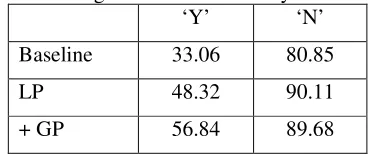
The performances (F-scores) for ‘Y’ and ‘N’ tags separately are shown in Table 3. First, we notice that the performances of the ‘N’ tag are much better than the ones of ‘Y’ tag. Second, it is surprising that incorporating the linguistic features significantly improves the ‘Y’ tag only (from 33% to 56%), but does not affect ‘N’ tag. This suggests that our linguistic features are effective to detect the presence of causal relation, and yet do not hurt the detections of ‘non_causal’ relation. Further-more, the general feature achieves ~8% improve-ments for the ‘Y’ tag.
Table 2: The overall performance with different feature sets of the multi-label system
Precision Recall F-score
Baseline 56.64 57.70 56.96
LP 74.92 66.70 69.21
[image:6.595.85.275.418.495.2]+ GP 73.90 72.70 73.26
Table 3: The separate performances for ‘Y’ and ‘N’ tags of the multi-label system
‘Y’ ‘N’
Baseline 33.06 80.85
LP 48.32 90.11
+ GP 56.84 89.68
6 Discussions
Many previous works on emotion recognition concentrated on emotion keyword detection. However, Ortony et al. (1987) pointed out the dif-ficulty of emotion keyword annotation, be it man-ual or automatic annotation. Emotion keywords are rather ambiguous, and also contain other in-formation besides affective inin-formation, such as behavior and cognition. Therefore, contextual in-formation provides important cues for emotion recognition. Furthermore, we propose an alterna-tive way to explore emotion recognition, which is based on emotion cause. Through two pilot ex-periments, we justify the importance of emotion contextual information for emotion recognition, particularly emotion cause.
We first examine emotion processing in terms of events. Context information is found to be very important for emotion recognition. Furthermore, most emotions are expressed with the presence of causes in context, which implies that emotion cause is the crucial information for emotion rec-ognition. In addition, emotion cause detection also explores deep understanding of an emotion. Com-pared to emotion recognition, emotion cause de-tection requires more semantic and pragmatic information. In this paper, based on the in-depth linguistic analysis, we extract different kinds of constructs to identify cause events for an emotion. To conclude, emotion processing is a compli-cated problem. In terms of emotion keywords, how to understand appropriately to enhance emo-tion recogniemo-tion needs more exploraemo-tion. With respect to emotion causes, first, event processing itself is a challenging topic, such as event extrac-tion and co-reference. Second, how to combine event and emotion in NLP is still unclear, but it is a direction for further emotion studies.
References
Abbasi, A., H. Chen, S. Thoms, and T. Fu. 2008. Af-fect Analysis of Web Forums and Blogs using Cor-relation Ensembles”. In IEEE Tran. Knowledge and Data Engineering, vol. 20(9), pp. 1168-1180. Aman, S. and S. Szpakowicz. 2007. Identifying
Ex-pressions of Emotion in Text. In Proceedings of 10th International Conference on Text, Speech and Dialogue, Lecture Notes in Computer Science 4629, 196--205.
Chang, D.-S. and K.-S. Choi. 2006. Incremental cue phrase learning and bootstrapping method for cau-sality extraction using cue phrase and word pair probabilities. Information Processing and Man-agement. 42(3): 662-678.
Chen, Y., S. Y. M. Lee and C.-R. Huang. 2009. Are Emotions Enumerable or Decomposable? And Its Implications for Emotion Processing. In Proceed-ings of the 23rd Pacific Asia Conference on Lan-guage, Information and Computation.
Chen, Y., Y. M. Lee, S. Li and C.-R. Huang. 2010. Emotion Cause Detection with Linguistic Construc-tions. In Proceedings of the 23rd International
Conference on Computational Linguistics.
Descartes, R. 1649. The Passions of the Soul. USA: Hackett Publishing Company.
Computational Approaches to Analysis and Genera-tion of EmoGenera-tion in Text. Los Angeles, CA: NAACL. Girju, R. 2003. Automatic Detection of Causal Rela-tions for Question Answering. In the 41st Annual Meeting of the Association for Computational Lin-guistics, Workshop on Multilingual Summarization and Question Answering - Machine Learning and Beyond, Sapporo, Japan.
Gupta, N., M. Gilbert, and G. D. Fabbrizio. Emotion Detection in Email Customer Care. In Proceedings of NAACL-HLT 2010 Workshop on Computational Approaches to Analysis and Generation of Emotion in Text.
James, W. 1884. What is an Emotion? Mind, 9(34): 188–205.
Keshtkar, F. and D. Inkpen. 2009. Using Sentiment Orientation Features for Mood Classification in Blog Corpus. In Proceedings of IEEE International Conference on Natural Language Processing and Knowledge Eng. (IEEE NLP-KE 2009), Sep. 24-27. Marcu, D. and A. Echihabi. 2002. An Unsupervised
Approach to Recognizing Discourse Relations. In
Proceedings of ACL.
Mihalcea, R., and H. Liu. 2006. A Corpus-based Ap-proach to Finding Happiness. In Proceedings of AAAI.
Mishne, G. 2005. Experiments with Mood Classifica-tion in Blog Posts. In Proceedings of Style2005 – the 1st Workshop on Stylistic Analysis of Text for Infor-mation Access, at SIGIR 2005.
Ortony, A., G. L. Clore, and M. A. Foss. 1987. The Referential Structure of the Affective Lexicon. Cog-nitive Science, 11: 341-364.
Pang B., L. Lee and S. Vaithyanathan. 2002. Thumbs up? Sentiment Classification Using Machine Learn-ing Techniques. In Proceedings of EMNLP02, 79-86. Pearl, L. and M. Steyvers. 2010. Identifying Emotions,
Intentions, and Attitudes in Text Using a Game with a Purpose. In Proceedings of NAACL-HLT 2010 Workshop on Computational Approaches to Analy-sis and Generation of Emotion in Text. Los Angeles, CA: NAACL.
Persing, Isaac and Vincent Ng. 2009. Semi-Supervised Cause Identification from Aviation Safety Reports. In Proceedings of ACL.
Plutchik, R. 1980. Emotions: A Psychoevolutionary Synthesis. New York: Harper & Row.
Quan, C. and F. Ren. 2009. Construction of a Blog Emotion Corpus for Chinese Expression Analysis. In Proceedings of EMNLP.
Strapparava, C. and R. Mihalcea. 2008. Learning to Identify Emotions in Text. In Proceedings of the ACM Conference on Applied Computing ACM-SAC.
Tokuhisa, R., K. Inui, and Y. Matsumoto. 2008. Emo-tion ClassificaEmo-tion Using Massive Examples Ex-tracted from the Web. In Proceedings ofCOLING.
Turner, J. H. 2000. On the Origins of Human Emotions: A Sociological Inquiry into the Evolution of Human Affect. California: Stanford University Press.
Wierzbicka, A. 1999. Emotions across Languages and Cultures: Diversity and Universals. Cambridge: Cambridge University Press.