Impact of the Gaussian Approximation
on the Performance of the Probabilistic
Data Association MIMO Decoder
Justus Ch. Fricke
Information and Coding Theory Lab, Faculty of Engineering, University of Kiel, Kaiserstraße 2, 24143 Kiel, Germany Email:[email protected]
Magnus Sandell
Toshiba Research Europe Ltd., Telecommunications Research Laboratory, 32 Queen Square, Bristol BS1 4ND, UK Email:[email protected]
Jan Mietzner
Information and Coding Theory Lab, Faculty of Engineering, University of Kiel, Kaiserstraße 2, 24143 Kiel, Germany Email:[email protected]
Peter A. Hoeher
Information and Coding Theory Lab, Faculty of Engineering, University of Kiel, Kaiserstraße 2, 24143 Kiel, Germany Email:[email protected]
Received 1 March 2005; Revised 24 July 2005; Recommended for Publication by Michael Gastpar
The probabilistic data association (PDA) decoder is investigated for use in coded multiple-input multiple-output (MIMO) systems and its strengths and weaknesses are determined. The conventional PDA decoder includes two approximations. The received symbols are assumed to be statistically independent and a Gaussian approximation is applied for the interference and noise term. We provide an analytical formula for the exact probability density function (PDF) of the interference and noise term, which is used to discuss the impact of the Gaussian approximation in the presence of a soft-input soft-output channel decoder. The results obtained resemble those obtained for the well-known PDA multiuser detector in coded CDMA systems for which similar investigations have been done before.
Keywords and phrases:probabilistic data association, MIMO systems, stochastic approximation, iterative methods, interference.
1. INTRODUCTION AND BACKGROUND
Probabilistic data association (PDA) has originally been de-veloped for target tracking by Yaakov Bar-Shalom in the 1970s. Since then, it has been applied in many different ar-eas, including digital communications. In the area of digi-tal communications, the PDA algorithm is a reduced com-plexity alternative to the a posterioriprobability (APP) de-coder/detector/equalizer. Near-optimal results were demon-strated for a PDA-based multiuser decoder (MUD) for code division multiple access (CDMA) systems [1,2]. Recently,
This is an open access article distributed under the Creative Commons Attribution License, which permits unrestricted use, distribution, and reproduction in any medium, provided the original work is properly cited.
probabilistic data association has been shown to achieve good results in multiple-input multiple-output (MIMO) sys-tems [3,4]. In [5], a PDA was presented for turbo equaliza-tion of a single antenna system. It should also be noted that the Gaussian assumption made in the PDA decoder is used in several other MUD detection schemes, especially when ap-plying iterative detection and decoding schemes, for exam-ple, [6,7,8]. In [9], it was shown that the performance of a coded CDMA system with PDA decoder degrades if the num-ber of users is not large enough.
Channel
encoder matcherRate
Inter-leaver
Space-time encoder
Rate dematcher
Channel
PDA MIMO decoder
Deinter-leaver Channel
decoder
b c π(cr) x
r π(L(c)r)
L(c)
b
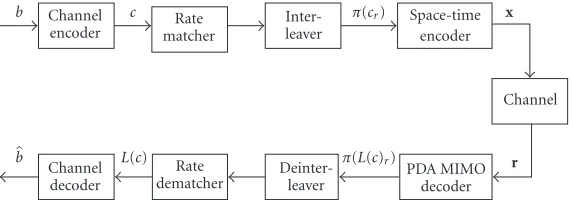
Figure1: Communication system investigated throughout this paper.
soft outputs which is far less obvious when using an iterative decoding scheme. Because the PDA decoder inherently pro-vides estimates of thea posterioriprobabilities of the trans-mitted data symbols, it seems to be well suited for the use in conjunction with a soft-input channel decoder. However, the results presented in the following show that the PDA MIMO decoder does not always work as well as expected. We provide an exact formula for the probability density function (PDF) of the interference and noise term to calculate the exact sym-bol probabilities for the symsym-bol-by-symsym-bol detection done in the PDA. Simulations based on these probabilities show that the Gaussian approximation made in the PDA decoder has a large impact on the quality of the soft outputs provided to the channel decoder, and therefore on the channel decoding itself. It can be concluded that the quality of the Gaussian ap-proximation, and therefore of the soft outputs, depends on the number of transmit antennas and on the cardinality of the symbol alphabet. To our best knowledge, such an analy-sis of the PDA MIMO decoder has not been presented before. The remainder of this paper is organized as follows. We first introduce the system model under investigation in
Section 2. In Section 3, a PDA decoder for use in a coded MIMO system is presented, followed by an analysis of the Gaussian approximation and its impact on the decoding process. A confirmation of the analytical results in form of simulations is given in Section 4. Conclusions are drawn in
Section 5.
2. SYSTEM MODEL
Consider a MIMO system with M transmit and N receive antennas. Like in V-BLAST [10], a single data stream is mul-tiplexed intoMparallel data streams and then mapped onto complex modulation symbols. TheMsymbols are transmit-ted simultaneously by the corresponding antennas. Before the multiplexing is done, the data stream is encoded by a channel encoder and interleaved by a channel interleaver. Assuming flat fading, the equivalent discrete-time channel model can be written in complex baseband notation as
r=Hx+v, (1)
where baud-rate sampling is assumed. The channel matrix H∈CN×Mis assumed to be constant during one data block (block fading assumption) and perfectly known at the re-ceiver. The channel matrix coefficientshn,mrepresent the gain
between transmit antennam(1≤m≤M) and receive an-tenna n(1 ≤ n ≤ N). The vector x ∈ QM×1 consists of
the complex-valued transmitted modulation symbols taken from a symbol alphabetQwith cardinalityQ, while the vec-torr∈CN×1contains the received samples. Additive noise is
given byv∈CN×1, with complex elements that are
indepen-dent and iindepen-dentically distributed white Gaussian noise sam-ples with zero mean and varianceσ2
v =E{|vn|2}. At the re-ceiver, the demultiplexing, or MIMO decoding, operation is performed by the PDA followed by a deinterleaver and a soft-input channel decoder. An overview of the system is given in
Figure 1. Please note that no turbo equalization as in [4,5] or feedback from the channel decoder to the PDA as in [11] is used.
3. PDA DECODER
3.1. Basic algorithm
The conventional PDA decoder1 uses two approximations.
Firstly, the PDA decoder looks only at one transmitted sym-bol at a time, treating the received symsym-bols as statistically in-dependent. A second approximation is the Gaussian approx-imation (“Gaussian forcing”) of the PDF of the interference and noise. The PDA decoder approximatesa posteriori prob-abilities Pr(xm|r) for every elementxmofx. All symbols in-terfering withxmand the noise are modeled as a single vector
w=
k=m
xkhk+v, (2)
wherehk denotes thekth column ofH, andxk thekth ele-ment ofx. The interference and noise term in (2) is assumed to be ann-variate Gaussian distributed random variable with mean
µw=E
k=m
xkhk+v
=
k=m
Exkhk, (3)
1The conventional PDA decoder uses the non-decoupled system model
(which means that the received signalris not multiplied with the inverse of the channel matrixH−1). Because we are interested in a fundamental
and covariance If noa prioriinformation is available, the PDA decoder ini-tializes the symbol probabilities as a uniform distribution. Assuming the Gaussian distribution of the noise and inter-ference term, the a posteriori probabilities for the possible symbolsxmcan be computed using (3) and (4):
For an estimate of the symbolxm, no information on sym-bolsxk,k≥m, is available. In order to provide information on these symbols, the PDA decoder may use multiple iter-ations, in each iteration using the symbol probabilities ob-tained by the previous iteration. As in [1], the mean (3) and the variance (4) are updated for every symbol probability es-timate, incorporating the new information gained from sym-bol probabilities already computed in the current or previous iterations. Given the PDF in (5), log-likelihood ratios (LLRs) can be computed to serve as soft-input for the channel de-coder after the last iteration of the PDA dede-coder:
Lcκ =log
3.2. Actual PDF of interference and noise term
The actual PDF of the interference and noise term is a sum ofQM−1Gaussian distributions, each of them caused by one
possible interfering symbol constellation as a convolution of the discrete symbol probabilities and the PDF of the Gaus-sian noise vectorv. LetXsbe the set of all possible symbol vector combinations causing interference for a fixed xm. It can be easily shown that the actual PDF of the interference and noise term is sian distributions with means depending on the channel as well as the interfering modulation symbols. It isnotthe PDF used for optimal (APP) detection; being the exact PDF of the interference for one of the detected symbols, it is not employ-ing the Gaussian approximation but still treatemploy-ing the symbols
−10 −5 0 5 10 15 20 25 30 35 Figure2: BER performance of a turbo-codedM×NMIMO system with PDA decoder. As a benchmark, the BER performance for an APP decoder is shown as well.
as statistically independent. A derivation for the CDMA case can be found in [12, Chapter 3.1] and was also published in [6].
According to the central limit theorem, the quality of the Gaussian approximation used in the PDA decoder improves by increasing the number of transmit antennas. On the other hand, the approximation becomes worse when modulation schemes with more constellation points are used. With an increasing number of constellation points, a soft bit accord-ing to (6) is calculated by a larger number of (approximated) probabilities, and is therefore more likely to be unreliable. It should also be noted that the approximation is better in the presence of strong noise. As can be seen in (9), the variance of the single Gaussian distribution is larger for a largerσ2
v, which makes the sum more likely to be Gaussian-like.
3.3. Consequences for soft-input channel decoder
Soft-input channel decoders use reliability information on the input in form of LLRs. The reliability of the LLRs is essen-tial for channel decoding; unreliable soft inputs cause wrong estimates of the information bits. The LLRs delivered by the PDA decoder are calculated from the symbol probabilities which are based on the approximated PDF of the interfer-ence and noise term. As shown above, the Gaussian approxi-mation, and therefore the soft inputs of the channel decoder, can be quite poor and thus inhibits the channel decoder from achieving good performance. Similar results were obtained for a coded CDMA system in [9].
4. NUMERICAL RESULTS
0 5 10 15 20 25 30 35 Eb/N0(dB)
10−6
10−5
10−4
10−3
10−2
10−1
100
Co
de
d
B
E
R
PDA with actual PDA it. 1 PDA with actual PDA it. 2 PDA with actual PDA it. 3 PDA it. 1
PDA it. 2 PDA it. 3 APP
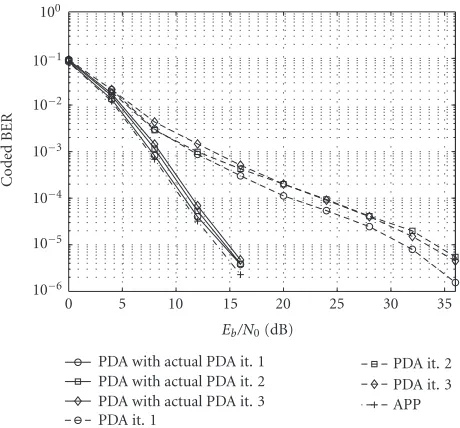
Figure3: BER performance of a turbo-coded 2×2 MIMO system with conventional PDA decoder and PDA decoder using the actual PDF of the interference and noise term. As a benchmark, the BER performance for an APP decoder is shown as well.
MIMO system in conjunction with a turbo code has been investigated. As a benchmark, the BER performance for an APP decoder has been simulated as well. A block length of 2304 information bits is used. The bit energy to noise ratio is defined asEb/N0 =σx2σh2/qRσv2, withqbeing the number
of bits per modulation symbol andRdenoting the code rate. The average power per symbol constellation point is denoted by σ2
x. The elementshn,m ofHare statistically independent
random variables (each component being complex Gaussian distributed with zero mean and varianceσ2
h =E{|hn,m|2}). A rate 1/2 turbo code with polynomials (5,7) and 4 iterations in the turbo decoder is applied. The rate matcher ensures that the coded block length is a multiple ofqM, and therefore can be multiplexed to theMtransmit antennas.
The number of iterations given in Figures2 and3are the iterations done in the PDA algorithm before the soft esti-mates of the bits are given to the channel decoder. While the PDA achieves good results when using no channel code [3], the results of the coded system can be far from the optimum. InFigure 2, it can be seen that the difference between the APP and the PDA decoder is the largest for the 2×2 system and improves with an increasing number of antennas. Especially for the 2×2 system, the gap between the APP and the PDA decoder is getting larger with an increase inEb/N0.
Further-more, the third iteration is not, as it should be, the best one. This is explained by the quality of the soft-output generated by the PDA decoder, which degrades with every iteration as (unreliable) probabilities computed by the previous iteration are used.
To demonstrate the impact of the Gaussian approxi-mation on the performance of the coded PDA system, in
Figure 3, the results for the 2×2 system are shown for the PDA decoder using the Gaussian approximation compared to the decoder using the actual PDF of the interference and noise. It is clearly seen that the problems arise from the Gaus-sian approximation made in the PDA, as the PDA decoder using the nonapproximated PDF achieves near-optimal re-sults. We have found similar results for convolutional codes and different code rates.
5. CONCLUSION
The impact of the Gaussian approximation in the conven-tional PDA MIMO decoder on the performance of a MIMO system using a soft-input channel decoder was shown. It was shown that the Gaussian approximation is the best for a large number of transmitting antennas and a small number of constellation points in the modulation scheme. Its influence on the quality of the soft outputs, and therefore the chan-nel decoder has been investigated. Furthermore, it has been illustrated that the main degradation of the performance of the PDA decoder is the Gaussian approximation and not the symbol-by-symbol decoding. The results of this paper hold, in principle, also for a multiuser detection scenario where the usually large number of interferers results in a good approx-imation. The PDA decoder was applied in iterative decoding schemes for CDMA [2] and MIMO [11] systems. In itera-tive schemes, the PDA decoder may achieve a performance close to optimum. A formula for the actual PDF of inter-ference and noise for CDMA MUD can be found in [12]. A way to improve the performance when using the PDA MIMO decoder with a soft input channel decoder might be impor-tance sampling as proposed in [11] or the combination with sphere decoding [13].
REFERENCES
[1] J. Luo, K. R. Pattipati, P. K. Willet, and F. Hasegawa, “Near-optimal multiuser detection in synchronous CDMA using probabilistic data association,”IEEE Commun. Lett., vol. 5, no. 9, pp. 361–363, 2001.
[2] P. H. Tan, L. K. Rasmussen, and J. Luo, “Iterative multiuser de-coding based on probabilistic data association,” inProc. IEEE International Symposium on Information Theory (ISIT ’03), pp. 301–301, Yokohama, Japan, June–July 2003.
[3] D. Pham, K. R. Pattipati, P. K. Willet, and J. Luo, “A gener-alized probabilistic data association detector for multiple an-tenna systems,”IEEE Commun. Lett., vol. 8, no. 4, pp. 205– 207, 2004.
[4] S. Liu and Z. Tian, “Near-optimum soft decision equalization for frequency selective MIMO channels,”IEEE Trans. Signal Processing, vol. 52, no. 3, pp. 721–733, 2004.
[5] Y. Yin, Y. Huang, and J. Zhang, “Turbo equalization using probabilistic data association,” inProc. IEEE Global Telecom-munications Conference (GLOBECOM ’04), vol. 4, pp. 2535– 2539, Dallas, Tex, USA, November–December 2004.
[7] W. K. Leung, L. Liu, and L. Ping, “Interleaving-based mul-tiple access and iterative chip-by-chip multiuser detection,” IEICE Transactions on Communications, vol. E86-B, no. 12, pp. 3634–3637, 2003.
[8] F. Br¨annstr¨om, T. M. Aulin, and L. K. Rasmussen, “Iterative detectors for trellis-code multiple-access,”IEEE Trans. Com-mun., vol. 50, no. 9, pp. 1478–1485, 2002.
[9] P. H. Tan and L. K. Rasmussen, “Multiuser detection based on Gaussian approximation,” inProc. IEEE 3rd Workshop on The Internet, Telecommunications and Signal Processing (WITSP ’04), pp. 231–236, Adelaide, Australia, December 2004. [10] G. D. Golden, C. J. Foschini, R. A. Valenzuela, and P. W.
Wolniansky, “Detection algorithm and initial laboratory re-sults using V-BLAST space-time communication architec-ture,”Electronics Letters, vol. 35, no. 1, pp. 14–16, 1999. [11] Y. Jia, C. Andrieu, R. J. Piechocki, and M. Sandell,
“Improv-ing soft output quality of MIMO demodulation algorithm via importance sampling,” inProc. IEE 5th International Confer-ence on 3G Mobile Communication Technologies (3G ’04), pp. 387–390, London, UK, October 2004.
[12] J. F. R¨oßler, Equalization for PAM- and DS-CDMA-based transmission systems, Ph.D. dissertation, Friedrich-Alexander University of Erlangen-N¨urnberg, Bayern, Germany, January 2005.
[13] Y. Jia, C. Andrieu, R. J. Piechocki, and M. Sandell, “Gaus-sian approximation based mixture reduction for near opti-mum detection in MIMO systems,” to appear inIEEE Com-mun. Lett..
Justus Ch. Fricke studied electrical en-gineering, information enen-gineering, and business administration at the Christian-Albrechts-University of Kiel, Germany, with a focus on digital communications. Dur-ing his studies, he spent six months with the Toshiba Telecommunications Research Laboratory in Bristol, UK. He received the Dipl.-Ing. degree from the Chris-tian-Albrechts-University, in 2004. Since
September 2004, he is working towards his Ph.D. degree as a Re-search and Teaching Assistant at the Information and Coding The-ory Lab (ICT) at the University of Kiel. His research interests con-cern multiple-access techniques for next-generation wireless sys-tems, especially interleave-division multiple-access (IDMA), and cross-layer design.
Magnus Sandellreceived an M.S. degree in electrical engineering and a Ph.D. degree in signal processing from Lule˚a University of Technology, Sweden, in 1990 and 1996, respectively. He spent six months as a Re-search Assistant with the Division of Sig-nal Processing at the same university be-fore joining Bell Labs, Lucent Technologies, Swindon, UK, in 1997. In 2002, he joined Toshiba Research Europe Ltd., Bristol, UK,
where he is working as a Chief Research Fellow. His research inter-ests include signal processing and digital communications theory. Currently, his focus is on multiple-antenna systems and space-time decoding.
Jan Mietznerstudied electrical engineering at the Faculty of Engineering, University of Kiel, Germany, with focus on digital com-munications. During his studies, he spent six months in 2000 with the Global Wire-less Systems Research Group, Bell Labs, Lu-cent Technologies, Swindon, England, UK. He received the Dipl.-Ing. degree from the University of Kiel in 2001. For his Diploma thesis on space-time codes, he received the
Prof. Dr. Werner Petersen-Award. Since August 2001, he is working toward his Ph.D. degree as a Research Assistant at the Information and Coding Theory Lab (ICT), University of Kiel. His research in-terests are concerned with physical layer aspects of future wireless communications systems, especially multiple-antenna techniques and space-time coding.
Peter A. Hoeher received the Dipl.-Ing. and Dr.-Ing. (Ph.D.) degrees in electri-cal engineering from the Technielectri-cal sity of Aachen, Germany, and the Univer-sity of Kaiserslautern, Germany, in 1986 and 1990, respectively. From October 1986 to September 1998, he was with the Ger-man Aerospace Center (DLR), Oberpfaff en-hofen, Germany. From December 1991 to November 1992, he was on leave at AT&T