Incremental Neo-Davidsonian semantic construction for TAG
Asad Sayeed and Vera Demberg
Department of Computational Linguistics/MMCI Cluster of Excellence Saarland University
66123 Saarbr¨ucken, Saarland, Germany
{asayeed,vera}@coli.uni-saarland.de
Abstract
We propose a Neo-Davidsonian semantics approach as a framework for constructing a semantic interpretation simultaneously with a strictly incremental syntactic deriva-tion using the PLTAG formalism, which supports full connectedness of all words un-der a single node at each point in time. This paper explains why Neo-Davidsonian semantics is particularly suitable for in-cremental semantic construction and out-lines how the semantic construction process works. We focus also on quantifier scope, which turns out to be a particularly interest-ing question in the context of incremental TAG.
1 Introduction
Incremental processing formalisms have increas-ing importance due to the growincreas-ing ubiquity of spoken dialogue systems that require understand-ing and generation in real-time usunderstand-ing rich, robust semantics. Dialogue systems benefit from incre-mental processing in terms of shorter response time to the user’s requests when the dialogue sys-tem can start interpreting and serving the request (e.g. by consulting databases, doing reference res-olution, backchannelling or starting to generate an answer (Aist et al., 2007; Schuler et al., 2009; Skantze and Schlangen, 2009)) before the request is fully stated. Another use of formalisms that support strict incrementality is psycholinguistic modelling: As there is a substantial amount of ev-idence that human sentence processing is highly incremental, computational models of human sen-tence processing should be incremental to the same degree. Such models can then be used to
calculate measures of human sentence process-ing difficulty, such as surprisal, which have been demonstrated to correspond to reading times (e.g., Levy, 2008; Mitchell et al., 2010).
Two strictly incremental versions of tree-adjoining grammar (TAG; Joshi et al., 1975) which have been proposed in recent years are DV-TAG (Mazzei et al., 2007) and PLDV-TAG (Demberg-Winterfors, 2010). Incremental syntax is how-ever only of limited interest without a correspond-ing mechanism for calculatcorrespond-ing the incremental semantic interpretation. And for that semantic model to be practically useful in psycholinguis-tic modelling or NLP applications such as speech recognition or dialogue systems, we believe that the semantic representation should ideally be sim-ple, flat and usefully underspecified, in order to be used in the future in a context of compositional distributional semantics. We propose a frame-work in which semantic expressions are built syn-chronously with the syntactic tree. Simple rules are used to integrate an elementary tree’s seman-tic expression with the semanseman-tic expression of the prefix tree at each stage. The semantic contribu-tion of the new elementary tree is thereby added to the semantic output expression in a manner that reflects closely the order in which semantic ma-terial has arrived. The necessary semantic anno-tation of elementary trees can be obtained from subcategorization frame information (PropBank, FrameNet). We use a Neo-Davidsonian event-based semantics with minimal recursion.
Integrating incremental syntactic analysis with a framework of incremental semantic interpreta-tion will allow one to model processing phenom-ena such as the decreased processing difficulty (1-b) (after Steedman, 2000) in comparison to
(1-a) by downranking the main verb analysis of sentwhen the subject (likeflowers) is unlikely to fill the sender role.
(1) a. The doctor sent for the patient arrived. b. The flowers sent for the patient arrived.
Incrementally generating the semantic interpreta-tion requires the underspecificainterpreta-tion of the output semantics given the syntax, such as underspeci-fying the number of arguments of a verb or (to a greater extent than for non-incremental devia-tions, as we will discuss below) the scope of quan-tifiers.
This paper sets forth the initial proposal for this semantic formalism in terms of underlying desiderata, principles, and basic use cases. It pro-vides one example derivation, and it outlines a way of dealing with the question of scope ambi-guities, an issue which affects a number of aspects of the theoretical plausibility of a semantic for-malism.
2 PLTAG Syntax
PLTAG (Demberg-Winterfors, 2010; Demberg and Keller, 2009, 2008) is a strictly incremental version of TAG. In order to achieve the strict in-crementality (i.e., all words are always connected under a single root), the formalism uses predic-tion trees, which are usually not lexicalized. Each node of a prediction tree carries markers (see in-dicesk andk in Figure 1(c)) which indicate that
the predicted node has to beverifiedby a canon-ical (= non-predictive) TAG tree with matching structure at a later point in the derivation, in or-der to yield a valid or-derived tree.
Thisverificationoperation applies when an el-ementary tree arrives that structurally matches nodes in the prefix tree which are marked with the prediction markers. A structural match is thereby defined as the verification tree containing all nodes with identical index (i.e. all nodes that were contributed by a specific prediction tree). Additionally, the verification tree can have further nodes to the right of the spine (= the path from the root to the anchor). The prediction markers are re-moved, and the lexical item in the elementary tree is placed in the head of the prediction tree as in Figure 4, and any additional nodes of the verifica-tion tree which were not part of the predicverifica-tion tree are inserted into the prefix tree. For more details
see Demberg-Winterfors (2010).
3 Semantic PLTAG
Consider the following ways of stating a com-mand to a hypothetical restaurant reservation sys-tem:
(2) a. Send every restaurant a reservation request. b. Send a reservation request to every
restau-rant.
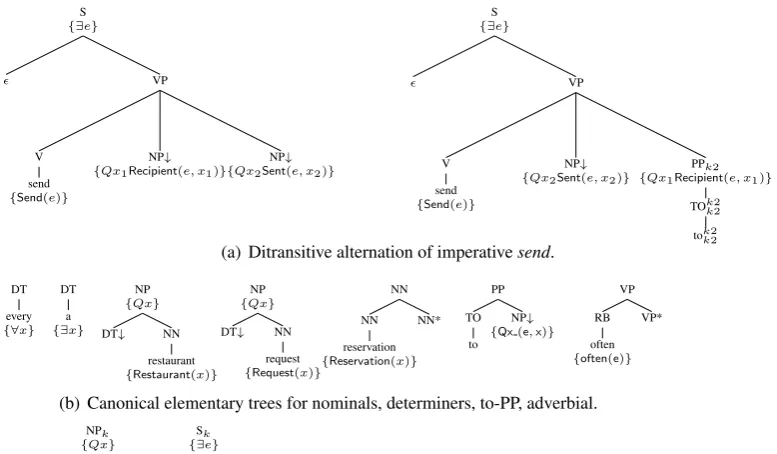
A system that derives syntax and semantics in-crementally and simultaneously can partially dis-ambiguate the ambiguity between the two ele-mentary trees of “send” (see Figure 1(a)) by tak-ing into account that restaurants are better recip-ients than reservation requests, while reservation requests are more typically sent. The following sections outline how we decorate the syntactic PLTAG trees with semantic annotations, how se-mantic expressions are composed, and how we deal with quantifier scope.
4 Neo-Davidsonian semantics
Neo-Davidsonian semantics (Parsons, 1990) is a form of first-order logic that uses existentially-bound event variables (∃e) to connect verb
pred-icates and their subcategorized arguments and separates predicate arguments into their own, separate event-modifying predicates connected through conjunctions. This permits a flexible means to underspecify function composition and argument structure (Hunter, 2009) by greatly lim-iting recursion (Example (3-a)) in semantic ex-pressions.
(3) a.Happily(Eating(Candy)) b.∃x1∃eCandy(x1)&Eaten(e, x1)&
Eating(e)&Happily(e)
The Neo-Davidsonian approach has been imple-mented in formalisms such as Robust Minimal Recursion Semantics (RMRS; Copestake, 2007). We use a variant exemplified in (3-b).
S
{∃e}
VP
V
send
{Send(e)}
NP↓ {Qx1Recipient(e, x1)}
NP↓ {Qx2Sent(e, x2)}
S
{∃e}
VP
V
send
{Send(e)}
NP↓ {Qx2Sent(e, x2)}
PPk2
{Qx1Recipient(e, x1)}
TOk2
k2
tok2
k2
(a) Ditransitive alternation of imperativesend.
DT
every
{∀x}
DT
a
{∃x}
NP
{Qx}
DT↓ NN
restaurant
{Restaurant(x)}
NP
{Qx}
DT↓ NN
request
{Request(x)}
NN
NN
reservation
{Reservation(x)}
NN* PP
TO
to NP↓ {Qx(e,x)}
VP
RB
often
{often(e)}
VP*
(b) Canonical elementary trees for nominals, determiners, to-PP, adverbial.
NPk
{Qx}
DT↓k NNk k
{(x)}
Sk
{∃e}
NP↓kVPk k
[image:3.595.72.461.69.296.2](c) Prediction trees
Figure 1: Example Lexicon
tree, expressing that a verb phrase is expected and that the structure is going to root in S, see right hand tree in Fig. 1(c). It does however not spec-ify the subcategorization frame of the verb that is going to be the head of the predicted verb phrase. Neo-Davidsonian semantics allows us to keep the same level of underspecification in the semantics, such that the verb-phrase prediction tree only in-troduces the event variable∃e, which is then
avail-able to be unified with the unbound variavail-able of of-ten. Furthermore, the breaking up of n-ary pred-icates into an event predicate and a binary rela-tion for each thematic role in Neo-Davidsonian semantics allows us to calculate the semantic con-tribution of a verb’s argument before having seen all arguments.
The minimally-recursive nature of the formal-ism also permits the order of predicates in the formalism to reflect approximately the order in which their corresponding syntactic fragments were incorporated into the structure. In our PLTAG-based formalism, we tie each elemen-tary tree to a neo-Davidsonian expression frag-ment which will be appended to the end of a se-mantic structure that grows along with the parse tree. This incorporates a notion of recency di-rectly into our semantic expression construction, a characteristic relevant to semantic enhancements of PLTAG’s syntactic prediction component.
This enables the produced expressions to be used directly in statistical prediction techniques where order may matter, including composi-tional distribucomposi-tional semantics (Mitchell and Lap-ata, 2010) or HMM-style sequence learning tech-niques. Its trade-off is that the semantic expres-sions are not always guaranteed to be immediately well-formed, particularly in the order of scopes. However, in the later sections we discuss ways to identify structure that needs to be rearranged, ways that can be applied at every incremental step.
4.1 Lexical construction and derivation These are some relevant aspects of the lexicon’s construction:
Verb trees are annotated at the root with an existentially-quantified event variable. The head node contains the verb’s own predicate, and the nodes representing arguments have argument predicates with entity variables. The argument predicates correspond to thematic roles.
The semantic expressions associated with ele-mentary trees consist of four types of variables, entity variables, written asxn, first-order
predi-cate variables, written as , quantifier variables, written asQn, and event variables, written asen.
Sentence:Sendkevery restaurant a reservation request S
{∃e}
VP
V
send
{Send(e)}
NPk
{Qx1Recipient(e, x1)}
DT↓k NNk k
{(x1)}
NP↓ {Qx2Sent(e, x2)}
S
{∃e}
VP
V
send
{Send(e)}
NPk
{Qx2Sent(e, x2)}
DT↓k NNk k
{(x2)}
PPk2
{Qx1Recipient(e, x1)}
TOk2
k2
tok2
k2
Semantics: ∃eQx1Recipient(e, x1)& (x1)&Qx2Sent(e, x2) Semantics: ∃eQx2Sent(e, x2)& (x2)&Qx2Recipient(e, x1)
[image:4.595.80.485.73.204.2]&Send(e) &Send(e)
Figure 2: Ambiguous derivation when ditransitiveSendis received.
values whenever a verification occurs that unifies a prediction tree with an elementary tree.Qn
vari-ables are given concrete quantifier values when-ever an elementary tree with a quantifier is sub-stituted into a noun elementary tree that has the
Qn variable. en variables represent events and
their connections to event participants through role predicates.
Determiners represent their own appropriate quantifier (e.g. ∀x). NP-rooted elementary trees
for nouns have an unspecifiedQquantifier at the
root and a semantic predicate corresponding to the noun. Nominal adjuncts (such as the example reservation auxiliary tree) contain a correspond-ing predicate over an unbound entity variable.
4.2 Composition rules
We describe our procedure for incremental se-mantic parsing in terms of triggered procedures for the incorporation of the semantic expressions residing on nodes of the most recently attached elementary tree. We first describe some common characteristics of the composition procedure, and then we describe how some frequent types of el-ementary trees are semantically processed on ar-rival. One aspect of our approach is that most of the “work” in building the semantic expression is defined in terms of the derived tree, in contrast to other TAG semantics approaches that use the derivation tree. We found this the simplest way to align the verification step’s role in giving values to prediction trees and the valuation of variables in the semantic expressions. Expressions and vari-ables in the derived tree are indexed to their cor-responding forms in the semantic expression, so that they grow in parallel.
The semantic component proceeds through
rules for unification and predicate emission. Se-mantic predicates are emitted as conjuncts from left to right, normally revising previous seman-tic structure based on unification events during PLTAG operations. Whenever an elementary tree is either substituted, adjoined, or predicted, the se-mantic expressions on that tree’s nodes are emit-ted as conjuncts, once all unifications have been resolved.1
When an unbound variable joins the structure, it is unified with the nearest compatible variable the shortest distance above it in the structure. (Un-bound variables generally appear in elementary trees representing adjunct structures like adjec-tives.) For thexnentity variables, when they are
unified, they will be assigned the same variable subscript. For Q quantifier variables, they will
search for the nearest quantifier or quantifier vari-able, by the same standard of nearness. variables are predictive and only bound during verification. By default, all predicates are joined with con-junction operators, except in the case where a∀xn
is called for. Then a→conditional operator must
be inserted when the universally-quantified NP is complete, with all adjuncts in the restrictor of the quantifier. We describe later a procedure to iden-tify NP adjuncts directly from the semantic ex-pression in order to insert the conditional operator as needed.
4.2.1 Example derivation
Figures 2-6 represent an example derivation based on the sentence Send every restaurant a reservation requestusing the lexicon in figure 1.
1We use the word “unification” in the sense of
Sentence:Send everykrestaurant a reservation request
S
{∃e}
VP
V
send
{Send(e)}
NPk {∀x1Recipient(e, x1)}
DTk
every
{∀x1}
NNk k {(x1)}
NP↓ {Qx2Sent(e, x2)}
S
{∃e}
VP
V
send
{Send(e)}
NPk {∀x2Sent(e, x2)}
DTk
every
{∀x2}
NNk k {(x2)}
PPk2
{Qx1Recipient(e, x1)}
TOk2
k2
tok2
k2
Semantics: ∃e∀x1Recipient(e, x1)& (x1)&Qx2Sent(e, x2) Semantics: ∃e∀x2Sent(e, x2)& (x2)&Qx2Recipient(e, x1)
[image:5.595.88.503.73.258.2]&Send(e) &Send(e)
Figure 3: Derivation remains ambiguous aftereveryis received.
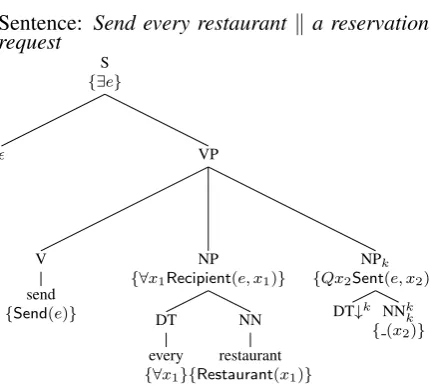
Sentence: Send every restaurant ka reservation request
S
{∃e}
VP
V
send
{Send(e)}
NP
{∀x1Recipient(e, x1)}
DT
every
{∀x1}
NN
restaurant
{Restaurant(x1)}
NPk {Qx2Sent(e, x2)}
DT↓k NNk k {(x2)}
Semantics:∃e∀x1Recipient(e, x1)&Restaurant(x1)
&Qx2Sent(e, x2)&Send(e)& (x2)
Figure 4: The prediction NP tree is verified through
unification with the tree forrestaurant.
In figure 2, the two possible trees forsendare in-troduced from the lexicon, and the semantic ex-pressions associated with the nodes are emitted.
In figure 3, the derivation remains ambiguous aftereveryis received. However, the quantifier∀
unifies with the quantifier variable represented as
Qin both the trees and in the resulting semantics.
Next, the prediction NP tree is verified through unification with the tree forrestaurant(figure 4). The empty predicate is also filled. Semantic se-lectional constraints abolish the second parallel derivation. The derivation is also now ready for the next NP prediction tree.
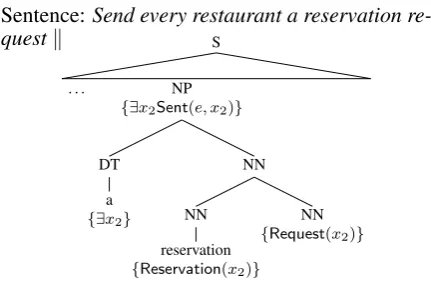
Prediction of a determiner and verification with aproceeds in analogy to the first NP. We then ad-join the noun reservation(figure 5). For brevity,
we omit the ambiguity created by the possible in-terpretation ofreservationas an argument; we are illustrating the effect of adjunction. The variable inReservation(x) unifies with the nearest
quan-tified variable along the spine of the tree; nomi-nal adjuncts generally do not bring entity variable bindings with them. The predicate is literally ap-pended to the semantic expression as another con-junct.
Finally (figure 6), the prediction tree is verified by the arrival of request, which fills out the last predicate variable. We demonstrate in this step an adjustment of the semantics to a form in which the event is quantified in the lowest position and the restrictor of∀is correctly placed before an in-serted→. We outline how to make this work in the next section.
4.3 Adjuncts and arguments
[image:5.595.73.289.285.480.2]must also have the capacity to distinguish between the restrictor and the nuclear scope of a quantifier. There are multiple ways to do this, including from the structure of the derived tree and the or-der in which the or-derivation proceeded, but we ar-gue that most of the work can be done within the semantic expression itself. Most trivially, nominal adjuncts can be identified by the lack of an event argument to their predicates. Relative clause ad-juncts will contain their own event variables, but will not refer to the exterior event directly. As an illustration:
(4) a. Some flower that some bride holds wilts. b.∃x1Flower(x1)&[∃x2Bride(x2)
&∃e2Hold(e2)&Holder(e2, x2)
&Held(e2, x1)]&∃e1Wilt(e1)&Wilter(e1, x1)
Sincee1is the root event, we know that the
rela-tive clause “that the bride holds” does not directly refer to it in its semantic expression and is an ad-junct only of “the flower”. We can even deduce from the expression that “the flower” is the host NP for the relative clause, because “the bride” is not directly connected to the root event as an ar-gument. We can therefore correctly insert the→
if the matrix subject had a universal quantifier.
(5) a. Every flower that some bride holds wilts. b.∀x1Flower(x1)&[∃x2Bride(x2)
&∃e2Hold(e2)&Holder(e2, x2)&Held(e2, x1)]
→ ∃e1Wilt(e1)&Wilter(e1, x1)
A similar procedure can be applied to the distinc-tion between argument clauses that appear after verbs like “say” and adjunct clauses heralded by “because.” Argument clauses are heralded by an event variable that itself becomes an argument of a role predicate of the matrix argument, as here:
(6) a. Some professor says some student failed. b.∃x1Professor(x1)&∃e1Say(e1)
&Speaker(e1, x1)&[∃x2Student(x2)
&∃e2Spoken(e1, e2)&Fail(e2)&Failer(e2, x2)]
In the case of an adjunct clause introduced with “because”, there is no role predicate connecting the subordinate event to the matrix event, which is practically the definition of an adjunct.
4.4 Scope and Underspecification
Our example derivation in Figures 2 to 6 shows how a syntactic tree and semantic interpretation
Sentence: Send every restaurant a reservationk
request S
. . . NPk {∃x2Sent(e, x2)}
DTk
a
{∃x2}
NNk
NN
reservation
{Reservation(x2)}
NNk {(x2)}
Semantics:∃e∀x1Recipient(e, x1)&Restaurant(x1)
[image:6.595.303.522.71.200.2]&∃x2Sent(e, x2)&Send(e)& (x2)&Reservation(x2) Figure 5: Prediction of a determiner and verification
witha proceeds in analogy to the first NP. We then
adjoin the nounreservation.
Sentence:Send every restaurant a reservation
re-questk S
. . . NP
{∃x2Sent(e, x2)}
DT
a
{∃x2}
NN
NN
reservation
{Reservation(x2)}
NN
{Request(x2)}
Semantics:∀x1Restaurant(x1)→ ∃x2Request(x2)
&Reservation(x2)&∃eRecipient(e, x1) Sent(e, x2)&Send(e)
Figure 6: Finally, the prediction tree is verified by the
arrival ofrequest, which fills out the last predicate
variable.
can be constructed for the sentences in (2-a). However, it only derives one possible reading for the sentence∃>∀, i.e. there exists a single reser-vation request, and that it is to be sent indiscrimi-nately to all restaurants. This reading reflects the linear order that quantifiers occurred in. It misses the other interpretation∀ > ∃ (which was likely
intended by the user). When sentences are derived incrementally, we cannot choose in the derivation to first substitute the second NP in order to get the other reading. Therefore, we need to systemati-cally useunderspecificationto get both readings. Note that this problem also exists to a certain ex-tent in standard LTAG (Joshi et al., 2007; Barker, 2010).
[image:6.595.302.518.270.415.2](7) Two politicians spied on some person from every city.
They describe a situation where syntactic con-straints prevent some readings out of all possi-ble permutations of quantifiers. In order to for-bid their hypothetical widest matrix scope read-ing of every city, we use dominance constraints (Koller et al., 2003) to implement restrictions based on the argument-adjunct distinction in pre-venting quantifier-raising.
Ruys and Winter (2010) describe two major approaches to developing a formal treatment of scope ambiguities. One of these approaches is the covert movement approach that comes from the Chomskyan generative tradition, sometimes known as Quantifier Raising (QR). In this ap-proach, alternative scope readings are found by applying highly constrained operators over an termediate representation. The other approach in-volves directly embedding the mechanism for the observed scope readings in the logical representa-tion of the semantics, typically assisted by type-raising operators.
The QR approach stems from the observation that there appears to be a close relationship be-tween wh-movement islands and the restrictions on scope readings, with wh-islands partially ex-hibited through restrictions on overt movement as well as covert movement. In other words, where an inverse scope reading is impossible, it is the case in languages that are notwh in situthat the overt wh-movement is also generally difficult or impossible.
This insight is difficult to capture in highly lexicalized, movement-less formalisms. Since wh-movement is overt, it is possible to lexical-ize these types of structures and analyse them in a movement-less way, mostly from the sur-face structure. Quantifier scope ambiguity, how-ever, “lives after the syntax” in some sense: fur-ther stipulations must be made in order to enable readings that do not come directly from the sur-face order. Multi-component TAG (MCTAG) for-malisms achieve this by permitting TAG struc-tures with ambiguous syntactic attachments for quantifiers; then it is possible to achieve scope ambiguity through the underspecification of the position of the quantifiers in the semantics (Joshi et al., 2007).
If, on the other hand, we need an explicit
representation of the quantifier positions in syn-tax and semantics—for example, at every step in statistically-guided predictive parsing—then we need also to make the operations that convert se-mantic expressions from surface to inverse scope readings a little more explicit. Champollion (2011) presents a means of enabling quantifier raising in a Neo-Davidsonian semantic formalism without movement by optionally applying a type-shifting operator to quantified items. The change in type is propagated up the syntactic tree via lambda-calculus operations in order to provide an expression with the intended scope.
However, the potential bottom-up recalculation of the entire semantic expression is also not par-ticularly friendly to a parsing technique that is striving to be meaningfully incremental and pre-dictive. Instead, we propose to bring back, in a very limited fashion, a movement-based analysis of QR.
For the object noun phrase in example (7), both scopal readings are possible: there was a sin-gle person whose origin at some point has been every city (∃ > ∀), or for every city, there is a person from that city (∀ < ∃)—they are
in-terchangeable. For the whole sentence, one of several available readings is that for every city, there is a person whom two politicians spied on (∀>∃<2). However, a reading that isnot
avail-able is *∀ > 2 > ∃—that every city has its own pair of politicians who are spying on some person in that city.2
2We can find a parallel for this distinction in wh
-movement islands. Consider the following question, anal-ogous to the *∀>2>∃:
(i) *From which cities did two politicians spy on some per-son? (with the interpretation that “from which cities” semantically applies to “some person”).
Adjunct phrases are islands forwh-movement, leading to the ungrammaticality of the reading. However, it is possible to ask a highly emphatic multiple question:
(ii) Which people from which cities did two politicians spy on?
It is possible to bring the adjunctwhalong with the argu-mentwh in this case of overt movement. In fact, many languages (Boˇskoviˇc, 2002) permit multiplewh-movement, constrained only by island restrictions such as adjunct is-lands. Multiplewh-movement by pied-piping is permitted in English when the lower question is a syntactic adjunct (Re-ich, 2002).
Focusing specifically on relations between quantifiers, we can define a representation and a set of constraints that limit the possible readings by looking at the relationships between variables in our semantic expression formalism. We struct a minimal spanning tree of variables con-nected to the event variable of the predicate in the main clause, which is then the root of the tree. Each edge in the variable tree, which is roughly analogous to a very stripped-down TAG deriva-tion tree, represents a pair of arguments present in a binary predicate in the expression; parent-child relationships between event variables and entity variables are only permitted through role predi-cates to prevent the events of adjunct clauses from participating in scope relations. Eachxnvariable
would be annotated in the tree by its associated quantifier. For example, consider the following interpretation of example (7) in our formalism, af-ter the lowering of the event scope and insertion of→:
(8) 2x1Politician(x1)&∃x2Person(x2)&∀x3
City(x3)&From(x2, x3)→
∃eSpyer(e, x1)&SpiedUpon(e, x2)&Spy(e)
The variable tree for this would be:
(9) e
2x1∃x2
∀x3
We interpret surface scope order left to right and top down. Then we can express the interchange-ability of∃and∀by declaring that variables in a
additional non-surface reading,∃> ∀,2, where∀is in the restrictor of∃(not surprising due to the adjunct status of “from every city”). While the requirement for pied-piping in English requires bothwh-phrases to be fronted, this is a restriction that belongs to the syntax. Many analyses show that pied-piping restrictions do not necessarily hold at the level of logical form (von Stechow, 1996; Reich, 2002), even if island constraints do. Consequently, the additional valid reading is not ruled out by a QR analysis based in covert movement.
Given this parallelism, one could reasonably be tempted to advocate for the re-adoption of movement-based analy-ses in movementless grammatical formalisms, but at least in the case of TAG, actually doing so would break many of the properties of the formalism. Consequently, we only pro-pose a form of movement-equivalent operation that focuses on representing ambiguities in semantic structure that are not easily accommodated in a monotonic, movementless incre-mental parsing system.
parent-child relationship can be interpreted inter-changeably. Another important stipulation over variable trees is that only the immediate children of an event variable can change their relation-ship to the other descendants of the event variable, which would rule out∀immediately taking scope over2 and∃. This represents adjunct island
re-strictions on covert movement. The ∀ > ∃ > 2 reading can be licensed by actually allowing
movement to occur in a manner somewhat analo-gous to the move operator in Minimalist accounts with no traces.
(10) e
∃x2 e
2x1∀x3
⇒ e
∀x3 e
∃x2 e
2x1
The last step is permissible because∀x3is an
im-mediate child ofein the previous step.
Extend-ing this analysis to, e.g., forbid QR from caus-ing subjacency violations can be accomplished in approximately the following way: no entity vari-able can rise above its own nearest ancestor event variable except in the circumstance that the event variable is itself a child of another event vari-able (equivalent to successive-cyclic movement). These scope order changes can be reflected in the semantics, if necessary, by explicitly reordering the affected variable bindings in the expression. We leave a fuller exploration of the details of this proposal to future work.
5 Concluding remarks
We have proposed here a semantic extension to PLTAG, a syntactic formalism intended to en-able robust, psychologically-plausible incremen-tal parsing. This presented us the challenge of reconciling potentially conflicting goals, such as strict incrementality, semantic well-formedness, psycholinguistic plausiblity, and engineering ap-plicability. Our solution consists of a variant of neo-Davidsonian semantics adjusted to support a close synchronisation between the composition of output semantic expressions and PLTAG opera-tions such as the prediction/verification mecha-nism.
ap-proach can be adapted to handle ambiguous scope phenomena that constitute a challenge for robust semantic representation. Potential extensions of this work include semantic PLTAG lexicon ex-traction from treebanks and further formalisation of our variable tree representation of scope phe-nomena.
References
Aist, G., Allen, J., Campana, E., Gallo, C., Stoness, S., Swift, M., and Tanenhaus, M. (2007). Incremental dialogue system faster than and preferred to its nonincremental coun-terpart. pages 761–766.
Barker, C. (2010). Cosubstitution, derivational lo-cality, and quantifier scope.
Boˇskoviˇc, ˇZ. (2002). On multiple wh-fronting. Linguistic inquiry, 33:351–383.
Champollion, L. (2011). Quantification and nega-tion in event semantics. The Baltic interna-tional yearbook of cognition, logic, and com-munication, 6(0).
Copestake, A. (2007). Semantic composition with (robust) minimal recursion semantics. InProc. of the Workshop on Deep Linguistic Process-ing.
Demberg, V. and Keller, F. (2008). A psy-cholinguistically motivated version of TAG. In Proc. of the 9th International Workshop on Tree Adjoining Grammars and Related Formalisms (TAG+9), T¨ubingen, Germany.
Demberg, V. and Keller, F. (2009). A computa-tional model of prediction in human parsing: Unifying locality and surprisal effects.
Demberg-Winterfors, V. (2010). A broad-coverage model of prediction in human sen-tence processing. PhD thesis, School of Infor-matics, The University of Edinburgh.
Hunter, T. (2009). Deriving syntactic properties of arguments and adjuncts from neo-davidsonian semantics. InProc. of MOL 2009, Los Angeles, CA, USA.
Joshi, A., Kallmeyer, L., and Romero, M. (2007). Flexible composition in ltag: quantifier scope and inverse linking.Computing meaning, pages 233–256.
Joshi, A., Levy, L., and Takahashi, M. (1975). Tree adjunct grammars. Journal of the Com-puter and System Sciences, 10.
Koller, A., Niehren, J., and Thater, S. (2003). Bridging the gap between underspecification formalisms: Hole semantics as dominance con-straints. In Proc. of EACL 2003, pages 367– 374.
Levy, R. (2008). Expectation-based syntactic comprehension.Cognition, 106(3):1126–1177. Mazzei, A., Lombardo, V., and Sturt, P. (2007). Dynamic tag and lexical dependencies. Re-search on Language and Computation, Foun-dations of Natural Language Grammar, pages 309–332.
Mitchell, J. and Lapata, M. (2010). Composition in distributional models of semantics. Cogni-tive Science, 34(8):1388–1429.
Mitchell, J., Lapata, M., Demberg, V., and Keller, F. (2010). Syntactic and semantic factors in processing difficulty: An integrated measure. InProc. of the 48th Annual Meeting of the As-sociation for Computational Linguistics, pages 196–206, Uppsala, Sweden.
Parsons, T. (1990).Events in the semantics of En-glish. MIT Press, Cambridge, MA, USA. Reich, I. (2002). Pied piping and the syntax and
semantics of wh-phrases. In Mauck, S. and Mittelstaedt, J., editors,Georgetown University working papers in theoretical linguistics, vol-ume 2, pages 263–286.
Romero, M. and Kallmeyer, L. (2005). Scope and situation binding in ltag using semantic unifica-tion. InProc. of the 7th international workshop on computational semantics (IWCS).
Ruys, E. and Winter, Y. (2010). Scope ambigu-ities in formal syntax and semantics. In Gab-bay, D. and Guenthner, F., editors, Handbook of Philosophical Logic, volume 16, pages 159– 225.
Schuler, W., Wu, S., and Schwartz, L. (2009). A framework for fast incremental interpretation during speech decoding. Computational Lin-guistics, 35(3):313–343.
Skantze, G. and Schlangen, D. (2009). Incremen-tal dialogue processing in a micro-domain. In Proc. of the 12th Conference of the European Chapter of the Association for Computational Linguistics, pages 745–753.
Steedman, M. (2000).The syntactic process. MIT Press.