Classifiers for data-driven deep sentence generation
Miguel Ballesteros1, Simon Mille1 and Leo Wanner2,1
1NLP Group, Department of Information and Communication Technologies
Pompeu Fabra University, Barcelona
2Catalan Institute for Research and Advanced Studies (ICREA)
<fname>.<lname>@upf.edu
Abstract
State-of-the-art statistical sentence gener-ators deal with isomorphic structures only. Therefore, given that semantic and syntac-tic structures tend to differ in their topol-ogy and number of nodes, i.e., are not iso-morphic, statistical generation saw so far itself confined to shallow, syntactic gener-ation. In this paper, we present a series of fine-grained classifiers that are essen-tial for data-driven deep sentence genera-tion in that they handle the problem of the projection of non-isomorphic structures.
1 Introduction
Deep data-driven (or stochastic) sentence gener-ation needs to be able to map abstract seman-tic structures onto syntacseman-tic structures. This has been a problem so far since both types of struc-tures differ in their topology and number of nodes (i.e., are non-isomorphic). For instance, a truly semantic structure will not contain any functional nodes,1 while a surface-syntactic structure or a
chain of tokens in a linearized tree will con-tain all of them. Some state-of-the-art propos-als use a rule-based module to handle the projec-tion between non-isomorphic semantic and syn-tactic structures/chains of tokens, e.g., (Varges and Mellish, 2001; Belz, 2008; Bohnet et al., 2011), and some adapt the semantic structures to be iso-morphic with syntactic structures (Bohnet et al., 2010). In this paper, we present two alternative stochastic approaches to the projection between non-isomorphic structures, both based on a cas-cade of Support Vector Machine (SVM) classi-fiers.2 The first approach addresses the projection
as a generic non-isomorphic graph transduction
1See, for instance, (Bouayad-Agha et al., 2012). 2Obviously, other machine learning techniques could also
be used.
problem in terms of four classifiers for 1. identi-fication of the (non-isomorphic) correspondences between fragments of the source and target ture, 2. generation of the nodes of the target struc-ture, 3. generation of the dependencies between corresponding fragments of the source and target structure, and 4. generation of the internal depen-dencies in all fragments of the target structure. The second approach takes advantage of the lguistic knowledge about the projection of the in-dividual linguistic token types. It replaces each of the above four classifiers by a set of classifiers, with each single classifier dealing with only one individual linguistic token type (verb, noun, ad-verb, etc.) or with a configuration thereof. As will be seen, the linguistic knowledge pays off: the sec-ond approach achieves considerably better results. Since our goal is to address the challenge of the projection of non-isomorphic structures, we focus, in what follows, on this task. That is, we do not build a complete generation pipeline until the sur-face. This could be done, for instance, by feed-ing the output obtained from the projection of a semantic onto a syntactic structure to the surface realizer described in (Bohnet et al., 2010).
2 The Task
The difference in the linguistic abstraction of se-mantic and syntactic structures leads to diver-gences that impede the isomorphy between the two and make the mapping between them a chal-lenge for statistical generation. Let us, before we come to the implementation, give some theoretical details on these structures as we picture them and on the possible approaches to the projection of a semantic structure to a syntactic one.
2.1 The Notion of semantic and syntactic structures
As semantic structure, we assume a shallow se-mantic representation that is very similar to the
PropBank (Babko-Malaya, 2005) and deep anno-tations as used in the Surface Realisation Shared Task (Belz et al., 2011): thedeep-syntactic layer
of the AnCora-UPF corpus (Mille et al., 2013). Deep-syntactic structures (DSyntSs) do not contain any punctuation and functional nodes, i.e., governed prepositions and conjunctions, auxil-iaries and determiners.3
As syntactic structure (in the terminology of Ancora-UPF: surface-syntactic structures, SSyntSs), we assume dependency trees in which the nodes are labeled by open or closed class lexemes and the edges by grammatical function relations of the type subject, oblique object, adverbial, modifier, etc.; cf.4 See Figure 1 for a
contrastive illustration of DSyntS and SSyntS.
rumor want new song be successful
I
II
ATTR I II
a rumor wants that the new song will be successful
det subj dobj
conj det
[image:2.595.82.285.292.370.2]modif subj analyt fut copul
Figure 1: DSyntS (above) and SSyntS (below) of an English Sentence.
Note, however, that the proposal outlined be-low for the projection of non-isomorphic struc-tures is trainable on any multi-layered treebanks where different layers are not isomorphic.
2.2 Projection of DSyntSs onto SSyntSs
In order to project a DSyntS onto its correspond-ing SSyntS in the course of sentence generation, the following types of actions need to be per-formed:
1.Project each node in the DSyntS onto its SSynS-correspondence. This correspondence can be a single node, as, e.g.,successful→successful, or a subtree (hypernode, known assyntagmin linguis-tics), as, e.g., song→ the song ‘DT NN’ (where
‘DT’ is a determiner and ‘NN’ a noun) or be
→ that will be ‘IN VAUX VB’ (where ‘IN’ is a
preposition, ‘VAUX’ an auxiliary and ‘VB’ a full
verb). In formal terms, we assume any SSyntS-correspondence to be a hypernode with a cardinal-ity≥1.
2. Generate the correct lemma for the nodes in
3For more details on the SSyntS, see (Mille et al., 2013). 4DSyntSs and their corresponding SSyntSs are stored in
the 14-column CoNLL’08 format.
SSyntS that do not have a 1:1 correspondence in the SSyntS (as ‘DT’, ‘IN’ and ‘VAUX’ above).
3. Establish the dependencies within the individ-ual SSyntS-hypernodes.
4. Establish the dependencies between the SSyntS-hypernodes (more precisely, between the nodes of different SSyntS-hypernodes) to obtain a connected SSyntS-tree.
3 Classifiers
As mentioned in the Introduction, the realization of the actions 1.– 4. can be approached either in terms of 4 generic classifiers (Section 3.1) or in terms of 4 sets of fine-grained (micro) classifiers (Section 3.2) that map one representation onto an-other. As also mentioned above, we realize both approaches as Support Vector Machines (SVMs).
3.1 Generic classifier approach
Each of the generic classifiers deals with one of the following tasks.
a. Hypernode Identification: Given a deep
syntactic node nd from the DSyntS, the system
must find the shape of the surface hypernode (= syntagm) that corresponds to nd in the SSyntS.
The hypernode identification SVM uses the fol-lowing features:
POS of nd, POS of nd’s head, voice,
temp. constituency, finiteness, tense, lemma of nd, andnd’s dependencies.
In order to simplify the task, we define the shape of a surface hypernode as a list of surface PoS-tags. This list contains the PoS of each of the lem-mas within the hypernode and a tag that signals the original deep node; for instance:
[VB(deep), VAUX, IN]
b. Lemma Generation. Once the hypernodes
of the SSyntS under construction have been pro-duced, the functional nodes that have been newly introduced in the hypernodes must be assigned a lemma. The lemma generation SVM uses the fol-lowing features of the deep nodesndin the
hyper-nodes:
•finiteness,•definiteness,•PoS ofnd,•lemma
ofnd,•PoS of the head ofnd
to select the most likely lemma.
c. Intra-hypernode Dependency Generation.
determined (and thus also the governor of the hy-pernode). For this task, the intra-hypernode de-pendency generation SVM uses the following fea-tures:
•lemmas included in the hypernode,•PoS-tags of the lemmas in the hypernode,•voiceof the headhof the hypernode,•deep dependency re-lation toh.
[VB(deep), VAUX, IN]
analyt fut prepos
Figure 2: Internal dependency within a hypernode.
d. Inter-hypernode Dependency Generation.
Once the individual hypernodes have been con-verted into connected dependency subtrees, the hypernodes must be connected between each other, such that we obtain a complete SSyntS. The inter-hypernode dependency generation SVM uses the following features of a hypernodess:
•the internal dependencies ofss,•the head of
ss,•the lemmas ofss,•the PoS of the
depen-dent of the head ofssin DSyntS
to determine for each hypernode its governor.
[VB(deep), VAUX, IN] [NN(deep), DT]
[image:3.595.310.524.417.521.2]subj
Figure 3: Surface dependencies between two hy-pernodes.
3.2 Implementation of sets of micro classifiers
In this alternative approach, a single classifier is foreseen for each kind of input. Thus, for the
hypernode identification module, for each deep
PoS tag (which can be one of the following four: ‘N’ (noun), ‘V’ (verb), ‘Adv’ (adverb), ‘A’ (ad-jective)), a separate multi-class classifier is de-fined. For instance, in the case of ‘N’, the N-classifier will use the above features to assign to the a DSynt-node with PoS ‘N’ the most ap-propriate (most likely) hypernode—in this case, [NN(deep), DT]. In a similar way, in the case of
the lemma generation module, for each surface
PoS tag, a separate classifier is defined. Thus, the DT-classifier would pick for the hypernode [NN(deep), DT] the most likely lemma for the DT-node (optimally, a determiner).
For theintra-hypernode attachments module, for each kind of hypernode, dynamically a sepa-rate classifier is genesepa-rated.5 In the case of the
hy-5This implies that the number of classifiers varies
depend-ing on the traindepend-ing set, in the intra-hypernode dependency generation there are 108 SVMs.
pernode[VB(deep), VAUX, IN], the
correspond-ing classifier will create a link between the prepo-sition and the auxiliary, and between the auxiliary and the verb, with respectively the preposition and the auxiliary as heads because it is the best link that it can find; cf. Figure 2 for illustration.
Finally, for the inter-hypernode attachments
module, for each hypernode with a distinct
in-ternal dependency pattern, a separate classifier is dynamically derived (for our treebank, we ob-tained 114 different SVM classifiers because it also takes into account hypernodes with just one token). For instance, the classifier for the hypern-ode[NN(deep), DT]is most likely to identify as
its governor VAUX in the hypernode[VB(deep),
VAUX, IN]; cf. Figure 3.
4 Experiments and Results
In this section, we present the performance of the two approaches to DSyntS–SSyntS projection on the DSyntS- and SSynt-layers of the AnCora-UPF treebank (Mille et al., 2013).6 Table 1 displays
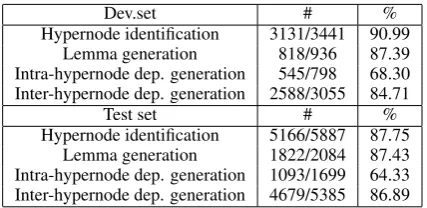
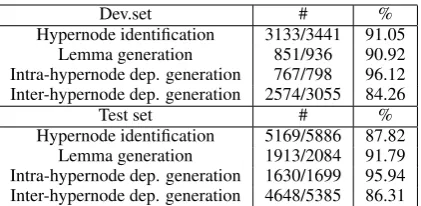
the results for the generic classifier for all tasks on the development and the test set, while Table 2 displays the results obtained through the sets of micro classifiers.
Dev.set # %
Hypernode identification 3131/3441 90.99 Lemma generation 818/936 87.39 Intra-hypernode dep. generation 545/798 68.30 Inter-hypernode dep. generation 2588/3055 84.71
Test set # %
Hypernode identification 5166/5887 87.75 Lemma generation 1822/2084 87.43 Intra-hypernode dep. generation 1093/1699 64.33 Inter-hypernode dep. generation 4679/5385 86.89
Table 1: Results of the evaluation of the generic classifiers for the non-isomorphic transduction.
The results show that for hypernode identifica-tion and inter-hypernode dependency generaidentifica-tion, the results of both types of classifiers are compara-ble, be it on the development set or on the test set. However, thanks to the micro classifiers, with the same features, the lemma generation model based on micro classifiers improves by 4 points and the intra-hypernode dependency generation by nearly
6Following a classical machine learning set-up, we
Dev.set # % Hypernode identification 3133/3441 91.05
Lemma generation 851/936 90.92 Intra-hypernode dep. generation 767/798 96.12 Inter-hypernode dep. generation 2574/3055 84.26
Test set # %
[image:4.595.77.288.52.155.2]Hypernode identification 5169/5886 87.82 Lemma generation 1913/2084 91.79 Intra-hypernode dep. generation 1630/1699 95.94 Inter-hypernode dep. generation 4648/5385 86.31
Table 2: Results of the evaluation of the micro classifiers for the non-isomorphic transduction.
30 points. This means that the intra-hypernode de-pendency generation task is too sparse to be real-ized as a single classifier. The micro classifiers are in this case binary, i.e., 2:1, or unary, i.e., 1:1 classifiers, which implies a tremendous reduction of the search space (and thus higher accuracy). In contrast, the single classifier is a multi-class clas-sifier that must decide among more than 60 pos-sible classes. Although most of these 60 classes are diferentiated by features, the differentiation is not perfect. In the case of lemma generation, we observe a similar phenomenon. In this case, the micro-classifiers are multi-class classifiers that normally have to cope with 5 different classes (lemmas in this case), while the unique classi-fier has to cope with around 60 different classes (or lemmas). Hypernode identification and inter-hypernode dependency generation are completely guided by the input; thus, it seems that they do not err in the same way.
Although the micro classifier approach leads to significantly better results, we believe that it can still be improved. First, the introduction of prepositions causes most errors in hypernode de-tection and lemma generation: when a preposition should be introduced or not and which preposi-tion should be introduced depends exclusively on the sub-categorization frame of the governor of the deep node. A treebank of a limited size as used in our experiments simply does not contain subcategorization patterns ofall predicative lexi-cal items (especially of nouns)—which would be crucial. Thus, in the test set evaluation, out of the 171 lemma errors 147 are prepositions and out of the 717 errors on hypernode identification, more than 500 are due to nouns and preposition. The in-crease of the size of the treebank would therefore be an advantage.
Second, in the case of inter-hypernode depen-dency, errors are due to the labels of the dependen-cies more than to the attachements, and are quite
distributed over the different types of configura-tions. The generation of these dependencies suf-fers from the fact that the SSyntS tag-set is very fine-grained. For instance, there are 9 different types of verbal objects in SSyntS,7 which capture
very specific syntactic properties of Spanish, such as “can the dependent can be replaced by a clitic pronoun? Can the dependent be moved away from its governor? Etc. This kind of information is not of a high relevance for generation of well-formed text. Using a more reduced (more coarse-grained) SSyntS tag set would definitely improve the qual-ity of the projection.
5 Related work
There is an increasing amount of work on sta-tistical sentence generation; see, e.g., (Bangalore and Rambow, 2000; Langkilde-Geary, 2002; Fil-ippova and Strube, 2008). However, hardly any addresses the problem of the projection between non-isomorphic semantic and syntactic structures. In general, structure prediction approaches use a single classifier model (Smith, 2011). But see, e.g., (Carreras et al., 2008), who use dif-ferent models to predict each part of the triplet for spinal model pruning, and (Bj¨orkelund et al., 2010; Johansson and Nugues, 2008), who use a set of classifiers for predicate identification in the context of semantic role labelling. Amalgam (Corston-Oliver et al., 2002), which maps a logi-cal input onto sentences with intermediate syntac-tic (phrase-based) representation, uses language-specific decision trees in order to predict when to introduce auxiliaries, determiners, cases, etc.
6 Conclusions
We presented two alternative classifier approaches to deep generation that cope with the projection of non-isomorphic semantic and syntactic struc-tures and argued that the micro classifier approach is more adequate. In spite of possible improve-ments presented in Section 4, each set of micro classifiers achieves results above 86% on the test set. For intra-hypernode dependency generation, it even reaches 95.94% .
Acknowledgments
This work has been partially funded by the Euro-pean Commission under the contract number FP7-ICT-610411.
7There are 47 SSynt dependencies in total, to compare to
References
Olga Babko-Malaya, 2005. Propbank Annotation Guidelines.
Srinivas Bangalore and Owen Rambow. 2000. Ex-ploiting a probabilistic hierarchical model for gener-ation. InProceedings of the 18th International Con-ference on Computational Linguistics (COLING), pages 42–48, Saarbr¨ucken, Germany.
Anja Belz, Michael White, Dominic Espinosa, Eric Kow, Deirdre Hogan, and Amanda Stent. 2011. The first Surface Realisation Shared Task: Overview and evaluation results. InProceedings of the Generation Challenges Session at the 13th European Workshop on Natural Language Generation (ENLG), pages 217–226, Nancy, France.
Anja Belz. 2008. Automatic generation of weather forecast texts using comprehensive probabilistic generation-space models. Journal of Natural Lan-guage Engineering, 14(4):431–455.
A. Bj¨orkelund, B. Bohnet, L. Hafdell, and P. Nugues. 2010. A high-performance syntactic and semantic dependency parser. In Proceedings of the 23rd In-ternational Conference on Computational Linguis-tics : Demonstration Volume (COLING), pages 33– 36, Beijing, China.
Bernd Bohnet, Leo Wanner, Simon Mille, and Ali-cia Burga. 2010. Broad coverage multilingual deep sentence generation with a stochastic multi-level realizer. In Proceedings of the 23rd Inter-national Conference on Computational Linguistics (COLING), pages 98–106, Beijing, China.
Bernd Bohnet, Simon Mille, Benoˆıt Favre, and Leo Wanner. 2011. StuMaBa: From deep representation to surface. InProceedings of the Generation Chal-lenges Session at the 13th European Workshop on Natural Language Generation (ENLG), pages 232– 235, Nancy, France.
Nadjet Bouayad-Agha, Gerard Casamayor, Simon Mille, and Leo Wanner. 2012. Perspective-oriented generation of football match summaries: Old tasks, new challenges. ACM Transactions on Speech and Language Processing, 9(2):3:1–3:31.
Xavier Carreras, Michael Collins, and Terry Koo. 2008. TAG, dynamic programming, and the per-ceptron for efficient, feature-rich parsing. In Pro-ceedings of the 12th Conference on Computational Natural Language Learning (CoNLL), pages 9–16, Manchester, UK.
Simon Corston-Oliver, Michael Gamon, Eric Ringger, and Robert Moore. 2002. An overview of Amal-gam: A machine-learned generation module. In Proceedings of the 2nd International Natural Lan-guage Generation Conference (INLG), pages 33–40, New-York, NY, USA.
Katja Filippova and Michael Strube. 2008. Sen-tence fusion via dependency graph compression. In Proceedings of the 2008 Conference on Em-pirical Methods in Natural Language Processing (EMNLP), pages 177–185, Honolulu, Hawaii. Richard Johansson and Pierre Nugues. 2008.
Dependency-based Semantic Role Labeling of Prop-Bank. In Proceedings of the 2008 Conference on Empirical Methods in Natural Language Processing (EMNLP), pages 69–78, Honolulu, Hawaii.
Irene Langkilde-Geary. 2002. An empirical verifi-cation of coverage and correctness for a general-purpose sentence generator. In Proceedings of the 2nd International Natural Language Generation Conference (INLG), pages 17–24, New-York, NY, USA. Citeseer.
Simon Mille, Alicia Burga, and Leo Wanner. 2013. AnCora-UPF: A multi-level annotation of Spanish. InProceedings of the 2nd International Conference on Dependency Linguistics (DepLing), pages 217– 226, Prague, Czech Republic.
Noah A. Smith. 2011. Linguistic Structure Prediction. Synthesis Lectures on Human Language Technolo-gies. Morgan and Claypool.