POS error detection in automatically annotated corpora
Ines Rehbein
SFB 632 Information Structure German Department
Potsdam University
Abstract
Recent work on error detection has shown that the quality of manually annotated corpora can be substantially improved by applying consistency checks to the data and automatically identi-fying incorrectly labelled instances. These methods, however, can not be used for automatically annotated corpora where errors are systematic and cannot easily be identified by looking at the variance in the data. This paper targets the detection of POS errors in automatically annotated corpora, so-calledsilver standards, showing that by combining different measures sensitive to annotation quality we can identify a large part of the errors and obtain a substantial increase in accuracy.
1 Introduction
Today, linguistically annotated corpora are an indispensable resource for many areas of linguistic re-search. However, since the emergence of the first digitised corpora in the 60s, the field has changed considerably. What was considered “very large” in the last decades is now considered to be rather small. Through the emergence of Web 2.0 and the spread of user-generated content, more and more data is accessible for building corpora for specific purposes.
This presents us with new challenges for automatic preprocessing and annotation. While conventional corpora mostly include written text which complies to grammatical standards, the new generation of corpora contain texts from very different varieties, displaying features of spoken language, regional variety, ungrammatical content, typos and non-canonical spelling. A large portion of the vocabulary are unknown words (that is, not included in the training data). As a result, the accuracy of state-of-the-art NLP tools on this type of data is often rather low. In combination with the increasing corpus sizes, it seems that we have to lower our expectations with respect to the quality of the annotations. Time-consuming double annotation or a manual correction of the whole corpus is often not feasible. Thus, the use of so-calledsilver standardshas been discussed (Hahn et al., 2010; Kang et al., 2012; Paulheim, 2013), along with their adequacy to replace carefully hand-crafted gold standard corpora.
Other approaches to address this problem come from the areas of domain adaptation and error detec-tion. In the first field, the focus is on adapting NLP tools or algorithms to data from new domains, thus increasing the accuracy of the tools. In error detection, the goal is to automatically identify erroneous labels in the data and either hand those instances to a human annotator for manual correction, or to auto-matically correct those cases. Here, the focus is not on improving the tools but on increasing the quality of the corpus and, at the same time, reducing human effort. These approaches are not mutually exclusive but can be seen as complementary methods for building high-quality language resources at a reasonable expense.
We position our work at the interface of these fields. Our general objective is to build a high-quality linguistic resource for informal spoken youth language, annotated with parts of speech (POS) informa-tion. As we do not have the resources for proofing the whole corpus, we aim at building a silver standard where the quality of the annotations is high enough to be useful for linguistic research. For automatic
This work is licensed under a Creative Commons Attribution 4.0 International Licence. Page numbers and proceedings footer are added by the organisers. Licence details:http://creativecommons.org/licenses/by/4.0/
preprocessing, we use tagging models adapted to our data. The main contribution of this paper is in developing and evaluating methods for POS error detection in automatically annotated corpora. We show that our approach not only works for our data but can also be applied to canonical text from the newspaper domain, where the POS accuracy of standard NLP tools is quite high.
The paper is structured as follows. Section 2 reviews related work on detecting annotation errors in corpora. Section 3 describes the underlying assumptions of our approach. In Section 4, we describe the experimental setup and data used in our experiments, and we present our results in Section 5. We conclude in Section 6.
2 Related Work
Most work on (semi-)automatic POS error detection has focussed on identifying errors in POS assigned byhuman annotators where variation in word-POS assignments in the corpus can be caused either by ambiguous word forms which, depending on the context, can belong to different word classes, or by incorrect judgments made by the annotators (Eskin, 2000; van Halteren, 2000; Kvˇetoˇn and Oliva, 2002; Dickinson and Meurers, 2003; Loftsson, 2009).
The variation n-gram algorithm(Dickinson and Meurers, 2003) allows users to identify potentially incorrect tagger predictions by looking at the variation in the assignment of POS tags to a particular word ngram. The algorithm produces a ranked list of varying tagger decisions which have to be processed by a human annotator. Potential tagger errors are positioned at the top of the list. Later work (Dickinson, 2006) extends this approach and explores the feasibility of automatically correcting these errors.
Eskin (2000) describes a method for error identification using anomaly detection, where anomalies are defined as elements coming from a distribution different from the one in the data at hand. Kvˇetoˇn and Oliva (2002) present an approach to error detection based on a semi-automatically compiled list ofimpossible ngrams. Instances of these ngrams in the data are assumed to be tagging errors and are selected for manual correction.
All these approaches are tailored towards identifying human annotation errors and cannot be applied to our setting where we have to detect systematic errors made by automatic POS taggers. Thus, we can not rely onanomaliesorimpossible ngramsin the data, as the errors made by the taggers are consistent and, furthermore, our corpus of non-canonical spoken language includes many structures which are consideredimpossiblein Standard German.
Rocio et al. (2007) address the problem of finding systematic errors in POS tagger predictions. Their method is based on a modified multiword unit extraction algorithm which extracts cohesive sequences of tags from the corpus. These sequences are then sorted manually into linguistically sound ngrams and potential errors. This approach addresses the correction of large, automatically annotated corpora. It successfully identifies (a small number of) incorrectly tagged high-frequency sequences in the text which are often based on tokenisation errors. The more diverse errors due to lexical ambiguity, which we have to deal with in our data, are not captured by this approach.
Most promising is the approach of Loftsson (2009) who evaluates different methods for error detection, including an ensemble of five POS taggers, where error candidates are defined as those instances for which the predictions of the five taggers disagree. His method successfully identifies POS errors and thus increases the POS accuracy in the corpus. Using the tagger ensemble, Loftsson (2009) is able to identify error candidates with a precision of around 16%. He does not report recall, that is how many of the erroneously tagged instances in the corpus have been found. We apply the ensemble method to our data and use it as our baseline.
ideas of this work, however, can be easily applied to POS tagging.
3 Identifying Systematic POS Errors
Taggers make POS errors for a number of reasons. First of all, anomalies in the input can cause the tagger to assign an incorrect tag, e.g. for noisy input with spelling or tokenisation errors. Another source of errors are out-of-vocabulary words, that is word forms unknown to the tagger because they do not exist in the training data. A third reason for incorrect tagger judgments are word forms which are ambiguous between different parts of speech. Those cases can be further divided into cases where the information for identifying the correct label is there but the tagger does not make use of it, and into cases that are truly ambiguous, meaning that even a human annotator would not be able to disambiguate the correct POS tag. Tagger errors can also be caused by ill-defined annotation schemes or errors in the gold standard (see Manning (2011) for a detailed discussion on different types of POS errors).
To assess the difficulty of the task, it might be interesting to look at the agreement achieved by human annotators for POS tagging German. The inter-annotator agreement for POS annotation with the STTS on written text is quite high with around 0.97-0.98 Fleiss κ, and for annotating spoken text using an extended version of the STTS similar numbers can be obtainded (Rehbein and Schalowski, 2013).
In this work, we are not so much interested in finding tokenisation and spelling errors but in identifying automatic tagger errors due to lexical ambiguity. Our work is based on the following assumptions:
Assumption 1:Instances of word forms which are labelled differently by different taggers are potential POS errors.
Assumption 2: POS tags which have been assigned with a low probability by the tagger are potential POS errors.
In the remainder of the paper, we present the development of a system for error detection and its evalu-ation on a corpus of informal, spontaneous dialogues and on German newspaper text. We report precision and recall for our system. Precisionis computed as the number of correctly identified error candidates, divided by the number of all (correctly and incorrectly identified) error candidates(number of true posi-tives / (number of true posiposi-tives + false posiposi-tives)), andrecallby dividing the number of identified errors by the total number of errors in the data(true positives / (true positives + false negatives)).
4 Experimental Setup
The data we use in our experiments comes from two sources, i) from a corpus of informal, spoken German youth language (The KiezDeutsch Korpus (KiDKo) Release 1.0) (Rehbein et al., 2014), and ii) from the TIGER corpus (Brants et al., 2002), a German newspaper corpus.
4.1 Kiezdeutsch – Informal youth language
KiDKo is a new language resource including informal, spontaneous dialogues from peer-to-peer commu-nication of adolescents. The current version of the corpus includes the audio signals aligned with tran-scriptions, as well as a normalisation layer and POS annotations. Additional annotation layers (Chunk-ing, Topological Fields) are in progress.
The transcription scheme has an orthographic basis but, in order to enable investigations of prosodic characteristics of the data, it also tries to closely capture the pronunciation, including pauses, and en-codes disfluencies and primary accents. On the normalisation layer, non-canonical pronunciations and capitalisation are reduced to standard German spelling. The normalisation is done on the token level, and non-canonical word order as well as disfluencies are included in the normalised version of the data (Example 1).
(1) [transcription]:
[normalisation]:ischIch habhabeauau #(–)PAUSEischIch habhabe ,ischich habhabeauchauch¨ah¨ahFLATrateFlatrate . I have too # I have , I have too uh flatrate .
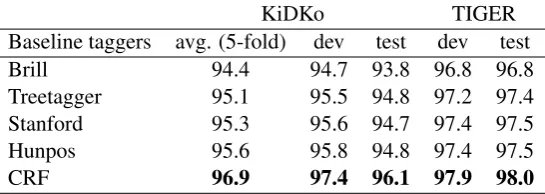
KiDKo TIGER Baseline taggers avg. (5-fold) dev test dev test Brill 94.4 94.7 93.8 96.8 96.8 Treetagger 95.1 95.5 94.8 97.2 97.4 Stanford 95.3 95.6 94.7 97.4 97.5 Hunpos 95.6 95.8 94.8 97.4 97.5 CRF 96.9 97.4 96.1 97.9 98.0
Table 1: Baseline results for different taggers on KiDKo and TIGER (results on KiDKo are given for a 5-fold cross validation (5-fold) and for the development and test set)
We plan to release the POS tagged version of the corpus in summer 2014. Due to legal constraints, the audio files will have restricted access and can only be accessed locally while the transcribed and annotated version of the corpus will be available over the internet via ANNIS (Zeldes et al., 2009).1
4.2 The TIGER corpus
The second corpus we use in our experiments is the TIGER corpus (release 2.2), a German newspaper corpus with approximately 50,000 sentences (900,000 tokens). We chose TIGER to show that our ap-proach is not tailored towards one particular text type but can be applied to corpora of different sizes and from different domains.
4.3 Baseline
In our experiments, we use a subpart of KiDKo with 103,026 tokens, split into a training set with 66,024 tokens, a development set with 16,530 tokens, and a test set with 20,472 tokens. The TIGER data was also split into a training set (709,740 tokens), a development set (88,437 tokens) and a test set (90,061 tokens).
To test our first assumption, we trained an ensemble of five taggers on the two corpora (see list below), and checked all instances where the taggers disagreed. We consider all cases as disagreements where at least one of the five taggers made a prediction different from the other taggers.
The five taggers we use reflect different approaches to POS tagging (including Transformation-based Learning, Markov Models, Maximum Entropy, Decision Trees, and Conditional Random Fields):
• the Brill tagger (Brill, 1992) • the Hunpos tagger2
• the Stanford POS tagger (Toutanova and Manning, 2000) • the Treetagger (Schmid, 1995)
• a CRF-based tagger, using the CRFSuite3
Table 1 shows the accuracies of the different taggers on KiDKo and on TIGER (because of the smaller size of KiDKo, we also report numbers from a 5-fold cross validation on the training data). The CRF-based tagger gives the best results on the spoken language data as well as on TIGER. For more details on the implementation and features of the CRF tagger, please refer to (Rehbein et al., 2014).
For the KiDKo development set, we have 1,228 cases where the taggers disagree, that is 1,228 error candidates, and 1,797 instances in the test set. Out of those, 267 (dev) and 558 (test) are true errors (Table 2). This means that the precision of this simple heuristic is between 21.7% and 33%, with a recall between 61.1 and 70.8%. For TIGER, precision and recall are higher. Applying this simple heuristic, we are able to identify around 70% of the errors in the data, with a precision of around 27%. We consider this as our baseline.
1ANNIS (ANNotation of Information Structure) is a corpus search and visualisation interface which allows the user to formulate complex search queries which can combine multiple layers of annotation.
2The Hunpos tagger is an open source reimplementation of the TnT tagger (https://code.google.com/p/
hunpos)
tokens candidates true err. out of % prec % rec.
KiDKo
dev 16,530 1,228 267 437 21.7 61.1 test 20,472 1,797 558 788 33.0 70.8
TIGER
[image:5.595.154.444.62.161.2]dev 88,437 4,580 1,280 1,818 27.9 70.4 test 90,061 4,618 1,246 1,754 27.0 71.0
Table 2: Number of error candidates identified by the disagreements in the ensemble tagger predictions (baseline)
5 Finding measures for error detection
When defining measures for error detection, we have to balance precision against recall. Depending on our research goal and resources available for corpus creation, we might either want to obtain a high precision, meaning that we only have to look at a small number of instances which are most probably true POS errors, or we might want to build a high-quality corpus where nearly all errors have been found and corrected, at the cost of having to look at many instances which are mostly correct.
5.1 Increasing precision
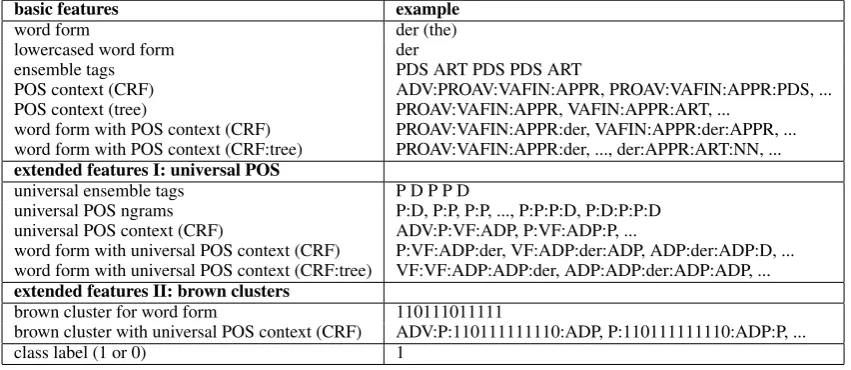
First, we try to improve precision and thus to reduce the number of false positives we have to look at during the manual correction phase. We do this by training a CRF classifier to detect errors in the output of the ensemble taggers. The features we use are shown in Table 3 and include the word form, the tags predicted by the tagger ensemble, ngram combinations of the ensemble POS tags, word and POS context for different context windows for the POS predicted by the CRF tagger and the Treetagger, a combination of word form and POS context (for CRF, Treetagger, and combinations of both; for window sizes of 3 and 4 with varying start and end positions), and the class label (1: error, 0: correct).
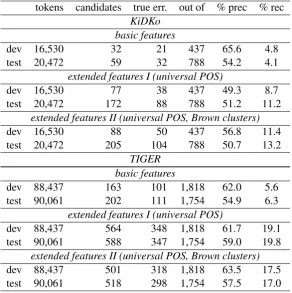
We experimented with different feature combinations and settings. Our basic feature set gives us high precision on both data sets, with very low recall. Only around 4-6% of all errors are found. However, precision is between 55-65%, meaning that the majority of the selected candidates are true errors.
Our extended feature sets (I and II) aim at improving recall by alleviating the sparse data problem. The extended feature set I extracts new features where the tags from the fine-grained German tagset, the STTS (Schiller et al., 1999), are converted into the coarse-grained universal tagset of Petrov et al. (2012),
basic features example
word form der (the)
lowercased word form der
ensemble tags PDS ART PDS PDS ART
POS context (CRF) ADV:PROAV:VAFIN:APPR, PROAV:VAFIN:APPR:PDS, ... POS context (tree) PROAV:VAFIN:APPR, VAFIN:APPR:ART, ...
word form with POS context (CRF) PROAV:VAFIN:APPR:der, VAFIN:APPR:der:APPR, ... word form with POS context (CRF:tree) PROAV:VAFIN:APPR:der, ..., der:APPR:ART:NN, ...
extended features I: universal POS
universal ensemble tags P D P P D
universal POS ngrams P:D, P:P, P:P, ..., P:P:P:D, P:D:P:P:D universal POS context (CRF) ADV:P:VF:ADP, P:VF:ADP:P, ...
word form with universal POS context (CRF) P:VF:ADP:der, VF:ADP:der:ADP, ADP:der:ADP:D, ... word form with universal POS context (CRF:tree) VF:VF:ADP:ADP:der, ADP:ADP:der:ADP:ADP, ...
extended features II: brown clusters
brown cluster for word form 110111011111
brown cluster with universal POS context (CRF) ADV:P:110111111110:ADP, P:110111111110:ADP:P, ...
class label (1 or 0) 1
[image:5.595.87.513.557.742.2]tokens candidates true err. out of % prec % rec
KiDKo basic features
dev 16,530 32 21 437 65.6 4.8
test 20,472 59 32 788 54.2 4.1
extended features I (universal POS)
dev 16,530 77 38 437 49.3 8.7
test 20,472 172 88 788 51.2 11.2
extended features II (universal POS, Brown clusters)
dev 16,530 88 50 437 56.8 11.4
test 20,472 205 104 788 50.7 13.2
TIGER basic features
dev 88,437 163 101 1,818 62.0 5.6 test 90,061 202 111 1,754 54.9 6.3
extended features I (universal POS)
dev 88,437 564 348 1,818 61.7 19.1 test 90,061 588 347 1,754 59.0 19.8
extended features II (universal POS, Brown clusters)
[image:6.595.153.446.62.356.2]dev 88,437 501 318 1,818 63.5 17.5 test 90,061 518 298 1,754 57.5 17.0
Table 4: Number of error candidates identified by the classifier, precision (prec) and recall (rec)
with minor modifications.4 On KiDKo, the universal POS features increase recall from around 5% up to
8-14%. On TIGER, the results are more substantial. Here, our recall increases from 5-6% up to nearly 20%, while precision is still in the same range (Table 4).
Our basic features were designed to add more (local) context useful for disambiguating between the different tags. Especially the right context (assigned POS) includes information which often helps, e.g. when distinguishing between a substitutive demonstrative pronoun (PDS) and a determiner (ART), which is a frequent error especially in the spoken language data.
We try to achieve further improvements by adding new features where we replace the word forms with Brown word cluster paths (Brown et al., 1992).5 The extended features are designed to address the
unknown word problem by generalising overvi t word forms. On the smaller KiDKo data set, this again has a positive effect, increasing both precision and recall. On TIGER, however, the results are mixed, with a higher precision on the development set but a somewhat lower recall for both, development and test sets. This is not surprising, as semi-supervised techniques are expected to help most for settings where data sparseness is an issue.
Overall, our error detection classifier is able to identify errors in the corpus with a good precision, meaning that only a small number of instances have to be checked manually in order to achieve an error rate reduction in the range of 11-17%. This approach seems suitable when limited resources are available for manual correction, thus asking for a method with high precision and low time requirements.
5.2 Increasing recall
While our attempts to increase precision were quite successful, we had to put up with a severe loss in recall. However, we would like to keep precision reasonably high but also to increase recall. Our next approach takes into account the marginal probabilities of the predictions (0: correct/1: error) of the CRF-based error detection classifier. We not only check those instances which the classifier has labelled as
4For instance, instead of converting all verb tags to V, we keep a tag for finite verbs (VF).
tokens threshold candidates true err. out of % prec % rec
KiDKo
extended features II (universal POS, Brown clusters)
dev 16,530 0.8 286 120 437 42.0 27.5
dev 16,530 0.85 350 138 437 39.4 31.6
test 20,472 0.8 472 190 788 40.2 24.1
test 20,472 0.85 561 227 788 40.5 28.8
TIGER
extended features I (universal POS)
[image:7.595.75.516.515.720.2]dev 88,437 0.8 1,208 602 1,818 49.8 33.1 dev 88,437 0.85 1,431 658 1,818 46.0 36.2 test 90,061 0.8 1,276 605 1,754 47.4 34.5 test 90,061 0.85 1,554 670 1,754 43.1 38.2
Table 5: Number of error candidates identified by the classifier using a marginal probability threshold
incorrect, but also those which have been labelled as correct, but with a marginal probability below a particular threshold. Table 5 gives results for a threshold of0.8and0.85, using the best-scoring feature sets from the last experiment.
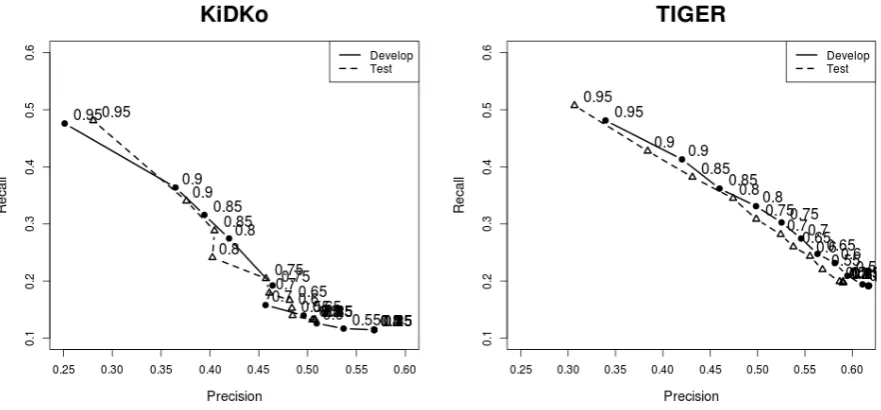
Our new measure results in a substantial increase in recall. Setting the threshold to 0.85, we are now able to detect around 30% of the errors in KiDKo and 36 to 38% in TIGER, while precision is still reasonably high. Figure 1 shows the relation between precision and recall for different thresholds from 0.95 to 0.1. Setting the threshold to 0.8, for example, would result in an error prediction presicion of around 40-42% for KiDKo and of around 47-50% for TIGER. Recall for error identification using a threshold of 0.8 would be in the range of 24-27.5% for KiDKo and 33-34.5% for TIGER. If we wanted to increase recall up to 50% for KiDKo, we would have to use a marginal probability threshold of approximately 0.65, and precision would drop to around 14%. This knowledge allows us to make an informed decision during corpus compilation, either starting from the POS accuracy we want to achieve, or from the resources we have for manual correction, and to predict the POS accuracy of the final corpus.
6 Conclusions
In the paper, we presented and evaluated a system for automatic error detection in POS tagged corpora, with the goal of increasing the quality of so-called silver standards with minimal human effort. Our baseline, a simple heuristic based on disagreements in tagger predictions, allows us to identify between 60 and 70% of all errors in our two data sets, but with a low precision. We show how to refine this method, training a CRF-based classifier which is able to identify POS errors in tagger output with a much higher precision, thus reducing the need for manual correction.
Our method is able to find different types of POS errors, including the ones most frequently made by the tagger (adjectives, adverbs, proper names, foreign language material, finite verbs, verb particles, and more). Furthermore, it allows us to define the parameters which are most adequate for the task at hand, either aiming at high precision at the cost of recall, or increasing recall (and thus the annotation quality of the corpus) at the cost of greater manual work load. In addition, our method can easily be applied to different corpora and new languages.
References
Sabine Brants, Stefanie Dipper, Silvia Hansen, Wolfgang Lezius, and George Smith. 2002. The TIGER treebank. InProceedings of the First Workshop on Treebanks and Linguistic Theories, pages 24–42.
Eric Brill. 1992. A simple rule-based part of speech tagger. In3rd conference on Applied natural language processing (ANLC’92), Trento, Italy.
Peter F. Brown, Peter V. deSouza, Robert L. Mercer, Vincent J. Della Pietra, and Jenifer C. Lai. 1992. Class-based n-gram models of natural language. Computational Linguistics, 18(4):467–479.
Markus Dickinson and Detmar W. Meurers. 2003. Detecting errors in part-of-speech annotation. In10th Confer-ence of the European Chapter of the Association for Computational Linguistics (EACL-03).
Markus Dickinson. 2006. From detecting errors to automatically correcting them. InAnnual Meeting of The European Chapter of The Association of Computational Linguistics (EACL-06), Trento, Italy.
Dmitriy Dligach and Martha Palmer. 2011. Reducing the need for double annotation. InProceedings of the 5th Linguistic Annotation Workshop, LAW V ’11.
Eleazar Eskin. 2000. Automatic corpus correction with anomaly detection. In 1st Conference of the North American Chapter of the Association for Computational Linguistics (NAACL), Seattle, Washington.
Arne Fitschen. 2004. Ein computerlinguistisches Lexikon als komplexes System. Ph.D. thesis, Institut f¨ur Maschinelle Sprachverarbeitung der Universit¨at Stuttgart.
U. Hahn, K. Tomanek, E. Beisswanger, and E. Faessler. 2010. A proposal for a configurable silver standard. In The Fourth Linguistic Annotation Workshop, LAW 2010, pages 235–242.
Ning Kang, Erik van Mulligen, and Jan Kors. 2012. Training text chunkers on a silver standard corpus: can silver replace gold? BMC Bioinformatics, 13(1):17.
Pavel Kvˇetoˇn and Karel Oliva. 2002. (Semi-)Automatic detection of errors in PoS-tagged corpora. In 19th International Conference on Computational Linguistics (COLING-02).
Hrafn Loftsson. 2009. Correcting a POS-tagged corpus using three complementary methods. InProceedings of the 12th Conference of the European Chapter of the ACL (EACL 2009), Athens, Greece, March.
Christopher D. Manning. 2011. Part-of-speech tagging from 97linguistics? InProceedings of the 12th Interna-tional Conference on ComputaInterna-tional Linguistics and Intelligent Text Processing - Volume Part I, CICLing’11, pages 171–189.
Heiko Paulheim. 2013. Dbpedianyd - a silver standard benchmark dataset for semantic relatedness in dbpedia. In CEUR Workshop, CEUR Workshop Proceedings. CEUR-WS.org.
Ines Rehbein and S¨oren Schalowski. 2013. STTS goes Kiez – Experiments on annotating and tagging urban youth language.Journal for Language Technology and Computational Linguistics.
Ines Rehbein, S¨oren Schalowski, and Heike Wiese. 2014. The KiezDeutsch Korpus (KiDKo) release 1.0. InThe 9th International Conference on Language Resources and Evaluation (LREC-14), Reykjavik, Iceland.
Vitor Rocio, Joaquim Silva, and Gabriel Lopes. 2007. Detection of strange and wrong automatic part-of-speech tagging. In Proceedings of the Aritficial Intelligence 13th Portuguese Conference on Progress in Artificial Intelligence, EPIA’07.
Anne Schiller, Simone Teufel, and Christine Thielen. 1999. Guidelines f¨ur das Tagging deutscher Textkorpora mit STTS. Technical report, Universit¨at Stuttgart, Universit¨at T¨ubingen.
Helmut Schmid. 1995. Improvements in part-of-speech tagging with an application to German. InACL SIGDAT-Workshop.
Kristina Toutanova and Christopher D. Manning. 2000. Enriching the knowledge sources used in a maximum entropy part-of-speech tagger. In Proceedings of the conference on Empirical methods in natural language processing and very large corpora, EMNLP ’00, Hong Kong.
Hans van Halteren. 2000. The detection of inconsistency in manually tagged text. InProceedings of the COLING-2000 Workshop on Linguistically Interpreted Corpora, Centre Universitaire, Luxembourg, August.