http://www.scirp.org/journal/aasoci ISSN Online: 2165-4336
ISSN Print: 2165-4328
DOI: 10.4236/aasoci.2017.78019 Aug. 15, 2017 305 Advances in Applied Sociology
Research on the Communication Effect of
Augmented Reality Technology in Electronic
Publications among Youth—A Case Study of
“Augmented Reality Interactive Science
Reading”
Yun Zhu, Hui Ye, Shukun Tang
The School of Public Affairs of the University of Science and Technology of China, Hefei, China
Abstract
Based on Technology Acceptance Model (TAM), this paper constructs the aug- mented reality electronic publication communication effect model (AREPCEM) and analyzes the data among youth. It is found that the first-level index (use and recognition) and second-level indicators (external variables, perceived useful-ness, perceived ease of use, satisfaction, dependency) have positive relevance to audience recognition among youth.
Keywords
Augmented Reality, Electronic Publications, Communication Effect, Youth
1. Introduction
With the continuous development of society, publications also continue to develop from the development of paper publications to the electronic publication stage. According to the definition, electronic publications are digital information that stored in the computer, so that it can be read and written magnetic media on the document information carrier, also known as machine-readable literature or elec-tronic database, tape, floppy disk and CD-ROM in the form of storage and ex-change, entered the computer through the screen display and printed for people to read (Azuma et al., 2001). Regardless of how the electronic publication changes, the youth is most concerned about the correct display of content and reading comfort of these two issues (Dünser et al., 2008). The combination of interactivity
How to cite this paper: Zhu, Y., Ye, H., & Tang, S. K. (2017). Research on the Com-munication Effect of Augmented Reality Te- chnology in Electronic Publications among Youth—A Case Study of “Augmented Reali-ty Interactive Science Reading”. Advances in Applied Sociology, 7, 305-318.
https://doi.org/10.4236/aasoci.2017.78019
Received: July 18, 2017 Accepted: August 12, 2017 Published: August 15, 2017
Copyright © 2017 by authors and Scientific Research Publishing Inc. This work is licensed under the Creative Commons Attribution International License (CC BY 4.0).
DOI: 10.4236/aasoci.2017.78019 306 Advances in Applied Sociology and immersion is one of the best carriers to achieve the correct display and reading comfort of electronic publications. The difference between augmented reality of electronic publications is that they move from static to dynamic, from reading to experience (Huang et al., 2016), so that youth’ needs is greatly satisfied, but also to stimulate the youth’s second interest in the development of the audience. Accord-ing to the relevant literature search and practice, the author believed that aug-mented reality of electronic publications is an extension of traditional paper pub-lications, referring to the computer technology. The virtual publication of the con-tent mapped to the real world, the real concon-tent or the environment and virtual content or the environment is superimposed in real time on the same screen or an electronic publication of the same space. At present, domestic and international enhancement of real electronic publications mainly concentrated in product re-search (Hwang et al., 2016; Lai et al., 2015) and product effects (Phillips, 1991;
Ro-thenberg, 2000). Dünser et al. (2008) identified all papers which include A
Revalu-ations we reviewed research publicRevalu-ations between the years 1993 and 2007 from online databases of selected scientific publishers. Lai et al. (2015) uses the technol-ogy with iPad mobile device to display 3D models, 3D animations, video splaying, websites and web server connectivity for children education. The results and eval-uation of the project shows the interactive 3D animation and self-assessment func-tions significantly support students to improve their learning experience and per-formance. The software product of this project, from the business perspective, creates a new business marketing dimension in digital publishing and increases the selling profits in the book publication business. Hwang et al. (2016) designed a competitive gaming approach which is proposed to support AR-based learning ac-tivities conducted in real-world contexts. An experiment has been conducted on an elementary school ecology course to explore the effectiveness of the proposed approach in comparison with the conventional AR-based mobile learning proach in field trips. The experimental results show that the AR-based gaming ap-proach can improve not only students’ learning attitudes, but also their learning performance on the field trip. Accordingly, discussions and some suggestions for future work are provided. Huang et al. (2016) based on Kolb’s experiential learn-ing theory, the current study develops an eco-discovery AR-based learnlearn-ing model (EDALM) which is implemented in an eco-discovery AR-based learning system (EDALS). In a field experiment at a botanical garden, 21 middle school students constitute three groups participated in a learning activity using different learning types and media. Quantitative results indicate that, compared to the human- guidance-only model, EDALS successfully stimulates positive emotions and im-proved learning outcomes among learners. In post-activity interviews, students indicated they found the exploration mode provided by the proposed system to be more interesting and helpful to their learning in school. The use of attractive technologies increases students’ willingness not only to learn more about the en-vironment, but also to develop a more positive emotional attachment to it.
DOI: 10.4236/aasoci.2017.78019 307 Advances in Applied Sociology example, based on the technical acceptance model of AREPCEM to study the future on electronic publications that provide a reference for the spread.
2. Research Design
2.1. Model Design
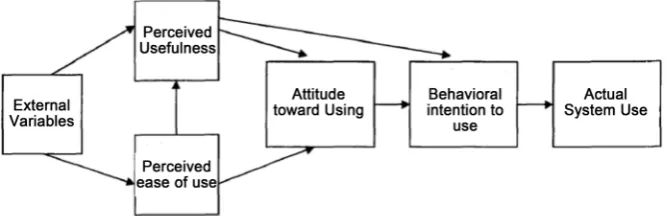
Davis (1989) proposed a technology acceptance model (TAM) based on the study
of rational behavior theory, which is mainly to study the degree of user acceptance of information systems (Venkatesh & Davis, 2000). The main contents of the technology acceptance model are: external variables are composed of willingness to use and use attitude, which is determined by the individual’s position and per-ceived usefulness of the system; the attitude towards is shared by perper-ceived useful-ness and perceived ease of use. The perceived usefuluseful-ness of the individual will have a direct impact on the use intention of the individual, and the perceived ease of use will directly affect the perceived usefulness of the individual (Venkatesh & Davis,
2000). The technology acceptance model considers that the use of the system is
[image:3.595.208.542.599.708.2]determined by the intent of the act, which is determined by the attitudes and per-ceived usefulness of a person’s desire to be used by the usefulness of cognition and the ease of use of cognition. The perceived usability is determined by perceived ease of use and external variables, and perceived ease of use is determined by ex-ternal variables, while exex-ternal variables are inex-ternal beliefs, attitudes, intentions, and differences in the technology acceptance model of the differences between in-dividuals, environmental constraints, and control of interference between the fac-tors established (Venkatesh & Davis, 2000).
Figure 1 shows that the technology acceptance model will be “used” into the
use of intentions, the use of attitude, perceived usefulness and perceived ease of use in four areas. Therefore, this article to “augmented reality interactive science books” as an example, designed AREPCEM among youth. Which AREPCEM level indicators designed to “use” and “identity” two indicators. The “use” of the secondary index is designed for external variables, perceived usefulness and per-ceived ease of use. External audiences are used by youth’s daily habits, youth’s holiday habits, frequency of youth use, and youth use years. Perceived usefulness through the access to relevant news information, youth tend to use which elec-tronic publications, “Recognition” is selected to satisfy (Attitude toward using) and the degree of dependence (Behavioral intention to use and actual system
DOI: 10.4236/aasoci.2017.78019 308 Advances in Applied Sociology use) are two indicators of measurement. The degree of satisfaction is measured by a clear presentation, access to knowledge, integration of relevant knowledge context, real-time feedback-related knowledge, multi-sensory integration expe-rience; dependency by youth who have been remembered augmented reality of electronic publications without the use of any electronic publications will rec-ommend other people to measure augmented reality of electronic publications.
Through the above AREPCEM can be speculated that: augmented reality elec-tronic publication among AREPCEM has a positive correlation. Therefore, the author boldly makes the following assumptions:
H1 Augmented reality of electronic publications in the model of the use of factors on the impact of youth has a positive correlation:
H1-1 Augmented reality electronic publication effect model in the external variables will affect the impact of youth spread;
H1-2 Augmented reality electronic publication effect model perceived useful-ness can improve the effectiveuseful-ness of youth communication;
H1-3 The perceived ease of use in the augmented reality electronic publication propagation effect model can improve the effect of youth communication.
H2 Augmented reality electronic publication in the dissemination of the mod-el of identity factors on the impact of youth has a positive corrmod-elation:
H2-1 The satisfaction degree of AREPCEM can improve the effect of the youth.
H2-2 The degree of reliance of AREPCEM can improve the effectiveness of youth.
2.2. Data Analysis
2.2.1. Data CollectionThe author set “augmented reality interactive science books” as an example, from 2017-02-15 to 2017-04-05, selected 350 youths by random in China Uni-versity of Science and Technology for surveying. A total of 314 valid question-naires were collected which is about 89.7% effective.
2.2.2. Reliability and Validity Analysis
The usual attitude and opinion questionnaire uses the Cronbach’s alpha reliabil-ity coefficient, which is used to test the consistency and stabilreliabil-ity of the topics under the same series of concepts. According to previous studies, Cronbach’s α represents the correlation between the subjects under the measurement va-riables. The larger the Cronbach’s α reliability coefficient, the greater the corre-lation, that is, the higher the degree of internal consistency between the various subjects under the measurement variable.
DOI: 10.4236/aasoci.2017.78019 309 Advances in Applied Sociology secondary indicators of the measurement factors include different topics, so the author of these items on the total term of the reliability of the further analysis.
Table 1 shows that the measurement factors of the questionnaire and the
rela-tionship between the various factors have good reliability, which are suitable for the subsequent validation factor analysis.
2.2.3. Structural Equation Model Analysis 1) Confirmatory factor analysis
[image:5.595.58.543.237.707.2]Based on the above, Figure 2 shows that the model of the validation factor
Table 1. Individuality of the overall reliability analysis table.
Elements Correlation coefficient Cronbach’s α X1 External variable
X11 Youth daily habits 0.8143
0.856
X12 Youth holiday habit 0.7497
X13 Frequency of youth use frequency 0.7789
X14 Youth years of use 0.7482
X2 Perceived usefulness
X21 When you get relevant news, youth tend to use the new media 0.7390
0.776 X22 When leisure and entertainment, youth tend to use what kind of new media 0.6369
X3 Perceived ease of use
X31 Youth feel that the new media is better to use 0.6656 0.883
Y1 Satisfied
Y11 Clearly show 0.5472
0.872
Y12 Acquire knowledge 0.6040
Y13 Into the relevant knowledge of the situation 0.6346
Y14 Real-time feedback related knowledge 0.6318
Y15 Multi-sensory fusion experience 0.6994
Y2 Dependency
Y21 Youth have been remembered with knowledge in the absence of their use 0.6786
0.865 Y22 I will recommend augmented reality electronic publication to others 0.6786
DOI: 10.4236/aasoci.2017.78019 310 Advances in Applied Sociology analysis model that augmented reality of the electronic publication effect model.
Based on the confirmatory factor analysis model of the augmented reality electronic publications, this paper analyzes the model by LISREL8.70 and ob-tains the relevant factors and the fitting index.
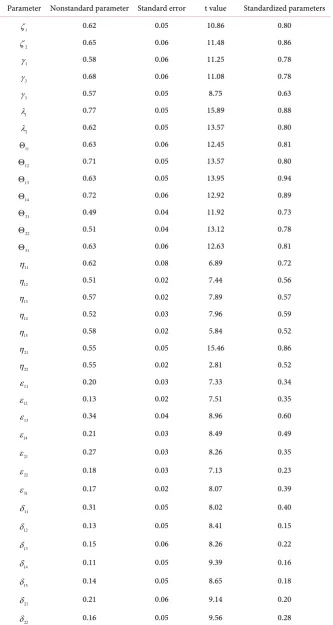
Table 2 shows that (Ζ, γ,
λ
, Θ, η) are all greater than 0.5, and the t valuesof all the observed variables are all greater than 1.96. According to the formula of t value, all the observed variables show a significant level of t = 0.05. It can be seen that the factors that are included in AREPCEM have good convergence va-lidity.
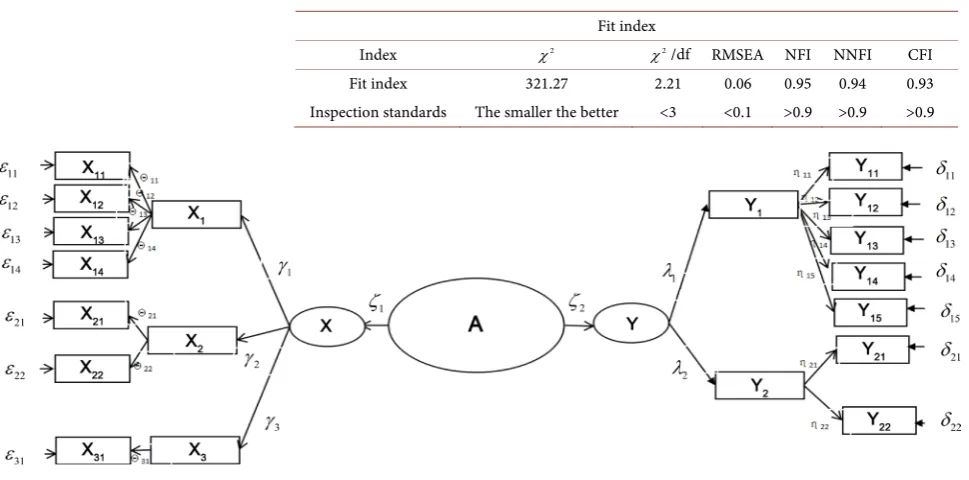
Table 3 shows that the fitting index of the confirmatory factor and the fitting
index of the confirmatory factor were found:
χ
2,χ
2/df, RMSEA, NFI, NNFIand CFI are in line with the test standard, which shows that the verification fac-tor of the propagation effect model of the effective in augmented reality elec-tronic publication has good fit.
2) Structural equation analysis a) Model construction
Through the confirmatory factor analysis of the previous section, the fitting index of the variables in the confirmatory factor model and the relationship be-tween the variables and the observed values is tested and found that the fitting is better. Based on this, the author divided them into five factors to enhance the observed variables of AREPCEM. First, we construct an overall model of AREPCEM. It is expressed as: A means to AREPCEM, X is used in the model, X1 is the external variable, X2 is the perceived usefulness, X3 is perceived ease of use; Y is the recognition, where Y1 is the satisfaction degree, Y2 means the degree of dependence factor. The specific path is presented in Figure 3.
b) Basic fit standard
Table 4 shows that the factor load (
λ
) of each observation variable is morethan 0.5, t value is greater than 1.96 (t is greater than 0.05 significant level). There are no negative measurement errors in all the factors that the effectiveness in AREPCEM. Therefore, the structural equation model is a good fitting model.
c) Overall fit of the model
According to the generalized exponential index of structural equation model,
Table 5 shows that the structural equation model conforms to the global fitting
index standard.
d) Intrinsic fit of the model
The author constructs the reliability and average variance extraction analysis and measurement of AREPCEM (A), use (X) and recognition(Y), and then un-derstands the intrinsic fit of the structural equation model.
DOI: 10.4236/aasoci.2017.78019 311 Advances in Applied Sociology Table 2. AREPCEM validation factor parameters.
Parameter Nonstandard parameter Standard error t value Standardized parameters
1
ζ 0.62 0.05 10.86 0.80
2
ζ 0.65 0.06 11.48 0.86
1
γ 0.58 0.06 11.25 0.78
2
γ 0.68 0.06 11.08 0.78
3
γ 0.57 0.05 8.75 0.63
1
λ 0.77 0.05 15.89 0.88
2
λ 0.62 0.05 13.57 0.80
11
Θ 0.63 0.06 12.45 0.81
12
Θ 0.71 0.05 13.57 0.80
13
Θ 0.63 0.05 13.95 0.94
14
Θ 0.72 0.06 12.92 0.89
21
Θ 0.49 0.04 11.92 0.73
22
Θ 0.51 0.04 13.12 0.78
31
Θ 0.63 0.06 12.63 0.81
11
η 0.62 0.08 6.89 0.72
12
η 0.51 0.02 7.44 0.56
13
η 0.57 0.02 7.89 0.57
14
η 0.52 0.03 7.96 0.59
15
η 0.58 0.02 5.84 0.52
21
η 0.55 0.05 15.46 0.86
22
η 0.55 0.02 2.81 0.52
11
ε 0.20 0.03 7.33 0.34
12
ε 0.13 0.02 7.51 0.35
13
ε 0.34 0.04 8.96 0.60
14
ε 0.21 0.03 8.49 0.49
21
ε 0.27 0.03 8.26 0.35
22
ε 0.18 0.03 7.13 0.23
31
ε 0.17 0.02 8.07 0.39
11
δ 0.31 0.05 8.02 0.40
12
δ 0.13 0.05 8.41 0.15
13
δ 0.15 0.06 8.26 0.22
14
δ 0.11 0.05 9.39 0.16
15
δ 0.14 0.05 8.65 0.18
21
δ 0.21 0.06 9.14 0.20
22
DOI: 10.4236/aasoci.2017.78019 312 Advances in Applied Sociology Table 3. Fit Index.
Fit index
[image:8.595.59.544.84.324.2]Index χ2 χ2/df RMSEA NFI NNFI CFI Fit index 321.27 2.21 0.06 0.95 0.94 0.93 Inspection standards The smaller the better <3 <0.1 >0.9 >0.9 >0.9
[image:8.595.208.539.364.481.2]Figure 3. Overall model of AREPCEM.
Table 4. AREPCEM of the factors in the measured variables on the factor load.
Observation variables Index Standardized parameters t value
AREPCEM (A) ζ1 0.57 5.92
2
ζ 0.59 8.70
Use(X)
X1 0.76 13.95
X2 0.83 14.61
X3 0.72 12.26
Recognition(Y) Y1 0.87 12.89
Y2 0.84 12.91
Table 5. Overall fitting index of AREPCEM.
Fit index
Index 2
X X2/df RMSEA NFI NNFI CFI
[image:8.595.208.542.600.730.2]Fit index 63.92 2.56 0.08 0.93 0.94 0.91 Inspection standards The smaller the better <3 <0.1 >0.9 >0.9 >0.9
Table 6. Intrinsic fitting index.
Variable Index R2 Construct the reliability Average variance extraction
AREPCEM (A) ζ1 0.62
0.72 0.62
2
ζ 0.69
Use(X)
X1 0.65
0.87 0.68
X2 0.76
X3 0.73
DOI: 10.4236/aasoci.2017.78019 313 Advances in Applied Sociology Table 7. Path parameters.
Path Model
Standardized parameters t value Use factors youth communication effect ζ1 = 0.86 11.93 External variable youth communication effect γ1 = 0.82 11.58 Perceived usefulness youth communication effect γ2 = 0.76 9.51 Perceived ease of use youth communication effect γ3 = 0.92 12.99
[image:9.595.211.539.262.379.2]Recognition factors youth communication effect ζ2 = 0.90 16.93 Satisfied youth communication effect λ1 = 0.89 16.57 Dependency youth communication effect λ2 = 0.85 14.21
Table 8. Research hypothesis verification summary.
Path Conclusion
Use factors youth communication effect stand by External variable youth communication effect stand by Perceived usefulness youth communication effect stand by Perceived ease of use youth communication effect stand by Recognition factors youth communication effect stand by
Satisfied youth communication effect stand by Dependency youth communication effect stand by
e) Hypothesis test
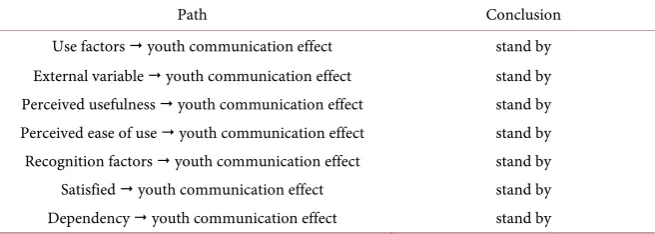
Table 7 shows that the normalized parameters of each independent variable
(external variable, perceived usefulness, perceived ease of use, satisfied degree, dependency degree) and the recognition variable (youth communication effect) are all greater than 0, and the t value is greater than 1.96 T is greater than 0.05), indicating that the relationship between the independent variables and the de-pendent variables are in line with the hypothesis test, that is: in the augmented reality electronic publication, there are positive correlations between external va-riables and youth communication effect. Perceived usefulness is positively corre-lated with the effect of youth communication. The perceived ease of use has posi-tive correlation with the effect of youth communication. There is a posiposi-tive corre-lation between the degree of satisfaction and youth communication effects. The degree of dependence has a positive correlation with youth communication effects.
In this paper, Table 8 shows that the hypothesis is tested by the three main analytical methods, such as descriptive statistical analysis of sample data, relia-bility and validity analysis and structural equation model analysis (confirmatory factor analysis and structural equation analysis).
3. Result
3.1. Use
3.1.1. External Variables
DOI: 10.4236/aasoci.2017.78019 314 Advances in Applied Sociology are made up of the intention to use and attitude towards using, which is deter-mined by the individual’s perceived ease of use and perceived usefulness of the system; the attitude towards is determined by perceived usefulness and percep-tion ease of use. Thus, the author’s external variable that enhances AREPCEM is a combination of basic habits, emotions, and cognitive behavior, through the corresponding carriers and channels for youth to create such as contact behavior and the two-way interaction between the publication and other experience, and then show the youth self-awareness and values of a degree of recognition of the means of action.
According to the author’s model, external variables are measured by the youth’s daily habits, youth’s holiday habits, youth use frequency, youth years of use. As we all know, external variables are not only the requirements of the youth itself, but also the environment where the experience there is a certain re-quirement. And AREPCEM of the surrounding environment creates the envi-ronment, real-time interaction so that youth not only get knowledge, but also based on their own habits of interest, even are stimulated by the power to get. At the same time, the author in the above assumptions H1-1: augmented reality electronic publication effect model in the external variables will affect the impact of youth spread. According to the above data analysis, in AREPCEM, external variable path parameters are high, that is, the model in the external variables will affect the impact of youth to disseminate the effect.
3.1.2. Perceived Usefulness
According to TAM, the perceived usefulness will have a direct impact on the willingness of the individual to use, in addition to having an impact on the use attitude. Therefore, the AREPCEM proposed by the author perceived usefulness refers to the ease with which youth use to enhance practical skills. Perceived usefulness will be affected by external variables, such as the use of youth habits, the use of behavior and so on.
ma-DOI: 10.4236/aasoci.2017.78019 315 Advances in Applied Sociology nipulating the marker card to simulate rigid body or fluid in the ideal state be-havior, access to its physical attribute experience. As the rigid body or fluid can not be in the real physical environment in the ideal state, other graphic media, 3D animation media and so on, this ideal process can only use the language of the text, picture or animation model of these forms or some show forms. Youth in less form of presentation are not easy to integrate their own cognitive habits. As a result, more than 60% of youth feel inclined to use real-world electronic publications when they get relevant news and entertainment. Meanwhile, the author assumes H1-2: augmented reality electronic publication effect model perceived usefulness can improve the effectiveness of youth communication. According to the above data analysis, in AREPCEM, perceived usefulness path parameters are higher, that is, perceived usefulness has a greater impact on its identity.
3.1.3. Perceived Ease of Use
Perceived ease of use in the “TAM” directly affects the perceived usefulness of the individual. Therefore, the author sets AREPCEM. Perceived ease of use re-fers to the extent to which youth use the effort to augmented reality electronic publications, or to make it easier to enhance the availability of augmented reality electronic publications. Perceived ease of use will directly affect the perceived usefulness of youth.
DOI: 10.4236/aasoci.2017.78019 316 Advances in Applied Sociology the perceived ease of use in the augmented reality electronic publication propa-gation effect model can improve the effect of youth communication. According to the above data, it is shown that the use of factors to enhance the effectiveness of AREPCEM is the highest, that is, perceived ease of use can improve the spread of youth in AREPCEM.
3.2. Recognition
3.2.1. SatisfiedTAM shows that the actual system will make use of youth to produce satisfactory results. Therefore, the AREPCEM proposed by the authors must appeal to the satisfaction of the youth. The augmented reality electronic publication and other types of publications are different for its dissemination of knowledge and cultur-al connotation; knowledge and culturcultur-al connotation is an invisible product. Therefore, the degree of satisfied is particularly important in the augmented re-ality electronic publication among youth. At the same time, poor performance of AREPCEM may result in the youth’s dissatisfaction towards certain knowledge. Therefore, the degree of youth’s satisfaction is the basis for the ultimate goal of enhancing the effectiveness in the augmented reality electronic publication.
DOI: 10.4236/aasoci.2017.78019 317 Advances in Applied Sociology 3.2.2. Dependency
“TAM” shows that the degree of dependency on the use of the actual system is an indispensable bridge between youth and media communication. Thus, in AREPCEM, the augmented reality electronic publication through youth relies on the youth to create a positive emotional experience, so that youth are in the promotion of real electronic publications in the communication of consciously or unconsciously to the publication of a certain degree of dependence. The au-thor builds AREPCEM, the degree of dependency is tested by the youth who have been remembered by the use of knowledge and will recommend others in the augmented reality electronic publication. It is well known that the emotional experience of youth is the strongest path in the augmented reality electronic publication. Youth have a strong dependence on emotional experience in the process of interacting in the augmented reality electronic publication, and con-tinue to deepen over time. In the process of youth experience, the direct face of interaction is one of the most powerful emotional dependence, this direct face interaction will continue to stimulate the youth perception of the organ, get a strong dependence experience. Thus, under the same or identical conditions of the carrier, the youth tends to choose products that make themselves feel good and will maintain lasting loyalty and promote in the augmented reality electron-ic publelectron-ication.
As a result of the augmented reality electronic publication that youth get the greatest degree of cognitive stimulation and experience, expand the creative thinking, to achieve a more effective dissemination of recognition results. And other graphic publication, 3D animation publication and other publications are usually only able to meet the augmented reality electronic publication to pro-mote the effectiveness, 3D animation publication and other publication can only get a level or a certain level of overlapping interaction rarely. As a result, the effect of the augmented reality electronic publication is higher than that of other publication. At the same time, the author in the above hypothesis H2-2: The degree of reliance of AREPCEM can improve the effectiveness of youth. According to the above table data analysis shows that in AREPCEM, depen-dency path parameters are higher, that is, dependepen-dency can improve the effec-tiveness of youth.
4. Conclusion
DOI: 10.4236/aasoci.2017.78019 318 Advances in Applied Sociology
References
Azuma, R., Baillot, Y., Behringer, R., Feiner, S., Julier, S., & MacIntyre, B. (2001). Recent Advances in Augmented Reality. IEEE Computer Graphics and Applications, 21, 34-
47. https://doi.org/10.1109/38.963459
Davis, F. D. (1989). Perceived Usefulness, Perceived Ease of Use, and User Acceptance of Information Technology. MIS Quarterly, 13, 319-340.
http://www.jstor.org/stable/249008
Dünser, A., Grasset, R., & Billinghurst, M. (2008). A Survey of Evaluation Techniques Used in Augmented Reality Studies. Human Interface Technology Laboratory New Zealand, 1-5.
https://www.researchgate.net/publication/216867631_A_Survey_of_Evaluation_Techni
ques_Used_in_Augmented_Reality_Studies
Huang, T. C., Chen, C. C., & Chou, Y. W. (2016). Animating Eco-Education: To See, Feel, and Discover in an Augmented Reality-Based Experiential Learning Environment.
Computers & Education, 96, 72-82. https://doi.org/10.1016/j.compedu.2016.02.008
Hwang, G. J., Wu, P. H., Chen, C. C., & Tu, N. T. (2016). Effects of an Augmented Reali-ty-Based Educational Game on Students’ Learning Achievements and Attitudes in Real-World Observations. Interactive Learning Environments, 24, 1895-1906.
https://doi.org/10.1080/10494820.2015.1057747
Lai, A. S., Wong, C. Y., & Lo, O. C. (2015). Applying Augmented Reality Technology to Book Publication Business. In e-Business Engineering (ICEBE), 2015 IEEE 12th Inter-national Conference, 23-25 October 2015,Beijing, 281-286.
http://ieeexplore.ieee.org/abstract/document/7349981/
Phillips, R. L. (1991). MediaView: A General Multimedia Digital Publication System.
Communications of the ACM, 34, 74-83. https://doi.org/10.1145/105783.105799
Rothenberg, J. (2000). An Experiment in Using Emulation to Preserve Digital Publica-tions, 1-28.
https://pdfs.semanticscholar.org/f95e/30933c29f8b1b3b8b51c62343a8b99dc5cac.pdf
Venkatesh, V., & Davis, F. D. (2000). A Theoretical Extension of the Technology Accep-tance Model: Four Longitudinal Field Studies. Management Science, 46, 186-204.
https://doi.org/10.1287/mnsc.46.2.186.11926
Submit or recommend next manuscript to SCIRP and we will provide best service for you:
Accepting pre-submission inquiries through Email, Facebook, LinkedIn, Twitter, etc. A wide selection of journals (inclusive of 9 subjects, more than 200 journals)
Providing 24-hour high-quality service User-friendly online submission system Fair and swift peer-review system
Efficient typesetting and proofreading procedure
Display of the result of downloads and visits, as well as the number of cited articles Maximum dissemination of your research work
Submit your manuscript at: http://papersubmission.scirp.org/