Combining Argument Mining Techniques
John Lawrence
School of Computing University of Dundee
UK
Chris Reed
School of Computing University of Dundee
UK
Abstract
In this paper, we look at three different meth-ods of extracting the argumentative structure from a piece of natural language text. These methods cover linguistic features, changes in the topic being discussed and a supervised machine learning approach to identify the components of argumentation schemes, pat-terns of human reasoning which have been detailed extensively in philosophy and psy-chology. For each of these approaches we achieve results comparable to those previously reported, whilst at the same time achieving a more detailed argument structure. Finally, we use the results from these individual tech-niques to apply them in combination, further improving the argument structure identifica-tion.
1 Introduction
The continuing growth in the volume of data which we produce has driven efforts to unlock the wealth of information this data contains. Automatic tech-niques such as Opinion Mining and Sentiment Anal-ysis (Liu, 2010) allow us to determine the views expressed in a piece of textual data, for example, whether a product review is positive or negative. Ex-isting techniques struggle, however, to identify more complex structural relationships between concepts.
Argument Mining1is the automatic identification
of the argumentative structure contained within a piece of natural language text. By automatically identifying this structure and its associated premises
1Sometimes also referred to as Argumentation Mining
and conclusions, we are able to tell not just what
views are being expressed, but alsowhy those par-ticular views are held.
The desire to achieve this deeper understanding of the views which people express has led to the recent rapid growth in the Argument Mining field (2014 saw the first ACL workshop on the topic in Baltimore2 and meetings dedicated to the topic in
both Warsaw3and Dundee4). A range of techniques
have been applied to this problem, including super-vised machine learning (starting with (Moens et al., 2007)) and topic modelling ((Lawrence et al., 2014)) as well as purely linguistic methods (such as (Vil-lalba and Saint-Dizier, 2012)); however, little work has currently been carried out to bring these tech-niques together.
In this paper, we look at three individual argu-ment mining approaches. Firstly, we look at us-ing the presence of discourse indicators, lus-inguistic expressions of the relationship between statements, to determine relationships between the propositions in a piece of text. We then move on to look at a topic based approach. Investigating how changes in the topic being discussed relate to the argumenta-tive structure being expressed. Finally, we imple-ment a supervised machine learning approach based on argumentation schemes (Walton et al., 2008), en-abling us to not only identify premises and conclu-sions, but to determine how exactly these argument components are working together.
Based on the results from the individual imple-2http://www.uncg.edu/cmp/ArgMining2014/ 3http://argdiap.pl/argdiap2014
4http://www.arg-tech.org/swam2014/
mentations, we combine these approaches, taking into account the strengths and weaknesses of each to improve the accuracy of the resulting argument structure.
2 Dataset
One of the challenges faced by current approaches to argument mining is the lack of large quantities of appropriately annotated arguments to serve as train-ing and test data. Several recent efforts have been made to improve this situation by the creation of corpora across a range of different domains; how-ever, to apply each of the techniques previously mentioned in combination means that we are limited to analysed data containing complete argumentation scheme specifications and provided along with the original text.
Although there are a number of argument analy-sis tools (such as Araucaria (Reed and Rowe, 2004), Carneades (Gordon et al., 2007), Rationale (van Gelder, 2007) and OVA (Bex et al., 2013)) which al-low the analyst to identify the argumentation scheme related to a particular argumentative structure, the vast majority of analyses which are produced us-ing these tools do not include this information. For example, less than 10% of the OVA analyses con-tained in AIFdb (Lawrence et al., 2012) include any scheme structure.
AIFdb still offers the largest annotated dataset available, containing the complete Araucaria cor-pus (Reed et al., 2008) used by previous argumen-tation scheme studies and supplemented by analy-ses from a range of other sources. Limiting the data to analyses containing complete scheme specifica-tions and for which the original text corresponds directly to the analysis (with no re-construction or enthymematic content (Hitchcock, 1985) added) leaves us with 78 complete analyses (comprised of 404 propositions and 4,137 words), including 47 ex-amples of the argument from expert opinion scheme and 31 examples of argument from positive conse-quences (these schemes are discussed in Section 5.)
3 Discourse Indicators
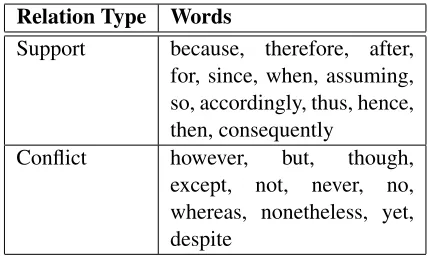
The first approach which we present is that of us-ing discourse indicators to determine the argumen-tative connections between adjacent propositions in
Relation Type Words
Support because, therefore, after, for, since, when, assuming, so, accordingly, thus, hence, then, consequently
[image:2.612.319.534.73.201.2]Conflict however, but, though, except, not, never, no, whereas, nonetheless, yet, despite
Table 1: Discourse indicators used to determine proposi-tional connections
a piece of text. Discourse indicators are explicitly stated linguistic expressions of the relationship be-tween statements (Webber et al., 2011), and, when present, can provide a clear indication of its argu-mentative structure. For example, if we take the sen-tence “Britain should disarm because it would set a good example for other countries”, then this can be split into two separate propositions “Britain should disarm” and “it (disarming) would set a good exam-ple for other countries”. The presence of the word “because” between these two propositions clearly tells us that the second is a reason for the first.
Discourse indicators have been previously used as a component of argument mining techniques for ex-ample in (Stab and Gurevych, 2014), indicators are used as a feature in multiclass classification of argu-ment components, with each clause classified as a major claim, claim, premise or non-argumentative. Similar indicators are used in (Wyner et al., 2012), along with domain terminology (e.g. camera names and properties) to highlight potential argumentative sections of online product reviews. By looking at discourse indicators in isolation, however, we aim to determine their ability to be used on their own as an argument mining method.
p r f1
Discourse Indicators 0.89 0.04 0.07
Table 2: Comparison of the connections between propo-sitions determined by discourse indicators and manual analysis
By performing a simple search for these terms across the text of each item in our corpus, we were able to determine suggested connections between propositions and compare these to the manual anal-yses. The results of this comparison can be seen in Table 2. In this case we look at the connections between the component propositions in the manu-ally analysed argument structure (385 connections in total), and consider a connection to have been cor-rectly identified if a discourse indicator tells us that two propositions are connected, and that the relation between them (support or attack) is the same as that in the manual analysis.
The results clearly show that, when discourse in-dicators are present in the text, they give a strong indication of the connection between propositions (precision of 0.89); however, the low frequency with which they can be found means that they fail to help identify the vast majority of connections (re-call of 0.04). Additionally, the approach we use here considers only those discourse indicators found be-tween pairs of consecutive propositions and, as such, is unable to identify connected propositions which are further apart in the text. Because of this, dis-course indicators may provide a useful component in an argument mining approach, but, unless supple-mented by other methods, are inadequate for identi-fying even a small percentage of the argumentative structure.
4 Topical Similarity
The next approach which we consider looks at how the changes of topic in a piece text relate to the argumentative structure contained within it. This method is similar to that presented in (Lawrence et al., 2014), where it is assumed firstly that the argu-ment structure to be determined can be represented as a tree, and secondly, that this tree is generated depth first. That is, the conclusion is given first and
then a line of reasoning is followed supporting this conclusion. Once that line of reasoning is exhausted, the argument moves back up the tree to support one of the previously made points. If the current point is not related to any of those made previously, then it is assumed to be unconnected.
Based on these assumptions we can determine the structure by looking at how similar the topic of each proposition is to its predecessor. If they are simi-lar, then we assume that they are connected and the line of reasoning is being followed. If they are not sufficiently similar, then we first consider whether we are moving back up the tree, and compare the current proposition to all of those made previously and connect it to the most topically similar previous point. Finally, if the current point is not related to any of those made previously, then it is assumed to be unconnected to the existing structure.
Lawrence et al. perform these comparisons using a Latent Dirichlet Allocation (LDA) topic model. In our case, however, the argument structures we are working with are from much shorter pieces of text and as such generating LDA topic models from them is not feasible. Instead we look at the seman-tic similarity of propositions. We use WordNet5 to
determine the similarity between the synsets of each word in the first proposition and each word in the second. This relatedness score is inversely propor-tional to the number of nodes along the shortest path between the synsets. The shortest possible path oc-curs when the two synsets are the same, in which case the length is 1, and thus, the maximum relat-edness value is 1. We then look at the maximum of these values in order to pair a word in the first proposition to one in the second, and finally aver-age the values for each word to give a relatedness score for the proposition pair between 0 and 1. Sim-ilar to in (Lawrence et al., 2014), the threshold re-quired for two propositions to be considered similar can be adjusted, altering the output structure, with a lower threshold giving more direct connections and a higher threshold greater branching and more un-connected components.
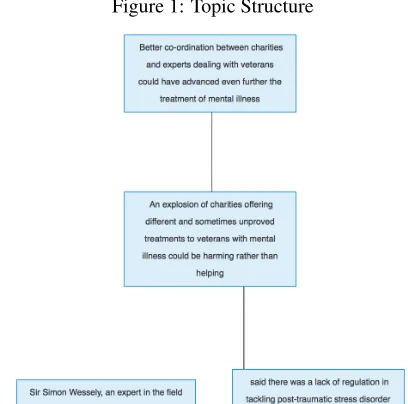
The results of performing this process using a threshold of 0.2 are shown in Table 3, and an exam-ple of the output structure can be seen in Figure 1.
p r f1
[image:4.612.90.285.73.133.2]Non-directed 0.82 0.56 0.67 Current to previous 0.63 0.43 0.51 Previous to current 0.19 0.13 0.15
Table 3: Topic Similarity Edge Predictions
For the results in Table 3, we consider a connec-tion to have been correctly identified if there is any connection between the propositions in the manual analysis, regardless of direction or type. The stan-dard output we obtain does not give any indication of the directionality of the connection between propo-sitions, and these results are given in the first row of the table. The other two rows show the results obtained by assuming that these connections are al-ways in one direction or another i.e. that the connec-tion always goes from the current proposiconnec-tion to its predecessor or vice-versa.
Figure 1: Topic Structure
The results for non-directed connections are en-couraging, as with the discourse indicators, preci-sion (0.82) is higher than recall (0.56) suggesting that although this method may fail to find all connec-tions, those that it does find can generally be viewed as highly likely. We can also see that the assump-tion of direcassump-tionality from the current proposiassump-tion to a previous proposition gives much better results than the other way around, suggesting that generally
when a point is made it is made to support (or attack) something previously stated.
5 Argumentation Scheme Structure
Finally, we consider using a supervised machine learning approach to classify argument components and determine the connections between them. One of the first attempts to use this kind of classification is presented in (Moens et al., 2007), where a text is first split into sentences and then features of each sentence are used to classify them as “Argument” or “Non-Argument”. This approach was built upon in (Palau and Moens, 2009), where each argument sen-tence is additionally classified as either a premise or conclusion. Our approach instead uses argumenta-tion schemes (Walton et al., 2008), common patterns of human reasoning, enabling us to not only identify premise and conclusion relationships, but to gain a deeper understanding of how these argument com-ponents are working together.
The concept of automatically identifying argu-mentation schemes was first discussed in (Walton, 2011) and (Feng and Hirst, 2011). Walton proposes a six-stage approach to identifying arguments and their schemes. The approach suggests first identi-fying the arguments within the text and then fitting these to a list of specific known schemes. A simi-lar methodology was implemented by Feng & Hirst, who produced classifiers to assign pre-determined argument structures as one in a list of the most com-mon argumentation schemes.
The main challenge faced by this approach is the need to have already identified, not just that an ar-gument is taking place, but its premises, conclusion and exact structure before a scheme can be assigned. By instead looking at the features of each compo-nent part of a scheme, we are able to overcome this requirement and identify parts of schemes in com-pletely unanalysed text. Once these scheme compo-nents have been identified, we are able to group them together into specific scheme instances and thus ob-tain a complete understanding of the arguments be-ing made.
[image:4.612.79.283.361.563.2]Walton, 1996; Grennan, 1997; Katzav and Reed, 2004; Walton et al., 2008), though the most com-monly used scheme set in analysis is that given by Walton. Here we look at two of Walton’s schemes, Expert Opinion and Positive Consequences. Each scheme takes the form of a number of premises which work together to support a conclusion (the structure of the two schemes used can be seen in Ta-ble 4.)
Expert Opinion
Premise: Source E is an expert in subject do-main S containing proposition A [FieldExper-tise]
Premise: E asserts that proposition A is true (false) [KnowledgeAssertion]
Conclusion: A is true (false) [KnowledgePo-sition]
Positive Consequences
Premise: If A is brought about, then good consequences will (may plausibly) occur [PositiveConsequences]
Conclusion: Therefore, A should be brought about [EncouragedAction]
Table 4: Argumentation schemes
The features of these common patterns of argu-ment provide us with a way in which to both iden-tify that an argument is being made and determine its structure. By identifying the individual components of a scheme, we are able to identify the presence of a particular scheme from only a list of the proposi-tions contained within the text. In order to accom-plish this, one-against-others classification is used to identify propositions of each type from a set of com-pletely unstructured propositions. Being able to suc-cessfully perform this task for even one of the propo-sition types from each scheme allows us to discover areas of the text where the corresponding scheme is being used.
This classification was performed with a Na¨ıve Bayes classifier implemented using thescikit-learn6
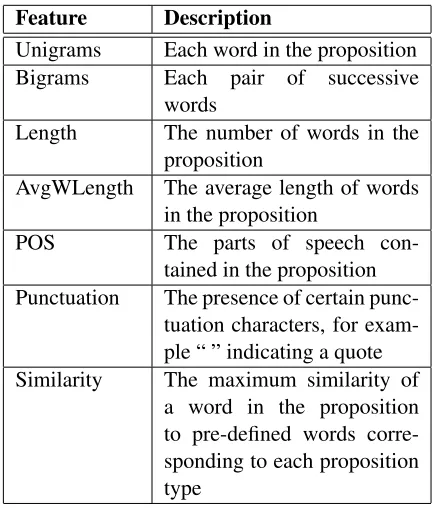
Python module for machine learning, with the fea-tures described in Table 5. Part Of Speech (POS)
6http://scikit-learn.org/stable/
tagging was performed using the Python NLTK7
POS-tagger and the frequencies of each tag added as individual features. The similarity feature was added to extend the information given by unigrams to in-clude an indication of whether a proposition con-tains words similar to a pre-defined set of keywords. The keywords used for each type are shown in Ta-ble 6, and are based on the scheme definitions from Table 4 by manually identifying the key terms in each scheme component. Similarity scores were cal-culated using WordNet8to determine the maximum
similarity between the synsets of the keywords and each word in the proposition. The maximum score for the words in the proposition was then added as a feature value, indicating the semantic relatedness of the proposition to the keyword.
Feature Description
Unigrams Each word in the proposition Bigrams Each pair of successive
words
Length The number of words in the proposition
AvgWLength The average length of words in the proposition
POS The parts of speech con-tained in the proposition Punctuation The presence of certain
punc-tuation characters, for exam-ple “ ” indicating a quote Similarity The maximum similarity of
[image:5.612.318.536.284.538.2]a word in the proposition to pre-defined words corre-sponding to each proposition type
Table 5: Features used for scheme component classifica-tion
Table 7 shows the precision, recall and F-score obtained for each proposition type. The results show that even for a scheme where the classification of one proposition type is less successful, the results for the other types are better. If we consider be-ing able to correctly identify at least one proposi-tion type, then our results give F-scores of 0.93 and
7http://www.nltk.org/
Type Keywords Expert Opinion
FieldExpertise expert, experienced, skilled
KnowledgeAssertion said KnowledgePosition be (to be)
Positive Consequences
[image:6.612.76.297.56.184.2]PositiveConsequences occur, happen EncouragedAction should, must
Table 6: Keywords used for each proposition type
0.75 for locating an occurrence of each scheme type considered. This compares favourably with (Feng and Hirst, 2011), where the occurrence of a particu-lar argumentation scheme was identified with accu-racies of between 62.9% and 90.8%. Furthermore, Feng & Hirst’s results only considered spans of text that were already known to contain a scheme of some type and required a prior understanding of the argumentative structure contained within the text, whereas the approach presented here does not have either of these requirements.
p r f1
Expert Opinion
FieldExpertise 0.95 0.90 0.93 KnowledgeAssertion 0.74 1.00 0.83 KnowledgePosition 0.93 0.55 0.62
Positive Consequences
PositiveConsequences 0.75 0.67 0.71 EncouragedAction 0.86 0.67 0.75
Table 7: Classifying scheme components
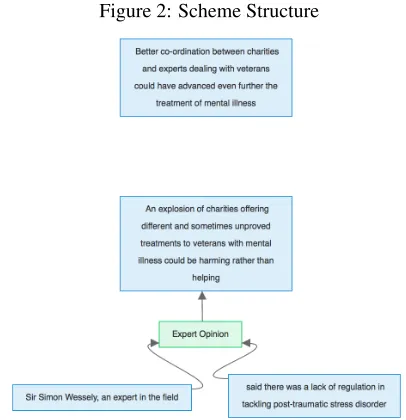
[image:6.612.322.525.66.276.2]By looking further at each set of three proposi-tions contained within the text, we can locate areas where all of the component parts of a scheme occur. When these are found, we can assume that a par-ticular scheme is being used in the text and assign each of its component parts to their respective role. This gives us an automatically identified structure as shown in Figure 2, where we can see that the com-ponent parts of the scheme are completely identified, but the remaining proposition is left unconnected.
Figure 2: Scheme Structure
6 Combined Techniques
Having looked at three separate methods for auto-matically determining argument structure, we now consider how these approaches can be combined to give more accurate results than those previously achieved.
In order to investigate this, we tested a fixed sub-set of our corpus containing eight analyses, contain-ing 36 pairs of connected propositions which we aim to identify. The remainder is used as training data for the supervised learning approach used to identify scheme instances. The use of such a fixed dataset al-lows us to compare and combine the computational methods used for discourse indicators and topical similarity with the supervised learning method used for scheme identification. The results of applying each approach separately are given in the first part of Table 8. In each case, the precision, recall and f1-score is given for how well each method manages to identify the connections between propositions in the set of analyses.
We can see from the results that, again, the pre-cision for discourse indicators is high, but that the recall is low. This suggests that where indicators are found, they are the most reliable method of deter-mining a connection.
[image:6.612.85.290.416.530.2]this method can determine well the links between components in an argumentation scheme instance it gives no indication as to how the other propositions are connected.
Finally, topic similarity gives the poorest results, suggesting that this method be used to supplement the others, but that it is not capable of giving a good indication of the structure on its own.
Based on these results, we combine the methods as follows: firstly, if discourse indicators are present, then they are assumed to be a correct indication of a connection; next, we identify scheme instances and connect the component parts in accordance with the scheme structure; and finally, we look at the topic similarity and use this to connect any propo-sitions that have previously been left out of the al-ready identified structure. This combination of ap-proaches is used to take advantage of the strengths of each. As previously discussed, discourse indica-tors are rare, but provide a very good indication of connectedness when they do occur, and as such, ap-plying this method first gives us a base of proposi-tions that are almost certainly correctly connected. Scheme identification offers the next best precision, and so is applied next. Finally, although topical sim-ilarity does not perform as well as scheme identifi-cation and does not give an indiidentifi-cation of direction or type of connection, it allows us to connect those propositions which are not part of a scheme instance. Carrying out this combined approach gives us the results shown in the last row of Table 8. Again, the results are based on correctly identified connections when compared to the manual analysis. We can see that by combining the methods, accuracy is substan-tially improved over any one individual method.
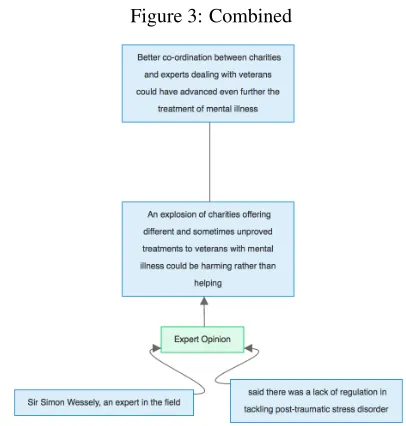
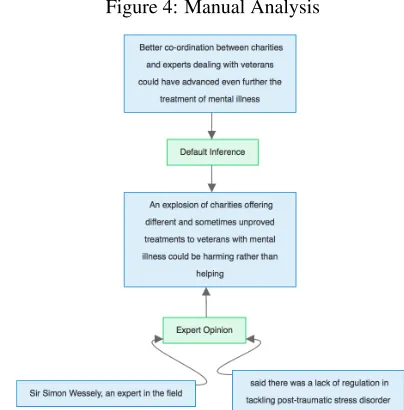
An example of the resulting structure obtained us-ing this combined approach can be seen in Figure 3. If we compare this to a manual analysis of the same text (Figure 4), we can see that the structures are almost identical, differing only in the fact that the nature of the relationship between the premises “An explosion of charities offering different and some-times unproved treatments to veterans with mental illness could be harming rather than helping” and “Better co-ordination between charities and experts dealing with veterans could have advanced even fur-ther the treatment of mental illness” is still unknown. We could make the further assumption, as detailed
p r f1
Discourse Indicators 1.00 0.08 0.15 Topic Similarity 0.70 0.54 0.61 Schematic Structure 0.82 0.69 0.75
[image:7.612.326.527.73.148.2]Combined Methods 0.91 0.77 0.83
Table 8: Identifying Argument Structure
in section 3 that the second proposition supports or attacks the first as it appears later in the text, and in so doing obtain a picture almost identical to that produced by manual analysis.
Figure 3: Combined
6.1 Proposition Boundary Learning
Until now, we have considered determining the ar-gumentative structure from a piece of text which has already been split into its component propositions; however, in order to be able to extract structure from natural language, we must also be able to perform this segmentation automatically.
[image:7.612.321.524.262.475.2]Figure 4: Manual Analysis
an EDU, for example, ‘when two EDUs are joined by some coherence relation that is irrelevant for ar-gumentation, the resulting complex might be the better ADU’.
We now look at how well our combined approach performs on text which is segmented using Propo-sitional Boundary Learning. This technique, intro-duced in (Lawrence et al., 2014), uses two na¨ıve Bayes classifiers, one to determine the first word of a proposition and one to determine the last. The clas-sifiers are trained using a set of manually annotated training data. The text given is first split into words and a list of features calculated for each word. The features used are given below:
word The word itself.
length Length of the word.
before The word before.
after The word after. Punctuation is treated as a
separate word so, for example, the last word in a sentence may have an after feature of ‘.’.
pos Part of speech as identified by the Python Nat-ural Language Toolkit POS tagger9.
Once the classifiers have been trained, these same features are then determined for each word in the
9http://www.nltk.org/
test data and each word classified as either ‘start’ or ‘end’. Once the classification has taken place, the individual starts and ends are matched to deter-mine propositions, using their calculated probabili-ties to resolve situations where a start is not followed by an end (i.e. where the length of the proposi-tion text to be segmented is ambiguous). Using this method, Lawrence et al. report a 32% increase in accuracy over simply segmenting the text into sen-tences, when compared to argumentative spans iden-tified by a manual analysis process.
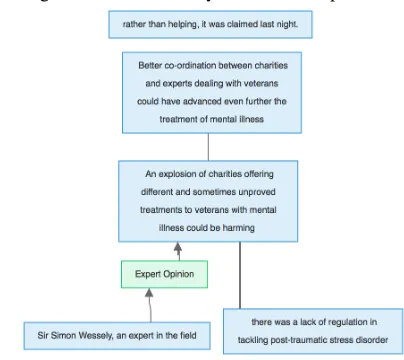
Performing this process on the text from the ex-ample in Figure 4, we obtain a list of five proposi-tions:
1. An explosion of charities offering different and sometimes unproved treatments to veterans with mental illness could be harming
2. rather than helping, it was claimed last night.
3. Sir Simon Wessely, an expert in the field
4. there was a lack of regulation in tackling post-traumatic stress disorder
5. Better co-ordination between charities and ex-perts dealing with veterans could have ad-vanced even further the treatment of mental ill-ness
Using these propositions as input to our scheme component classification identifies proposition 1 as an Expert Opinion KnowledgePosition, and proposi-tion 3 as FieldExpertise, though fails to identify any of the propositions as a KnowledgeAssertion. Addi-tionally, applying topical similarity to these propo-sitions results in suggested connections from 1 to 4 and from 1 to 5.
Figure 5: Automatically Identified Propositions
7 Conclusion
We have implemented three separate argument min-ing techniques and for each achieved results compa-rable to those previously reported for similar meth-ods.
In (Feng and Hirst, 2011), the occurrence of a particular argumentation scheme was identified with accuracies of between 62.9% and 90.8% for one-against-others classification. However, these re-sults only considered spans of text that were already known to contain a scheme of some type and re-quired a prior understanding of the argumentative structure contained within the text. By consider-ing the features of the individual types of premise and conclusion that comprise a scheme, we achieved similar performance (F-scores between 0.75 and 0.93) for identifying at least one component part of a scheme.
We have shown that, although there are strengths and weaknesses to each of these techniques, by us-ing them in combination we can achieve results that are remarkably close to a manual analysis of the same text. The accuracy we achieve for determin-ing connections between propositions (f-score of 0.83) compares favourably with other results from the argument mining field. For example, in (Palau and Moens, 2009) sentences were classified as ei-ther premise (F-score, 0.68) or conclusion (F-score, 0.74), but in the case of our combined results, not only are we able to determine the premises and con-clusion of an argument, but its schematic structure
and the precise roles that each of the premises play in supporting the conclusion.
Finally, we have shown that by using Proposi-tional Boundary Learning as an initial step in this process, we are able to take a piece of natural lan-guage text and automatically produce an argument analysis that still remains close to that determined by a manual analyst.
As the field of argument mining continues its dramatic growth, there are an increasing number of strategies being explored for contributing to the task. In building a simple algorithm for combin-ing these techniques, we have demonstrated that it is quite possible to yield significant increases in per-formance over any single approach. This is in con-trast to some other areas of text mining and ma-chine learning in general, where combining differ-ent techniques is either not possible or else yields only marginal improvements. It seems likely that this strong complementarity in techniques for argu-ment mining reflects a deep diversity not just in the techniques but in the underlying insights and strate-gies for identifying argument, which in turn reflects the breadth of philosophical, linguistic and psycho-logical research in argumentation theory. We might hope as a consequence that as that research is in-creasingly tapped by algorithms for extracting vari-ous aspects of argument, so the combinations of al-gorithms become more sophisticated with ever bet-ter argument mining performance on unconstrained texts.
Acknowledgments
References
Floris Bex, John Lawrence, Mark Snaith, and Chris Reed. 2013. Implementing the argument web. Communica-tions of the ACM, 56(10):66–73, Oct.
Vanessa Wei Feng and Graeme Hirst. 2011. Classify-ing arguments by scheme. InProceedings of the 49th Annual Meeting of the Association for Computational Linguistics: Human Language Technologies-Volume 1, pages 987–996. Association for Computational Lin-guistics (ACL).
Thomas F Gordon, Henry Prakken, and Douglas Walton. 2007. The Carneades model of argument and burden of proof. Artificial Intelligence, 171(10):875–896. Wayne Grennan. 1997.Informal Logic: Issues and
Tech-niques. McGill-Queen’s Press-MQUP.
Arthur C Hastings. 1963. A Reformulation of the Modes of Reasoning in Argumentation. Ph.D. thesis, North-western University.
David Hitchcock. 1985. Enthymematic arguments. In-formal Logic, 7(2):289–98.
Joel Katzav and Chris Reed. 2004. On argumentation schemes and the natural classification of arguments.
Argumentation, 18(2):239–259.
Manfred Kienpointner. 1992. Alltagslogik: struktur und funktion von argumentationsmustern. Frommann-Holzboog.
Alistair Knott. 1996.A data-driven methodology for mo-tivating a set of coherence relations. Ph.D. thesis, De-partment of Artificial Intelligence, University of Edin-burgh.
John Lawrence, Floris Bex, Chris Reed, and Mark Snaith. 2012. AIFdb: Infrastructure for the argument web. In
Proceedings of the Fourth International Conference on Computational Models of Argument (COMMA 2012), pages 515–516.
John Lawrence, Chris Reed, Colin Allen, Simon McAl-ister, and Andrew Ravenscroft. 2014. Mining ar-guments from 19th century philosophical texts using topic based modelling. In Proceedings of the First Workshop on Argumentation Mining, pages 79–87, Baltimore, Maryland, June. Association for Compu-tational Linguistics (ACL).
Bing Liu. 2010. Sentiment analysis and subjectivity.
Handbook of natural language processing, 2:627–666. Marie-Francine Moens, Eric Boiy, Raquel Mochales Palau, and Chris Reed. 2007. Automatic detection of arguments in legal texts. InProceedings of the 11th international conference on Artificial intelligence and law, pages 225–230. ACM.
Raquel Mochales Palau and Marie-Francine Moens. 2009. Argumentation mining: the detection, classifi-cation and structure of arguments in text. In Proceed-ings of the 12th international conference on artificial intelligence and law, pages 98–107. ACM.
Andreas Peldszus and Manfred Stede. 2013. From ar-gument diagrams to arar-gumentation mining in texts: a survey. International Journal of Cognitive Informatics and Natural Intelligence (IJCINI), 7(1):1–31.
Chaim Perelman and Lucie Olbrechts-Tyteca. 1969. The New Rhetoric: A Treatise on Argumentation. Univer-sity of Notre Dame Press.
John L Pollock. 1995. Cognitive carpentry: A blueprint for how to build a person. MIT Press.
Chris Reed and Glenn Rowe. 2004. Araucaria: Software for argument analysis, diagramming and representa-tion. International Journal on Artificial Intelligence Tools, 13(4):961–980.
Chris Reed, Raquel Mochales Palau, Glenn Rowe, and Marie-Francine Moens. 2008. Language resources for studying argument. InProceedings of the 6th Lan-guage Resources and Evaluation Conference (LREC-2008), pages 91–100, Marrakech.
Christian Stab and Iryna Gurevych. 2014. Identifying ar-gumentative discourse structures in persuasive essays. In Proceedings of the 2014 Conference on Empirical Methods in Natural Language Processing (EMNLP), pages 46–56, Doha, Qatar, October. Association for Computational Linguistics (ACL).
Tim van Gelder. 2007. The rationale for rationale. Law, probability and risk, 6(1-4):23–42.
M.G. Villalba and P. Saint-Dizier. 2012. Some facets of argument mining for opinion analysis. InProceedings of the Fourth International Conference on Computa-tional Models of Argument (COMMA 2012), pages 23– 34.
Douglas Walton, Chris Reed, and Fabrizio Macagno. 2008.Argumentation Schemes. Cambridge University Press.
Douglas Walton. 1996. Argumentation schemes for pre-sumptive reasoning. Lawrence Erlbaum Associates, Mahwah, New Jersey.
Douglas Walton. 2011. Argument mining by applying argumentation schemes. Studies in Logic, 4(1):38–64. Bonnie Webber, Markus Egg, and Valia Kordoni. 2011. Discourse structure and language technology. Natural Language Engineering, 18(4):437–490.