A multivariate model for classifying texts’ readability
Katarina Heimann M ¨uhlenbock, Sofie Johansson KokkinakisDepartment of Swedish, University of Gothenburg, Sweden
[email protected], [email protected]
Caroline Liberg, ˚Asa af Geijerstam, Jenny Wiksten Folkeryd Department of Education, Uppsala University, Sweden
Arne J¨onsson, Erik Kanebrant, Johan Falkenjack
Department of Computer and Information Science, Link¨oping University, Sweden
Abstract
We report on results from using the multi-variate readability model SVIT to classify texts into various levels. We investigate how the language features integrated in the SVIT model can be transformed to values on known criteria like vocabulary, gram-matical fluency and propositional knowl-edge. Such text criteria, sensitive to con-tent, readability and genre in combination with the profile of a student’s reading abil-ity form the base of individually adapted texts. The procedure of levelling texts into different stages of complexity is presented along with results from the first cycle of tests conducted on 8th grade students. The results show that SVIT can be used to clas-sify texts into different complexity levels.
1 Introduction
Standardized international tests demonstrate a continuous deterioration for Swedish 15-year-olds when it comes to knowledge in mathematics, read-ing and science (OECD, 2014). The task of find-ing adequate texts to fit the individual student’s reading level is by necessity one of the most chal-lenging and important tasks for teachers today. To facilitate this, tools for teachers are needed that allow individual reading comprehension testing, presenting a reading profile for each student and suggestions of texts suitable with regard to genre, age and reading level. Essential to this endeavour is the ability to measure text complexity; which is what the SVIT model (Heimann M¨uhlenbock, 2013) is designed to do.
In this paper we will start in Section 2 by pre-senting how text complexity is measured, how the texts were selected and levelled, and how the tests were carried out. In Section 3 we present the first results from a subset of the tests carried out in the
first year of the project. The correspondence be-tween the text levelling and the students’ results will be discussed in Section 4, and a final dis-cussion on to which extent the results from the tests actually agree with the automatic selection and levelling of texts will follow in Section 5.
2 Method
The first task was to find adequate reading materi-als for each of the three school grades. Automated readability assessment has long rested upon very simplified heuristics for text complexity. Most measurements contain a factor that relates to a text’s average sentence length and another fac-tor related to the average word length (Flesch, 1948; Gunning, 1952; Senter and Smith, 1967; McLaughlin, 1969; Coleman and Liau, 1975; Kin-caid et al., 1975). The underlying assumption is that the sentence length to some extent is corre-lated with the syntactic complexity and that the word length reflects the semantic load of a text. We used a more sophisticated method based on the SVIT model (Heimann M¨uhlenbock, 2013) for grading a bank of texts into appropriate levels. The first cycle of tests was devoted to investigating nar-rative texts, while texts concerning civics and sci-ence will follow in future studies.
After text selection, reading comprehension tests of narrative texts suiting students in the 4th, 6th and 8th grades in 74 Swedish schools were car-ried out on more than 4000 students. The schools were situated in three major Swedish municipali-ties, one for each grade. All the tests were given anonymously, and only the teacher was able to see the results from the individual students.
2.1 SVIT
are purely descriptive and not interpretive. This is why readability researchers long struggled to find an easy and cost efficient way to devise a link be-tween the quantitative textual properties and the qualitative characteristics. Eventually, the most widely known and used methods for readability measurement built upon formulas containing both a semantic and a syntactic variable. The semantic component is expected to be expressed in the vo-cabulary use, and more precisely in the texts aver-age word length. The syntactic properties are ac-cordingly anticipated to be found in the sentence structure through calculation of the average sen-tence length. The Swedish LIX Readability Index is based on these principles (Bj¨ornsson, 1968).
A multilevel theoretical readability framework considers additional levels of language and dis-course. Chall (1958) proposed four different el-ements to be significant for a readability criterion; namely vocabulary load, sentence structure, idea density and human interest. Graesser et al (2011) distinguish five levels, including words, syntax, text base, situation mode,l and genre and rhetor-ical structure. The two theories are consistent in that they, in addition to vocabulary and syntactical properties, also consider the message intended to be conveyed in a text, through analysis of the idea density or text base. The genre structure refers to the category of text, while the situation model is assumed to capture the subject matter content of the text and inferences that are activated by the ex-plicit text. Finally, the human interest level pro-posed by Chall is evidently strongly tied to the readers experiences and thus the least prone to ex-ternal inspection.
The SVIT language model (Heimann M¨uhlenbock, 2013) includes a combination of properties at the surface, vocabulary, syntac-tical and idea density levels. The surface level measurement includes simple word and sentence length counts, but also measures of extra-long words (>13 characters), and token iteration. At the vocabulary level we find the vocabulary properties analysed in terms of word lemma vari-ation and the proportion of words belonging to a Swedish base vocabulary (Heimann M¨uhlenbock and Johansson Kokkinakis, 2012). The syntactic level is inspected through measurements of mean distance between items in the syntactically parsed trees, mean parse tree heights, and the proportions of subordinate clauses and nominal modifiers. The
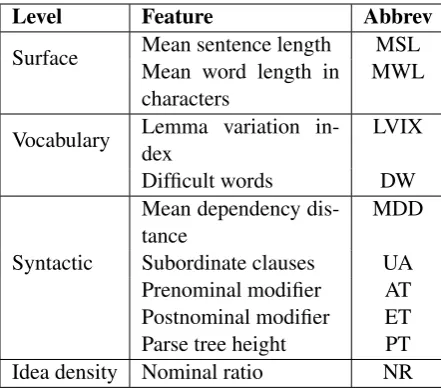
idea density is supposed to be revealed through calculations of average number of propositions, nominal ratio and noun/pronoun ratio. Finally, it is assumed that the personal interest to some extent might be captured through the proportion of proper nouns in a text. We will focus on the results achieved for the most prominent features, i.e. those who were expected to be least mutually correlated. Some of the features listed in Table 1 are quite straightforward, while others need an explanation.
The Lemma variation index is calculated with the formula:
LV IX= log(N)
log(2−loglog((UN)))
whereN = Number of lemmas andU = Number of unique lemmas
Words considered as Difficult words are those not present in category (C), (D), or (H) in the Sw-eVoc base vocabulary. In category (C) we find 2,200 word lemmas belonging to the core vocabu-lary. Category (D) contains word lemmas referring to everyday objects and actions. Category (H), fi-nally, holds word lemmas highly frequent in writ-ten text. In all, 4,700 word lemmas are included in these categories. The values in Table 2 refer to the mean percentage of the lemmas complementary to the mentioned categories.
The syntactic features MDD, UA, AT, ET and PT refer to properties in the dependency parsed sentences in the texts.
The Nominal ratio is achieved by calculating the proportion of nouns, prepositions and partici-ples in relation to verbs, pronouns and adverbs.
2.2 Text selection method
In all, 22 texts from the L¨aSBarT corpus (Heimann M¨uhlenbock, 2013) and 31 texts from a bank of National reading tests were checked with the goal of finding suitable portions of narrative texts for the intended group of readers in the 4th, 6th and 8th Swedish school grades, which corresponds to students aged from 10 to 15 years.
2.3 Levelling texts
Level Feature Abbrev Surface Mean sentence length MSL
Mean word length in characters
MWL
Vocabulary Lemma variation in-dex
LVIX
Difficult words DW
Syntactic
Mean dependency dis-tance
MDD
Subordinate clauses UA Prenominal modifier AT Postnominal modifier ET
Parse tree height PT
[image:3.595.72.293.62.257.2]Idea density Nominal ratio NR
Table 1: SVIT features
Earlier experiments showed that for the task of differentiating between ordinary and easy-to-read childrens fiction, language features at the vocab-ulary and idea density levels were found to have the highest impact on the discriminative power. The features mirroring vocabulary diversity and difficulty, and idea density were given precedence when the metrics did not unambiguously point to-wards significant differences at the syntactic level. For the students who attended 8th grade, six texts were selected based on the SVIT-values, ranging between 527 and 1166 words in length. The texts were then split into two groups (Group 1 and Group 2) with similar internal distribution between easier and more difficult texts. We will here present here the properties of the hardest and the easiest of the six texts, both present in Group 1. The two texts were not of equal length, but the students were allowed to read the texts and answer the questions at their own pace.
The easiest text (Text 1) was a short story re-trieved from the collection of National reading tests, entitled Att fiska med morfar’Fishing with Grandpa’ by Ulf Stark. The most difficult text (Text 2) was also picked from the National read-ing tests. It is entitledPopul¨armusik fr˚an Vittula ’Popular music from Vittula’, written by Mikael Niemi. Some of their respective values are shown in Table 2.
Based on the SVIT-values, we can derive the following information about the two texts:
Text 1 shows low average values regarding word and sentence lengths. At the vocabulary level, the word lemma variation is at medium level
for the six texts. The syntactic complexity is very low, both regarding prenominal modifiers and parse tree height. The idea density level is below average.
Text 2is slightly above average regarding word length. The word lemma variation index and percentage of difficult words are both consider-ably above average. The syntactic complexity is slightly above average for all features. Finally, the idea density is above average.
2.4 Testing method
Items testing two overall reading processes were constructed for each of the three texts (Langer, 2011; Luke and Freebody, 1999; Mullis et al., 2009; OECD, 2009):
1. Retrieve explicitly stated information and make straightforward inferences
2. Interpret and integrate ideas and information and reflect on, examine and evaluate content, language, and textual elements
In assessing the vocabulary knowledge of stu-dents, we focused on the receptive knowledge of subject and domain neutral content words in Swedish novels as test items. We used a reliable approach to create vocabulary tests similar to the Vocabulary Levels Test (VLT) (Nation, 2001). The test items were extracted from a frequency based vocabulary list of compiled corpora representing each level of text difficulty. The test items were presented in context in an authentic sentence taken from the text book. Three alternative meanings of the test item and one correct meaning were pre-sented to the student. The alternative meanings (distractors) were similar to the test item regard-ing phonology or orthography.
332 students in the 8th grade in 5 schools in Gothenburg participated. The teachers were in-structed to allow the students to read the texts and answer the questions at their own pace, which usu-ally corresponded to a total time of one lesson per test. The tests were administered as paper ques-tionnaires and the texts were read on paper.
3 Results from students’ testings
Text Surface features Vocabulary features Syntactical features Idea density
MSL MWL LVIX DW MDD UA AT ET PT NR
Text 1 9.7 4.2 54.1 23.0 2.2 0.3 0.1 0.3 4.9 0.44
[image:4.595.74.521.63.120.2]Text 2 11.3 4.8 69.8 33.0 2.1 0.3 0.3 0.4 5.5 0.70
Table 2: SVIT values
the most difficult. For each text, the students an-swered 12 questions regarding the content and 15 questions regarding the understanding of isolated words not present in the texts.
3.1 Text reading results
On average, students’ performance on Text 1 was 74.2% correctness on content questions, and 68.3% on Text 2. These results indicate, that the texts were well adapted for the age group, but also that Text 2 was perceived as more difficult by the normally performing students.
For the low-performing students, the correlation between the results, i.e. correctness on content questions, and text complexity was even more ob-vious. 26 students scored<1 S.D. of the students’ results. On average, they had 55.2% correctness on content questions for Text 1, and 37.0% cor-rectness for Text 2. Furthermore, the 10 stu-dents who presented results<2 S.D. below normal scored on average 48.2% and 36.7%, respectively.
3.2 Vocabulary results
As could be expected, we found that there was a strong correlation between reading comprehen-sion and vocabulary knowledge. The correlation was significant, 0.68 resp. 0.63 with Pearson’s cor-relation at level 0.01.
4 Correspondence between readers and texts
When looking at the overall reading processes, it was found that among the 26 low-performing stu-dents, 12 showed reading profiles indicating that they were only able to correctly answer a few of the text-based and the interpretive and evaluative questions. They were assumed to work only on in-dividual parts of the text and were most likely not able to grasp the big picture in the texts and how different aspects of the text were related. They all performed better on Text 1 than Text 2. Five students were found to perform pretty well on the text-based questions but not as good when it came to the interpretive and evaluative questions on Text
1. None of these students were able to correctly answer more than a few of the text-based and the interpretive and evaluative questions on Text 2. For the remaining low-performing students the re-sults were more mixed. Four of them had a read-ing profile which implied rather good results on the text-based, interpretive and evaluative ques-tions on Text 1, but did not grasp the content of Text 2. Finally, 5 students performed somewhat better on Text 2 than on Text 1, but were still not able to entirely comprehend the content of any of the two texts.
5 Discussion
We have presented an approach that investigates the extent to which automated text levelling with a multivariate analysis based on the SVIT lan-guage model really proved to correspond to stu-dents’ actual reading performance. We found that the participating students performed better on the text judged as the easiest as opposed to the most difficult, with a mean difference in correctness of 5.9%. Furthermore, the low-performing stu-dents showed a significant difference in correct-ness of 18.2% between the two texts. These find-ings support the hypothesis that the SVIT readabil-ity model based on language features derived com-putationally, and present at deeper levels than the purely superficial, can devise a link between quan-titative and qualitative text characteristics. Fur-ther studies investigating the efficiency on level-ling texts from other genres than fiction will fol-low.
References
Carl Hugo Bj¨ornsson. 1968. L¨asbarhet. Liber, Stock-holm.
Jeanne S. Chall. 1958. Readability: An appraisal of research and application. Ohio State University Press, Columbus, OH.
Meri Coleman and Ta Lin Liau. 1975. A computer readability formula designed for machine scoring.
Rudolf Flesch. 1948. A new readability yardstick.
Journal of Applied Psychology, 32(3):221–233.
Arthur C. Graesser, Danielle S. McNamara, and Jonna M. Kulikowich. 2011. Coh-metrix. Educa-tional Researcher, 40(5):223–234.
Robert Gunning. 1952. The technique of clear writing. McGraw-Hill International Book Co., New York, NY.
Katarina Heimann M¨uhlenbock and Sofie Johans-son Kokkinakis. 2012. SweVoc – A Swedish vo-cabulary resource for CALL. InProceedings of the SLTC 2012 workshop on NLP for CALL, pages 28– 34, Lund, October. Link¨oping University Electronic Press.
Katarina Heimann M¨uhlenbock. 2013. I see what you mean. Assessing readability for specific tar-get groups. Dissertation, Spr˚akbanken, Dept of Swedish, University of Gothenburg.
J. Peter Kincaid, Robert P. Fishburne, Richard L. Rogers, and Brad S. Chissom. 1975. Derivation of new readability formulas (Automated Readabil-ity Index, Fog Count, and Flesch Reading Ease For-mula) for Navy enlisted personnel. Technical report, U.S. Naval Air Station, Millington, TN.
Judith A. Langer. 2011. Envisioning Knowledge. Building Literacy in the Academic Disciplines. New York: Teachers’ College Press.
Allan Luke and Peter Freebody. 1999. Further notes on the four resources model. Reading Online. http://www.readingonline.org/research/lukefreebody.html.
G. Harry McLaughlin. 1969. SMOG grading – a New Readability Formula. Journal of Reading, 12(8):639–646.
Ina V.S. Mullis, Michael O. Martin, Ann M. Kennedy, Kathleen L. Trong, and Marian Sainsbury. 2009.
PIRLS 2011 Assessment Framework. PIRLS 2011 Assessment Framework.
Paul Nation. 2001. Learning vocabulary in another language. Cambridge University Press.
OECD. 2009. Pisa 2009 Assessment Framework. Key Competencies in reading, mathematics and science. Paris: OECD.
OECD. 2014. Pisa 2012. Results in Focus. What 15-year-olds know and what they can do with what they know. Paris: OECD.