The Relationship between Science and Technology and
Evolution in Methods of Knowledge Production
R B Grover*
(Received 03 December 2018)
Abstract
The concept of knowledge for the sake of knowledge was practiced by many philosophers considering knowledge as civilising and to have intrinsic values. A utilitarian case for knowledge was made during 13th century; however, science and engineering continued to follow parallel trajectories. Pursuit of technology intensified with the availability of energy from coal on a large scale during the 18th century, and during the 19th century, some scientists started pursuing engineering (increasingly called technology) with an eye for the use of science in practice. Some were members of both communities and worked as scientists-engineers or engineer-scientists. Gradually technology became a mirror-image of science with its norms, practices and journals, and science & technology are now fully intertwined. After the second world war, a linear model stating that basic science leads to technological development was proposed. It was challenged by the reverse linear model emphasising that new scientific possibilities are created by technology. During recent decades, several models analysing relationship between science and technology have been proposed and these are non-hierarchical. Increased understanding of the relationship between science and technology, acceleration in knowledge production, and a squeeze on funding of research by Governments has changed methods of knowledge production. This paper analyses the relationship, presents a modified version of an existing representation of the relationship, and explains the characteristics of current methods of knowledge production.
Key words: Methods of knowledge production, Technology applies basic scientific knowledge, Technology creates new scientific possibilities, Technology and science are mirror image twins, Technology and science are fully intertwined, Utility of science.
* Emeritus Professor, Homi Bhabha National Institute, Mumbai – 400094. Email: [email protected] Alternate email: [email protected]
1. INTRODUCTION
1.1 Classical Paradigm
Humans have been making tools and developing crafts for a long time. Useful arts i.e., tools and crafts developed by early civilizations have progressed to become present day techno-logies. Along with useful arts, earlier advanced civilisations also came up with scientific concepts, but it is difficult to say when and where the concept of scientific enquiry originated. Some historians opine that it started in Europe and dismiss all that was done elsewhere. However, there is sufficient
(undated). Wootz steel is a pioneering steel alloy, developed in the southern part of India in the 6th century BCE and was exported globally
(Srinivasan & Ranganathan, 2004). It is a pointer to ancients pursuing well-developed metallurgical practices. Since objective of this paper is to concentrate on the recent past, it touches briefly upon achievements of early advanced civilisations. Greeks looked at the nature as a system governed by natural causes. They also delinked philosophical enquiry from practical arts. Greek scholars or philosophers pursued knowledge for its own sake and did not look at the practical arts. Practical arts or engineering was supposed to be pursued by the people of lesser station who were not financially well off. Greek elites were interested primarily in knowledge and under-standing, and only secondarily in its practical usefulness.
However, Hippocratic physicians were excep-tion to the idea of using knowledge for the sake of knowledge. From the time of Hippocrates in the fifth century BCE, physicians from Greece studied human anatomy and physiology with the objective of developing cures for diseases, and surgical means for healing wounds and fractures. Of course, Greeks were not alone in this endeavour. Ayurveda emerged in India based on observation and theorization. Indian advances in surgery were very impressive (Narasimha, undated).
The ancient concept of scholarship envisaged ‘pursuit of knowledge for the sake of knowledge’ and this concept is alive in the thinking of a part of elites even today. Pursuit of knowledge is civilising and has its own intrinsic value (Stokes, 1997, p.100). A parallel thought advocating a utilitarian case for science was made as early as thirteenth century and this arose from the prestige
which the trade guilds had acquired in Europe. Italian renaissance (14th to 17th century) was a
result of coupling of knowledge and action. To quote Charles Coulston Gillespie (1918–2015), enterprises of individuals like Leonardo da Vinci (1452–1519), Michelangelo (1475–1564), Vasco da Gama (1460–1524), Christopher Columbus (1451–1506) were “animated by the same instinct that later formed a Galileo (1564–1642), namely, that knowledge finds its purpose in action and action its reason in knowledge” (Stokes, 1997, p. 32). Interest in practical arts among the elites grew with the realisation about the necessity of experiments and observations for the growth of science.
1.2 Utility of Knowledge
The fact that knowledge has utilitarian and material fruits was realised by philosophers like Francis Bacon (1561–1626) when he said1,
The roads to human power and to human knowledge lie close together, and are nearly the same.
Bacon’s utilitarian concept of science was included in the charter of the Royal Society incorporated after his death. The charter2 charges
the fellows of the Royal Society with “further promoting by the authority of experiments the sciences of natural things and [the] useful arts….to…the advantage of human race.” Proceedings of the Royal Society do contain references to investigations into navigation, mining and other practical technologies. It has been “reported that 40% to 60% of discoveries in the 17th century could be classified as having their
origins in trying to solve problems in navigation, mining etc (Etzkowitz and Leydesdorff, 2000)”.
Despite Bacon emphasising utilitarian aspect of knowledge and despite Italian renaiss-ance,
1 This is a motto by Francis Bacon and is quoted in many books including ‘The Discovery of India’ by Jawaharlal Nehru, published in 1946, republished by Penguin Books, p. 283, and ‘The Power of Scientific Knowledge: From Research to Public Policy’, by R Grundmann and N Stehr, Cambridge University Press, 2012, p. 1.
technology was being pursued by individuals independent of science and pursuit of technology intensified with the availability of energy on large scale. This happened with coal mining becoming safer with the invention of a steam driven mine dewatering pump in 1698. Until coal was available on large scale, humans were dependent on muscle (of humans or animals) power for energy, but large-scale coal mining made available a large amount of energy for the first time in the history of mankind. Several developments followed including steam engine, steam boat, railways and so on. Individuals like James Watt (1736–1819) and Thomas Edison (1847–1931) were pure inventors3, and were inventing products or devices
or machines for use based on their knowledge of technology, and systematic and intutive approach to development.
Humans have been accumulating and trans-ferring knowledge ever since, thousands of years ago, someone drew on stone somewhere the first pictograph or ideograph (Toffler and Toffler, 2006, p. 108). Transfer of knowledge that began with this first act enabled the humans to master agriculture, urbanize, invent machines and set up industries, and reach the present age when knowledge is supreme. Historians may call the three wealth systems as agrarian, industrial and knowledge-based (Toffler and Toffler, 2006, p. 225), but know-ledge was embedded in the earlier two systems as well. While in the 21st century, there has been a
tremendous expansion of aggregate supply of knowledge to make historians name the present-day economy knowledge-based, the fact is that knowledge was always important and has been continuously growing. Realising the importance of knowledge, Francis Bacon equated knowledge with power (Toffler, 1990, p. 12) and Wise (1985) opined that ‘technology is knowledge’. The issue which needs to be emphasised is that prior to 19th
century, technologies were being developed by inventors based solely on their technical knowledge.
1.3 Interactions between Science and Technology since the 19th Century
Science was still evolving, but its impact on technology was still minimal. Science was not bringing any economic return to those who were pursuing it. Therefore, it was being pursued by elites of the society. By contrast, technology was being pursued by people who were dependent on it for sustenance. They might not have had the benefit of formal education but followed a systematic approach. To quote Donald Stokes (1997, p. 35),
[T]he inventors of European society were far removed from the gentlemen scientists. Although their approaches to invention could be highly systematic, they had little theoretical grasp of science and needed little as the pace of their contributions accelerated into the industrial revolution.
Enactment of the patent laws were very helpful to the inventors as it raised their income level and status.
Universities were established during the 19th
century and science became even more meritocratic. Universities provided a career path to scientists and the separation between science and engineering continued. The outlook that science should be pursued for the sake of science was further reinforced. However, some of the scientists started pursuing science with an eye for its use in practice. Stokes (1997, p. 36) writes about the work done by James Clerk Maxwell (1831– 1879) as an example and writes, “The triumph of Maxwellian field theory over the more primitive ideas of the ‘half-educated4 electricians’ was a
watershed in the development of electric power in Britain and America.” Research, which was the occupation of well-endowed individuals, first moved to research universities, and then to research laboratories. According to Peter Drucker (1970, p. 62), the turning point came with the synthesis of aspirin in 1899 by Adolf von Baeyer 3 The words ‘inventor’ and ‘technologist’ are interchangeably used, but with due regard to the fact that the word technologist is
of recent origin.
(1835–1917). The worldwide success of aspirin made the chemical industry realise the value of research dedicated to technological work. Before World War I, new laboratories were built both in Europe and Americas. Earlier, the laboratories were places for testing or surveys and just prior to the World War I, they became places for technological research. We will come back to the subject of research laboratories later in this paper. However, Layton (1971) provides a different perspective. Contribution by Maxwell had to be translated before they could be used by engineers. Elaborating, he writes that Maxwell’s “influence was indirect, since very few engineers could understand him. It required a creative effort almost equal to Maxwell’s own by the British engineer Oliver Heaviside to translate his electromagnetic equations into a form usable by engineers.” This viewpoint can also be seen in the following statement, “Maxwell’s ideas and equations were expanded, modified, and made understandable after his death, mainly by the efforts of Heinrich Hertz, George Francis Fitz Gerald (1851–1901), Oliver Lodge (1851–1940) and Oliver Heaviside (1850–1925). The last three of these were christened as ‘The Maxwellians’ by Heaviside (Sengupta and Sarkar, 2003).
Layton has given more examples in his paper and this brings us to an interesting conclusion regarding interchange between science and technology. To quote Layton (1971), “For information to pass from one community to the other often involves extensive reformulation and an act of creative insight. This requires men who are in some sense members of both communities. These intermediaries might be called ‘engineer-scientists’ or ‘scientist-engineers’, depending on whether their primary identification is with engineering or science. Such men play a very important role as channels of communication between the communities of science and technology. It is perhaps significant that among the American physical scientists of the 19th
century, Joseph Henry, Alexander D Bache, Henry Rowland, and J Willard Gibbs were all trained as engineers. Kelvin can be cited as an example in the category of scientist-engineer. He was trained in mathematics and physics, but also worked on engineering problems. However, many scientists continued to consider engineers as second-rate minds and didn’t recognise engin-eering problems as intellectually rewarding. Rutherford went to the extent that nine years prior to the running of Chicago pile he didn’t believe that energy of nucleus would ever be released (Snow, 1961, p. 34).
Inventors started using scientific methods and to progress, they had to build the field of engineering sciences. Layton (1971) writes,
The engineering sciences, by 1900, constituted a complex system of knowledge, ranging from highly systematic sciences to collections of ‘how to do it’ rules in engineering handbooks. Some, like the strength of materials and hydraulics, built directly on science, and they were often classed as branches of physics. Others, such as the kinematics of mechanisms, evolved from engineering practice. In either case, their development involved the adoption by engineers of the theoretical and experimental methods of science, along with many of the values and institutions associated with their use. By 1900, the point of origin made little difference; the engineering sciences constituted a unity. Those derived from practice took on the qualities of a science in their systematic organization, their reliance on experiment, and in the development of mathematical theory. At the same time, sciences like the strength of materials gradually diverged from physics, assuming the characteristics of an autonomous technological science.
This trend is continuing and engineering science is now a discipline at par with disciplines of natural sciences. Continuing further Layton notes:
contributions. Scientists such as Hooke, Euler, Young, and Coulomb did much to lay its foundations; it is worth remembering that the second of Galileo’s “two new sciences” was the strength of materials. But once it reached the stage of being technologically useful, its development was undertaken by engineers.
Layton writes, “Equivalents were created in technology for the experimental and theoretical branches of science. As a result, by the end of the 19th century, technological problems could be
treated as scientific ones; traditional methods and cut-and-try empiricism could be supplemented by powerful tools borrowed from science. This change was most marked in the physical sciences and civil, mechanical, and electrical engineering, …... But similar changes were taking place at the same time in the relations of chemistry, biology, geology, and other sciences to their corresponding technologies (Layton, 1971)”. Layton terms it as ‘the scientific revolution in technology.’ He writes, “By 1900 the American technological community was well on the way to becoming a mirror-image twin of the scientific community.”
Elsewhere in the same paper, Layton writes, “In the case of mirror-image twins there is a subtle but irreconcilable difference which is expressed as a change in parity. Between the communities of science and technology there was a switch in values analogous to a change in parity. One way of putting the matter would be to note that while the two communities shared many of the same values, they reversed their rank order. In the physical sciences the highest prestige went to the most abstract and general – that is to the mathematical theorists from Newton to Einstein. Instrumentation and applications generally ranked lowest. In the technological community, the successful designer or builder ranked highest, the ‘mere’ theorist the lowest. These differences are inherent in the ends pursued by the two communities: scientists seek to know, technologists to do.”
The relationship between science and technology proposed by Layton is thus non-hierarchical. This contrasts with hierarchical
relations proposed by others which we will see in the next section. Before that we’ll examine some more developments that took place during the nineteenth century that laid the foundation of the linear model described later.
Developments in technology spurred economic growth, and as technologies other than mechanical entered industry, interaction of science with technology increased. This led to the start of technical education beginning with the establishment of ‘Ecole Poly-technique’ in France to cater to increasing demand of technically qualified manpower for the growing industry.
Universities in Germany emphasised the role of research in universities and the result was an explosive growth in scientific research. Unity of research and education became the buzz word. Donald Stokes (1971, p. 38) writes, “Given Science’s increasing importance for technological change, there were inevitable examples of research undertaken in the universities with an eye on practical technology as well as fundamental understanding.” Chemical industry thrived on this meld of science and technology. Kaiser Wilhelm Institutes (forerunner of the present-day Max Planck Institutes) were established as centres of use-inspired scientific research. Developments in Germany made applied research prestigious and helped in the growth of industry. By placing applied research in institutes other than universities, Germany created an institutional separation between science and technology.
of American experience when he writes (p. 45), “The applied fields, while they seemed to repeat the separation of basic from applied science, have in fact provided an institutional home for research that is driven by the goals of understanding and use.” The Manhattan Project is a specific example and apart from its utilitarian aspect, it led to an understanding of implosion phenomena, and contributed important insights to the later study of supernovae. (Stokes, 1997, p.16).
2. MODELLING THE RELATIONSHIP
2.1 The Linear Model of Relationship between Science and Technology
Views like ‘knowledge for the sake of knowledge’ as well as ‘utilitarian aspect of knowledge’ have existed for a long time, but the former was reinforced in the report by Vannewar Bush (1945) written in response to a request by the President of the USA. He wrote, ‘basic research is performed without thought of practical ends’ (Bush, 1945, p. 16) and what he wrote led to a linear model with basic and applied research placed at the end of a linear spectrum5. This, with
the addition of further steps, translates into linear model (Fig. 1), implies a causal direction and asserts that science always precedes engineering, and implies that technology is applied science.
2.2 Challenges to the Linear Model and the Reverse Linear Model
As stated earlier, for most part of history, technology developed independent of science, and
even in the recent history there are several examples that defy the linear model. To quote just two: first is the development of the steam engine before the development of science of thermo-dynamics; and second is the flight by Wright Brothers before the emergence of Aerodynamic Theory. Therefore, the linear model was challenged and systematic surveys were done to know more about the relationship between science and technology. Project ‘Hindsight’, commi-ssioned by the US Department of Defence in 1960s is one such survey that provided useful insights.
‘Hindsight’ traces research ‘events’ that led to the development of twenty military systems over a period of ten to twenty years. Research events could be science events or technology events. Science events are further classified as undirected science or applied science (directed science). Results, as summarised in an article by Sherwin and Isenson (1967), are as follows:
(i) "The most significant finding was that the
improvement in performance or reduction in cost is largely the synergistic effect of a large number of scientific and technological innova-tions, of which only about 10 percent had been made at the time the earlier system was designed."
(ii) "Of the innovations, or Events, 9 percent were classified as science and 91 percent as technology. Ninety-five percent of all Events were funded by the defence sector. Nearly 95 percent were motivated by a recognized defence need. Only 0.3 percent came from undirected science."
5 A recent history of the National Science Foundation suggests that Bush permitted the drastic oversimplification included in the report reluctantly. “He had hoped that the report would include under the title “pioneering efforts of a technical sort”, as exemplified by Wright Brothers. But he found to his annoyance that the panels drawing up the report did not think that “a couple of bicycle mechanics working on a flying machine would …. be doing research.” He hoped briefly that the panels might be enlarged to include members representing “the rugged type of thing that the Wright Brothers exemplified,” but he did not push his views, and no endorsement of that type of research appeared in the report” (Wise, 1985).
Basic Applied Design Production
Research Research and development and operation
(iii) "In light of our findings, 5 to 10 years are often required before even a piece of highly applied research is “fitted in” as an effective contributing member of a large assembly of other Events, it is not surprising that “frag-ments” of undirected science are infrequently utilized on even a 20–year time scale."
(iv) "The most obvious way in which undirected science appears to enter into technology and utilization on a substantial scale seems to be in the compressed, highly organized form of a well-established, clearly expressed general theory, or in the evaluated, ordered knowledge of handbooks, textbooks, and university courses."
The study confirms that “the recent, mission oriented science and technology are a good investment in the short term – the 10 to 20–year period”. The results of the project ‘Hindsight’ acknowledge the value of undirected science on the 50–year-or-more time scale. It also acknow-ledges that the pursuit of undirected, but generally relevant, research in mission oriented research and development organisations ‘provides a body of in-house expert consultants to help in unusually difficult applied technical problems.’ Therefore, pursuit of undirected research that is “skilfully” relevant to the mission of a research and development organisation is very useful.
Project ‘Hindsight’ provided useful insights, but one may not agree with the time scale of 50–years for undirected research to become useful. It could be less, as for example, nuclear fission was discovered in 1938, chain reaction was first demonstrated in 1942, production of nuclear electricity was first demonstrated by EBR-I in 1951, and reactor Obninsk, designed to produce 5 MW power, was commissioned in 1954. It could be more, as for example, photovoltaic effect was first observed by A E Becquerel in 1839, the first solar cell was experimented by Charles Fritts in 1884, and the first practical photovoltaic cell was publicly demonstrated in 1954 by Bell Lab.
More surveys were done and the results deepened the suspicion about the linear model and science historians began to explore alternatives. They came to conclusions that technology is not merely applied science, but ‘technology is knowledge’ (Wise, 1985). A meeting organised by science historians in 1972 is considered by them as an extended funeral of the linear model (Wise, 1985).
Relationship between science and technology and direction of causality is not a matter of just academic interest. Linked to this idea are issues like policies for funding of research, and structure of institutions of higher education and research. Research is funded by Governments to generate innovations that can be deployed. “If science drives technology, the money should be spent on science. If technology drives both itself and science, then the money should be spent on technology” (Wise, 1985).
This line of reasoning gave rise to the reverse linear model stating, ‘technology creates new scientific possibilities’ (Price, 1984). Price writes, “When we study the world of nature, the result is basic science.” He continues, “When we study the artifactual world of techniques, the result is applied science. It can therefore be seen that the common view, in which basic science is directly applied to technology by inserting a stage labelled ‘applied science’ is incorrect. The arrow of derivation runs from technology to the applied science, not the other way round.” In summary, ‘advances in instrumentation and experimental techniques’ -what Price calls instrumentalities – “have been of major importance in stimulating and enabling both radical theoretical advances in fundamental science, and radical innovations in practical application.”
2.3 A Two-Dimensional Model
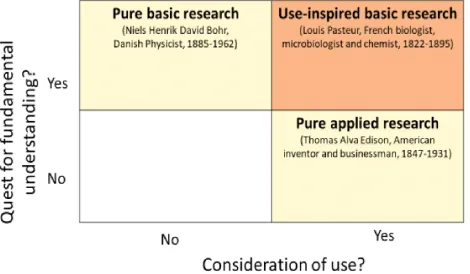
to a two-dimensional model shown in Fig. 2. Stokes doesn’t contest the terminology basic and applied science, but emphasises that the two can co-exist in many cases as in the case of research by Louis Pasteur, whose research was use-inspired and had both elements that is quest for knowledge and inspiration for immediate use. This can be said for research in many fields including chemistry, metallurgy, biotechnology, computer science. One of the four quadrants is not named. It represents research that can be a precursor to what might result in basic research and move to Bohr quadrant, or be a precursor to applied research and move to Edison quadrant. This also includes research done with a view to enhance skills of the researchers.
While the two-dimensional model is a way forward and severely dented the linear model, it sticks to the old terminology that is ‘pure basic’ and ‘pure applied’. William Shockley (1956) opines that adjectives like pure, applied, unrestricted, fundamental, basic, academic, industrial, practical etc. are being used by some in a derogatory sense. Some use it ‘to belittle practical objectives’, while other use them ‘to brush-off long-range values of explorations into new areas where useful outcome cannot be foreseen.’ Narayanamurti and Odumosu (2016, p. 31-32) propose an alternative in the form of the Discovery-Invention Cycle (DIC). For them “the essence of invention is the accumulation and
creation of knowledge that results in a new tool, device or process that accomplishes a particular, specific purpose. The essence of discovery is the creation of new knowledge and facts about the world.” In their book, they have given several examples to show that research comprises both elements that is discovery and invention, and have emphasised the role of inventions in generating new knowledge as well as new applications. They opine that engineering was crucial to the success of the Manhattan Project, the proximity fuse and the development of synthetic rubber, and radar. Radar could be successfully deployed only because of the development of a multi-cavity magnetron, an engineering device. There is an implicit acknowledgement of what earlier authors like George Wise have written, reinforced with examples from research and development work done in the Bell Labs6 and elsewhere.
The relationship between advances in science and development of technology is bidirectional, and far more interactive as compared to what has been proposed by the linear model. Stokes (1971, p. 87) proposed replacement of the linear model by ‘an image that conceives of their dual, upward trajectories as interactive but semiautonomous.’ The two trajectories are strongly influenced by each other and the influence moves in either direction. Investment in research in fields like high energy physics leads to development of sophisticated instruments which find use elsewhere is an argument in support of the role of technology in research in science. Training of individuals in methods of scientific research also contributes to success of technical missions. Harvey Brookes (1994) has observed that scientists trained in nuclear physics worked on problems such as radar and the proximity fuse, as well as atomic weapons. Also, scientists trained in nuclear physics, rather than solid-state physics, led much of the early development of
semi-Fig. 2. A Two-Dimensional Model.
[image:8.612.64.299.117.254.2]conductors. The success of nuclear physicists was due to their familiarity with sophisticated electronic circuits and instrumentation and the system-type thinking – knowledge base they had acquired while doing experiments in nuclear physics.
2.4 Classification of R&D according to the Frascati Manual
Despite having been challenged, the linear model is enshrined deep in national data reporting systems and the thinking of people. R&D statistics are used in a wide variety of policy decisions, and to collect such statistics, the Frascati Manual7,
which was first drafted in 1963, provides guidelines for data collection. It also provides classification of research as can be seen from the following quote.
The term R&D covers three types of activity: basic research, applied research and experimental development. Basic research is experimental or theoretical work undertaken primarily to acquire new knowledge of the underlying foundation of phenomena and observable facts, without any particular application or use in view. Applied research is original investigation undertaken in order to acquire new knowledge. It is, however, directed primarily towards a specific, practical aim or objective. Experimental development is systematic work, drawing on knowledge gained from research and practical experience and producing additional knowledge, which is directed to producing new products or processes or to improving existing products or processes. This manual follows the SNA [system of national accounts] convention in which ‘product’ refers to a good or a service. Further, throughout the manual, ‘process’ refers to the transformation of inputs to outputs and to their delivery or to organisational structures or practices. It is often helpful and relevant to classify R&D according to the knowledge domain in which it is conducted, including the natural sciences, engineering and technology, the medical and health sciences, the agricultural and veterinary sciences, the social sciences, the humanities and the arts.
Public funding of applied research is consi-dered controversial as it amounts to use of public funds to influence private markets (Goldstein and Narayanamurti, 2018). This consideration and several other issues, that are beyond the scope of this paper, have made members of OECD reluctant to re-sculpt categorization of R&D in the manual (Stokes, 1997, p. 69).
2.5 Multiple Facets of Science and Technology Relationship
Science and technology have similarities as well as differences; they are related, but follow different trajectories that are now intertwined. Systematic progress based on robust research in universities, and research and development laboratories has led to the evolution of engineering science as a distinct discipline. “Part of our difficulty in seeing the profound differences between science and technology must relate to the fact that progress is an obvious attribute of both fields”, writes Thomas Kuhn (1962, p. 61). Technology is now an enterprise larger than science.
Views about the relationship between science and technology have been evolving, and multiple models, which can be classified as hierarchical and non-hierarchical, have been proposed. Hierarchical models include the linear model ‘technology as the application of basic scientific knowledge’ (Bush, 1945) and the reverse linear model ‘technology creates new scientific possibilities’ (Price, 1984).
Non-hierarchical models include ‘technology and science as mirror-image twins’ (Layton, 1971), and ‘the continuum model’ which considers science and technology as a single entity, named science-technology complex proposed from sociological perspective (Cuevas, 2005). Cuevas proposes another model, but considers two
communities that is engineers and scientists as distinct, which is far from reality as both elements – quest for knowledge and inspiration for use – can co-exist in many cases. Military-industrial complex in the previous century and computer science and engineering related developments in the past some decades have blurred the line between science and technology as well as between academia, research laboratory and industry. Bentley et al. (2015), based on a comprehensive survey, concluded that most academics engage in a combination of undirected and directed research. There, however, seems to be a decline in publications based on undirected research due to various reasons explained later in this paper.
Undirected basic research thrives on patronage. It has now become so large that its patrons have put ceilings on funding and are insisting on relevance of its end results to the needs of the society (Ziman, 1996). Multi-faceted relationship between science and technology, acceleration in the growth of knowledge production, squeeze on funding of research by governments, and scrutiny by the society are transforming the way knowledge is produced and this is discussed next.
3. METHODS OF KNOWLEDGE PRODUCTION
3.1 Emergence of several Knowledge Organisations to address present day Problems
In section 1.3, we have briefly discussed the advent of research laboratories with the synthesis of aspirin. During the period between the two World Wars, laboratories came up in chemical, pharmaceutical, electrical, and electro-nics industries. Laboratories were also set up in the USA to carry forward the work under the Manhattan project. Argonne National Laboratory, initially established to carry out Enrico Fermi’s work on nuclear reactors, was designated as the
first national laboratory in the United States on July 1, 1946. After the second World War, labo-ratories to carry out research in the areas of nuclear, aerospace, defence and computer technologies were set up in several countries outside the university framework. Complex technologies and complex problems demand a high level of skill and continuity of skills without disruptions. Such continuity cannot be provided by universities, where students come for the duration of the academic programme they enrol in. Industry can provide such skills only if it is funded to do so by the governments and not purely on altruistic basis (Kakodkar and Grover, 1999). Therefore, government funded national labo-ratories have become the norm for carrying out research on complex technological areas. When research in such areas is carried out in industry, it is funded by the governments.
Increasing size of experimental facilities is another reason for setting up of laboratories dedicated to research. For setting up medium, or large-scale facilities, well-qualified and creative engineers and scientists supported by technical staff are needed. They have designations like ‘scientific officers’ for senior positions and ‘scientific assistants’ for junior positions. University culture does not reward contributions of such individuals at par with contributions of faculty and as a result, universities have not been able to nurture large facilities. Some well-endowed universities in developed countries have been able to partially address8 this problem by establishing
centres for studies on specific disciplines and set up medium-scale facilities, but this is not so for all countries. Large facilities like research reactors, tokamaks and synchrotrons have been set up only in national research centres.
Cost of facilities proposed during the past few decades has become huge and is beyond the capability of one nation. Therefore, many
science facilities are being set up as international cooperative ventures. International mega-science projects have any of the two objectives: to probe complex scientific issues such as fundamental structure of the universe, e.g. CERN9, FAIR10,
LIGO11 etc., or to address a specific challenge such
as energy security, e.g. ITER. Such projects are also being used as diplomatic tools to bring nations together. ITER venture was launched as an initiative for cooperation between the USA and the Soviet Union by the US President Reagan and Soviet General Secretary Gorbachev (Katz, 1992). It aims to demonstrate harnessing of fusion for electricity generation. After going through various phases, it is now under construction at Cadarache, France and seven Parties (China, EU, India, Japan, Russia, USA, and South Korea) are participating in it. In view of increasing role of science for diplomacy12, American Association for
Advancement of Science (AAAS) launched the journal ‘Science and Diplomacy’ in 2010.
Technological advances have helped to solve most old problems like large scale famines and large-scale epidemics. New problems, which are increasingly complex, are emerging and this is influencing the structure of institutions and research teams. Examples include burgeoning energy demand, environmental degradation, climate change, water shortages and resource sustainability. For their solution, the emerging problems demand the expertise of large teams where scientists and technologists, and in many cases social scientists work together.
In parallel, universities are nurturing res-earchers many times more that their requirements and they are finding employment in national
laboratories, industries, consulting organisations, international agencies and non-governmental think tanks. According to data from the USA, only 43.2% doctorates in STEM fields are employed in academic institutions including universities (USNAP 2018). Amongst various STEM fields, the percentage for engineering is 25%, while for all other fields it is above 40%. In case of engineers, 67.2% are employed with business or industry. This data points out that the work places other than universities, now manned by highly qualified individuals coming from the university system, are store-houses of knowledge; they use knowledge as well as generate and disseminate knowledge. Knowledge production, therefore, is now distributed across many actors. It is not a new element. Prior to the advent of research univers-ities, work places were generating knowledge and they are doing so again now and on a much bigger scale. Emergence of multiple knowledge centres is influencing knowledge production in several ways as explained in the next section.
3.2 Knowledge Production
Because of new problems and new institutional settings, a new mode of knowledge production has emerged and was first addressed by a group of six researchers in a book published in 1994. In 2001, three of the original six researchers came up with another book to respond to questions raised. Nowotny et al. (2003) write, “The old paradigm of scientific discovery (‘Mode 1’) characterised by the hegemony of theoretical or, at any rate, experimental science; by an internally-driven taxonomy of disciplines; and by the autonomy of scientists and their host institutions, the univer-9 CERN, the European Organization for Nuclear Research, sits astride the Franco-Swiss border near Geneva, and has 22
mem-ber-states.
10The Facility for Antiproton and Ion Research (FAIR) is an international accelerator facility under construction at Darmstadt, Germany.
11The Laser Interferometer Gravitational-Wave Observatory (LIGO) is a large-scale physics experiment and observatory to de-tect cosmic gravitational waves and to develop gravitational-wave observations as an astronomical tool.
sities, was being superseded by a new paradigm of knowledge production (‘Mode 2’) which was socially distributed, application-oriented, trans-disciplinary and subject to multiple accounta-bilities.” Authors claim that ‘Mode 2’ or context-ualised research results in socially more robust knowledge.
This thesis has been analysed in many publications. Ziman (1996) uses an alternative terminology ‘academic’ and ‘post-academic’. Academic research emerged in universities in the 19th century and is also being practiced in
laboratories funded by the Government and in some cases large industrial houses. It follows the Mertonian (Robert K Merton 1910–2003) norms: norm of Communalism13 (the common ownership
of scientific discoveries, according to which scientists give up intellectual property in exchange for recognition and esteem), norm of Universality (according to which claims to truth are evaluated in terms of universal or impersonal criteria, and not on the basis of race, class, gender, religion, or nationality), scientists should be Disinterested (scientists should adopt a neutral, impersonal stance, and subject their work to peer review and testing by the scientific community), Originality, and Scepticism (all ideas must be tried and subject to a rigorous, structured scrutiny)14. All these
norms have been combined by Ziman in an abbreviation, CUDOS: Communalism, Universa-lity, Disinterested, OriginaUniversa-lity, Scepticism). Overall, “The argument is that academic scientists undertake research, and make public their findings, in exchange for ‘recognition’ by the peers. The citations in the literature, prizes and medals, exalted titles and other tokens of communal esteem are not just frippery: they are important functional elements of the academic culture” (Ziman, 1996).
Mode 2 or post-academic research follows the norm PLACE: Proprietary, Local (problem solving in local context), Authoritarian (industrial researchers act under the managerial authority rather than as individuals), Commissioned (research is commissioned by the funding agency) and Expert (researchers are employed as expert problem solvers rather than as creative indivi-duals), Ziman (1996). In many instances, large teams are involved. As a result, “Individual achievement is being merged into the collective action of multidisciplinary teams” (Ziman, 1996). Research priorities are being steered by large industries, national governments and international bodies. Agencies funding research are setting research agenda by prioritising research topics and auditing research outcomes.
According to Kellogg (2006), post-academic science fits neither the academic nor the industrial model. Academic science assumes the linear model (Fig. 1), while the post-academic model acknowledges that technological development may drive basic research, knowledge moves in both directions and it may be created at the point of application.
Hessels and Lente (2008) surveyed methods of knowledge production and came to conclusions that ‘Mode 1 – Mode 2’ classification has a broad canvas, and has been successful as a manifesto. They find that some of the claims (the rise of trans-disciplinary research, reflexivity demonstrated by greater awareness by researchers of societal consequences of the research, and quality control based on economic, political social or cultural criteria in addition to peer review) need empirical validation. Despite lack of empirical validation, Mode 1 – Mode 2 classification has caught considerable attention in science policy circles.
13 In the literature both communalism and communism are used, see Kelogg (2006). This word should not be confused with the political system that goes with the same name.
Mode 2 or post-academic research has entered the university system in a big way. Most of the nations are finding it difficult to provide liberal funding to support the growth of higher education system and the growth is taking place in several ways. The first is in terms of enrolment of students. The second is in terms of missions assigned to it. Universities were initially established as organis-ations for teaching, but in the second half of the 19th century, function of research was added as its
second mission. In recent decades, a third mission, contributing directly to industry, has been assigned to universities (Etzkowitz and Leidesdorff, 2000; Etzkowitz et al., 2000; Etzkowitz, 2003).
Addition of the third mission is necessary to address the issue of constraints on funding but it is having a profound influence on the university system as “capitalization of knowledge appears to be taking increasing precedence over dis-interestedness as a norm of science” (Etzkowitz et al. 2000). It is making “academic scientists to combine Mertonian and entrepreneurial values in an ethos of entrepreneurial science in which the extension and capitalization of knowledge are made compatible. There are continuing tensions between mobilizing knowledge as a public good (and maintaining incentives for to do this) and controlling its value as a private good” (Etzkowitz et al. 2000). This will eventually settle down as can be seen from the fact that technology transfer function has now been accepted as a part of the university administration and incubation parks are being set up as part of universities. One may recall that there were tensions when research became a university function as members of faculty pursuing research requested for reduction of teaching load and “others accused them of abandoning their calling as educators” (Etzkowitz, 2003). Academics have been able to balance conflicting legitimate interests (between teaching and research) by using insights they gained from research in teaching, and now they are balancing conflicting interests (research and contributing to industry) by ensuring
that while contributing to industry or social problems, they are able to make fundamental contribution to the development of new methodo-logies, new concepts and theories.
Service to industry and society can include an element of imparting practical skills to students in addition to imparting broad, liberal education that teaches students to think, analyse, discrimi-nate and compare. The series of ministerial meetings between European countries held under the Bologna process has resulted in a set of three descriptors for education: knowledge; skills both cognitive and practical; and competence in terms of responsibility and autonomy (European Parliament Council, 2008). Tension between intrinsic values, and utilitarian values have been central to the debate on the idea of a university, ever since John Henry Newman delivered a series of lectures on the topic, “The idea of a university” in 1852 in Dublin and later published his lectures in a book. This topic was discussed in a conference in 2005, where the participants noted that the process of adopting to circumstances has led to the co-existence of several “ideas of a university” (Kaoru, 2005). Assigning of a third mission to the university can, thus, be seen as a part of the process of evolution.
Considering that work places generate knowledge, one can integrate the function of education or a university to a work place. This is another approach toward integrating the three missions in a single organisation. This has been done by the Department of Atomic Energy, India by setting up Homi Bhabha National Institute and is an example of unity of education, practice and research (Grover, 2017).
Coming back to ‘Mode 2’, it is not something new. As explained by Etzkowitz (2003), “The basic research model of science was ascen-dant from the mid-19th to the mid-20th century. Before
involved in both activities. Prior to the advent of research universities and laboratories, work places were generating knowledge and they are doing so again now. Mode 2 thus came before Mode 1 and was only temporarily superseded. In recent decades, these processes have collapsed into each other again, opening up opportunities for scientific entrepreneurship.” In the words of Nowotny (2003), “The context of application… describes the total environment in which scientific problems arise, methodologies are developed, outcomes are disseminated and uses are defined.” This is different from the process of application of results of academic research, which involve the process of technology transfer and management.
In the literature, some more terms like Post-normal science, Academic Capitalism, Strategic Science, Innovation Systems and Finalisation Science have been used to address specific characteristics of the present methods of knowledge production (Hessels and Lente, 2008).15 However, in my opinion it is desirable to
keep it simple and use the terms used by Ziman (1996) that is Academic Research and Post-Academic Research. Both academic and post-academic research can have epistemic and use objectives. Dominant objective in the case of the academic research is epistemic and it may or may not be a scheduled activity. On the other hand, post-academic research is pursued with use as the end goal, and it will always have an epistemic sub-objective. Post-academic research is likely to be accompanied by development, which is invariably a scheduled activity, and teams pursuing it are likely to be large and multi-disciplinary. Precise definitions are difficult as the boundary between categories, howsoever one may choose to categorise, will remain hazy and subjective. At the individual level, a researcher to be successful should be open to move between theory and practice. It is worth recalling William Shockley (1956), who in his Nobel speech stated that having
a practical goal doesn’t degrade the quality of research.
4. A REPRESENTATION OF THE RELATIONSHIP
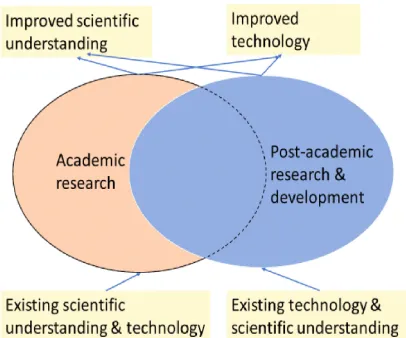
Donald Stokes, presented a dynamic model, to represent many connections, but retained the adjectives ‘pure basic’ and ‘purely applied’. Considering the role of technology in research and vice versa, the fact that the boundary between different categories of research cannot be sharp, and derogatory usage of adjectives like pure, fundamental etc. by certain authors (Shockley, 1956), the dynamic model by Donald Stokes needs a revision and I propose an alternate as in Fig. 3 for the relationship. I dispense with all adjectives like basic, pure, fundamental, applied, mirror image and choose to use ‘academic research’ and ‘post-academic research & development’ to harmonise the representation of the relationship with methods of knowledge production as they have now emerged. The words ‘scientific understanding’ as used here represents under-standing in all branches of science including natural sciences, engineering sciences, health (or medical) sciences, agricultural sciences and social sciences. The words ‘existing scientific understanding’ used in Fig. 3 include human resource trained in existing understanding of science, instrumentation, computational methods, simulation techniques and systems approach. Academic research includes both directed and un-directed research. The boundary between academic and post-academic research is not sharp, rather there is a large overlap between the two. Post-academic research can have epistemic sub-objective and academic research can have an objective that leads to its practical use. Both existing scientific understanding and technology are inputs to both types of research, but their relative contribution could vary – so note the switch in the order in which they appear.
becoming more and more important as cost of empirical testing and complex prototype systems is mounting. Brookes (1994) elaborates:
Theoretical prediction, modeling, and simulation of large systems, often accompanied by measurement and empirical testing of subsystems and components, has increasingly substituted for full scale empirical testing of complete systems, and this requires design tools and analytical methods grounded in phenomenological understanding. This is particularly important for anticipating failure modes under extreme but conceivable conditions of service of complex technological systems.
Research, particularly in engineering, agriculture and medicine, must lead to guidelines for practice. As stated earlier, improved under-standing finds place in text books and hand books before it is used in practice by engineers. This is applicable to understanding based on research in natural sciences as well as engineering science. For example, pressure vessels are designed based on codes developed by professional societies. Methodologies included in the codes are based on detailed investigations that have been published by researchers. Before results based on published research can find a place in a design code and put to practice, a lot of work is involved and that kind of work is also research and equally important. It is through this process that ASME Boiler and Pressure Vessel code has gone from 114 pages contained in one volume when first issued in 1914 to 17,000 pages contained in 31 volumes in the edition issued in 2017. This process of including results of research in design codes is akin to ‘translational research’, a phrase commonly usedin life and health sciences.
5. DOCTORAL RESEARCH
[image:15.612.77.280.115.284.2]For doctoral research, a student and the acad-emic supervisor select a problem which can be completed in a specified time frame and the problem should have enough epistemic content to justify the award of a degree of doctor of philosophy in a discipline. ‘Originality’ and
Fig. 3. A representation of the relationship between science and technology.
Thus, prior technical knowledge is a significant contributor toward development of a new technology or improvement of an existing technology. The prior knowledge includes know-ledge cross-over from one industry to another. The field of probabilistic safety analysis as used by nuclear engineers can be taken as an example. It crossed-over to nuclear industry from aviation industry. The overlap or the intersection between post-academic and academic research is a recognition of the fact that knowledge can be created at the point of application, as well as the fact that academic research can have practical use. Subject areas will depend on the context of application. For nuclear energy, intersection will include research covering subjects such as reactor physics, nuclear chemistry, fluid mechanics, fracture mechanics and others; for space appli-cations, it will include earth and space sciences, avionics, aerodynamics, propulsion etc.
‘significant contribution to knowledge’ understood in relation to each other are the explicitly stated criteria for the award of a Ph.D. Even when post-academic research has gained prominence, the requirement of contribution made by a student to knowledge in the form of methodologies, new concepts and theories has to be significant and have general applicability. It is particularly appli-cable to engineering science where, theoretical prediction, modeling, and simulation of large systems, often accompanied by measurement and empirical testing of subsystems and components, has increasingly substituted for full scale empirical testing of complete systems. Development of new design tools and analytical methods grounded in phenomenological understanding become very important in such cases.
A thesis may address a problem that has elements of professional practice, but the findings based on research should lead to improvement of professional practice (Winter et al., 2000) including regulatory regime or should have policy impli-cations. Based on a survey related to practice based research leading to Ph.D., Winter et al. (2000) conclude that a doctoral thesis must demonstrate relevance of knowledge generated “beyond the immediate context”. This must be ensured by a student irrespective of the topic of research. However, to paraphrase Charles Darwin16, a parade of mathematics need not be a
necessary element of a thesis.
6. CONCLUDING REMARKS
Based on an analysis of various views about the relationship and knowledge production including my own views formed during a long career pursuing research and development, and academics, I would like to list the following as characteristics of the many facets of the relation-ship and current methods of knowledge production.
6.1 Relationship between Science and Technology
6.1.1 Science consists of several disciplines, each having its own characteristics. As a result, ‘research is too heterogeneous and doesn’t lend itself to a single model. Quest for knowledge and inspiration for use can exist independently as well as simultaneously. A scientist while pursuing the objective of increasing the state of knowledge can have a sub-objective in the use of the knowledge in improving or inventing an artefact. Similarly, an engineer while pursuing practical arts can also have an epistemic sub-objective in science. 6.1.2 The strength of the link between science and technology varies from discipline to discipline. It is strong in case of electrical (including electronics and opto-electronics), chemical, aerospace, nuclear and computer technologies and not so strong in case of classical mechanical techno-logies. In emerging mechanical technologies such as robotics, its link with mathematical and computer sciences is quite strong. So is the case with the development of new materials having specific properties. There are individuals, who are members of both communities. This is particularly so in case of disciplines where linkage is strong. 6.1.3 Engineering science has emerged as a distinct discipline with its own norms, practices and journals. Increasing complexity of techno-logical systems is driving development of analytical, computational and simulation tools and this in fact is the major activity that comprises engineering research.
6.1.4 Results of undirected research may be separated from use in space and time, but do find use in textbooks, ordered knowledge of handbooks, university courses and eventually to application in a field. However, time to application could vary: it can be short, or very long – several decades.
6.1.5 Pursuit of undirected, but skilfully relevant, research in mission-oriented research and develop-ment organisations provides a body of in-house expert-consultants who can catalyse altogether new developments and also help in solving unusually difficult technical problems.
6.1.6 The Fig. 3 represents the relationship between science and technology. It recognizes that science and technology are intertwined and the progress in one depends on itself and the other. In this figure, adjectives like basic, pure, funda-mental, applied, mirror image are dispensed with and phrases ‘academic research’ and ‘post-academic research & development’ are used to harmonise the representation of the relationship with methods of knowledge production as they have now emerged.
6.2 Methods of Knowledge Production
6.2.1 Work places such as industry, consultants, non-governmental think tanks, and international agencies are store-houses of knowledge; they use knowledge as well as generate and disseminate knowledge. Knowledge production, therefore, is now distributed across many actors. It is not a new element. Prior to the advent of research univer-sities and laboratories, work places were genera-ting knowledge and they are doing so again now. Considering that work places generate knowledge, one can integrate the function of education or a university to a work place.
6.2.2 Due to squeeze in funding and linkage of knowledge with economy, in addition to teaching and research, universities now have a third mission that is participation in the economic development of the society. This has added significant entrepre-neurial activity to the university.
6.2.3 Complexity of issues and environment surrounding researchers are replacing the norm CUDOS with PLACE in many instances. Since the university faculty will continue to work on both academic research and post-academic research, they must ensure that while contributing to
industry or social problems, they can continue making fundamental contribution to the develop-ment of new methodologies, new concepts and theories.
6.2.4 Funding constraints have also triggered setting up of many mega-science projects and have given a role to science in diplomacy. A direct opposite to this cooperation is the emergence of technology control regimes and nations targeted by such regimes are forced to steer their research priorities to ‘reinvent the wheel’.
6.2.5 As post-academic research becomes a predominant activity, it is influencing doctoral research as well. However, main criteria for the evaluation of doctoral research will continue to be ‘originality’ and ‘significant contribution to knowledge production’ understood in relation to each other. Even when post-academic research has gained prominence, the requirement of contri-bution made by the student to knowledge in the form of methodologies, new concepts and theories has to be significant and have general applicability. While a thesis may address a problem that has elements of professional practice, the findings must lead to improvement of professional practice including further evolution of an informed policy framework and regulatory regime.
ACKNOWLEDGEMENTS
Author thankfully acknowledges useful observations by P Rama Rao, S Banerjee, SA Bhardwaj, KN Vyas, Vasudev Rao, BK Dutta, RR Puri, and Praveen Chaddah on the draft as it was evolving. However, the material included in the paper is based on the decisions taken by the author.
BIBLIOGRAPHY
Bentley, P J; Gulbrandsen M and Kyvik S. The Relationship between Basic and Applied Research in Universities,
High Edu, 70(2015): 689–709.
Bush, V. Science – The Endless Frontier, A Report to the President by Vannevar Bush, Director of the Office of Scientific Research and Development, July 1945, United States Government Printing Office, Washington, 1945.
Cuevas, A. The many faces of science and technology relationships, Essays in Philosophy, 6. 1(2005) Article 3.
Drucker, Peter. Technological trends in the twentieth century, in the book of essays by Drucker, Technology,
Management and Society, Pan Books Ltd., London,
1970.
Etzkowitz, H and Leidesdorff, L. The dynamics of innovation: from National Systems and “Mode 2” to a Triple Helix of university–industry–government relations, Research Policy, 29 (2000): 109–123. Etzkowitz, H; Webster A; Gebhardt C & Terra B R C. The
future of the university of the future: evolution of ivory tower to entrepreneurial paradigm, Research Policy, 29(2000): 313–330.
Etzkowitz, H. Research groups as ‘quasi-firms’: the invention of the entrepreneurial university, Research
Policy, 32(2003): 109–121.
European Parliament Council, Recommendation of the European Parliament and the Council of 23 April 2008 on the Establishment of the European Qualifications Framework for Lifelong Learning.
Frascati’s Manual. Guidelines for Collecting and Reporting Data on Research and Experimental Development, 7th edition (2015): para 1.35 and 1.36
Goldstein, A P and Narayanamurti, V. Simultaneous pursuit of discovery and invention in the US Department of Energy, Research Policy, 47(2018): 1506–1512. Grover, R B. Setting up of Homi Bhabha National Institute,
(2017), retrieved at https://www.dropbox.com/sh/ 3uwqetea7xuwzd0/1dEIsyXF9_?preview=Nov+2 017+Setting+up+of+Homi+Bhabha+Nationa l+Institute+by+Dr+RB+grover.pdf on 18.04.2018. Hessels, L K and Lente, van Harro. Re-thinking new
knowledge production: A literature review and a research agenda, Research Policy, 37(2008): 740– 760.
Kakodkar, A and Grover, R B. Nuclear research centres: their evolution in the Indian context, Meeting on Nuclear Research Centres in the 21st Century, Vienna, Dec.1999.
Kaoru, N. The Co-existence of Several Ideas of a University, in The Idea of a University in Historical Perspective: Germany, Britain and Japan, edited by K. Sneba, Y. Yasuhara and T. Hata, (Reviews in Higher Education 84), Research Institute for Higher Education, Hiroshima University, 2005, pp 79–84.
Katz, A. Fusion Power: Is ITER the way, Bulletin of the
Atomic Scientists, (October 1992): 8–10.
Kellogg, D. Toward a Post-Academic Science Policy: Scientific Communication and the Collapse of the Mertonian Norms, International J of Communications
Law & Policy, Special issue, Access to Knowledge,
Autumn 2006.
Kuhn, Thomas. The Structure of Scientific Revolutions, University of Chicago Press, 1962.
Layton, E T Jr. Technology as knowledge, Technology and
Culture, 15.1(January 1974): 31–41.
Layton, E T Jr. Mirror-Image Twins: The Communities of Science and Technology in 19th Century America,
Technology and Culture, 12.4(October 1971): 562–
580.
Narsimha, R (undated). Math, Science, and Technology in India—From the Ancient to the Recent Past, Asia society, accessed on 6 August 2018 at https:// asiasociety.org/education/math-science-and-technology-india.
Narasimha, R. Science, Technology and Economy: An Indian Perspective, 2008, accessed on 6 August 2018 at http://jncasr.ac.in/emu/rnsimha/RN_Website_ 12may08/rn_files/Attachments/STE-22June2008.pdf. Narayanamurti, V and Odumosu, T. Cycles of Invention and Discovery: Rethinking the Endless Frontier, Harvard University Press, 2016.
Nehru, J. The Discovery of India, 1946.
Nowotny, H; Scott P and Gibbons M. ‘Mode 2’ Revisited: The New Production of Knowledge, Minerva, 41(2003):179–194.
Price, D S. The Science-Technology Relationship, the Craft of Experimental Science, and Policy for the Improvement of High Technology Innovation,
Research Policy, 13.1(1984): 3–20.
Sengupta, D L and Sarkar, T K. Maxwell, Hertz and the Maxwellians, and the early history of electromagnetic waves, IEEE Antennas and Propagation Magazine, 45.2(April, 2003).
Department study of the utility of research, Science, Jun 23, 1967; 156(3782): 1571–7.
Shockley, W. Transistor technology evokes new physics, Nobel Lecture, 11 December 1956, accessed on 6 June 2018 at https://www.nobelprize.org/nobel_prizes/ physics/laureates/1956/shockley-lecture.pdf. Snow, C P. The Two Cultures and the Scientific Revolution,
Cambridge University Press, New York, 1961. Srinivasan, S & Ranganathan, S. India’s Legendary Wootz
Steel: An Advanced Material of the Ancient World, Iron & Steel Heritage of India, National Institute of Advanced Studies, Bangalore 2004, pp 69– 82, accessed on 2 August 2018.
Stokes, D E. Pasteur’s Quadrant: Basic Science and
Technological Innovation, Brookings, 1997.
Toffler, A. Power Shift, Bantam Books, New York, 1990.
Toffler, A and Toffler, H. Revolutionary Wealth, Alfred A Knopf, New York, 2006.
USNAP, “Graduate STEM Education for the 21st Century”, A Consensus Study Report of the National Academy of Sciences, Engineering and Medicine, The National Academies Press, USA, pre-publication copy, accessed on 28th July 2018.
Winter, R; Griffiths M and Green K. “The Academic Qualities of Practice: What are the criteria for a practice-based PhD?”, Studies in Higher Education, 25.1(2000): 25–37.
Wise, G. Science and Technology, OSIRIS, 1(1985): 229– 246.