XNU: a security evaluation
D Keuper (s1019775)
University of Twente and Certified Secure
Abstract
The XNU kernel is the kernel that powers Apple’s OS X and iOS operating system. Originally developed by Next, but later acquired by Apple it has been around for more then twenty years. It is only since the introduction of code signing on iOS that hackers have developed a real interest in XNU. Prior to iOS 2.0 only a handful of articles were published on XNU in the context of security. In the past few years the interest of hackers increased by the popularity of jailbreaking (the process of removing the security restrictions of iOS) and iOS security is often discussed at the various security conferences. The interest of hackers in the XNU kernel has not gone unnoticed by Apple, which started to harden the security of their XNU kernel. In the latest releases of their operating systems they added different mitigation techniques such as kernel ASLR.
The latest release of OS X (Mountain Lion) and iOS (6) are hardened with new protection mechanisms, which should reduce the risk of successful exploitation. In this thesis we describe all techniques that are meant to protect the kernel from attackers and their implementation. We argue the effectiveness of those techniques and how an attacker might try to circumvent them. We conclude this thesis with a comparison with other kernels, our opinion on the current security state of the XNU kernel and some recommendations on how to further improve the security.
Contents
I
Introduction
4
1 Introduction 5
1.1 Introduction . . . 5
1.2 The history of XNU . . . 5
1.3 Kernel security and exploitation . . . 7
1.4 Contents . . . 8
1.4.1 Purpose of our research . . . 8
1.4.2 Research questions . . . 8
1.4.3 Versions and source code . . . 9
1.4.4 Outline . . . 9
2 General design 11 2.1 Introduction . . . 11
2.2 The design of the XNU kernel . . . 11
2.2.1 General overview . . . 11
2.2.2 The different components . . . 12
2.3 Syscalls . . . 13
2.3.1 Syscalls in XNU . . . 13
2.3.2 BSD syscalls . . . 14
2.3.3 Mach Traps . . . 15
2.3.4 Moving data from user to kernel space . . . 16
2.4 Memory management . . . 16
2.4.1 Virtual memory . . . 16
2.4.2 Process stack . . . 17
2.4.3 The heap allocators . . . 17
2.5 Conclusion . . . 18
II
XNU security features
20
3 Memory protection 21 3.1 Introduction . . . 213.2 WˆX protection . . . 21
3.3 NULLpointer dereference protection . . . 23
3.4 Kernel ASLR . . . 25
3.5 Heap protection . . . 27
3.6 Stack canaries . . . 28
4 Code signing and sandboxing 30
4.1 Introduction . . . 30
4.2 Code signing . . . 30
4.2.1 The iOS secure boot chain . . . 30
4.2.2 Application code signing . . . 32
4.3 Sandboxing . . . 35
4.4 iOS jailbreaks . . . 35
4.4.1 Tethered versus untethered jailbreaks . . . 35
4.4.2 Tethered jailbreaks . . . 36
4.4.3 Untethered jailbreaks . . . 38
4.5 Conclusion . . . 38
III
Exploitation techniques
39
5 Security research 40 5.1 Introduction . . . 405.2 Strategy . . . 40
5.2.1 OS X . . . 40
5.2.2 iOS . . . 40
5.3 Attack vectors . . . 41
5.3.1 Syscalls . . . 41
5.3.2 I/O Kit . . . 41
5.3.3 ioctlcalls . . . 42
5.3.4 File systems . . . 42
5.4 Conclusion . . . 42
6 Exploitation 43 6.1 Introduction . . . 43
6.2 Bypassing the mitigation techniques . . . 43
6.2.1 Kernel ALSR . . . 43
6.2.2 Stack canaries . . . 46
6.2.3 WˆX protection . . . 47
6.2.4 Code signing . . . 48
6.2.5 Sandboxing . . . 48
6.3 Exploitation . . . 49
6.3.1 Attacking the zone allocator . . . 49
6.3.2 The post-exploitation step . . . 51
6.4 Conclusion . . . 52
IV
Evaluation and comparison
54
7 Comparison 55 7.1 Introduction . . . 557.2 FreeBSD . . . 56
7.2.1 Memory protection . . . 56
7.2.2 Advanced mitigation techniques . . . 56
7.2.3 Security research . . . 58
7.3.1 Memory protection . . . 58
7.3.2 Advanced mitigation techniques . . . 59
7.3.3 Research . . . 60
7.4 Windows . . . 60
7.4.1 Memory protection . . . 60
7.4.2 Advanced mitigation techniques . . . 61
7.4.3 Secure development practices . . . 62
7.4.4 Research . . . 62
7.5 Conclusion . . . 63
8 Conclusion and discussion 65 8.1 Introduction . . . 65
8.2 Research questions . . . 65
8.3 Discussion . . . 73
A Toolchain 75 A.1 Introduction . . . 75
A.2 OS X . . . 75
A.3 iOS . . . 77
A.3.1 Extracting kernel images . . . 77
A.3.2 Static analysis . . . 78
A.3.3 Debugging the kernel . . . 79
Part I
1
Introduction
1.1
Introduction
XNU, which is an acronym for X is Not Unix, is the kernel used by Apple in its OS X and iOS operating system. It has been the default kernel for Apple’s operating systems since the first release of Mac OS X in 2001. Originally developed by NeXT for their NeXTSTEP operating system (which was later acquired by Apple), the XNU kernel has a long history with its first public release in 1989.
For this thesis we investigated the current state of the XNU kernel in the context of security. We try to answer the question ’how secure is the XNU kernel?’.
1.2
The history of XNU
The Mach kernel project was started in 1985 at the Carnegie Mellon University in Pittsburgh. Its goal was to build a true micro kernel which could act as a replacement for the BSD kernel. At the time the generally accepted theory was that micro kernels would eventually replace the monolithic kernels used at the time. In a micro kernel design as much code as possible is moved from kernel space to user space in so called services, making the kernel a message parsing service between the different services and between the hardware and its drivers in user space. This design should improve the overall stability since crashed user space services could be restarted without panicking the kernel, as well as offer a better security model by running services, such as drivers, under a less privileged account.
Despite the performance problems the Open Software Foundation (OSF) an-nounced they would use the Mach 2.5 kernel in their OSF/1 operating system and NeXT adopted the Mach 2.5 kernel for their NeXTSTEP operating system. However, the Mach kernel was not yet finished, it was lacking some important features like a virtual file system and a network stack. Therefore NeXT copied these features from the BSD kernel. This mixture of Mach and BSD was called XNU. Since the BSD components also run in kernel space, the XNU kernel is not a micro kernel but a monolithic kernel.
In the nineties Apple had to admit that their Mac OS operating system was missing some important features which were needed to be able to compete with their competitors at the time, most notably Microsoft who had just released their Windows 95 operating system. Apple’s current operating system at the time, called System 7, had no support for protected memory and preemptive multitasking. For this reason Apple started a new research project called Cop-land. Copland was intended to become the successor of System 7, but the release date kept slipping into the future. It became clear to Apple that Copland would never see a final release, so Apple decided to buy an existing operating system instead, and cancel the development of Copland.
There were two candidates at the time for an acquisition by Apple. Both can-didates were founded by ex employees of Apple. The first option was Be which developed BeOS and was founded by Jean-Luis Gass´ee. The other was NeXT, which was founded by Steve Jobs, with their NeXTSTEP operating system. Apple chose for NeXT and announced the acquisition of NeXT on December 20, 1996.
Ever since the acquisition of NeXT, Apple continued working on their new operating system under the code name Rhapsody, which would eventually be released as Mac OS X (which was renamed to just OS X with the release of Mountain Lion). Before the consumer version was released, Apple first released Mac OS X Server 1.0 on March 16, 1999. This server OS contained components from all of the operating systems Apple owned at the time (Mac OS, NeXTSTEP and Mac OS X). The consumer edition, called Mac OS X 10.0, was released on March 24, 2001, more then four years after the acquisition of NeXT. Mac OS X was the first operating system by Apple that featured the XNU kernel, and it has been the OS X kernel ever since. Apple made some changes to the original XNU kernel over time, most notably the additions of I/O Kit for driver development, the update of the Mach component from version 2.5 to version 3.0 and the porting of XNU to the Intel and ARM processors as well as the transition from 32-bits to 64-bits.
1.3
Kernel security and exploitation
Kernel exploitation is the art of exploiting a vulnerability in kernel space. It is no new technique and kernel exploits have been seen for all major platforms. Nonetheless they are less common than exploits for user space applications, which can be devoted to the fact that kernel exploits often require a higher skilled attacker due to the added complexity in kernel space, by for example concurrency and a less sophisticated debug setup.
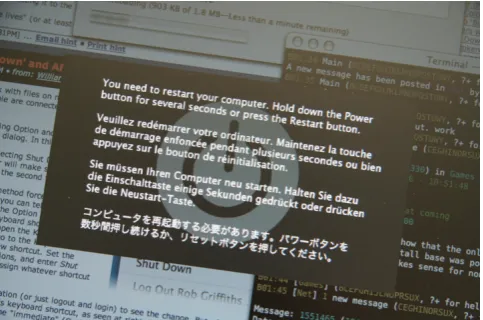
[image:10.595.175.417.408.568.2]The performance of today’s computers allows us to implement more advanced exploitation mitigation techniques. Modern operating systems are equipped with multiple techniques in order to prevent successful user space exploitation, such as NX protection, ASLR and stack canaries. While many of those tech-niques are provided by the kernel, it is interesting to note that they are often not used to protect the kernel itself. This can be because the impact on per-formance would be too large, or because of implementation difficulties in kernel space. This makes the kernel an interesting target for attackers and protecting the kernel against those attackers is critical. The kernel runs at the highest privilege level available and exploiting the kernel gives the attacker full system privileges. As ‘a chain is only as strong as its weakest link, which will become the target for attackers’[36]. If user space applications are protected by ad-vanced exploitation mitigation techniques, it is only natural that attackers will focus on the kernel instead.
Figure 1.1: a crashed XNU kernel
Because the kernel should remain in a stable state, the attacker should have a deep understanding of some of the kernel internals. There are more processes that require kernel resources at the same time. Therefore a solid understanding of the kernel scheduler and virtual memory system is required for writing a reliable kernel exploit.
1.4
Contents
1.4.1
Purpose of our research
Millions of people use the XNU kernel everyday without knowing. The XNU kernel is used to power almost all hardware platforms from Apple. All OS X devices like the MacBook and iMac are powered by XNU, but also all iOS powered devices, such as the iPhone, iPad and the Apple TV, run on the XNU kernel. During the lifetime of XNU it has powered numerous operating systems and got ported to multiple architectures like the PowerPC, Intel and ARM.
While the XNU kernel is roughly twenty years old and is used on so many devices in today’s world, it never received much attention from the security scene. It is only since the release of iOS 2.0, which featured code signing, that hackers (or for iOS often referred to as jailbreakers) started investigating and exploiting the XNU kernel. Because the jailbreaking scene is playing a cat and mouse game with Apple by breaking the security model of iOS, Apple is starting to invest into kernel security.
Since the XNU kernel was long time ignored by the security field a lot of in-formation about XNU in the context of security is either missing, incomplete or outdated. With our research we hope to close this gap and provide other researchers with a current list of security features in the XNU kernel and new insights about exploiting it. Our research is threefold, first we will discuss some of the current features of the XNU kernel in the context of security. This covers both the implementation details of certain components as well as the currently active mitigation techniques. Secondly we will discuss what attackers can do to gain code execution in kernel space and thus circumvent the present mitigation techniques. Lastly we compare the XNU kernel with other kernels and their mitigation techniques.
1.4.2
Research questions
We try to answer the following research questions:
1. What security mechanisms are currently implemented and how effective are they against exploitation?
2. How much protection does the XNU kernel offer when compar-ing it to other kernels?
By comparing the answer of the first research question with that of other mainstream kernels, we can say something about the level of security the XNU kernel offers to its users, as well as pointing out some points of improvement.
3. Which exploitation techniques can be used under XNU?
When looking at other kernels there are a lot of public exploits available together with presentations that cover the topic of exploitation. This not only makes the life of exploit developers a little easier, but this information is also useful for further protecting a kernel against attackers. By investi-gating these techniques, developers can focus on disarming the commonly used tricks.
4. How can we harden the security of the XNU kernel?
By answering the three research questions above we should have a solid understanding of the current state of security in kernels and the XNU kernel in specific. Based on those findings we should be able to make some specific recommendations for further enhancing the security of the XNU kernel.
1.4.3
Versions and source code
This research is based on the latest version of OS X and iOS at the time of writing. For OS X this is version 10.8.2 (Mountain Lion) and for iOS this is version 6.0.1.
Throughout this thesis numerous source code examples are listed from the XNU source tree, these were taken from XNU version 2050.18.24. A local copy can be obtained from opensource.apple.com/tarballs/xnu/xnu-2050.18.24.tar.gz or be viewed on line at opensource.apple.com/source/xnu/xnu-2050.18.24/. The XNU source is released under the BSD1and APSL2 license.
The core component of OS X and iOS is called the Darwin operating system and is maintained by Apple under an open source license. Darwin is POSIX compliant and contains the XNU kernel as well as many system libraries and system utilities. Darwin does not contain the graphic components that are used in OS X and iOS. More information about Darwin and its source code can be found at Apple’s open source website at opensource.apple.com.
1.4.4
Outline
We start with describing the design an implementation of the XNU kernel in Chapter 2. This includes a description of the different components of XNU, the syscall calling mechanisms and how XNU manages memory allocations. This chapter concludes the introduction part of his thesis.
The next part focuses on the security mechanisms present in todays XNU re-lease. In Chapter 3 we describe all techniques that should mitigate the risk of memory corruption in kernel space (e.g. kernel ASLR and heap protection). Chapter 4 describes the more advanced protection mechanisms, that not only protect the kernel but the whole system (i.e. code signing and sandboxing). This part will only describe the implemented techniques, but not how an at-tacker might bypass them. Note that we can only see the protection mechanisms that should prevent exploitation at runtime. It is unknown if Apple also uses some form of static or dynamic source code analyzer to detect vulnerabilities before compilation.
Part III focuses on security research and exploitation. We start this part with Chapter 5, which describes the techniques that can be used to find new vulner-abilities as well as possible attack vectors. Chapter 6 goes into greater detail on how to bypass the mitigation techniques and exploit certain vulnerabilities (such as exploiting the zone allocator). Knowing where and how an attacker might strike, helps in forming the recommendations to increase the level of protection the XNU kernel can offer.
In the final part we compare and conclude our research. Chapter 7 compares the security features of XNU with that of other kernels. In the final chapter (Chapter 8) we answer our research questions and give our opinion and recommendations about the security of XNU.
2
General design
2.1
Introduction
The XNU kernel is a hybrid of the Mach kernel and the BSD kernel. There are no user space services (for the file system or network stack for example) like in the design of the original Mach kernel. This has its implications for security, since the attack surface for the kernel is much larger in a monolithic design. Kernel services that would run in user space could run as a less privileged user, something which is not possible in a monolithic design.
This chapter should give the reader a basic understanding of the design of the XNU kernel, as well as some more in depth insights in the way XNU handles memory management and syscalls. This chapter details how the different com-ponents of XNU interact with each other, which is a necessary precondition when doing security research in XNU. The rest of this thesis assumes that the technical details presented in this chapter are known to the reader.
2.2
The design of the XNU kernel
2.2.1
General overview
The XNU kernel is separated into three core components that heavily interact. Each component has its own origin and a specific task and reason to be included into the XNU kernel. The components are: the original Mach kernel, specific parts of the FreeBSD kernel and Apple’s own I/O Kit framework for drivers.
At the basis of XNU lies the Mach kernel. The Mach kernel was developed by Carnegie Mellon University from 1985 until 1994. Mach is one of the few true micro kernels, which means that things like a network stack or a virtual file system are not included. To add those features, NeXT copied them from the BSD kernel. In a true micro kernel concept, such as Mach, these functions should run in user space, but in the XNU kernel the BSD component also runs in kernel space.
Memory
management Scheduler Interupt Task Thread Exception Process POSIX
thread Signal
IPC Mach message Syscall
BSD
Mach
Syscall
[image:15.595.129.463.130.271.2]VFS, /dev, network
Figure 2.1: XNU design overview as sketched by Lucy[21]
hardware devices, such that hardware manufactures only have to implement a communication channel to the actual hardware.
In figure 2.1 one can see that BSD extends many of the Mach concepts. Where Mach introduces the concept of tasks, BSD extends this concept with its defini-tion of processes, which adds things like a user ID and terminal to a task. Both Mach and BSD provide user space applications with various syscalls. BSD syscalls work by invoking the syscall handler with a syscall number, whereas Mach syscalls work by sending IPC messages to the kernel.
2.2.2
The different components
Mach
Being a micro kernel, Mach is responsible for all low level hardware interaction, the scheduler and the memory management. The Mach component can be found under osfmk/in the XNU source tree.
Mach is designed as a message passing service. Rather than invoking func-tions, Mach enables applications to send messages back and forth in order to communicate. The idea of message passing is widespread in the design and implementation of OS X and iOS.
BSD
As an example we look at the implementation of the Mach task struct, which has its BSD counterpart in a process struct. In listing 1 we can see that a Mach task has a pointer to its process struct and vice versa.
// osfmk/kern/task.h
struct task { ...
void* bsd_info; ...
};
// bsd/sys/proc_internal.h
struct proc { ...
void* task; ...
};
Listing 1: thetaskandprocessstruct with a pointer to each other
I/O Kit
To reduce the complexity of driver development for XNU, Apple added a driver framework called I/O Kit. I/O Kit uses a minimal version of C++, called Embedded C++, which misses features that are, accordingly to Apple, unsafe for usage in a kernel, like multiple inheritance, templates and exceptions[4].
I/O Kit contains base classes for many different hardware types. Meaning that hardware vendors can focus on implementing hardware specific features, instead of writing an entire device driver from scratch. Base classes are called families in I/O Kit, for example there is acom.apple.iokit.IOUSBFamilyfamily for USB and a family for human input devices called com.apple.iokit.IOHIDFamily. The I/O Kit source can been found underiokit/in the XNU source tree.
2.3
Syscalls
2.3.1
Syscalls in XNU
Syscalls are the main entry point to kernel space for user space applications. Syscalls cover a large portion of the kernel source and, because they can be called from user space, are a large attack vector. In this section we describe the calling mechanism for syscalls in the XNU kernel.
compliant and are equal to that of FreeBSD. The Mach syscalls have a negative number so that they don’t interfere with the BSD syscalls.
Calling a syscall on OS X follows the System V ABI[23]. A syscall is invoked by thesyscall[16] instruction. The syscall number is passed in the raxregister, which will also hold the return value upon return. Syscalls normally support up to six arguments which are passed through using therdi,rsi,rdx,r10,r8and
r9 registers respectably. If a syscall requires more than six arguments it will copy the arguments from the user space stack, pointed to by the rspregister, using thecopyin()method (described in 2.3.4). As an example, the assembly code below will call exit(42)under OS X:
mov rax, 0x2000001 ; exit has syscall number 1
mov rdi, 0x2a ; give 42 as argument
syscall ; invoke the syscall handler
Listing 2: callingexit() on OS X
On iOS the calling convention is similar, but adapted for the ARM architec-ture. The arguments for syscalls are passed through the R0, R1, R2, and R3
registers as defined in the ARM ABI[6]. When requiring more arguments the data is copied in from the user space stack. The syscall number is passed in theR12register, which is also called the Intra-Procedure-call scratch register or
IPregister for short (not to be mistaken with the Instruction Pointer, which is stored inR15). The syscall is invoked using thesvc 0x80[7] call, which raises a software interrupt. As an example, the assembly code below will callexit(42)
under iOS:
mov r12, 0x1 ; exit has syscall number 1
mov r0, 0x2a ; give 42 as argument
svc 0x80 ; invoke the syscall handler
Listing 3: callingexit() on iOS
2.3.2
BSD syscalls
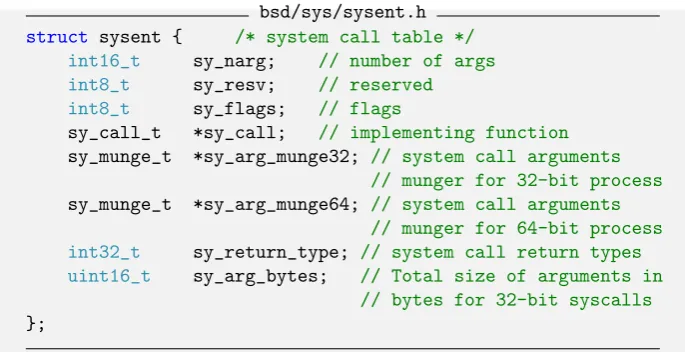
All BSD syscalls ends up in the so called sysent table, defined in bsd/kern/ init_sysent.c(the file can be generated by runningbsd/kern/makesyscalls. sh syscalls.master). Thesysenttable holds asysentstruct for each syscall, which is shown in listing 4.
The BSD syscalls are handled by the unix_syscall64() method for 64-bits applications and theunix_syscall()method for 32-bits applications. Both are defined inbsd/dev/i386/systemcalls.c. The methods have one argument: a pointer to a so called saved state struct. The saved state struct holds the value of all CPU registers at the moment of kernel entry. The unix_syscal[64]()
bsd/sys/sysent.h
struct sysent { /* system call table */
int16_t sy_narg; // number of args
int8_t sy_resv; // reserved
int8_t sy_flags; // flags
sy_call_t *sy_call; // implementing function
sy_munge_t *sy_arg_munge32; // system call arguments // munger for 32-bit process
sy_munge_t *sy_arg_munge64; // system call arguments // munger for 64-bit process
int32_t sy_return_type; // system call return types
uint16_t sy_arg_bytes; // Total size of arguments in // bytes for 32-bit syscalls
};
Listing 4: thesysentstruct
too high they will invoke thecopyin()method to copy the arguments to kernel space. In the end they will call the syscall by thesy_callfunction pointer in thesysentstruct.
2.3.3
Mach Traps
[image:18.595.125.468.121.297.2]The Mach syscalls are called through the IPC subsystem, but behind the scenes it uses the syscall mechanism. The various Mach Traps are combined in a large table called the mach_trap_table, similar to the BSD sysent table. There are currently a little over 30 active traps, much less than the number of BSD syscalls (more than 300). Each trap in themach_trap_tablehas amach_trap_t
structure, which is shown in listing 5.
osfmk/kern/syscall sw.h
typedef struct {
int mach_trap_arg_count;
int (*mach_trap_function)(void); ...
#if MACH_ASSERT
const char* mach_trap_name;
#endif /* MACH_ASSERT */
} mach_trap_t;
Listing 5: themach trap tstructure
Themach_trap_table is defined inosfmk/kern/syscall_sw.c. A trap is in-voked by the kernel_trap() macro, which is machine dependent (the x86 64 version is defined in osfmk/mach/i386/syscall_sw.h). The kernel_trap()
2.3.4
Moving data from user to kernel space
If a syscall has to many arguments, or the arguments cannot be stored in a CPU register (like a string for instance) the data must be copied from user space into kernel space. In XNU thecopyin()method is used to copy data from user space to kernel space, whereas the copyout() method works the other way around by coping data from kernel space to user space. Both the copyin() and the
copyout()method are wrappers around thecopyio()method, which is defined in osfmk/x86_64/copyio.c(for the x86 64 architecture).
In the old 32-bit version of XNU, used in Mac OS X until Snow Leopard, XNU did not share its address space with user space. Instead the kernel had its own virtual address space, requiring a context switch on every call to the kernel. Nowadays the XNU kernel shares its address space with the user space appli-cation. This allows a much simpler implementation of the copyin()function (before a special copy window had to be created with a shared memory seg-ment). Thecopyio()function will do some initial checking before invoking the
_bcopy()function, which is defined inosfmk/x86_64/locore.sfor the x86 64 architecture. The_bcopy()function will copy the data directly from user space based on a source and destination address and a length parameter.
2.4
Memory management
2.4.1
Virtual memory
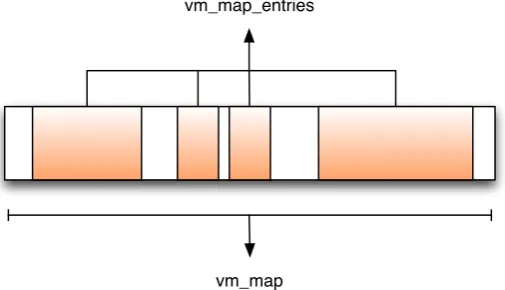
In modern operating systems memory is virtual, just like the file system. For each process it will look like he owns the entire address space. The memory manager is responsible for mapping virtual memory to physical memory. Un-der XNU a virtual memory map is represented by a _vm_map struct, defined in osfmk/vm/vm_map.h. Because not the entire virtual memory address space is mapped at any given moment, the virtual memory map is divided in sev-eral entries, each representing a continuous block of mapped memory which share common properties. Each entry is represented by avm_map_entrystruct (also defined inosfmk/vm/vm_map.h), which holds access rights information for example. Figure 2.2 illustrates the concepts of the virtual memory map.
vm_map vm_map_entries
Figure 2.2: the vm map with multiple entries
2.4.2
Process stack
Each user space thread has a corresponding stack in kernel space, which is used whenever code gets executed in kernel space (when calling a syscall for example). The kernel stack base pointer is declared in thethreadstruct, which is defined in osfmk/kern/thread.h. The kernel stack works just like its user space equivalence and follows the platforms ABI convention.
Whenever a thread gets started, the kernel_thread_create() function will invokestack_alloc(), which is defined inosfmk/kern/stack.c. The stack_ alloc()method will allocate a new stack and attach it to the specified thread. Stacks are stored in a stack free list, which is a single linked list. If the list is empty a new memory page is requested which will form the new stack for the thread. This means that kernel stacks are not necessarily adjacent in XNU.
2.4.3
The heap allocators
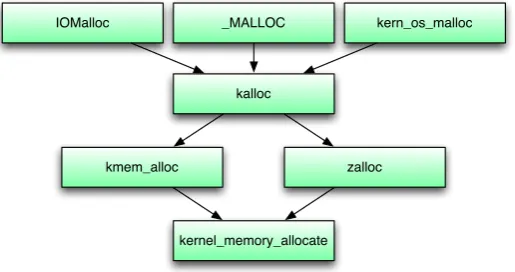
Allocating kernel memory on the heap is required when data should be preserved even when the current method returns and the current stack frame is removed from the stack. For this the XNU kernel provides multiple routines to choose from, depending on the location and requirements of the calling method. There are routines that will return aligned or wired memory for example, or routines that should only be called from the BSD or I/O Kit sections of the kernel. Some methods store meta information in- or outbound, others leave bookkeeping to the calling method. This section will give an overview of most common routines for allocating memory in the kernel. Figure 2.3 shows the most common path for allocating kernel memory.
In practice there are two allocators being used: the zone allocator (invoked by calling zalloc()) and the kmem_alloc() routine. The zone allocator is used for allocations up to 8 KB, whereas for larger allocations the kmem_alloc()
_MALLOC kern_os_malloc IOMalloc
kalloc
zalloc kmem_alloc
[image:21.595.168.426.134.270.2]kernel_memory_allocate
Figure 2.3: overview of heap allocating functions
whereaszalloc()manages its own pages and keeps track of free blocks. Because allocations rarely exceed the 8 KB mark, most allocations end up in the zone allocator.
The allocation routines, except for the zone allocator, require no further ex-planation. Reading the source when needed should provide the reader with all necessary information. The zone allocator is a notable exception because of its size and frequent usage. The rest of this section will therefore focus on the zone allocator.
The zone allocator (which is defined inosfmk/kern/zalloc.c), divides its mem-ory in zones. A zone has one or more associate pages which are divided into multiple blocks of the same size. Each zone has a name and is represented in thezone struct which is defined inosfmk/kern/zalloc.h. The current list of defined zones can be printed with thezprintcommand, which is shown in 2.4. A calling function will request a free block from a specified zone.
A zone keeps track of its free slots by an inbound single linked list. Each free block holds a pointer to the next free block, as can be seen in figure 2.5. When a new block is requested the allocator will pop the head of the free list for allocation. If a block gets freed its free pointer will point to the current head of the free list and the freed block will become the new head of the free list. The free list works on a ”first in, last out” bases.
The different zones are maintained by zalloc(). For the allocation of new memory it will invoke thekernel_memory_allocate()function. At boot time the kernel will create a list of default zones which are used by the kalloc()
routine, calledkalloc.*for all powers of two starting at 16.
2.5
Conclusion
Figure 2.4: overview of defined zones
4
3
2
1
head of freelist
2
1
head of freelist
4
2
1
head of freelist
Free zone After two allocations After one free
Figure 2.5: example of zone allocations
working kernel. Each component has a specific list of tasks within the the overall design of the kernel.
[image:22.595.139.458.358.482.2]Part II
3
Memory protection
3.1
Introduction
Memory protection works on the premises that applications (and thus the ker-nel) will always contain vulnerabilities that will allow an attacker to alter mem-ory of some sort. Rather than trying to find and fix the vulnerabilities itself, nowadays protection mechanisms try to limit the damage that can be done. Most kernel vulnerabilities concern some sort of memory overwrite. By care-fully corrupting memory an attacker could gain code execution in kernel space. There are many different types of memory corruption vulnerabilities, like for ex-ample a stack based buffer overflow, double free or write anywhere. Therefore, a single mitigation technique that can withstand all different attacks cannot exist. Modern operating systems implement different techniques that combined should prevent memory corruption vulnerabilities from becoming exploitable.
User space applications nowadays come with a whole arsenal of techniques which try to protect them against attackers. This has resulted in vulnerabilities that require either a higher skilled attacker or even have become unexploitable. After user space, manufacturers started to implement the same mechanisms in kernel space. Not all mechanisms have been implemented with the same level of effec-tiveness, due to the strict performance rules that apply in kernel space. A kernel that operates a few percent slower due to security checks has its effect on the performance of the entire operating system. Therefore protection mechanisms in kernel space must be low in required resources.
Apple only recently started with the implementation of protection mechanisms in kernel space. OS X Mountain Lion and iOS 6 contain new mechanisms (such as kernel ALSR) and others have been greatly improved (such as WˆX). This shows that Apple is actively trying to harden its kernel against attackers. In this chapter we describe the techniques present in todays release.
3.2
WˆX protection
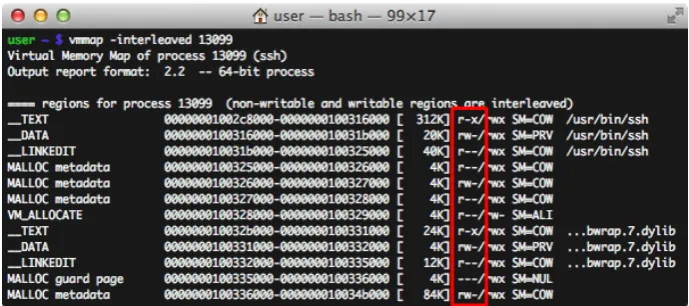
the patching of code in memory, by marking the code pages executable but not writable. It also protects against the execution of code from user controlled memory (such as the stack or the heap), a common used trick where the attacker would use a vulnerability to set the program counter to user controlled memory, to gain arbitrary code execution. WˆX prevents this attack by marking the pages that hold user controlled information as non executable.
[image:25.595.124.469.286.439.2]For user space applications one can use thevmmap command to print the cur-rently mapped memory pages and their permissions. Figure 3.1 shows some of the output ofvmmap of a running process. The red bordered column shows the current page permissions. In this example the first_TEXTsection (holding pro-gram code) is executable, but not writable and the first_DATAsection (holding initialized global and local static variables) is writable, but not executable.
Figure 3.1: vmmapoutput of a SSH process
In OS X Mountain Lion and iOS 6, Apple improved the number of pages that are WˆX protected in the kernel. The stack and the heap are marked non-executable, as it can contain user controlled data. This prevents the execution of code from user controlled data, meaning the attacker has to find new ways of executing code in kernel space.
Besides the non-executable heap and stack the code section can no longer be altered. Altering the code pages is used by the jailbreaking community to patch certain routings in kernel space. Most notably the disabling of the code signing enforcement, so that iOS will run custom signed binaries.
Important kernel structs such as the sysent struct (see Chapter 2 for more information about thesysentstruct) are placed in read-only memory. It was a common trick used to inject a new syscall into thesyscalltable, and then call this syscall from user space. This gives the attacker control over the instruction pointer.
protec-tion or to find a way around it, for example by chaining existing code chucks. A technique commonly referred to as Return Oriented Programming (ROP)[18].
3.3
NULL
pointer dereference protection
struct ucred* test = 0; test->cr_uid = 0;
int (*ptr)() = 0; ptr();
Listing 6: NULLpointer dereference
Consider the code of listing 6 in kernel space. Here two pointers are set to zero after which they are either dereferenced or called. Since there is nothing mapped at this location, the kernel will crash. The attacker can use this to its advantage by mapping a memory page at address 0 (using themmap()syscall). A precondition for this attack is that the kernels shares its address space with user space and that user space has control over the first page of virtual memory. In case of a function pointer the kernel will execute the attackers payload with kernel privileges. When the pointer points to a variable or struct, the attacker can try to change the program flow by altering the values to its advantage. Such a vulnerability is referred to as aNULLpointer dereference vulnerability.
#include <stdio.h> #include <unistd.h> #include <sys/mman.h> #include <fcntl.h>
int main(int argc, char **argv) {
void* page = mmap((void*)0x0, 4096, PROT_READ | PROT_WRITE | PROT_EXEC, MAP_PRIVATE | MAP_ANON | MAP_FIXED, -1, 0);
if ((long)page < 0) { perror("mmap"); } else {
printf("page mapped at %p\n", (void*)page); }
return 0; }
Listing 7: mapping a memory page at address 0
this code will succeed if it runs in 32 bit mode, for this the application needs to be compiled as a 32-bits executable (llvm-gcc -m32). Since in 32-bit mode the kernel does not share its address space with user space there is no harm in allocating a memory region at address 0, thusNULL pointer deferences are not exploitable.
OS X applications that are compiled as 64-bits applications share their virtual address space with the kernel. The bottom 128 TB can be used by the applica-tion as the top 128 TB is marked as kernel memory. Trying to access memory above the 128 TB border would raise an access violation error. When loading the Mach-O binary a special memory page is added, the so called page zero. This page is not actually mapped in memory, but prohibits the mapping of an-other page at address 0. The page zero page is 4GB in size by default, meaning the first 4 GB of memory in a 64 bits application cannot be mapped by the ap-plication. This effectively protects the kernel againstNULLpointer dereferences. The implementation of the page zero mapping in kernel can be seen in listing 8.
bsd/kern/mach loader.c
static
load_return_t load_segment(
... ) {
...
/*
* This is a "page zero" segment: it starts at address * 0, is not mapped from the binary file and is not * accessible. User-space should never be able to access * that memory, so make it completely off limits by * raising the VM map’s minimum offset.
*/
ret = vm_map_raise_min_offset(map, seg_size);
if (ret != KERN_SUCCESS) {
return (LOAD_FAILURE); }
return (LOAD_SUCCESS); ...
}
Listing 8: part of the page zero implementation
As we will describe in Chapter 4, mapping a new memory page under iOS (either writable or executable) would violate the code signing restrictions and is therefore not possible. Furthermore mapping a memory page with both write and execute permissions is forbidden and enforced by the kernel. Mapping a page with such wide permissions will halt execution, leaving NULL pointer dereference bugs unexploitable on iOS.
harmless.
3.4
Kernel ASLR
Address Space Layout Randomization (ASLR) is a familiar technique to prevent exploitation in user spaces, by loading memory pages on a random offset in memory for each new process. Which memory pages are randomized depends on the implementation. For iOS 6 and OS X Mountain Lion this means that the stack and heap are randomized each time an application starts. However the libraries are only randomized after each reboot, this is different from Linux for example where library randomization is done for each new process. The current ASLR implementation for user space is therefore easy to bypass for local attackers, as the attacker can determine the random offset (with gdbor
vmmapfor example) before starting his exploit.
In iOS 6 and OS X Mountain Lion Apple implemented ASLR in the kernel. Prior to those releases the kernel was mapped at a deterministic location. Kernel ASLR should prevent exploitation as for attackers precise knowledge of parts of the memory map is required. For kernel ASLR the kernel is compiled as a position independent executable, which can be seen by executingotool -hv / mach_kernel. Meaning that all calls, jumps and references are relative in the binary. No absolute addresses are used.
Randomization is done by the addition of two random offsets. The first random offset is generated by the boot loader and is used to slide the entire kernel image in memory. The second random offset is generated in the early boot process of the kernel and is used to slide thekernel_map, which holds the heap and stack. Two random offsets are used so that if the attacker can leak a stack or heap address, he or she gains no extra information on where the code segment lies in memory.
The boot loader (iBoot for iOS andboot.efifor OS X) will generate a random number and pass this to the kernel in the boot-args struct. For OS X the random number is generated by using the rdrand instruction[34], on iOS the current tick counter is used. The random number is then used in the formula
0x010000000 + (random_number * 0x00200000), giving the slide offset. The kernel base will slide into higher addresses using the slide offset. The slide offset has an entropy of 8 bits, with gaps of 2 megabyte.
Apart from the kernel base offset an extra random value is generated to which the kernel_map will slide in memory. The kernel_map will hold the heap and stack during execution. For the kernel_map a 9 bits random number is generated invm_mem_bootstrap()(osfmk/vm/vm_init.c), which is multiplied by the page size (shown in listing 9). This gives 512 possible addresses in a 2 MB range.
osfmk/vm/vm init.c
/*
* Eat a random amount of kernel_map to fuzz subsequent heap, * zone and stack addresses. (With a 4K page and 9 bits of * randomness, this eats at most 2M of VA from the map.) */
if (!PE_parse_boot_argn("kmapoff", &kmapoff_pgcnt,
sizeof (kmapoff_pgcnt)))
kmapoff_pgcnt = early_random() & 0x1ff; /* 9 bits */
if (kmapoff_pgcnt > 0 &&
vm_allocate(kernel_map, &kmapoff_kaddr,
kmapoff_pgcnt * PAGE_SIZE_64, VM_FLAGS_ANYWHERE) != KERN_SUCCESS)
panic("cannot vm_allocate %u kernel_map pages", kmapoff_pgcnt);
Listing 9: calculating thekernel map randomization
return a list with information about the loaded kernel extensions, including the loading address. Apple tried to obfuscate all kernel pointers that leak to user space, by unsliding them, picking a random offset or by just setting the pointer to 0. An example is shown in listing 10, where the kernel extension load address is being unslide. As a result thekextstatutility shows invalid kernel addresses on OS X Mountain Lion.
libkern/c++/OSKext.cpp
// osfmk/mach/vm_param.h
#define VM_KERNEL_UNSLIDE(_v) \ ((VM_KERNEL_IS_SLID(_v) || \ VM_KERNEL_IS_KEXT(_v)) ? \ (vm_offset_t)(_v) - vm_kernel_slide : \ (vm_offset_t)(_v))
OSDictionary *
OSKext::copyInfo(OSArray * infoKeys) {
...
loadAddress = VM_KERNEL_UNSLIDE(loadAddress); ...
}
3.5
Heap protection
Corrupting the heap’s internal state is a common attack technique for gaining code execution, for example the kernel exploit used to jailbreak iOS 5.0.1[27] was a heap based overflow in mounting a corrupted HFS+ image. But also in user space heap based vulnerabilities are common[37][2]. Due to the rise of stack protection mechanisms, heap exploits gain popularity.
We can classify different heap based vulnerabilities such as a double free, where a block of heap memory is freed twice or a use-after-free where a memory block is used after is was already freed. Heap exploits tend to overwrite either the contents of an allocated block or some inbound meta information. Heap allo-cators often store heap state information inbound, which also is the case with most heap allocators in the XNU kernel (which can be seen in Chapter 2.4). Corrupting the inbound meta data is a common technique which could lead to code execution[10].
Most user space heap allocators try to protect themselves against attackers by checking the heap state before each (de)allocation[29]. In the XNU kernel the _MALLOC(), kern_os_malloc() and zalloc() all store meta information inbound. The integrity of the inbound meta data gets compromised if the at-tacker is able to overflow an allocation, or access an already freed block. Due to the fact that performance is of such importance in kernel space, only basic checking is done at this moment. Most checks are not meant for withstanding attacks, but merely try to detect bugs in an early stage before harm can be done.
Thekalloc()function will keep track of its largest allocated block by storing its size inkalloc_largest_allocated. When freeing a memory block the size is compared to that of the largest allocated block at the time and halts execution if the size is larger, which offers some protections against unwanted frees. If an exceptionally large size would be freed, blocks that are still in use would also be return to the system. This would leave the system in an unpredictable state. However scenarios where the freed length is invalid but smaller than the largest allocation go unnoticed, which would still result in unwanted frees.
The zone allocator has an inbound free list which could give an attacker control over where newly allocated blocks are allocated in memory. For OS X the zone leak detector is enabled, which tries to detect overflows in a basic manner. On deallocation a block will be marked either poisoned or non poisoned (currently every 16th deallocation will be poisoned), by placing a marker behind the next pointer. A poisoned block has the magic marker 0xfeedface and a non poi-soned block uses 0xbaddecaf. If the block is poisoned its content will also be overwritten with the magic marker 0xdeadbeef and a clean copy of the next pointer will be added at the end of the block. The difference between a poisoned and non poisoned block is shown in figure 3.2.
previous content next pointer
next pointer
next pointer 0xbaddecaf 0xfeedface
0xdeadbeef 0xdeadbeef 0xdeadbeef
[image:31.595.217.374.130.253.2]poisoned non poisoned
Figure 3.2: the contents of a free poisoned and non poisoned zone block
next pointer. Without the next pointer at the end the attacker would be able to overflow only the next pointer, leaving the rest of the block untouched.
The leak protector is implemented byalloc_from_zone()andfree_to_zone(), both inline functions defined in osfmk/kern/zalloc.c.
3.6
Stack canaries
Cowan et al.[11] presented a way to protect the stack as exploitation target, which led to multiple implementations in compilers, such as GCC’s Stack-Smashing Protector (SSP) and Microsoft’s /GS.
Stack protection uses a canary value (or sometimes called stack cookie) to detect stack based buffer overflows. A stack canary is a random value that is placed on the stack before the stored CPU registers, as shown in figure 3.3.
stored rbp stored rip canary local vars
Figure 3.3: canary value on the stack
[image:31.595.269.322.504.654.2]the stack has been altered and execution is halted as can been seen in listing 11. Stack canaries protect the stack against scenarios where the attacker is able to overflow any of the local variables. Without stack canaries the attacker can overwrite the stored instruction pointer, giving him control over the execution flow.
mov rax, qword [ds:rax] ; load known good backup
mov rdx, qword [ss:rbp-8] ; load stack canary
cmp rax, rdx ; compare the two
mov qword [ss:rbp-16], rcx ; if the two are not equal,
jne 0xffffff8000269929 ; jump to
-mov rax, qword [ss:rbp-16] ; |
add rsp, 0x10 ; |
pop rbp ; |
ret ; |
call ___stack_chk_fail ;
<---nop ; ___stack_chk_fail will
endp ; cause a kernel panic
Listing 11: checking of the stack canary at the end of a function
During boot the canary value is randomly generated inosfmk/x86_64/start.s
and the second byte is set to zero as seen in listing 12. This is done to break the various string functions, as C-style strings are 0 terminated. Meaning that the stored CPU registers can never be overwritten by the attacker. Even if he or she would be able to determined the canary value in advance.
osfmk/x86 64/start.s Lstore_random_guard:
xor %ah, %ah //Security: zero second byte of // stack canary
movq %rax, ___stack_chk_guard(%rip)
Listing 12: zero the second byte of the stack canary
3.7
Conclusion
XNU is feature rich when it comes to memory protection mechanisms All tech-niques combined raise the bar for attackers to develop a reliable exploit for a vulnerability in XNU. Attackers now might need to chain multiple vulnerabili-ties in order to bypass all memory protection mechanisms.
4
Code signing and sandboxing
4.1
Introduction
Code signing is an important security concept in iOS, which now also has been ported to OS X Mountain Lion. By adding a digital signature to applications their integrity can be assured and the identity of the developer can be verified. This should reduce the risk of malware infections, since malware would not pass Apple’s strict App policy and will, as a result, lack the required signature. This design only works if code signing is actually enforced by the operating system. For iOS this enforcement is enabled by default without a way to disable this for the end user. OS X Mountain Lion introduces Gatekeeper which brings the concept of code signing to the Mac, but can, at least for now, be disabled by the user.
Code signing is implemented by adding a signature for each segment in a Mach-O binary. The loader of the binary will check the signature for each segment before loading it into memory. The application may only run if it has valid signatures for each segment. For checking the signatures the loader has a copy of Apple’s public key.
Besides code signing, applications also run inside a sandbox, restricting file, network and syscalls access. For example the PDF renderer in Preview.app does not allow file access. This limits the possibilities of an attacker whenever he gains code execution by abusing a vulnerability in the PDF render engine.
This chapter will look into the implementation of code signing and sandboxing and how this is used to protect the kernel. We start with the description of code signing. Since there are differences between code signing in iOS and OS X this section will describe both implementations. In the second part of this chapter the sandbox implementation will be discussed. In the conclusion we discuss the impact these features have on kernel exploitation.
4.2
Code signing
4.2.1
The iOS secure boot chain
signing such that only firmware images from Apple can be booted. This process is described below.
Boot ROM
The Boot ROM is the first stage in booting an iOS device. The Boot ROM is stored on a piece of read-only memory, which is embedded in the system chip (like the A5 chip which is used in the iPhone 4S and iPad 2). Programming the Boot ROM in read-only flash memory eliminates the risk of tampering, and ensured its integrity. The Boot ROM contains Apple’s root CA, which is used for signature verification during the rest of the boot chain. The Boot ROM is also handles the DFU mode (device firmware upgrade) for flashing new firmware images on the device.
The Boot ROM will decrypt the Low-Level Boot loader (LLB), which is en-crypted with the so called GID key. The GID key is embedded in the hardware and equal for all devices with the same type of system chip. It cannot be ex-tracted via software. After decryption the Boot ROM will verify the signature of the LLB before loading it into memory and handing over the execution. The LLB is the first application that is loaded from writable flash memory and is therefore susceptible to tampering. Code signing prevents tampering by halting execution when a invalid signed binary is provided.
Since the Boot ROM is embedded into the hardware of the device, Boot ROM updates require a new hardware revision. This makes Boot ROM exploits valu-able, since Apple is unable to provide a fix for already released devices. There have been several Boot ROM exploits in the past, such as the 0x24000 seg-ment overflow for the iPhone 3GS1 and the Limera1n exploit for the A4 devices (iPhone 4, iPad 1, iPod 4G)2, allowing to break the secure boot chain by booting an unsigned LLB.
Low-Level Boot loader
The Low-Level Boot loader is the first stage in the iOS boot process that uses code signing. Replacing the LLB with an unsigned patched version will fail to boot because the signature check done by the Boot ROM will fail. The LLB will do some initial setup and initialization after which it will read the iBoot boot loader from memory and decrypt the image using the GID key. It will check the signature of iBoot before handing over the boot process.
The LLB is stored inFirmware/all_flash/all_flash.*.production/LLB.*. RELEASE.img3inside the IPSW firmware file. Decryption keys can be found on the iPhone Wiki3for the appropriate firmware version.
1theiphonewiki.com/wiki/index.php?title=0x24000 Segment Overflow 2theiphonewiki.com/wiki/index.php?title=Limera1n Exploit
iBoot
iBoot is the second stage boot loader. It supports USB and serial for recovery purposes. During a normal boot process iBoot will load the kernel from memory, decrypt the image using the GID key and check its signature. If the signature is valid, iBoot will disable all access to the GID key until the next reboot before handing over the boot process to the kernel. Because of this restriction it is only possible to decrypt kernel image from devices that are vulnerable for a Boot ROM vulnerability, so that the decrypted kernel image can be dumped before the access is restricted. There are currently no known Boot ROM vulnerabilities for the newer devices (with an A5 or A6 chip).
The iBoot firmware image is stored in Firmware/all_flash/all_flash.*. production/iBoot.*.RELEASE.img3 inside the IPSW firmware file. Decryp-tion keys can be found on the iPhone Wiki for the appropriate firmware version.
XNU kernel
The kernel will mount the system partition as read-only file system on the /
mount point. Making this partition read-only will make sure that all system files stay intact after a forced shutdown of the device. It will also mount a data partition with write privileges under the/private/varmount point. This partition is used for storing user applications and data. After loading the file system all system daemons will start. The kernel checks the signatures of each loaded binary. This ensures that no unsigned binaries are able to run on iOS. Mandatory code signing such as on iOS cannot be disabled from user space, but only by patching the kernel in memory. Since kernel extensions from the attacker will also be unsigned, this patching has to be done via a kernel exploit.
The entire boot chain is shown in figure 4.1. In section 4.2.2 we show how application code signing is enforced by the kernel.
[image:35.595.130.459.516.550.2]Bootrom
LLB
iBoot
XNU
Apps
Figure 4.1: iOS boot process
4.2.2
Application code signing
Apple adopted the TrustedBSD project[38] in XNU, which implements a Manda-tory Access Control (MAC) framework. The MAC framework allows custom policies to be registered. Both code signing and sandboxing are registered MAC policies in the XNU kernel.
this code signing enforcement cannot be disabled, which makes that an end user can only install applications from the App Store.
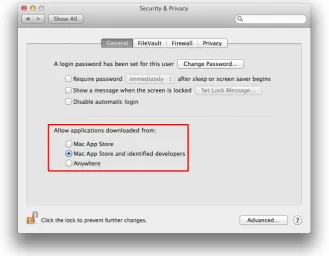
Figure 4.2: the option menu for Gatekeeper
On OS X the user can optionally enable code signing, where it is called Gate-keeper. Enabling Gatekeeper should reduce the risk of malware infections, though its implementation is not as strict as on iOS. For example it is possible on OS X for a signed application to introduce new unsigned code by mapping a page withrwxpermissions. Currently the user has three options: disable Gate-keeper, only allow signed applications and only allow signed application from the Mac App Store, as can be seen in figure 4.2.
osfmk/vm/vm page.h
struct vm_page { ...
cs_validated:1, // code-signing: page was checked
cs_tainted:1, // code-signing: page is tainted
... }
Listing 13: code signing field in thevm pagestruct
memory). Thevm_pagestruct stores the current code signing state of the page, if it needs checking (tained) or has been validated (as can been seen in listing 13). Thevm_fault_enter()function will request a check of the signature if needed. Signatures are stored inside the Mach-O binary, in the theLC_CODE_SIGNATURE
section. They can be viewed usingotool.
osfmk/vm/vm page.h kern_return_t
vm_map_enter(...) { ...
#if CONFIG_EMBEDDED
if (cur_protection & VM_PROT_WRITE){
if ((cur_protection & VM_PROT_EXECUTE) && \ !entry_for_jit){
printf("EMBEDDED: %s curprot cannot be \ write+execute. turning off execute\n", \ __PRETTY_FUNCTION__);
cur_protection &= ~VM_PROT_EXECUTE; }
}
#endif /* CONFIG_EMBEDDED */
... }
kern_return_t
vm_map_protect(...) { ...
#if CONFIG_EMBEDDED
if (new_prot & VM_PROT_WRITE) {
if ((new_prot & VM_PROT_EXECUTE) && \ !(current->used_for_jit)) {
printf("EMBEDDED: %s can’t have both \ write and exec at the same time\n", \ __FUNCTION__);
new_prot &= ~VM_PROT_EXECUTE; }
}
#endif
... }
Listing 14: enforcing the strict norwxpage policy
On iOS a memory page may also not be mapped with rwxpermissions, which is enforced by both vm_map_enter() and vm_map_protect(). The vm_map_ enter()function is called when the page is first allocated,vm_map_protect()
compiler can compile JavaScript to native byte code, allowing faster execution of JavaScript. JIT implies introducing new code in memory, which breaks the mandatory code signing requirement, therefore Apple restrictes the use of JIT to Mobile Safari. Mobile Safari is the only process that is allowed to have a singlerwxpage in memory, trying to map a second rwxpage in Mobile Safari will fail. Page permissions enforcing is currently only enabled on iOS, and not on OS X. The implementation can been seen in listing 14.
4.3
Sandboxing
Each application installed from the (Mac) App Store comes with a sandbox profile, designed to protect the system after exploitation. The sandbox not only limits file access and network capabilities, but also limits the syscalls a process is allowed to call. On iOS and on OS X with Gatekeeper enabled an attacker cannot run its own code due to the code signing restrictions, and thus the attacker can only achieve arbitrary code execution by exploiting an already signed application, meaning that the attacker is bound to the sandbox profile of the exploited process.
Just as code signing, the sandbox is implemented as a TrustedBSD policy in the closed sourced com.apple.security.sandbox kernel extension. The sandbox profiles are defined in the Scheme language and are compiled and delivered to the kernel by the libsandbox.dylib library, through the mac_syscall trap. An example sandbox profile is shown in listing 15.
The sandbox implementation is already covered by others[9][19], we will briefly discuss the implementation in kernel space. Most syscalls in the kernel have support for the sandbox policy. For example listing 16 shows the connect()
syscall asking the TrustedBSD framework for permission.
Themac_socket_check_connect()function uses theMAC_CHECK()macro (de-fined insecurity/mac_internal.h), which iterates over all registered policies of the TrustedBSD framework, to ask for permission.
4.4
iOS jailbreaks
4.4.1
Tethered versus untethered jailbreaks
Jailbreaking is the process of removing the code signing enforcements from an iOS device. This allows for custom binaries to be installed on the device which have not been verified or approved by Apple. Because the kernel enforces the signing of binaries a kernel exploit is required in the jailbreaking process.
/usr/share/sandbox/named.sb
;;
;; named - sandbox profile
;; Copyright (c) 2006-2007 Apple Inc. All Rights reserved. ;;
;; WARNING: The sandbox rules in this file currently
;; constitute Apple System Private Interface and are subject ;; to change at any time and without notice. The contents of ;; this file are also auto-generated and not user editable; ;; it may be overwritten at any time.
;;
(version 1) (debug deny)
(import "bsd.sb")
(deny default) (allow process*) (deny signal) (allow sysctl-read) (allow network*)
;; Allow named-specific files
(allow file-write* file-read-data file-read-metadata (regex "^(/private)?/var/run/named\\.pid$"
"^/Library/Logs/named\\.log$"))
(allow file-read-data file-read-metadata (regex "^(/private)?/etc/rndc\\.key$"
"^(/private)?/etc/resolv\\.conf$" "^(/private)?/etc/named\\.conf$" "^(/private)?/var/named/"))
Listing 15: an example sandbox profile
be jailbroken after each reboot. An untethered jailbreak is able to survive a reboot.
4.4.2
Tethered jailbreaks
Because of the code signing enforcement attackers cannot upload a kernel exploit to the device. The exploit would be unable to load. This means that attackers first need to take control over a validly signed application, from which they can stage their kernel exploit. The steps for a tethered jailbreaks are described below:
1. Gain initial code execution
bsd/kern/uipc syscalls.c int
connect_nocancel(__unused proc_t p, struct
connect_nocancel_args *uap, __unused int32_t *retval) {
...
#if CONFIG_MACF_SOCKET_SUBSET
if ((error = mac_socket_check_connect( kauth_cred_get(), so, sa)) != 0) {
if (want_free)
FREE(sa, M_SONAME);
goto out; }
#endif /* MAC_SOCKET_SUBSET */
... out:
file_drop(fd);
return (error); }
Listing 16: checking the sandbox policy
This can be done by exploiting a vulnerability in Apple’s Mobile Safari browser, document viewer or any other service.
2. Break out of the sandbox
The exploited process runs within a sandbox and unless the attacker has a kernel exploit that falls within the sandbox profile he or she first needs to break out of the sandbox. Because the attacker cannot introduce new code onto the device, this step has to be done using a 100% ROP payload. Unless the entry point in the previous step was Mobile Safari which has a JIT page which can be abused.
3. Elevate privileges
Depending on the kernel vulnerability, it might be that the attacker needs to elevate privileges to those of the root user. If the kernel vulnerability can be triggered by the current user, this step can be omitted. If root privileges are required, a root process needs to be exploited.
4. Run the kernel exploit
Only now the attacker has met all preconditions for his or her kernel exploit. The kernel exploit needs to be written by using ROP in the current process. The kernel exploit should allow the attacker to write in kernel memory.
5. Patch kernel memory
4.4.3
Untethered jailbreaks
All kernel patches of a tethered jailbreak will be gone after a reboot, effectively meaning an iOS device always boots in a clean state. An untethered jailbreak should be able to make these patches persistent trough reboots. Because the kernel image cannot be altered due to the secure boot chain, an untethered jailbreak re-exploits the kernel after each reboot.
Untethered jailbreaks work by finding a vulnerability in one of the services that will be loaded at boot time (such as the VPN service). It should be possible to trigger this vulnerability by overwriting a configuration file, as they do not need a valid signature.
For example, for the jailbreak of iOS 5.1.1 a vulnerability in the mobile backup service was exploited that allowed the attackers to write outside the chrooted environment. This vulnerability was used to overwrite the default configuration file for the VPN service. Whenever the device was rebooted the VPN service would load the configuration file, containing an exploit for a vulnerability in the VPN service. After the attackers have control over the VPN service, a kernel exploit is staged. The kernel exploit allows the attackers to overwrite arbitrary kernel memory, which is used to patch the code signing routines.
4.5
Conclusion
The strict code signing enforcement on iOS means that kernel exploits has to be staged from a 100% ROP exploit in user space. This makes exploiting consider-ably more difficult as things like branching and looping are difficult to achieve using ROP. Under OS X, where code signing is less strict, this is generally less of an issue.
Sandboxing limits the attack surface, which might mean that a vulnerability cannot be triggered from within the application sandbox. The attacker is limited to the attack surface available from within the sandbox, or the attacker requires an extra vulnerability to establish a sandbox break.
Code signing and sandboxing are generally much harder to defeat than the memory protection mechanisms described in the previous chapter. Having a closed platform like iOS where only applications that have been reviewed and approved by Apple are allowed, require a much higher skilled attacker than on an open platform like OS X. The attackers require multiple exploits, for both user space and kernel space, in order to completely compromise a system.
Part III
5
Security research
5.1
Introduction
We have described the architecture of XNU and its protection mechanisms. In this chapter we focus on the threats of XNU and why attackers target the XNU kernel. There is a clear distinction between XNU exploitation on OS X and iOS. This will be described in the first section of this chapter.
The previous two chapters described the way XNU tries to protect itself and the rest of the system against attackers. The mechanisms do not close vulner-abilities, but raise the bar for exploitation. In the second part of this chapter we will discuss which parts of XNU are worth investigating and which approach should be used.
5.2
Strategy
5.2.1
OS X
An attacker would typically target OS X to gain root privileges. For this the attacker is bound to attack surface that is accessible for an unprivileged user. The XNU kernel is rarely targeted on OS X. Malware infections are slowly becoming more of a threat on OS X, but until now they run under a unprivileged user account. Or use traditional social engineering techniques, such as disguising themselves as a software updates, to obtain the system password[15].
Attackers are currently no real threat of the XNU kernel on the OS X operating system. This might also be because if the attacker gains access to a user’s Mac, he already has full access to all its personal files, and thus has less need for root privileges.
5.2.2
iOS
This goal has changed since the introduction of code signing for iOS. Suddenly attackers require a kernel exploit for disabling code signing, so that custom binaries can be run. Often the attacker already has root privileges on the device, but cannot leverage from this because of the code signing enforcement. With the introduction of the strict code signing requirement, vulnerabilities that can only be triggered by the root user are suddenly valuable. If the attacker is targeting iOS he should focus on attack surface that is only accessible to the root user as this attack vector has been less researched.
An iOS attacker should take into account that code signing will limit the pos-sibility of implementing complex kernel exploits, and that sandboxing might make certain attach surface unaccessible to the attacker.
Attackers on iOS are a threat to XNU. The so called jailbreaking is popular under iOS users, as it allows them to use applications that are unavailable on a non-jailbroken device. Looking at the list of public kernel exploits from the past few year we see that they are all found and used by jailbreakers.
5.3
Attack vectors
5.3.1
Syscalls
Syscalls are the most common way of interacting with the kernel. There are more than 300 BSD syscalls and another 45 Mach traps. Chapter 2 contains more information on syscalls.
Besides auditing rarely used syscalls, it is also interesting to see how syscalls interact with other syscalls, with respect to locking for example. The scheduler might choose to schedule out a syscall mid execution, which can lead to locking issues and/or race conditions. There are also syscalls that operate on base of a large switch block, such as fcntl() for example. Syscalls which contain a lot of code, specially ones with do a lot of branching, are interesting to audit. It is easy for a programmer to loose sight in all those code, which can lead to edge cases that have not been unaccounted for.
5.3.2
I/O Kit
5.3.3
ioctl
calls
Theioctl call is a special syscall, as its implementation reaches out to many different kernel components. Being an abbreviation of input/output control,
ioctl() is a single syscall used for setting or retrieving control variables of devices or components in kernel space. For example a call toioctl()could be used to eject a DVD drive or add a rule in the packet filtering chain.
Many ioctl calls require moving data from and to kernel space and because so much functionality is added into a single syscall it is error prone, examples are CVE-2009-1235 and CVE-2012-3728. Theioctl()system works by calling the fo_ioctl function pointer in fileproc->fg_ops->fo_ioctl, defined in
bsd/sys/file_internal.h. Each device has its own method responsible for handling theioctlcalls, for example the TTY driver definesttioctl()as his ioctl method in bsd/kern/tty.c.
5.3.4
File systems
File systems are complex data structures which usually contain many header fields, header fields with variable sizes and pointers to other data structures. Because file systems are complex but have a fixed data structure, they can automatically be tested by using fuzzing. Creating a valid image of a supported file system and start flipping bits until the kernel crashes is proven to be an effective technique.
A good example of fuzzing is CVE-2012-0642, which is a vulnerability found in the XNU kernel by mounting a corrupted HFS+ image. The vulnerability was found by fuzzing the HFS+ file system by automatically flipping bits in a valid HFS+ image. This eventually led to an image that would consistently crash the kernel.
5.4
Conclusion
There are great differences between targeting XNU on OS X and iOS. Not only the reasons for targeting the XNU kernel differ, but also the attack strategy. Code signing and sandboxing should be taken into account under iOS, where on OS X the attack surface is limited to that of an unprivileged user.
![Figure 2.1: XNU design overview as sketched by Lucy[21]](https://thumb-us.123doks.com/thumbv2/123dok_us/9914643.493220/15.595.129.463.130.271/figure-xnu-design-overview-sketched-lucy.webp)