submit of the
Doctorate of
A thesis
of
M. A.
i Of 1990
al fulfilment for the
'I, I
i i
CHAPTER PAGE
" . " " " " " " , , , , , 0 0 " " " " " " " " ' " ' ' ' ' 0" " , , , , , , , , , , @ " " " ' " @ @ ,0 I INTRODUC'I'ION" " """"" 0 " • " " " " @ 0 " " • " • 0 • " • " • • " " " , • " " " • , ,,1 II. REVIEW OF THE THERAPEUTIC LITERATURE
ew" " " • " • " " " • " " " " " " • " " " , " " " • " " " " " • , " , " " ••• " " • 4 at i on .. , . " " .. " " . " " . " . " .. , . , . . . " , . , . " 5 Without Augmentative .. " " . . . . " . . . . • 5 General F 0 • • • • " • • • • • • • • • • • • • • • • • • • • • • • • • • 5
.An Example . . . 8 Conclusions . . . 9
With tch Detailed
Ai d s . . . 9 • . . . • • • . • • • • . . . • . • . • . • • 9
of one programme . . . l1 Interface Ergonomics and Dis Ii . . . 12 and Lewis Research Programme . . . 16 . . . 16
ects . . . 0.17 Method . . . " . 0 " • " • • • G • • • • • • • • • • • • • G O . 17 Ra tionale . . . " . . . " . .. . . . . . 20 Data
Conclusions. " . . . " ... G • • • • • • • • • • • • • • • • • • 24
Behrmann and Lahm Research
Resul ts 0 0 0 0 0 0 " • 0 • • • 0 • • 0 e o • • • • • • • • • • •
's Resource Book. 's PEARL Software . . . .
• 033
33
37
.39 III. REVIEW OF RELEVANT OPERANT RESEARCH
V.
of Human • • 0 0 • • • • • 42
Interval 45
Schedule
Infant FI Performance. . • . • . . • . • • . . . . • . . . • • • . • . 48
Idren' Idren and
ferences FI Performance .. and FI Schedules . . .
.49 .. 51 Schedules . . . 54 . . . 56
8
tates. Data
Skewness
I.
•.. 79
. . . 81
.83 . . . 83
. . . . 8
3
4
. . . " . . . 85
Confl
. . . . 1
c~ • • • • • • • • • • • • • • • • • • • • • • • • • • • • 1 . . . 139
. . . 142
143 . . . . 143
. . . 146
Batches . . . . . . . . 147
. . . . 147
table . . . 0 • • • • • • • • . . . 147
table . . . 0 • • • • • • 1 8 .14 . . . 152
STUDY
®" 0 G ® 0 ' , 0 • • ® 0 0 0 • • • 17 017 1
• 0 • • • • • • • • " <' • • • • ffi • • 0 • • • 189
. . . 189
Database . . . . .189
. . . 1 1
. . . ,' .192
. . . . 192
Performance
J
ect E . . . .
ect M . . . .
XI. CONCLUSION
. . . 216
batches in case tudy one.
Tabl 2 . . . 75 Global summary measures from case study one.
Table 3 . . • . . . • . • • . . • . . . 80 Contrast of reward ratio and slope ratio distribut
Table 4 • . • • . • • . • • • . • • • . . . • . . . . • . • • • . . . . • . • . . . • . . . • • . 96 The number of reward
of responses and the
ods with odd and even numbers lity of this ratio
chance alone.
Table 5 • . . . • . . . 97 Shapiro-Wilk W for each component of the reward period. Table 6 . . • . . . • . . . • . • . . . • . . . 97 Shapiro-Wilk W for each component of the reward period
(with data from ch outs values have been removed) .
Table 7 . . . 101 Sta tical sons th the Gaussian tribut for Delay
i i
Tab 1 e 9 . . . . " 0 0 0 • " • 0 • • 0 • • @ • " • • @ • • • • • • • • • @ 0 0 • • • • • • • • • • • • " • • 10:2
t ti t
for
1 comparisons th the Gaussian tr ion
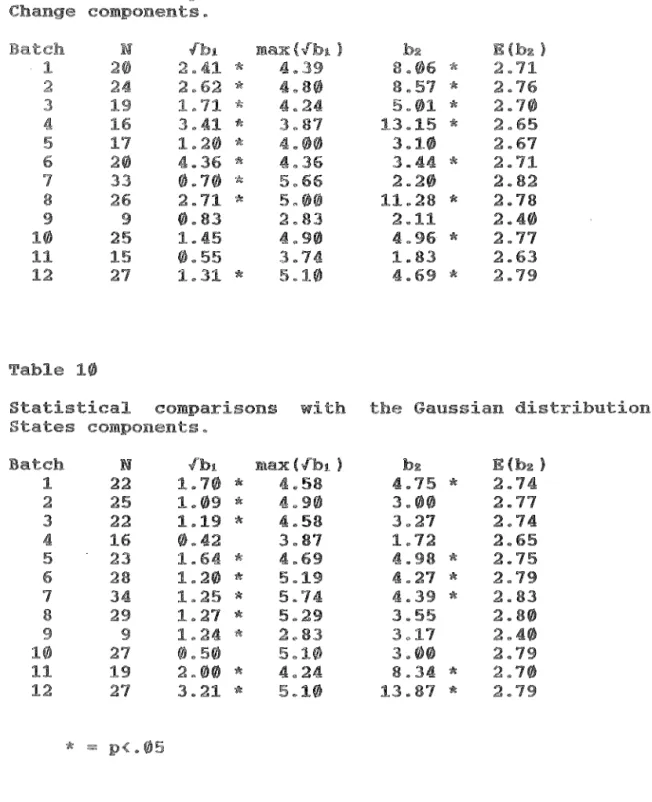
Tabl e 10 .. " 0 • • . " . 0 0 0 " • • • " " • " • • • • 0 • 0 • • " " • • • 0 " • • • • • @ • " • • 0 .10:2 statis cal comparisons th the Gaussian di tr
for States
Tab 1 e 11. 0 • • 0 0 • • • • • • • • • • • 0 • • • • • • • • • • • • • • • @ • • • • @ @ • • • • • • • • • 103
s
stical sons with the Gaussian stribution for Delay components (with outlying values removed). Table 12 . . . @ • • • • • • • • " " " • • 0 • • " • • " • • " • • • • • • • • • • • • • • • 103Statistical comparisons with the Gaussian distribution for t components (with outlying values removed). Table 13 . . . c o • • • • • • • • • • • • • • • • • • • • • • • • • • • • • • • • • • 104
Statistical comparisons th the Gaussian tr
for Change components (with outlying values removed). '1' ab 1 e 14., . . . 0 • • • • • • • • 1 (1) 4
Statistical compari ons th the Gaus ian stribution for States s (with out values removed). Table 15 . . . 112
Central locat est for Delay s.
'I'able 16 . . . 112
Central tes for Wait s .
Table 17 .. c • • • • • • • • • • • • • • • • • • • • • • • • • • • • • • " " " • • • • • • • • • • ".113
Central loc t tate
Tabl . . . 138
cal based on the B al Theorem.
Tab Ie 20 . . . 0 " • • 0 • • • " • • 0 0 • • • • • • • • • " • • • 0 • • • 0 • 0 • • • " • • • 0' " • • e • 138
ca ies based on the Runs-Test.
Tab
1
e21...
141Decision table for establishing the importance of a feature on the basis of
rat
and randomness
Tab 1 e 22.. 0 • • 0 0 • • • • • • • • • • • • • • • • • • • • • • • • • • " • " • • • " • • • • • • " • •
145
Attribute features which define good execution of a stra and at features whichdes 1.
Tab Ie 2 3 • • • • • • • • • • • • • • • • • • • • • • • • • • • • • • • • • • • • • • • • • • • • • • • • • 158 The relationship between subject factors and data
batches in case study two.
Table
24 ... 160
Global summary measures from case study two.Tab I e
25... 162
The number of t the reward was act ted a fx
Tab 1 e :2 6 . . . . 0 • • • • • • • • • • • • • • • • • • • • • • • • • • • • • • • • • • • 0 • • • • • • • 162
The number of the
cond cture reward task and the 15 econd music
Table 27 .•• 0 • • • • • • • • • • • • • • • • • • • • • • • • • • • • • • • • • • • • • • • • • • • • • 162 The rat of responses to rewards the 5 second
cture reward task and the 15 second music reward task.
Table 28 . • • . . . " . . . 184 stem and Leaf ays for Delay
Table 29 . . . 185 Stem and Leaf displays for components.
'r
ab 1 30 . . . , . . . , . . . 186 stem and Leaf for S Ratios.Tab 1 e 31, . . . , . . . . , . . . 187 Stem and Leaf di ays for States components.
Table .32 . . . 188 Stem and Leaf ays for Wait
Table 3.3 . . . , . . . 198
S adopted subject J.
Table 34 . . . , ... , . . . " . . . 204
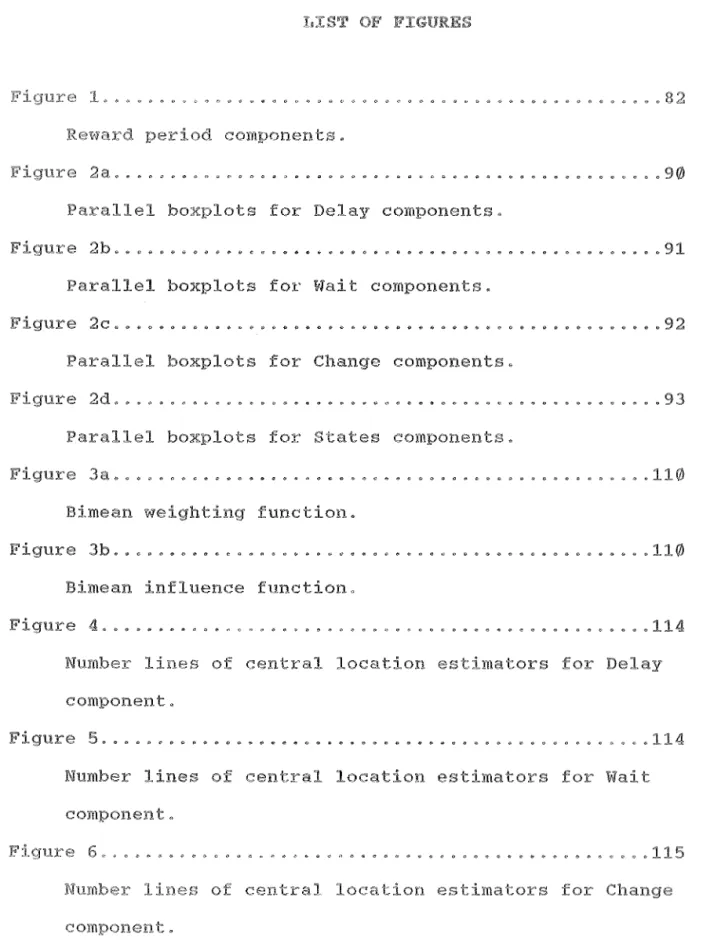
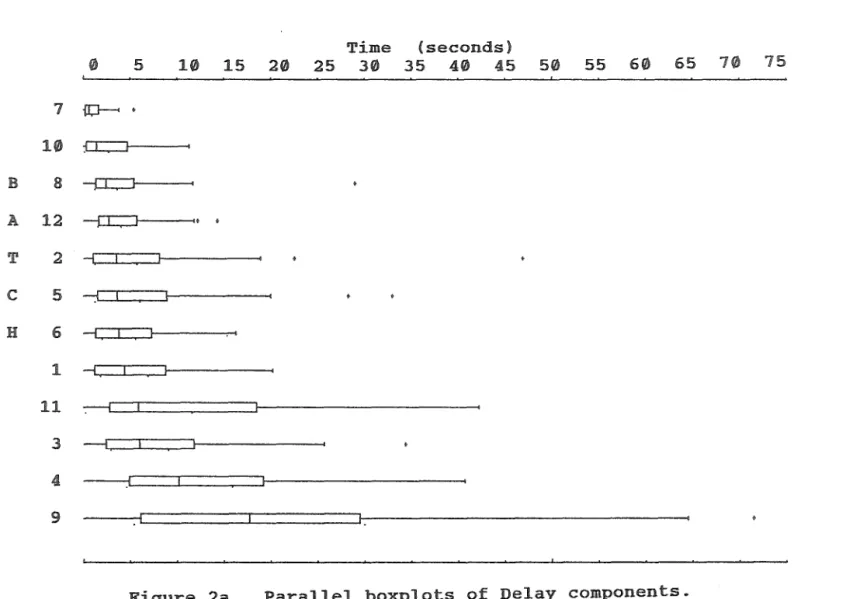
Parallel ot for Delay components.
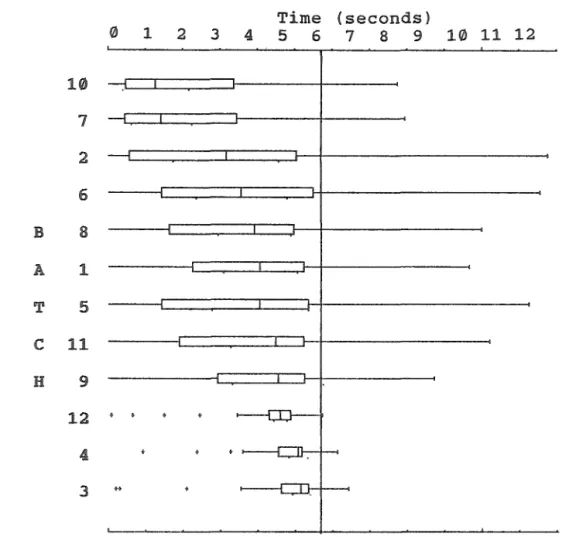
2 b . . . 91 Parallel boxplots for Wait components.
2 c . . . .. . . . . 92 Parall I ots for components.
2 d. . . . .. . • . . . • . . . 93
Parallel for states
3a . . . 110 B weight function.
Figure 3b . . . 110 Bimean influence func on.
4 . • . . . 114
Number 1 component.
of central loc e for Delay
5 . . . 114 Number 1 of central loc est for Wait
F
i
7 . . . 115 Number 1
tat
of central location tor for the
8 . . . • . . . • . . . 0 • • • • • • • • 0 • • • • • • • .123
Central location 95% conf s for the Delay
Central location 95% confidence intervals for the Wait
component.
10 . . . 124
Central locat 95% conf e s for the
component.
11.0 . . . 124
Central loc on 95% conf 1 for the
states component.
12 . . . " . . . 127
A cumulat record.
13 . . . 127 A bar
f 12.
repres of same data as in
14 . . . " . . . 131
Bar of reward per to illustrate feature
def tions.
F 15 . . . 135
Patterns of respons used to deduce tenc of
an alternat equence of succes and
17 " •.. 0 • • • Parallel
1
Parallel
19 Parallel
21
3. 22 ••.••.
of States
of
of
of
S
bar
bar
labeled
. . . . • • • . . . • • • • . • 172,
• • . • . . . 17 labeled
.. 17 labeled
.199 for ect J from
24.
26.
18.
state 3.
state 13
29 • . • . • • . . • . . • • . . . state
state
bar
€let L.
bar
bar
bar
5 for €let E from
9
. . . . . • 210 for €let L from
. .210 for €let 111 from
. . . 21 for €let M.
11, ful
eel
Cent Idren'
1::1:1
t the Soci
I :1,
, S
and the ld
We land branch of the
and other did much to
arous my curi i about the tream of consciousne
younger ects and parents me many practical
lessons. I am thankful to the long hour
at di abled formanc I comput tas
mus al mention thos indispensabl tool, th
language and the able , the 13 t
Atari.
t thanks go to my wife th, thout whos
love and support I would have never been able to undertake
s ifwrk or
put it, slH~
each , t
tl'1e1'. Of
"
earn
.
.
i t to et
.the wonderful money, so
.
As she hers If1i:foma.rl who goes ou to work
A
tied
i
on devel child's
k
t of the cont
development of a s
two s es of norm"ll 'US
Idren. i te
th a ies of the was invest
ffE~rent vers
task. The value of cons ing the dynamics and compe was established with e of
ell
for
task and with of the of pe
programme th four severe ically sabled but mental
and s
t children. Robust computerized
timation of performane system for dat
cl sifica were major c innovat
t the i thos who are world. The part
st are 15
to
ical unable to ful of and mul
ldren who, due to the physi ic te
development. like to deve
many of experiences th high level a ens of learned
th('~
crucial experienc
act the
abled who are of ically dis ch of Ii s essness sabled , can not
t are
further decrease the tion th the
11 and th deve
these Idren make use of , and there
sts a strong for shar ormat about
adaptions of technology for therapy. Thi is supported very little
A liter ture ew establ
that used and outl
r ew highl the need for
Idren th the 15
and ff t t The
lIs needed to fit from more i
al 0
to cll the more bCc?en abl master.
cal research. of
research to date. The research how ated cause ences and
1'he s't s
ied i of human
performance
ch has not
th abl Idren.
1
It 1 11
to o
i
ous to shown that the methodology, and f of operant research on how the tr es used to orm simple cause and ffect tasks. It that simpler tasks than those used in operant research are needed to t those th low level of
impoverished experience at control 1 a task i sed
ical Ii and ronment. lar to tasks used
the de led therapy but
performance data
also
al of research. s i a tas]~ to competent which Ii is not a limitat
ormance.
The focus of this work is on establ an methodology' for
cause and ff ct task.
competent performance on the simple s is a necessary foundation
future research tabli the effect of
particular ons or deve agnosti
ts. The research ch is reported consi of very
detailed f ut Ii of f f i
me tll three
of that
i th a group of
Problems th me
The data
recent
researc.:h are to bear on the . In a
an automated
of used to
It an al to -the usual
of data. These shown have some
another group of
of the task. The of the
then case
an extended programme tb four
A theme
to
may not
the rather
the
for the task.
are then second
from disabled
of
Thi
t
int
target at
4
the ati programmes which aim to ons of evere and mult
I
Ie
e the handic
cal ronmental children. tion is f
population.
t to the characteristics of this Therapy before the emergence of a is shown to have been generally unsuccessful. The ems that were encountered are
1 ed with one programme scussed as an This is then contrasted with the br prospects
off the devel of es which do inc
the us of ative . The al framework behind the movement based on switch adapted toys is outl and the ial of this simple technology is illustrated by a review of another programme. is followed a
of VUVJlLLC pr es for providing
more general di cuss
communication face for the disabled. Discussion then focuses on the issue of how and the skills necessary to
such have to be to severely ically
disabled ant and toddlers. 'rhe two or
1 c 1 earch programme ch have t ted
ed to teach t skill to
children eviewed de 1,
an I i programme.
fi Id,
i progres report from of how
techno are then covered ews of ourc
book and a speech
awn i
f o r t could
The stinct cl
software current di t ted. at at
. Conclus are
tice and where further
of t s
the i i thos severe mult handic children who
have ext ens sensory and neuromuscular deficits. This
population has been labelled as . . . tat
~Nona.mbul
& Sackett, 1978)
~~Severe and Mult
el, 1966)
Mental Retarded (Landesman-Dwyer
c (Behrmann
&
Lahm, 1987)cial Needs (Burkhart, 1987)
cap
of to
ical disabili and of mental
similar syndromes in children. In
all cases the salient feature linking the subject groups is
the lack of
result in s
helplessnes ,
sman.
thei ive
tic
1 t
and work tabas of al motivat Without to Sackett to of el (NPMR) 1 the i
tion', This is s to
sorders, such as learned t
s at ~,qas
(1978) . A or methodol cal
1 e a cl
tiol and 1
t 'nonambul :f
of the
then
uncommon.
In
sbows
f
open )
"For
and Sackett and
note that
many ects,
gave very
results
of
there
related to and
motor control and
relevant
had been
Sackett, 1978, p.79) between 1949 and 1976
All these NPMR
t
or for all
used the
(The
not
ct what would act as re orcer for particular Even after an operant response was successful tablished, the 1 often transient. After
ful end to
there ~~ould be ch no procedural
sudden decl or
1 tter t t of this effect
could recover '. ce and MCDaniel
(19 6) it was tablished that the effect is not due to
t tion or schedule manipulation. This phenomena was termed taneous Extinction' and no explanation was off for
One tri feature of the ewed operant studies is
the arines of the ical response the
pauci of the re s used. In all reported studies the detection of the response and the del of the
on a human exper
switches to detect and ampli the
No use was made of special ect's t behavior and no cal apparatus was used to deliver the reward. There were no t to develop in the ects any skill
(Le. communication method) that could use outs the
1 sett The anat of
extinction could be that ects become frustrated with
f es and difficult task and ultimate fus to cont
indif
the tabli
were
not ronment
diff tie operant e
ted 1
t
the
had ended.
are often
programs, even those to cope a severe
level of mental u due to the f
them. A comes from a
on
of Pre:mack' and
non~verbal
"
forresponses" 1976, constructed
p.529} of sequences
ensure success, and on
The programme th
th method
a
low level tasks, extends task
a
to have been number of
have
ory ems. " ldren th motor ems that interf with the respons have 1 arned sl and
orne have not been abl to go of
deve
The
" (Carri that
, 1976, and
.54 ces di abili could be deve
as an area for 'further
fficulties experienced
)
.
ier revealed antable for use with . He ment the
in early research programme with the severe
been due to a lack of
ically sabled seem to have ic focus. As the next two sections will show, s need not be the case. Even before
the 1 Ii of computer there were
ilab1e terface methods us very simple technology. These a enable the disabled to t
tasks which are also suitable for research purposes. With Augmentative
One of the simplest aids for enhanc the environmental interactions of a mult sabled child is a tch. Commercial lable tches have if to such an t there has arisen ications which discuss the s of tches and group them ac to
f the method (
.
Holt, Buelow1976; Silverman, Me Kate 1982,
4) • Often tche are from other purpos
:for th the abled and there ci Ii t
10
tom switches (Burkhart, 1980, 1985; (1987). on construct
ted to the
ces are also to be found journal t, " cation Outlook", :i hed the International Soci for t and tive c tion (ISAAC) , which is subtitled
o oc"Focus on Communication and n . Another
"Communicating
shar
Ii
bat
cial ther" , whose
exper
t publication is
torial aim is providing ... a means of es, systems, and techniques of non-speaking cial attention is to the non-reader's
t communication system and the role of lic "
At the s t level tches are used with adapted and educat ces. Toys are modi led
on-off
wir tch leI or in series with the tch so i t becomes part of the circuit between bat and motor. The use of standardized plugs on all
switches and mat sockets on s the
ications of choos ate tches for an
1 and so that they can be
with an external tch. Advocates of the on of so can oper ted a simple tch stress the importance
env 1)
their
t t
abl Id oppor to
Lack of such oppor towards " ... les construct
more
elf 1
and 1 0
ay th some ties i een stimul ion to the at tude toward the
..
(Burkhart, 1980,attached to
full
The
Porber.
use of a morse code (a
. There
connected to
motor
shown
the buzzer)
of v'ery low
and had no of
based on a
The
of sound tone "no" and three tones
a . These
relevant to the
were
A
"
code that tone meant "I need two short tones meant staff to
were from
to ask
t
of
and tten to the
all that could be
t
us that t:he
to . The
documented
between the often
1;
1
the
progra:mIlle of the
, 197 ; 1982b;
use of
iden Harris~Vanderhe 1976, .611), All the
different of a have been ized ac to
b.ow the three ic of c
t elect
t elect elements of message i the most forward and easy to understand indi on method. it are most fied keyboard designs, often of
cial size or th The simplest
modificat are those which guard against accidental and mult e presses due to poor motor control. This is often
achieved with a ctive overlay or by
i monitor of movements to detect and disallow unintentional act t . An example of the latter would be with no automatic when are held down, an ustable delay before a is stered (to screen out acc momentary presses) and programmable to substitute for the multiple simultaneous keying sequences that modern software often . Provision can Iso made for parts other than f to the
such as light beams ted or
e for foot typing. Chord are another ion to llow t election with minimal movement (Kirschenbaum, Friedman
&.
k, 1986). All such ctIe ion systems r and fl e but a
1 mo control.
i the term ied to ituations where mes age 1 presented in equence the us its until
to
most
from
The
for t
that
access the
more
can be
number of
then of
used
t
element can be enhanced
are traversed elements.
rearrange the order of the after each (Heckathorne
th more than one of
the scan.
table for the the very of
the
chart.
, 1 8 ). response opens the the pace and
slow. to
of these
. The
where
look up
than the number of
us code indicat the row and column of ired choice. A more abstract method is to use ial codes
f 1983) or
or, 1981). such Mor (Shannon t a l , 1981; S
(Bolton
t
sc user
i
t suck and f code
quarter of an array of elements until a final reached has also been descr as a of method (Terrell, 1985). The random access nature of schemes allows for greater communication speed than The disadvantages of encoding techniques are that need the mental lity to learn the code and sufficient motor control to operate many switches. As no red wi a set time period, encoding methods doe t those with slower physical movements.
It is tant to note that s and
di ct te be t\1here answer 1 limit
election schemes can all be implemented at various cal levels. Taking scanning as an example, i t can emented as a simple unaided communication technique any two s Is for 'yes' and 'no' are used to a sequence of quest
.
Fundamental such as ath system cr on i t can be used to the vocabulary being scanned. S e elec c or mechani a1 ces cal move a light through a
of vocabulary 'Ii tener' i still
Connect remove
croproce speech
ce th s level of aid a red to remember the message i t i
t to or sual
rement. Further, allm\fs for t
i the
ay
16
towa.rds ce sUbstitute. f I e of
e is the ce small and robust
to be portabl .
c pr ommunication
i al c
has progresed unders of the basic for erfac a sabled person with a ceo The focus is now on mat a person's Ii and a system, th the goal of maximizing the information transfer rate. Systematic assessment procedures have been devised
l'1ethod for ing
Needs-(e.g. the Handicapped User's tem Development, Behrmann, 1984) and efforts have also been made to devise computerized
rt systems and real t computerized testing batteries to prescribe a ce for an individual (Rosen
&
er, 1982a). How the skills needed to use the aids are to be taught has not been addressed. This is a icularly important issue for children who have been evere disabled since rth and who will never be able to
cate without an augment
The Contingency Intervention ect is a curriculum of
t des to teach multiply handicapped ants control of consequences (Br s 1982a, 1982b, 1982c). It i based around an ant t th
ronment ch arranges events so that
controll an ant's or. Thi
ammc", was the f t to de I of such
" not seem
"
. The ects who were choosen to
the programme were those who to grasp on an
hands, not tent
reach for ects and not resulted two
the programme. There of
of four had Downs and
one had
.
A second group wasof labelled as
,
and
range of
.
All both18
it , enabl mult e basel measurement de to be us At the arne time, an observer could us 16
box to enter real-t record of specific observed such I , cr , voe liz t , head rai e , I level of arousal and distract directly into erG to e computer controlled output I could used to turn on and off ces external to the
er ch functioned as 'rewarding consequent events'. Rewards luded images on a computer display, music from an audio tape player, a t pad and electro-mechanical such as a musical toy, a bat powered train and a
A pre-intervention e was used to identify the movements an ant was c e of making, to arrange switches
record a curriculum expec
to automatically basel level of then started with
tor these movements, and to activity. The intervention a task to teach a basic of cause and effect. A t response was associated with a computer delivered reward and the computer an ongo record of act rates from several limbs. The reinforced movement was changed between sessions. If the infant could di ferentiate
then there was a decreas
ch movement produced the reward overall movement and an e
most f
(8r
t t respons " The most r I occurred when sponse was the movement that the infant had made dur the bas I measurement ession
second level wi thin~~
software
of the the cont control 1
curriculum of re the task formanc , c it aga t preselected
tored teria c I a minimum response rate) and the reward target devic which was to be act or the
. The aim was to challenge the infant's expectancies. Br
he ff movement
and Lewis stress the importance of determining cts of a
to make)
to the thout any
contingency rule (which
reinforcement. Renewed st cons
in the type of upon alteration of the number of responses required for delivery of a reward was
taken as of causal awareness. Subjects
showed one of two dist t terns the reaction to such thin- ession changes (Brinker & Lewis, 1982a, p.12. 1982b, p.39). Some ects immediately detected the change and ased the frequency of the new t responses. The behavior of other ects was more complex. Changes in respons
qradual
criteria caused generalized arousal followed ease the proportion of t responses
a
ion. On subs sess this process of response dtf
t '1'he
iation would be the absence of
This is term retention
ted these
1 1 of the curriculum added
20
z tion of esponse as means to an end. Of t
was the par cular s if any, an
of r sponses needed to
ant used to reward.
determine the s
i 1
Br
ont
1 i about s ext ens
and s devote a self confessed 'cons e
to the
awareness
tance of the background concept of
Early research using contingency
awareness with very young infants reported difficulty in
tioned responses. The reason offered was the
pauci of actions e of being linked to an operant
eward r for the reI between action and
reward to be easily perceived and remembered. It took some
time be ore researchers devel tasks which used responses
infants could readi make, such as head turning,
non-"nutri t
from demons
t'l'hether I
stimUlate I
sucking, and eye-movements. Research then moved ons of infant competency to investigation of
in artificial cont situations would
other more natural settings. From this
13r and Lewis deve their a of using a sequence of
tasks, des
cont i
and devel
ontrol
i ieul
the
to e experience and awareness of
as a therapy programme for ically disabled
del ldren ~4'ho f like ants, can
1 events. argue that
i abl to
ieal Ii
lack f motor
cont
i
Ii was
based abled
to
v.ri th per ion and memory ems to e a reduced experienc of having
s
1 1
i
loth)' level of t f thei sabled
tions for the arned as ically
in turn leads to expect ldren
ld. He
ch further reduce essness was s
sabled infants "o •• lose
to est world do not expect to control" (Br & Lewis, 198 c, p.164).
The curriculum is claimed to derive its remedial proper es from the use of crucial developmental ences in an appropriate sequence. An infant's level of psycho-motor devel is agnosed from the of tasks that the infant can successfully perform. Developmental progress to levels is then promoted by experience of the computer task
the
The theoretic justification for the order of in culum was derived from Piaget's description of normal s
Br desc deduced
and
of the from the Reaction stage an
development in the first year of life. reformulated
ant's cognit
Piaget's as
awareness that can be In the Primary Circular
ant es
tivi esponse to a reward. Use of a
levels of motor t behavior in
to others demonstrate S Circular
actions. Elaborat
and 'I'd
e Coordinat on of S c
us of
of Sec C cular Reactions occurs rewarded t
React
act is new ituations.
levels. cated
22
to ither the t or the
for
event s stage. The ('IIould pre
Means-End i s reflected the last level of i um where t of respons are
and s scussed demonstrations of
competenc t the PI' and ear S s s.
It:1. very t to note that the same e in al s stication that inspired Brinker and Lewis's to highlight the competency of handicapped infants, has Iso been used to demonstrate competencies in normal infants that call into question the validity of Piagetian It is now general that an ordered stage formulation of infant development is t and that children's t lity are a result of
increas knowl not tive ability
(Anderson, 1985, pp.400~426). Case studies of individuals who have normal adult cognitive ability in spite of having been infants with minimal motor experience, due to their severe
ical dis lity. a demonstration that
s an 1972;
Pi r formulat further s
det
" lIes' heel" Piagetian theory (Jordan,
&. Shaperman, 1973). Br and Lewis appear to
t i s without question. Unfortunately their
of agetian has been thout
i several ews of work th
abled children. The fi Id wher
tands out as
rec on i ma
pragmat:tc ions.
is 11 the more
the behavioral tance of most workers s field. eri ed cont
A further of
intervent on programme was said to arise from nonsocial
0 1 ie
.
It wastioned whether an ant can learn that are fully in control of a situation if it involves tion with e. The suggestion is that an infant has more direct experiences of being control when they are left to t with a computer controlled task and that this ence enhances the 1 of contingency awareness. No
was presented to back up this intriguing argument.
On~l
claimed to 'focuses' measured
computer a ' on cumulat movement. The
is of ormance data was oral microscope'. The microscope response rates over time for each computer is used to compare performance with stored data from previous sessions and to cal presentation of results. These di ays are ted by sual tion to generate about how effect an infant is reacting to
cont This is then used to decisions
task ental expectat
fication. There was a reported rise and awarene s of 1
were involved the ta on of the data and
1. of the proces
.
number of made about the pragmati
( ) f us i ed the
It used when there
events
programme for open to
to the means-end
an that
need for a more
or
work of
the further
data collected of
8 8 )
.
to
the
research . How an
level of the
. There also a 'the way of
run rather than jus
records and of
to
The effect
a
"menus'
on abstract
the allows
.) scheme
of an advanced of
programme task.
sound
.
Once the ofresponse been mastered the
.
Two screencauses the reward to
foods or between
{ are then
select
model
i
choose an i terl!. of
a
should be easy
a cause and rewarded a
selected and of choos
011
selected The
i t
correct accuracy
1\.
that
and the
to chose~
to choose
.
Four ofof a reward. method was that
too many at one
allows fOl" a of
these data are collected
the response on each • the the average response
th
and
of from
programrne to common format and
• 'the number of
to and
the ,to move
ects could ze from one to another.
for low Lahm.
/
once
task
level
fol." each measures have
been
results from an
of the programme that
the next more f
(Behrmann Lahrn. 1983a) the programme have been
progress the
used two groups of and
. Half of t:he
at all the
severe motor unable to
program, level
to reach a
cause and effect task. (The
was seconds or less, 8
over three to four
.
) It wasof the the that "
tood task. but .•. los
the became more "
and i t that
"
the task, but Lahm 98
effort
i lower when a had
made and due both to the
mental and the amount of
for the to scan between the two
Slower were as
and the of the task was i f
... to
and use of
of the
w, (Behrmann , 1983a, p.198)
In the s very 1
sys programme was
was slow on the
with some ects a decl
to the
task and better
for were
overcome these
the
of
of the
mastered cause and effect
over
. A more assessment
focus became programme to
research
The programme Beh:rmann and
clear for
~ The programme has had
of a of software and malmal enables the tasks to be run on the lIe
hardware (Lahm,
1985). An of research suggested the
'the
A
results would be to concentrate on those the
would
and accuracy
more at
cause and effect level of the taske
cause and effect the
programme' for the
Allen &: 8
for
to
at
for one
30
thi intervention th each client. The account of programme
encountered
izes deve
the lessons learned and ems both the hardware and
The eleven clients in the programme were all in their ar teens to early twent s, were functionally prof retarded (with mental ages below two years), and had sensory-motor handicaps. They were described as being limited their environmental interactions, with low levels of ical movement and showing little learning in any type o situat Such a sample was deliberately chosen to an exacting test of the limitations and capabilities of microcomputers tructional use'.
The major therapeutic goal of the programme was to break a negat
to few ext
feedback cycle where low overt behavior rates lead environmental tions, gradually almost all This problem was to be treated by increas the rate of occurrence of specific motor s. For each subject an individualized educ tional plan def des and rate of response.
Achi the e goal would ed respons Sf
ical deter on and motor skills. were chosen which could act as sites for
1 lIs. It further
i f control of the
t the eff ct of learned he
that the
It was reported that ems were experienced th tch des and acement, and a number of fferent
mi
and a
andum'
tch,
were tried tic cuff rota
it any rection, pneumatic blow/suck
the programme progressed. These
ttached tr to a
inder, a joystick act by a wobble tch, an cushion,
tch. The technique of modeling how to ac te the reward consequence before a session began was developed to 'prime' clients. Rewards were chosen to c talize on visual and hearing skills. These included music on a cassette recorder, cool blown from a hair bat operated and light displays. A trial method was used to determine which items produced highest or rates th no signs of distress. Four seconds of t tories and fan blown were reported to be the two most erred items. Planned refinements of the treatment method luded systematic examination of reward duration, onset and offset parameters, and formalizing a procedure for as sing the effect s of a reward.
Sessions were
f blocks per
to ensure cont 1 ather than the '
structured as three consecutive . The division of a therapeutic was action between staff and clients
and t
a er) and to allow for
• of clients in front ustment to seat
blocks of and
rOlJ, t
of
tch posi
structured a line block where
ed
tch act tion no
unrewarded baseline every ession.
are
success
32
tion was used as the first block of
ted us
f
of the minute blocks.
number of (Blocks are to either 'cont stimulation' or labelled as be
'no consequation' situations.) The effectiveness of the treatment was apparently very varied. One subject produced no response in any condition. Another subject had a varying but response rate, unaffected by reintroduction of the non'--re
increases decl
basel Several subjects showed transient rate, sustained for a few sessions and then into long runs of no responding at all Comments about these ects indicate that their es in
re ided with changes in Finally, one
ect showed very clear and responsive behavior in a classic ABA design situation.
In assessing the effect s of the programme, the 'failures' were due to comment was made that
" ies, not of the computer system, but in our tate of knowl about effect truction with NPMR tudent " (Bourland, Jablonski, Allen & White, 1983, p.147). However the overall tone of the paper reflects optimism about
future devel and ication of method. It
was erted that much had been ac ished in a si on where extensive t was to just assembl the basic t to ement the programme. was
to ication. )
the many that
be
ec on have been
table for of
11 sho~1i1 , s programme is cal
established ied settings. The general and ications are very simple and yet are shown to be worth the development effort. The candid cuss of problems highlights the technical achievements behind the package developed by Behrmann and Lahm. The weakest part of the programme is the limited way in which ormance of the computer task was analysed. The use of e c e exper 1 des and global performance measures was ficient for an adequate evaluation or ion of the level of competent ormance. This contrasts with the potent for using a computer as a
oral microscope as in the Brinker and Lewis programme.
In many situations where computers are used to develop communication s lIs with non~vocal children, the therapists are enthusiasts who develop the own hardware and software. Their practical work is often mentioned fly in speci 1 intere t publicat
eported ormal or devel
and newsletters but is seldom a research programme. One on that is c 1 of movement is a
ourc book (Burkhart, 1987) that a is of many fferent and str from a large number of
acknowl contr la
of backed up
. There of
a the
of have the
for the
on how to for use
t many of the recorder and a looping
message However
1 of
are implernented
of that a be
how of a message It
for some • A
erred over a
because of the can
handle the
as the
screen to
the screen. It
of response
the use of mode from
to cut from
th the use of boxes on the and
alone may not
to
to be the becomes
of
ticated
accommodated, as can a
systems, can all
able vocabulary. It i
i be
that are best
to
ted programme
ite 11 and de
1 before a cated portable device, us one set communication method, is prescr for a child.
The as and actual software listings presented are very e, but the comment is made that the majority of commercially available software is not geared for the low functional level of a child just learning to communicate. Also it is noted that with commercial software the physical responses are often more fficult for a disabled child than the educational concept being taught.
The is of the book is not on computers, switches, tape recorders and , but on using these as a means and motivation
Communicat funct
for functional communicative interaction. is presented as the most important skill for soc ty. The work promotes a therapeutic tra of using contrived play experiences to provide feedback for experimental I
scussion on
This strategy is best cause and effect. illustrated in the
This is introduced a cons tion of the factors that can cause disabled ldren to t limited ways th
the These include learned helplessness,
ration, emot 1 ical and t
limitat and outr lack of oppor
.
Particular tre i aced on the pos Ii that Id maybecause are so effect is outl
arly
crit
devel
o t
ed 0 It i
36
low to . Le cause and
as be a basic 11 that i learned programmes that large awarenes of caus and ffect are tated that it should be able to teach aus and effect ckly if the situation is appropriate. This is followed a ist of points to attend to in
cause and effect: positioning of the child, selection of a switch activation movement, switch selection and posi oning, use of an appropriate reinforcer (with special comments about avoiding over-stimulation), placement f the re cer thin visual , and environmental cons ons to elicit a quiet-alert state. The stricture is to avoid prompting and other 'teaching'
ons, instead letting the child experiment with the se , " .. ,stepping back and letting the child teach himself"
(Burkhart, 1987, p.12).
The on cause and effect training is followed by " ... suggested functional and purposeful activities for the concept of cause and effect into the area of communicative interaction" (Burkhart, 1987, p.13). The f t extension cussed involves establishing a play situation where adult and
ound. The
turn-Id take turns game is then
an activity or
deal with 'games' that use the cause and effect s ommunication situat
t and request ti ,and indic
such choices,
call
i
i
Another cal that many ammes for Ear commercially derived from Elizabeth
e of the
it of lable software
on of a have at
(PEARL). This (Meyers, 1985) , research and therapeutic work conducted from a speech therapy perspective (Meyers, 1984). The only formal presentation of PEARL, apart from the oftware operation manuals, is one written to describe the way the therapy s
a very short descr
was developed. This paper includes ion of some research findings.
The
language use
of the therapeutic programme is to initiate language del toddlers. It is mentioned that ects have included Cerebral Palsy children with ems in oral control and Down's Syndrome children but no comment is made about the level of physical disability of these children. It can be assumed that all Meyer's subjects had a relat ly large amount of physical control because in descr the i t is mentioned that the children had to manipulate objects into and out of a purse, use American ay dress up games and touch labels on different areas of a
The is der from the PI' that
" language i learned context
cat alog th another person" ( , 1984,
p. (l)) • 'l'he ic se s i entered around ay
to
followed
It:;.
The membrane words.
'say' the a
allows for
( ,
context
levels of
and sensory cause and effect, ects and
the can be es to feel
84, p.49).
a
's name
used sheets on the
as
context an " •.. where the
"
the programme a and
to causes a
and to
. The soft:ware and
custom of u text and
control also used to match the
of
under on the
motivat and results more language 1
over " ... other modalities, such as a cs
than control ay on the tor. " , 1984, .43) The overall
ends th f of the
devi as conf e communica and basic formal language kills are built up.
The effect s of PEARL has been verified in an ieal study, which compared the computerized intervention t more traditional speech therapy (O'Connor
&
Schery, 1986). With a group of eight handic toddlers, the PEARL programme was found to be equivalent to traditionalin stimul communication growth, as assessed standard measures.
PEARL has had an important influence because commercial availabili has led to i t being widely distributed. The oftware is easily adapted for used in basic cause and effect 1
the
therapy with severely disabled children as well as applications for which i t was designed. The general therapy emphasis on structured play sequences which te the use of augmentative is very similar to that advocated by Burkhart. This is
cal of children.
The
ied
es
th severely physically abled
Conclusions
and (1982a, 1982b, 1982c), Behrmann and Lahm (1983, 1984), and Bourland et al (1983) are
thE, only ished research works deal th deve
40
disabled ldren. (Although more informal ical work is Iso being
resource book
, as is reflected the scuss of the Burkhart and the PEARL software.) I three earch studies have the arne basic ic
1 of ronmental tions and combatting
1 arned helplessness . The starting point in all tudies is a very similar basic task, using a single switch face, at developing simple cause and effect awareness.
An issue of contention is how much stress can be placed on this initial s of interaction with a computer. Burkhart, writing from prac cal ence, argues that the basic awareness of cause and effect is taught 'fairly
r when a table
and biomedical
environment factors are
and equipment are attended to. Other sts working in the field have however stressed the difficulties that can occur with this first step in training. For " . . . . Training the student to understand the cause and effect relationship of the tch to the toy, can take a long time, from months to a couple of years, so try to be pa ent, and make sure you are clear on your objec
(Martin, 1988).
"
It is clear that orne sabled individuals have fficul
lot c
a
th the simplest cause and ffect tasks. Half the of Behrmann and Lahm were unable to
tas where t of a tch
reward, and COUldn't progre s to tasks
ects
al (1983 ) of
conducted
fect
up the task,
of task f t for
lower mental and @ Because the
these
work t
all more
disabled i t deserves more research
at areas
The programme
most successful use of a to have
to the reward
of ect's
was the response task.
of
awareness and control. The 'focus' of measurement was on
and between have not
a The
of response totals between tasks responses a task. An
ect uses to
to look more the task.
forward
to date. Other
1 at the
about
CHAPTER. III
Thi ews i of s
that very similar to the based cause~and~effect es used th severe ical sabled Idren. In both situations ects use a single tch as the response device circumstances where reward contingencies are being icit manipulated. Severely physically disabled humans
infra~human subjects ('animals') as
are analogous to
both are without expressive linguistic unknown intelligence, and can only
lity, are of by using the simple s-vJi tch
ronmental
ces. Teaching of cause and effect or interaction is an operant conditioning
It consequences to control
behaviour with the therapeutic aim of developing schedule control of behaviour. Cons ion of the operant literature will be limited to the few papers that have used young children as ects and have touched on developmental issues. The pr reason for s research is to e t.ablish what can be expected of developmental normal children and to look for methodol cal
de s e tch tasks for ical i Of Human
The ear Hammack,
(1958) looked at human
i of ic operant ttent re
ights sabled
our and formance on orcement
how to Idren.
with a s of almost 200 In discuss the
Idren between four and t al comment t years.
specifical on the results rom Interval (FI) chedule which
nega cal
s include knees, mult celerations and, cumulat record
ems' and ities.
runs, second order effects, above all, the absence of the tern al of animal research. The other major feature of this study is the changes to standard operant practices which were made to accommodate the young human subjects. These subjects had complained about a lack of 'novelty' and of the long intervals between re orcements. A procedure involving a continuous sl show in conjunction with other reward
s was developed to infuse the task with interest. Del of the re ement was highl by sounding a buzzer and fl a signal light for two seconds as well as
or trinkets. This reinforcement was acement of a slide with a new one that del
followed
of
remained visible until the next reinforcement was signaled (Long et al. 1958, pp. 331-333). Even th these s attempts to use a younger group of children as ects were unsuccessful because ... the children refused to remain alone the 1 cles for more than a few minutes"
et ale 1958, p. 315).
ffect of
The
children Iso established Zeiler and Kelley (1969) Thei procedure was to
ctures as another
ch used
at the
of black and shorter ten
their
of the and
cartoon to
and
the of
were escape from an absence of
the four to ~ In
that the
the also note
of and that there were
a
The humans had schedule
1987,
of
... anecdotes.
of the
was an
that based
to
1987, p.12).
branch the
call
cumulative records of et al (1958)
in that
of human subjects , 1983. p. 528; Etzel. concern arose among
ects was a that humans was
lead to the of the
area from based on
of Human
, 1987) the (EAHB) ~ The
and
ldren~ It
f o f l i t t l t on I i 1
logy, even from the 1 I I i
i ient tion (Deitz, 1987).
Human F 1 B our
f humcH1 f 1 schedule studi
Lowe (1979) that many st had reported the same
two st t terns of re Performance was
ither at a high s response rate throughout each
1 t 1 o v'] rate th one or two response at
the of the inter reinforcement Neither of the e
patterns r embl the 1 results of a post
forcement pause and then a accelerat rate f
re the
ted stUdies ch show humans to be to marty
of the factors that ed variation 1 performance,
uch as variation in the at of the f
s s 11ave to isolate the variable that ad tl'lese t human performanc patterns.
Response cost has been 1 to the low rate ttern becaus
this pattern occurs when e i reduc or if
i al effort is requ to Previous 1
hi and 1 have al be to
be a caus 1 f ctor th f rati experienc
oci th the t ttern ti 1 i
f f i 1 inf ement f 1 r te
1 1 t f int 1 t t
46
artifacts due to a lack of cal
(Matthews,
with human
f, Cat
&
s
, 1977).ects do not follow the procedures cal
minimal
1 response
us
d:iffers water a
th exper
ext ens
such
pre~exper
and us er that a time filling
ive The saliency of the re er also
quali as humans are not purposefully food or
ived before an experiment. Another approach has
to isolate controll factors by developing
experimental procedures which produce animal~like results in
humans. (Lowe, 1979, pp. 171-185). Tasks which 'establish
effec s
FI control of human operant behaviour' rely on
temporal cues and use concurrent dual tasks to
fere with verbal counting s es. Even th such
care to remove verbal strategies, subjects s t i l l use
strategies such as visualizing clock movements or counting on
their - fingers to • evade schedule control' (Lowe, 1979,
p. 185). A final 1 of anation has concentrated on
isolating what unique human lities are causal factors. The
most powerful determinant of response was found
to be instruct
prior truct
truct
prior to ormance on a schedule, or
on ects
other schedules, or even self
the absence of any from the
ions of self truction
have and
correlations between
ects' verbal formulation of the i
of the of
that n • • • the effects of when
the verbal of own
consequences" (Lowe, 1984, p. 563). It to
the of
or behaviour and the usefulness of
controlled (e.g.
1984; Horne, 1988) even
research programme (Lowe, 1979). In research has been
effects animal research
The researcb
of wbat can
A
humans and been
has been
of such
several . Further th have also controls
to
48
from the claim that ldren develop the ways of performing f
develop language. If cl
I chedule tasks can be
lop a s
then the ould be extended to
the level of language devel on
performanc basi of performance. could be appropriate for use with Idren becaus i t would use of a e switch
Ii
ch could be to allow for physical
Infant FI Performance
A t ction from the findings of the importance of language controlling human behaviour is that ormances on FI schedules es. An experiment by infants will produce animal-like
because they can't use verbal s
Lowe, Beasty and I (1983) with two ants,
and ten months, produced results that were seen to confirm this hypothesis. Both ects achieved steady state performances characterized by scalloped pattern response rates and both showed cumula record sensitivity to vari
"indist
chedule parameters that were descr e" from those of animals.
as
In this experimental demonstration the way the was had many imilarities to tasks used th disabled children, apart from the icit use of a FI
schedule. A large ic I lec c was
used the res pons c
.
Thetor both the tch and the schedul ounded i
tone. It was stressed, prel work t
that there was ons abl 1
th the t~vents that
or er
..
(Lowe, 11, 1 8 • 1. ).
The1 th of an expel' 1 s was t on chedu.l
terval value vJith 12 to 20 reinforcer delivered
chedule of PI 1(1) , PI 20~·s, PI 30~~s and FI 50·-s. 'rhe two
s ects c to work at the expel" al task for 26
43 sessions respect Presentation of results
included of ative records, gr of rat
(the response rate after any post re orcement pause),
comparisons of mean duration of po t re orcement paus , and
plots of mean duration of respons times aga t
ord 1 position in the re orcement
Developmental Differences FI Performance
The result from t e two subjects were extended
follow~up tudy Bentall, Lowe and Beasty (1985) that
looked at the f rval performanc of four groups
6 months to 1.5 years, 2.5 to , 5 to G.
years, and 7.5 to 9 year. All ee ach group
a eved ste state performanc on succes chedule f
FI 0- • FI 70- , FI 25- and a f 1 repetition of FI 40
Members of the two oldest groups ar reported to
It low rate respons pat . In the
t1t~een f half, thes f
patterns took orne to iIi
50
j thE~ Idest groups s Idom
al ses ions, al three r
counted out loud to t the in tlS::rval
11 ted us
In ontr t t the r ult thos f. tlH?
ant group show scalI rate
patterns, had the f Be
ent 11 exper . The group of two and a half to four year
Id Gcts had a fferent f 1 performance pattern to
that of either the older or younger groups. A great varie
of fferent respons terns occurred and "
verbal our" v;Jas reported (Bentall, [,ovJe &: Be 1985,
p. 173). The subj ts auld not deser the exper
eont ies. They were deser as be t
..
transi onal and humcln t···1
our" (Bentall, Lmqe &: Beas , 1985, p. 177) and th
" . . . some that may have eracted th thai
re and s the scalI pattern . . . " (Bentall,
1985, 78). Thi';; ts'
a to be eal of Idren before the age f four to five
who have limited capaci to 1 to 1 the
our. The f 1 ion the paper the
ed for 1 B i t
s
iantake eOl.mt what 1 11
ontrol' , t our', 'formul
'rule behaviour', 'language' f and"
(Doubl quot used 1
cartoon
a screen
a high level of s s cation. Sl of
sequence were back proj ted onto
of
from a re
ect, and . Del
pop music orcement
1j~as
was s
an
led a ver cal column of ten 1 lighting
puppet,
second sequence. Also a 'Sooty'
by the experimenter from behind the screen, was made
to appear at the top of the screen and drop snack items down
a plastic tube to the subject. Because experimental sessions
for the youngest subjects were conducted at their own homes,
a simpler portable version of this apparatus was used. An
illuminating s light sequence, four to f seconds of
music from a portable recorder, presentation of a cuddly
doll and items were at t used as the reinforcers.
Also with the infant group re was shaped by
successive approximation and in the first two sessions every
occurrence of a response was reinforced.
The majority of data analysis consisted of visual
comparisons of individual cumula records of res
different t of mean post re orcement pause
duration and running rate were also presented. A power
function of the s of mean pause duration t FI
was used to demonstrate how s lar the ant data
was to data exper th or ts
ects.
Idren's Self at and FI Schedules
A s Bentall and Lowe (1987) extends s
a verbal
low~' or
between (low rate
The
on an PI
was to rest
rewards and must not be awoken too soon
or was
was and had to be woken by