University of Warwick institutional repository: http://go.warwick.ac.uk/wrap
A Thesis Submitted for the Degree of PhD at the University of Warwick
http://go.warwick.ac.uk/wrap/59560
This thesis is made available online and is protected by original copyright. Please scroll down to view the document itself.
W HIT N E Y S T RAT I F I CAT ION S J
FAULTS AND DETECTORS
BY
David John Angelo T ROT M A N
Thesis submitted for the degree of Doctor of Philosophy
Uni v'crsity of ~Brwiok
Department of Mathematios
BEST COpy
•
AVAILABLE
PREFACE
It is a pleasure to thank everyone who has proYided .. wfthhelp, enoouragemen~ or inspiration during the tour years ot researoh 1973-77 whioh have oulminated in this thesis.
During the tirst ot those tour years Christopher Zeeman supervised .e. Z· am grateful to hill tor having convinced me that it is both more esse.tial and IIIOre rewarding to partioipate in mathematioal researoh than to remain merely a,.ell-intormed spectator.
Betore I went to Cambridge, when I was debating it I should conoentrate on pure mathematios, it was an artio1e by Christopher Zeeman desoribiBg the pre ••nt time as the "golde. age ot pure llatheaaticB ..whioh persuaded ae to do so.
Another artiole ot his, this time in n Manito1d M ,te.pted ae towards topology.
I tirst heard of the vonders ot Catastrophe Theory trom him at an evening meetillg of the Arohiaedeans Sooiety in November 1970 , and interested by this talk, an4 drawn by the creati.e aura emanating from ~ oopies of H Manifold" , I deoided
to come to Warwick.
In my M.So. year 1972-73, I was l'lOky t., have Clint McCrory as supervisor I
he in! tiated .e into the seoret. of ditferential topology via the works of John • Milnor, and by running a seainar on Whitney stratifioations, helped to'determine the tuture course ot my researoh.
also a short talk bT Jim Timourian desoribing a conjeoture ot Teissier that
tt Milnor number oonst811t implies Whi tneT's condition (b) " (
r
30] , (311 ) •
On disoovering that this was part of a theor,y (equisingularity) whioh involved a fine study ot Whitney regulari tT and both used and produoed results about
*
singularities, I deoided to work on .Teissier's conjeoture. About the same time Poenaru suggested
I BD
to Ors~, and with Rolph Sohwarzenberger's praotioalassistanoe as Chairman ot the Department, I prepared to do so, in the mean tille making contaot with the researoh group at Liverpool, who were studying WhitneT stratifioations during
1974-75
as part of the proot of the topologioal stabilitT theorell ([7] ) •
At Liverpool I was able to disouss with Chris Gibson and Eduard Looijenga, both ot whom provided me with triendlT encourageillent. Moreover there I had the opportunity ot being direoted bT Terry Wall, whose oritioal advioe has been ot
great assistanoe to me throughout these past three years, espeoiallT in gauging the worth ot .y various ideas and results. I am pleased to be able to present here (see
§
3 and§
5 ) proofs of the conjeotures concerning geometrio versions of Wbi tney regulari ty whioh were pu t forward by him in [43] •In Orsay I had the good tortune to be ottered a teaohing post, whioh although delaying the oompletion of my thesis by taking up time and energy, vas interesting, gave me a taste ot responsibility, and provided necessary tinancial support.
With the equisingglarity tealllat the Ecole Polyteohnique I have had ~
pleasant and profitable discussions I notably with Jean-Pierre Henr." Je&D~acq.e.
Risler, ant L'
nang
Tr~g, and especiallT with Bernard Teissier, whose unfailing enthusiasm and willing ear I have .uch appreciated.I thank ToD3' larro bil'lOtor persuating me to give .ellinars , Bob MaoPherson tor discussions about twenty-tirst century mathematios ; and ot oourse Rene Thos,
vithout wholl the greater part of the work contained here, and much
ot
the workot those III&thematician. nailed above, would not as yet exist, and. whose Monday
seminars at the I.E.E.S. a.re a constant source of delight and inspiration.
Counterexample. were to..d
b.r
Brianoon and. Speder[21
I am also indebted to my wife, Xarie-H'l~ne, for her patient support, faith,
and understanding.
Finally I acknowledge with thank. the Research Studentehip provided by the Soienoe Research Counoi1 while I was at Warwiok, and the Frenoh Government Scholarship whioh enabled •• to writ. up ~ results.
June- July- August 1977 Paris - Aix-en-Provenoe
1'"
TABLE OF CONTENTS
CHAPTER O. INTROIXJCTION 1
CHAP'l'BR 1. WlI'I'fllE!' ( a )-RJXroLARITY 8
1. (a )-regulari ty and stability
ot
traa.verse mape 92. (a)-regularity and transverse submanitolds 16
). (a )-regul.ari ty alld transverse foliations :32
4.
Detecting Tho. taults i. stratified mappings42
CHAPTER2. WHITNE!'(b )-Rmt1LARITY
5.
(b )-regulari t;r and tubular neighbourhoods6. (b)-regularity and generio .eotions
1.
Stronger generio regularity47
48
57
71
CHAPTER 3. COMPUTA'l'IOIS
8.
7&. ibxo + xd79
79
CHAPTER O. I:tIJ'TROIDC'rION
=-a i,s work deals with properties of ~ihitney (a)- and (b )-regulari ty. The
regul~rity oonditions presoribe the looal behaviour of limits of tangent spaoes
to sziooth mani.f'oLds1 whioh ar-e usually strata of a stratifioation. So, first,
¥hat is a stratifioation ?
, stratifioation
L
of a subset V of a Cl manifold M is a parti~ion :>f Y into connected Cl submanifolds, oalled the strata of2. . ~
is locally;!'ini -'ce if eaoh point. of V' has a neighbourhood meeting only finitely many strata.
::xamnle 0.1. V a connected Cl submanifold of :M. There is a trivial stratification of V vdth just one stratum.
2xamnle 0.2. V the underlying spaoe of a linearly embeddedsimplioial oomplex. :here is ~ natural stratification whose strata are the interiors of the simplioes
of t::e complex.
.:::::xamtlle0.3.
v
an analytio variety in ~n. Let S(V) be the set of points S2CV)= sCS(V» , eto.G(A) denote
v is not a submanifold of maximal dimension. ~Jrite
3uppose r is the smallest integer suoh that sr+l(V) =
9S .
Letthe s et of conneoted components of a set A. Then
iefi:r:es a looally fini te stratif~_cation of V ca.Ll~d the full TIl'!rtition by dimension
tby l{hitney in
[46] ).
2
::Ohe ;.,onitney condl tions
Let X, Y be disjoint Cl submanifolds of a Cl manifold M and let y
:e a poLrrt in YI"X •
is (a)-regular over Y ~ Y if,
:;iven a sequence of points in X tending to y, such that
tends to 1: , then TyY C 1:' •
, is (b)-regular over Y at y if,
\b) ]iven se~uences {xi
J,
in X, (Yi~ in Y , both tending to y, such that,..., -r
A
X.
~
tends to 't , and the uni t vector in the direction of
0.
J. J. tends
-';0 ~ , then
Tie~e conditions were first defined by Whitney in
(45)
and(46).
AccountsJf them !:.ave been given by Thorn in
[35]
and[36] ,
by Mather in[21]
and[22] •
by Wall in[431
and [44], and by Gibson and Wirthmliller in (7) •Following Thorn, we say that X is (bl )-regular over Y at y if, for
some Cl local ret.raction 1t' associated to p Cl tubular neighbourhood of Y
:.ear y ,see §5) ,
•
• I )
,0 Given ? sequence
f
xJ
inx
tending to y, such that,
Tx.X tends to 1:J.
t\ ,
thent\
c1: •
and the unit vector in the direction of x:~(x.) tends to
J. J.
(0) clearly implies (b I ) for any 1'( • Also (b) implies (a)
,
sincegiven en;{ vector v in T Y and any sequence fxi} in X we oan choose fYiJ
y
in y co:ning in to y in the direction of v so slowly that
Xi/
ill
xi'1' tendsto v (sel! I.;,.J.ther
[21).
Conversely,' if (a) holds and (b') holds for someone in TyY and one in Ty( Tt-I(y». (Compa.re Hall (43]) To sum up,
(0.4) (bl) + (a) ~ (b)
\leshall make frequent use of this eouivalence.
A stratification ~ is (a)-regular if, for each pair of strata X, Y
and at every point yE YnX, X is (a)-regular over Y at y. Similarly,
'ire speak of (b)-regula.rstratifications. {{ecall a locally finite (b )-regular
stratif5.cationa ilhitney stratification.
EXample 1. (0.1) is trivially a Whitney stratification since there is only one stratum, and (a)- and (b)-regularity are conditions on a pair of strata.
Example 2. The stratification in (0.2) defined by a linearly embedded simplicial complex is a Whitney stratification by the next example.
Example 3. Let X be a Cl submanifold-with-boundary of a Cl manifold M,
with interior X and boundary Y • Then X is (b)-regular over Y , since
(b)-regularity is invariant under Cl diffeomoruhism (see Corollary 5.3) , and
ffiPX (O,oo)qx Or is (b)-regular over RP+q+r • (b)-regularity '"
is far from being a topological invariant.
x
Y Y
Pictured is a topological manifoXd-l'Tith-boundary
X,
with interior X acl
manifold and boundary Y a line, such thl!!.tX is not (b)-regule.rover Y at Y.Iwe Se.y the p...>ir (X,Y) has a (b)-fault ~.t y (see belOW).
4
Examnle
4.
The stratifioation defined in (0.3) by the full partition by dimension of an analytio variety is not neoessarily a Whitney stratifioation. riegive the standard examples~I) V
==
f
y2=
t2x2 + x3J
C 1R3.Let Y be the t-axis, and X be V - Y.
Then set Xl
=
xntx>
01 ,
X2
= x('\[x<03
n ft,)o} ,
x
3.. X (lf
x<
01 ()
£
t<
cl ,
Xl is (b)-regular over Y at 0 but
at
and X~ are not (b)-regular over Y
-'
O. However all three are (a)-regular over Y at O. The reader may cheok that KIlLX2lLK311.Y is the full partition by dimension of V •
Let Y be the t-axis, and X be V - Y •
Then set Xl
=
XAtx">o}, X2=
xn[x<ol.Xl and X2 are neither (a )-re.gularover Y
at 0, but are both (bl )-regular over Y.
Again XIllX21lY is the full partition by dimension of V •
t
x
y
f I
,
I Iy
'I'hefaot that.·we do not get a ilhitney stratifioation from the full partition
'::y dimensi:m of an 3.naly-tic',rarietyis on!;! a mi,:or handicap becauee of the following theorem.
5
?his is proved by showing that every locally finite analytic stratification \i.e. whose strata are locally analytic manifolds) admits an analytic Whitney stratification aB a refinement: this is because (b)-regularity is generic --~ae set of points where (b) fails for a pair (X,Y) of analytic strata is contained in the complement of an open dense subset of Y •
'I'he class of sets for which (b )-regularity is generio has been extended by
:'ojasierlcz
[18]
and Hironaka[12].
See also Hardt0.0]
and Gabrielov' s thesis.Definition :A subset of IRn which is globally (resp. Lo ce.Ll.y at each point of Rn .) F.!, finite union of subsets each of the form
a=l •....
oJ
r
gjJ
.?repoLynomd e.L (resp. p,nalytic) functions,-,n .
II..-\. , ~ s c~lled ~irlgebraic (resp. semianalytic) •
Theorem(Lojasiewioz
(f81) :
EVery semianalytio set admits an analytic stratification, and every analytio stratifioation of a semianalytic set admits ~ analytic Whitney stratification as a refinement.,:..more accessible proof, for semialgebraic sets, was given by Wall
[431.
Definition: A subanalytic set in ~n is the image of a semianalytio set
in
mID
,some m, by a proper analytic map mm ~ IRn •..
Theorem(Hironaka
[121) :
Every subanalytic set admits an analytic stratificatic~, and every analytic stratification of a subanalytic set admits an analytic~itney stratification as a refinement.
6
(l'heoremA : Let
L
be a localll finite stratification of a closed subset ofa Cl manifold M •
s;
is (a )-regule.r ~ the set of mans transverse to. ~1 Cl
is o:pen in C (N,M) for all manifolds N •
See §1 for a precise statement and proof of Theorem A.
Theorem B : A Whitnel stratification is locally topologically trivial.
T~eorem B ,-Tasconjectured by Thorn and proved by !v1e.ther[21] •
l~either Theorem A nor Theorem B makes use of analyticity. However in most of the work done either on the Whitney conditions themselves -- as in Speder's ~~esis
[29],
and Teissier's study of the equisingularity of hypersurfaces[30J ,
[311,
and the equimul tiplici ty theorem of Hironaka.[111 --
or using th~ Whi tney conditions as tools -- as in the proof of the topological stability theorem[7] ,
~d the Lefschetz hyperplane theorems of Hamm and L~
[91 ,
and the extensionsof characteristic class theory to singular varieties by MacPherson
[19 , 20],
snd ;.:.-H.Schwartz[26] -
extensive use of the special properties of analytiC l~rieties has been made. And it was for oomplex analytio hypersurfaoes that :ariski demanded a theory of equisingularity[49,50] •
'rhis thesis can be thought of as a study of aspeots of the theory of
..
~uisingularity of smooth stratified sets, the plans of which were drawn'in Thom's "£lsembles et morphismes stratifies"
[36J •
lihen there are improvements in the oaae of subanalytio sets we give them; and we make special mention of any relations ll"ith com-plex hypersurfaces.With ~heorem B in mind, we make all our counterexamples topologioal ,
m&nifolds-with-boundary, henoe topologioally trivial, whenever possible. This
1
obtained for complex hypersurfaces, for whioh topological triviality has fairly strong consequenoes, inoluding (a)-regularity.
The basic looal situation is as follows: let X and Y be Cl submanifolds
(and, when appropriate, subanalytio subsets) of ~n , with ye X - X. Y is the
base stratum, and X the attaching stratum. When X is (b)-regular over Y at
o
in Y , we will say that the pair (X,Y) is (b)-regular at 0, or that(X,Y)O is (b )-regular. I'ihen (X,Y)O is not (b )-regular, we say that .(X'Y)o is a (b)-fault: we justify this term below.
Faults and detectors:
:lhensome equisingulari ty condition E is not satisfied at a point of a stratifioation, it is natural to oall the point an E-fault (so retaining the geologioal terminology). Many proofs showing that one equisingularity 90ndition implies another are by reduotio ad absurdum: we suppose that the second condition fails, and then we show that the first oondition neoessarily fails as well. When we oan do this we say we have deteoted the fault (the point where the seoond condition fails). In the same way oounterexamples to implioations between. 8quising-'.lla.rity conditions tend to be faults whioh are not detectable in some given way. :Most of tlleresults given in this thesis consist of taking an
8
CHAPl'ER 1. WHIT1TEY (a )-REJULARI'rY
~e begin by sLowing that (a)-regularity is precisely the condition to impose on a stratification in order that the maps transverse to the stratifioation form ~n open set, i.e. that transversality be stable, as well as being generic (the transverse maps always form a dense set). (a)-regularity was introduced by
{hitney in
[45J
as a sufficient condition for this to be true ; at the time it °1i'3.S thought that (t )-regulari ty (defined in §2) was the oondi tion required, and. .hat (a) '\-Iasonly useful in that it implied (t) (see the introduotion to[45] ).
:his is true in tne analytic case, sinoe then (t) and (a) are equivalent as ~roved in Theorem 2.5 below (and[37J),
but we give examp'Lee (2.1 and..2.4)showing that (t) is in general weaker than (a). (a) is necessary and
sufficient for openness : the sufficiency was proved in detail by E. A. Feldman in
[5]
and we prove necessity here in Theorem 1.1. The only difficulty in the ?roof is to find a transverse map with a given transverse I-jet at a given point: for tais Re show that in a suitably chosen Baire subspace of the spaoe of maps containing the given jet at the given point, transverse maps are dense.Example 2.1 ,showing (t) to be weaker than (a) in the smooth case, has \a) failing for a sequence on a curve (in the ambient space) tangent to'the base stratum, thus defining an (a)-fault not detectable by transverse submanifolds. To show that the property that the (a)-fault be given by sequences tangent to the oase stratum does "not characterise those (a)-faults which are not detectable by tl"an.sversesubmanifolds, '\-Ie give a second example (2.4) which uses a basic
s6mia1gebraic object called a "barrow", whioh is defined in 2.3 • }le then prove, in ~heore~ 2.5 ,that (t) is equivalent to (a) when curve selection is
avail~ble, and obtain as a consequence in this case the conjecture of C. T. C. Wall
9
Gl retraction onto the base stratum be transverse to the attaching stratum for
~ retractions. Weprove this conjecture in general as Theorem3.3 after
rephrasing the conjecture to read "do transverse Cl foliations detect
(a)-faults? It Example3.6 shows, using the barroW'Sof 2.3 , that transverse
C2 foliations do not deteot all (a)-faults.
To complete
§
2 we discuss results relating to a theorem of T.-C. Kuo , that(a)-regularity implies that transversals to the base stratum have germs at Oof
their intersection with the attaohing stratum, of a single topologioal type, and
~e prove a partial converse to Kuo's theorem.
F~nally in §4 we desoribe the analogues of the results proved here about
(a)-regularity of st~atified sets for the (af) oondition on stratified morphisms.
1. (a)-regularity and stability of transverse maps
,le + 1 .
~~opo ogJ.es
topc2.0gies on 'tl:.e space of
~ thorough treatment of these topologies is given in Hirsch's book ~Differential
•
I'opoLogy"
[131.
Other versions are given by Morlet [24J , Feldman[51 ,
and}olubi tsky and Guillemin
[8
J .
Let N, P be ~ manifolds. Ck(N,P) denotes the set of
cf
mappings from 'r.: to ?, .J-~(N.,F) ienotes the bundle of k-jets .'lEsociated to such mappil4;-:;'"l,
and j!:: d<lN,P) ~ CC.~N,Jk\N,P» is the associated jet map. The map
}=f:
1;~. Jk(N,?) Ls called the k-jet prolongation of f.A basis for the ,ieRk ck topolo& on Ck(N,?) is given by taking all sets
10
A basis for the strong
Ck
topology (also known as the Whitneydk
topology)on ~(N,P) is given by ,taking all sets of the f'orm {f E: Ck(N,P) I jkf(N)C
u1
k
where U is an open subset of' J (N,P) •
If N is oompaot these topologies are olearly the same.
Transversali
q
~ieshall use the notation ~ for "is transverse to" •
If X, Yare Cl submanifolds of a Cl manifold M,
xm
Y at m ~ T X+ T Y=
T Mm ID ID
X ~ Y ¢=:> X '"
Y at m,\! mG;.XnY
If f :
N-+
M is a Cl map,f
'"
X at n ¢:::) Tf(n)X + (df)n(TnN)=
Tf(n)Mor fen)
Et
Xf ~ X ~ f '" X at n,
V
n 6 f-l(x)If z € Jl(N,:r.I) is a I-jet, and f E Cl(N,:iw1)is a map representing z (at neI: '
z '" X ~ f ~ X at 'n
~ie say X is transverse to a stratifioation
L ,
and write X '"L
,
when X
,'h s
V
stra ta. S of2.. •
;:e say X is transverse to a folia.tion
"::f
of M a.Ii ;::, :l!:d. y,r::>itQx
It\
3
at x , when X is transverse at x to the leaf of ):. through x.iie say a foliation
3-
of a submanifold X is transverse at :x: to' afoliation ~ of a submanifold Y , and write
3- '" ~
at x, when theleaf of
'J.
through x is transverse at :x: to the leaf ofg.
through x.\This requires that X be transverse to Y at
x.)
11
'rheorem 1.1 Let
E
be a locally finite sj;ratification of a closed subsetV of a C1 manifold M. Then the following conditions are equivalent
(1)
(2 )
(3)
L
is (a)-regular,for eve!:l Cl manifold N
,
for everl Cl manifold N
,
(ZEJ1(N,M)
(feCl(N,M)
z ~
EJ
is open inf ~~] is ouen in 1 J (N,M),
Cl(N,lrl)
with the strong cl topology,
(4) there is some integer r, l~ r~ max(l,min(dim
S»
,and some ClSE:L
manifold N with dimN = dimM - r , for which {f~Cl(N,I¥1) : f
t\\2:.}
is ope~in cl(N,rli.) with the stronB Cl topology.
Notes 1.2 (L) (1) ~ (2) is -proved by Ilall
(44).
In tact he assertsthat (2) implies that V is closed, which is not quite true. Consider the
case where V
=
1.1 - pt., and E he,s a Single stratum.(ii) (1) ~ (3) is implicit in Thom[34J (1964) and explicit in
[35,361
,
but see the discussion in §2 below. It was proved by Feldman[5],
whodescribes ~ as cohesive if ~ is (a)-regular, and now appears as Exercise 15
at the end of Chapter
3
of Hirsch's "Differential Topology"[13] •
Feldman'sproof went unnoticed by several specialists in the theory to the extent that a
very short false proof of (1) ~ (3) appeared several times (see '~l...t:: discussion
and counterexample in §2 ), and in 1975, D. W. Bass [11 wrote "there seems to
be no published proof of this". ri'his was probably due to Feldman's use '01' the
term "cohesive" before "(a)-regular" came into commonusage; also his proof
appeared as a teohnica1 lemma in a paper on immersion theory rather than in a
.'
paper onstratifioation theory. Observe also that before the term "stratifioation"
was accepted people talked of "submanifold complex"and "manifold colle.otion" •
(iii) lie have the same theorem replaoing Cl everywhere by Ck
(l~ k~oo) , as the problem reduces to a study of'
.
I-jets.'
(iv) The set of Ck maps transverse to
L
(l~ k~ ex> ) is denseG":I-·T ,\.1\f, ~;~) -,.;i th the strong Ck
12
theorem countably often as in
[81
or[13] ,
even without applying {a)-regularity.?hus if ~ is (a)-regular, the maps transverse to ~ in ck(N,M) form an
open dense set in the strong
c'k
topology ( cl_open implies Ck-open ),(v) If each stratum is closed, then it follows from the result that for a. closed submanifold
rl
of lr1, {fe.
Ck(N,J.i) : flhW
1
is open (see[81
or[13J),
that ffe~(N,M): f~l:l is open. But we do not assume the strata are olosed
(on~Y that V =
\t'
is closed) and in almost every situation of interest theywill not be olosed.
Proof of Theorem
1.1 : (2)
implies (3) by definition of the strong topology. l'hat (3) implies (4) is immediate. lieshall prove that (1) implies (2), andthat (4) implies
(1),
which will establish the equivalences. (1) implies (223uPTose
(2)
is not satisfied for some Cl manifoldN.
Then there is a I-jetwith and a sequence such that Z
n tends
to z as n tends to 00, but for all n,
denote the maps Jl(N,M) __. N,
z is not transverse to
2: •
Letn
1
J (N,M) ~ M, taking souroe and
target respeotivelY. Let x
=
V (z) , x=
v{z ) , y = u(z) ,y = U (z ) •n n
r-
n r' n3ince z
rh
L..
and zn1;<
r:. ,
for all sufficiently 1.ll"g9 n ',liO! have that Yn" Y..:Uso clearly y
e»
n for all n • Since V is closed, and since yn ~ y (n ...J:J) )
we have that ye.V • Let S be the stratum of
l:
containing y. Since1:
is locally finite, we can sup~ose (by taking a subsequence) that for all n,
Yn belongs to the same stratum S'. SI ~ S sinoe S is a Cl submanifold.
:::1:'.lS yES n
"S'
I - SI) and S' is (a )-regula.:r-0ver S by the hypothesis (1). :~ow by means of a chart for :M at y we can identify all the tangent spaces (and their subspaces) to M at points near y, with ~m (and its subspaces) , '"here m= dim IVi •Let P (resp. r ) denote the vector subspace
0-:
mill determined by the jet n13
dimension of P is constant for all n. (It is possible however that the
n
dimension of P is less than that of P.) Because grassmannians are compact
n
we ma:y suppos e by taking more subsequences that fp n3 tends to a limit P00 and
f
T S •J
tends to a limit 't •Then Ps. P00' and, since S' is (a )-regularYn
over S, TyS So 1:' •
if
z ~
L
means that p", TyS , and. sod(F ,Q)< E (Q E. G~im P ), and
ex> 00
T (transversality is an open condition on vector
p ~ 1: • Then
00
d('t",T)<£
3 ~
:> 0 such that(TG G~m
s')'
then subspaces). Nowchoosesuch that n ~ "i ' d(P ,p)
<
£. , and n2 such thatV
n ~n2 'CD n
Then
'51
n ~ ma.x(~,n2) ,P ""
T S· , i.e. Z ~
2:
,
n Yn n
choice of fZn1 , and proving that (1) implies (2) •
d(t'( tTy S·)
<
£ :.
noont~adicting the
,4) imnlies (1) :
Suppose that
L.
is not (a )-regular. Then there is a point y i.n Voontained in a stratum Y of
L
(dim Y ~ 1) , and a sequence of pointsr
xJof V in a stratum X of ~ such that X. ~ y as i ~ 00, and
J.
~ X ~ '( as i ~ 00, and there is a vector v
e
TyY such that v ¢:"t •Xi
Let E be the I-dimensional subspace of T M spanned by v. Choose a basis y
for T:M such that
y
=
E. WI$ Tl
Tl $ T2
Be
WI ~ 1126Tl$T2..
T M
Y =
are
perhaps empty. Then find a subspace H. of Til. with dim H:II • - r (= dim N ),
.'
(this l~r~dim
r ),
such that 'r2
e
Ii2-c:= Hs:
Tl ~ T2e
tile
W2 is possible since:hen z; + T Y ~ T M
,
but ;1 ""'L
.*
T ~-1• Let Pe £1, a.nd define:I
s
Y£)H
'" [fe.
Cl(N,M) : f(p)=
y t (er)p(T N)p = H]14
Choose a ohart (W,
'V )
for N at p suoh thatgJw
is an embedding (ifge ~H ' (dg)p has maximal rank) , and ohoose a ohart (U,
4> )
for M at y such that g(W)C U • Then it is not hard, sinoe we have reduoed the problem to one forc
l( lRm-r, mm) , to oonstruot, for eaoh i suoh that XiE. U ,an fiin Cl(N,M) suoh that,
(i) filN-W
=
gIN-W'(ii)
filw is an embedding, (iii) fi(W)C:u,
fi(p)=
xi 'oonsidered as subspaoes of T M.
x.
a,
(iv) (df.) (T N)
=
H. ~ T X ei-l1@W2 '1. P P 1. X.
1..
for i suffioien~lY 1arge~ where we have
(v) Hi ~ H (i ... co) ,
(vi ) f i ~ g (i
-+
00) in thestrong C1 topology.
Then for eaoh suffioient1y large i, f. is not transverse to X at x.',
lo ~
sinoe E ~ H. + T X ,i.e. f. is not transverse to
2: •
But by the lemma,lo %i lo
lim f. = g is transverse to
L ,
thus we have a oontradiotion to the hypothesis 1.of (4) that the set of maps transverse to
2:
is open in Cl(N,M), oomp1etinathe proof that (4) implies (1).
Proof of lemma1.3 : Choose oharts
(u,4»
for M at y,(w,'P)'
for N at p, and a Cl map h: N ~ Id suoh that h(W)c U ,h\W is an embedding, h(p) = Y , and (dh) (T N)=
H • Let V'c: W be an open set oontaining p, with.p p
Compact olorn.re if lew • Then
3
.5
'> 0 such that ifr a
'1"..~,
(h) , ...hdch =',;1<;" 1 ~
;,3 Lf E CJ.(l'I,}1): jj-f(x) - /'h(x)1 <.
b
\J:x:~
W~,
chenfJ
ri' is an erobeddin:;(eee
L131,
~...la.pter2, Lemza 1.3). LetiYo,w.(h) denote the weak: Cl closureof the weakly open set
\J'6,w'
(h) , ~nd 113tCH "'"
S.tI
n
V
O/
2,w
t(h). rrhent
Ii. 1 1
loS weakly C olosed in C (N,M) • For, oonsider any limit point
to
of a15
and (dfO) (T N)~ H ; however the inclusion can be strict: the rank of f can
p p
drop at p • But if fO€
\fcf/2,W,(h) C LJJ;w,(h) ,
choice of ~ • Thus
fQ, has maximal rank at (dfO) (T N)
=
H , andp p
p
since
fol
~-l' is an embedding byfoe
.f)
H •
HenceE,H
is weakly C1closed. Nowwe quoteTheorem l.~ : Any weakly
Ck
closed subspace of Ck(N,M) is a Bairesnace in the strong
eft
topology (1 ~ k -600 ).Proof. See
[13],
Chapter2,
Theorem4.4
,or[241.
Using this result we Fan now applY the usual procedure of the Thom
transversality theorem (as in
[8] ,
or [13] ) to prove that [fe
CH:
frh2:1
is strongly dense inCH.
f
T's]
~:LA
compact coordinate discs ~
~=
contains y, and if f E ~ H ' then each S and each DC, { f 6 ~ H :
such that if
of
L
by countably manyy y
y€ Koc(y) then no other ~ Cover each stratum S
f(W' ) (\
K~(y)f ~ S on
K~1
= y. Nowverify that for
is open and dense in
with the strong Cl topology. The proof of this is a local argument near K~
and goes through as for the standard proof in Cl(N,M) by the choice of y K(;(y) •
(Given f G ;:: ~-I
,
t not transve~se to Y on KY.;:.(.(y),
we C3...."1 find anarbi trarily small perturbation of f to a map g e
C
H which is transverse to yY on KOC(Y), and such that glw' = fl
w,.)
Because there are coumtabIy many _strata
(2:
being assumed locally finite) , and because ~ H is a Baire space in the strong Cl t9POlogy (Theorem1.4) , we deduce thatf
f €<!
H : f.1\ S on K;is strongly dense in
t:
H • Sincet
is,*.;6 , asu
g in ~ H ' and hence in
aJ
H ' with, 'V ~ ,
V
SJ
={f
6C.
II : fth ~
J
h E /:_ H ' we have shown the
existence of some g '" ~ • This completes
the proof of Lemma1.3 •
notes on the nroo! : 1. It is not clear if
-I>
H is a Baire spaoe • This is16
not weakly closed, since the rank at p of a limit map may be less than the
ra~~ of the ma~s of a sequence in
f)H '
convergent in Cl(N,H) •2. rfhe proof of (4) implies (1) shows that if there is a Cl manifold
N idth
f
f E Cl(N,:M) : f IhI:]
open, then ~ is (a )-regular over thestrAta of dimension ~ dim M - dim N •
2. (a)-regularity and transverse submanifolds
Consider the follo1dng condition on a pair of adjacent strata (X, Y) at
a point 0
ey n
(X-
X) , with X, Y Cl submanifolds of Rn •(t) Given a Cl submanifold S of ffin transverse to Y at 0, t~ere is a
neighbourhood U of
o
in jRn such that is transverse to x in UIf (t) is satisfied for (X,Y)O we say X is (t )-regular over Y at O.
If Y is (t )-reguler over Y for each point in Y n (X' - X) we say X is
(t)-regular over Y • If each pair of adjacent strata of a stratification
pre (t)-regular, then ~ is a (t)-regular stratification.
Since spanning is an open condition. it follows at once that (a) implies (t) .
-'I'he:false argument referred
[(a) implies (t)]
to above to prove
implies [(a)
III (1)
(1) implies (3) of Theorem 1.1 i::
implies epenness of transverse map~1
...
---'V'
~
(3)
c'his sugGests -;hat (t) implies the openness of transverse naps , rrlhichis fa.lse
in £"e1':';;::""'1. aLthough true in theoar-13 of subanaLytLc stratn (or A.r,y si"tu'3,tion
w~ere t;::3 curve selection lemma. is ava.iLa ble), as proved in Theorem 2.5 below.
Thom, in
[341
mentioned that (t) implied that the transverse mans formed anopen set in the semialgebr~ic Cese. In
[35]
he used this to deduce that (a)17
mistake first occurs in [36J where he repeats the argument, but does not assume analyticity. 'I'he error was then copied by ~ja1l [41] ,Trotman [37] ,and Chenciner
[41 .
Although [371 contains an example showing that (t) does not imply (a), I did not then realise that (a) was equivalent to the openness of transverse maps, and missed the fact that the example there was actually acounterexample to (t) implies openness. A fortuitous remark by E. Bierstone at Oslo in August 1976 led to the recognition of the counterexample which follows.
Example 2.1.
!
(t )-regular stratification which is not (a )-regular[:~9J.
Let (x, y, z) be coordinates in 1a3 • Take y to be the y-axis, and let
,
X -
(Jj
{f
n = 0 , en~oJ)
U (01(X ::
0 , en ~ 0 , s>o})
wherei~~
0J
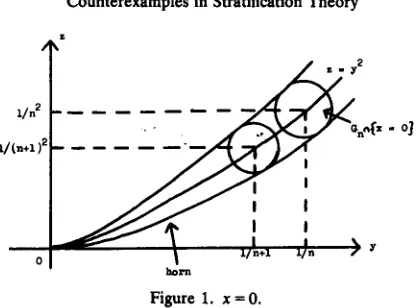
defines the cylinder Gn of radius l/3n(n+l) with axis the line (y ::
lin "
z=
1/ and wheref
fn = 0] defines the surface Fn 0btained from[x
=
«y2+.
z2) -if}
by translating the origin to
(0,
lin,
l/n2)
and reducing by a factor of3n(n+l
)112
so that F intersects ~G exactlY wheref
x ::0] is tangent to F •n n n
(0 ,
l/n&:')
1----r
It'igure:x = 0
(0 ,1/(n+l)2) G~
n
fx
=
oj ..
o
;( is a Cl submanii'old and is semia.lgebraic on the co:nplement of the origin. The normal vector to X at the point
,
xn = (1/2~n(n+1),
(lin)
+ l/3l2n(n+l) ,1/n2 )
18
and (a) fails. (For (a) to hold, all limits of,:orma1s would have to be of
the form (cl: 0 : c2 ) ,where cl' c2 are not both sero. )
\
x =
\
\
-/
/
/
/ /
x
(.J2/12n{n+l),s)
y
F·l.gpre: z -_l/n2
(t) holds since any submanifold transverse to Y will intersect X near
Y only at points near which X is defined by
f
x=
0] • Hence thestr3.tification ~ of R3 defined by
f
Y , X ,m
3 - (X uY ~ is (t )-regular • Now we verify explicitly that the set of maps transverse to ~ is notopen. The mapping h in Cl(S2, ffi3) defined by inclusion of the sphere of
radius 1 and tangent
f2X
+ Y=
0] at 0 and with centre at (-l/3,-2/{5, 0)by inclusion of the unit sphere with tangent at
is transverse to the stratification, but for each n the mapping hn defined
[ 2x + Y
=
x the plane
n (5 + l2~(n+l»/(12~n(n+l»]
~3
... h ,.:3-- "" o in the bounded ccnponerrt:Jf
to X at xn• Since
fh
nl
tends to h in the weak Cl topology, which isalso the strong Cl topology (sinc~ S2 is compaot) , the set of mappings transverse to
L
is not open in Cl(S2,m
3 ).19
liote that by smoothing near each circle
{x
=0 ,
gn =-0]
,
X can bemade into a COO subrnanifold of ffi3
,
with the normal veotor to X at eachx
as before, for all n , thus producing a COO counterexample. nConstruction 2.2 (Hills, or Round Ba.rrows)
The example above used a simple construction of a Cl semialgebraic hill which will prove useful as a, building block for both examples and proofs of
2
2]
2
theorems. Consider the curve fx = (y - 1) in
m
:
it has tangent parallelto the y-a.xis for y == ±1 •
x
Figure Hill of dimension one
~otating in
m
3 aaout the x-axis, and cutting ~~ound the circle 2+ Z = 1 ,
+
i-~
1 ,x
=
0]
01
and then inserting in the plane )x ==
01
with the di80removed, gives a Cl semialgebraic manifold. The vital
...
x
=
property of the curve
fx
=
(y2 - 1)23 which will be used again and again is that in the region fy2 ~ 11 the tangent to the curve is furthest fromf
x ..0]
Construotion 2.3 (Long Ba.rrows)
Consider the surface in R3 with coordinates x , y , z ,
=
(m2\ -z 2)2( 2 2mr-y 2)220
7 3 222 222 2 2 222 2
( m r : ,. 4(m - z ) (m r - y )y: 4(m r - y ) (m - z .)z ) •
z
(O,-m)
On ..[ z2 = m2, x =
oJ
and [y2=
m2r2, x=
oJ
the normal is (1: 0 : 0), and thus we can cut alon$ these lines to obtain the surfaceB(m,r)
=
[m7r3x = (m2_ z2 )2(m2r2_ y2)2 , z2 ~ m2 ,:l ~
m2r2] and we can insert B(m,r) in the planefx
=01
with a rectangle[ x
=
0 , z2 ~ m2 , y2!;._ m2r2j removed, to give a Cl semialgebraic manifold.( 1
At '(mrx , mr,y , mz ) for : 4y(1 _ z2)2(1 _ y2) :
2~ 2
z _ 1 , y ~ 1 , the normal is now
2 2 2)
4rz(l - z )(1 - y) • Thus as m varies
B(_,r) varies in size, but the tangent structure (that is the set of points
in p2 \ It) defined by the normals or tangents to the surface) remains the
same. But as r varies the normals change, and as :r t~nds to 0 the
Wecall thic ~urf.?ce
: ~- \, : \)
"--.-.;0:,
_,,,,,.) (_lo::;.c,;.;n ...r:.J..)_l_' <...,;;..-tr::..;;r;;...:01'T ,)f
a
with axis :)z, and centre 0, and base yOz. The axi.s , centre, and base will alw~,ys be flT,)ecified. Calculation shows tr....atfor r <.',.(j/4 ,the normal to the
21
and at these points, (4mr/9, 1:mr/-J3,O), the normal is (l;:t
8/3...f3 ~
0 ) • (Compare Construction 2.2)Linguistic Note : The term barrow is used because of the resemblance of the surface to the ancient burial mounds called by that name in England, when
r is small.
Examnle
2.4 :
This will show that the phenomenon that (t) be strictly weaker than (a) is not solely due to the possibility of (a)-faults given bysequences tangent to the base stratum as in Example 2.1 that is, it is not true that (a) holds for those sequences on curves with limiting direction not tangent to the base stratum.
In
m
3 with coordinates(x,
y ,z )
let Y be the y-axis, snd let00 00
X be
<hi
[fn == 0 , gn~o}) U(IJ.
fx
== 0 , gn~ ,z>01)
where [fn=
oj is the equation defining the barrow B(mn,rn) with centre(0,
lin , lin ) and axisfx
== 0,z
+ y == 2/n"J. ,with base in the plane~·x
==01,
andf
gn~o
1
defines the interior of the rectangular base of the barrow. X is a, 3
C~ manifold, and is semialgebraic on the complement of the origin in ffi • We
choose ~(mn,rn)}~l such that,
(1)
(2 )
(3)
r tends to
n o as n tends to 00,
..
the barrows are pairwise disjoint (in particular mn tends to 0),
m tends to 0 fast enough so that the nth barrow B(m ,r ) is
n n n
contained in the 2-sphere with centre (0, lin , l/n) and radius
.'
, 2
1/2n (so m == 1/4n2
n will do).
By (1) the Eet of limiti:'lgnor~.l.lsis exac'tl.y
f<
~.:(4*"/3E)~:(4~/j.fj)~)o ~
I
X\ ~
1] • (Cf. Construction 2.3) l'nus (a) f'ai.La, since for (cl.) 1;0hOld!!! limiting normals must be
ot
the .form (cl' 0, c2) •By (3) the set of barrows is contained in the horn which is tangent to
{z
::s
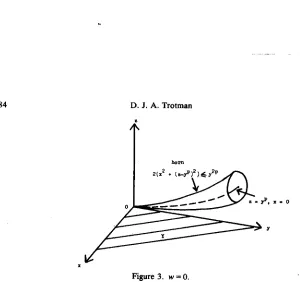
x.;)
~ which .. 'the ~lt:?:a
[z
y ')+7
~i.1.1~,;::irola of""
radius t2• Hence a Cl submanifold S transverse to Y at 0 intersects
infinitely many barrows only if
[z
= y ,x
= O]e: TOS • But then S will betransverse to all barrows in some neighbourhood of O. For, suppose S were
nontransverse to infinitely many barrows; then NOS would be one of the limiting
( 1 :(4.J2/1J3)~:(4,J2/3rr) ~) • But
fz
= Y ,x
=o]e
TOS , and 5 is transverseto {x = 0 , ?: =
oJ
R,t 0, thus NOS is of' the f'orm(l"': ~ :
-'Y) with'V
=F-
0 , which is not a limiting normal to X.'rhus we have shown that (t) holds and that (a) fails along sequences
which are not tangent to Y •
As in example,.2.1 , by~ smoothing near the base of each barrow we obtain a
c
oo examp e.1z y
Figure : x = 0 •
- -.-- ....-.".--- ..---- ..-.---.,.-.~ y
Now we shall prove that (t) and (a) are equivalent in the subanalytio
..
Case. Preoisely, we have the following result.
Theorem 2.,.~ : Let X , Y sub~nifolds of Rn a.nd let
----
o
e: yn('x -x.
,".l1,i~t
--
~-.~ ~ ...."_·C:·~,1.!"'_~.l.~rtic.. ...~,-'_-_:; ,~ , o ifand only_.-If for every sem~ana y ~c. 1t' Cl submanifold 5 transverse to Y at 0
there is some neighbourhood U of 0 in loThich 5 is transverse to X.
The proof will depend upon two technical lemmas which we display for future
23
Curve Selection Lemma 2.6 : Let U be a subanalytic subset of the analytic s~ace A, and let 0 ~ U • Then there is an analytic arc
()( : [0,
lJ ~
A
such that ()«O):= 0, ~(t) E U if t-::f::O.
Proofs of Lemma 2.6 a (1) Subanalytio U : Hironaka [12, Proposition
3.9J ·
(2) Semianalytio U : LojasiewiozQ.8,
page103J .
(3) Semialgabraic U: Ir:ilnor[23,
Chapter21 •
~Of course, (1) implies (2) , and (2) implies (3). )Lemma
2.7 :
Let Xm be a Cl submanifold of Rn, and a subanalytic subsetof [Rn • 'l'hen
£(
x , TxX ) : x € X1
is a subanalytio subset of IRn x G:( a) •Proof : See Verdier
[40,
Lemma 1.6J •Lemma
2.7 ,
with semianalytic replacing subanalytic each time, follows after ~artition into real analytic manifolds from the proof of Whitney[47]
for complex analytio varieties. A short proof of Lemma2.7 ,
with semialgebraic replacing subanalytic eaoh time, appears in Gibson[6,
page301 .
Froof of Theorem
2.2
a Only if - this is immediate since spanning (and henoe_ transversality) is an open oondition.If - Suppose (a) fails. Thus there is a unit veotor v E TOY' a
sequenoe
f
Xi} G X suoh that xi tends toand v¢.1.:.
o , and T X tends to a limit Xi
~hoc.:e 2.;> J _._ -'I ,
-'
).> ,~ ,
where d( v , p ) denotes the distance between
--i
and the endpoint of the unit veotor v, both oonsidered as subspaoes of, IRn at O.
Define VI := &.."nx [F E. ,;n(R): d(v,P)
>
eJ
Can X Gn( JR)m ill
V._
=
\"(
:x,
, '" ).'1..
.
~c
A-1J .:_k-:til x " l.l(Jm, tl)..
24
VI is semialgebraic, and V2 is subanalytic by Lemma2.7 ,since X is
assumed to be subamalytic. Semialgebraic sets are subanalytic, and the finite
intersection of subanalytic sets is suhanalytic ( by Hironaka [l:~J ). Hence
VI
n
V2 is subanalytic and (0, 't )E. V1" V2 sa tisfies the hypotheses of thecurve selection lemma2.6. Thus there is an analytic arc in Rn x G~(
m)
(which is an analytic, even algebraic, manifold) ,lX:[0,11
~\RnXG~(lR)with ()(( 0) = ( 0 , 'C) and
ex: (
t) € V1 (\ V2 if t>
0 •;Iri te 'Xl (t ) for the !Rn_componentof 0« t) ; the G~(
re
)-component isl' Dl1(t
l ·
Let Nt € G~_l(.IR) denote the normal space at 0(1 (t) to the cl rnanifold--vlith-boundary ~l ([0 , IJ ) ,
and let the vector vt be theprojection of v into Nt spanning (vt
>
e
G~(fR) •He shall define a1\ analytic arc (5":
[0,1] ~
G~_2OR) such that6(t) ~
<v,'> ,:
Nt (*)'rhen the union of the
f
(j(t)1'
considered as embedded (n-2 )-planes in mnpassing through the points 0(1(t) defines M'l analytic
manifold-with-boundary SI of dimension (n-l). Reflection in NO extends SI to a Cl
manifold S which is a semianalytic subset of IRn , and which is t ...ansverse to
y at 0 by
(*).
However we shall show that no neighbourhood U of 0 exists within which S is transverse to X.Construction of 0'" :
Let Pt
=
Nt" T~l(tl €G~l(R). Then o=t=vt.Pt by definition ofVI (\ V2 • Let (S(t) :s Pt El) (Pt Ea
<V
t,,>
)..L€ G~_2(R) ,where ( )..1.. denotes25
6 satisfies
(*)
by construction, and so it only remains to show that Sfails to be transverse to X in any given neighbourhood U of
° .
Now thereexists some toE-(0,11 such that U " 0(1(0,1] ? o(l(O,toJ • But S· (and
hence S ) is not transverse to X at any point of atl (O,lJ • For, if At
(){l(0,11 at
(j(t) eAt '"
denotes the tangent space to the curve
'l'hiscompletes the proof of Theorem 2.5.
Note 2.8 : Even if X and Yare COO submanifolds we cannot restrict to
00 2
C ,or even C, semianalytic submanifolds S, since (a) may fail only near
Cl. cusp of type "y2 = x3" , each branch of which is a Cl
manifold-with-boundary, but not a C2 manifold-with-boundary. The same type of example excludes
restricting to analytic submanifolds S, although by the proof of 2~.5 we
can restrict to analytic submanifolds-with-boundary S , since the statement
that S be transverse to Y at
°
still makes sense if°
6 Y {\as.
Theproof of 2.5 also shows that we can restrict to those S which are "ruled
submanifolds " , that is a differentiable one-dimensional family of planes of
:-;odimeY1.sLon2 in !Rn • J\corsover it auf'f'Lces to cons i.der-:-~ll eubman i.f'oLda of
·::);.:e L..::cd .::'i:le!~sicc. c;re,s,ter -:han:)r ea.t;aL to t:.:9 codd zeneion 01 Y , ::;; a.
small adjustment in the proof (choose (Sl(t) C 6(t) ,where 0"1(0) + TOY'" NO.'
61 (t) €.G~_l (a ) ,and c ~ codim Y ).
T.-C. Kuo has recently proved the following result, which is related to the
'=cuestionsalready treated in this section.
'rheorem 2.9 (Kuo) : Let X, Y be COO submanifolds of (Rn, Y:IIX - X in
some neighbourhood of Y • Suppose X.
!:L
(a)-regular over Y at 0 €. Y.J:!!
,.
, '::'r
C. be COO submanifolds transverse to y
-
at 0, with-
dim S.J. '" n - dim Y .J.26
F'roof : In
[15
J ·
This is an attractive result since it parallels the 'l'hom-!v1athertheorem
(:rheoremB of the introduction) that (b )-regulari ty implies topological triviality. Explicitly, if X is (b)-regular over Y and SI and S2 are
t'Woeubmand f'oLda transverse to Y at points Yl and Y2 in Y (with Yl
'*
Y2llllo,:ed) , then the germs of' SI
rv
X at Yl and S2 () Xhoneonorphd c, 'I'hd.a follows from Corollary 10.6 of (211.
at are
(a )-regula.ri ty is
de iLru tely insufficient for the latter property as shown by the figure belOl'l.
\/
/\
y./\
germ of S2 t'\ X
'3.t y at 0
Conjecture 2.10 : Theorem2.9 is true with the weaker hypothesms that X
Observe that the hypothesis Y 2 X - X rather than ye
X -
X is essential_in
2.;
and 2.10, as shown by the next figure.o
.Ie might also ask if the converse of ,'l'heorem2.9 is true. Howeverexamples
2.1 and 2.4 show,that this is not so. In both examples X is not (a)-regular
"
...
<-,X ina topological open half-line near
o.
We do though have a converse to2.9if we replace (a)-regularity by (t)-regu1arity as in Theorem 2.11 below.
Definition: Let X, Y be Cl submanifolds of tRn ,and 0 ~ ye X - X •
The pair (X, Y ) is said to have homeomorphio
Ck
transversals of dimensions at 0 ( I ~ k
=:;,
ID, codim Y ~ s ~ n ) if,\hk )s Gi ven a ~ submanifold S of dimension s transverse to Y at 0,
the topological type of the germ of S n X at 0 is independent of S •
Theorem 2.9 says that (a) implies (h~d Y) • From the proof of 2.9
r15),
one sees that (a) implies (h~Od Y) , but it is left in doubt whether (a)
implies (hI ) since the proof makes use of a (tangent) vector field in a
cod Y
blowing-up.
lirite (t::) for condition (t ) restricted to those Cl submanifolds S
s
of olass ~ (1 ~ k ~ (0) and dimension s ( codim Y 4 s ~ n ) • Then we have,
l~ed.i3 ~~J';_1~~
...
._._>4_~_._
implies
and s
>
n - dim X •( David Epstein has given a counterexample showing that the restriction on
s when k
>
1 is necessary.)Proof: Su~pose X is not (tk)-regular over Y at 0
s Then there is some
submanifold S of dimension s transverse to Y at
o
and an infinitesequence of ~ointB x.
~{e are working locally at 0, so wa can suppose that S is iLle image of' a
Choose a.sequence of pairwise disjoint balls B. of radius
1
x. , which a.re contained in coordinate charts for
1
x ,
such thatri and centra
i
s-
1(snBi) ""Diis an open subset of
m
S , and diffeomorphic tom
S • Let s. ~ is-l(x.) •1 J.
Ue shall show the existence of a Ck embedding
e
» ( IRs, 0) ~ (a",
0)such that,
(I) off
U
1::1 D~ ,
1..
(II) for all i g( (Rs)(\XnB. is not homeomorphic to a manifold of
1..
dimension (s + dim X - n ) , and is nonempty.
From (I) it follows that is and g have the same k-jet at 0, so that
in particular gems) = S· is transverse to Y at
o.
Existence of g when k = 1 :
Finding such a g is particularly simple when k = 1 •
Fix i , and let be a el diffeomorphism of B. , fixing x. , so that
J. 1
el_perturbation of i. near si
embedd.ing gi : (Di,si) ~ (Bi,xi), such
et> .
(Xt\B. )J. ]. is affine. By an arbitrarily small
we can change is' D. to a Cl
J.
that there are open neighbourhoods N.
J. and L.1 of s.J.
in IRs with
11. c N. C L.C. L. Co D. , and
gi
l
D.-L. ::zis
I
D.-L.,
and1 ]. ]. 1 J.
J. 1 l. J.
--~ iCl g. )N
=
d (et>i0 is)( si)tN. ·
(We have pushed4>
i(S) onto its tangelit J. .L.J. 1
Space near x .• )
].
lJep..rx
.:. ife no';;have two affine SuDsna.ces ~ I_(X ('\ B.)1. and (.-k.o'+'1 g.1)(li.)1.
which intersect'at x. , but are not transverse at x. , and hence intersect in
1 1
an affine subspace of dimension greater than d s max ( -1 , s + dim X - n ) •
Thus dim (-~.(X f\ B. ) " (4).0 g. )(D.» is gre9ter than
a ,
and hence~1. 1. 1. 1. 1
(*) dim (X" g.(D.»
>
d •]. ].
In particular
X"
g.(D.)]. ]. is nbnempty.
:Now riefine by setting gin
1 , g.J,. for all i .
29
For g to be a Cl embedding, it suffioes to ohoose [gil such that
Ijl(iS)(S) - jl{gi)(s)1
<:
ri/2i for all s EDi ' for all i. Then (I) is satisfied by oonstruotion, and (*) gives (II).Existenoe of gwhen k> 1 ,and s ~(n - dim X} s
Fix i. We shall ohange !SID to a
ok
embedding gi: (Di,s!) ~ (Bi,xi)k i i
by an arbitrarily small C -perturbation (les8 than r1/2 ,say) near 8i, so
that there are open neighbourhoods Ni with Ni C Li '
gi-l{X) f\ Ni is suoh that
gi(Di-Li• is\Di-Li
in
m
S , of the forms+dimX-n+l 2
' L
E..jz.j • 1 J
, and 8uoh that homeomorphio to a oone
o ,
where.. ±
1 ,henoe gi-l(X) 1'\ Ni is not homeomorphio to a topological manifold of dimension
(s + dim X - n) , and is nonempty.
The existenoe of suoh a Si follows from the perturbation Lemma of May (Lemma lA of his thesis
[53]
Damon has given a detalled proof of a more preoiseperturbation in Lemma 3.1 of [51] ) applied to the Ck embedding is at o ,
using the hypothesis s
>
n - dim X • The Perturbation Lemma is stated for COOmaps and uses the COO Morse Lemma. however the proof works for Ck maps (k~2),
.,
,~-'"provide different proofs) • Note that the classioal proof of the Morse Lemma is only valid for
C3
funotions (see[13],
Chapter6,
Seotion1) •
(I)
and(II)
now follow for theCk
embedding S defined in terms ofis and {gil , as in the oase ot k
=
1 • This oompletes our proof of the existen,of g.
Lemma 2.12 :i1here is some
c
k submanifold S" of dimension s ,,_
...itho
€ S" '. tra.nsverseto Y at 0 a'.':; transverse to X :.ear 0Proof: This proof will be simiiar to that of Lemma 1.3 •
is weakly olos~d in the
c
k topology. Now we apply the standard proced.ureof covering X by countably many coordinate discsf
KO(1 ,
and proving thatf
fGC
s : f ~ X on K ClJ
is open and dense inC.
S in the strong Ck topology, for each 0( , to deduce thatf
fe ~
S : f'" XJ
ie dense inc:
S •Choose a weak
cf-
neighbourhood lJ6,V(is) of the (Ck) mapping isdefined by inclusion of S in Rn, where
cS
is a positive real number, V isa neighbourhood of 0 in S , with compact closure
V,
and if f~1Jr
d
,v(iS) ,flv is a Ck embedding transverse to Y at 0 (Lemma 1.3 in Chapter 2 of
Hirsch [13 ] gives
0',
V for such a Cl neighbourhood, and the same.cf ,
V ~rovide an adequate
c~
neighboUrhood). Then the strong Ck neighbourhood Uo,s(is) hasLJ",
=U
6
,s(is)n ff€~ S : flf\xj
as a. strongly Ck dense subset. For any f in1J"" '
S" = f(V) satisfies the requirements of Lemna 2.12 •Let SIt be given by Lemma 2.12. Then S" f"\ X is either empty in some
neighbourhood of 0, or is a topological manifold of dimension (8 + dim X - n) •
Let S' be given as the image of the embedding g construoted above. Then the Gsr::_...:!at :) of S'f\X and S",,",X are of d.~sti:1;;t 'opologica.l"types, by (II), and so (hk) is not satisfied, thus proving Theorem 2.11 •
s
Corollary 2.13 I If X is subanalytio and the pair (X,!) has ho~eomorphio'
Cl transversals of dimension s at 0 for some s, n - 1 ~ s -:;.- codim Y ,
then X is (a)-re~lar over Y at 0
•
--
?roof.
.
Combine Theorem 2.11 wi.~h l'heorez~.5
,
using the relllarkat theend.of Note 2.8 that for aD¥ s n - 1 ?:- s ~ codim Y
,
(t1) implies (a)•
"
Remark: Conjecture 2.10 and Theorem 2.11 are in accord with the general principle of Thom that instability of topologioal type corresponds to a lack of transversality.
One of the original motivations for this work was the hope of generalising the theorems about equisingularity of families of complex hypersurfaces
achieved by Zariski and the French School (led by Teissier). We now explain how the results ,just desQribed fit in with this idea.
Let F: ( ",n+l....~ ~ ~-_k_ ,Ox ~-_k) __~ ()~,O be a complex analyt~c.
function such that y
=
0 x Ck contains the singular set of F. Letr:
e
n+l xe
k ~ Y be an analytic retraction. In [30] we find'thefollowing implications
:-(T.E)
II
(~)
n
(a)
topological type of F-l( 0) " r-l(y) is constant as y varies in Y
is oonstant as y varies in Y
(F-l(O) - Y) is (a)-regular over Y
...
(The first implioation is (0.1.4) of [30], and is also sketohed on page 62 of L23] • The second implication is (I1.3.10) of [30J ; a different proof
appears in
[161.)
Teissier denotes by (s.v.s) the condition tha"t \,l.'.!!I} hold for ~ suoh retractions r. Corollary 2.13 can now be thought of as a
,
unsettled in
[31).
The exam9le given by Teissier in the post-script to
[3i]
is instructive. Consider V=
f
y3=
tx2 + x5'} inn
3 and let Y be the t-axis, and X=
V - Y • Then X is topologically trivial over Y , and the topological type of theintersection of X with each plane
f
t == oonstantJ
is constant, so that(T.E) holds for r: 1R3 ~ Y defined by (x, y , t ) ~ t • However
A is not (a)-regular over Y at 0, and (:(,Y) does not have homeomorphic
,,1
v transversals of dimension 2 at 0 as is seen from the figure.
Y t
Figure
3. (a)-regularity and transverse foliations
In his paper "Regular Stratifications"
[431
c.
T. C. Wall notad that(x, y ) ~n. !Onn (a)-:-egular at o in Y then,
Given a local retraction onto Y defined near o , then there is
He suggested that the converse was also true, and this will be the main result of this section.
First note that
'Tt
I
X 1"'\ U is a submersion if and only if the fibres of 'Tt:are transverse to X in U • Then we see that (as) implies (t) • F'ar, given
a Cl submanifold S transverse to Y at 0 we can choose a chart at 0 in
which Sand Y become linear and then take a linear retraction 1t whose
fibres lie in S • If the fibres of 11 are ~ransverse to X, S will be
transverse to X. Thus we obtain,
Corollary 3.1' : Let X", Y be Cl submanifolds of lRn and let 0 E.ye:.X - X
~nd let X be a subanalytic set. Then X is (a)-regular over Y at 0 if
and only if ;{ is (a )-regular over Y at 0
s
Proof: As above, (a) implies Ca), and (a) implies (t). Now apply
s s
Theorem 2.5 •
Clearly if Y is an analytic manifold we can restrict to Cl local retractions
rr
whose fibres are semianalytic : further improvements onRemark 3.2 : In both examples 2.1 and 2.4 we can choose a (linear) retraction
n
whose fibres are translates (over Y) of a limiting tangent plane for which (a) fails, and these fibres fail to be transverse to X at each -pointof a aequence t.ending too.
Before we prove that (a) implies
s (a) , we give a helpful reformulation
of (as) suggested by Dennis Sullivan.
Given a foliation ~ transverse to y at o , there is a
It is clear that (a) is equivalent to (~l). Given
(:t
l), (a)s s
follows since the fibres of a Cl looal retraction define a foliation transverse
to Y of codimension the dimension of Y • Given (a ) ,
s (3-1) follows by
choosing a retraction whose fibres are contained in the leaves of the foliation.
So the question of whether (a) implies
s (a) can be formulated as : do
transverse Cl foliations detect (a)-faults?
rrheorem 3.3 (II Transverse Cl foliations detect (a ~faul ts II)
Let X, Y be Cl submanifolds of !Rn , and let 0 EYe X - X • ThGln
x:
is
-
(a)-regular over Y,
at o if and only if X is (']-1 )-regular over Y at
(1"11) •
implies ~ So suppose
o
Froof :i'/ehave already established that (a)
that there is an (a)-fault at 0 given by a sequence fXiJ E X tending to 0,
W'ith
"C
= lim T X ,and TOYet:.
L .
x. ~
~ie shall adjust a codimension 1 foliation by hyperplanes parallel to a
hyperplane containing ~ so as to be nontransverse to x at infinitely many x .•
1.
Construction 3.4 (Ripples)
Given a hyperplane H eG~_l(IR), a real number
SE.[O,!l,
and a real':unber l'
>
0 , we construct a v.,1 foliation of Codimension 1 01 t~'.aball Bn of radius
r r with oentre o in mn suoh that
..
(1) for all x €. Bn - 13n1
,
T:;.S
= H ,r ~r x H
(2 ) for all x
e.
Btr
n,
d(H,T::0-~) ~ s,
U)
for all. K ~ G~_l (m) such that d(K,H) = s,
there is a unique'1c
e.
Birnsuch that
(4) thel"e is a. diffeomorphism th't'H :S.n b ~ :an
r I' such that
<p:
C
3-:)
is the trivial foliation ~H"10 by' hyperplanes parallel to H , and suoh
,
that <p~IBn _
B~ = idfB~ _ B~
,
and dCP: tends to the identityr itr :~r
35
implies for all
Figure
(lie shall postpone the verification of Construction 3.4 until after the proof
of Theorem 3.3 • The reader may in any case prefer to admit the verification as
geometrically evident.)
Choose a one-dimensional subspace VeT oY such that V
q:
"t • Define ahyperplane H by 1: ~("( a;,V)..L ,where ( )..1. denotes orthogonal complement
1"7\ n-!1
.Left •
Since T X tends to
't
as i tends to 00 , there is some iO suchx. ~
that i ~ iO implies V¢: Tx. X • Then for alli'>- iO define. a hyperplane
..L ~
Hi by T X~(T xev) C T IRn. Then H. tends to H as i tends to 00.
x , x. x. ~
~ ~ ~
Pick il ~ iO such that \Hi - H'
<
i
for i ~ i1 •ill
Now pick an infinite sequence of pairwise disjoint balls B (x.) with
r. ~
a
o is the or~y accu~ula~±nn
radius r. and centre x .• 'I'hds is possible since
~ ~
Point of
fxJ
i::l • Then for all i, 0 ~ Br. (xi) •~
For all i ;;:.il ' place inside B (x.) a
r. ~
~
with radius
ir. ,
centre y. , and the foliation~ ~
" ripple " : a foliated ball
'::r ,,:rJH. -HI """i
=
JH~ Bi = Bir:(yi)~
given by Construction 3.4 such that x. = L .. ' i.e. T~. = H .• (There are
.1 tl X. 1 1
~ ~
trivia.l foliation
:fH
by hyperplanes parallel toLet
on Bi for all i ~ il•
2J.,
diffeomorphism
cf>
I mn ~= identity, and qplB. = ~ .
H on ~n -
(U
B.) ,i~ i l.
will be a Cl foliation if
Rn taking
3-
onto ~ H • .,-h1H.-HI~Hl. as defined in together with ~i
we can define a Cl
Construction 3.4 • To check that
c}
is a v..,1 diffeomorphism it is enough tocheck that dCP(x) is continuous at 0 and equal to the identity at O.
Given £.
>
0 , (4) of Construction 3.4 gives us an s£>
0 • Pick i2 ~ ilsuch the.t \Hi - H\
<
se:
for all i ~ i2 • Let&
== mi_!![r
xl1 •<5
is x€Bi. il,i<i2
i,.,-l ~2-1
,·jell-defined and nonzero since 0
<$
\.:J
B.
c.
tJ
J3 (x.)... ~ .. r. ~
].:::~l ~=~l].
i -1
r \ (" x ~ ,2 J B; ,so i'hen x c::::: 0 implies q::: \.._/ ...
i=il
<c
by (4) of Construction 3.4 ,and t..:e choice of sCo ' i2•
?hus dqp(x) is continuous near 0, and dcp(O) = I (the identity matrix). Jence
S
is a Cl foliation and T03- = H , so that3-
is transverse to Y•
at
o (
Vet- H by definition of H). Bu:b for all i ~ il ,T x.J.
=
Tx.3-.:::
~ Hi~ ].
X at x .• This shows that ].
Theorem3.3 •
and Tx.X cH.- ]. , so that r::r.... is nontransverse to
J
]. 1
is not (~)-regular over Y at 0, proving
i:~rifica tion of CoroStruction 3.4 : It suffices to taka H = ;an-l x 0C Rn
and n
=
2 • For n>
2 the calculations are similar. Gonsider,t
::: ~ + (1_~2)2(x2_ a2)2 ~2 ~ 1 x ~2 a2,,2 ~
2 2:II
A
1,
a ~ x '-- 1 ,37
~e aaall prove that this defines a Cl foliation of [_1,~2 of codimension
of
f\ •
(If n'>
2 , take1, ~ith the leaves corresponding to fixed values
2~ n-1 2 2 2
= ~
+ (l-~ I(2:
xi - a) ,et cetera.) i=lx
n
I.:lultiplying by r/4 gives a foliation of [-r/4, r/4] 2 which fits into
the ball B~ (0) and extends trivially to a foliation
3-
a of B (0) whiohff.t" r
satisfies (1) • 'llhe leaf "Idth normal vector furthest from (0 : 1) is clearly given by
x
=
o ,
and this normal is (1 :+
(8a3 )/(3.0) ) at the points( (4/9)804
,±
a/J3 ). (Compare Construotion 2.2)iirite
v,
=, (8a3)/0I3)
.
Then \(1: "Va) - (1: 0)' == So,
given s,
choose a such that')
"\J
a<- 2 1 +'V
2 ==s
,
a
2 2
i.e. ~ = s 2 •
a
1- s
Then 6
a =
2
64(1 - s ) •
l'lith this choice of a, (2) and (3) of 3.4 are satisfied.
:;ote that for s
e
[o,~]
we have : a6 ~ 9/64 (*) •Jef:'::-.e
¢
e.:[-1.11
2 ~
[-l,:y 2
b;'l{(X'Y)
• ~ 2 2 2 2
(x,
Y +(I_ye) (x - a ) )
2a ~ x2 ~ 1
2
a
..
<P
a. is then a Cl map. Elementary calcul"l.tion using (*) shows that4>
ais injective. ITow
2 ~ 2
if x ~ a ,
?nd
d¢>
~x.y)a is the identity ffi",trix if 1 •
Calculation using ( ;(-) shows that 'dtP (x,y) is always nonsingu1ar. Thus
a