in the population sciences published by the Max Planck Institute for Demographic Research Konrad-Zuse Str. 1, D-18057 Rostock · GERMANY www.demographic-research.org
DEMOGRAPHIC RESEARCH
VOLUME 26, ARTICLE 3, PAGES 63-98
PUBLISHED 3 FEBRUARY 2012
http://www.demographic-research.org/Volumes/Vol26/3/ DOI: 10.4054/DemRes.2012.26.3
Research Article
Couple disagreement about short-term fertility
desires in Austria: Effects on intentions and
contraceptive behaviour
Maria Rita Testa
© 2012 Maria Rita Testa.
This open-access work is published under the terms of the Creative Commons Attribution NonCommercial License 2.0 Germany, which permits use, reproduction & distribution in any medium for non-commercial purposes, provided the original author(s) and source are given credit.
1 Introduction 64
2 The role of partner context in theories of fertility decision-making 65
3 Research hypotheses 68
4 Data and methods 69
4.1 Data sample 69
4.2 Short-term fertility desires, short-term fertility intentions and non-use
of contraception 70
4.3 Respondent’s perception of agreement/disagreement with the partner about wanting a(nother) child now 71
4.4 Methods 72
4.5 Background variables 73
5 Results 75
5.1 Descriptive analysis 75
5.2 Multivariate analysis 77
5.2.1 Socio-demographic determinants of the respondent’s own short-term fertility intentions and contraceptive behaviour 77 5.2.2 Effects of disagreement: Testing the research hypotheses 81
6 Accuracy of the perception of the partner’s short-term fertility desires 87
7 Summary and concluding remarks 91
8 Acknowledgements 93
Couple disagreement about short-term fertility desires in
Austria: Effects on intentions and contraceptive behaviour
Maria Rita Testa1
Abstract
BACKGROUND
Because of the dyadic nature of reproduction, the couple is the most suitable context for studying reproductive decision-making.
OBJECTIVE
I investigate the effects of couple disagreement about short-term childbearing desires on the formulation and implementation of fertility intentions. Do men and women incorporate the perception of a disagreement with the partner about wanting a(nother) child now in their reports on short-term fertility intentions and contraceptive behaviour? Are there relevant differences by type of disagreement, parity, gender and gender equality within the couple?
METHODS
Using individual-level data from the Austrian Generation and Gender Survey conducted in 2008, I regress respondent’s short-term fertility intentions (ordinal regression models) and non-use of contraception (logistic regression model) on couple’s short-term childbearing desires and a set of background variables.
RESULTS
The findings show that disagreement is shifted toward a pregnancy intention\pregnancy-seeking behaviour at parity zero and toward avoiding pregnancy and maintaining contraceptive use at higher parities. Childless women are less responsive to the perception of their partner’s desires than childless men when they express their short-term childbearing intentions. Neither women nor men are likely to stop contraception if they perceive a disagreement with their partner about wanting a(nother) child. Moreover, if the man is actively involved in childcare duties the chance to resolve the couple conflict in favour of childbearing increases.
CONCLUSION
This paper calls for the collection of data from both members of each couple so that the analysis of the partner’s actual desires can complement the analysis of the partner’s perceived desires.
1 Vienna Institute of Demography, Austrian Academy of Sciences. Wittgenstein Centre for Demography and
1. Introduction
In this paper, I address the issue of fertility decision-making among couples using individual-level data. Following the approach proposed by Miller and Pasta (1996), a distinction is made between respondents who perceive a positive disagreement (with the partner having weaker desires than the respondent), and respondents who perceive a negative disagreement (with the partner having stronger desires than the respondent).
The importance of including both partners in the fertility analysis is well recognised (Ryder 1973). Several studies have adopted a couple-oriented approach (Fried and Udry 1979; Coombs and Chang 1981; Morgan 1985; Thomson et al. 1990; Corijn et al. 1996; Thomson 1997; Thomson and Hoem 1998; Jansen and Liefbroer 2006; Miller and Pasta 1996; Miller et al. 2004; Becker 1996), fertility research, however, has been primarily based on the female perspective. This choice has been justified by the high degree of homogamy within the couple, and the fact that women
are the main actors and the most reliable reporters of childbearing events.
A major difficulty in the couple-level research lies in the need to have high quality data that collect information on both partners, possibly in repeated waves, which allow researchers to ascertain the differences between partners’ reproductive goals, and to identify the contribution of each partner to the final childbearing outcome. If this is true for every country, the lack of adequate data is an even greater problem in European countries, where longitudinal household surveys have only rarely been conducted in recent decades.
Some surveys have tried to get around the difficulties related to the collection of couple data by asking individual respondents questions about their partner’s childbearing desires. Empirical findings based on this kind of data have demonstrated that the respondent’s reports about the couple’s fertility intentions are influenced almost twice as strongly by the individual’s own desire to have a child as by the perception of the partner’s desire to have a child (Morgan 1985). Moreover, respondent’s proxy reports of spouse’s desired family size are subject to both systematic and random error (Williams and Thomson 1985).
Estimating the degree of egocentric biases contained in respondents’ perceptions of their partner’s fertility desires is beyond the scope of the current paper. My basic assumption is that the partner’s perceived and actual childbearing desires are different measures, both contributing to creating the context in which individual fertility
decisions are made (Miller et al. 2004).
Are there relevant differences by type of disagreement, parity, gender and gender
equality within the couple?
The empirical analysis is based on a sample of 3,402 individuals from the survey “Familienentwicklung in Österreich” conducted by the Austrian National Statistical Office (Statistik Austria) in 2008. Austria is a country with low gender equity and high incompatibility between childrearing and employment. In addition to lacking couple level data, which is the case for most European countries, Austria has just few micro-level studies on fertility intentions.
This article is organised as follows. I begin by reviewing the relevant literature on couple fertility decision-making (Section 2). This is followed by a statement of the research hypotheses (Section 3). I present the data and the methodology in Section 4, and describe the results of the statistical analyses in Section 5. In Section 6 I compare the main findings with those that could have been observed by using the actual partner’s desires rather than the respondent’s proxy report of them. The most relevant results are summarised and discussed in the concluding section.
2. The role of partner context in theories of fertility decision-making
There are two major theoretical frameworks suitable for studying fertility decision-making: the Theory of Planned Behaviour (TPB) and the Theory of Traits-Desires-Intentions-Behaviour (TDIB). I will review both with the intention of showing how they take into account the dyadic aspect of reproduction. Moreover, I will discuss an overview of decision rules used to resolve conflict.
The Theory of Planned Behaviour (Ajzen 1991) was first applied in the domain of fertility decision-making by Billari et al. 2009. It studies intentions as an immediate forerunner of the corresponding behaviour, and views intentions as being formulated under the immediate influence of three groups of factors: (a) personal positive and negative attitudes towards the behaviour, i.e., having a child; (b) subjective norms, i.e., perceived social pressure to engage or not to engage in the behaviour; and (c) perceived behavioural control, i.e., ability to perform the behaviour which may depend, for example, on the availability of housing, income, or other resources.
subsequent behaviour holds true only if the behaviour is specified in all of its four components: namely, the target, the action, the context and the time (Ajzen 2010). In the field of fertility, the target is a child, the action is giving birth, the context could be the current partner, and the time could be a short-term horizon, which may make the intentions more realistic. Consistent empirical evidence has been collected on the crucial importance of the partner’s context for the construction of pregnancy intentions (Barret and Wellings 2002; Zabin et al. 2000).
The Theory of Planned Behaviour has been criticised because it does not explicitly consider the complexity of the dyadic nature of reproduction (Philipov 2011) nor does it describe the disagreement effects of couple’s decisional conflicts (Miller and Pasta 1996).
Unlike the TPB theory, the traits-desires-intentions-behaviour theory (Miller 1986 and 1994) has been reformulated to explicitly consider the dyadic nature of reproduction (Miller and Pasta 1996; Miller et al. 2004). This theoretical framework sees the behaviour that determines whether or not a pregnancy occurs as the last step of a motivational sequence which encompasses four major stages. The first one refers to motivational traits, or the dispositions to feel, think, and behave in certain ways with respect to fertility; the second stage concerns the desires, emotional feelings or conscious wishes which do not lead directly to action; the third stage refers to intentions, desires constrained by reality, psychological states that represent conscious commitment to act in a certain way or to achieve a certain goal at some future time. Eventually, the reproductive behaviour is aimed at achieving (proceptive) or avoiding (contraceptive) a pregnancy. According to the TDIB intentions are assumed to incorporate the perception of desires of significant others, above all the partner, as well as other situational factors that may prevent individuals from simply doing what they want. This distinction is worth emphasising, given that the focus of my analysis is on the translation of desires into intentions and contraceptive behaviour. In the couple-based version of the theory, the interaction between partners is examined at each stage of the sequence, and the perception of the partner is considered an important element in the individual’s construction and performance of the subsequent stages of the motivational structure (Miller et al. 2004).
Miller and Pasta (1996) have disentangled two main components of disagreement between partners which influence the individual’s decision-making differently. The
signed difference component describes an influence effect, i.e. which member of the
couple has more or less influence on the behaviour. The absolute difference component
Beach et al. 1982) Indeed, research has shown that the behaviour of couples with conflicting childbearing desires is more similar to that of couples in which both partners want no (more) children than to that of couples with a shared desire for (more) children (Miller and Pasta 1994), which suggests the presence of a symmetric veto power model (Thomson 1997; Thomson and Hoem 1998; Voas 2003). The influence effect will depend on which of the partners has stronger and weaker childbearing desires, the level of gender equality between the partners, and the decision-making rules within the couple. Previous studies have demonstrated that, in low-fertility societies, the decision-making process tends to be dominated by the woman, who controls most methods of contraception (Beckman 1983). Moreover, a couple who disagree will tend to seek pregnancy if the wife’s subjective expected utility favours pregnancy (Townes et al. 1980). Empirical evidence indicates that women have greater influence over the negotiation process in societies in which childbearing lies mainly in the women’s sphere of interest (Fried et al. 1980; Beckman 1984; Rindfuss et al. 1988; Miller and Pasta 1994).
3. Research hypotheses
I suppose that people incorporate the perceptions of their partner’s childbearing desires into their own reports on fertility intentions and contraceptive behaviour but the extent to which they do so varies by the type of decision each partner wants to make, as well as by parity, gender and gender equality within the couple.
I expect that both women and men tend to emphasize their own desires over their partner’s perceived desires in their reports of their own short-term fertility intentions. Hence, once disagreement is disaggregated into a positive and a negative component I
hypothesise that men and women who want to have a child now and perceive that their
partner does not want (positive disagreement) are more likely to report a child intention than men and women who do not want to have a child now but perceive that their partner wants (negative disagreement) (Hypothesis 1a, signed difference effects of disagreement on intentions.) Moreover, since contraceptive behaviour is a couple construct, I expect that the effect of disagreement with the partner about wanting a(nother) child now does not depend on whether respondent’s own desires are stronger
or weaker than the partner’s perceived desires. Hence, I hypothesise that absolute and
signed disagreement have the same effects on contraceptive behaviour (Hypothesis 1b,
absolute difference effects of disagreement on contraception).
The lack of agreement between partners may favour a decision not to have a child, given that delaying fertility is a normatively acceptable life course strategy, while having a baby has immediate and permanent implications for individuals (Rindfuss et
al. 1988; Miller and Pasta 2002). Hence, I hypothesise that men and women who
perceive a disagreement with their partner about wanting a(nother) child now show intentions and contraceptive outcomes closer to that of respondents who perceive agreement on not having a(nother) child now than to that of respondents who perceive agreement on having a child now (Hypothesis 2, double-veto power effect).
Since the two-child family is the most prevalent normative model in Europe, I expect a shift of disagreement toward intending a child and stopping contraception at parity zero and one and a shift toward preventing a pregnancy intention and using contraception at parity two or above (Hypothesis 3, two-child norm effect).
Women generally have the primary responsibility for childrearing and face a number of barriers in combining work and family life in Austria (Prskawetz et al. 2008). It is therefore reasonable to assume that gender differences exist in the respondent’s responsiveness to the partner’s perceived desires. My third research
hypothesis may be stated as follows: women are less responsive than men to the
perception of a disagreement with their partner about wanting a(nother) child now when they express their own short-term fertility intentions (Hypothesis 4, gender
Fertility is particularly low in those contexts where high levels of gender equity in education and labour market are combined with low levels of gender equity in the family (McDonald 2000). Hence, I expect that gender equality within the couple
favours a decision to have another child. I hypothesise that men and women who
perceive a disagreement with the partner about wanting a(nother) child now and who live in more gender-egalitarian relationships in terms of gender division of childcare tasks will be more prone to resolve the conflict in favour of childbearing (i.e., express an intention to have a child and stop contraception) than men and women who live in less gender egalitarian relationships (Hypothesis 5, gender equality effect).
In contemporary societies, the intra-household distribution of bargaining power has become an important factor driving the fertility decisions of spouses with different interests (Jansen and Liefbroer 2006). The partner with more socio-economic resources will be more empowered in the reproductive decision-making if the power rule is the predominant heuristic adopted by the couples in conflict. The last research hypothesis
may be stated as follows: men and women with less bargaining power than their
partner are more likely to reflect their partner’s perceived desires into their own short-term fertility intentions and non-use of contraception, while respondents with more bargaining power than their partner are less likely to reflect their partner’s perceived desires into their own short-term childbearing intentions and related behaviour
(Hypothesis 6, bargaining power effect).
To test these hypotheses, I disaggregated the respondent’s desires and the partner’s perceived desires into positive and negative components, since the degree of responsiveness that people may have to the partner may vary with the type of the decision that has to be made. Miller and Pasta (1996) have proved the utility of such an approach by showing that each of these two components may vary independently of the other, and each of them may be differently associated with important demographic backgrounds.
4. Data and methods
4.1 Data sample
I used data from the survey Families in Austria (Familienentwicklung in Österreich),
conducted by the Austrian National Statistical Office in 2008 in the framework of the international Generations and Gender Programme. The whole sample size included 5,000 individuals, men and women, aged 18-45.
selected only those unions in which neither partner had been surgically sterilised, and the respondent answered both questions about his or her own and the partner’s fertility desires.
4.2 Short-term fertility desires, short-term fertility intentions and non-use of contraception
Short-term fertility desires were measured by asking individuals not only about their
own fertility desires (Do you yourself want to have a/another child now?), but also
about their partner’s fertility desires (Does your partner want to have a/another child
now?), if they had a partner. The later question was introduced by the following
statement: “Couples do not always agree on when and how many children they want”.
Respondents were given a choice between the following answers: yes, no, or don’t
know; and in the question about the partner’s wishes, they were offered an additional
option: partner is not sure. 12 respondents answered “don’t know” to the question on
their own fertility desires and 15 respondents did so for the question on the partner’s desires. Four individuals reported a “don’t know” answer to both questions.
Short-term fertility intentions were measured by asking respondents the following
question: “Do you intend to have a/another child during the next three years?” The
interviewees were asked to indicate on a four-point scale how certain they were about
their intentions. The specific options were: “Certainly not”, “Probably no”, “Probably
yes” and “Certainly yes”. 22 respondents answered “don’t know” to this question.
“Don’t know” answers may be informative of particular desires and intentions (Morgan 1981). However, since the uncertain individuals were very few in the Austrian GGS survey, I could not consider them as a distinctive category in the bivariate and multivariate statistical analysis.
The literature on fertility decision-making generally uses the term ‘want’ to capture wishes, or emotional feelings that do not incorporate any situational constraints, and do not lead directly to action, and the expression ‘intent’ to measure goal-related actions (Miller 1994). Since, however, the interviewers who administered the questionnaire were not trained to first explain to the respondents the difference between desires and intentions, the extent to which the interviewees may have perceived the
distinction between the concepts remains unclear.
Moreover, it is worth noting that the two questions on fertility desires and intentions refer to periods of time of differing lengths: namely, “now” for the desires and “three years” for the intentions. This may have introduced an additional source of
Non-use of contraception was measured by asking respondents the following
question: “Do you currently use contraception?” The interviewees could choose
between two options: yes or no. 78 respondents answered “don’t know” (2% of the
analytic sample).
I excluded from the multivariate analyses the 122 individuals reporting a “don’t know” answer on any of the items on fertility desires, intentions, or contraceptive behaviour. This eliminated 122 respondents and resulted in a sample size of 3,280 individuals.
4.3 Respondent’s perception of agreement/disagreement with the partner about wanting a(nother) child now
I defined the agreement/disagreement variable from a respondent’s individual perspective by disaggregating the entire sample into four categories, outlined in Scheme 1: 1) respondents who do not want to have a child and perceive that their partner does
not want one either (agreement on no); 2) respondents who do want to have a(nother)
child, and perceive that their partner wants to have one as well (agreement on yes); 3)
respondents who do not want a(nother) child, but perceive that their partner wants to
have a(nother) child or is unsure (respondent’s perception of negative disagreement); 4)
respondents who want to have a(nother) child, but perceive that their partner does not
want a(nother) child or is unsure (respondent’s perception of positive disagreement).
Since I made the distinction between the positive and negative types of disagreement from the respondent’s perspective, the adjective ‘negative’ describes the type of disagreement in which the respondent does not want to have a(nother) child and the adjective ‘positive’ describes the type of disagreement in which respondent does want to have a(nother) child.
I considered disagreement to be any discrepancy between the respondent’s and the partner’s perceived desire, irrespective of the direction of disagreement (Scheme 1).
Scheme 1: Definition of couple’s agreement and disagreement about wanting a(nother) child now
Partner is perceived as: Respondent....
Not wanting a child Being unsure Wanting a child
does not want a child AGREEMENT ON NOT
WANTING
NEGATIVE
DISAGREEMENT
wants a child POSITIVE
DISAGREEMENT
In the empirical analysis I labeled the four categories as follows: R yes, believes partner yes (agreement on wanting), R yes, believes P no or unsure (positive disagreement), R no, believes P yes or unsure (negative disagreement), R no, believes P
no (agreement on not wanting). R stands for respondent and P for partner.
4.4 Methods
I used ordinal regression models to analyse the predictors of the respondent’s short-term fertility intentions, and logistic regression models for examining the determinants of the respondent’s report on non-use of contraception. In the ordinal regression models, the response variable is the intention to have a child in the next three years, which has the following four categories: certainly not, probably not, probably yes, certainly yes. They are assumed to be ordinal, and are coded one, two, three and four. The key covariate of the model is the respondent’s perception of agreement/disagreement with the partner about wanting a(nother) child now. This is included as a three-category variable (Model 1), and as a four-category variable (Model 2), depending on whether the difference between the respondent’s and the partner’s desires is considered as a whole, or is specified as a positive or a negative component. The ordinal regression models assume that the ratio of the odds of two individuals does not depend on the category (the
proportional odds property). This assumption, which is known as the parallel regression assumption, is convenient for the parsimony of interpretation, and can be checked using, for instance, the test developed by Brant (1990). Since just a few covariates in each model violated such an assumption, and they did so only slightly, I used the proportional odds models for the sake of simplicity. Estimates of the partial proportional odds models may be provided by the author upon request.
4.5 Background variables
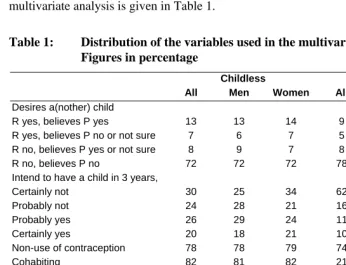
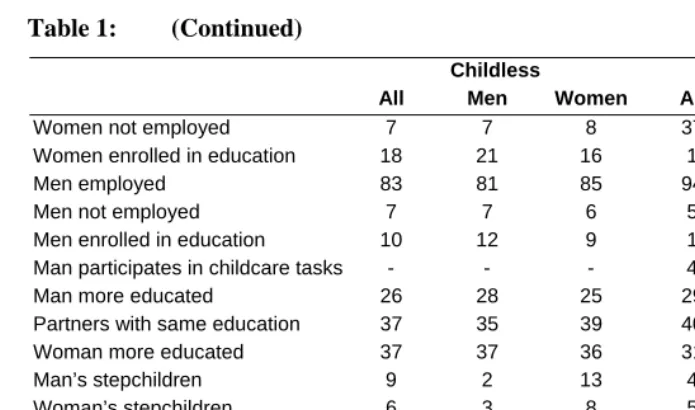
The same set of explanatory variables was included in all the models: the respondent’s gender, the type of union, the duration of the partnership, the man’s and the woman’s education, the man’s and the woman’s employment status, the man’s and the woman’s age, the man’s and the woman’s stepchildren (i.e., children from a previous union), the number of common children, the number of years that have elapsed since the birth of the last child, the difference in education levels between the partners, men’s involvement in childcare duties. The percentage distribution of the variables used in the multivariate analysis is given in Table 1.
Table 1: Distribution of the variables used in the multivariate analysis. Figures in percentage
Childless Parents
All Men Women All Men Women
Desires a(nother) child
R yes, believes P yes 13 13 14 9 10 8
R yes, believes P no or not sure 7 6 7 5 7 4
R no, believes P yes or not sure 8 9 7 8 6 9
R no, believes P no 72 72 72 78 77 79
Intend to have a child in 3 years,
Certainly not 30 25 34 62 56 66
Probably not 24 28 21 16 21 13
Probably yes 26 29 24 11 12 11
Certainly yes 20 18 21 10 11 10
Non-use of contraception 78 78 79 74 71 76
Cohabiting 82 81 82 21 22 21
More than 3 years from the start of partnership
39 36 41 90 88 92
Women with low education 34 36 33 48 49 48
Women with medium education 45 47 44 38 38 38
Women with high education 20 17 23 14 13 15
Men with low education 50 51 49 60 61 60
Men with medium education 33 34 32 26 27 25
Men with high education 18 15 19 14 12 15
Table 1: (Continued)
Childless Parents
All Men Women All Men Women
Women not employed 7 7 8 37 37 37
Women enrolled in education 18 21 16 1 1 1
Men employed 83 81 85 94 94 94
Men not employed 7 7 6 5 5 5
Men enrolled in education 10 12 9 1 1 1
Man participates in childcare tasks - - - 4 8 2
Man more educated 26 28 25 29 30 28
Partners with same education 37 35 39 40 38 41
Woman more educated 37 37 36 31 32 31
Man’s stepchildren 9 2 13 4 2 6
Woman’s stepchildren 6 3 8 5 1 7
Couple’s one child - - - 35 37 35
Couple’s two or more children - - - 65 63 65
More than 3 years from the birth of the last child
- - - 63 61 64
N. cases 1354 563 791 1926 717 1209
I measured men’s involvement in childcare tasks with a dummy variable equal to one if men take part in at least six of the following childcare duties: dressing the children, putting them to bed, staying home with them when they are sick, playing with them or spending leisure time with them, helping them with their homework and taking them to school or to kindergarten; and zero otherwise.
Previous studies have shown that partners often differ in their reports on the division of household and childcare tasks (Kamo 2000). These findings seem to be supported by the Austrian GGS data. However, since the data at hand provide information from just one of the partners, I was not able to rigorously test for the possibility of discrepancies in the partners’ reports.
5. Results
5.1 Descriptive analysis
In Table 2, I looked at the percentages of respondents who were in perceived agreement/disagreement with their partner about wanting a(nother) child now, following the classification described in the methodological section. The share of respondents who perceived that their partner agreed with them was high: 87%. The share who agreed about wanting a(nother) child, 76%, was considerably higher than the share who agreed about not wanting a(nother) child, 11% (Table 2). When interpreting these results, it should be noted that the desires refer to a short time frame, and do not imply any long-term decision. Of the 13% of the respondents who perceived that their partners disagreed with their own fertility desires, they were almost evenly divided between those who wanted a child when their partners were perceived as not wanting a child or being unsure, and vice versa (6% and 7%, respectively). Parent respondents reported negative disagreement more frequently (8%) than positive disagreement (5%) (Table 2).
Table 2: Respondent’s and partner’s perceived short-term fertility desires by couple’s parity (%)
Partner is perceived as: N.cases
All respondents
Not wanting Being unsure Wanting
Does not want 76 3 4 2770
Wants 4 2 11 510
N.cases 2639 169 472 3280
Childless
Does not want 73 3 5 1099
Wants 4 3 12 255
N.cases 1046 82 226 1354
Parents
Does not want 79 3 5 1671
Wants 4 1 8 255
N.cases 1593 87 246 1926
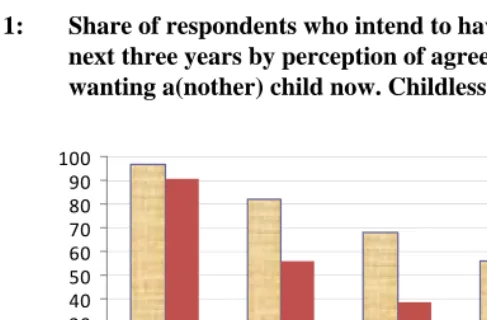
intention gradually decreased, going from perceived agreement on yes (97% and 91% among childless persons and parent respondents, respectively) to perceived agreement on no (33% and 10%, respectively). The decline was steeper for parents than for childless respondents. The percentage of men and women expressing a childbearing intention in the disagreement categories was between that of respondents who agreed on wanting a child and that of those who agreed on not wanting a child. When disagreement is distinguished by the respondent’s and partner’s desire for a child now, the respondent’s intentions are much closer to those of respondents who perceive partner agreement, whether on having or not having a child. That is, the respondent’s desire appears to have a stronger influence on her/his intentions than perception of the partner’s desire.
Figure 1: Share of respondents who intend to have a(nother) child within the next three years by perception of agreement with the partner about wanting a(nother) child now. Childless and parent respondents
0 10 20 30 40 50 60 70 80 90 100
R yes, believes P
yes
R yes, believes P
no
R believes
P disagrees
R no, believes P
yes
R no, believes P
no
Childless Parents
Figure 2: Share of non-use of contraception by respondent’s perception of agreement with the partner about wanting a(nother) child now. Childless and parent respondents
0 10 20 30 40 50 60 70 80 90 100
R yes, believes P
yes
R yes, believes P
no
R believes P disagrees
R no, believes P
yes
R no, believes P
no
Childless Parents
5.2 Multivariate analysis
In this section I present the findings of the multivariate analysis in two different sub-sections. First, I discuss the estimates related to the socio-demographic determinants of respondents’ own short-term fertility intentions and contraceptive behaviour (Tables 3 and 4). Next, I discuss the effect of the disagreement by describing the results of the goodness of fit tests used to accept/reject each of my research hypotheses (Tables 5 and 6). The evidence provided by these tests justifies keeping the signed difference disagreement variables in the final models for intention and the absolute disagreement variable in the final models on contraceptive non-use.
5.2.1 Socio-demographic determinants of the respondent’s own short-term fertility intentions and contraceptive behaviour
negatively associated with the length of the relationship, the number of shared children and the years elapsed from the birth of the last child if the respondent already had children at the time of the survey (2nd column of Table 3). In this latter sub-group, the intention to have a child in the short-term was positively associated with the cohabiting status.
Table 3: Determinants of the respondent’s own short-term fertility intentions. Estimates of the ordinal regression models. Beta coefficients
Childless Parents
Partners’ desires for a(nother) child (ref. R no, believes P no)
R yes, believes P yes 3.84 *** 3.74 ***
R yes, believes P no 2.89 *** 2.50 ***
R no, believes P yes 1.07 *** 0.93 ***
Gender (ref. woman)
Man 0.10 0.17
Man*R yes, believes P no -1.01 * -
Childcare tasks (ref. only woman)
Man participates - -0.44
Bargaining power (ref. women and men with the same level of education)
Man more educated -0.26 -0.14
Woman more educated -0.13 -0.10
Type of union (ref. Married)
Cohabiting -0.21 0.32 *
Duration of union (ref. up to three)
More than 3 years 0.12 -0.40 *
Woman’s education (ref. Medium)
Low -0.05 -0.19
High 0.27 0.19
Man’s education (ref. Medium)
Low -0.18 -0.27
High 0.29 0.07
Woman’s employment (ref. Empl.)
Not employed -0.47 * 0.20
Enrolled in education -1.12 *** -0.96
Man’s employment (ref. Empl.)
Not employed -0.81 *** 0.18
Table 3: (Continued)
Childless Parents
Stepchildren (ref. None)
Man’s stepchildren -1.26 *** 0.04
Woman’s stepchildren -0.75 *** 0.02
Couple’s children (ref. One)
Two or more children - -0.87 ***
Years from last birth (ref. up to three)
More than three years - -0.58 ***
First cutpoint -0.95 *** -0.68 *
Second cutpoint 0.44 0.74 **
Third cutpoint 2.34 *** 2.36 ***
N. cases 1354 1926
* p<0.05; ** p<0.01; *** p<0.001. Models controlled for woman’s age and man’s age.
In Table 4, all the estimates of the logistic regression models for the respondent’s report on the non-use of contraception are provided. Models run on childless and parent groups yielded different results.
In the sub-sample of childless respondents, non-use of contraception was negatively associated with cohabiting status, with the man’s high level of education, and the man’s stepchildren. It was positively associated with the woman’s non-active status (1st column of Table 4). In the sub-sample of parents, the non-use of contraception was negatively associated with the cohabiting status, and positively associated with the man’s non-active status (2nd column of Table 4).
As expected, the chance of reporting non-use of contraception was higher if the respondent expressed an intention to have a child in the next three years (Table 4). The fertility intention’s coefficients were smaller than those related to the perception of agreement with the partner about wanting a(nother) child now in both models on childless couples and parents. This evidence suggests that the latter may play a more relevant role than the former in predicting fertility-related behaviour.
Table 4: Determinants of the respondent’s non-use of contraception. Estimates of the logistic regression models. Beta coefficients
Childless Parents
Partners’ desires for a(nother) child (ref. R no, believes P no)
R yes, believes P yes 2.47 *** 1.94 ***
R believes P disagrees 0.73 *** 0.16
Gender (ref. Woman)
Man 0.19 0.24
Childcare tasks (ref. only woman)
Man participates - -0.11
Man participates*R believes P disagrees - 1.48 *
Bargaining (ref. women and men with the same level of education)
Man more educated -0.14 -0.56
Woman more educated -0.03 -0.03
Intention to have a child (ref. Cert. No)
Probably not 0.23 0.65 ***
Probably yes 0.13 0.67 **
Certainly not 1.05 *** 0.83 ***
Type of union (ref. Married)
Cohabiting -0.48 * -0.43 **
Duration of union (ref. up to three)
More than 3 years 0.37 -0.12
Woman’s education (ref. Medium)
Low 0.19 0.23
High 0.19 -0.00
Man’s education (ref. Medium)
Low -0.00 0.25
High -0.98 ** 0.02
Woman’s employment (ref. Empl.)
Not employed 1.18 *** 0.26
Enrolled in education -0.18 0.19
Man’s employment (ref. Empl.)
Not employed 0.56 0.58 *
Table 4: (Continued)
Childless Parents
Stepchildren (Ref.None)
Man’s stepchildren -0.93 ** 0.32
Woman’s stepchildren 0.14 -0.12
Couple’s children (Ref. One)
Two or more children - 0.00
Years from last birth (Ref. up to three)
More than three years - 0.06
Intercept -1.88 -2.26 ***
N. cases 1354 1926
* p<0.05; ** p<0.01; *** p<0.001. Models controlled for woman’s age and man’s age.
5.2.2 Effects of disagreement: Testing the research hypotheses
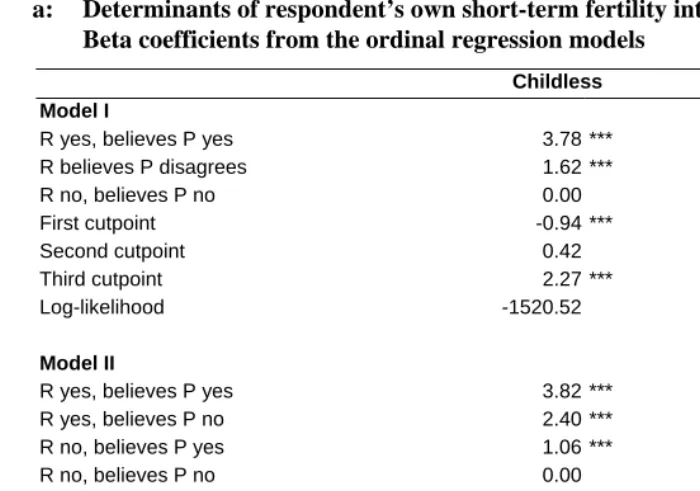
Hypothesis 1a: Signed difference effect of disagreement on intention. To test this hypothesis I compared the fit of a model in which perceived positive and negative disagreements are collapsed in one single category with that of a model in which they are kept separated. As shown in Table 5a, the latter fit the data much better than the former in the case of fertility intentions. Hence, one can argue that, for childbearing intentions, the conflict effect (absolute disagreement) is different from the influence effect (signed disagreement). More specifically, perceived negative disagreement had stronger inhibiting effects on childbearing intentions than perceived positive disagreement: the coefficients for intending a child were 1.06 and 2.40, respectively, for childless persons and 0.93 and 2.50 for parents (Table 5a).
Table 5: Test for signed difference effect
a: Determinants of respondent’s own short-term fertility intentions. Beta coefficients from the ordinal regression models
Childless Parents
Model I
R yes, believes P yes 3.78 *** 3.67 ***
R believes P disagrees 1.62 *** 1.59 ***
R no, believes P no 0.00 0.00
First cutpoint -0.94 *** -0.64 *
Second cutpoint 0.42 0.74 **
Third cutpoint 2.27 *** 2.30 ***
Log-likelihood -1520.52 -1467.68
Model II
R yes, believes P yes 3.82 *** 3.73 ***
R yes, believes P no 2.40 *** 2.50 ***
R no, believes P yes 1.06 *** 0.93 ***
R no, believes P no 0.00 0.00
First cutpoint -0.98 *** -0.68 *
Second cutpoint 0.40 0.75 **
Third cutpoint 2.29 *** 2.35 ***
Log-likelihood -1508.21 -1448.19
N. cases 1354 1926
Likelihood-ratio test 24.61 *** 38.97 ***
p<0.05; ** p<0.01; *** p<0.001. Models controlled for all the background variables.
b: Determinants of couple’s non-use of contraception. Beta coefficients from the logistic regression models
Childless Parents
Model I
R yes, believes P yes 2.47 *** 1.92 ***
R believes P disagrees 0.74 ** 0.23
R no, believes P no 0.00 0.00
Intercept -1.88 *** -2.24 ***
Table 5: (Continued)
Childless Parents
Model II
R yes, believes P yes 2.48 *** 1.94 ***
R yes, believes P no 0.80 * 0.39
R no, believes P yes 0.68 * 0.13
R no, believes P no 0.00 0.00
Intercept -1.88 *** -2.23 ***
Log-likelihood -448.40 -946.00
N. cases 1354 1926
Likelihood-ratio test 0.10 0.71
* p<0.05; ** p<0.01; *** p<0.001. Models controlled for all the background variables.
Hypothesis 2: Double-veto power effect. To test this hypothesis, I compared the fit of a model with a linear specification of both partners’ combined desires in which disagreement had a score midway between agreement on yes and agreement on no with that of a model in which a categorical variable (N-1 dummies) reflected the possible combinations of the respondent’s own and the partner’s perceived desires. The linear variable for the partners’ combined desires took the value 0 for agreement on no, 1 for disagreement and 2 for agreement on yes. Because equal effects for the two types of disagreement on fertility intentions were rejected above, we would expect this model to be rejected for fertility intentions, and it is. A second model that allows the two forms of disagreement to differ in their effects, but maintains a ‘linear’ character was also tested: 0=agreement on no, 1=negative disagreement, 2=positive disagreement and 3=agreement on yes (Table 6a). This model was not rejected in comparison to the categorical model and therefore signals that the four categories are not only ordinal but also equidistant. Although there is a ‘bias’ toward reporting intentions that are more similar to one’s own than to one’s partner’s desires, the bias is symmetrical – it doesn’t matter whether one wants or does not want a child.
childless persons and parents, respectively, Table 6b). Remarkably, in the models run on the parents’ sub-sample, the effect of disagreement was not statistically significantly different from that of perceived agreement on no, which provides very strong evidence for a double-veto effect.
Table 6: Test for double-veto power effect
a: Determinants of respondent’s own short-term fertility intentions. Beta coefficients from the ordinal regression models
Childless Parents
Model I
Linear specification of partners’ desires 1.24 *** 1.23 ***
First cutpoint -0.98 *** -0.66 *
Second cutpoint 0.40 0.77 **
Third cutpoint 2.30 *** 2.36 ***
Log-likelihood -1508.89 -1449.72
Model II
R yes, believes P yes 3.82 *** 3.73 ***
R yes, believes P no 2.40 *** 2.50 ***
R no, believes P yes 1.06 *** 0.93 ***
R no, believes P no 0.00 0.00
First cutpoint -0.98 *** -0.68 *
Second cutpoint 0.39 0.75 **
Third cutpoint 2.29 *** 2.36 ***
Log-likelihood -1508.21 -1448.19
N. cases 1354 1926
Likelihood-ratio test 1.34 3.05
* p<0.05; ** p<0.01; *** p<0.001. Models controlled for all the background variables.
b: Determinants of couple’s non-use of contraception. Beta coefficients from the logistic regression models
Childless Parents
Model I
Linear specification of partners’ desires 1.18 *** 0.77 ***
Intercept -1.85 *** -2.24 ***
Table 6: (Continued)
Childless Parents
Model II
R yes, believes P yes 2.46 *** 1.92 ***
R believes P disagrees 0.73 ** 0.23
R no, believes P no 0.00 0.00
Intercept -1.88 *** -2.24 ***
Log-likelihood -448.45 -946.35
N. cases 1354 1926
Likelihood-ratio test 5.49 * 16.53 ***
* p<0.05; ** p<0.01; *** p<0.001. Models controlled for all the background variables.
Hypothesis 3: Two-child norm effect. To test this hypothesis, I compared the fit of a model with an interaction term between a dichotomous variable, indicating whether or not respondents have at least one child, and the partners’ combined short-term fertility desires with that of a model in which the interaction for parity zero, one and two or above are contemplated. Since the latter model did not fit better, I reject the hypothesis of norms regarding the two-child family and I support the hypothesis of parenthood as a norm (results not shown but available upon request). This result provides good justification for stratifying the analysis by childless respondents and parents.
Figure 3: Predicted probabilities to report a short-term fertility intention for disagreeing couples in which respondent wants to have a child and believes that partner does not want. Estimates from the model run on the childless sub-sample shown in Table 3
0 0.1 0.2 0.3 0.4 0.5 0.6
Pr(Certainly not) Pr(Probably not) Pr(Probably yes) Pr(Certainly yes)
women men
Hypothesis 5: Gender equality effect. To test this hypothesis, I compared the fit of a model in which the effect of the perception of partner’s agreement/disagreement was constrained to be the same for couples in which the man participates in child care tasks and for couples in which he does not with that of a model where this effect was allowed to be different in the two types of couples. The inclusion of such an interaction term significantly improved the fit of the model on non-use of contraception. From the sign of the coefficient, one can argue that when men were involved in childcare duties a positive disagreement tended to be shifted toward stopping contraception. The coefficient was 0.16 for couples in which the male partner did not participate in childcare and 1.64 (0.16+1.48) for couples in which the male partner participated in childcare (Table 4). In Figure 4 I show the predicted probabilities of contraceptive non-use from the models run on parents’ sub-sample. The man’s involvement in childcare tasks increased the chance to report non-use of contraception if disagreement was perceived (Figure 4).
Figure 4: Predicted probabilities of non-use of contraception by perception of partner's desires and gender equality within the couple. Estimates from the model run on the parents’ sub-sample shown in Table 4
0.0 0.1 0.2 0.3 0.4 0.5 0.6 0.7 0.8
R yes, believes P yes R believes P disagrees R no, believes P no couples in which men do not participate in childcare
couples in which men participate in childcare
Hypothesis 6: Bargaining power effect. To test this hypothesis, I compared the fit of a model in which the effects of the combined partners’ desires was constrained to be the same for couples in which either the woman or the man was more educated with that of a model in which these effects were allowed to differ between the two types of couples. The empirical evidence was always in favour of the restricted models, meaning that the inclusion of the interaction term between the partner’s perceived desires and a difference in partners’ educational levels did not significantly improve the fit of the model. Results are not shown but available upon request.
6. Accuracy of the perception of the partner’s short-term fertility
desires
participate, 1,115 returned the questionnaire. The response rate was, at 29%, very low. Hence, the couple-level data could not be used for any robust statistical analysis.
Since there were 796 individuals of my selected analytic sample for whom a comparison between perceived and actual partner’s short-term fertility desires could be performed, I looked at this small sub-sample to assess the accuracy level of the respondents’ perceptions of their partner’s desires. It is worth pointing out that the share of perceived disagreement did not significantly differ in the main sample and in the small sub-sample of couple data.
In Table 7 the distribution of the partners’ combined short-term fertility desires is reported by using either the proxy or the partner’s actual desires. The full distribution of proxy by actual report is not shown because of the small sample size. The share of disagreement differed depending on whether it was based on respondent’s proxy report for partner’s desires or on each partner’s own report of desires. The differences were statistically significant here only for childless respondents. As expected, the respondent’s perceptions of their partner’s desire tended to overestimate the actual level of agreement and to underestimate the actual level of disagreement between the partners. Parents’ proxy reports were more correct than childless respondents’ ones, the consistency levels here were 90% and 84%, respectively (Table 7). In each of the sub-groups considered, the highest level of error was observed in the category ‘respondent no, partner yes’. This was the most difficult case to be ascertained by the respondent in his/her proxy report. The other category of disagreement ‘respondent yes, partner no’ registered a higher proportion of consistent reports, even higher than that of the agreement category ‘respondent yes, partner yes’.
Table 7: Distribution of proxy and actual partner’s report and proportion of error by partners’ combined short-term fertility desires and couple’s parity
Partners’ desires for a(nother) child
Childless respondents (%) Parent respondents (%)
Proxy Actual % correct Proxy Actual % correct
Both yes 17 15 76 9 8 84
R yes, P no 6 9 76 4 5 91
R no, P yes 7 11 56 8 10 58
Both no 70 65 89 79 77 94
Total 100 100 84 100 100 90
I ran on the sub-sample of respondents with couple data the same models used for the analysis of respondents who had just a proxy report of their partners’ desires (Tables 8 and 9). I included in these couple models the variables associated with partners’ participation in the survey in order to control to some extent for partners’ response bias. This is because in the sub-sample of respondents with an interviewed partner, couples who were married, couples with children and couples in which the male partner was the main respondent tended to be over-represented.
I tested all the research hypotheses by using the same procedure adopted in the main analysis. Some of the results obtained in the earlier analysis were confirmed. In the models for intentions run on childless or parent respondents, the effects of signed differences were different from those of absolute disagreement and the disagreement produced an outcome which was lying midway between that of an agreement on yes and that of an agreement on no (Table 8). Moreover, men reported a childbearing intention less frequently than women if they wanted a child but the partner did not want one (beta coefficient for men=1.9 (3.67-1.77) (Table 8). Disagreeing couples, whether childless or not, reported non-use of contraception almost as often as those who agreed on not having a child (Table 9). This result held, independent of whether the disagreement was signed or absolute, and did not depend on whether the woman or the man was higher in their short-term fertility desires.
Some other findings obtained in the main analysis were not confirmed. The effect of the partner’s disagreement on the respondent’s intentions and contraceptive behaviour did not depend on the gender equality within the couple. Moreover, the parity-specific effect of disagreement was not consistent with the one observed in the main sample: disagreement had the strongest inhibiting effects at parity zero and two or above. This result, however, has to be interpreted with great caution, given that the sub-sample of respondents with an interviewed partner was strongly selected by parity.
Table 8: Determinants of the respondent’s own short-term fertility intentions. Estimates of the ordinal regression models run on the sub-sample of respondents with an interviewed partner. Beta coefficients
Childless Parents Childless Parents
Model 1 Model 2
Gender
Men -0.27 -0.32 -0.12 -0.32
Women (ref.) 0.00 0.00 0.00 0.00
Couple’s desires for children
R yes, P yes 4.88 *** 3.94 *** 4.88 *** 3.97 ***
Table 8: (Continued)
Childless Parents Childless Parents
Model 1 Model 2
R yes, P no - - 3.67 *** 2.62 ***
R yes, P no * Man - - -1.77 * -
R no, P yes - - 1.23 ** 1.37 ***
R no, P no 0.00 0.00 0.00 0.00
First cutpoint -0.36 *** 0.90 ** -0.23 *** 0.86 *
Second cutpoint 0.81 2.16 * 0.96 2.14 **
Third cutpoint 2.81 *** 3.74 *** 3.07 *** 3.75 ***
N. cases 266 530 266 530
* p<0.05; ** p<0.01; *** p<0.001. Model controlled for marital status. Models for parents controlled also for couple’s parity and man involvement in childcare tasks.
Table 9: Determinants of the respondent’s non-use of contraception.
Estimates of the logistic regression models run on the sub-sample of respondents with an interviewed partner. Beta coefficients
Childless Parents Childless Parents
Model 1 Model 2
Gender
Men 0.20 0.64 ** 0.20 0.64 **
Women (ref.) 0.00 0.00 0.00 0.00
Couple’s desires for children
R yes, P yes 1.83 *** 2.60 *** 1.88 *** 2.61 ***
R disagrees with P -0.56 0.42 - -
R yes, P no - - 0.22 0.46
R no, P yes - - -1.92 0.39
R no, P no 0.00 0.00 0.00 0.00
Short-term child intention
Certainly or probably yes 1.04 * 0.32 0.96 * 0.31 Certainly or probably not 0.00 0.00 0.00 0.00
Intercept -0.97 * -1.70 *** -0.93 * -1.69 ***
N. cases 266 530 266 530
7. Summary and concluding remarks
In this paper, I examined how couple disagreement about short-term childbearing desires affects two aspects of reproductive decision-making: the formation of short-term fertility intentions, and their implementation, as measured by the prediction of non-use of contraception. I disaggregated differences between the respondent’s own and the partner’s perceived desires into negative and positive components depending on whether the respondent’s desires were weaker or stronger than the partner’s perceived ones, and examined those components separately.
Results showed that the perception of the partner’s childbearing desires is an important element in the formation and implementation of one’s own fertility intention, as theoretically discussed by Miller and Pasta (1996), Miller et al. (2004), and recently emphasised by Ajzen (2010). The perception of a lack of agreement with the partner about wanting a(nother) child now discourages the intention to have a child in the short-term and inhibits the non-use of contraceptives. There are, however, important differences by type of disagreement (positive versus negative), gender, parity and gender equality within the couple.
Absolute and signed disagreements produced different effects on the respondent’s own short-term childbearing intention. Positive disagreement was closer to agreement on yes and negative disagreement was closer to agreement on no while absolute disagreement had an effect lying between the two indicated signed differences. This result may reflect the circumstance that individuals are not willing to be discouraged by their partner if they want to have a child. It is also consistent with the acceleration effect found by Miller and Pasta (1996) in their longitudinal research according to which the member of the couple who intended to have a child sooner had more influence on the timing of subsequent proceptive behaviour. However, it may also signal the predominance of the respondent’s desires over his/her partner’s desires and it is consistent with the bias in the perception of partners’ desires which is usually driven by the respondents’ own desires (Thomson 1997; Miller et al. 2004).
The double-veto model worked only for contraceptive behaviour but not for respondents’ own short-term childbearing intentions. Respondents who perceived a difference between their own and their partner’s desires reported an intention outcome in between that of respondents who perceived an agreement on having a child and that of respondents who perceived an agreement on not having a child. This evidence suggests that the partner context is not always adequately incorporated in the respondent’s report of his/her own short-term fertility intentions.
contraceptive use at higher parities. This signals that below replacement family size ideals are the norm in Austria, as evidenced in previous studies (Goldstein et al. 2003).
Moreover, at parity zero, women were less responsive than men to their partner’s desires if they wanted to have a child now but perceived that the partner did not. This finding supports the women’s greater influence on childbearing decision-making outlined in my fourth research hypothesis. It is also in line with a recent qualitative study according to which Austrian men think it is fair to leave the final say on having a child to their female partner (Rille-Pfeiffer 2009). A woman’s prevalence in reproductive decision-making was also found in other countries, such as Italy, where childbearing lies mainly in woman’s domain (Testa et al. 2011).
In the sub-sample of parents, the man’s active involvement in childcare duties shifted disagreement more in favour of childbearing rather than contraception (see interaction effects between man’s participation in childcare tasks and disagreement, in the Model for the prediction of non-use of contraceptives, sub-sample of parents, Table 4). The result provides evidence for my fifth research hypothesis. It is also consistent with the positive association between an equal gender division of childcare duties within the couple and the second-birth intentions observed in a previous Austrian empirical study (Buber-Ennser 2003).
The data reveal that the respondent’s perception of agreement with the partner about wanting a(nother) child now predicts more strongly the non-use of contraception than the respondent’s own fertility intentions. This result indicates that fertility desires may bypass fertility intentions and act directly on behaviour (Miller 2011). It is worth pointing out that fertility desires have a closer time referent than fertility intentions in the Austrian GGS. This discrepancy is in many respects a limitation, but the use of the word ‘now’ is important in identifying conflicts between the partners, which may vary over time, given that desires are frequently reassessed over the individual’s life course (Morgan 1985). Moreover, it reduces the area of potential agreement because the partners may disagree about whether they want to have the next birth at the current time (now), or whether they want to postpone it to a later point in time.
The remarkably high proportion of fertility desires converted into fertility intentions in the case of a perceived agreement between the partners implies that fertility desires could be the most suitable context for investigating the couple’s interaction. Indeed, intentions might conceal the conflict between the partners because they reflect the resolution of it, as has been suggested by previous research (Ajzen 1991; Miller 1994; Barret and Wellings 2002). This would explain why in some studies looking at partners’ differences in fertility intentions, a high degree of homogeneity in partners’ responses has been found (Berrington 2004).
processes should be based on surveys in which the two partners are interviewed independently (Thomson 1997; Thomson and Hoem 1998). The ideal situation would be to have a double source of information on the partner’s desires—i.e., as perceived by the respondent and as reported by the partner—as this may ease the interpretation of conflicting desires (Becker 1996). My analyses of the restricted couple sample suggest that the bias introduced by using partners’ perceived fertility desires as proxies for their actual fertility desires was not particularly high. This means that real disagreement, not just perceived disagreement, is the source of continuing to use contraception among conflicting couples. This assessment, however, could only be based on a valid sub-sample affected by a very low response rate and high selectivity.
Because of the dyadic nature of reproduction, the couple is the most suitable context for investigating fertility decision-making. In this study I attempted to take a step forward in the analysis of couples’ childbearing decisions. My findings reveal that respondents who perceive that their partner disagrees with them about wanting another child now do not always refrain from expressing a short-term child intention but are not likely to stop using contraception. This sub-sample of people probably will not actively try to conceive until an agreement has been reached within the couple. Whether they will eventually have a baby in the short-term future and whether this will happen more often to couples in which only the woman wanted to have a child while the man did not want one might be clarified in further investigations using a longitudinal approach, once the data from the second wave of the Austrian GGS become available.
8. Acknowledgments
References
Ajzen, I. (1991). The theory of planned behavior. Organizational Behavior and Human
Decision Processes 50(2): 179-211. doi:10.1016/0749-5978(91)90020-T.
Ajzen, I. (2010). Fertility intentions and the theory of planned behaviour. Paper
presented at the International Conference on Reproductive Decision-making in a Macro-Micro Perspective, Vienna, December 2-3, 2010.
Barret, G. and Wellings, K. (2002). What is a ‘planned’ pregnancy? Empirical data
from a British study. Social Science & Medicine 55(4): 545-557. doi:10.1016/
S0277-9536(01)00187-3.
Beach, L.R., Hope, B.D., and Campbell, F.L. (1982). The expectation-threshold model
of reproductive decision making. Population and Environment 5(2): 95-108.
doi:10.1007/BF01367489.
Becker, S. (1996). Couples and reproductive health: A review of couple studies. Studies
in Family Planning 27(6): 291-306. doi:10.2307/2138025.
Beckman, L.J. (1983). Communication, power, and the influence of social network in couple decisions on fertility. In: Bulatao, R.A. and Lee, R.D. (eds.).
Determinants of fertility in developing countries, Vol. 2. New York: Academic Press: 415-443.
Beckman, L.J. (1984). Husbands’ and wives’ relative influence on fertility decisions
and outcomes. Population and Environment: Behavioral and Social Issues 7(3):
182-197. doi:10.1007/BF01255488.
Berrington, A. (2004). Perpetual postponers? Women’s, men’s and couples’ fertility intentions and subsequent fertility behaviour. Applications and Policy Working Paper A04/09. Southampton: Southampton Statistical Sciences Research Institute.
Billari, F., Philipov, D., and Testa, M.R. (2009). Attitudes, norms and perceived
behavioural control: Explaining fertility intentions in Bulgaria. European
Journal of Population 25(4): 439-465. doi:10.1007/s10680-009-9187-9.
Brant, R. (1990). Assessing proportionality in the proportional odds model for ordinal
logistic regression. Biometrics 46(4): 1171-1178. doi:10.2307/2532457.
Buber-Ennser, I. (2003). The influence of the distribution of household and childrearing
Yearbook of Population Research 1: 165-180. doi:10.1553/populationyearbook 2003s165.
Bulatao, R.A. (1981). Values and disvalues of children in successive childbearing
decisions. Demography 18(1): 1-25. doi:10.2307/2061046.
Coombs, L.C. and Chang, M.C. (1981). Do husbands and wives agree? Fertility
attitudes and later behavior. Population and Environment 4(2): 109-127.
doi:10.1007/BF01255801.
Corijn, M., Liefbroer, A.C., and De Jong Gierveld, J. (1996). It takes two to tango, doesn’t it? The influence of couple characteristics on the timing of the birth of
the first child. Journal of Marriage and the Family 58(1): 117-126.
doi:10.2307/353381.
Davidson, A.R. and Beach, L.R. (1981). Error patterns in the prediction of fertility
behaviour. Journal of Applied Social Psychology 11(6): 475-488. doi:10.1111/
j.1559-1816.1981.tb00837.x.
Fried, E.S., Hofferth, S.L., and Udry, J.R. (1980). Parity-specific and two-sex utility
models of reproductive intentions. Demography 17(1): 1-11. doi:10.2307/
2060959.
Fried, E.S. and Udry, J.R. (1979). Wives’ and husbands’ expected costs and benefits of
childbearing predictors of pregnancy. Biodemography and Social Biology 26(4):
265-274. doi:10.1080/19485565.1979.9988385.
Goldstein, J., Lutz, W., and Testa, M.R. (2003). The emergence of sub-replacement
family size ideals in Europe. Population Research and Policy Review 22(5-6):
479-496. doi:10.1023/B:POPU.0000020962.80895.4a.
Jansen, M. and Liefbroer, A.C. (2006). Couple’s attitudes, childbirth, and the division
of labor. Journal of Family Issues 27(11): 1487-1511. doi:10.1177/
0192513X06291038.
Kamo, Y. (2000). “He said, she said”: Assessing discrepancies in husbands’ and wives’
reports on the division of household labor. Social Science Research 29(4):
459-476. doi:10.1006/ssre.2000.0674.
Lundberg, S. and Pollak, R.A. (1996). Bargaining and distribution in marriage. Journal
of Economic Perspectives 10(4): 139-158. doi:10.1257/jep.10.4.139.
McDonald, P. (2000). Gender equity in theories of fertility transition. Population and
Miller, W.B. (1986). Proception: An important fertility behavior. Demography 23(4):
579-594. doi:10.2307/2061352.
Miller, W.B. (1994). Childbearing motivations, desires, and intentions: A theoretical
framework. Genetic, Social, and General Psychology Monographs 120(2):
223-258.
Miller, W.B. (2011). Differences between fertility desires and intentions: Implications
for theory, research, and policy. Vienna Yearbook of Population Research 9:
75-98.
Miller, W.B. and Pasta, D.J. (1994). The psychology of child timing: A measurement
instrument and a model. Journal of Applied Social Psychology 24(3): 218-250.
doi:10.1111/j.1559-1816.1994.tb00580.x.
Miller, W.B. and Pasta, D.J. (1996). Couple disagreement: Effects on the formation and
implementation of fertility decisions. Personal Relationships 3(3): 307-336.
doi:10.1111/j.1475-6811.1996.tb00119.x.
Miller, W.B. and Pasta, D.J. (2002). The motivational substrate of unintended and
unwanted pregnancy. Journal of Applied Biobehavioral Research 7(1): 1-29.
doi:10.1111/j.1751-9861.2002.tb00073.x.
Miller, W.B., Severy, L.J., and Pasta, D.J. (2004). A framework for modelling fertility
motivation in couples. Population Studies 58(2): 193-205. doi:10.1080/
0032472042000213712.
Morgan, S.P. (1981). Intention and uncertainty at later stages of childbearing: The
United States 1965 and 1970. Demography 18(3): 267-285. doi:10.2307/
2060997.
Morgan, S.P. (1985). Individual and couple intentions for more children: A research
note. Demography 22(1): 125-132. doi:10.2307/2060991.
Namboodiri, N.K. (1972). Some observations on the economic framework for fertility
analysis. Population Studies 26(2): 185-206. doi:10.2307/2173577.
Philipov, D. (2011). Theories on fertility intentions: A demographer’s perspective.
Vienna Yearbook of Population Research 9: 37-45.
Prskawetz, A., Sobotka, T., Buber-Ennser, I., Engelhardt, H., and Gisser, R. (2008).
Austria: Persistent low fertility since the mid-1980s. Demographic Research
Rille-Pfeiffer, C. (2009). Kinder – jetzt, später oder nie? Generatives Verhalten und Kinderwunsch in Österreich, Schweden und Spanien. Schriftenreihe des Österreichischen Instituts für Familienforschung (ÖIF) 21. Vienna: Budrich UniPress.
Rindfuss, R.R., Morgan, S.P., and Swicegood, G. (1988). First births in America:
Changes in the timing of parenthood. Berkeley: University of California Press.
Ryder, N.B. (1973). A critique of the National Fertility Study. Demography 10(4):
495-506. doi:10.2307/2060877.
Testa, M.R., Cavalli, L., and Rosina, A. (2011). Couples’ childbearing behaviour in
Italy: Which of the partners is leading it? Vienna Yearbook of Population
Research 9: 157-178.
Thomson, E. (1997). Couple childbearing desires, intentions, and births. Demography
34(3): 343-354. doi:10.2307/3038288.
Thomson, E. and Hoem, J.M. (1998). Couple childbearing plans and births in Sweden.
Demography 35(3): 315-322. doi:10.2307/3004039.
Thomson, E., McDonald, E., and Bumpass, L.L. (1990). Fertility desires and fertility:
Hers, his, and theirs. Demography 27(4): 579-588. doi:10.2307/2061571.
Townes, B.D., Beach, L.R., Campbell, F.L., and Wood, R.L. (1980). Family building:
A social psychological study of fertility decisions. Population and Environment
3(3-4): 210-220. doi:10.1007/BF01255339.
Voas, D. (2003). Conflicting preferences: A reason fertility tends to be too high or too
low. Population and Development Review 29(4): 627-646.
doi:10.1111/j.1728-4457.2003.00627.x.
Williams, R. and Thomson, E. (1985). Can spouses be trusted? A look at husband/wife
proxy reports. Demography 22(1): 115-123. doi:10.2307/2060990.
Zabin, L.S., Huggins, G.R., Emerson, M.R., and Cullins, V.E. (2000). Partner effects on
a woman’s intention to conceive: ‘Not with this partner’. Family Planning