RESEARCH ARTICLE
Vestibular function can be affected by autoimmune processes in
rheumatoid arthritis
Nahid Heydari1, Fahimeh Hajiabolhassan1*, Jamileh Fatahi1, Shafieh Movaseghi2, Shohreh Jalaie3
1
- Department of Audiology, School of Rehabilitation, Tehran University of Medical Sciences, Tehran, Iran
2
- Rheumatology Research Center, Imam Khomeini Hospital, Tehran University of Medical Sciences, Tehran, Iran
3- Biostatistics, School of Rehabilitation, Tehran University of Medical Sciences, Tehran, Iran
Received: 15 Dec 2014, Revised: 10 Apr 2015, Accepted: 24 Apr 2015, Published: 23 Sep 2015
Abstract
Background and Aim: Autoimmune inner ear disease (AIED) may accompany certain systemic conditions, such as rheumatoid arth-ritis, and manifest audiovestibular dysfunction. This study aimed to compare the vestibular function between rheumatoid arthritis (RA) patients and normal subjects using cervical vestibular-evoked myogenic potentials and caloric tests.
Methods: In this cross-sectional study, 25 patients with RA and 20 normal subjects underwent pure tone audiometry, acoustic immittance, cervical vestibular-evoked myo-genic potentials (cVEMPs), and bithermal calo-ric test which eye movements were recorded by videonystagmography.
Results: Sensorineural hearing loss was found in 40% of patients with rheumatoid arthritis, which was significantly higher than controls (p<0.05). Biphasic waveforms of cVEMPs were obtained from all of the participants. There were no significant differences in mean peak-to-peak amplitude and asymmetry ratio between the two groups (p>0.05). The mean peak latency of p13 was significantly higher in RA patients (p<0.05). The mean peak latency of n23 was
statistically different in the left ear (p<0.05), but in the right ear the difference was not significant (p>0.05). Unilateral weakness in patients with RA were significantly higher than those in the control group (p<0.05). The values of direc-tional preponderance were not significantly different between groups (p>0.05).
Conclusion: Audiovestibular dysfunction may present in the patients with rheumatoid arthritis to a varying degree. The possible pathology was discussed in here. Further studies may shade more light to the pathogenesis of the AIED.
Keywords: Rheumatoid arthritis; cervical vestibular evoked myogenic potentials; caloric test
Introduction
Rheumatoid arthritis (RA) is an autoimmune systemic disease that is characterized by inflammation of the joints. The entrance of inflammatory cells into the joints causes des-tructive changes that usually result in bilateral and symmetrical deformity and disability [1]. RA affects 1-2% of the population with the highest prevalence in the fourth to sixth decades of life. Women are more affected than men [2]. Extra-articular manifestations may develop in the lung, heart, eye and skin in patients with RA [3]. Previous studies suggest that autoimmune processes influence hearing and vestibular functions [3,4,5]. In various *
connective tissue diseases such as RA, Wegener's granulomatosis, polyarthritis nodosa, systemic lupus erythematosus, and Cogan's syndrome with involvement of the inner ear, auditory and vestibular dysfunction may deve-lop [4].
Autoimmune inner ear disease (AIED) is chara-cterized by a subacute onset of sensorineural hearing loss (SNHL), that is often accompanied by aural fullness, tinnitus, and vestibular dysfunction [5]. Cochlear hair cell pathology and SNHL is seen in about 24-60% of RA patients [3,6,7].
Studies that have evaluated the vestibular system in RA are few [8] and the results are controversial. Yilmaz et al. contrasted the result of caloric, positional and smooth pursuit tests and found that there is an association between RA and the vestibular system dysfunction as well as with the auditory impairment [8]. Kakani et al. evaluated the results of the saccade and the bithermal caloric test on patients with RA but did not find abnormalities in the test results [9]. King et al. investigated postural control, vestibulo-ocular reflex (VOR) and optokinetic reflex (OKR) in patients with RA and compared them with control group. They concluded that RA patients do not show significant deficits in visual-vestibular function [10].
The influence of RA on the vestibular system is unknown and the results of previous studies are inconclusive. In this study, we evaluated vestibular function in RA patients using cervical vestibular-evoked myogenic potentials (cVEMPs) and the caloric test.
cVEMPs assess the vestibular system, espe-cially the saccule, the inferior vestibular nerve and the saculocollic pathway. High intensity sound bursts activate the saccule and saculo-collic pathway. The pathway stimulation can be recorded as a far-filed biphasic responses with the latency of approximately 10 to 25 ms [11,12]. To our knowledge this is the first report that evaluates the vestibular system in RA patients with cVEMP test.
The bithermal caloric test measures unilateral labyrinthine function and it can be used to
validate a tentative diagnosis of asymmetric function in the peripheral vestibular system. Previous studies have used electronystagmo-graphy and have measured the slow-phase velocity of the horizontal component of caloric nystagmus to quantify the response [13,14]. In the present study, we have recorded the caloric responses by videonystagmography (VNG).
Methods
This study was a comparative cross-sectional analysis. Participants were 25 patients with rheumatoid arthritis (19 women and 6 men with mean age range of 40.06, with SD=7.92) and 20 healthy people (15 women and 5 men with mean age range of 35.35 with SD=10.48). Patients with the past history of any systemic diseases such as diabetes, and also those with history of ear surgery, conductive hearing loss, limited neck movement, and vestibular dis-orders before developing RA were excluded from the study. Patients with RA were chosen from Rheumatology Clinic of Imam Khomeini Hospital in Tehran, Iran and normal subjects were selected from among staff and students of School of Rehabilitation of Tehran University of Medical Sciences, Iran. This study was approved by the ethics committee of Tehran University of Medical Sciences.
Pure tone audiometry (PTA) was performed by GSI clinical audiometer (Grason-Stadler, USA). Air and bone- conduction audiogram were obtained at frequencies 125-8000 Hz. Air-conducted hearing threshold above 20 dB considered hearing loss. Immittance acoustic was carried out by using GSI61 (Grason-Stadler, USA).
difference between electrodes was less than 2 kohm.
Subject sit on a chair and turn their head toward the opposite direction of the tested-ear and slightly forward and downward. The range of SCM muscle contraction during the testing seasons was keep constant using a sphygmo-manometer bulb. Visual feedback was used for this purpose. The bulb was inflated up to 20 mmHg and the subject was asked to place and squeeze the bulb between their upper chest and chin, fixing the needle on the dial on 40 mmHg. Also, the subject was asked to look straight at the number 40 on the dial and avoid looking around while pressuring the bulb, because eye movement would affect the response domain. The pressure level was kept within 2 mmHg deviation to obtain creates a pressure equal to 40 micro-volts [15-17].
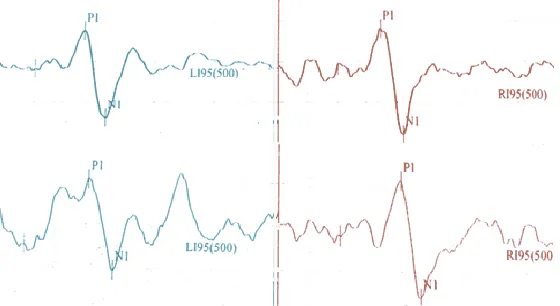
Short tone-burst of 500 Hz at 95 dBnHL (rise/fall time=2ms), plateau time=0 ms, and repetition rate=5.1Hz) was delivered monaurally via ER-3A insert earphone without masking. Analysis time of 100 ms, 5k amplitude and a 10-1500 Hz band pass filter was chosen. Total of 150 sweeps per run were presented ipsilate-rally. Total of two runs were collected on each side to ensure the reproducibility of the res-ponses. Subjects were rested between the test runs. Initial biphasic responses consisting p13 and n23 were recorded and analyzed (Fig.1).
Only 15 patients (12 women and 3 men, with mean age of 40.06 and SD=7.16 years) and 13 controls (10 women and 3 men, with mean age of 34.46 with SD=7.52 years) were volunteered to undergo caloric testing. Before vestibular system assessment, patients were asked not to smoke on the test day, and avoid consuming chocolate, drinking alcohol or caffeine 48 hours before beginning of the test [18].
After initial otoscopic examination, patients asked to lay down in the supine position with their head tilted 30 degrees forward. VNG (Eye Dynamic model, USA) was used to collect the data. Before caloric test, spontaneous nystagmus was recorced and then, each ear was stimulated for 60 seconds using air at 24 and 50°C. Recording the results continued for two minutes. Unilateral weakness (UW) and direc-tional preponderance (DP) were calculated based on Jongkees formula. Findings more than 20% and 25% were considered as UW and DP, respectively [19] (Fig 2).
Data were analyzed using SPSS 16. Kolmogorov-Smirnov test was used to deter-mine the normal distribution of data. In order to compare the means (UW, DP, and cVEMP parameters) ANOVA and t-test was performed. Chi square and Fisher Exact test was used to compare the prevalence of hearing loss and prolonged latency between groups. Significance level was p<0.05.
Results
There was no significant difference between the mean age of patients and normal groups (p>0.05). After the onset of RA, 14 patients (56%) complained about vestibular disorder. Among those 14 patients, eight were suffering from vertigo while another six had dizziness. All cases had normal middle ear pressure and static complianc. One patient had type As tym-panogram and another one had Ad tympano-gram. SNHL observed in 10 patients with RA, seven with bilateral and three with unilateral SNHL. Bilateral hearing loss was observed in two controls without vestibular symptoms. Five out of ten patients with SNHL had cVEMPs with prolonged latencies.
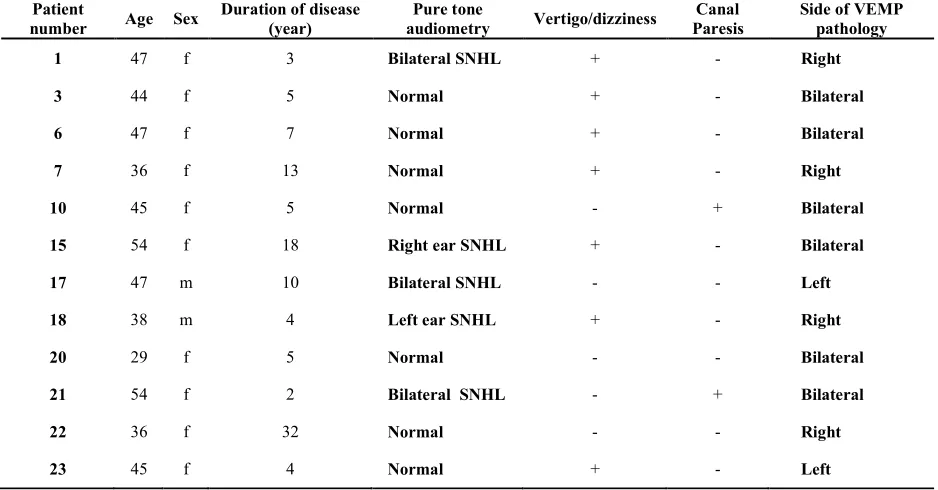
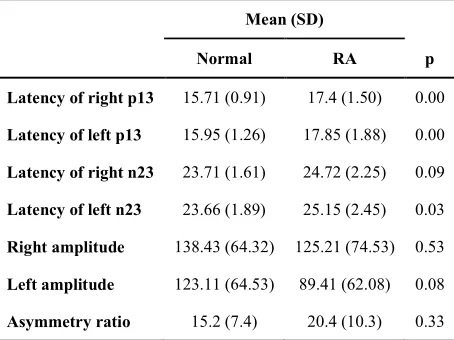
Biphasic potentials were recorded in the all cases. 12 patients (48%) had prolonged cVEMPs peak potentials. Six patients had bilat-eral and another six had unilatbilat-eral prolonged cVEMPs. Table 1, showes clinical characteris-tics of these patients. p13 mean latency in the patients group was significantly (p<0.001) higher than the normal group (Table 2). For n23, although its latency was prolonged as well, but only left ears latency reached to a statisti-cally significant level in the patients with RA (p=0.03). Fig 1, showes a bilaterally normal VEMP recording in a healthy control (above) subject, and a bilaterally delayed VEMP res-ponse in a RA patient (below).
The mean p13-n23 amplitude and asymmetry
ratio between the two groups had no significant differences (Table 2).
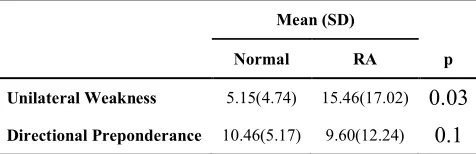
Disease duration and complaining of vertigo had no significant effect on test results (p>0.05). There were no significant difference between hearing loss and increased latency (p=0.3). Mean of directional preponderance had no significant difference between the two groups (p=0.1), but mean of unilateral weakness in RA patients was higher than normal subjects (p=0.03) (Table 3).
Directional preponderance was observed in one of the patients. Spontaneous nystagmus was observed in none of the patients.
Four patients had unilateral weakness (canal paresis) but the degree did not reached statistical significant (p=0.06). Fig. 2, showes the caloric recording in a RA patient with right canal paresis (left side) and a normal recording in a healthy control (right side). Two of the patients had suffered from bilateral prolonged cVEMPs as well as unilateral weakness.
Discussion
The purpose of this study was to evaluate vestibular system in patients with RA using caloric and cVEMPs tests. The current study is the first study to included the VEMPs testing to assess saccule function and inferior vestibular nerve in the patients with RA. Our results revealed that some degree of superior as well as inferior vestibular nerve dysfunctions exists in
the patients with RA. VEMPs results revealed 48% abnormality in responses latencies. Caloric testing revealed 26% of patient with abnormal tests results. Some patients had involvements of the both branches of the vestibular nerve. Ears are frequently involved in autoimmune diseases. AIED, which is usually accompanied by hearing loss, tinnitus and vestibular symp-toms and signs, might occur as an independent state and without multi-organ involvement, or happens as a part of a systemic autoimmune disease. Although the exact mechanism is unknown, proposed immune mechanisms for this disorder include humoral antibody attack to inner ear antigens, cell ototoxicity to inner ear antigen, immune complex disease in the small vessels of the inner ear, and direct or indirect involvement of the neuronal path-way. Connective tissue diseases such as rheumatoid arthritis, Behcet’s syndrome, Lupus erythematosus and Cogan syndrome might affect the inner ear and cause vestibular and auditory function disorder [5,6,20,21]. Nerve fibers atrophy and vasculitis have seen in the systemic rheumatologic diseases. Vascular
involvement (vasculitis, thrombosis), production of antibodies against neural antigens, ribosomes and phospholipids as well as inflammation caused by local cytokinin production has been observed in the patients with rheumatologic disorders and the central nervous system involvement. Demyelination lesions (lipoid scl-erosis) can create clinical characteristics and imaging findings very similar to multiple sclerosis [22-27].
Ozkiris et al. reported that the prevalence of high frequency SNHL in patients with RA, is higher than normal subjects [21]. In this study, SNHL was observed in 40% of patients which was significantly higher than control group .The results of this research confirm earlier studies that the SNHL prevalence rates of 24-60% were reported in patients with RA [3,8,21].
Ozkiris et al. also reported that the prevalence of vestibular deficit symptoms in patients with RA was higher than healthy people [21]. In Yilmaz et al. study the prevalence of vertigo was 18.6% higher than normal control groups [8]. The pre-valence rate of vestibular complains in this study is higher than previous studies, 66.03% of Table 1. Clinical characteristics of patients with delayed cervical vestibular evoked myogenic potentials
Patient
number Age Sex
Duration of disease (year)
Pure tone
audiometry Vertigo/dizziness
Canal Paresis
Side of VEMP pathology
1 47 f 3 Bilateral SNHL + - Right
3 44 f 5 Normal + - Bilateral
6 47 f 7 Normal + - Bilateral
7 36 f 13 Normal + - Right
10 45 f 5 Normal - + Bilateral
15 54 f 18 Right ear SNHL + - Bilateral
17 47 m 10 Bilateral SNHL - - Left
18 38 m 4 Left ear SNHL + - Right
20 29 f 5 Normal - - Bilateral
21 54 f 2 Bilateral SNHL - + Bilateral
22 36 f 32 Normal - - Right
23 45 f 4 Normal + - Left
patients with RA complained of having vertigo or imbalance. This may be due to restricted inclusion criteria and more detailed screening work up. Ozkiris et al. study reported abnormal results of VNG test in 38.23% of patients with RA, in which 24.6%, 6.17%, and 7.4% of the patients have central disorders, peripheral problems and combination of both, respectively [21]. Yilmaz et al. observed the vestibular disorder prevalence rate of 34.7% in patients with RA, among which 20.9% of patients suffered from central disorder, 6.9% peripheral problem and 6.9% suffered from both [8]. Our results did not revealed any meaningful unilateral weakness or directional preponde-rance. The observed unilateral weakness in 4 patients (26%) did not reached statistical differences. This could be due to very small sample size and difference in degree and site of the involvement. The results of this study are consistent with studies which did not report any significant relationship between vertigo com-plain and vestibular test results [8,21].
Although cVEMPs test has not been studied in patients with RA, but it has been reported in some of the other systemic rheumatologic diseases such as Lupus and Behcet. Farhadi et al. found a significant cVEMPs latency increase in patients with Lupus in compare to normal subjects [22]. Bayir et al. claimed cVEMPs
wave latency in Behcet’s syndrome is less than normal subjects while there was no justification for this reduction [23]. Contrary to Bayir study, Erbek study suggests an increase in latency in Behcet’s syndrome [23,24]. In this study the comparison of VEMP latency revealed 12 patients (48%) with prolonged latencies for p13. This can be due to effect of the disease, directly or indirectly, on saccular hair cells, neuronal synapses and or first degree neuronal pathway. There is some evidence of the central and peripheral nervous system involvement in inflammatory diseases of connective tissue such as rheumatoid arthritis, systemic Lupus erythematosus and Behcet’s syndrome [27]. Demyelination can lead to substantial trans-mission delay in vestibular neuronal pathway. Presence of an inflammatory process causing demyelination seems to be an attractive hypo-thesis to explain the observed latency delay in systemic rheumatologic diseases [17,27].
In this study, mean peak to peak amplitude in both ear and asymmetry ratio mean of cVEMPs wave showed no significant difference between patients with RA and normal subjects. Farhadi et al. study showed no significant difference in cVEMPs mean amplitude between patients with lupus and normal subjects [22]. Bayir and Erbek reported no significant difference in cVEMPs amplitude between patients with Behcet’s Table 2. Mean (standard deviation) cervical vestibular evoked parameters of normal and rheumatoid
arthritis groups
Mean (SD)
Normal RA p
Latency of right p13 15.71 (0.91) 17.4 (1.50) 0.00
Latency of left p13 15.95 (1.26) 17.85 (1.88) 0.00
Latency of right n23 23.71 (1.61) 24.72 (2.25) 0.09
Latency of left n23 23.66 (1.89) 25.15 (2.45) 0.03
Right amplitude 138.43 (64.32) 125.21 (74.53) 0.53
Left amplitude 123.11 (64.53) 89.41 (62.08) 0.08
syndrome and normal subjects [23,24]. In the present study mean difference of cVEMPs wave asymmetry ratio between patients with RA and normal subjects was not statistically significant. This finding may indicates that the amount of disease involvement is not severe enough to cause dys-synchrony of the action potentials affecting the response amplitude but latency, and this hypothesis can explain the 100% rate of response presence and reproducibility in systemic autoimmune diseases [22,24].
In this study five patients suffered from hearing loss as well as prolonged cVEMPs. However, there was no significant relationship between hearing loss and increased in latency (p=0.3). This finding may be due to different neuronal and receptor pathway and blood flow diffe-rences for vestibular and auditory system. It has been long proven and documented that auditory and VEMPs pathway are different [12,28]. Certain diseases can affect both or individual pathway independently to a varying degree [3,21].
In the present study no significant relationship between the disease duration and vestibular test results. This is in agreement of some studies but not all of them. Ozkiris et al. observe a signifi-cant relationship between VNG results and disease duration [21]. Yilmaz et al. reported no relationship between RA disease and vestibular disorders [8].
It is of importance to know the vestibular involvement in patient with systemic auto-immune disease to early detect, prevent further advancement of the disease, balance related complications, and design optimal treatment plan [29,30].
Further studies with more power will further excel our understanding of these disorders.
Conclusion
The result of this study suggests vestibular system involvement in RA patients without related auditory system involvement. This is the first study in which prolonged cVEMPs has been reported in RA patients. We believe that cVEMPs is a beneficial test to assess balance condition of RA patients.
Acknowledgments
This research has been supported by Tehran University of Medical Sciences with grant number 92-03-32-24252. We would like to express our gratitude to Dr. Kianoush Sheikholslami, from The State University of New Jersey, for his critically reading and editing the manuscript and constructive and insightful comments on a previous version of the article
REFERENCES
1. Arend WP. The pathophysiology and treatment of rheumatoid arthritis. Arthritis Rheum. 1997;40(4):595-7. 2. Choy EH.S, Panayi GS. Cytokine pathways and joint inflammation in rheumatoid arthritis, N Engl J Med. 2001;344(12):907-16.
3. Takatsu M, Higaki M, Kinoshita H, Mizushima Y, Koizuka I. Ear involvement in patients with rheumatoid arthritis. Otol Neurotol. 2005;26(4):755-61.
4. Gomides AP, do Rosário EJ, Borges HM, Gomides HH, de Pádua PM, Sampaio-Barros PD. Sensorineural dysacusis in patients with systemic lupus erythematosus. Lupus. 2007;16(12):987-90.
5. Ruckenstein MJ, Autoimmune inner ear disease. Curr Opin Otolaryngol Head Neck Surg. 2004;12(5):426-30. 6. Salvinelli F, Cancilleri F, Casale M, Luccarelli V, Di
Peco V, D'Ascanio L, et al. Hearing thresholds in patients affected by rheumatoid arthritis. Clin Otolaryngol Allied Sci. 2004;29(1):75-9.
Table 3. Mean (standard deviation) unilateral weakness and directional preponderance of normal and rheumatoid arthritis groups
Mean (SD)
Normal RA p
Unilateral Weakness 5.15(4.74) 15.46(17.02) 0.03
Directional Preponderance 10.46(5.17) 9.60(12.24) 0.1
7. Salvinelli F, DAscanio L, Casale M. Staging rheumatoid arthritis: what about about otoacoustic emissions ? Acta Otolaryngol. 2004;124(7):874-5.
8. Yilmaz S, Erbek S, Erbek SS, Ozgirgin N, Yucel E.. Abnormal electronystagmography in rheumatoid arthritis. Auris Nasus Larynx. 2007;34(3):307-11. 9. Kakani RS1, Mehra YN, Deodhar SD, Mann SB, Mehta
S .Audiovestibular functions in rheumatoid arthritis. J Otolaryngol. 1990;19(2):100-2.
10. King J, Young C, Highton J, Smith PF, Darlington CL. Vestibulo-ocular, optokinetic and postural function in humans with rheumatoid arthritis. Neurosci Lett. 2002;328(2):77-80.
11. Piras G, Brandolini C, Castellucci A, Modugno GC. Ocular vestibular evoked myogenic potentials in patients with acoustic neuroma. Eur Arch Otorhinolaryngol. 2013;270(2):497-504.
12. Sheykholeslami K, Murofushi T, Kermany MH, Kaga K. Bone-conducted evoked myogenic potentials from the sternocleidomastoid muscle. Acta Otolaryngol. 2000;120(6):73-4.
13. Fetter M, Aw S, Haslwanter T, Heimberger J, Dichgans J. Three-dimensional eye movement analysis during caloric stimulation used to test vertical semicircular canal function. Am J Otol. 1998;19(2):180-7.
14. Casse G, Sauvage JP, Adenis JP, Robert PY. Videonystagmography to assess blinking. Graefes Arch Clin Exp Ophthalmol. 2007;245(12):1789-96.
15. Colebatch J, Halmagyi G, Skuse GM, Myogenic NF. Potentials generated by a click-evoked vestibulocollic reflex. J NeurolNeurosurg Psychiatry. 1994;57:190-7. 16. Vanspauwen R, Wuyts FL, Van De Heyning PH.
Validity of a new feedback method for the VEMP test Acta Otolaryngol. 2006;126(8):796-800.
17. Murofushi T, Shimizu K, Takegoshi H, Cheng PW. Diagnostic value of prolonged latencies in the vestibular evoked myogenic potential. Arch Otolaryngol Head Neck Surg. 2001;127(9):1069-72.
18. Barros AC,Caovilla HH. From nystagmus to the air and water caloric tests, Braz J Otorhinolaryngol. 2012;78(4):120-5.
19. Bhansali SA, Honrubia V. Current status of
electronystagmography testing. Otolaryngol Head Neck Surg. 1999;120(3):419-26.
20. Zeigelboim BS, Jurkiewicz AL, Palmonari A, Alberti A, Filho AR, Ferrari KA. Otoneurological evaluation in women with systemic lupus erythematosus: a preliminary study. Intl Arch Otorhinolaryngol. 2006;10(2):126-31.
21. Özkırış M, Kapusuz Z, Günaydın İ, Kubilay U, Pırtı İ, Saydam L. Does rheumatoid arthritis have an effect on audiovestibular tests? Eur Arch Otorhinolaryngol. 2014;271(6):1383-7.
22. Farhadi R, Hajiabolhassan F, Akhlaghi M, Jalaie Sh, Akbarian M, Vestibular evoked myogenic potentials in patients with inactive stage of systemic lupus erythematosus, Audiol. 2013;22(2):63-72. Persian. 23. Bayir O, Comoglu SS, Ozdek A, Aytac E, Guven H,
Ozdal MP, et al. Vestibular Evoked Myogenic Potential Responses in Behçet’s Disease. Int Adv Otol. 2012;8(1):113-7.
24. Erbek S, Erbek SS, Yilmaz S, Yucel E, Ozluoglu LN. Vestibular evoked myogenic potentials in Behcet's disease. Eur Arch Otorhinolaryngol. 2008;265(11):1315-20.
25. Rosengren SM, Colebatch JG. Ocular vestibular evoked myogenic potentials are abnormal in internuclear ophthalmoplegia. Clin Neurophysiol. 2011;122(6):1264-7.
26. Bruns A, Meyer O. Neuropsychiatric manifestations of systemic lupus erythematosus. .Joint Bone Spine. 2006;73(6):639-45.
27. Chin RL, Latov N. Central nervous system manifestations of rheumatologic diseases. Curr Opin Rheumatol. 2005;17(1):91-9.
28. Sheykholeslami K, Kaga K. The otolithic organ as a receptor of vestibular hearing revealed by vestibular-evoked myogenic potentials in patients with inner ear anomalies. Hear Res. 2002;165(1-2):62-7.
29. McCabe BF. “Autoimmune sensorineural hearing loss.” Ann Otol Rhinol Laryngol. 1979;88(5 Pt 1):585. 30. Stone JH, Francis HW “Immune-mediated inner ear