doi:10.5681/jcs.2015.005 http:// journals.tbzmed.ac.ir/ JCS
* Corresponding Author: Marzieh Abdolalipour (MSc), E-mail: [email protected].
Nurses’ Knowledge Regarding Hand Hygiene and Its Individual and
Organizational Predictors
Malihe Asadollahi1, Mohammad Arshadi Bostanabad1, Mahnaz Jebraili1, Majid Mahallei2, Alehe Seyyed Rasooli3,MarziehAbdolalipour4*
1Department of Pediatric Nursing, Faculty of Nursing and Midwifery, Tabriz University of Medical Sciences, Tabriz, Iran 2
Department of Pediatrics, Faculty of Medicine, Tabriz University of Medical Sciences, Tabriz, Iran 3
Department of Medical-Surgical Nursing, Faculty of Nursing and Midwifery, Tabriz University of Medical Sciences, Tabriz, Iran
4
Department of Pediatric Nursing, Faculty of Nursing and Midwifery, Student Research Committee, Tabriz University of Medical Sciences, Tabriz, Iran
ARTICLE INFO ABSTRACT
Article Type:
Original Article Introduction:hygiene is the most important way to control the hospital infections. Due to the critical Based on recommendations from World Health Organization, hand
role of nurses in patient care, they should have essential and updated information regarding hand hygiene. So this study aims at determining the knowledge of hand hygiene and its individual and organizational predictors among nurses in neonatal units.
Methods: This descriptive and cross-sectional study was conducted in neonatal units in the hospitals affiliated to Tabriz University of Medical Sciences. The participants surveyed in this study were 150 nurses who were invited by census sampling method. A researcher prepared questionnaire that investigated the knowledge of participants about hand hygiene and was used after approving its validity and reliability. The quantitative analysis of this study used Statistical Package for Social Sciences SPSS version 13 by descriptive statistics and pearson correlation test, independent samples t-test, One-way ANOVA. For multivariable explanation of nurses’ knowledge based on independent variables multiple linear regressions was used.
Results: Most of participants have an acceptable level of knowledge regarding hand hygiene. The highest score was for infection control domain and the lowest score was for definition of hand hygiene domain. Multivariable analysis showed that work experience and history of previous training were the most important predictors of participants’ knowledge about hand hygiene.
Conclusion: It is recommended that infection control committees should revise their educational methods and give more emphasis on update guidelines regarding hand hygiene. Also, more experienced nurses should be employed in neonatal units.
Article History: Received: 19 Aug. 2014 Accepted: 7 Sep. 2014 ePublished: 1 Mar. 2015
Keywords: Knowledge Hand hygiene Nurses
Intensive care, Neonatal
Introduction
According to statistics from World Health Organization (WHO), at any time, 1,400,000 people suffer from complications related to hospital acquired infections (HAI). In developing countries, the rate of preventable hospital acquired infections due to medical care is estimated to be about 40% or above.1
Askarian et al., estimated the prevalence of hospital infections in Iranian health care settings as 9.4%. Also, these authors reported that the most common type of hospital infection is related to circulatory system.2
One of the main problems and challenges in intensive care units (ICU) are hospital acquired infections.3 Patients admitted to ICU
nosocomial infection due to some risk factors such as multiple trauma, low levels of
awareness, and lack of preventive
mechanisms.3, 4
The results of some studies have shown that HAI is one of the main causes of infant mortality in developing countries.5 On the
other hand, in the last century, the number of premature and twinning birth increased in developing countries due to the technological advancement in the treatment of infertility.6 In result, preterm infants that hospitalized
in neonatal units are more susceptible to infection and mortality due to their immature immune systems.7,8 Therefore, prevention
and treatment of nosocomial infections in neonatal units is very important.
Based on recommendations from World Health Organization (WHO) and the Centers for Disease Control, hand hygiene is the most important and easy way for the control of hospital infections.9,10 Due to the critical role
of nurses in patient care, there is more emphasis on the role of them in the control of hospital acquired infections.11 So, according
to the vital role of nurses in preventing of nosocomial infections, they are key members of infection control team in hospitals. Therefore, nurses should have sufficient knowledge and skills in the field of infection control.
Studies that investigated the nurses' knowledge about hand hygiene have not reached the same conclusion.12,13
Malekmakan et al., in a study about hand
hygiene among health care staff; notes that
nurses' knowledge about standard
precautions is not enough and many of them believed that by wearing gloves there is no need for washing hands.12 The results of
another study on nurses' knowledge and performance about control of nosocomial infections showed that only 43% of nurses had a good knowledge in this regard.14 Najafi
et al., in a systematic review reported that the knowledge, acceptance, and performance of intensive care personnel about hand hygiene is poor. They concluded from the literature
published in Iran that in 83% of situations, nurses do not respect hand hygiene protocols and in most cases they wash their hands after contact with patients.15
Due to low acceptance of hand hygiene protocols among health care personnel and high prevalence of nosocomial infection in critical areas such as neonatal units,16,17 some
interventions designed to increase the attentiveness of health care personnel about hand hygiene. In this regard, special attention was paid to training courses aimed at increasing the knowledge of health care personnel.18 But in this case, consensus has
not been achieved and some studies reported that despite having a good knowledge, the performance of health care personnel about hand hygiene is weak.19 On the other hand,
other researchers believed that the first steps in improving the performance of health care personnel about hand hygiene is increasing their knowledge in this regard.20 Here, the
key question is that what factors influence the knowledge of nurses about hand hygiene? In this field, the results of some studies showed the effects of some individual and organizational factors on nurses’ knowledge about hand hygiene.13,21-23 So, this
study aims at determining the knowledge of hand hygiene and its individual and organizational predictors among nurses in Tabriz neonatal units.
Materials and methods
10% of questions in the questionnaire.
The study instrument was a researcher made questionnaire that developed based on wide review of literature, articles and guidelines. This questionnaire consisted of two parts: The first part was a demographic checklist. The second part investigated the knowledge of nurses about hand hygiene by 15 multiple choice items with 4 responses for each item. Each item has one correct answer and the total score was calculated by adding the score of all correct answers and ranged from 0 to 15. Then, the score of each participant was divided to low level of knowledge (scores between 0 and 5), moderate level of knowledge (scores between 6 and 10), and high level of knowledge
(scores between 11 and 15). This
questionnaire investigated the knowledge of nurses in four domains including: hand hygiene situations (4 items), infection control (4 items), antiseptic solutions (4 items), and definitions of hand hygiene (3 items).
The content validity of questionnaire was approved by 10 academic members from nursing (7 academic members) and medicine (3 neonatal sub-specialists) faculties in Tabriz University of Medical Sciences. According to the experts' comments, the first versions of the questionnaire (25 items) were eliminated to 14 items, 1 item added, and 2 items were modified. In addition, the total score of questionnaire was divided into four domains according to experts’ comments. The reliability of the questionnaire was confirmed by Cronbach's alpha coefficient (0.81) after pilot study on 30 nurses.
Data analysis was performed using SPSS software version 13 according to qualitative or quantitative nature of variables by
descriptive statistics including mean,
standard deviation, frequency, and
percentage and inferential statistics including
pearson correlation test, independent
samples t-test, One-way ANOVA. For
multivariable explanation of nurses’
knowledge based on independent variables multiple linear regressions was used.
Data collection was started after: approval of the study proposal by Regional Ethics Committee at Tabriz University of Medical Sciences (number 5/4/10330); obtaining permission from the research deputy of Tabriz nursing and midwifery faculty; and acquisition informed consent from all participants.
Results
All nurses (100%) were female. The degree of 95.5% of participants was baccalaureate in nursing and 4.5% of them had a master of sciences (MS) degree in neonatal intensive care. Among participants, 61.1% of them were employed in NICU and 89.3% (134 nurses) were working in rotation shifts and 10.7% (16 nurses) of them were working in fixed shifts. Also, 15.9% of participants were not participated in previous educational courses about hand hygiene. In addition, among educated nurses, 55.5% participated in 1 to 3 previous educational courses, 20% of them participated in 3 to 5 previous educational courses. Furthermore, 68% of participants reported a need for continuing education regarding hand hygiene. More demographic characteristics details are shown in table 1.
The mean score of nurses’ knowledge was 10.39 (SD = 2.44). Additionally, 1.9%, 29.9%, and 68.1% of nurses obtained low, moderate, and high levels of knowledge respectively. Among different domains of questionnaire, the highest score was for infection control domain and the lowest score was for definition of hand hygiene domain (Table 2). All items of different domains of questionnaire are presents in table 2.
difference between the scores of educated and uneducated nurses (about hand hygiene), so this finding needs a special attention. The score of definitions of hand hygiene domain was statistically higher among staff nurses in comparison with head nurses and clinical ones. There was a statistical relationship between knowledge of participants about hand hygiene and age, employment status, and job experiences of participants in neonatal units (P< 0.05). It means that by increase in the age and job experience, the score of knowledge was increased. Similarly, the total knowledge score was further in nurses with decisive employment status. There was no statistical difference between the knowledge score of married and single nurses. On the other hand, the total knowledge score and the score of definitions of hand hygiene domain was meaningfully different among different teaching centers.
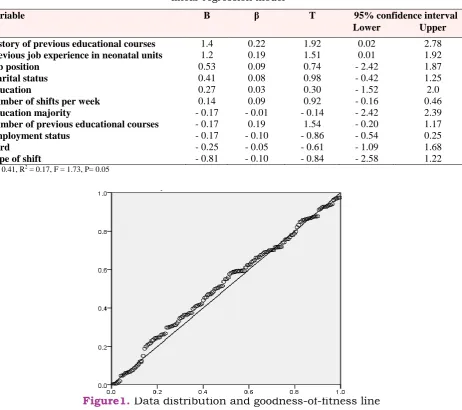
For explanation the knowledge of nurses regarding hand hygiene based on the sum of independent variables enters, linear regression method was used (Table 3). Finally, as indicated in table 3, a total of 11 independent variables with pure explanation coefficient (R2) of 0.17 and multiple
regression coefficient of 0.41 involved in statistical explanation of nurses’ knowledge about hand hygiene. It means that 17% of variance of nurses’ knowledge is explained by independent variables in selected regression diagram. In figure 1, the distribution of residual and line of goodness-of-fitness for a dependent variable (nurses’ knowledge) and independent variables are drawn. As appeared in this figure, the data moves around the line of goodness-of-fitness.
Discussion
This study showed that most participants had a good level of knowledge about hand hygiene. Contrary to this finding, in a study by Ghadamgahi et al.,23 only 47.8% of nurses
obtained an acceptable level of knowledge in this regard. On the other hand, in another study by Parmeggiani et al., the knowledge of participants about standard precautions regarding hand hygiene was reported as high. Although, it was reported that the knowledge of personnel was better in some aspects, such as the transmission of infection from patient to health care staff, and was lower in some other aspects, such as situations that health care staff may transfer
infection to patients. Finally, these
researchers advised training of health personnel based on their findings.13 In
contrast to the study of Parmeggiani et al., the score of infection control domain in present study was high. But, the ways for convey the information to nurses in continuing education is very impressive. In
this regard, stimulating and giving
motivation to nurses about infection control (including an emphasis on safety and personal protection) by innovate educational methods are more effective than other traditional education methods. Experiences and similar studies showed that the acceptance of participants in such situations is more appropriate.16,24 On the other hand,
much emphasis on theoretical concepts and not giving priority to the safety of personnel, especially in hospital environments, cause a resistance among health care providers. Despite the acceptable level of knowledge among participants regarding hand hygiene, 67% of them reported a need to renew their training in this regard. In a similar study by Askarain et al., 90% of participants reported a need for revise their training on standard precautions.25
The extent of demand for re-training about hand hygiene is due to the dissatisfaction of nurses about the management of previous courses and educational methods used in these programs.
Table 1. Some demographic characteristics of nurses in the neonatal units
Variable Minimum Maximum Mean (SD)*
Age 22 50 33.17 (6.39)
Job experience in month 3 340 99.91 (75.12)
Job experience in neonatal units in month 3 216 67.88 (57.53)
Number of shifts per week 3 15 6.98 (1.34)
*SD: standard deviation
Table 2. Rating the score of nurses knowledge in different domains of hand hygiene
Domains Mean (SD)* Percent of correct
responses
Minimum and maximums score in domains
Definition of hand hygiene domain 1.21 (0.94) 40 0-3
Antiseptic solutions domain 2.48 (1.04) 62 0-4
Hand hygiene situations domain 3.08 (0.83) 77 0-4
Infection control domain 3.47 (0.76) 86 1-4
*SD: standard deviation
Table 3. Explanation of nurses’ knowledge score based on the sum of independent variables in linear regression model
Variable B β T 95% confidence interval
Lower Upper
History of previous educational courses 1.4 0.22 1.92 0.02 2.78
Previous job experience in neonatal units 1.2 0.19 1.51 0.01 1.92
Job position 0.53 0.09 0.74 - 2.42 1.87
Marital status 0.41 0.08 0.98 - 0.42 1.25
Education 0.27 0.03 0.30 - 1.52 2.0
Number of shifts per week 0.14 0.09 0.92 - 0.16 0.46
Education majority - 0.17 - 0.01 - 0.14 - 2.42 2.39
Number of previous educational courses - 0.17 0.19 1.54 - 0.20 1.17
Employment status - 0.17 - 0.10 - 0.86 - 0.54 0.25
ward - 0.25 - 0.05 - 0.61 - 1.09 1.68
Type of shift - 0.81 - 0.10 - 0.84 - 2.58 1.22
R = 0.41, R2 = 0.17, F = 1.73, P= 0.05
hand hygiene domain. In the other word, participants had a lack of knowledge about the basic principles of hand hygiene guidelines. This finding indicated a need for the education of basic concepts about hand hygiene for nurses. Jang et al., in a descriptive study reported that health care personnel had many knowledge deficit about guidelines related to hand hygiene. These personnel believed that these guidelines are not realistic and they can judge better than guidelines on situations that require hand hygiene.26
Another considerable finding of this study is that there was no statistical relationship between previous training classes and nurses’ knowledge about hand hygiene (P> 0.05). On the other word, these programs have no great impact on increasing nurses’ knowledge in this regard. Despite this fact, many previous studies showed the impact of education on increasing nurses’ knowledge about hand hygiene.26,27 In this regard, Rongming et al.,
reported that for the reinforce of related concepts to hand hygiene among nurses, different educational methods should be used and promoting hand hygiene knowledge can increase the knowledge and hand hygiene quality among nurses.18 On
the other hand, Erasmus et al., reported that contact with blood or other secretions are main factors in increasing hand hygiene practice among nurses and the effect of education is very small in this regard.24
Similarly, Erasmus et al., reported that hand hygiene behavior influenced by the willingness of people to clean themselves and the behavior of other employees in this regard. Based on this finding, these
researchers concluded that holding
workshops and continuing education programs that focus on the protection of patients may have a lower impact on nurses’ performance regarding hand hygiene.16 The
most important issue in this regard is educational methods used for the transfer of contents regarding hand hygiene to nurses.
Jang et al., discussed about this issue in a different way and stated that as long as the health care personnel carry out hand hygiene for self-protection, education in this regard will not have a large impact. They give an important role for management factors and believed that respectable communication patterns, team efforts, and the education of nurses about how to comply with hand hygiene guidelines, despite the high workload, are important factors.26
Work experience and type of employment had a significant relationship with the knowledge of nurses regarding hand hygiene. Maybe with increasing work experience in clinical settings and the determination of nurses’ employment status, their motivation for further learning and respecting update guidelines will increase. Although this relationship has not been shown in previous studies, such as studies by Ghadamgahi et al.,23Also, the results of
this study showed a significant relationship between age and knowledge of nurses regarding hand hygiene (r= 0.25, P = 0.001). This finding is consistent with the result of another study by Butsashvili et al.,28 Also,
the results of this study showed that the knowledge score of staff nurses was further than other ones. These results may be due to the disengagement of staff nurses in executive tasks and its related problems. Also, in one of the previous studies, the score of staff nurses were equal with other ones.25
factors for participants’ knowledge about infection control and standard precautions.28
Other similar studies have shown the effect of several variables on nurses’ knowledge
about hand hygiene.13 The knowledge
demand on nurses about hand hygiene may be met by considering factors determined from multivariate regression.
Alterations in knowledge score among hospitals under study, especially regarding the definitions of hand hygiene, could be due to differences in hospital policies, different educational methods, and diverse condition of selected neonatal wards (number of neonates, number of neonates who need mechanical ventilation or advance care, the extent of wards, availability of equipment, and management style).
Conclusion
In this study, the general knowledge of nurses about hand hygiene was high. But, their knowledge about hand hygiene-related concepts was not on acceptable level. Multivariate analysis showed that work experience and the history of previous training about hand hygiene were important predictors of nurses' knowledge about hand hygiene. Also the findings of this study indicated that 68% of participants reported a need for continuing education regarding hand hygiene. So, infection control committees in health centers should increase the knowledge of nurses about hand hygiene via revise their teaching strategies and emphasis on latest guidelines about hand hygiene. Also, more experienced nurses should be employed in neonatal units. This study has two main limitations. First, all participants of this study were female. Second, this study was conducted in a busy environment. So, it was suggested that the knowledge of nurses should be increased about hand hygiene via continuing education based on nurses’ knowledge deficiencies. Also, there is a need for
improvement in nurses’ attitude especially in the field of patient safety.
Acknowledgments
This study is a part of an approved master thesis in Tabriz nursing and midwifery faculty (number 341). We are grateful to all of those who have helped us with data collection: management office and the nursing staff of selected hospitals, research deputy of Tabriz nursing and midwifery faculty, Tabriz students’ research committee, and health deputy of Tabriz University of Medical Sciences. This research was conducted by the financial support of research deputy of Tabriz University of Medical Sciences.
Ethical issues
None to be declared.
Conflict of interest
The authors declare no conflict of interest in this study.