Online at http://jdesert.ut.ac.ir
DESERT 18 (2013) 177-183
The Identification of Effective Factors of Strategic Implementation
in Water Resources Management
(Case Study: Lake Urmia Basin)
A. Azarnivand
a*, M.E. Banihabib
ba M.Sc. Graduated, College of Abureyhan, University of Tehran, Iran b College of Abureyhan, University of Tehran, Iran
Received: 3 November 2013; Received in revised form: 10 December 2013; Accepted: 14 December 2013
Abstract
There is a little room for doubt that Lake Urmia, which is the second largest permanent hyper saline lake in the world, is currently suffering from a lack of appropriate management strategy. Accordingly, this study was done using the SWOT matrix to analyze the key factors affecting declining water levels and increasing salinity. Results of group decision-making by brainstorming among a group of experts identified 17 internal factors (four strengths and 13 weaknesses) and nine external factors (five opportunities and four threats). Then four kinds of strategy groups were formulated by matching internal and external factors. And the most feasible policy was introduced from evaluations of Attractiveness Scores and Quantitative Strategic Planning Matrix (QSPM). These reality-based solutions can be applied to facilitate progress towards realizing the target vision. This information was used to select the best alternatives according to strategies based on weaknesses and opportunities (WO Strategies). This study illustrates that the existing water use pattern did not conform to the requirements necessary for sustainability. Furthermore, managerial-based strategies with the objectives of preserving surface and groundwater sources, orienting stakeholders towards implementing efficient water use pattern, adjusting water consumption with existing potential in the field and improving irrigation efficiency and reduction of losses can be applied to eradicate the ecological issues associated with Lake Urmia.
Keywords: Basin management; Lake Urmia; SWOT; QSPM; Strategy
1. Introduction
Lake Urmia is a vast hyper saline lake in northwestern Iran that is grappling for survival in the midst of environmental crises. Water resources management in Urmia basin is plagued by dire the impact of climate change and is affected by thoughtless human activity. Population growth has markedly increased the demand for water, which results in serious water scarcity and has accelerated the process of desertification. Public concern is growing over the lake’s unfavorable condition.
Corresponding author. Tel.: +98 912 2878447, Fax: +98 21 36040906.
E-mail address: [email protected]
There is much debate among environmental commentators over ways in which water resources management responds to increasing water scarcity and water quality deterioration (Kampragou et al. 2007). This accelerated trend of environmental disasters can be attributed to a lack of education in agricultural practice that includes a lack of awareness of new irrigation and cultivation technologies (Ziaei et al, 2012).
(Mehrabi et al. 2008). But an effective management strategy needs to adopt a systematic mechanism and research has shown that extensive, systematic and structured stakeholder engagement plays a central role in modern water resources’ management (Lennox et al. 2011).
Strategic planning and management has a considerable impact on the utilization of natural resources and these impacts on local communities (Hiltunen et al. 2009). Thus, strategic planning must be an organized process that involves formulation of a strategy based on analyzing both the internal and external factors of a system (Lu, 2010). Strategic management is concerned with the process of formulating, implementing, evaluating cross-functional decisions and matching internal resources and skills and the opportunities and risks created by the external factors of a system so as to produce strategies that enable a system to achieve its objectives (Wheelen and Hunger, 1995). Due to the fact that resources are limited and demand is increasing (Taleghani, 2010) a strategic framework can be made to reform mainstream policy and practice (Ferguson et al. 2013). In addition, strategic analysis of policy options can facilitate controlled development and facilitate collective responsibility in terms of environmental impact (Rahm and Riha, 2012).
The Environment and Development Division of United Nations (2004) indicated the following points in relation to what motivates managers to implement strategic planning approaches:
1. The crucial role of internal organizational environments in implementing strategies is central to a strategic planning and management approach. 2. Although the external environment is changing very quickly and trends are unpredictable, a range of likely future events can usually be identified by strategic planning and management. Consideration of changes in the external environment seems critical because factors affecting rapid growth such as technology and increasingly large-scale physical developments can significantly affect the environment.
3. Stakeholders have various different values, goals, or socio-economic interests. Due to these divergent interests, a long-term strategy must be adopted that facilitates negotiation among the various stakeholders to the greatest extent possible, based on mediation.
The Strengths-Weaknesses-Opportunities-Threats (SWOT) Matrix is a practical matching tool for implementing strategic management. Longevity of the SWOT analysis lies in its many features, one of which is its simplicity (Lu, 2010). Internal and external scanning is a crucial stage in applying the strategic management framework (Weihrich, 1982):
Strengths: internal characteristics of the system that give it an advantage over others;
Weaknesses: internal characteristics that place the system at a disadvantage;
Opportunities: external elements that could be advantageous to the project;
Threats: external elements that could cause problems.
Mugabi et al (2007) used a strategic planning framework to assist water utilities in developing meaningful and useful plans for performance improvement. Gallego-Ayala and Juizo (2011) emphasized the leading role of IWRM in strategic planning and management frameworks and identified effective factors for strategic implementation of integrated water resources management in Mozambique through discussion by a group of experts in the context of a SWOT matrix. Of course strategies were not actually formulated. Celik et al (2012) found that strategic thinking and management was needed to develop future planning for the Turkish fishery sector. According to that study, SWOT performed as a helpful tool for defining and structuring the problem. Anjasni (2013) applied the SWOT method to analyze internal and external factors of communities in the Merapi Volcano region in order to provide strategic planning for a disaster-management system.
2. Material and methods
2.1. Case study
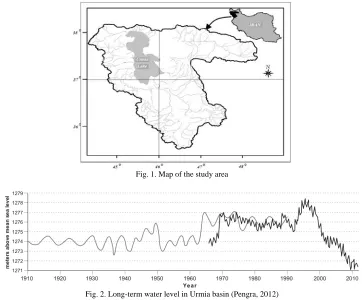
The Urmia basin is located between the provinces of East and West Azerbaijan and Kurdistan; it covers a land area of 51951 km2. The climate of the basin is characterized with cold winters and relatively temperate summers. Its long- term average precipitation is about 350 mm and the mean annual temperature varies between 6.5 0C in higher altitudes to 13.5 0C in lower altitudes. Annual evaporation from the lake was estimated to vary between 900 to 1170 mm. The water supply to the lake was provided through 14 rivers with permanent flow and a number of waterways with seasonal flow and there were records of occasional floods. The average annual inflow to the Lake was estimated at 5300 mcm, and varied from 760 to 15260 mcm. Other sources
of water to the lake were from direct precipitation and groundwater seepage (Integrated Management Plan for Lake Urmia basin, 2010). A map of the region was prepared and is presented in Figure 1.
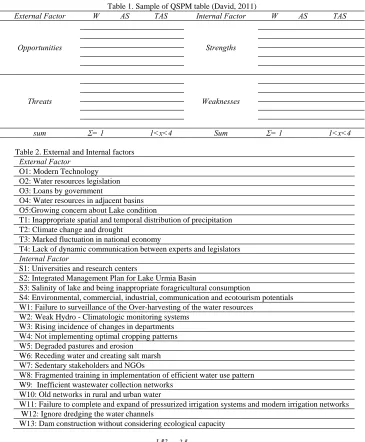
The current water level of the lake was 1270.67 meters above sea level, and as such was 4.5 meters less than the average level and more than 3 meters below the level determined as ecologically sustainable for Lake Urmia. This means that desertification was in progress and that prevention of desertification would require a minimum inflow of 3.1 million cubic meters per year. Increased salinity 400 mlg/lit has resulted in a severe decline of Artemia urmiana density in the lake and consequently its capacity to host water birds had significantly declined (Department Of Environment of Iran, 2010). The long-term water balance fluctuation for Lake Urmia is shown in Figure 2.
Fig. 1. Map of the study area
Fig. 2. Long-term water level in Urmia basin (Pengra, 2012)
2.2. Vision
The first step for making analysis of the key factors in strategic planning was to develop a vision statement to illustrate the desired future (David, 2011). This can be useful to direct
will have adequate water to sustain an attractive landscape and rich biodiversity where people and local communities can make wise use of its resources, and will enhance cooperation between the involved provincial organizations."
2.3. Separating internal and external environment
Both internal and external environments must be defined. Internal factors can be completely controlled whilst external factors cannot be controlled by provincial management organizations. This management realm is shared between the provinces of East and West Azerbaijan and Kurdistan.
2.4. SWOT matrix framework
There are six steps involved in constructing a SWOT matrix (Weihrich, 1982; David, 2011): 1. Listing the key external opportunities and threats.
2. Listing the key internal strengths and weaknesses.
3. Matching internal strengths with external opportunities, and recording the resultant SO strategies in the appropriate cell. SO strategies use a firm’s strengths to take advantage of opportunities.
4. Matching internal weaknesses with external opportunities, and recording the resultant WO strategies. WO strategies aim at improving weaknesses by taking advantage of opportunities. 5. Matching internal strengths with external threats and recording the resulting ST strategies. ST strategies use a firm’s strengths to avoid or reduce the impact of threats.
6. Matching internal weaknesses with external threats, and recording the resultant WT strategies. WT strategies are defensive tactics directed at reducing weakness and avoiding threats.
2.5. The Quantitative Strategic Planning Matrix
Quantitative Strategic Planning Matrix (QSPM) is an analytical technique designed to determine the relative attractiveness of feasible alternative actions and sets of strategies that can be examined sequentially or simultaneously. This matrix objectively indicates which alternative strategies are the best (David, 2011). After making a list of internal and external factors in two separated columns, there are four steps needed to construct an QSPM Matrix, these are as follows:
1. Assigning weights to each factor due to its significance (W):The weights must be normalized. 2. Determining Attractiveness Scores (AS): "AS" is the extent that one strategy, compared to others, enables to capitalization of each strength, improves weakness, exploits opportunity, or avoids threats. The range for Attractiveness Scores is 1=not attractive, 2=somewhat attractive, 3=reasonably attractive, and 4=highly attractive. 3. Computing Total Attractiveness Scores (TAS): "TAS" is defined as the product of multiplying the weights (Step 1) by the Attractiveness Scores (Step 2) in each row.
4. Computing Sum Total Attractiveness Score (STAS): In this step TAS in each strategy column of the QSPM must be added. STAS reveals the appropriate strategic position among SO (Maxi-Maxi strategies), ST ((Maxi-Maxi-Mini strategies), WO (Mini-Maxi strategies) and WT (Mini-Mini strategies). Table 1 illustrates these components of the QSPM table.
2.6. Brainstorming
Brainstorming is a suitable group decision-making method for creative thinking and generating large numbers of responses to questions or issues (Osborn, 1963). In a brainstorming session, the narrator explains the different aspects of a problem and records all statements by participants without making comments (Marin et al. 2008). A brainstorming session was held to determine critical factors. Participants in the brainstorming session were by a group of experts, each of which was aware of the serious problems of the Lake Urmia basin.
3. Results and Discussion
After collecting ideas of experts, effective factors for strategic management in Lake Urmia basin were identified and a summary is presented in Table 2.
Figure 3 illustrates the strategic position. The horizontal axis presents the internal factors STAS
and the vertical axis shows the external factors STAS.
Table 1. Sample of QSPM table (David, 2011)
External Factor W AS TAS Internal Factor W AS TAS
Opportunities Strengths
Threats Weaknesses
sum Σ= 1 1<x<4 Sum Σ= 1 1<x<4
Table 2. External and Internal factors External Factor
O1: Modern Technology O2: Water resources legislation O3: Loans by government
O4: Water resources in adjacent basins O5:Growing concern about Lake condition
T1: Inappropriate spatial and temporal distribution of precipitation T2: Climate change and drought
T3: Marked fluctuation in national economy
T4: Lack of dynamic communication between experts and legislators Internal Factor
S1: Universities and research centers
S2: Integrated Management Plan for Lake Urmia Basin
S3: Salinity of lake and being inappropriate foragricultural consumption
S4: Environmental, commercial, industrial, communication and ecotourism potentials W1: Failure to surveillance of the Over-harvesting of the water resources
W2: Weak Hydro - Climatologic monitoring systems W3: Rising incidence of changes in departments W4: Not implementing optimal cropping patterns W5: Degraded pastures and erosion
W6: Receding water and creating salt marsh W7: Sedentary stakeholders and NGOs
W8: Fragmented training in implementation of efficient water use pattern W9: Inefficient wastewater collection networks
W10: Old networks in rural and urban water
W11: Failure to complete and expand of pressurized irrigation systems and modern irrigation networks W12: Ignore dredging the water channels
W13: Dam construction without considering ecological capacity
Table 3. The Sum Total Attractiveness Scores
External Factor W AS TAS
O1 0.093 3.714 0.344
O2 0.109 3.714 0.407
O3 0.120 3.286 0.394
O4 0.114 3.571 0.406
O5 0.122 3.286 0.401
T1 0.099 1.571 0.155
T2 0.112 1.571 0.175
T3 0.128 1.286 0.165
T4 0.103 1.286 0.133
STAS 2.58
Internal Factor W AS TAS
S1 0.052 3.286 0.171
S2 0.061 3.714 0.226
S3 0.053 3.429 0.182
S4 0.071 3.571 0.253
W1 0.065 1.000 0.065
W2 0.046 1.714 0.080
W3 0.044 1.571 0.069
W4 0.070 1.000 0.070
W5 0.060 1.429 0.085
W6 0.048 1.857 0.088
W7 0.062 1.286 0.080
W8 0.069 1.143 0.078
W9 0.049 1.429 0.069
W10 0.059 1.286 0.075
W11 0.072 1.000 0.072
W12 0.053 1.714 0.091
W13 0.069 1.000 0.069
STAS 1.82
Given the significance of this issue, in that WO strategies were selected as the most attractive, it was shown that matching internal weaknesses
with external opportunities could generate practical solutions. Table 4 reveals these Mini-Maxi strategies.
Table 4. The best Strategies
Strategies Key Factors
Promoting and establishing the integrated system of operation, protection, monitoring, and maintenance of soil and water resources of the basin, with the financial and legal supports, public concern and new technologies
W1,2,5 O1,2,3,5
Promoting stakeholder participation in the process of training, planning and implementation of efficient water use pattern with creating and developing NGOs
W7,8,10 O5 Implementing optimal cropping pattern to the regional climate with financial and legal supports and
guiding public concerns
W4 O2,3,5 Improving efficiency and reducing water losses in irrigation systems and water consumption with
financial and legal supports and using facilities
W9, 10,11,12 O2, 3
4. Conclusion
Strategic management analyzes dialectic connection between socio – economic growth, technical and environmental factors. In this paper, three questions were answered. Taking every aspect of strategic planning and management into consideration, the paper identified some effective strategic factors, and selected the most attractive policy based on internal and external analyses and presented a group of strategies. In the Lake Urmia Basin, strengths were categorized in
between WO and WT strategies, was considered and it was decided that that WT strategies should not be ignored. Accordingly, it was suggested that WT strategies be matched as the second priority. Not surprisingly, because of mismanagement, orientation of WO strategies is managerial-based. With this knowledge, objectives of these remaining strategies relevant to the surface under preservation and groundwater sources were applied to direct stakeholders’ orientation towards implementing efficient water use patterns, adjusting water consumption with existing potential in the field and to improve irrigation efficiency and reduce losses.
References
Anjasni, B., 2013. SWOT Assesment of the Community Potency to Determine the Strategic Planning for Volcano Eruption Disaster Management (Case Study in Cangkringan, Yogyakarta Province). Procedia Environmental Sciences, 17: 337-343.
Celik, A., I. Metinn and M. Celik, 2012. Taking a Photo of Turkish Fishery Sector: A Swot Analysis. Procedia - Social and Behavioral Sciences, 58: 1515-1524. David, F.R., 2011. Strategic management: concepts and
case. Prentice Hall, 384p.
Department of Environment of IRAN, 2010. Integrated Management Plan for Lake Urmia Basin, 91p.
Ferguson, B.C., R.R. Brown and A. Deletic, 2013. Diagnosing transformative change in urban water systems: Theories and frameworks. Global Environmental Change, 23(1): 264-280.
Gallego-Ayala, J. and D. Juízo, 2011. Strategic implementation of integrated water resources management in Mozambique: An A’WOT analysis. Physics and Chemistry of the Earth, 36: 1103-1111. Hiltunen, V., M. Kurttila, P. Leskinen, K. Pasanen and J.
Pykäläinen, 2009. Mesta: An internet-based decision-support application for participatory strategic-level natural resources planning. Forest Policy and Economics, 11: 1-9.
Kampragou, E., E. Eleftheriadou and Y. Mylopoulos, 2007. Implementing equitable water allocation in transboundary Basins: the case of river Nestos/Mesta. Water Resources Management, 21(5): 909-918. Kingsford, R.T., H.C. Biggs and S.R. Pollard, 2011.
Strategic Adaptive Management in freshwater
protected areas and their rivers. Biological Conservation, 144: 1194-1203.
Lennox, J., W. Proctor and S. Russell, 2011. Structuring stakeholder participation in New Zealand's water resource governance. Ecological Economics, 70: 1381-1394.
Lu, W., 2010. Improved SWOT Approach for Conducting Strategic Planning in the Construction Industry. Construction Engineering and Management, 136: 1317-1328.
Marin, V.H., L.E. Delgado and P. Bachmann, 2008. Conceptual PHES-system models of the Aysen watershed and fjord (Southern Chile): Testing a brainstorming strategy. Journal of Environmental Management, 88: 1109-1118.
Mehrabi, A.A., Gh.R. Zehtabian, N. Rostami and A. Malekian, 2008. Investigation of the socio-economic criteria, indicator and indices in desertification. DESERT, 13: 67-74.
Mugabi, J., S. Kayaga and C. Njiru, 2007. Strategic planning for water utilities in developing countrie. Utilities Policy, 15: 1-8.
Osborn, A.F., 1963. Applied Imagination: Principles and Procedures of creative Problem solving, New York, 417p.
Rahm, B.G. and S.J. Riha, 2012. Toward strategic management of shale gas development: Regional, collective impacts on water resources. Environmental Science & Policy, 17: 12-23.
Taleghani, Gh.R., 2010. The role of resource management and environmental factors in sustainable development. DESERT, 15: 27-32.
UNEP (United Nations Environment Programme) and GEAS (Global Environmental Alert Service), 2012. The drying of Iran’s Lake Urmia and its environmental consequences. Environmental Development, 2(1): 128-137.
United Nation (UN), 2004. Guidelines on Strategic Planning and Management of Water Resources, Environment and Development Division, New York, USA.
Wheelen, T.L. and J.D. Hunger, 1995. Strategic Management and Business Policy, (5th ed.) Addison Wesley, Reading, MA, 450p.