in the population sciences published by the Max Planck Institute for Demographic Research Konrad-Zuse Str. 1, D-18057 Rostock · GERMANY www.demographic-research.org
DEMOGRAPHIC RESEARCH
VOLUME 22, ARTICLE 27, PAGES 863-890
PUBLISHED 07 MAY 2010
http://www.demographic-research.org/Volumes/Vol22/27/ DOI: 10.4054/DemRes.2010.22.27
Descriptive Finding
Single motherhood and low birthweight
in Spain: Narrowing social inequalities
in health?
Teresa Castro-Martín
© 2010 Teresa Castro-Martín.
This open-access work is published under the terms of the Creative Commons Attribution NonCommercial License 2.0 Germany, which permits use, reproduction & distribution in any medium for non-commercial purposes, provided the original author(s) and source are given credit.
1 Introduction 864
2 Nonmarital childbearing: an increasingly common path to family formation in Spain
865
2.1 The changing sociodemographic profile of unmarried mothers 866
3 Single motherhood as a sociodemographic risk factor for low birthweight
870
4 Data and methods 873
5 Results 874
6 Conclusions 881
7 Acknowledgements 882
Single motherhood and low birthweight in Spain:
Narrowing social inequalities in health?
Teresa Castro-Martín1
Abstract
Nonmarital childbearing is becoming an increasingly common path to family formation in Spain. The proportion of births to unmarried mothers has increased from 2% in 1975 to 30.2% in 2007. Along with this marked increase, there has been an important shift in the sociodemographic profile of unmarried mothers. This study focuses on the impact of mothers’ marital status on the health status of their newborns, using low birthweight as an indicator. We are interested in examining how the impact of mothers’ unmarried status on birth outcomes changes as nonmarital childbearing shifts from a marginal to a relatively common behaviour. The results of the analysis reveal that the health disadvantage gap between marital and nonmarital births has narrowed significantly over the past decade in Spain. We argue that diminishing selection processes and increasing social acceptance could explain the declining significance of marital status as a risk factor for low birthweight.
1 Instituto de Economía, Geografía y Demografía. Centro de Ciencias Humanas y Sociales, CSIC, Madrid.
1. Introduction
The retreat from marriage and the rise in nonmarital childbearing are significantly transforming the family biographies of women, men and children in numerous societies (Lichter 1995, Seltzer 2000, Kiernan 2001, Raley 2001, Heuveline, Timberlake, and Furstenberg 2003). Out-of-wedlock fertility has been traditionally low in Spain, but during the past decade it has undergone an extraordinary increase. The proportion of births to unmarried mothers rose from 13.1% in 1997 to 30.2% in 2007, i.e. nearly one out of three births occurs nowadays outside the framework of marriage. Nonmarital childbearing has therefore become a common path to family building (Baizán, Aassve, and Billari 2003), and Spain no longer fits the traditional family formation sequence (courtship-marriage without prior cohabitation-first birth) that has long prevailed in Southern Europe (Billari et al. 2003).
This recent –and largely unanticipated– rise in nonmarital fertility is likely to have important repercussions for family dynamics, child welfare and overall social inequality, given the increasing links between social disadvantage and family structure (Wu and Wolfe 2001). A large number of studies have documented a wide range of socioeconomic and health disadvantages faced by children of unmarried mothers (McLanahan and Sandefur 1994, Whitehead, Burström, and Diderichsen 2000), although the extent of disadvantage varies significantly across societies (Christopher et al. 2001).
This paper focuses on the association between marital status and low birthweight, a commonly used indicator of child health and an important predictor of long-term well-being. Our objectives are threefold: (a) to determine whether the disparities in low birthweight by marital status documented for numerous countries are also found in Spain, (b) to ascertain whether the observed gap is partially or entirely due to dissimilar socio-demographic composition of married and unmarried mothers, and (c) to test whether the gap has narrowed over time.
2.
Nonmarital childbearing: an increasingly common path to family
formation in Spain
Although out-of-wedlock childbearing was not unknown throughout history in Spain – the proportion of births to unmarried mothers was within the range of 4%-6% in the period from 1900-1930, it was an exceptional behaviour, and childbearing within the context of marriage remained the prevailing norm throughout most of the century (Revuelta and Villuendas 2008). During most of the Franco dictatorship (1939-1975), nonmarital fertility remained at very low levels. The influence of Catholicism, which acquired the status of “official religion” during the dictatorship, shaped politics, legislation, and the education system, endorsing a traditional concept of the family, asymmetric gender relations, and a strict sexual code for women (Nash 1991). In 1970, Spain (with only 1.3% of births occurring out of wedlock) was, together with Greece (1.1%), the European country with the lowest level of nonmarital fertility.
It was not until 1975, coinciding with the transition to a democratic political system, that a sustained upward trend in nonmarital childbearing began (Figure 1). The gradual democratization of political, social and family life, the secularization of the society, women’s rapid advancement in education and labour force participation, as well as increasing sexual freedom and tolerance towards private behaviour were some of the social processes that accompanied this trend. The proportion of out-of-wedlock births increased from 2% in 1975 to 8% in 1985 and to 11.1% in 1995. The pace of change accelerated considerably from the second half of the 1990s, and in 2007 nonmarital births accounted for 30.2% of all births.
Figure 1: Trends in the number and percentage of nonmarital births, 1900-2008
0 20.000 40.000 60.000 80.000 100.000 120.000 140.000 160.000 180.000 200.000 19 00 19 05 19 10 19 15 19 20 19 25 19 30 19 35 19 40 19 45 19 50 19 55 19 60 19 65 19 70 19 75 19 80 19 85 19 90 19 95 20 00 20 05 no. 0.0 5.0 10.0 15.0 20.0 25.0 30.0 35.0 %
no. nonmarital births % nonmarital births
The initial rise in nonmarital fertility during the late 1970s preceded major legislative changes. In 1981 the Civil Code was amended, the concept of illegitimacy eliminated and the equality of rights among births within and outside marriage established. It is also important to mention that in 1978 the ban on contraception was lifted and that since 1985 abortion has become accessible on several grounds (Ruiz Salguero et al. 2005). Since the rapid increase in nonmarital childbearing coincides with a sharp rise in the prevalence of contraception among the unmarried youth (Castro-Martín 2005) and wider access to abortion, a large proportion of out-of-wedlock births can be assumed to be intended.
Although Spain is usually portrayed as a “traditional” society regarding its family patterns, except for its lowest-low fertility,2 recent trends in nonmarital childbearing
suggest a delayed but rapid process of convergence with the rest of Europe. In fact, the current level of nonmarital childbearing in Spain (30.2%) is close to the European average (32% for EU-25), although it remains below that prevailing in Northern Europe.
Attitudes have changed even more rapidly than behaviour and tolerance of a variety of family forms is currently widespread. According to two nationally representative opinion surveys conducted by the Center of Sociological Research in 1992 and 2004, the proportion of respondents that declared that they would consider it a serious problem if a daughter of theirs had a child outside marriage declined from 37.8% in 1992 to 17.3% in 2004.
2.1 The changing sociodemographic profile of unmarried mothers
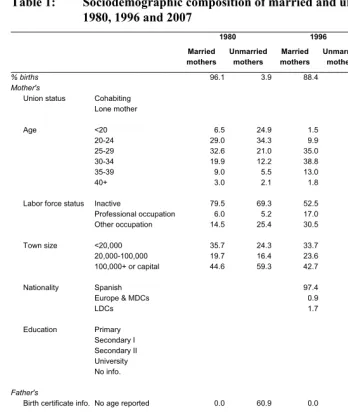
Not only has nonmarital childbearing increased rapidly, but its very nature has profoundly changed. Out-of-wedlock childbearing has been traditionally associated with adolescent unplanned fertility, but this portrayal is no longer accurate. Whereas 24.3% of nonmarital births were born to adolescent mothers in 1980, the corresponding proportion in 2007 was only 8.2%. In turn, during this period, the proportion of nonmarital births to mothers over age 30 increased from 19.9% in 1980 to 46.2% in 2007. Also, the proportion of first births among nonmarital births declined from 77% in 1980 to 69.1% in 2007 (Table 1).
2 Spain’s total fertility rate remained below 1.3, the lowest-low fertility threshold, from 1993 to 2003. In
Table 1: Sociodemographic composition of married and unmarried mothers, 1980, 1996 and 2007
1980 1996 2007
Married mothers
Unmarried mothers
Married mothers
Unmarried mothers
Married mothers
Unmarried mothers
% births 96.1 3.9 88.4 11.6 69.7 30.3
Mother's
Union status Cohabiting 66.8
Lone mother 33.2
Age <20 6.5 24.9 1.5 14.7 0.7 8.2
20-24 29.0 34.3 9.9 23.4 5.4 20.1
25-29 32.6 21.0 35.0 24.4 22.5 25.8
30-34 19.9 12.2 38.8 22.7 43.7 26.7
35-39 9.0 5.5 13.0 12.3 23.9 15.3
40+ 3.0 2.1 1.8 2.6 3.9 3.8
Labor force status Inactive 79.5 69.3 52.5 63.0 37.0 47.9
Professional occupation 6.0 5.2 17.0 9.7 21.3 11.8
Other occupation 14.5 25.4 30.5 27.3 41.7 40.2
Town size <20,000 35.7 24.3 33.7 26 31.5 26.7
20,000-100,000 19.7 16.4 23.6 23.9 27.8 28.2
100,000+ or capital 44.6 59.3 42.7 50.2 40.7 45.2
Nationality Spanish 97.4 92.8 84.7 74.9
Europe & MDCs 0.9 3.1 4.0 8.1
LDCs 1.7 4.1 11.3 17.0
Education Primary 10.2 21.4
Secondary I 22.2 29.6
Secondary II 29.1 25.8
University 32.7 16.1
No info. 5.8 7.1
Father's
Birth certificate info. No age reported 0.0 60.9 0.0 9.8 0.0 5.4
Occupation Professional 11.7 3.5 19.6 11.2 25.9 13.9
Newborn's
Sex Boy 51.9 52.2 51.5 51.5 51.6 51.6
Girl 48.1 47.8 48.5 48.5 48.4 48.4
Birth order 1 41.4 77.0 49.3 63.2 53.4 69.1
2 31.8 13.9 39.3 24.3 36.8 22.3
3+ 26.8 9.0 11.3 12.5 9.8 8.7
Gestational age Full-term 98.0 96.8 96.0 93.9 94.0 92.7
Pre-term 2.0 3.2 4.0 6.1 6.0 7.3
N 540459 22061 293959 38417 314460 136651
Numerous studies have warned against assuming that all births to unmarried women are births to unpartnered mothers (Bumpass and Lu 2000, Sigle-Rushton and McLanahan 2002). In the European context, a large proportion of births classified as nonmarital are actually born to a cohabiting couple (Kiernan 2004), and hence in a family context analogous to that of a married couple, although exposed to higher risks of disruption (Manning, Smock, and Majumdar 2004). Furthermore, although a birth to a lone mother reduces her chances of marrying in the future (Bennet, Bloom, and Miller 1995), a birth within a cohabitating union increases the probability that the parents will marry in the short term (Manning 1995); hence, many of the children born to non-married mothers will actually be raised in a marital context.
Although cohabitation is becoming increasingly common among young generations in Spain (Domínguez-Folgueras and Castro-Martín 2008) and data from the latest 2001 census confirm that cohabitation is not merely a childless stage before marriage –39% of cohabitating partners have children in common (Castro-Martín and Domínguez-Folgueras 2008)–, birth registers in Spain have traditionally collected only the legal marital status of the parents and not their de facto family situation. It is not until 2007 that information on parents’ cohabiting status and on a mother’s and father’s home address is introduced in the birth certificate. Possibly due to the novelty, there is a large non-response rate to the question on cohabitation (22% among unmarried women). However, if we combine the information on declared cohabitation and the information on whether the father lives at the same address as the mother for those unmarried women who did not respond to the question of cohabitation, the outcome is that about two-thirds (66.8%) of nonmarital births (which represent 20.2% of all births in 2007) correspond to cohabiting couples, and only one-third correspond strictly to lone mothers. This level is significantly higher than previous estimates based on the 1995 Fertility and Family Survey, which indicated that 42%3 of nonmarital first births
corresponded to women in cohabiting unions (Castro-Martín 2007).
Concomitant to the rise in nonmarital births where parents are cohabiting, there has been a dramatic increase in the legally acknowledged paternity of nonmarital children. Although Spain does not have official statistics on this important issue, we can infer them through an indirect indicator, proposed by Muñoz-Pérez (2003): the proportion of nonmarital births for which the father’s age is reported at the birth registry. Whereas only 39.1% of all nonmarital births registered the father’s age in 1980, the corresponding proportion in 2007 reached 94.5% (Table 1). This is a crucial development because the legal and financial responsibilities of unmarried fathers to
3 This estimate refers to all first nonmarital births born to women aged 18-49, but the proportion varies
their children can only be enforced if paternity is formally established (Hirczy de Miño 2000, Guzzo 2009).
Another important shift in the profile of unmarried mothers is linked to the rapid growth of immigration that Spain has experienced since the mid-1990s (Arango 2000). Whereas in the 1991 Census the foreign population comprised less than 1% of the total population, according to the continuous population register, in January 2009 they represented 12% of the overall population. This rapid increase has greatly influenced recent demographic dynamics, including fertility levels and nonmarital fertility patterns (Roig and Castro-Martín 2007). In 2007, 18.9% of all births in Spain were to foreign mothers, but if we focus on nonmarital fertility, the share of foreign mothers was even larger: 25.9%. The immigrant population is, however, a heterogeneous population and the prevalence of nonmarital childbearing varies greatly according to region of origin. The nonmarital fertility ratio is highest among Latin American women (59.5%) and lowest among Northern African women (9.6%).
Besides the demographic profile of unmarried mothers, it is relevant to examine their education and work profile, since the opportunities and disadvantages of children born out-of-wedlock are largely conditioned by the socioeconomic level of their mothers, especially in those households where the father is not present. Even though education and labour force participation are not always a guarantee against poverty, particularly for single mothers raising a family on one income, they significantly reduce the risk of social exclusion. Previous analyses of the Spanish Fertility and Family Survey 1995 showed that the probability of bearing a child outside marriage was significantly higher among women with primary education than among college-educated women (Castro-Martín 2007), following the pattern that has been observed in other societies (Kennedy 2004). Vital statistics data from 2007 confirm the existence of important educational differences between married and unmarried mothers: the proportion of mothers with a college education is 32.7% among the former and 16.1% among the later (Table 1). Although we cannot examine trends in the educational composition of unmarried mothers using vital statistics –due to the lack of data for this variable before 2007– when we compare the proportion of unmarried mothers with a professional or technical occupation, which usually requires a college degree, we observe an important increase: from 5.2% in 1980 to 11.8% in 2007. The overall participation of unmarried mothers in the labour market has also increased significantly over time –although at a slower pace than that of married women. The proportion of unmarried mothers classified as economically inactive decreased from 69.3% in 1980 to 47.9% in 2007.
time with images of adolescent women having an unplanned first birth and whose subsequent life trajectories were largely conditioned by this event, often adversely – regarding their educational and labour market opportunities as well as their marriage prospects (Wu, Bumpass, and Musick 2001). Nowadays, however, there is not an homogeneous profile of unmarried mothers: nonmarital births occur within a wide age range but they are increasingly late, they are not necessarily first births, they may precede or follow a marriage, they are born to both unpartnered women and women living with the child’s father, and they may speed up or slow down the transition to marriage. The changing profile of unmarried mothers could have important social implications. Maternal age, education and labour force attachment significantly reduce the economic, social and emotional vulnerability of unmarried mothers and, hence, the health and social disadvantages faced by their children (Foster, Jones, and Hoffman 1998).
3. Single motherhood as a sociodemographic risk factor for low
birthweight
Birthweight is widely acknowledged in the literature as an important indicator of individual and population health (UNICEF and WHO 2004). Low birthweight is strongly associated with neonatal mortality and infant morbidity, and is also an important predictor of children’s long-term health, psychological development and cognitive skills (Boardman et al. 2002, Jefferis, Power, and Hertzman 2002, Conley, Strully, and Bennett 2003, Reichman, 2005). Examining health inequalities at birth is hence relevant to understand subsequent inequalities from early childhood through adulthood.
(Reime et al. 2006). Other studies have documented that maternal health and health-related behaviours, such as smoking during pregnancy, are worse among unmarried mothers compared to married mothers (Kiernan and Pickett 2006). Social support, and in particular emotional support from the baby’s father, has also been shown to influence mothers’ physical, emotional and reproductive health and, consequently, pregnancy outcomes (Hohmann-Marriott 2009). In fact, some studies have found that a woman’s partnership duration and quality may be more relevant for infant health than her formal marital status (Bird et al. 2000). Pregnancy wantedness is also strongly associated with pregnancy outcomes and unmarried women are more likely to report pregnancies as unintended (Williams 1994).
Nevertheless, since the socioeconomic status, health-related behaviour and social support networks of unmarried mothers vary widely across cultural, social, and welfare contexts (Burstrom et al. 2010), the influence of marital status on perinatal health cannot be assumed to be analogous in all societies (Grimmer et al. 2002) In the case of Spain, it is unlikely that observed disparities in low birthweight between married and unmarried mothers result from differential access to health care, since the whole pregnant population is covered by high standard maternity care in the public health system. This asset should lower the risks of adverse pregnancy outcomes associated with unmarried status compared to other countries with no universal access to health care.
acceptance of nonmarital childbearing can also lessen the level of psychological stress linked to unmarried pregnancy and its detrimental effects on infant health.
In brief, unmarried and married mothers are currently more alike in terms of sociodemographic characteristics than in the past and, hence, we expect to find a weakening of the association between maternal marital status and birth outcomes. Moreover, as alternative family structures have become more widely accepted, less stigma from the community and less disapproval from the inner circle of friends and relatives are likely to benefit the health status of unwed mothers and their newborns. Increasing father involvement is also likely to reduce children’s health disadvantages (Padilla and Reichman 2001). In this vein, a recent study found that marital status was no longer a significant predictor of the risk of preterm birth in those European countries where the nonmarital birth ratio was above 20% (Zeitlin et al. 2002).
Although the literature on the risk factors of adverse birth outcomes is copious, time trends in unmarried mothers’ disadvantage in relation to low birthweight remains understudied. Furthermore, empirical results are far from uniform: the impact of marital status on pregnancy outcomes has diminished over time in some societies (Fairley 2005), but remained relatively stable in others (Luo, Wilkins, and Kramer 2004, Raatikainen, Heiskanen, and Heinonen 2005). Spain provides a good case study because the nonmarital birth ratio increased nearly three-fold in the past decade, and hence offers a good opportunity to test whether children’s health disadvantages associated with mothers’ unmarried status lessen when nonmarital childbearing shifts from a marginal to a relatively frequent behaviour.
4.
Data and methods
This study uses data from the Spanish birth register from 1996 and 2007 to examine trends in low birthweight associated with mother’s marital status. The birth microdata files are provided by the National Institute of Statistics and are based on the information collected in the statistical birth bulletin. This document is filled out by the infant's parents at the time of birth and is recorded in the civil register.
Since the establishment of the national vital registration system in 1871–and even before, in the parish registers– births within and outside marriage have been clearly differentiated, although the terms used and the legal and social consequences of this categorization have changed over time. In 1981 the concept of illegitimate birth
disappears and birth statistics begin to record births to married mothers and unmarried
mothers. In 2007, information on whether unmarried mothers are single, separated/divorced or widowed, and whether they are cohabiting with a partner, is collected for the first time.4 The information on birth weight has been gathered since
1981.
A major strength of population-based register data is their complete coverage and high quality. A major weakness for social research purposes is that only a limited number of variables are collected in register data. For instance, no information on mothers’ and fathers’ education is recorded until 2007, limiting the study of social inequalities in nonmarital childbearing. Nevertheless, in the analysis we include the information available on mothers’ and fathers’ professional occupations as a proxy for college education.
In order to explore the health disadvantages of nonmarital births, we focus on a dimension of perinatal health, birthweight, for which reliable information is available in recent birth microdata.5 Low birthweight is defined by the World Health Organization
as less than 2,500 grams (or less than 5 lb, 8 oz.), regardless of period of gestation.6 The
analysis is restricted to singleton deliveries because multiple births, which are at high
4 In 2007 there was a substantial change in the birth registration form, expanding the information collected.
Mothers’ legal marital status, cohabitating status and union duration, as well as mothers’ and fathers’ education and country of birth were recorded for the first time. Other new information includes mode of delivery (caesarean vs. vaginal birth) and the newborn’s nationality.
5 The data on birthweight exhibit some heaping on digits that are multiples of 500 grams, indicating that
birthweights are usually rounded. However, heaping at 2,500 grams, the cut-off point for low birthweight, is not severe: 0.6 % of all infants in 2007. Therefore, there is no reason to believe that estimates of the prevalence of low birthweight are substantially biased downwards.
6 Low birth weight can be the result of pre-term delivery (less than 37 weeks of gestation), intrauterine growth
7.
risk of low birthweight,7 are more frequent among married than unmarried women.8
We also excluded from the analysis those births for which information on birth weight was missing (6% in 1996 and 4.7% in 2007). The final data set includes 332,376 births for 1996 and 451,111 births for 200
The analysis on birth weight focuses on the more recent period 1996-2007, because before 1996 the proportion of births with no weight recorded is relatively high (an average of 12.8% in 1990-1995) and no information on the mother’s nationality is collected. Although this is a relatively short period, it should be noted that the nonmarital birth ratio nearly tripled during this time span (from 11.7% in 1996 to 30.2% in 2007).
Our focus of interest is the relationship between marital status and low birthweight. Marital status refers to the moment of birth –not conception– and is categorized as married and unmarried, but for 2007 an additional category for cohabiting women is added. A number of socio-demographic characteristics whose association with low birthweight has been documented in the literature are also included in the analyses as potential confounders (Valero de Bernabé et al. 2004). However, the variables that could be included in such analyses were limited to those collected on birth certificates: mother’s age, labor force status and professional occupation, nationality and town size, and newborn’s sex, birth order and pre-term delivery. The presence of information on father’s age in the birth certificate is also used as a proxy for paternity acknowledgement.
Logistic regression techniques are used to examine differentials in the probability of delivering a low weight birth by mother’s marital status, before and after controlling for the socio-demographic covariates mentioned above. Unadjusted and adjusted odds ratios and 95% confidence intervals are presented in the tables of results.
5.
Results
The prevalence of low birthweight infants has increased notably in Spain during the past two decades: from 5.2% in 1990 to 8% in 2007. The current proportion of low weight births is above the OECD average (6.8%), and well above the level in Nordic
7 In 2007, 61.6% of multiple births had low birthweight compared with 5.8% of singletons.
8 The percentage of multiple births has increased over time: from 2.5% in 1996 to 3.9% in 2007, partly as a
countries (less than 4.5%) (EURO-PERISTAT 2008). The recent upward trend in low birthweight goes against what we would expect to observe, given the improvement in living standards and health care, but it has also been observed in several developed countries (OECD 2009). The epidemiological literature offers some explanations for this apparent paradox. First, the number of multiple births, which have a substantially higher risk of low birthweight, has risen steadily, partly as a result of more frequent fertility treatments (Blondel et al. 2002, Daltveit et al. 1999). Second, the proportion of first births –also at higher risks of low birthweight– among all births has also been increasing. Other factors which may have influenced the rise in low birthweight are older age at childbearing9 (Luque Fernández 2008), and increased use of induction of labour and caesarean delivery (Silva et al. 2004). The rising prevalence of smoking among pregnant women is another factor which has been hypothesized to partly account for the rise in low weight births (Martínez Frías et al. 2005).
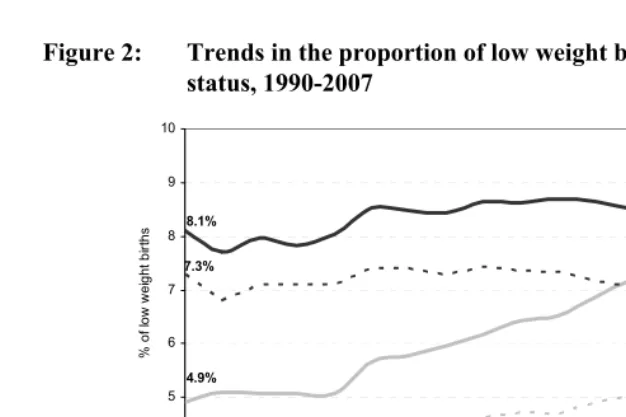
With regard to the differentials in low birthweight by mother’s marital status, Figure 2 reveals that, when we take into account all births, the gap narrows over time, but the observed convergence between unmarried and married mothers is mainly due to the combination of an upward trend in low birthweight among married women (from 4.9% in 1990 to 7.8% in 2007) and a relative stability among unmarried women (around 8.0-8.5%), not to a downward trend in low birthweight among unmarried women. Since these trends are partly linked to the higher probability of having multiple births among married women, from now on we restrict the analysis to singleton live births in order to avoid the potential confounding effect of multiple gestations. When we confine the comparison to singleton deliveries, a narrowing of the gap in low birthweight between unmarried and married mothers can also be observed. Whereas in 1990 the proportion of low weight births among unmarried women (7.3%) nearly doubles that of married women (4%), in 2007 differentials have lessened (6.9% vs. 5.4%).
Figure 3 displays the unadjusted odds ratios of low birthweight for unmarried mothers relative to married mothers for the more recent period: 1996 to 2007. The declining significance of maternal marital status as a risk factor of low birth weight is evident: unmarried women’s odds of delivering a low weight birth were 73% higher than their married counterparts in 1996, but only 31% higher in 2007. The reduction in relative risks has been sustained throughout the period under study. Nevertheless, despite diminishing differentials, low weight births still remain more frequent among unmarried mothers than among their married counterparts.
Figure 2: Trends in the proportion of low weight births by mother's marital status, 1990-2007 8.5% 8.1% 4.9% 7.8% 6.9% 7.3% 5.4% 4.0% 4 5 6 7 8 9 10 19 90 19 91 19 92 19 93 19 94 19 95 19 96 19 97 19 98 19 99 20 00 20 01 20 02 20 03 20 04 20 05 20 06 20 07 % of low w ei gh t bi rt hs
Unmarried - all births Married - all births Unmarried - singleton births Married - singleton births
Source: Birth microdata 1990-2007.
Figure 3: Unadjusted odds ratios and 95% confidence intervals from logistic
regression for low birthweight among unmarried mothers (compared to married mothers), 1996-2007
1.00 1.10 1.20 1.30 1.40 1.50 1.60 1.70 1.80 19 96 19 97 19 98 19 99 20 00 20 01 20 02 20 03 20 04 20 05 20 06 20 07
Observed differentials could be partly conditioned by the dissimilar sociodemographic composition of unmarried and married mothers. In order to take into account potential confounding factors, we perform a logistic regression analysis of the influence of maternal marital status on the risk of having a low weight birth in 1996 and in 2007, controlling for a number of sociodemographic characteristics of the mother, the father and the newborn.
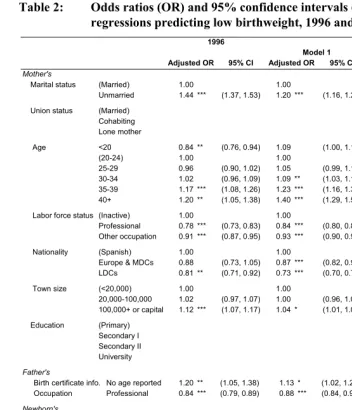
Table 2 provides the adjusted odds ratios from the logistic regression models on low birthweight. Differentials in infant’s low weight by mother’s marital status attenuate once the compositional variables are introduced in the model, particularly in 1996 (Unadjusted OR of 1.73 vs. Adjusted OR of 1.44), but also in 2007 (Unadjusted OR of 1.31 vs. Adjusted OR of 1.20). These results suggest that part of the observed differentials in low birthweight by maternal marital status can be attributed to the dissimilar sociodemographic composition of unmarried and married mothers. For instance, compared to their married counterparts, unmarried mothers are more likely to be primiparous, to have a premature delivery, to be out of the labour market, to have a non-professional occupation and to live in a large town (Table 1), and these are all factors that increase the risk of low birthweight (Rodríguez, Regidor, and Gutiérrez-Fisac 1995). Unmarried mothers have, on the other hand, some “protective” compositional factors in relation to low birthweight, such as a younger average age and a higher likelihood of being foreign-born. Congruent with former studies on immigrant women’s birth outcomes, our models show that foreign women –from both developed and developing countries– residing in Spain have lower risks of low birthweight than native women. Nevertheless, although attenuated after adjusting for sociodemographic characteristics, the increased risk of low birthweight associated with unmarried motherhood remains statistically significant.
Table 2: Odds ratios (OR) and 95% confidence intervals (CI) from logistic regressions predicting low birthweight, 1996 and 2007
1996 2007
Model 1 Model 2
Adjusted OR 95% CI Adjusted OR 95% CI Adjusted OR 95% CI Mother's
Marital status (Married) 1.00 1.00
Unmarried 1.44 *** (1.37, 1.53) 1.20 *** (1.16, 1.24)
Union status (Married) 1.00
Cohabiting 1.16 *** (1.12, 1.20)
Lone mother 1.20 *** (1.14, 1.26)
Age <20 0.84 ** (0.76, 0.94) 1.09 (1.00, 1.18) 1.05 (0.96, 1.14)
(20-24) 1.00 1.00 1.00
25-29 0.96 (0.90, 1.02) 1.05 (0.99, 1.10) 1.09 ** (1.03, 1.15)
30-34 1.02 (0.96, 1.09) 1.09 ** (1.03, 1.15) 1.17 *** (1.10, 1.23)
35-39 1.17 *** (1.08, 1.26) 1.23 *** (1.16, 1.30) 1.32 *** (1.24, 1.40)
40+ 1.20 ** (1.05, 1.38) 1.40 *** (1.29, 1.52) 1.49 *** (1.38, 1.62)
Labor force status (Inactive) 1.00 1.00 1.00
Professional 0.78 *** (0.73, 0.83) 0.84 *** (0.80, 0.88) 0.93 ** (0.89, 0.98) Other occupation 0.91 *** (0.87, 0.95) 0.93 *** (0.90, 0.96) 0.95 ** (0.92, 0.99)
Nationality (Spanish) 1.00 1.00 1.00
Europe & MDCs 0.88 (0.73, 1.05) 0.87 *** (0.82, 0.93) 0.88 *** (0.82, 0.93)
LDCs 0.81 ** (0.71, 0.92) 0.73 *** (0.70, 0.76) 0.71 *** (0.67, 0.74)
Town size (<20,000) 1.00 1.00 1.00
20,000-100,000 1.02 (0.97, 1.07) 1.00 (0.96, 1.04) 1.01 (0.97, 1.04)
100,000+ or capital 1.12 *** (1.07, 1.17) 1.04 * (1.01, 1.08) 1.06 ** (1.02, 1.10)
Education (Primary) 1.00
Secondary I 0.90 *** (0.86, 0.94)
Secondary II 0.83 *** (0.79, 0.87)
University 0.72 *** (0.68, 0.77)
Father's
Birth certificate info. No age reported 1.20 ** (1.05, 1.38) 1.13 * (1.02, 1.24) 1.10 (0.99, 1.22) Occupation Professional 0.84 *** (0.79, 0.89) 0.88 *** (0.84, 0.91) 0.92 *** (0.88, 0.95)
Newborn's
Sex (Boy) 1.00 1.00 1.00
Girl 1.44 *** (1.39, 1.50) 1.43 *** (1.39, 1.47) 1.43 *** (1.39, 1.47)
Birth order (1) 1.00 1.00 1.00
2 0.70 *** (0.67, 0.73) 0.73 *** (0.70, 0.75) 0.72 *** (0.69, 0.74) 3+ 0.77 *** (0.72, 0.82) 0.75 *** (0.72, 0.79) 0.72 *** (0.69, 0.76)
Gestational age (Full-term) 1.00 1.00 1.00
Pre-term 45.41 *** (43.61, 47.29) 29.62 *** (28.75, 30.51) 29.47 *** (28.60, 30.35)
-2 log likelihood 94669.803 152092.118 151957.501
df 18 18 23
N 332376 451111 451111
presumably greater father involvement throughout the pregnancy, cohabiting mothers in Spain are closer to lone mothers than to married mothers in terms of low birthweight risks.
Regarding the mediating effect of mother’s education, Model 2 suggests that the impact of educational level is in the direction expected –higher educational attainment reduces the odds of low birthweight–, but its inclusion in the model only slightly reduces the effect of union status on birth outcomes.10 The lower educational attainment
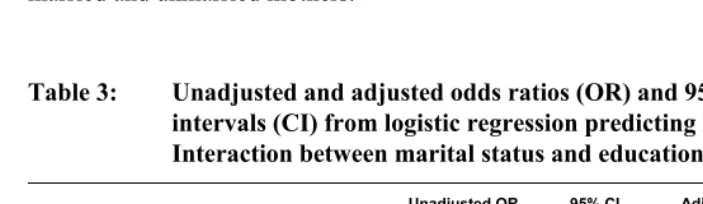
of unmarried mothers, hence, can only partially account for the observed gap in birth outcomes. Nevertheless, the inclusion of an interaction between marital status and education in the model reveals that maternal education modifies the impact of marital status on low birthweight risks.11 The results of the interaction, displayed in Table 3,
show that differentials in low birthweight by marital status are substantially larger among low educated women than highly educated women. In fact, the risk of delivering a low weight birth among college-educated women does not differ significantly for married and unmarried mothers.
Table 3: Unadjusted and adjusted odds ratios (OR) and 95% confidence
intervals (CI) from logistic regression predicting low birthweight. Interaction between marital status and education
Unadjusted OR 95% CI Adjusted OR 95% CI
Marital status * Education
Married and less than Secondary 1.35 *** (1.28, 1.42) 1.34 *** (1.25, 1.44)
Married and Secondary 1.17 *** (1.13, 1.22) 1.14 *** (1.09, 1.19)
(Married and University) 1.00 1.00
Unmarried and less than Secondary 1.83 *** (1.74, 1.93) 1.57 *** (1.47, 1.69)
Unmarried and Secondary 1.48 *** (1.42, 1.53) 1.38 *** (1.31, 1.46)
Unmarried and University 1.07 (1.00, 1.14) 1.05 (0.98, 1.13)
Notes: The multivariate model controls for all covariates of Model 1 in Table 2. *** p<.001
10 The contrast between unmarried women (regardless of cohabiting status) and married women is also
slightly attenuated once educational composition is taken into account (Adjusted OR of 1.17 when education is included in the model vs. Adjusted OR of 1.20 when it is not included).
11 In order to simplify the interpretation of the interaction between marital status and education, the categories
Regarding the time trends in the effect of maternal marital status on newborns’ low weight, the comparison of the model for 1996 and Model 1 for 2007 –which includes the same covariates– reveals that the weakening influence of marital status on the risk of low birthweight reflected in the unadjusted odds ratios can also be observed after the sociodemographic composition of unmarried and married mothers is controlled for. The adjusted odds of low birthweight were 44% higher among unmarried mothers relative to their married counterparts in 1996, but only 20% higher in 2007. We can conclude, hence, that the health disadvantages of unmarried mothers’ newborns relative to married mother’s newborns have lessened during the past decade.
Table 4: Unadjusted and adjusted odds ratios (OR) and 95% confidence
intervals (CI) from logistic regression predicting low birthweight. Interaction between marital status and year
Unadjusted OR 95% CI Adjusted OR 95% CI
Marital status * Year
(Unmarried 1996) 1.00 1.00
Unmarried 2007 0.93 *** (0.89, 0.97) 0.83 *** (0.78, 0.87)
Married 1996 0.58 *** (0.56, 0.60) 0.66 *** (0.63, 0.69)
Married 2007 0.71 *** (0.68, 0.74) 0.69 *** (0.65, 0.72)
Notes: The multivariate model controls for all covariates of Model 1 in Table 2. *** p<.001
6.
Conclusions
Over the last two decades, Spain has witnessed a remarkable increase in nonmarital childbearing, a reflection of the growing dissociation between marriage and motherhood. Despite the considerable influence that the Catholic Church retains on the education system and social habits, marriage has lost its traditional status as the near-exclusive context for bearing and raising children. Whereas only thirty years ago nonmarital childbearing was a marginal behaviour facing strong social disapproval, nowadays nearly 1 out of 3 births take place outside the framework of marriage and social acceptance of unmarried families is widespread. Although the current nonmarital birth ratio is lower than that prevailing in most Northern European countries, the recent pace of increase has been the most rapid among Southern European countries.
Not only has out-of-wedlock childbearing become more frequent, but the sociodemographic profile of unmarried mothers has undergone a significant transformation. Some of the changes in the demographic composition of unmarried mothers documented here could have important social implications. For instance, the fact that nearly half of nonmarital births currently occur to mothers over the age of 30 and approximately two-thirds to cohabiting mothers suggests that a substantial proportion of those births are planned and desired. These changes in the age profile and the conjugal situation of unmarried mothers, together with their increasing education and labour force participation, are likely to have favourable implications for children’s well-being.
In this study we have examined to what extent mothers’ marital status affects the health status of their newborns, using low birthweight as an indicator. Although birth statistics show that the low birthweight rate is consistently higher among unmarried than married mothers, the dissimilar sociodemographic composition of these groups suggests the need to assess health risks in a multivariate framework. The logistic regression analysis revealed that differentials in the risk of delivering a low birth weight infant by marital status lessen substantially after controlling for sociodemographic factors, although they remain sizable and statistically significant. Also, we found that among college-educated women, low birthweight risks do not differ significantly between married and unmarried mothers.
disadvantage gap between marital and nonmarital births narrowed significantly over the past decade.
Several limitations of this study should be noted. Common to other studies using vital registration data, we lack information on important medical, psychosocial and behavioural risk factors, such as maternal weight and health problems, pregnancy unwantedness at the time of conception, smoking habits or levels of stress. These unmeasured risk factors and behaviours may account for the observed disparities and trends. Further research is needed to elucidate the causal pathways that link marital status and pregnancy outcomes. Nevertheless, this study makes an important contribution by documenting the diminishing health disadvantage of unmarried women’s newborns compared to married women’s.
Despite these positive developments, unmarried women’s infants still face higher health risks than those born to married women, a reflection of social inequities. In contrast to other European Union countries, Spain has not developed any social policy specifically aimed at improving the living conditions and health of unmarried mothers and their children. Nevertheless, it is plausible that the recent increase in nonmarital births will promote a wide social debate on the vulnerabilities faced by unmarried families and create the political will to design a range of interventions and policy measures aimed at counteracting the health and social disadvantages still associated with nonmarital childbearing. Since the number of babies being born outside of a married family setting is expected to keep on growing, it is also important to continue monitoring health inequalities at birth.
7. Acknowledgements
References
Andersen, A.N., Goossens, V., Ferraretti, A.P., Bhattacharya, S., Felberbaum, R., Mouzon, J., Nygren, K.G., EIM Consortium, and ESHRE (2008). Assisted reproductive technology in Europe, 2004. Results generated from European
registers by ESHRE. Human Reproduction 23(4): 756-771.
doi:10.1093/humrep/den014.
Arango, J. (2000). Becoming a country of immigration at the end of the twentieth century: The case of Spain. In: King, R., Lazaridis, G., and Tsardanidis, C. (eds.). Eldorado or Fortress? Migration in Southern Europe. New York: St. Martin’s Press: 253-276.
Baizán, P., Aassve, A., and Billari, F.C. (2003). Cohabitation, marriage, and first birth: The interrelationship of family formation events in Spain. European Journal of Population 19(2): 47-169.
Bennett, N.G., Bloom, D.E., and Miller, C.K. (1995). The influence of nonmarital childbearing on the formation of first marriages. Demography 32(1): 47-62.
doi:10.2307/2061896.
Bennett, T. (1992). Marital status and infant health outcomes. Social Science & Medicine 35(9): 1179-1187. doi:10.1016/0277-9536(92)90230-N.
Billari, F.C., Castiglioni, M., Castro-Martín, T., Michielin, F., and Onagro, F. (2003). Household and union formation in a Mediterranean fashion: Italy and Spain. In: Klijzing, E. and Corijn, M. (eds.). Comparative Research on Fertility and the Family in Contemporary Europe: Findings and Lessons from Comparative Research, Vol. II. New York/Geneva: United Nations: 17-41.
Bird, S.T., Chandra, A., Bennett, T., and Harvey, S.M. (2000). Beyond marital status: Relationship type and duration and the risk of low birth weight. Family Planning Perspectives 32(6): 281-287. doi:10.2307/2648196.
Blondel, B., Kogan, M.D., Alexander, G.R., Dattani, N., Kramer, M.S., Macfarlane, A., and Wen, S.W. (2002). The impact of the increasing number of multiple births on the rates of preterm birth and low birth weight: An international study.
American Journal of Public Health 92(8): 1323-1330.
doi:10.2105/AJPH.92.8.1323.
Bumpass, L.L. and Lu, H.H. (2000). Trends in cohabitation and implications for children's family contexts in the United States. Population Studies 54(1): 29-41.
doi:10.1080/713779060.
Burstrom, B., Whitehead, M., Clayton, S., Fritzell, S., Vannoni, F., and Costa, G. (2010). Health inequalities between lone and couple mothers and policy under different welfare regimes: The example of Italy, Sweden and Britain. Social Science & Medicine 70(6): 912-920. doi:10.1016/j.socscimed.2009.11.014. Castro-Martín, T. (2005). Contraceptive use patterns among Spanish single youth. The
European Journal of Contraception and Reproductive Health Care 10(4): 218-227. doi:10.1080/13625180500282379.
Castro-Martín, T. (2007). Maternidad sin matrimonio: nueva vía de formación de familias en España. Madrid: Fundación BBVA (Documento de Trabajo 16).
http://www.fbbva.es/TLFU/dat/dt_16_maternidad.pdf.
Castro-Martín, T. and Dominguez-Folgueras, M. (2008). Matrimonios “sin papeles”: Perfil sociodemográfico de las parejas de hecho en España según el Censo de 2001. Política y Sociedad 45(2): 51-72.
Christopher, K., England, P., McLanahan, S., Ross, K., and Smeeding, T.M. (2001). Gender inequality in poverty in affluent nations: The role of single motherhood and the state. In: Vleminckx, K. and Smeeding, T. (eds.). Child Well-Being, Child Poverty and Child Policy in Modern Nations: What Do We Know?
London: Policy Press: 199-219.
Conley, D., Strully, K.W., and Bennett, N.G. (2003). The Starting Gate: Birth Weight and Life Chances. Berkeley, CA: University of California Press.
Daltveit, A.K., Vollset, S.E., Skjærven, R., and Irgens, L.M. (1999). Impact of multiple births and elective deliveries on the trends in low birth weight in Norway, 1967– 1995. American Journal of Epidemiology 149(12):1128-1133.
Domínguez-Folgueras, M. and Castro-Martín, T. (2008). Women’s changing socioeconomic position and union formation in Spain and Portugal.
Demographic Research 19(41): 1513-1550.
http://www.demographic-research.org/Volumes/Vol19/41/. doi:10.4054/DemRes.2008.19.41.
EURO-PERISTAT Project (2008). European Perinatal Health Report.
Fairley, L. (2005). Changing patterns of inequality in birthweight and its determinants: A population-based study, Scotland 1980–2000. Paediatric and Perinatal Epidemiology 19(5): 342-351. doi:10.1111/j.1365-3016.2005.00665.x.
Foster, E.M., Jones, D., and Hoffman, S.D. (1998). The economic impact of nonmarital childbearing: How are older, single mothers faring? Journal of Marriage and the Family 60(1): 163-174. doi:10.2307/353449.
Grimmer, I., Bührer, C., Dudenhausen, J.W., Stroux, A., Reiher, H., Halle, H., and Obladen, M. (2002). Preconceptional factors associated with very low birthweight delivery in East and West Berlin: A case control study. BMC Public Health 2: 10. http://www.biomedcentral.com/1471-2458/2/10.
doi:10.1186/1471-2458-2-10.
Guendelman,S., Buekens, P., Blondel, B., Kaminski, M., Notzon, F.C., and Masuy-Stroobant, G. (1999). Birth outcomes of immigrant women in the United States, France and Belgium. Maternal and Child Health Journal 3(4): 177-187.
doi:10.1023/A:1022328020935.
Guzzo, K.B. (2009). Paternity establishment for men’s nonmarital births. Population Research and Policy Review 28(6): 853-872. doi:10.1007/s11113-009-9131-z. Heuveline, P., Timberlake, J.M., and Furstenberg, F.F. Jr. (2003). Shifting childrearing
to single mothers: Results from 17 Western countries. Population and Development Review 29(1): 47-72. doi:10.1111/j.1728-4457.2003.00047.x. Hirczy de Miño, W.P. (2000). From bastardry to equality: The rights of nonmarital
children and their fathers in comparative perspective. Journal of Comparative Family Studies 31(2): 231- 262.
Hohmann-Marriott, B. (2009). The couple context of pregnancy and its effects on prenatal care and birth outcomes. Maternal and Child Health Journal 13(6): 745-754. doi:10.1007/s10995-009-0467-0.
Jefferis, B., Power, C., and Hertzman, C. (2002). Birth weight, childhood socioeconomic environment, and cognitive development in the 1958 British birth cohort study. BMJ 325(7359): 305-308. doi:10.1136/bmj.325.7359.305. Kennedy, S. (2004). Education and the formation of new families: a comparative study
Kiernan, K. (2001). The rise of cohabitation and childbearing outside marriage in Western Europe. International Journal of Law, Policy and the Family 15(1):
1-21. doi:10.1093/lawfam/15.1.1.
Kiernan, K. (2004). Unmarried cohabitation and parenthood in Britain and Europe. Law & Policy 26(1): 33-55. doi:10.1111/j.0265-8240.2004.00162.x.
Kiernan, K. and Pickett, K.E. (2006). Marital status disparities in maternal smoking during pregnancy, breastfeeding and maternal depression. Social Science & Medicine 63(2): 335-346. doi:10.1016/j.socscimed.2006.01.006.
Kost, K., Landry, D.J., and Darroch, J.E. (1998). The effects of pregnancy planning status on birth outcomes and infant care. Family Planning Perspectives 30(5): 223-230. doi:10.2307/2991608.
Kramer, M.S., Séguin, L., Lydon, J., and Goulet, L. (2000). Socio-economic disparities in pregnancy outcome: Why do the poor fare so poorly? Paediatric and Perinatal Epidemiology 14(3): 194-210. doi:10.1046/j.1365-3016.2000.00266.x. Lichter, D.T. (1995). The retreat from marriage and the rise in nonmarital fertility. In:
Report to Congress on Out-of-Wedlock Childbearing. Hyattsville, MD: Department of Health and Human Services, DHHS Pub. No. (PHS) 95-1257: 137-146.
Luo, Z.C., Wilkins, R., and Kramer, M.S. (2004). Disparities in pregnancy outcomes according to marital and cohabitation status. Obstetrics and Gynecology 103(6): 1300-1307.
Luque Fernández, M.A. (2008). Evolución del riesgo de mortalidad fetal tardía, prematuridad y bajo peso al nacer, asociado a la edad materna avanzada, en España (1996-2005). Gaceta Sanitaria 22: 396-403. doi:10.1157/13126919. Manning, W.D. (1995). Cohabitation, marriage and entry into motherhood. Journal of
Marriage and Family 57(1): 191-200. doi:10.2307/353827.
Manning, W.D., Smock, P., and Majumdar, D. (2004). The relative stability of cohabiting and marital unions for children. Population Research and Policy Review 23(2): 135-159. doi:10.1023/B:POPU.0000019916.29156.a7.
McLanahan, S. (2004). Diverging destinies: How children are faring under the second
demographic transition. Demography 41(4): 607-627.
doi:10.1353/dem.2004.0033.
McLanahan, S. and Sandefur, G. (1994). Growing Up with a Single Parent: What Hurts, What Helps? Cambridge, MA: Harvard University Press.
Meggiolaro, S. (2009). Low birth weight and parental resources in Italy. Genus 65(1): 103-121.
Muñoz-Pérez, F. (2003). Tener hijos sin casarse. Sistema 175-176: 67-85.
Musick, K. (2002). Planned and unplanned childbearing among unmarried women.
Journal of Marriage and the Family 64(4): 915-929. doi:10.1111/j.1741-3737.2002.00915.x.
Nash, M. (1991). Pronatalism and motherhood in Franco’s Spain. In: Bock, G. and Thame, P. (eds.). Maternity and Gender Policies: Women and the Rise of the European Welfare States, 1880s-1950s. London: Routledge: 160-177.
OECD (2009). Health at a Glance 2009: OECD Indicators. OECD Publishing.
http://dx.doi.org/10.1787/health_glance-2009-en.
Padilla, Y.C. and Reichman, N.R. (2001). Low birthweight: Do unwed fathers help?
Children and Youth Services Review 23 (4/S): 427-452.
Pattenden, S., Dolk, H., and Vrijheid, M. (1999). Inequalities in low birth weight: Parental social class, area deprivation, and “lone mother” status. Journal of Epidemiology and Community Health 53(6): 355-358.
doi:10.1136/jech.53.6.355.
Raatikainen, K., Heiskanen, N., and Heinonen, S. (2005). Marriage still protects pregnancy. BJOG: An International Journal of Obstetrics and Gynaecology
112(10): 1411-1416. doi:10.1111/j.1471-0528.2005.00667.x.
Raley, K.R. (2001). Increasing fertility in cohabiting unions: Evidence for the second demographic transition in the United States? Demography 38(1): 59-66.
doi:10.1353/dem.2001.0008.
Reichman, N.E. (2005). Low birth weight and school readiness. The Future of Children
15(1): 91-116. doi:10.1353/foc.2005.0008.
social deprivation and low birth weight in Germany. Social Science & Medicine
62(7): 1731-1744. doi:10.1016/j.socscimed.2005.08.017.
Revuelta, B. and Villuendas, B. (2008). Bastards and foundlings: Child abandonment, retrieval and illegitimacy in Madrid during the early 20th century. Paper presented at the European Social Science History Conference, Lisbon, February 28 – March 1, 2008.
Rodríguez, C., Regidor, E., and Gutiérrez-Fisac, J.L. (1995). Low birth weight in Spain associated with sociodemographic factors. Journal of Epidemiology and Community Health 49(1): 38-42. doi:10.1136/jech.49.1.38.
Roig, M. and Castro-Martín, T. (2007). Childbearing patterns of foreign women in a new immigration country: The case of Spain. Population62(3): 351-380.
Ruiz Salguero, M., Cabré, A., Castro Martín, T., and Solsona, M. (2005).
Anticoncepción y Salud Reproductiva en España: crónica de una (r)evolución. Madrid: CSIC, Colección de Estudios Ambientales y Socioeconómicos nº 6. Seltzer, J.A. (2000). Families formed outside of marriage. Journal of Marriage and the
Family 62(4): 1247-1268. doi:10.1111/j.1741-3737.2000.01247.x.
Sigle-Rushton, W. and McLanahan, S. (2002). The living arrangements of new unmarried mothers. Demography 39(3): 415-433. doi:10.1353/dem.2002.0032. Silva, A., Barbieri, M., Bettiol, H., Goldani, M., and Rona, R. (2004). Can we explain
why Brazilian babies are becoming lighter? International Journal of Epidemiology 33(4): 821-828. doi:10.1093/ije/dyh101.
United Nations Children’s Fund (UNICEF) and World Health Organization (WHO) (2004). Low Birthweight: Country, regional and global estimates. New York: UNICEF. http://www.unicef.org/publications/index_24840.html.
Valero de Bernabé, J., Soriano, T., Albaladejo, R., Juarranz, M., Calle, M.E., Martínez, D., and Domínguez-Rojas, V. (2004). Risk factors for low birth weight: a review. European Journal of Obstetrics and Gynecology and Reproductive Biology 116(1): 3-15. doi:10.1016/j.ejogrb.2004.03.007.
Whitehead, M., Burström, B., and Diderichsen, F. (2000). Social policies and the pathways to inequalities in health: A comparative analysis of lone mothers in Britain and Sweden. Social Science & Medicine 50(2): 255-270.
doi:10.1016/S0277-9536(99)00280-4.
Williams, L.B. (1994). Determinants of couple agreement in U.S. fertility decisions.
Wu, L.L., Bumpass, L.L., and Musick, K. (2001). Historical and life course trajectories of nonmarital childbearing. In: Wu, L.L. and Wolfe, B. (eds.). Out of Wedlock: Causes and Consequences of Nonmarital Fertility. New York: Russell Sage Foundation: 3-48.
Wu, L.L. and Wolfe, B. (2001). Out of Wedlock: Causes and Consequences of Nonmarital Fertility. New York: Russell Sage Foundation.
Young, R.L. and Declercq, E. (2010). Implications of subdividing marital status: Are unmarried mothers with partners different from unmarried mothers without partners? An exploratory analysis. Maternal and Child Health Journal 14(2): 209-214. doi:10.1007/s10995-009-0450-9.