in the population sciences published by the Max Planck Institute for Demographic Research Konrad-Zuse Str. 1, D-18057 Rostock · GERMANY www.demographic-research.org
DEMOGRAPHIC RESEARCH
VOLUME 22, ARTICLE 7, PAGES 159-188
PUBLISHED 02 FEBRUARY 2010
http://www.demographic-research.org/Volumes/Vol22/7/ DOI: 10.4054/DemRes.2010.22.7
Research Article
Marriage, childbearing,
and migration in Kyrgyzstan:
Exploring interdependences
Lesia Nedoluzhko
Victor Agadjanian
© 2010 Lesia Nedoluzhko & Victor Agadjanian.
This open-access work is published under the terms of the Creative Commons Attribution NonCommercial License 2.0 Germany, which permits use, reproduction & distribution in any medium for non-commercial purposes, provided the original author(s) and source are given credit.
1 Introduction 160
2 Theoretical considerations and hypotheses 160
3 The setting 163
4 Data, study population, and research method 166
4.1 Data and study population 166
4.2 Data limitations 167
4.3 Analytical method 168
4.4 Description of the covariates 168
5 Results 171
5.1 Transition to first birth 171
5.2 Transition to second birth 174
5.3 Transition to first marriage 175
5.4 First migration 179
6 Conclusion 181
7 Acknowledgements 182
Marriage, childbearing, and migration in Kyrgyzstan:
Exploring interdependences
Lesia Nedoluzhko1
Victor Agadjanian2
Abstract
In this study, we investigate interdependences between entry into a marital union, childbearing, and migration. We apply event-history techniques to retrospective data on women aged 18-29 from a survey conducted in northern Kyrgyzstan in 2005 to examine how these events can influence one another, with a special focus on the effects of duration of exposure. In our analysis, we account for several duration dependences (‘clocks’). The results illustrate that months since marriage formation is the most important duration variable in the first-birth propensities model. Out-of-wedlock conception is associated with increased marriage risks prior to the childbirth. Migration is often a part of the family-formation process: High first-birth propensities of recent migrants, as well as high migration risks among pregnant women, are due to marriage-related migration.
1. Introduction
In this article we investigate the links between entry into marriage, childbearing, and internal migration (hereafter referred to as migration). We focus on duration interdependences of these demographic events and estimate the effects of some individual characteristics on the propensity to get married, to have a child, and to migrate.
Whereas earlier research dealing with the interplay between demographic events usually linked childbearing either with migration (Goldstein and Goldstein 1984; Hervitz 1985; Kahn 1988; Andersson 2004; Andersson and Scott 2005; Kulu 2005, 2006; Kulu and Vikat 2007) or with union formation (Lillard 1993; Brien, Lillard, and Waite 1999; Le Goff 2002; Baizan, Aassve, and Billari 2004), our study connects all three of these events. It is also intended to contribute to the limited research on demographic behavior in transitional settings, such as those of the former Soviet Union: We use unique, high-quality survey data from Kyrgyzstan to study how family formation and migration are interconnected in the lives of young women in that country.
The article is organized as follows. First, we present the theory and hypotheses that guide our analysis. Then we provide an overview of recent demographic developments in Kyrgyzstan, and describe our data, the study population, and the analytical method. We then present and discuss the results of our study and end with brief conclusions.
2. Theoretical considerations and hypotheses
strong effect of a pregnancy on the rate of entry into marriage can be misleading as a causal explanation—what often matters is not the high marriage rate among pregnant women but the high pregnancy rate among brides (Santow and Bracher 1994).
Because in Kyrgyzstan, as in many other similar transitional settings, most children are born within marital unions, and marriage is perceived as the main institution for childbearing and childrearing by the majority of the population, we expect to find the following interdependence between entry into marriage and childbearing:
- Marriage risks will be highest among pregnant women: To legitimize a child and to avoid stigma (as norms prescribing that a child should be born within a marital union are still strong), women who experience out-of-wedlock pregnancy will tend to get married before the birth of a child, particularly during the early months of a pregnancy. Out-of-wedlock birth, on the other hand, will entail lower marriage risks.
- Birth risks will be much higher among married women than among unmarried women.
- With respect to the duration dependence, guided by universal evidence, we expect to find an elevated first-birth propensity within one or two years following marriage.
adjustments are made. For married or cohabiting individuals, the disruptive effects can also result from spousal separation (Lindstrom and Giorguli Saucedo 2002).
The ‘selectivity’ hypothesis provides a counterargument to the ‘disruption’ hypothesis, suggesting that, because migration is often motivated by union formation or couple reunification (i.e., migrants tend to be ‘selected’ with respect to their motivations and/or fertility intentions), it might result in increased fertility shortly after the move. These patterns of association have been found in a number of studies: By Andersson (2004) and Andersson and Scott (2005) for female immigrants in Sweden; by Milewski (2007) and Lindstrom and Giorguli Saucedo (2007) for immigrants to Germany and the U.S., respectively; and by Kulu (2006) for female internal migrants in Austria and Poland. The previous analysis by Nedoluzhko and Andersson (2007) also revealed an increased first-birth propensity among female internal migrants in Kyrgyzstan (particularly within the first year of migration). In this study, we decompose the overall migration effect to examine whether the increased fertility among recent migrants that is associated with marriage conceals some elements of disruption. We therefore posit the following:
- If migration has any disruptive effect on fertility, this effect should become evident in the form of comparatively low childbirth risks among women who migrated for marriage (for whom the duration of marriage and the duration since migration are the same). We would expect such women to have lower first-birth risks shortly after marriage formation than married non-migrants with the same duration since marriage.
Our theoretical framework of interdependence assumes not only that migration affects fertility but also that fertility affects migration. With respect to the latter, several recent studies have shown that the arrival of or anticipation of having a child are likely to trigger migration for housing reasons, or moves to the settings that offer child-friendly living conditions (Lindgren 2003; Kulu 2008). In the context of Kyrgyzstan, however, this effect of childbearing on migration is unlikely to be strong due to the country’s highly deficient housing market and its underdeveloped community residential amenities. We expect that:
dominated by unmarried women, and most likely should take place during the early stages of pregnancy.
- Because children raise the costs of moving, childless (not pregnant) women will have higher migration risks than women with children.
With regard to the link between migration and marriage, we hypothesize that:
- Recent migration is related to a low propensity to get married: Unless marriage is the main reason for a move, a migrant may need some time to find or reunite with a partner, and to establish the conditions necessary for family life (a trend referred to above as the disruptive influence). Disruption in such cases can arise from the necessity to adapt to the new environment, and/or from the forces that push an individual to migrate: If migration is motivated by educational or earning opportunities, which often compete with family life, a delay in marriage can be expected. - Unmarried (in our study, mostly single) women who, all other things
being equal, have fewer ties that hold them back and therefore are more flexible in their migration decision-making than married women, will have a higher propensity to migrate.
We have no theoretical basis on which to formulate hypotheses concerning the influence of duration since marriage formation on migration; migration obviously can take place at any time, before and/or after the formation of a marital union. However, the sequence of these events, as well as their mediating effects in the marriage-migration-childbearing nexus, might be of importance (see Hoem and Nedoluzhko 2008 for a relevant discussion).
In addition to looking at the triangular link between demographic events of interest, in our analysis, guided by earlier research (Hoem 1986; Thornton, Axinn, and Teachman 1995; Edwards 2002; Kantorová 2004; Agadjanian and Qian 1997; Agadjanian 1999; Nedoluzhko and Andersson 2007), we account for the effects of individual characteristics, such as education, employment, and ethno-cultural background. Women’s age is the baseline propensity in our models.
3. The setting
smaller groups autochthonous to the region (hereafter, all ethnic groups autochthonous to Central Asia are summarily referred to as Asians). Kyrgyzstan is also home to a considerable number of ethnic Russians and other people of European origin (hereafter, Europeans), who altogether constitute about 10% of the country’s population (NSC of the Kyrgyz Republic 2008).
Since its independence in 1991, Kyrgyzstan has endured spells of political instability and deep economic crisis, which have impoverished large segments of the population (Huskey 1997; Falkingham 2005). Currently about 40% of Kyrgyzstanis are classified as poor, i.e., having consumption expenditures below the official poverty line (NSC of the Kyrgyz Republic 2007; Ruget and Usmanalieva 2008). The hardships of the post-Soviet period have, in turn, contributed to dramatic changes in population dynamics and structure.
The increased geographic mobility of Kyrgyzstan’s population has been one of the most notable features of the country’s demographic situation since the breakup of the Soviet Union. Like other Central Asian states, Kyrgyzstan has experienced large-scale net out-migration. Right after the breakup of the Soviet Union, the emigration flow mostly consisted of Europeans. As a result of this ethnic-specific migration, the share of Europeans in the country’s population has declined considerably (Tishkov 1994; Kumskov 2002). However, recent studies point to an increasing number of native Kyrgyz and other Asians among international migrants who are attracted by the employment and business opportunities, mostly in the Russian Federation and in neighboring Kazakhstan (Shuler and Kudabaev 2004; Ruget and Usmanalieva 2008; Schmidt and Sagynbekova 2008).
Mass international migration in the post-Soviet period has been accompanied by rising internal migration, which can largely be explained by the unbalanced economic development of the country’s different regions. Although the economic crisis following the disintegration of the Soviet Union has strongly affected the entire country, rural areas have been particularly hard hit. As a result, the main direction of internal moves, mostly motivated by economic considerations, has been from rural to urban areas, particularly to the capital Bishkek and the surrounding Chui oblast (province) in the northern part of the country.3 These are the only regions that have had a positive internal migration balance since the country’s independence. The 1999 population census data show the contribution of internal migration to the population of these regions: Some 30% of residents in Chui oblast and 40% in Bishkek were born
3 Recent survey data suggest that (self-)employment, earning opportunities, living standards that are higher
elsewhere in Kyrgyzstan, and about two-thirds of them moved during the post-Soviet period (NSC of the Kyrgyz Republic 2002).
Reflecting the ethnic structure of the population, most internal migrants are ethnic Kyrgyz. Internal migration is also characterized by the predominance (up to 80%) of working-age individuals. Moreover, a peculiar characteristic of internal migration in the country is the relatively high share of women, who constitute about 60% of interprovince migrants, and more than 65% of intraprovince migrants (NSC of the Kyrgyz Republic 2008). This gender pattern may be attributable, at least in part, to marriage-related migration: Because of the patrilocal tradition prescribing that a married couple should live in the house of the husband, women are more likely than men to migrate for or because of marriage. Some Kyrgyz practices, such as ‘bride kidnapping’, may also contribute to the high levels of female marriage-related migration. Earlier research on demographic developments in Kyrgyzstan paid no attention to migration motivated by marriage, although its share in the overall internal migration flows can be considerable, particularly among women. Thus, our data, which are described in the next section, indicate that marriage was among the main reasons for moving for 27% of female migrants, but only for 3% of male migrants.
Another distinctive feature of the demographic situation of the post-Soviet period is a rapid fertility decline, which has often been seen as a response to adverse socioeconomic conditions (Sarygulov 2001; Denisenko 2004). Thus, between 1991 and 2001, the total fertility rate (TFR) in Kyrgyzstan dropped from 3.58 to 2.38 children per woman; in the following years, fertility increased, and in 2007 the TFR reached 2.75 children per woman. It should be noted that relatively high fertility characterizes the Asian population; in contrast, fertility among Europeans has long been below replacement level. The unbalanced geographical distribution of the ethnic groups partly explains the considerable differences in fertility levels across different parts of the country, and between urban and rural areas, even though these differences were gradually narrowing due to the changing ethnic structure of the population and mass internal migration. In 2007, the urban and rural TFRs were 2.41 and 3.01, respectively; whereas in 1991, for comparison, the corresponding TFRs were 2.44 and 4.46 (NSC of the Kyrgyz Republic 2008).
Assessing the dynamics of union types other than formal marriage is problematic due to the lack of data. The statistics on informal unions that were collected for the first time in the 1999 population census distinguished between just two union types: ‘registered’ and ‘unregistered’. According to the census data, the share of the latter was about 8% (Kumskova et al. 2007). As the 2009 census data are not yet available, we can estimate the pace with which informal unions have been spreading indirectly based on the number of out-of-wedlock births registered by both parents. Between 1991 and 2007, this number more than doubled (Denisenko 2004; NSC of the Kyrgyz Republic 2008).
4. Data, study population, and research method
4.1 Data and study population
We use retrospective data from the survey ‘Marriage, Fertility, and Migration in Kyrgyzstan’ conducted in 2005. The main aim of this survey was to capture ethnic differences in demographic behavior and in the aspirations of the Kyrgyz and European (mainly Russian) subgroups of the population; therefore, it was carried out in the northern regions of the country, where over 90% of Europeans reside. The survey covered three areas—the capital city of Bishkek and two oblasts (provinces), Chui and Issyk-Kul—each of which constituted a separate sampling domain. A three-stage cluster sample was used in each domain; rural and urban areas were sampled separately. (For details of the sample design see Agadjanian, Kumskov, and Nedoluzhko 2006). To allow for a sufficient representation of different ethnic groups in rural areas, where ethnic Kyrgyz greatly predominate, ethnic minorities (mostly Europeans) were oversampled. The survey is therefore not representative of the rural population of northern Kyrgyzstan. Nevertheless, it provides unique information on migration, family formation, education, and the employment histories of young Kyrgyzstanis.
4.2 Data limitations
The survey provides rich and high-quality data that can be of diverse use both to the scientific community and to policy-makers. However, the data have some limitations that constrain our analysis. For example, we do not consider consensual unions because information on them is incomplete. There is no complete information on unions formed by a religious ceremony either; this information was recorded only for those respondents who combined both a religious ceremony and the official registration of their marriage.
The young age of the respondents and the relatively short segments of their lives covered by the survey limit our ability to examine higher-order births and marriages. As a result, our modeling of second births is based on a rather small number of observations. We do not analyze the formation of second- and higher-order marital unions because few respondents had experienced divorce/separation, and even fewer had remarried by the time of the interview. The narrow age range of the respondents also precludes us from accounting for a calendar period effect: Any attempt to split our observation time would lead to an unbalanced distribution of the age groups in the various sub-periods. To avoid possible data noise related to this limitation, the duration splines presented in the paper are estimated only for the periods of up to three years since marriage or migration, and up to two years since the birth of a child.
Another problematic issue is the information on employment: While details of employment histories were collected, more complete characteristics (full- or part-time employment, occupation, income, etc.) were obtained only for the current job. Thus, we cannot estimate the influence of these characteristics on marital union formation, childbearing, and migration, as other studies have done (Bernhardt 1993; McLaughlin and Lichter 1997). Nor can we examine the effects of the partner’s characteristics, because the survey provides information only on the partner with whom the respondent was living when interviewed, and, again, this information refers exclusively to the time of interview.
4.3 Analytical method
In the analysis, we use hazard regression (Hoem 1987, 1993; Yamaguchi 1991; Blossfeld and Rohwer 1995). Our main models can be specified in the following general form:
ln hi(t) = ψ(t) + Σkzk(t-uik) + Σlαixil + Σmβmwim(t) (1)
where
hi(t) denotes the hazard of a selected event for individual i at time t;
ψ(t) is a piecewise linear spline that represents the effect of process time t;
zk(t-uik) is a spline representation of a time-varying variable, which is a continuous
function of t with origin at uik; the functions zk are specified in such a manner that they
have the value of zero for negative arguments, i.e., zk(τ) =0 for negative τ. These
functions are called ‘kick-in’ functions because they operate starting from the time when a corresponding event occurs and have no effect before that time (Lillard and Panis 2003, pp. 293-294). All the splines presented in this paper are examples of ‘kick-in’ functions. For instance, the function that picks up the effect of migration ‘kicks ‘kick-in’ at the time that corresponds to the age of the respondent when migration took place;
αixil is the value (xil)and parameter(αi) for the effects of time-constant covariates;
βmwim(t) is the value (wim)and parameter(βm) for the effects of time-varying covariates
other than ‘kick-in’ splines.
4.4 Description of the covariates
Pregnancy/parity status
To test our hypotheses concerning the links between childbearing and marriage and between childbearing and migration, we estimate splines that account for the duration effect of pregnancy/age of a child.4 In the models with interactions, we also use a time-varying covariate reflecting the pregnancy/parity status of the respondent with three levels: ‘no children/not pregnant’, ‘pregnant’ and ‘has [a] child(ren)’. Because we assume that it normally takes one to two months for a woman to be certain that she is pregnant, and thus that her behavior is likely to be motivated by pregnancy a few
4 In the model for migration, we account for any pregnancy/age of the youngest child, and in the model for
months after conception, we code a woman as pregnant only in the last seven months of a pregnancy that preceded a live birth.5
Marital status
Based on the marital status information, we construct a time-varying covariate with two levels, namely, ‘unmarried’ and ‘married’ (in an officially registered union).6 The former level includes single, in an unregistered union, divorced/separated, and widowed. We group these different categories of unmarried women together for two reasons: First, because our data do not allow us to fully reconstruct the partnership histories of women who lived with a man without registering their union (at the time of interview, such women comprised 8.6% of the sample), and, second, because the fraction of divorced/separated women and widows in our young study population is very small. In the model of first birth propensity, we account for duration since marriage.
Migration
We control for any internal migration (i.e., residential change that involved crossing the administrative border of a settlement within the country) past age 15.7 In our models, we account either for duration since migration or for migration experience, which is captured by a corresponding time-varying covariate with two levels: ‘not migrated’ and ‘migrated’.International migration is not within the scope of this study (as we have only few cases of such migration reported in our survey); observations are censored at the time of the first international move.
5 Ninety percent of the pregnancies reported in the survey resulted in live births. Accounting only for
pregnancies that resulted in live births does introduce a bias, but we have no information about the duration of pregnancies for which the outcome was abortion or miscarriage.
6 In modeling first and second births, we censor observations at the time of the first divorce; hence, the
category ‘married’ includes only respondents in their first marital unions.
7 Most moves recorded in the survey resulted in a stay that lasted six months or longer, as the corresponding
Education
The survey data provide information on the dates of completion of each educational stage. Based on this information, we construct a time-varying covariate that reflects educational enrolment and attainment. We assume continuous enrollment for a standard duration prior to graduation. For the cases in which the time between the completion of successive educational stages exceeds standard duration, breaks in the educational process are coded. Because the distribution of our respondents by educational level is heavily skewed towards relatively low attainment, we only differentiate between (i) those who have completed general secondaryeducation (the lowest educational level in the sample) and (ii) those with vocational or higher education. The category ‘in education’ combines the following three levels: ‘in general secondary education’, ‘in vocational education’, and ‘in higher education’.
Employment
We use only two categories for the employment covariate, namely, ‘employed’ and ‘non-employed’. We code respondents as employed regardless of whether they were in full- or part-time jobs. Being employed therefore also includes temporary employment. For example, women who were studying could be both ‘in education’ and ‘employed’ if they also reported engaging in any activities (including seasonal work and self-employment) for which they received money or other compensation. Finally, women who reported a pregnancy or birth as the reason for interrupting work are coded as ‘employed’ from the start of employment until the occurrence of the reported birth.
Ethno-cultural background
We define three categories of the ‘ethno-cultural background’ covariate (‘European’, ‘russified Asian’, and ‘non-russified Asian’) to reflect both a respondent’s ethnicity, and the language she usually speaks outside of the home.8 Women of Asian origin who usually speak Russian are classified as ‘russified’, and those who speak other languages (mostly Kyrgyz) as ‘non-russified’. In the ‘European’ and ‘Asian’ categories, ethnic Russians and ethnic Kyrgyz, respectively, represent overwhelming majorities (about
8 An ethno-cultural classification based on both ethnic identity and language use was first proposed for
90%). Reflecting the fact that rural areas with high shares of Europeans were oversampled in the survey, the study population is relatively evenly distributed among the three ethno-cultural groups. Europeans in our study are thought to be the most ‘modernized’ in terms of family-formation behavior, and linguistic ‘russification’ therefore serves as a marker of Asians’ cultural and demographic modernization, operating through the socialization process, as language and related cultural norms and values are often learned from parents and through everyday communication with others.
5. Results
5.1 Transition to first birth
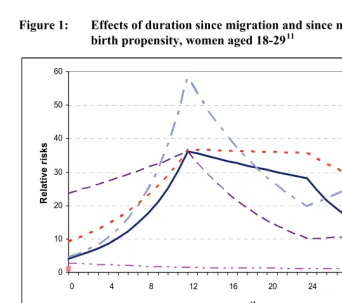
When considering interconnected demographic events, we inevitably face the problem of ‘multiple clocks’, i.e., dependence of the propensity of interest on several durations. Hoem and Nedoluzhko (2008) discussed a technique for dealing with such multiple clocks, which also allows us to decompose the total migration effect. Figure 1 illustrates an application of this technique: In addition to taking into account the respondent's age, it keeps track of time since marriage and time since migration, and accounts for the sequence of these events in modeling a first birth. With the goal of empirical comparison, we estimate (in the same model) five duration splines that correspond to the first-birth propensities of respondents who (1) migrated without being married; (2) married without experiencing migration; (3) migrated after marrying; (4) migrated before marrying,9 and (5) migrated and married in the same month (marriage-related migration). To facilitate the comparison, all the splines have nodes at same durations corresponding to 12 and 24 months since marriage or migration, respectively.10
9 To account for the sequence of migration and marriage events, we must expand Equation (1) by adding a
term that allows us to differentiate between (a) those respondents who first experienced migration and then marriage, and (b) those for whom the order of these two events was the reverse (Hoem and Nedoluzhko 2008). The effect of duration since marriage and the effect of duration since migration are estimated for the former and the latter, respectively.
10 We have experimented with more nodes and with placing nodes at different durations, but this has not
Figure 1: Effects of duration since migration and since marriage on the first-birth propensity, women aged 18-2911
0 10 20 30 40 50 60
0 4 8 12 16 20 24 28 32 36
months
R
el
at
ive
r
isk
s
not migrated, never married
migrated, never married (duration since migration) not migrated, married (duration since marriage) migrated after marrying (duration since migration) migrated before marrying (duration since marriage)
migrated and married in the same month (duration since marriage/migration) 2 3 5 4
1
Note: The model controls for respondent’s age, ethno-cultural background, education, and employment.
Notably, none of the splines in Figure 1 that pick up the effects of duration since migration show that recent migrants temporarily delay the birth of a child. The splines for married non-migrants, and for those who moved and married in the same month (Splines 2 and 5, respectively), have similar shapes: Marriage that results from migration and marriage that do not exert a similar influence on the first-birth
11 The intercepts and the slope estimates for the first year since marriage or migration, respectively, are
propensity. Because the latter spline has higher values at short durations of marriage/migration, we can conclude that there is no disruptive effect related to migration; those who migrate for marriage generally have higher first-birth risks.12
We also find no evidence of a disruptive effect in the case of unmarried migrants (Spline 1), as for them first-birth propensities shortly after the move are higher than the propensities of never-married non-migrants (which is the reference category at Level 1). Two explanations for this result are possible. First, it may be due to a contribution to the corresponding spline of migration that, like marriage-related migration (as we define it), results in elevated first-birth risks. For example, migration and a birth can be closely spaced in time if a woman moves to enter a cohabitational union or a union formed by a religious ceremony (the types of union about which our data provide scant or no information), or if her marriage occurs shortly after migration, but not necessarily in the same month. Couple migration is also likely to be associated with higher first-birth risks. And second, migrants may be younger at first first-birth than non-migrants. This supposition makes sense when we take into account the fact that the majority of migrants are from rural areas, where the mean age at first marriage and at first birth is lower than in urban areas.
Finally, Spline 3, which reflects the effect of duration since migration for married migrants (i.e., for those who first married and then migrated), shows no disruptive effect either as it has the highest values at short durations since migration.
All the splines that refer to the married respondents point to the universal regularity that, regardless of whether or not a woman migrated (before, after, or for marriage), her risk of having a child dramatically increases as soon as she gets married. However, Spline 4, which corresponds to the first-birth propensities of those women who migrated prior to marriage, looks notably different from the other two splines that pick up the effect of duration since marriage, particularly in that it has considerably higher values for the first year after union formation. We do not have an explanation for the shape of this spline, and are inclined to attribute it to possible data noise.13
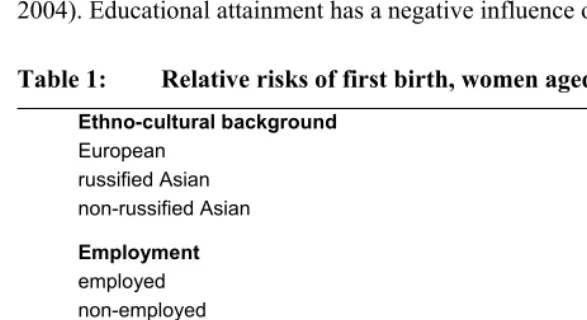
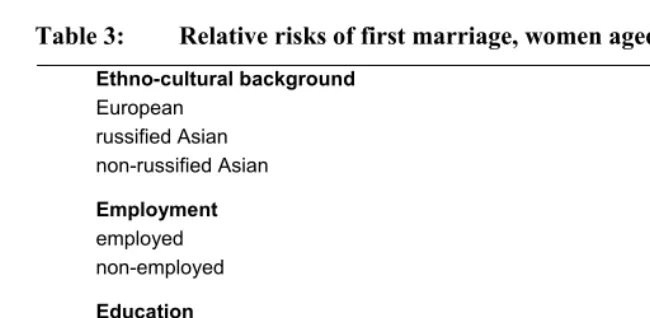
The effects of individual characteristics are presented in Table 1. They show a clear ethno-cultural difference in fertility behavior, with Europeans having higher first-birth risks than Asians. This difference may be due to earlier sexual debut among Europeans and to a higher propensity among that group to have a first child in
12 To test the ‘disruption’ hypothesis, some studies model first conception and not first birth, as we do in this
analysis. We opt for modeling first birth because it allows for a broader coverage of the respondents’ histories; specifically, it captures migration and marriage events that took place during a pregnancy and were likely motivated by that pregnancy (e.g., marriage-related migration). In the previously mentioned study based on the same data, Hoem and Nedoluzhko (2008) tested both approaches. Neither approach showed that the overall migration effect is associated with temporarily delayed childbirth.
cohabitational unions. Employment appears to delay childbearing. A woman is also likely to delay the birth of her first child until the completion of her education, which tends to confirm the incompatibility of educational enrollment with childbearing reported for other settings (Edwards 2002; Baizan, Aassve, and Billari 2004; Kantorová 2004). Educational attainment has a negative influence on first-birth risks.
Table 1: Relative risks of first birth, women aged 18-29
Ethno-cultural background
European 1
russified Asian 0.70*
non-russified Asian 0.71*
Employment
employed 1 non-employed 1.59**
Education
in education 1
out of education
general secondary education 1.93** vocational or higher 1.76**
Note: The model controls for respondent’s age and durations since marriage and migration. Significance level: *p≤.05, **p≤.01.
5.2 Transition to second birth
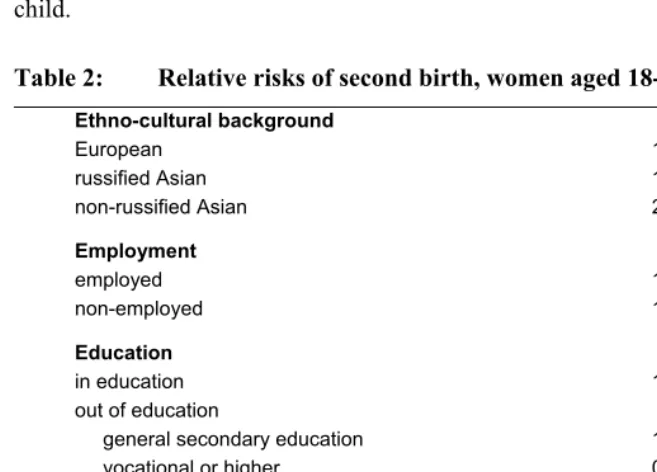
The results for the transition to second birth are presented in Table 2. Our data do not allow us to estimate the duration splines since marriage and migration for this transition; therefore, we use categorical time-varying covariates to capture the effects of marital status and migration experience. The effect of marital status in the model of second birth propensity appears quite moderate because the reference category ‘never- married’ here includes women who have already had their first child and are thus likely to be in a cohabiting or other type of unregistered union. In the model of first birth propensity, where the gap between married and never-married women is much wider (as indicated by Figure 1) this reference category comprises all women who have not yet been married (including those who did not have a permanent sexual partner). The effect of migration experience is not statistically significant.
finding reflects the difference between the lower and higher fertility groups in the study population. The risks of a second birth for russified Asians are about 30% lower than for non-russified Asians, which might be the result of either a delayed second birth or a limitation of the family size among the former group. Neither education nor employment has a statistically significant effect on the propensity to have a second child.
Table 2: Relative risks of second birth, women aged 18-29
Ethno-cultural background
European 1
russified Asian 1.84*
non-russified Asian 2.57**
Employment
employed 1 non-employed 1.26
Education
in education 1
out of education
general secondary education 1.06
vocational or higher 0.95
Marital status
never-married 1 in the first marital union 1.52+
Migration experience
not migrated 1
migrated 1.19
Note: The model controls for the age of the first child. Significance level: +p≤.1, *p≤.05, **p≤.01.
5.3 Transition to first marriage
slightly during the last months of pregnancy. The dramatic drop in marriage risks right after the birth of a child indicates that ‘single’ mothers have difficulties finding a marriage partner, or converting a non-marital partnership into marriage. In addition, we cannot rule out the possibility that, for some women, having a child outside of a registered union might be a deliberate choice. Results similar to the ones presented in Figure 2 were previously reported for women in Sweden and Germany (Baizan, Aassve, and Billari 2004).
Figure 2: Effect of pregnancy/age of the first child on the risk of first marriage, women aged 18-29
0 1 2 3 4 5 6 7 8 9 10
-7 -5 -3 -1 1 3 5 7 9 11 13 15 17 19 21 23
months
R
el
at
ive ri
sks
no children/not pregnant
Note: The model controls for respondent’s age, ethno-cultural background, education, employment, and duration since migration. The X-axis reflects time before (negative X-values indicate a pregnancy) and after (positive X-values indicate the age of a child) childbirth; month 0 is the month of childbirth.
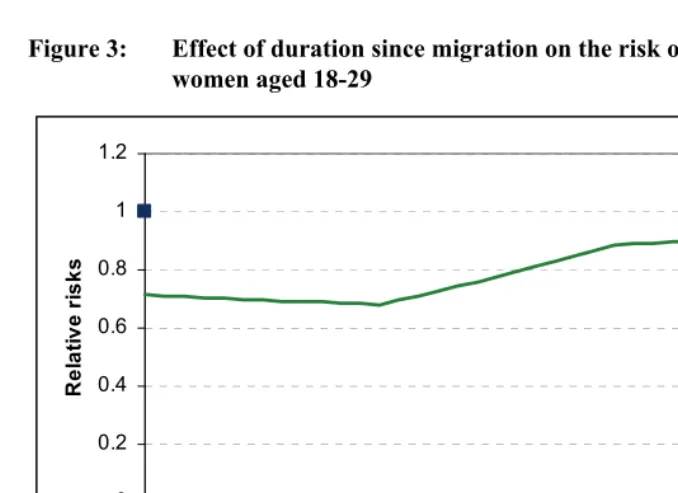
Figure 3: Effect of duration since migration on the risk of first marriage, women aged 18-29
0 0.2 0.4 0.6 0.8 1 1.2
0 4 8 12 16 20 24 28 32 36
months
Rel
a
ti
ve r
isks
non-migrants
Note: The model controls for respondent’s age, ethno-cultural background, education, employment, and pregnancy/age of the first child. Marriage-related migration (i.e., migration that took place in the same month as the marriage) does not contribute to this spline.
Table 3: Relative risks of first marriage, women aged 18-29 Ethno-cultural background
European 1
russified Asian 1.07
non-russified Asian 2.31**
Employment
employed 1 non-employed 1.04
Education
in education 1
out of education
general secondary education 1.59** vocational or higher 2.22**
Note: The model controls for respondent’s age, pregnancy/age of the first child and duration since migration. Significance level: **p≤.01.
The ‘ethno-cultural background’ covariate again proves to be a strong determinant of family-formation strategies. The results indicate that non-russified Asians are less likely to delay marriage than the other two groups.14 Table 4 provides further insights into ethno-cultural differences in marital behavior. It suggests that non-russified Asians have the highest marriage risks, regardless of parity. The difference between Europeans and russified Asians is noticeable only with respect to first pregnancy, which is a crucial cultural test that stacks the three ethno-cultural groups in an order that reflects the strength of the pressure to marry before the birth of a child. This pressure appears to be strongest for non-russified Asians and weakest for Europeans, while russified Asians hold an intermediate position. In the case of the ‘one child’ category, the ethno-cultural differences are much less pronounced, as this is already a self-selected group, composed of those who resisted the pressure to get married during the first pregnancy, failed to comply with the corresponding cultural norm, or, possibly, converted a union initially formed only by a religious ceremony into an official marriage. In any case, this group constitutes only 2.6% of the sample.
14 We interpret the relatively low marriage risks as an indication of delayed family formation, and not as a
Table 4: Relative risks of first marriage, women aged 18-29: Risks by ethno-cultural background and pregnancy/parity status (interaction effects)
Ethno-cultural background Pregnancy/parity status
European russified Asian non-russified Asian no children/not pregnant 1 0.99 2.21**
pregnant (first pregnancy) 5.67** 12.92** 16.35**
has a child 1.11 0.67 2.70**
Note: The model controls for respondent’s age, education, employment, and migration experience. Significance level: **p≤.01.
5.4 First migration
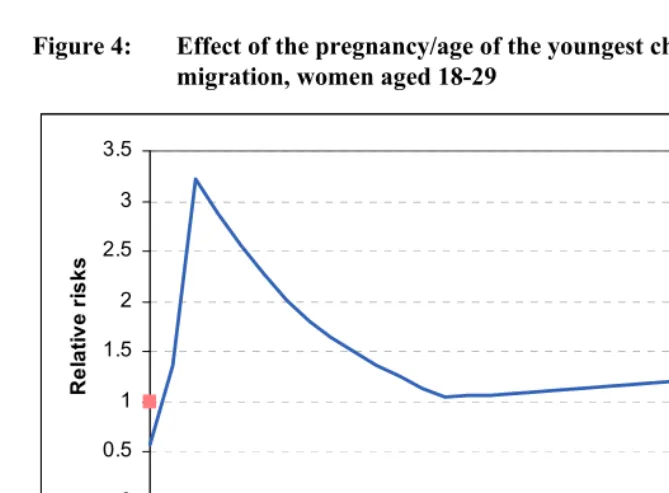
Figure 4 depicts the duration effect of pregnancy/age of the youngest child on the propensity to migrate. Migration risks dramatically increase in the early months of a pregnancy, reach a maximum value of 3.22 at five months prior to the birth, and then drop. Having a newborn baby, not surprisingly, entails relatively low migration risks. Our data do not allow for estimating a separate spline for married women, as very few of them migrated while pregnant. Therefore, to test the hypothesis that the increased mobility of pregnant women is due to marriage-related migration, and thus should be more common among unmarried women, we also fit a model with an interaction between ‘pregnancy/parity status’ and ‘marital status’ covariates. This interaction (shown in Table 5) confirms that the increase in migration risks during pregnancy is entirely attributable to unmarried women, while married women expecting a child are less likely to migrate than childless women.
Figure 4: Effect of the pregnancy/age of the youngest child on the risk of first migration, women aged 18-29
0 0.5 1 1.5 2 2.5 3 3.5
-7 -5 -3 -1 1 3 5 7 9 11 13 15 17 19 21 23
months
R
el
a
ti
ve
r
isk
s
no children/not pregnant
Note: The model controls for respondent’s age, ethno-cultural background, education, marital status, and employment. The X-axis reflects time before (negative X-values indicate a pregnancy) and after (positive X-values indicate the age of a child)
childbirth; month 0 is the month of childbirth.
Table 5: Relative risks of first migration, women aged 18-29: Risks by parity
and marital status (interaction effects) Marital status Pregnancy/parity status
unmarried married no children/not pregnant 1 0.87
pregnant 3.22** 0.74
has [a] child(ren) 1.30 0.52*
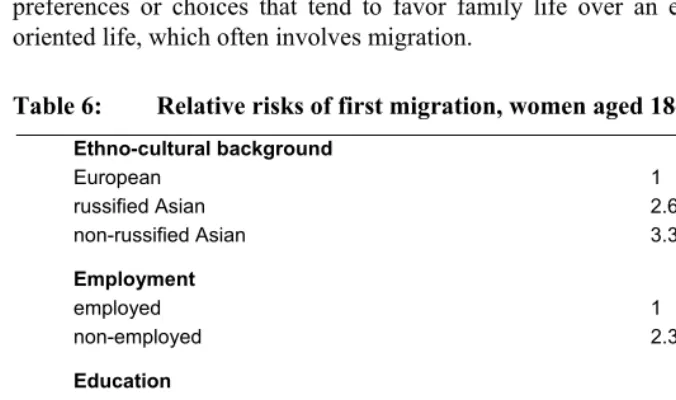
The results presented in Table 6 also point to lower migration risks among married women than among unmarried women. This finding indicates a lower propensity toward couple migration versus migration by individuals. It may also reflect gender differences in migration behavior: We would anticipate that, for married individuals, temporary migration is more likely to be driven by the opportunities of male partners. Bearing in mind the specificity of the data (i.e., the young age of the respondents and the fact that most migratory moves were reported as motivated by studies), we propose another possible explanation: Marriage itself might be a manifestation of particular preferences or choices that tend to favor family life over an education/employment-oriented life, which often involves migration.
Table 6: Relative risks of first migration, women aged 18-29
Ethno-cultural background
European 1
russified Asian 2.64**
non-russified Asian 3.32**
Employment
employed 1 non-employed 2.39**
Education
in education 1
out of education
general secondary education 2.22** vocational or higher 2.74**
Marital status
unmarried 1 married 0.49**
Note: The model controls for respondent’s age and pregnancy/age of the youngest child. Significance level: **p≤.01.
6.
Conclusion
risks associated with marriage or high marriage risks of pregnant women) seem to be universal, as they correspond to evidence from a large number of studies.
However, other findings, such as high first-birth propensities among recent migrants, contribute to the ongoing debate in the literature. In an attempt to move beyond the simplistic analysis of the migrant vs. non-migrant fertility gap resulting from the total effect of migration, we decomposed this effect in our study. We estimated several duration splines picking up the effects of migration. The technique employed here allowed us to account not only for migrants’ marital status, but also for the sequence of migration and marriage events in their lives. Thus we differentiated between the effects of migration pertaining to married and unmarried migrants. Moreover, we also accounted for the effect of marriage-related migration (i.e.,
migration that took place in the same month as the marital union formation). Notably, none of the splines corresponding to these effects revealed that migration exerts a disruptive effect on childbearing. It is also important to emphasize that in the case of marriage-related migration the move does not interfere with the connection between marriage and the onset of childbearing: Movers for marriage have higher first-birth propensities than married non-migrants at any duration since marriage.
Another interesting finding of our analysis is the high propensity toward internal migration among unmarried pregnant women. A result also pointing to the tendency to migrate while pregnant is the relatively high first-birth risk shortly after moving. Evidently, migration is an integral part of the family-formation process, and, just like marriage itself, it is sped up by an out-of-wedlock pregnancy. Unfortunately, our data are not sufficiently detailed to interweave information on union types other than formal marriage into the complex nexus between family formation and migration. Corresponding analyses will become possible as new, more comprehensive data are collected.
7. Acknowledgments
References
Agadjanian, V. and Qian, Z. (1997). Ethnocultural identity and induced abortion in Kazakstan. Studies in Family Planning 28(4): 317−329. doi:10.2307/2137862. Agadjanian, V. (1999). Post-Soviet demographic paradoxes: Ethnic differences in
marriage and fertility in Kazakhstan. Sociological Forum 14(3): 425-446.
doi:10.1023/A:1021447602704.
Agadjanian, V., Kumskov, G., and Nedoluzhko, L. (2006). Marriage, fertility, and migration in Kyrgyzstan: Study overview and main findings. Bishkek: UNFPA in Kyrgyzstan (in Russian).
Andersson, G. (2004). Childbearing after migration: Fertility patterns of foreign-born women in Sweden. International Migration Review 38(2): 747-774.
Andersson, G. and Scott, K. (2005). Labour-market status and first-time parenthood: The experience of immigrant women in Sweden, 1981-97. Population Studies
59(1): 21-38. doi:10.1080/0032472052000332683.
Baizan, P., Aassve, A., and Billari, F. (2004). The interrelations between cohabitation, marriage and first birth in Germany and Sweden. Population and Environment
25(6): 531-561.doi:10.1023/B:POEN.0000039064.65655.3b.
Bernhardt, E. (1993). Fertility and employment. European Sociological Review 9(1): 25−42.
Blossfeld, H-P. and Rohwer, G. (1995). Techniques of event history modeling: New approaches to causal analysis. Mahwah, NJ: Lawrence Erlbaum Associates. Brien, M.J., Lillard, L.A., and Waite, L.J. (1999). Interrelated family-building
behaviors: Cohabitation, marriage, and nonmarital conception. Demography
36(4): 535-551. doi:10.2307/2648089.
Chattopadhyay, A., White, M., and Debpuur, C. (2006). Migrant fertility in Ghana: Selection versus adaptation and disruption as causal mechanisms. Population Studies 60(2): 189-203. doi:10.1080/00324720600646287.
Denisenko, M. (2004). Fertility in Kyrgyzstan. In: Kudabaev, Z., Guillot, M., and Denisenko, M. (eds.). Population of Kyrgyzstan. Bishkek: National Statistical Committee of the Kyrgyz Republic: 206-241 (in Russian).
Edwards, M. (2002). Education and occupations: Reexamining the conventional wisdom about later first births among American mothers. Sociological Forum
Falkingham, J. (2005). The end of the rollercoaster? Growth, inequality and poverty in Central Asia and the Caucasus. Social Policy and Administration 39(3): 340-360. doi:10.1111/j.1467-9515.2005.00444.x.
Goldstein, S. and Goldstein, A. (1984). Inter-relations between migration and fertility – their significance for urbanization in Malaysia. Habitat International 8(1): 93-103. doi:10.1016/0197-3975(84)90030-4.
Guzzo, K.B. (2006). The relationship between life course events and union formation.
Social Science Research 35(2): 384–408. doi:10.1016/j.ssresearch.2005.06.002. Hervitz, H. (1985). Selectivity, adaptation or disruption? A comparison of alternative
hypotheses on the effects of migration on fertility: The case of Brazil.
International Migration Review 19(2): 293-317. doi:10.2307/2545774.
Hoem, J.M. (1986). The impact of education on modern family-union initiation.
European Journal of Population 2(2): 113-133. doi:10.1007/BF01796886. Hoem, J.M. (1987). Statistical analysis of a multiplicative model and its application to
the standardization of vital-rates: A review. International Statistical Review
55(2): 119-152. doi:10.2307/1403190.
Hoem, J.M. (1993). Classical demographic models of analysis and modern event-history techniques. Stockholm: Stockholm University, Demography Unit. (Stockholm Research Reports in Demography; 75).
Hoem, J.M. and Nedoluzhko, L. (2008). Marriage formation as a process intermediary between migration and childbearing. Demographic Research 18(21): 611-628.
doi:10.4054/DemRes.2008.18.21.
Huskey, E. (1997). Kyrgyzstan: A case study for conflict potential. The Soviet and Post-Soviet Review 24(3): 229-249.
Kahn, J. (1988). Immigrant selectivity and fertility adaptation in the United States.
Social Forces 67(1): 108-128. doi:10.2307/2579102.
Kantorová, V. (2004). Education and entry into motherhood: The Czech Republic during state socialism and the transition period (1970-1997). Demographic Research SC 3(10): 246-273. doi:10.4054/DemRes.2004.S3.10.
Kulu, H. (2005). Migration and fertility: Competing hypotheses re-examined. European Journal of Population 21(1): 51-87. doi:10.1007/s10680-005-3581-8.
Kulu, H. (2006). Fertility of internal migrants: comparison between Austria and Poland.
Kulu, H. and Vikat, A. (2007). Fertility differences by housing type: the effect of housing conditions or of selective moves? Demographic Research 17(26): 775-802. doi:10.4054/DemRes.2007.17.26.
Kulu, H. (2008). Fertility and spatial mobility in the life-course: Evidence from Austria.
Environment and Planning A 40(3): 632-652. doi:10.1068/a3914.
Kumskov, G. (2002). Patterns and peculiarities of contemporary migration processes in Kyrgyzstan. Bishkek: Kyrgyz-Russian Slavic University (in Russian).
Kumskova, N., Kumskov, G., and Ploskich, E. (2004). Contemporary problems of internal migration in Kyrgyzstan. Bishkek: UNFPA in Kyrgyzstan (in Russian). Kumskova, N., Kumskov, G., Ploskich, E., Kuznetsova, L., and Torgasheva, L. (2007).
Demographic development of the Kyrgyz Republic. Bishkek: UNFPA in Kyrgyzstan (in Russian).
Le Goff, J.M. (2002). Cohabiting unions in France and West Germany: Transitions to first birth and first marriage. Demographic Research 7(18): 593-624.
doi:10.4054/DemRes.2002.7.18.
Lillard, L.A. (1993). Simultaneous-equations for hazards: Marriage duration and fertility timing. Journal of Econometrics 56(1-2): 189-217.
doi:10.1016/0304-4076(93)90106-F.
Lillard, L.A. and Panis, C.W.A. (2003). aML multilevel multiprocess statistical software, Version 2.0. Los Angeles: EconWare.
Lindgren, U. (2003). Who is the counter-urban mover? Evidence from the Swedish urban system. International Journal of Population Geography 9(5): 399-418.
doi:10.1002/ijpg.296.
Lindstrom, D. and Giorguli Saucedo, S. (2002). The short- and long-term effects of US migration experience on Mexican women's fertility. Social Forces 80(4): 1341-1368. doi:10.1353/sof.2002.0030.
Lindstrom, D. and Giorguli Saucedo, S. (2007). The interrelationship of fertility, family maintenance and Mexico-U.S. migration. Demographic Research 17(28): 821-858. doi:10.4054/DemRes.2007.17.28.
McLaughlin, D.K. and Lichter, D.T. (1997). Poverty and the marital behavior of young women. Journal of Marriage and the Family 59(3): 582-594.
Milewski, N. (2007). First child of immigrant workers and their descendants in West Germany: Interrelation of events, disruption, or adaptation? Demographic Research 17(29): 859−896. doi:10.4054/DemRes.2007.17.29.
Nedoluzhko, L. and Andersson, G. (2007). Migration and first-time parenthood: Evidence from Kyrgyzstan. Demographic Research 17(25): 741-774.
doi:10.4054/DemRes.2007.17.25.
NSC of the Kyrgyz Republic. (2002). Migration of the population of Kyrgyzstan. Bishkek: National Statistical Committee of the Kyrgyz Republic (in Russian). NSC of the Kyrgyz Republic. (2007). Men and women of the Kyrgyz Republic.
Bishkek: National Statistical Committee of the Kyrgyz Republic (in Russian). NSC of the Kyrgyz Republic. (2008). Demographic yearbook 2003-2007. Bishkek:
National Statistical Committee of the Kyrgyz Republic (in Russian).
Ruget, V. and Usmanalieva, B. (2008). Citizenship, migration and loyalty towards the state: A case study of the Kyrgyzstani migrants working in Russia and
Kazakhstan. Central Asian Survey 27(2): 129-141.
doi:10.1080/02634930802355055.
Santow, G. and Bracher, M. (1994). Change and continuity in the formation of 1st marital unions in Australia. Population Studies 48(3): 475-496.
doi:10.1080/0032472031000147986.
Sarygulov, B. (2001). Current demographic situation in Kyrgyzstan and alternatives of its development. Bishkek: UNFPA in Kyrgyzstan (in Russian).
Schmidt, M. and Sagynbekova, L. (2008). Migration past and present: changing patterns in Kyrgyzstan. Central Asian Survey 27(2): 111-127.
doi:10.1080/02634930802355030.
Shuler, M. and Kudabaev, Z. (2004). Migration in Kyrgyzstan. In: Kudabaev, Z., Guillot, M., and Denisenko, M. (ed.). Population of Kyrgyzstan. Bishkek: National Statistical Committee of the Kyrgyz Republic: 281-303 (in Russian). Singley, S. and Landale, N. (1998). Incorporating origin and process in
migration-fertility frameworks: The case of Puerto Rican women. Social Forces 76(4): 1437-1464. doi:10.2307/3005841.
Thornton, A., Axinn, W.G., and Teachman, J.D. (1995). The influence of school enrollment and accumulation on cohabitation and marriage in early adulthood.
American Sociological Review 60(5): 762-774. doi:10.2307/2096321.
Tishkov, V.A. (1994). Russians in Central Asia. In: Kozlov, V. I. and Shervoud, E. A. (ed.). Russians in the near abroad. Moscow: Institute of Ethnology and Anthropology of the Russian Academy of Sciences: 115-134 (in Russian). Yamaguchi, K. (1991). Event history analysis. Newbury Park, California: Sage