ARTHROPOD MANAGEMENT
Evidence That Light Stink Bug Damage Does Not Influence
Open End Yarn Processing Performance
Philip J. Bauer*, David D. McAlister, III, and Mitchell E. Roof
P. J. Bauer, USDA-ARS, 2611 West Lucas Street, Florence, SC 29501; D. D. McAlister, III, (formerly USDA-ARS, Cotton Quality Research Station, P.O. Box 792, Clemson, SC 29633) Uster Technologies, Inc., 456 Troy Circle, Knoxville, TN 37919; M. E. Roof, Clemson University, 2200 Pocket Road, Florence, SC 29501
*Corresponding author: [email protected]
ABSTRACT
Stink bugs [Acrosternum hilare (Say), Nezara
viridula (L.), and Euschistus servus (Say)] have
become an important pest of cotton (Gossypium
hirsutum L.) concurrent with the expansion of
acres planted to transgenic cotton cultivars. The objective of this study was to determine the effect of stink bug damage on the textile mill performance of cotton cultivars that represented all combinations of transgenic technology (avail-able in 2002). Six cotton cultivars (Stoneville 474 and its five transgenic siblings; ST 4793R, ST 4691B, ST 4892 BR, ST BXN 47, and ST BXN 49B) were grown with and without insecticide applications for stink bug control in 2002 and 2003. Stink bug damage was assessed in early August and in late August of each season. Cotton yield, fiber properties, and mill performance were measured. Transgenic traits did not substantially affect cotton mill performance. Stink bug dam-aged bolls were always greater for cotton not treated with insecticides than for cotton that was treated. Average damaged bolls ranged from 2 to 12% for the treated cotton and 9 to 21% for the untreated control. Although damage to bolls was greater for the untreated control, average seed cotton yield was not different between the cotton treated for stink bugs (1767 kg ha-1 and 3765 kg ha-1 in 2002 and 2003, respectively) and the un-treated control (1981 kg ha-1 and 3769 kg ha-1 in 2002 and 2003, respectively). Fiber properties and yarn and fabric quality were not improved with insecticide applications to control stink bugs. The data indicate that light stink bug damage does not
result in reduced textile mill performance of the harvested fiber.
S
tink bugs have increased in economic importance in cotton production in the southeastern United States. Their importance rose with the reduction in broad spectrum insecticide applications following boll weevil (Anthonomus grandis Boheman) eradication. Further reductions in pesticide applications came with the introduction and widespread adoption of cotton cultivars containing the Bollgard trait that provides resistance to cotton bollworm [Helicoverpa zea (Boddie)] and tobacco budworm [Heliothis virescens (F.)].Because of the rapid increase in the importance of stink bugs, population thresholds for triggering control measures to limit yield losses have been developed only relatively recently. Recommenda-tions include applying insecticides when one stink bug is found per 1.8 m of row or when 10% to 20% of mid-sized bolls exhibit internal signs of stink bug feeding (Greene et al., 2001; Greene et al., 2005). Reductions in yield occur because stink bugs feed-ing on developfeed-ing bolls decrease seed cotton weight per boll and increase the percentage of locks that are not harvestable by spindle pickers (Barbour et al., 1990), but the extent of yield reduction appears dependant on when infestation occurs during the flowering period (Willrich et al., 2004a). Willrich et al. (2004b) also reported higher incidence of rotted bolls in association with stink bug feeding.
Farmers in southeastern USA have rapidly adopted transgenic technology by planting cotton cultivars with insect resistance (B) and/or herbicide tolerance [glyphosate (R) and bromoxynil (BXN)]. Textile manufacturers have raised concerns about mill performance of the cotton harvested from transgenic cultivars (Jordan et al., 2003). Research indicates transgenic cultivars are not different from conventional cultivars in mill performance (Ethridge and Hequet, 2000; Bauer et al., 2006). The concur-rent rise in importance of the stink bug complex in the Southeast with the adoption of transgenic technology prompted this study to simultaneously investigate these two factors for mill efficiency and yarn and fabric quality. The objective of this study was to determine the effects of stink bug damage on textile mill performance in cotton cultivars rep-resenting all combinations of transgenic technology (available in 2002).
MATERIALS AND METHODS
Experiments were conducted at the Clem-son University Pee Dee Research and Education Center near Florence, SC. Soil type was Norfolk loamy sand (fine-loamy, kaolinitic, thermic Typic Kandiudults) in 2002, and Goldsboro loamy sand (fine-loamy, siliceous, subactive, thermic Aquic Paleudults) in 2003. Treatments were stink bug control (with or without) and cotton genotype. Cy-fluthrin (Baythroid 2EC; Bayer CropScience, Re-search Triangle Park, NC) and dicrotophos (Bidrin 8; AMVAC, Los Angeles, CA) were used to control stink bugs in the assigned plots. Application dates were 16, 23, and 29 July (cyfluthrin at 0.046 kg a.i. ha-1), and 8 and 16 August (dicrotophos at 0.56 kg
a.i. ha-1) in 2002, and 28 July and 4, 12, 18, 22, and
29 August (dicrotophos at 0.56 kg a.i. ha-1) in 2003.
On those dates, all plots received an application of spinosad at 0.088 kg a.i. ha-1 (Tracer Naturalyte;
Dow Agrosciences; Indianapolis, IN) for heliothine control. The six genotypes were the conventional cultivar Stoneville 474 (ST; Stoneville Pedigreeed Seed Co.; Memphis, TN) and its five transgenic siblings; ST 4793R, ST 4691B, ST 4892BR, ST BXN 47, and ST BXN 49B. Experimental design was randomized complete block and there were four replications. Plot size was 12 rows each 1 m wide and 30 m long. To encourage stink bug infesta-tion, four rows of soybeans (Glycine max L.) were planted between plots.
Cotton was planted following in-row sub-soiling into corn (Zea mays L.) residues at 13 seeds m-1 with
a four-row planter equipped with wavy coulters on 9 May 2002 and 14 May 2003. Aldicarb at 0.84 kg a.i. ha-1 (Temik 15G; Bayer CropScience LP) was
applied in-furrow at planting. In 2002, 56 kg N ha-1
(as NH4NO3) was applied as a side-dress to all plots
on 22 May and an additional application of 45 kg N ha-1 was made on 19 June. In 2003, 117 kg N ha-1
was applied as a side-dress on 27 May. Weeds were controlled with a combination of herbicides and hand-weeding. A pre-emergence broadcast applica-tion of pendimethalin (Prowl 3.3EC; BASF Corp.; Research Triangle Park, NC), fluometuron (Cotoran 4L; Griffin LLC; Valdosta, GA), and glyphosate (Roundup; Monsanto Co.; St. Louis, MO) was made each year. In both years, a directed-spray applica-tion was made approximately 6 wk after planting consisting of monosodium methanearsonate (Bueno 6; KMG Chemicals; Houston, TX) and prometryn (Caparol 4L; Syngenta Crop Protection; Greens-boro, NC). In addition, broadcast applications of pyrithiobac (Staple LX; E.E. DuPont de Nemours and Co.; Wilmington, DE) (4 June) for broadleaf weed control and fluazifop-p-butyl (Fusilade DX; Syngenta Crop Protection) (6 June) for grass weed control were made in 2002. In 2003, an application of sethoxydim (Poast Plus; BASF Corp.) was made for grass control on 20 June. All herbicides were applied at rates recommended by the label.
Rainfall was supplemented with irrigation us-ing surface drip irrigation equipment. The equip-ment was installed on 16 June in 2002 and 18 June in 2003. Irrigation laterals were placed in middle of every other row. Water (approximately 2.5 cm per application) was applied on 16 d from 17 June through 21 August in 2002 and on 7 d from 8 July through 2 September in 2003. Irrigation was sched-uled based on weekly rainfall. Target total weekly water amounts were 3.8 cm through the second week after first bloom, 6.4 cm from three through the five weeks after first bloom, and 5 cm of water from six through eight weeks after first bloom.
damage to young bolls was estimated approximately 4 and 7 wk after first flower on 5 and 20 August in 2002 and on 7 and 26 August in 2003. Twenty-five, 2.5-cm diameter bolls were collected from each plot and the interior of the carpel walls were inspected for callus growth (warts) and bolls were inspected for stained lint (Bundy et al., 2000).
The effect of stink bug damage on the number of hard-locked bolls and boll weight at harvest were determined in each year for ST 4892BR. On 22 and 29 July in 2002 and 24 and 31 July in 2003, 75 dated tags were placed on white blooms in each plot (eight plots total). When nearly all of the surviving bolls with dated tags within a tagging date were open, approximately 25 entire bolls were randomly collected from each of the eight plots. In 2002, seed cotton weight, total lock number, locks that did not fluff, and callus sites on burs from stink bug damage were determined for each boll. In 2003, the same data were collected plus the number of visible punctures (using a magnifying glass) was counted on each burr.
Cotton was chemically defoliated with thidi-azuron (Dropp 50WP; Bayer CropScience LP), tribu-phos (DEF 6; Bayer CropScience LP), and ethephon (Prep 6L; Bayer CropScience LP) at recommended rates each year. Defoliation dates were 1 October in 2002 and 9 October in 2003. All interior rows of each plot were harvested with a spindle picker on 21 October in 2002 and 22 October in 2003. Seedcotton was ginned on a 20-saw laboratory gin. Ginning was done without lint cleaning, so comparisons for color and trash content are not reported. Low cotton yields occurred in 2002 because an extended rainy period during late August and early September caused a considerable amount of boll rot. To provide enough fiber for textile mill performance analysis, all four replicates of each of the twelve treatment combina-tions (two stink bug control and six genotypes) were combined into one sample for yarn spinning tests. In 2003, only two of the four replicates were evaluated for textile mill performance.
Ginned cotton was tested and processed in the Pilot Spinning Laboratory at the Cotton Quality Re-search Station in Clemson, SC. Cotton processing and data collection were as described by McAlister and Rogers (2005). A sample was also evaluated for HVI fiber properties at the Cotton Classing office in Memphis, TN. Each lot of cotton was mixed thoroughly using three blending hoppers in a Fiber Controls Synchromatic Blending System and fed
to a modern Truetzschler cleaning line consisting of an Axi-Flo cleaner, a GBRA blending hopper, a RN cleaner, a RST cleaner, and a DUSTEX fine dust remover (all Truetzschler; Monschengladbach, Germany). The cotton was then fed by chute into a DK 740 card (Truetzschler) operating at 36 kg h-1
to produce 5.67 g m-1 card sliver. Two processes
of drawing, six and eight doublings, respectively, using Rieter RSB draw frames (Rieter; Witerthur, Switzerland), produced 3.90 gm-1 drawing sliver.
Fiber was tested for maturity ratio, short fiber con-tent, and neps using the Advanced Fiber Information System (AFIS; Uster Technologies; Knoxville, TN) before (raw stock) and after (finish draw) carding and drawing. A Zinser model 660 roving frame (Ebersbach, Germany) was used to produce 590.5 Tex roving for spinning into 21.9 Tex yarn with a 3.75 twist multiplier on a Zinser model 321 spin-ning frame at a spindle speed of 14,500 rpm. Data were collected from various fiber yarn tests, as well as from processing efficiency measurements. Jersey knit fabrics (griege and dyed) were produced from the resultant yarns and evaluated for quality differences.
All data analyzed using the MIXED procedure (Littell et al., 1996) of SAS (SAS Institute; Cary, NC). For yield, stink bug damage, and boll charac-teristics, analysis was done by year as a split-plot model with replicates considered random. For HVI fiber properties and textile mill performance data, the ANOVA was computed using a randomized complete block model with three replicates using the data from 2002 as one replicate and the two replicates from 2003 as the others. Replicates were considered random. Genotype and interaction means were separated by calculating a least significant dif-ference (LSD) when these sources of variation were significant at P≤ 0.05.
RESULTS AND DISCUSSION
Green, Acrosternum hilare (Say), and brown,
in the treated plots (all green). Stink bug numbers increased at the later sampling dates in August of that year, averaging 2.5 bugs per 25 plants for the control plots and 2.4 bugs per 25 plants in the treated plots on 11 August (63% green) and 2.8 bugs per 25 plants for the control plots and 0.8 bugs per 25 plants in the treated plots on 18 August (47% green).
The percentage of bolls damaged by stink bug feeding was greater (P < 0.05) in the untreated plots than in treated plots in early in both years and nearly significantly greater (P = 0.06) in late August of both years (Table 1). In early August of both years and late August of 2002, damage in the untreated plots was at levels where an insecticide application might be warranted (Greene et al., 2001). In early August, damage exceeded the minimum level for treatment in both the treated and untreated plots in 2003, but damage was below threshold levels for both treat-ments in late August of that year. There were no stink bug treatment by genotype interactions for boll damage at any sampling time, and genotypes were different for boll damage only at the early August 2003 sampling date (Table 1). It is unlikely that this difference represents genotypic variation in tolerance for stink bug damage, since it was the only sampling time cultivar differences occurred in this study.
Even though insecticide application reduced stink bug damage during the season, it did not increase seed cotton yield in either year. Average seed cotton yield was not different between the cotton treated for stink bugs (1767 kg ha-1 and 3765 kg ha-1 in 2002 and 2003,
respectively) and the untreated control (1981 kg ha-1
and 3769 kg ha-1 in 2002 and 2003, respectively). The
stink bug treatment by genotype interaction for yield was not significant in either year. All six genotypes had similar yield in 2002 (data not shown). Differences occurred among the genotypes for yield in 2003, but the yield for all genotypes was high, ranging from 3576 kg ha-1 for ST BXN 47 to 3873 kg ha-1 for ST
BXN 49B. Genotype yield was not related to the amount of stink bug damage in early August. Geno-type ST4793R, which had the lowest damage (Table 1), was not different from ST BXN 47 in yield. Both of these genotypes had lower yield than ST 474, ST 4892BR, and ST BXN 49B.
Stink bugs pierce the wall of developing cotton bolls and feed on or near the growing seeds. This dam-age causes a decrease in the proportion of harvestable locks per boll (Barbour et al., 1990). The data collected from this study in 2003 on the characteristics of indi-vidual bolls of the ST 4892BR support this concept. In 2002, only about 9% of the harvested bolls (less than 20 total) had damage in each flowering date. With this low number of damaged bolls, there was no relationship between the amount of damage and boll characteristics. In 2003, damage was much higher in both the first (50% of total bolls) and second (34% of total bolls) flowering dates.
The relationship between the number of vis-ible damage marks on the burrs of the bolls and the number of hard locks per boll for both flowering dates in 2003 is shown in Figure 1. For the 24 July flowering date, hard locks per boll increased (over bolls with no punctures) with two or more visible punctures. At that flowering date, there were 10 bolls with three total locks, 140 bolls with four locks, and 48 bolls with five locks. For bolls that flowered on 31 July, the number of hard locks per boll did not increase until more than four visible punctures per boll were found (Fig. 1). At that flowering date, there were two bolls with three locks, 125 bolls with four locks, and 72 bolls with 5 locks. It is not apparent why the two flowering dates had different responses for hard-locked bolls, especially since boll weight decreases with number of punctures were similar up to five punctures per boll (Fig. 2).
Table 1. Effect of insecticide application and cotton genotype on the percentage damaged bolls from stink bug feeding
Variable
Damaged bolls (%)
2002 2003
5 August 20 August 7 August 26 August Insecticide control
Yes 6 2 12 4
No 16 13 21 9
Prob > F 0.02 0.06 0.04 0.06
Genotype
ST 474 12 7 20 5
ST 4793R 12 6 9 7
ST 4691B 4 11 12 4
ST 4892BR 13 6 23 4
ST BXN 47 12 7 20 11
ST BXN 49B 12 9 16 7
Prob > F 0.23 0.48 0.03 0.14
LSD (P = 0.05) z -- -- 9.0
--z LSD values were not calculated when source of variation
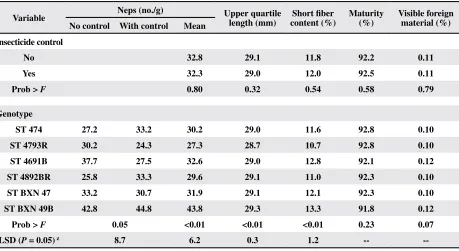
There were no differences between stink bug treat-ments or among cultivars for HVI-determined fiber properties (data not shown). This agrees with the find-ings of Greene et al. (2001), who found no difference in HVI-determined fiber properties for different stink bug control treatments. Stink bug treatment had no effect on visible or invisible waste during carding and drawing (measured with the Shirley Waste Analyzer), nor any of the AFIS fiber properties of the raw cotton
(upper quartile length, short fiber content, maturity, neps, or visible foreign matter). Similarly, stink bug treatment had no effect on upper quartile length, short fiber content, maturity, or visible foreign matter of the finisher drawer cotton (Table 2). Neps in the finisher drawer sliver for ST4691B were lower in plots treated for stink bugs than in the untreated control, but stink bug treatment had no effect on neps for the other five genotypes (Table 2).
0 1 2 3 4 5 6 7 8 9
Visible punctures (per boll)
0 1 2 3 4 5
H
a
rd
lo
c
k
s
(p
e
r
b
o
ll) Anthesis date: July 24
Anthesis date: July 31
Table 2. Effects of cotton genotype and insecticide control for stink bugs on AFIS fiber properties of finisher draw cotton
Variable Neps (no./g) Upper quartile length (mm) content (%)Short fiber Maturity (%) Visible foreign material (%) No control With control Mean
Insecticide control
No 32.8 29.1 11.8 92.2 0.11
Yes 32.3 29.0 12.0 92.5 0.11
Prob > F 0.80 0.32 0.54 0.58 0.79
Genotype
ST 474 27.2 33.2 30.2 29.0 11.6 92.8 0.10
ST 4793R 30.2 24.3 27.3 28.7 10.7 92.8 0.10
ST 4691B 37.7 27.5 32.6 29.0 12.8 92.1 0.12
ST 4892BR 25.8 33.3 29.6 29.1 11.0 92.3 0.10
ST BXN 47 33.2 30.7 31.9 29.1 12.1 92.3 0.10
ST BXN 49B 42.8 44.8 43.8 29.3 13.3 91.8 0.12
Prob > F 0.05 <0.01 <0.01 <0.01 0.23 0.07
LSD (P = 0.05) z 8.7 6.2 0.3 1.2 --
--z LSD values were not calculated when the source of variation was not significant (P ≤ 0.05).
0 1 2 3 4 5 6 7 8 9
Visible punctures (per boll)
0 1 2 3 4 5 6
B
ol
lw
ei
gh
t(
g)
Anthesis date: July 24
Anthesis date: July 31
Figure 1. Effect of stink bug puncture number on hard locks per boll for bolls at two anthesis dates in 2003. The cultivar was Stoneville 4892BR. Vertical lines indicate standard de-viation of means. Pearson correlation coefficients between bug punctures and hard locks were r = 0.71 (P < 0.01) for the 24 July anthesis date and r = 0.56 (P < 0.01) for the 31 July anthesis date.
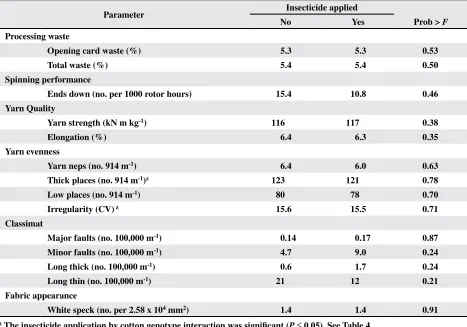
Averaged over all genotypes, stink bug treatment was not different for any measure of yarn process-ing performance, yarn properties, or fabric quality (Table 3). Mean data were numerically very similar for almost all variables. Stink bug treatment did af-fect yarn evenness parameters for three genotypes, as the stink bug treatment by genotype interaction was significant for thick places in the yarn and yarn
irregularity. Two genotypes exhibited opposite re-sponses for thick places. Genotype ST 4793R had more thick places in the untreated control than in the treated, but ST BXN 47B had more thick places in the treated than the untreated control (Table 4). For yarn irregularity, both ST 4793R and ST 474 had lower yarn irregularity with insecticide control for stink bug than without (Table 4).
Table 3. Effect of insecticide application for stink bug control on processing waste, yarn spinning performance, yarn quality, and fabric appearance
Parameter Insecticide applied
No Yes Prob > F
Processing waste
Opening card waste (%) 5.3 5.3 0.53
Total waste (%) 5.4 5.4 0.50
Spinning performance
Ends down (no. per 1000 rotor hours) 15.4 10.8 0.46
Yarn Quality
Yarn strength (kN m kg-1) 116 117 0.38
Elongation (%) 6.4 6.3 0.35
Yarn evenness
Yarn neps (no. 914 m-1) 6.4 6.0 0.63
Thick places (no. 914 m-1)z 123 121 0.78
Low places (no. 914 m-1) 80 78 0.70
Irregularity (CV) z 15.6 15.5 0.71
Classimat
Major faults (no. 100,000 m-1) 0.14 0.17 0.87
Minor faults (no. 100,000 m-1) 4.7 9.0 0.24
Long thick (no. 100,000 m-1) 0.6 1.7 0.24
Long thin (no. 100,000 m-1) 21 12 0.21
Fabric appearance
White speck (no. per 2.58 x 104 mm2) 1.4 1.4 0.91
z The insecticide application by cotton genotype interaction was significant (P ≤ 0.05). See Table 4.
Table 4. Effect of insecticide application for stink bug control and cotton genotype on yarn evenness measures of thick places, low places, and irregularity
Thick places (no./914m) Low places (no./914m) Irregularity (no./914m)
Genotype Without control controlWith Mean Without control controlWith Mean Without control controlWith Mean
474 134 117 126 91 77 84 15.8 15.5 15.6
4793 R 159 124 141 97 87 92 16.0 15.6 15.8
4691 B 110 118 114 67 72 70 15.4 15.5 15.4
4892 BR 118 116 117 82 82 82 15.6 15.5 15.5
BXN 47 110 120 114 75 79 77 15.4 15.6 15.5
BXN 47 B 107 130 118 69 74 71 15.4 15.6 15.5
Prob > F <0.01 <0.01 0.18 <0.01 <0.01 <0.01
LSD(P = 0.05) z 22 14 -- 9 0.3 0.2
Yarn evenness parameters were the only yarn and fabric quality measures that were different among genotypes. For thick places, low places, and irregularity, ST 4793R had higher values than the other genotypes except for ST 474 (Table 4). It is interesting to note that for thick places and for ir-regularity, the two parameters for which the stink bug treatment by genotype interaction was significant, there were differences among the genotypes only in the untreated control, while genotypes had similar means when treated for stink bugs.
In summary, there was no evidence that light stink bug damage causes a reduction in cotton textile mill performance. Although stink bug damage in this study was not high enough to reduce seed cotton yield, it was greater when insecticides applied to control stink bugs were not used. It is likely that many bolls damaged by stink bugs have locks that do not fluff, so they do not get harvested by spindle pickers (Barbour et al., 1990; Fig. 1). McAlister and Rog-ers (2005) reported higher quality fiber for spindle picker-harvested than for stripper-harvested cotton grown in ultra-narrow row widths (cotton grown in 19-cm rows). A stripper harvester would be able to collect hard lock cotton. It would be interesting to know how much of the reduction in quality might be due to stink bugs. Although differences among genotypes did occur for some traits in this study, the findings support previous research in that transgenic traits do not reduce mill performance (Ethridge and Hequet, 2000; Bauer et al., 2006).
ACKNOWLEDGEMENT
We thank the South Carolina Cotton Board and Cotton Incorporated for partial support of this study and Stoneville Pedigreed Seed Company for the gift of seed.
DISCLAIMER
Mention of trade names or commercial products in this publication is solely for the purpose of provid-ing specific information and does not imply recom-mendation or endorsement by the U.S. Department of Agriculture.
REFERENCES
Barbour, K.S., J.R. Bradley, Jr., and J.S. Bacheler. 1990. Re-duction in yield and quality of cotton damaged by green stink bug (Hemiptera: Pentatomidae). J. Econ. Entomol. 83:842-845.
Bauer, P.J., D.D. McAlister III, and J.R. Frederick. 2006. A comparison of bollgard/glyphosate-tolerant cotton cultivars to their conventional parents for open end yarn processing performance. J. Cotton Sci. 10:168-179 [On-line]. Available at http://www.cotton.org/journal/2006-10/3/168.cfm
Bundy, C.S., R.M. McPherson, and G.A. Herzog. 2000. An examination of the external and internal signs of cotton boll damage by stink bugs (Heteroptera: Pentatomidae). J. Entomol. Sci. 35:402-410.
Ethridge, M.D. and E.F. Hequet. 2000. Fiber properties and textile performance of transgenic cotton versus parent varieties. p. 488-494. In Proc. Beltwide Cotton Conf., 4-8 Jan. 2000, San Antonio, TX. Natl. Cotton Counc. Am., Memphis, TN.
Greene, J.K., C. Capps, G. Lorenz, G. Studebaker, J. Smith, R. Luttrell, S. Kelly, and W. Kirkpatrick. 2005. Manage-ment considerations for stink bugs – 2004. p. 1527-1538. In Proc. Beltwide Cotton Conf., 4-7 Jan. 2005, New Orleans, LA. Natl. Cotton Counc. Am., Memphis, TN. Greene, J.K., S.G. Turnipseed, M.J. Sullivan, and O.L. May.
2001. Treatment thresholds for stink bugs (Hemiptera: Pentatomidae) in cotton. J. Econ Entomol. 94:403-409. Jordan, A.G., P.J. Wakelyn, and O.L. May. 2003. Transgenic
cotton and fiber quality. Part 1. Effect of transgenic technology. In Proc. Engineered Fiber System Conf., 16th, Greenville, SC. 9-11 June 2003. Cotton Inc., Cary, NC. Available online at www.cottoninc.com/ 2003ConferencePresentations/TransgenicCotton/Trans-genicCotton.pdf
Littell, R.C., G.A. Milliken, W.W. Stroup, and R.D. Wofinger. 1996. SAS system for mixed models. SAS Institute, Inc., Cary, NC.
McAlister, D.D. III, and C.D. Rogers. 2005. The effect of har-vesting procedures on fiber and yarn quality of ultra-nar-row-row cotton. J. Cotton Sci. 9:15-23 [Online]. Available at http://www.cotton.org/journal/2005-09/1/15.cfm Roberts, P., C. Bednarz, and J. Greene. 2005. Impact of boll
feeding bugs on lint yield and fiber quality. p. 1718-1724. In Proc. Beltwide Cotton Conf., 4-7 Jan. 2005, New Orleans, LA. Natl. Cotton Counc. Am., Memphis, TN. Toscano, N.C. and V.M. Stern. 1976. Cotton yield and quality
loss caused by various levels of stink bug infestation. J. Econ Entomol. 69:53-56.
Willrich, M.M., B.R. Leonard, R.H. Gable, and L.R. Lamotte. 2004a. Boll injury and yield losses in cotton associated with brown stink bug (Heteroptera: Pentatomidae) during flowering. J. Econ. Entomol. 97:1928-1934.