Demographic Research a free, expedited, online journal of peer-reviewed research and commentary
in the population sciences published by the Max Planck Institute for Demographic Research Konrad-Zuse Str. 1, D-18057 Rostock · GERMANY www.demographic-research.org
DEMOGRAPHIC RESEARCH
VOLUME 13, ARTICLE 8, PAGES 189-200
PUBLISHED 04 NOVEMBER 2005
http://www.demographic-research.org/Volumes/Vol13/8/ DOI: 10.4054/DemRes.2005.13.8
Research Article
Tempo effect on age-specific death rates
Shiro Horiuchi
1 Introduction 190 2 Intuitive visual explanation 190 3 Mathematical presentation 194
4 Discussion 196
5 Acknowledgments 197
References 198
Demographic Research: Volume 13, Article 8 a research article
Tempo effect on age-specific death rates
Shiro Horiuchi 1
Abstract
It is widely known that shifts of cohort fertility schedule can produce misleading trends in period TFR. This note shows that such a “tempo bias” can occur in age-specific mortality as well: if the age distribution of cohort deaths shifts toward older (younger) ages, the period age-specific death rate is biased downward (upward).
1. Introduction
Relationships between “quantum” and “tempo” of demographic behavior are crucial for understanding population dynamics, in particular, discrepancies between demographic profiles of periods and cohorts. In this note, tempo measures are defined as indicators of the location and shape of the age curve of the given demographic behavior. Thus the first and higher moments of the age curve are tempo measures. Quantum measures are based on the area under the age curve, either over the entire life span or for a finite age range. For example, the number of deaths is a function of age, the mean and variance of age at death are tempo measures of the age curve, and the total number of deaths and the crude death rate are quantum measures.
Changes in tempo and quantum of demographic behavior among cohorts and over periods can produce trends that are misleading, apparently inconsistent, or difficult to interpret. Such trends may be considered biased or distorted, even though the concept of the true value is not always clear. It is widely known that shifts of cohort fertility schedule can produce misleading trends in period TFR (Ryder 1956).
Bongaarts and Feeney (2002, 2003) argue that tempo biases occur in mortality as well. Using an artificial example, Feeney (2003, Figure 4) has demonstrated that cohort changes in the death distribution within an age interval can distort the period death rate for the age interval. The example is essentially a straightforward conversion of their previous fertility example (Bongaarts and Feeney 1998, Figure 2) from birth to death. It has been developed for a special case that all deaths occur only at one point in the age range and the point shifts linearly among cohorts.
The purpose of this note is to show that tempo effects can operate in mortality, using a more general assumption about the shape and shift of death distribution than Feeney’s hypothetical example. Sections 2 and 3 give a mathematical proof that if the age distribution of cohort deaths within an age interval shifts toward older (younger) ages, the period number of deaths in the age interval and, in turn, the age-specific death rate are biased downward (upward). Section 2 discusses main points of the proof in an intuitive and visually oriented way and Section 3 presents the inference in a formal manner. In addition, two hypothetical illustrations of mortality tempo effect by Bongaarts and Feeney are examined in Appendix, with focus on their implications for age-specific survival ratios.
2. Intuitive visual explanation
Demographic Research: Volume 13, Article 8
age interval between x and x+1 over the time period from t-1 to t+2. Time-age coordinates of six important points in Diagram 1 are as follows: A(t,x+1), B(t+1,x+1), C(t+2,x+1), D(t-1,x), E(t,x) and F(t+1,x). We compare the number of deaths in the square ABFE (the estimation period), that in the parallelogram ABED (the earlier cohort) and that in BCFE (the later cohort). If both the number and the distribution of deaths in the age interval are identical for the two cohorts and age-specific deaths are evenly distributed over time within each cohort, the square ABFE also has the same number of deaths as each parallelogram has.
Diagram 1: Lexis Diagram for one period (ABFE) and two cohorts (ABED and BCFE)
x x+1
t t-1
B
t+1 time
age
A B C
E F
D
t+2 x+y1
x+y2
than that for either one of the two cohorts that pass through the age interval during the period.
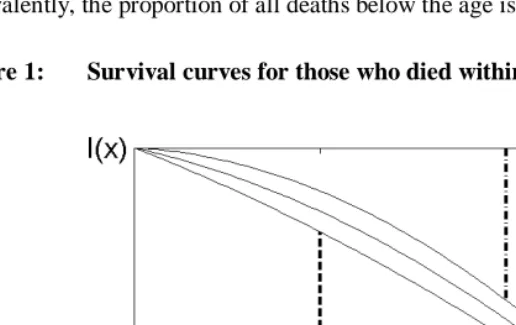
The second main point of the proof is the definition of “shift of age distribution of deaths toward older ages (or more briefly, aging of death distribution) within a given age range.” This issue is essential when the continuous cohort (instead of two discrete cohorts) is considered. There are possibly at least several different definitions of the concept, including those based on central tendency measures (e.g., rise in the mean age at death). In this note, the shift is defined as an overall rise of survival curve, as illustrated by the three curves in Figure 1. If the age distribution of deaths in population A is older than that in population B, then for any age (excluding the both ends of the age range), the proportion of all deaths above the age is greater in A than in B, and equivalently, the proportion of all deaths below the age is smaller in A than in B.
Figure 1: Survival curves for those who died within the one-year age interval
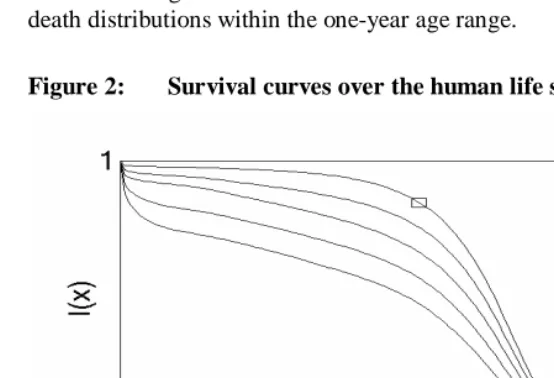
This may seem to be a strong condition, because the inequality has to hold at any age. However, to my knowledge, in any of widely used model life table systems, survival curves within the system do not cross over with each other, as illustrated in Figure 2. This means that in the model life system, the age distribution of deaths over the entire life span shifts toward older ages in the manner defined above.
Figure 1 shows survival curves for three cohorts over the one-year age range from
x to x+1. It can be viewed as a part (for example, the small rectangle on the highest
Demographic Research: Volume 13, Article 8
1 are for only those who died in the age interval, excluding all those who died outside the interval. It is assumed that all of the three cohorts have the same number of survivors at age x and the same number of deaths between x and x+1, but different death distributions within the one-year age range.
Figure 2: Survival curves over the human life span
Now, for further discussion, the definition of “cohort” needs to be changed from discrete (the two parallelograms in Diagram 1) to continuous (infinitely many 45-degree diagonal lines in the parallelogram ACFD). Let the cohort aged x at t (line EB) be called the mid-cohort, which splits the rest into earlier cohorts and later cohorts. Suppose that the number of deaths2 in the age interval is same for all cohorts, but the age distribution of deaths shifts toward older ages as defined above. Then the three survival curves in Figure 1, from high to low, can be considered to represent mortality experiences of a later cohort, the mid-cohort, and an earlier cohort in Diagram 1. Obviously, for any age x+y in the age range (y is between 0 and 1), the number of deaths above age x+y (corresponding to l(x+y)-l(x+1), the dashed line in Figure 1) in an earlier cohort is lower than that in the mid-cohort, and the number of deaths below age
x+y (corresponding to l(x)-l(x+y), the dash-dot line in Figure 1) in an later cohort is
lower than that in the mid-cohort.
Diagram 1 indicates, however, that for an earlier cohort, deaths above a certain age occur during the period from t to t+1 (e.g., on the dashed line in Diagram 1), and for a later cohort, deaths below a certain age occur in the period (e.g., on the dash-dot line in Diagram 1). (Note that the vertical dashed (dash-dot) line at age x+y1 (age x+y2) in Figure 2 corresponds to the number of deaths occurred on the diagonal dashed (dash-dot) line in Diagram 1.) Thus, for any cohort of the both earlier and later groups, the number of deaths that occur between t and t+1 is smaller than the number of deaths that would occur to the cohort during the period if the cohort has the same death distribution as that of the mid-cohort. This means that if the death distribution shifts toward old ages, the total number of deaths in ABFE is smaller than the total number of deaths in ABFE that would occur if the death distribution remains same as that of the mid-cohort (or actually that of any cohort because the number of deaths for each cohort was set to be equal).
Therefore, a cohort shift of death distribution toward older ages seems to downwardly bias the age-specific number of period deaths. In the next section, this intuitive explanation is presented in a more formal manner.
3. Mathematical presentation
We use the regular continuous-variable Lexis framework. Let d(x,t) be the number (density) of deaths at age x and time t, and let dc(x,u) be the number of deaths at age x
for the cohort born at time u:
) , ( ) ,
(x u d x u x
dc = + . (1)
The cumulative death function from age x to x+y is given by
∫
+=
y
dz t z x d t y x F
0
) , ( ) , ,
( for time t (2)
and
∫
+=
y c
c x yu d x z u dz
F
0
) , ( ) , ,
Demographic Research: Volume 13, Article 8
We consider a Lexis square for the age interval between x and x+1 and the time period from t and t+1 (ABFE in Diagram 1). The number (density) of deaths that occur in the square is:
∫ ∫
+ += 1 1
) , ( ) 1 , , 1 , ( t t x
x d yudydu
t x
D
.
(4)Now, it is assumed that the cumulated death function from age x and x+1 is constant for all cohorts:
g u x
Fc( ,1, )= (5)
for any u between t-x-1 and t-x+1. This assumption is needed in order to examine effects of cohort changes in the age distribution of deaths, independently of effects of cohort changes in the number of deaths. Obviously, if the age distribution of age at death remain constant among cohorts, i.e., if
) , , ( ) , ,
(x yu1 F x yu2
Fc = c (6)
for any y between 0 and 1 and any u1 and u2 between t-x-1 and t-x+1, then the total
number of deaths in the Lexis square is
g t x
D( ,1, ,1)=
.
(7)Suppose that the distribution of age at death within the age interval shifts toward older ages among cohorts. As described earlier, this means, by definition,
2 1 2 1) ( , , ) if
, ,
(x yu F x y u u u
Fc < c > (8)
for any y between 0 and 1 (excluding 0 and 1) and any u1 and u2 between x-1 and
t-x+1.
Inequality (8) concerns deaths below age x+y. As for deaths above age x+y, we have
2 1 2 1) ( , , ) if
, ,
(x y u g F x y u u u
F
Cohorts that pass through the Lexis square were born between t-x-1 and t-x+1 and reached age x between t-1 and t+1. Let the cohort born at t-x be called the mid-cohort. It follows from (8) and (9) that for a cohort born after the mid-cohort, i.e. for u>t−x
) , , ( ) , ,
(x y u F x yt x
Fc < c − , (10)
and for a cohort born before the mid-cohort, i.e., for u<t−x,
) , , ( ) , ,
(x yu g F x y t x
F
g− c < − c − . (11)
By separating deaths during the period into deaths to cohorts born before and after the mid-cohort and using (10) and (11), the total number of deaths in the Lexis square is given by . ) , 1 , ( )} , 1 , ( { ) , 1 , ( )} 1 , 1 , ( { ) , ( ) 1 , ( ) , ( ) 1 , , 1 , ( 1 0 1 0 1 0 1 0 1 0 1 0 1 0 1 1 1 1 g du x t u x F du x t u x F g du u x t u x F du u x t u x F g dydu u x t y x d dydu u x t y x d dydu u y d t x D c c c c u c u c t t x x = − − + − − − < + − − + + − − − − = + − + + + − − + = =
∫
∫
∫
∫
∫ ∫
∫ ∫
∫ ∫
− − + + (12)4. Discussion
As indicated above, if the number of deaths in an age range remains constant among cohorts but the death distribution within the age interval shifts toward older ages, the number of deaths in the age range for the estimation period is smaller than the corresponding number of cohort deaths. Similarly, a cohort shift of death distribution toward younger ages makes the number of period deaths higher than the corresponding number of cohort deaths.
Demographic Research: Volume 13, Article 8
die in the age interval. In most one-year age intervals, a vast majority of persons survive through the interval.
In addition, the number of person-years for the period is likely to be very close to the number of person-years that would be obtained if the death distributions of all cohorts are identical to that of the mid-cohort, because losses in ABE and gains in BFE cancel each other to some extent.3 Thus, it can be concluded that a shift of death distribution toward older (younger) ages is likely to bias the age-specific death rate downward (upward).
A few points about the assumptions adopted in this analytical study may be noteworthy. The age-specific number of deaths was assumed constant among cohorts. Admittedly, this is not realistic for two reasons. First, when the age-specific death rate changes, usually both the number and distribution of deaths within the age range change. When the overall mortality level declines, the number of deaths tends to increase above the modal age of adult deaths and decrease below it, shifting the mode to the right. Second, when the distribution of deaths moves toward older or younger ages, the shift occurs over a wide age range, thereby changing the number of deaths in each age group. Furthermore, in practice, the tempo effect will be numerically small if the distributional change is restricted to a narrow age range.
The purpose of this note, however, is not to produce a realistic and comprehensive picture of mortality change. Probably there are different pathways through which mortality changes bias period measures, and this investigation is an attempt to clarify the logical mechanism of one of those pathways. Thus the cohort number of deaths was assumed constant in order to investigate effects of cohort changes in the distribution of deaths independently of other effects that may confound the analysis.
Concerning the shift of age distribution, this analytical study is less restrictive than some previous studies of tempo effects, in which linear parallel shifts of the age curves were assumed (Ryder 1956, Inaba 1986, Bongaarts and Feeney 1998, Feeney 2003). The assumed pattern of shift in this study allows changes to occur in both the location and shape of distribution.
5. Acknowledgments
This research was supported by grants R01-AG14698 and R01-AG11552 from the National Institute on Aging, U.S.A.
References
Bongaarts, J., and Feeney, G. (1998). On the quantum and tempo of fertility. Population and Development Review, 24(2), 271-291.
Bongaarts, J., and Feeney, G. (2002). How long do we live? Population and Development Review, 28(1), 13-29.
Bongaarts, J., and Feeney, G. (2003). Estimating mean lifetime. Proceedings of the National Academy of Sciences, 100 (23), 13127-13133.
Feeney, G. (2003). Mortality tempo: a guide for the skeptic. Unpublished manuscript.
Inaba, H. (1986). On the relationship between the period total fertility rate and cohort fertility. Journal of Population Problems, 178, 48-53 (In Japanese).
Demographic Research: Volume 13, Article 8
Appendix
An implication of transition between two stationary age distributions for age-specific death rates
This appendix examines two artificial examples of mortality tempo effects presented by Bongaarts and Feeney (2002: Figure 3; 2003: Figure 5) and discusses an implication for age-specific death rates of the population dynamics assumed in the examples. In both of the examples, the hypothetical population shifts from a stationary age distribution to another stationary distribution through a one-year transition period. Thus there are three different periods (first stationary period, transition period, and second stationary period), and the number of births remains unchanged throughout these three periods. The mortality level in the second stationary period is slightly lower than that in the first stationary period.
It seems reasonable to expect that the mortality level for the transition period falls between those for the two stationary periods. However, the hypothetical computations show that the total number of annual deaths and the crude death rate for the transition period are substantially lower and the life expectancy at birth is considerably higher than those for either stationary period. For example, in one of the hypothetical illustrations, the life expectancy rises suddenly from 70.0 years in the first stationary period to about 73 in the transition period, and then falls to 70.25 in the second stationary period. This anomalous trend was interpreted to show the tendency for the life expectancy to be distorted when the mortality pattern is changing.
However, it is important to note that these examples were produced under the special scenario of shift between two stationary age distributions. In the hypothetical populations, tempo effects of mortality change seem to be confounded with effects on mortality trend of this particular type of population dynamics. This appendix will explain why the special scenario leads to the anomalous mortality trend.
Suppose that a population is stationary before time T and after time T+1 and the age distribution shifts between T and T+1. The number of individuals in the age interval between x and x+1 at time t is given by
N(x,t) = N1(x) if t ≤ T and N(x,t) = N2(x) if t ≥ T+1 (A.1)
where N1(x) and N2(x) are the number of individuals in the age interval between x and
x+1 during the first stationary period and that during the second stationary period,
It is assumed that the number of births remains constant and the force of mortality at any age is lower in the second stationary period than in the first stationary period. Then
N1(x) < N2(x) for any x > 0 (A.2)
if x is not greater the highest age of the second stationary population.
The age-specific survival ratio from the age interval between x and x+1 to the next age interval between x+1 and x+2 is N1(x+1)/ N1(x) for the first stationary period,
N2(x+1)/N2(x) for the second stationary period, and N2(x+1)/ N1(x) for the one-year
transition period. The survival ratio for the transition period is higher than that for the first stationary period because of the inequality of the numerator, i.e., N2(x+1) >
N1(x+1). It is higher than that for the second stationary period as well, because of the
inequality of the denominator, i.e., N1(x) < N2(x).
The above results can be generalized to any length u of transition period by considering the survival ratio from the age interval between x and x+1 to the age interval between x+u and x+u+1, as far as x+u is under the highest age of the population. Obviously, high age-specific survival ratios imply low age-specific death rates. Thus it can be claimed that if the population shifts between two stationary age distributions and the mortality level in the later stationary period is lower (higher) than that in the earlier stationary period, then age-specific death rates in the transition period tend to be lower (higher) than those in either stationary period.