80 LAWES AND GILBXRT ON THE COMPOSITION, VALUE,
XI.-On the Composition, Value, and Utilization of Town Sewaye."
By J. B. LAWES, Esq., F.R.S., F.C.S., and J. H. GILBERT,
Ph.D., F.R.S., F.C.S.
Position of the Sewage Question.
IT is no less true than strange that, after so many centuriesof advance
in regard to almost every other requirement of civilised life, the lesson should not yet have been learnt of how to dispose of the excretal matters of large populations, in such a manner as to secure
both their collection and removal without nuisance and injury to
*
The substance of this paper was given as a discourse before the Chemical Society, February 1, 1866, by Dr. Qilbert.AND UTILIZATION OF TOWN SEWAGE, 81
health, and their economical utilization for the reproduction of food. But it is undoubtedly the fact that, hitherto, where utilization has been the most complete, comfort and health have generally been in the greatest degree sacrificed, and where, on the other hand, the refuse matters of town populations have been the most rapidly and perfectly removed from their dwellings, there has been either no utilization at all, or it has been most imperfectly attained.
S ew age, the foul stream which flows through the underground veins and arteries of our great cities, carrying with it the excretal
and other refuse matters of large populations, hitherto to little better purpose than to be wasted, and to be a source of pollution to our rivers-to destroy their fish, injure their channels, and render them unfit as a water-supply to other towns-is the product of the, to us, modern, but in the history of the world onlyresuscitated and elaborated, water-system of town purification. There is no doubt that excretal and other refuse matters are removed from habi- tations more rapidly, with less nuisance to the occupants, and with less injury to their health, by means of water, than in any other way hitherto practised on a large scale. But such is the dilemma into which the progress of modern civilisation in this direction has brought us in this country, so far as utilization and the condition of our rivers are concerned, that some authorities, especially on the Continent, incline to the reactionary conclusion that a return to the cesspool system, or rather the adoption of some improved barrel, tank, or cesspool system, of collection and removal without admixture with extraneous water, is inevitable.
Before, therefore, entering upon the question of the composition, value, and modes and results of' the utilization of dilute town sewage, it will be well to call attention, though very briefly, to some of the results of experience hitherto attained, under other systems of town purification, and other modes of utilizatiou of
the products, than the modern ones by means of water.
China and Japan are frequently c i t d as affording examples of very perfect utilization of human excretal matters, and, as a con- sequence, of great productiveness of the soil and great concen- tration of population on a given area of land. The manner of collecting, removing, and transporting human excretal matters in those countries is, however, such as to be quite inadmissihle with our modern notions of cleanliness, decency, comfort, and health,
It is frequently stated that in Belgium human excretal matters are very perfectly utilized, and realise considerable money return
82 LAWES AND GTLBERT ON THE COMPOSITION, VALUE,
to the town populations. Indeed, in one of the applications made only last year to the Metropolitan Board of Works for the conces- sioii of the Southern sewage of the Metropolis, and still under the consideration of that body, it is stated that the excretal matters sell in Belgium for something over &1 per person per annum.
There is no doubt that in some parts of Belgium the solid, and
a portion of the fluid excrements of the town poptilations are collected, as free as possible from extraneous water, in receptacles
of more or less perfect construction, and periodically removed for application to the land, and that the land so fertilised is very pro- ductive. From observation and inquiry made in some of the towns in question, it may, however, be safely affirmed, that the practices adopted are attended with, at any rate, so much of nuisance and discomfort as would not now be permitted in this country; whilst it would appear that a considerable proportion of the urine
of the populations escapes collection and utilization. As the result of the same inquiries, it was concluded that, in no case, did the town population realise by the disposal of their excretal matters as much as averaged one franc per head per annum.
The conclusion that, as a rule but little, and frequently nothing, is realised by town populations when their excretal matters are collected under more or less modified cesspool or tank systems, as free as possible from extraneous water, and so removed for appli- cation to the land, is fully confirmed by the results of an inquiry conducted by a Commission sent out by the Prussian Government in 1864, to investigate the modes of coliection, removal, and utili- zation, in various localities, with a view to the adoption of improved plans for the city of Berlin.
The Prussian Commissioners, H e r r e u C. v. Salviati, 0.
Roder, and Dr. E i c h h o r n , visited and reported upon, not only the Belgium towns of Ghent, Ostend, and Autwerp, hut likewise Hanover, Cologne, Metz, Carlsruhe, Strasburg, Basle, Lyons, Zurich, Munich, Nurernberg, Dresden, and Leipzig ; and their report shows riot only that the householders seldom realised any- thing like a franc per head per annurn for their excretal matters, but that in the majority of cases it cost them something for the removal. Nevertheless, looking to the position and local circum- stances of Berlin, and especially to the results of the water-system
in this country hitherto, the Commissioners deprecate the adop- tion of that system for that city, and recommend more perfect arrangements and more stringent regulations for the emptying
AND UTILIZATION OF TOWN SEWAGE. 83
and removal of the contents of existing cesspools, and, where practicable, the adoption of a system under which the excretal matters of each house are to be collected in a barrel placed at the bottom of the shaft leading from the closets, which, when removed, is covered with a closely fitting lid, and is of such dimensions that two men can carry it by means of handles attached for that pur- pose. They seem to anticipate little, if any, pecuniary profit to the town from these arrangements, but consider that they will
be attended with scarcely any, or even no, nuisance or discomfort, and that by their means a large amount of valuable manure will be provided in a convenient form for transport and utilization. There can, however, we think, be little doubt that under such a system the collection and removal must be attended with con- siderable nuisance, that the greater part of the urine mill be lost, and that the cost of the collection, removal, and transport will be such as to render the utilization unprofitable beyond a compara- tively limited distance from the city.
There is little probability that the difficulties of the water-system will lead us in this country to have recourse again in our large towns to any system of cess-pools, tanks, or barrels, however improved; but it may be well here to notice one or two attempts that have been made within the last few years to obviate the use of water, and thereby to avoid the pollution of rivers, and to secure the coilection of the manurial matters in a form more readily transportable by ordinary means, and, therefore, more appli- cable for general agricultural use : for there cannot be a doubt that
if any system could be devised by which human excretal matters could be collected and removed from dwellings, without either nuisance or injury to health, and obtained economically in a con- centrated, dry, and portable condition, their utilization would be much more perfectly attained by such means than is at a11 likely, or even possible, under the water-system.
Perhaps the most noticeable attempt of the kind in question is
that which has been made at Hyde, in Lancashire, a manufactur- ing town of more than 20,000 inhabitants. Some few years ago
a company contracted to carry out what they call the
‘‘
Eureka system.” They provided boxes to fit in at the back of the privyor closet of nearly every house, leaving scarcely a water-closet in the place. Some disinfecting or deodorising mixture is put into the box before it is placed in its position, and the box is excha~lged
for a fresh one after a certain number of days, according to the
84 LAWES AND GILBERT ON THE COMPOSITION, VALUE,
number of individuals frequenting the place; and it is stipulated that neither extraneous water, nor any other than human excretal matters, should be accumulated in these receptacles. The bDxes, when removed, are covered with closely fitting lids, and so trans- ported in closed vans to a manure manufactory close to the town. Here the matters are first well mixed, and then strained to remove rags, which are washed and sold for paper-making. More disin- fectant is then added, and the matter concentrated by distillation, the distilled water being sold to dyers and bleachers. The residue thus thickened is theri mixed with coal-ashes, which are collected
in the houses in casks left for the purpose, and before being used are re-burnt in a reverberatory fnrnace, and finely ground.
On visiting Hyde in 1863, i t certainly appeared that the mode of collection and preparation adopted was attendetl with, at any rate, very little unpleasant odour, and it was maintained by the advocates of the system, that its adoption had been successful in
a sanitary point of view ; though even a t that time some difference
of opinion existed, aud a controversy on the subject was i n
progress. The system is still in operation; but we are informed that the feeling of the inhabitants is very Rtrong against the main- tenance of the works in the neighbourhood; indeed, that an injunction against them has been sought, though unsuccessfully, and that proceedings by indictment are now being taken. This opposition has reference not to the mode of collection, but to the conducting of the manufacture so near to the town,
But, whether or not, the plan of collection and removal may have proved successful, so far as the avoidance of nuisance and injury to health are concerned, the process of manufacture seems, unfortunately, to offer but little prospect of successful utilization, so far at least as can be judged from the results
of an analysis made at Rothamsted, of a sample of the manure obtained direct from the works. I t was found to contain only between I and 2 per cent. of ammonia. Such a manure, although it might be useful enough when applied in quantities of many tons to the acre, would obviously be not worth more than its carriage beyond thedistance of a very few miles. Besides the great dilution of the more valnable manurial matters by the admixture with ashes, a little consideration of the habits of the people is sufficient to account for the small quantity of ammonia found in tlle manure; for it is obvious that little of the urine beyond that passed ouce a day with the faxes would reach the
AND UTILIZATION O F TOWN SEWAGE. 85
boxes, and so find its way into a manure thus collected and pre- pared.
One more dry system, the offspring of the difficulties of the wet one, should be briefly noticed, namely, that of the Rev. Mr. Moule.
Mr. Moule has invented and patented an arrangement for the use
of dry sifted earth, instead of water. He states that by the use of
about 41bs. per head per day of finely sifted clay, deposited by means of a mechanical arrangement upon the fzecal matters as soon as
passed, they are at once entirely deodorised, and in a few weeks are so entirely disintegrated that neither excretal matters nor paper can be detected. in the mass, which, he says, looks and smells like fresh earth, and may, after reeifting, bere-used, until it has done duty four times over, by which, of course, there is not only a great saving of material, but the value of the manure is considerably increased.
Very obvious objections to such a system are-the difficulties of the supply and preparation of the soil in the case of towns, or even in the country in wet seasons; the fact that but little of the urine, containing as it does so large a proportion of the valuable manurial constituents of human excretal matters, wouid reach the compost
so prepared; and that, in the manure produced, the more valuable matters would be diluted with so large a proportion of compara- tivelj useless material, that beyond a very short distance the cost of carriage would be all that the manure was worth. On the other hand, that the adoption of such a system would be a great irnprove- ment in a sanitary point of view, in the cases of sick rooms, detached houses, or even villages, where the water-system is not available, and that it might be even economical where the earth for preparation and absorption, and the land for utilization, are in close proximity, may, perhaps, be readily granted. But we are cer- tainly not so sanguine as the Rev. Mr. M ou'te, who seems to think
that with the aid of Earth-closet Companies, his plan is as prac- ticable for large towns as is the supply of water, gas, and coal, at present, and much more so than the removal and utiiization of dilute town sewage.
Whilst it must be admitted that the agricultural utilization of human excretal matters has, hitherto, been much more completely attained under the system of collection without water tharl under our new one with it, it must riot be forgotten that neitl~er on the continent of Europe nor in this country has such utilization resulted in any substantial profit to the towns; and t h a t it is, with
VOL. XIX. H
86 LATVES AND GILBERT ON THE CONPOSITION, VALUE,
the recorded results of China and Japan before us, and after so many centiiries of experience nearer home, of at least comparatively successful utilization, that the old systems have been abandoned,
as utterly inconsistent with advance in habits and notions of
cleanliness, and with the maintenance of the comfort and health
of large popnlations. Nor do the modifications of the dry systems,
to which brief reference has been made, seem to hold out any
hope of general and permaiient applica bihty to large populations, looking, as me must, to the combined requirements of convenience, comfort, health, and utilization. Our mhter-system of house defecation and town cleansing is, on the other hand, scarcely more than a generation old. By its means excretal and other refuse matters are more rapidly removed from dwellings than is possible by any other ; and, independently of the increased comfort and freedom from nuisance obvious to all, sanitary statistics hare abundantly shown increased immunity from zy motic diwases, and increased longevity, as the result of the adoption of that system. True it is that these advantages have, hitherto, been attained at the cost of the almost universal sacrifice of the manure, and of
great injury to our rivers.
This, then, is admittedly the existing dilemma of our modern practices. But public attention is now so thoroughly directed to the subject, that little fear need be entertained that either the systematic non-utilization of the sewage, or the pollution of our
rirers by it, will long be permitted. Least of all is it reasonable to find discouragement in the fact, that the system which hasdone
so much for some of our town populations in so short a time, should not, at this early stage of its trial, have accomplished all
that might be desired, or to conclude that the nuisances and diffi- culties incident to the old plans, which have remained unremedied through so many centuries, have much better chance now than formerly of being successfully obviated.
Assuming that there is more likelihood of the general appli- cability, success, and permanence of the water, than of any other s p t e m of urban defecation, it becomes irnportztht to consider the composition, the value, and the modes and results of the utiliza- tion of the product of that system, namely, dilute town sewage.
Many plans have been proposed for the separation of the valu- able constituents from sewer-water, and the manufacture of them into dry and easily portable manure. But whilst several of these plans have been successful in separating the whole of the insoluble
AND UTlLIZATION OF TOWN SEWAGE. 87 or sedimentary matter, and even some small portion of the soluble constituents, leaving the fluid to a great extent, or a t any rate temporarily, purified, and in a much less objectionable condition
for turning into rivers, none have succeeded in either adequate or permanent purification, OF in the. separation of the more valuable
manurial matters, and the production of a concentrated solid sewage-manure, having a sufficient value to be remunerative, and to bear the cost of transport more than a very €ew miles
;*
norwhen we consider the great solubility of some of the more active manurial constituents of sewage, and the great dilution of them
in the sewage, can any hope be held out of so desirable a consurn- rnation ;--desirable, indeed, €or if human excretal matters, the residue of the constituents consumed as food, cannot be recovered in the form of a concentrated, dry and easily transportable manure, little hope can be entertaincd of their re-distribution over anything like the area from which they came, or of their general use for
the direct reproduction of the varied descriptions of food which were their source.
The questions arise : What is the amonnt, and what approxi- mately the money value for the purposes of manure, of the con- stituents contributed to sewage by a given population ? What their state of dilution in sewer-water? To what soils and crops
is dilute sewage the most applicable ? What is the money-value realisable in practice by sewage utilization? What are the conditions of profit or loss to towns of such utilization?
Composition and Value of Town Sewage.
It is one thing to determine the amount of constituents con- tained in sewcge, or contributed to it by 8 given population, and
to estimate their value accordingly, as if they existed in the dry
and portable condition of the various concentrated manures of
known value in the market ; but it is obviously quite another to settle the really available or realisable value of the same consti-
*
For information in regard to some of the plans proposed for the partial purifi-cation of sewage-water: or for the separation of a solid manure from it, see-“ On
the A4pplication of Sewage to Agriculture,” by D u g a l d Campbell, Esq., F.C.S., Chem. Soc. Qu. J. vol. x, p. 212. “ Report of Chemical Investigations relating to
Metropolitan Main Drainage Question,” by A. W. H ofmaun, LLD., F.R.S., and H e n r y M. W i tt, F.C.S., Report on Metropolitan Drainage, 1851. Deodori- zation of Sewage, Second Report of the Royal Sewage Commission, 1862., Appendix No. 6, p.. 64.
13 2
88 L A W S AND GILBERT ON THE COMPOSITION, VALUE, tuents when they are distributed through an enormous volume of water, and if they must be transported and utilized in that condition. Let us first consider what may be called the theoretical value of the constituents of sewage, or their estimated value, taking as the measure the value of the same constituents in dry and portable manures.
Numerous authorities have undertaken the consideration of
this question, and two chief methods have been adopted. One
of these has been to take samples of sewage and determine its composition by analysis, to adopt such estimqtes as are at comniand relating to the amount of sewage available within a given time or
from a given population, and so to reckon the amount and value of the constituents in a given quantity of sewage, or per head, or for a given number of persons, per annum. Another is to base the calculation upon the amounts of faxes and urine, or of the various constituents of these, which have been recorded as voided by individuals of different sexes and ages-sometimes making allowance, and sometimes not doing so, for other than human excretal matters reaching the sewers.
First, as to the results attained when the calculation is based upon the analysis of sewage, and estimates of the amount of it
yielded by a given population.
In estimates of the value of the constituents of sewage, about three-fourths of the total value has generally been attributed to the ammonia (or nitrogen reclconed as ammonia) ; a i d it so happens that if a value of 8d. be put upon every lb. of ammonia shown by analysis to be contained in sewage, or if for each grain
of ammonia per gallon, a value of one farthing be given to the total constituents in I ton of' the sewage, the result will, in either case, agree almost exactly with that obtained by the elahorate method of giving the currently adopted market values to the several constituents, taking dry and portable manures as the standard.
One or two illustrations map be given of the applicability of
the latter mode of reckoning. I n the summer of 1863, Haron Liebig, adopting as the basis of his calculations an analysis of the Dorset Square sewage by Mr. Way, which showed nearly 18 grains
of ammonia per gallon, estimated that (provided the quantity of
phosphates which he considered requisite to render the whole of the ammonia available were employed with the sewage) tiie con- stituents in 1 ton of sewage of that composition would be worth
AND UTILIZATION O F TOWN SEWAGE. 89
about 4d. Now, according to oiir mode of estimate stated above,
18 grains of ammonia per gallon would indicate a value of
18 farthings, or 44d., for the total constituents in 1 ton of the sewage. I n January, 1865, Baron L i e b i g assumed the average sewage of the Metropolis to contain only 7.2 (instead of IS) grains
of ammonia. per gallon; and he estimated the value of the con- stituents in 1 ton of' such sewage t o be rather over 1gd. Our estimate would also give rather over 7 farthings, or 12d. Lastly on this point, in 1857, Messrs. H o f m a n n and W i t t c w h d e d from their investigations that the average dry weather sewage of the Metropolis contained about 8.2 grains of ammonia per gallon;
and calculating the value of the sewage according to the amount of ammonia, organic matter, phosphoric acid, and potassa, they estimated that of the total constituents in 1 ton of such sewage
to be about 2*lld, I t is clear that giving a value of' i d . to the total constituents per ton of sewage, for each grain of ammonia per gallon, would yield almost identically the same result.
I t is obvious, therefore, that in this part of the discussion we
may, for all practical purposes, safely disregard everything but the amount of ammonia contained in the sewage, and that by so doing the consideration of the subject, will be greatly simplified. It
mill be seen, too, that in adopting this course we do not in any way ignore, or undervalue, the importance of the associated con- stituents, but, on the contrary, accord to them the same value as B a r m Liebig, Messrs. H o f m a n n and W i t t , and others, have done by a much more elaborate process of calculation.
Numerous analyses have been made from time to time of samples of the Metropolitan and other sewage; and sometimes very important theoretical conclusions, and even propositions for the investment of enormous amounts of capital in utilization schemes,
and anticipations of enormous profits from their adoption, have been based upon the results of a single analysis Such, however,
is the variation in the dilution of the sewage of any one locality at differeut times, that it is quite impossible to draw any safe conclu- sions from the results of analysis without carefully taking into consideration the circumstances affecting the dilution at the time
of sampling. This is strikingly illustrated by the results given in Table I., in which are recorded the grains of ammonia per gallon,
as determined by various experimenters, in samples of the Metro- politan sewage, taken at different times and places, and also the estimated value of the total constituents in one ton of the sewage,
90 LAWES AND GILBERT ON THE COMPOSTTION, VALUE,
reckoned according to the number of grains of ammonia per gallon as above referred to.
TABLE I.
Gyrains of Ammonia per gallon in difeyent samples of Metropolitan Xewage, and
estimated value oj' Cowtituents in one ton.
Hofmann & Witt
..
Authority.
Savoy Street
...
Way..
...
Letheby
...
Name of Sewer.
Barrett's Court
...
Dorset Square...
...
...
The Fleet London Bridge.. Dowgate Dock
Iron Gate
...
Paul's Wharf..Whitefriar's Dock..
Cusbm Home, West
.
.
Custom House, East.. Hambro' Wharf.....
i
...
{
{
{
{
I
Wool Quay
...
{
....
..
...
Tower Dock
...
{
Time of
Sampling W =aY Noon Midnight Noon Midnight; Noon Midnight Noon Midnight Noon Midnight Noon Midnight Noon Midnight Noon Midnight Noon Midnight Noon Midnight Noon Midnight
...
24 hours Ammoni: Per Gallon. Urains.41 '28
17.96
5 -15
8 -50 6 -69 8 910 10.03
3 a43
8 -13 6 *20
12 -01
3 *13
5 *35
3 -41
6 -25 8 -17 '7.28 15 *01
7 *69
5 *69 6 95
5 so0 10 so2 7.15
'7 *24
8 *21 -__.
---
The results given at the head of the table, on the authority of
Mr. Way, are those of probably the first analyses made of the Metropolitan sewage, and it is only fair to say that at the time he published them, he expressly stated that although they showed that there was great manurial value in sewage, yet they could not
be taken as in any way afTording a measure of that value. It was,
however, upon the analysis of the sample of the Dorset Square sewage, showing nearly 18 grains of ammonia per gallon, that Baron L i e b i g based his calculations as to the value of the Metropolitan
AND UTILIZATION O F TOWN SEWAGE. 91
sewage in 1863 j and the advocates of particular sewage schemes, and even members of P.zrlizmentary Committees, have sought to
fouiid much upon the results of those analyses.
From the varying circumstances under which the samples analysed by Dr. L e t h e b y were taken, as indicated in the table, it
is obvious that the results, though very valuable in that respect,
must be considered rather as illustrations of the variation in composition of the Metropolitas sewage at different times and places, and as showing the danger of founding important practical conclusions upon the results of the analysis of an individual &le, than as affording direct evidence as to the average composition of the Metropolitan sewage.
The sample analysed by Messrs. H o f m a u n and W i t t was B mixture of equal portions taken every hour during twenty-four hours of dry weather, and there is no doubt that that sample had better claims to be taken as representing the average dry weather sewage of the Metropolis than any other that had up to that time been collected and examined. It was upon the analysis of this sample that Messrs. H o f m a n n and W i t t , calculating the value of the ammonia, organic matter, phosphoric acid, and potassa, which it contained, estimated that the constituents in one ton of such dry weather sewage would be worth rather over 2d., and, according to the information supplied to them for the purpose of
their calculations, the quantity of sewage, exclusive of rainfall, would be about 158,000,000 tons per annuen, or scarcely three- fifths as much as that assumed in the estimates of Baron L i e b i g and Mr. T h o m a s Ellis, as the total sewage, namely, 266,000,000 tons. Yet, Messrs. H o f m a n n and Witt’s estimate of a little over 2d. for the value of the constituents in one ton of the normal dry weather sewage was taken by Mr. Ellis, i n his application for the concession of the Metropolitan sewage, as applying to the whole amount of dilute sewage (inclusive of rainfall and subsoil water), which he estimated would be available for utilization (266,000,000 tons), and his calculations of profit to his Company and to the ratepayers were based upon this erroneous assumption.
To conclude in reference to the results recorded in Table I.,
attention may be called to the fact that the different samples show a variation of from about 3 to more than 41 grains of ammonia per gallon, representing approximately a difference of from about
gd.
to about 10id. for the estimated value of the total constituents in one ton of the sewage.92 LAWES AND GILBERT ON THE COMPOSITION, VALUE, That the results of an analysis of a sample of sewage of any locality taken without careful reference to the circumstances of its
dilution, are not only entirely inadequate as the basis of general conclusions, but may even be utterly misleading, is even more strikingly illustrated by the results next to be considered, which were obtained in the course of an investigation undertaken by the late Royal Sewage Commission.
Three members of the Commission, the late Mr. H e n r y Austin, C.E., Mr. Way, and one of the authors (J. B. Lawes) were appointed a subcommittee to undertake an investigation on the utilization of sewage. The agricultural experiments were conducted at Rugby, and their management, and the selection, collection, and preparation of samples for analysis, devolved upon the authors, the analyses being made in the laboratory of
Mr. T7C'ay. The inquiry extended over a period of between three and four years, and involved the application of different quantities of sewage to meadow-grass and some other crops ; the determina- tion of the amounts of produce obtained; the feeding of fattening oxen and milking cows on the unsewaged arid the sewaged grass;
and the sampling, and more or less complete analysis, of the soil, of the sewage, of the drainage-water from the irrigated land, of the unsewaged and the sewaged grass, of the milk yielded by the
cows fed upon it, &c., &c. It is proposed to embody in the sequel
a brief abstract statement of some of the more importaut facts and conclusions brought out by the experimental inquiry above referred to, and the reader is referred fur all fuller details to the Reports of the Commission.*
The mode of collecting samples of the Rugby sewage for
analysis was, to take ahout a quart (from a gauge-tank holding between 3 and 4 tons, through which the sewage flowed bcfore passing on to the land), at intervals of about two hours for several days tugether, well mix the quantity so accumulated, acd take a
sample of the mixture for analysis. 93 sueh mixed samples were collected and analysed, the period of collection extending over 31
moxths, from April, 1861, to October, 1863, inclusive. Table 11. shows the highest, the lowest, and the average amounts of ammonia and total solid matter wliich the analyses of these numerous mixed samples indicated.
*
Second and Third Reports of the Commission appointed to inquire into the best mode of Distributing the Sewage of Towns, and applying it to beneficial andprofitable uses. 1862 and 1865.
AND UTILIZATION OP TOWN SEWAGE. 83
TABLE
IT.
Slwwing the highest, lowest, and average amounts of Ammonia, and tot& So;lid
M a t h , in raked samples of Rugby Sewage at diferent times.
--
1861
{
i
1861-21862-3
Highest..
...
Lowest...
Mean Df 24 analyses...
Highest.....
Lowest...
Mean of 34 analyses...
Highest.
...
Lowest...
Mean of 35 analyses...
Ammonia.
Grains Per
Gallon.
1 5 *64 2 -99 6 -39
-11 -38 2 -55
5 -95
1 2 *81 3.14 7-08
lba. per lOQO
Tons.
500 - 5
95 -7
204 -5
364.2
81 *6 190 -4
409 -9 100 -5 226 *5
Potal Solid Matter.
Grains Per Gallon.
-7
216 -5 37 *6 75 -1
129 *3 50 -5
ao .3 269.9
62 *2 103 *2
Ibs. xr 1000
T0I.U.
--
6928 1203 2405 4138 1616 2570 8637 1989 3302Thus, although each sample andysed was a mixture of samples taken over several days together, as above described, there was a
variation among the 93 samples of from 2+ to 15+ grains of ammonia, and from 374 to 270 grains of total solid matter, per gallon; or, of from S l i to 50031bs. of ammonia, and from 1203
to 8,6371bs. of total solid matter, per 1,000 tons of sewage. Reckoned according to the number of grains of ammonia per gallon, the estimated value of the total constituents in 1 ton of sewage varied from about Sd. to nearly 4d.
Notwithstanding the very great differences in the composition of the Rugby sewage a$ different times, much greater, indeed, khan could have been expected, considering the circumstances of the sampling, it is still believed that the mean of so many deter- minations may be taken as indicating, at any rate approximately, the average eomposition of the Rugby sewage over the period to which they refer. The probability of this will be seen on a
consideration of the average results for each of the three sea-
sons, and for $he total period of 31 monthsof collection, given in
Table 111.
I
I
- -
- -
-...
...
s!uomm~
....
uo!soadsns UI
no pn p
UI
Z9.9f 82.01
PI.
98 Zll.82
AND UTILIZATION O F TOWN SEWAGE. 95
It i s seen that the mean result of the analyses of 24 samples collected from April to October, inclusive, 1861, indicates 6.39
grains of ammonia per gallon; that of 34 samples collected from November 2861, to October 1862, inclusive, 5-95 grains, and that of 35 samples, collected from November 1862, to October
1863, inclusive, 7.08 grains. This difference in the average con- centration of the sewage of the different seasons is perfectly consistent with the difference in the character of the seasons them- selves. Thus, the season of 1861-2 was much the wettest, and its sewage was, accordingly, the most dilute; the season of 1862-3
was much the driest, indeed extremely dry, arid its sewage was the strongest; and the season of 1861 being intermediate in this respect, its sewage was of intermediate strength.
Looking to the average result of the 93 analyses, it will be observed that the sewage contained about 874 grains per gallon of total solid matter, of which about two-thirds was inorganic, and one-third organic. About half of the total solid matter was in ;.Suspension, and half irr solution : of the half in suspension about four-sevenths was inorganic and three-sevenths organic, and of the half in solution, about four-fifths inorganic, and one-fifth organic. Lastly, of the nitrogen reckoned as ammonia, about one-fourth mas in suspension, and three-fourths in solution.
The mean of the 93 analyses shows about 6$ grains of ammo- nia per gallon, indicating a value of about I3d for the total constituents in 1 ton of the sewage. But taking into considera- tion the fact that the samples were not collected at exactly equal intervals throughout the total period, it is concluded that, by taking the mean result for each of the 31 months separately, and then the mean of the 31 means so obtained, the result will more nearly represent thereal average composition of the sewage of the whole period, than will the direct mean of the 93 analyses; and the calculated average so obtained indicates about 7, instead of only 64, grains of ammonia per gallon.
From all the informqtion at command as to the population con- tributing to the sewers, the water-supply, the rainfall, and the drainage area, it was concluded that, taking the average of seasons, there are about 60 tons of sewage per head of the population of
Rugby, per anrium ; but that, as the period of the experiments was drier than usual, the amount probably then reached to only about 55 or 56 tons.
Now, if we reckon C;& grains of ammonia per gallon, and 60
96 LAWES AND GILBERT QN THE COMPOSITIOR, VALUE,
1bS.
Urine
...
15 -8Faeces 2.3
Total
...
18.1...
tons of sewage per bead per annum, it would result that 124Ibs.
of ammonia were contributed annually for each average individual
of the mixed population, of both sexes and all ages; or, if we
reckon 7 grains of ammonia per gallon, and 56 tons of sewage per head per annum, we equaIly arrive at the amount of 129 lbs. of
ammonia per head per annum; and from a careful consideration
of the Rugby results, it was concIuded, at the time the Report was issued, that this probably very nearly represented the actual truth.
Having, then, by means of the results of a great many analyses of sewage, and a consideration of the amount of sewage contri- buted by each average individual of the population, estimated that for each such average individual there would be about 12; lbs. of
ammonia contributed to the sewer-water, let us next see what
8. d.
10 0%
1 s+ 11 9)
---
TABLE
IV.Urine
...
11 -32Faxes 1 -64
Total 12.96
...
---...
Amount of Nitrogen reckoned as Ammonia, and estimated value of totaE Conetittaents in Human Voidings, per head per unnum.
7 3 1 22 8 52
--
Value ofConatituents.
Food..
...
Voidings....
....
Mean....
Adult Males ; Hofmann and Witt.
12 *2 12 -6
12 -7
12.5
--
Average, both sexes and all ages ; Lawes and Gilbert.
AND UTILIZhTPON OF TOWN SEWAGE, 97
result is arrived at by t.he other method of comptation which has been referred to, namely, by the calculation of the amounts of faxes and urine, or of the various constituents of these, recorded
as voided by persons of different sexes and ages. Table IV. very concisely summarises the information available on this subject, SO
far as it is necessary for our present purpose.
To check their estimates founded on the analysis of the 24-hours’
mixed sample of the Savoy Street sewage, Messrs. H o f m a n n and
Witt took the amount of urine estimated to be daily voided by an
adult, and the amount of faxes recorded as voided on the average per head of the body-guard of the Grand Duke of Hesse Darmstadt (but allowing, as they said, a little more for ‘ I John
Bull”), and applying the results of Berzelius’ analysis of urine, and those of the analyses of Way, Liebig, and V e s a r g , of faxes, they calculated the amount of ammonia, and other constituents,
daily voided by such persons. Accorrling to their data, the amount
of ammoriia annually voided by an adult male was, in urine 15.8, ir? faxes 2.3, total 18.1 lbs. ; and the estimated money value of the constituents was in urine 10s. Oid., in faxes 1s. 8#d., total
11s. 94d. The result so obtained for adult males they take as
applicable to each individual of a mixed population, of both sexes and all ages, assliming that other matters reaching the sewers would probably make up the difference. There can belittle doubt that this was making far too liberal an allowance for other than human excretal matters contributing to the value of the sewage.
Some years later, in 1863, Dr. Thudichum, from much more comprehensive data, gave for the urine alone of an adult male 15.9 lbs. of ammonia, and 10s. 34d. of value; amounts which, it will be seen, are almost identical with those of Messrs. H o f m a n n and Witt.
But Dr. T h u d i c h u m , instead of directly applying the results obtained for an adult male to each average individual of a mixed population, considered that t cvo adult males would approximately represent 2.8 such average persons. Now, if me take the mean of
the estimates of Messrs. H o f m a n n and W i t t , and Dr. Thudi-
churn, with regard to the urine, and those of Messrs. H o f m a n n and Witt with regard to the faxes, of an adult male, and reduce both in the proportion of from 2-8 to 2, according to Dr. T h u d i - chum’s basis of calculation, we shall, provided the estimates of
these authorities be correct, arrive at amounts approximately applicable to a11 averzge individual of a mixed population of both
98 LAWES AXD GILBERT ON THE COMPOSITION, VALUE. sexes and all ages. By this process, as the Table shows, we have iiearly 13 lbs. of ammonia, and nearly 8s. 6d. of value, to represent the mixed voidings of such an average individual.
I n 1854, the authors, basing their estimates on very compre- hensive data, relating both to the amounts of constituents con- sumed in the food, arid voided in the urine arid fieces, of persons
of different ages arid both sexes, concluded that probably about 10 Ibs. of ammonia, and total constituents of the estimated manurial value of about 6s. 8d., were annually contributed to sewage per individual of a mixed town population. More recently, for the purposes of the Report of the Koyal Sewage Commission,
all the estimates relating to the constituents voided were carefully revised, bringing into the calculations such fuither information as
was then at command
;*
and the results so obtained are recordedin the Table (IV).
The amount of nitrogen estimated to he a m u d l y consumed in the food of an average individual was deduced from the calculatioii of 86 dietaries, arranged in 15 classes, according to sex, age, activit7 of mode of lifc, and other circumstances, and corresponded
t o about 12.2 lbs. of ammonia; from which, of course, a deduc- tion has to be made for the nitrogen retained in the body, and for
loss in various ways. When the calculation was based upon deter- minations or coniputations of the amounts of iii trogen or ammonia-
yielding matters voided by persons of differerid sexes and ages, the
residt arrived at was 12.6 lbs. of ammonia; and when upon tlie rccorded amounts of fresh wine ahd fzces voided, and the average composition of these, the amount indicated was 12.7 111s. of
ammonia per head per annum. A careful consideration, however, of the circumstances of the majority of the mses contributing to the averages among those divisions of the population in relation to which the evidence is the most plentiful, and of the relative character of the results where it is the most deficient, led to the conclusion that the estimate of 12.6, or 18*71bs. for the amount
*
For nearly the whole, if not the whole, of tlie data upon which the new estimates are based, 6ee ” On the Sewage of London,” by J. B. Lawes, F.R.S., Jairnal 0-f theSociety of Arts, March 9, 1855 ; “The Composition of the Urine in Health and Djs- ease,” by E. A. Parkes, M.D., 1560; “On an Improved Mode of collecting Excre- mentitious Matter, with a view to its Application to the benefit d Agriculture, &c ,”
by J. L. W. T h u d i c h u m , M.D., F.C.S., Journal of the Society of Arts, May 15,
1863; and @‘On the Elimination of Urea and Urinary Water, in relation to the
period of the Day, Season, Exertion, Food, &c., &c.,” by l i d w a r d Smith, M.D.,
LL.B., F.R.S., Pliilosophical Transactions, vol. cli, p. 747.
AND UTILIZATION OF TOWN SEWAGE. 99
of ammonia voided annually by an average individual of a mixed population, was in all probability too high.
Reviewing the whole of the evidence, both that relating to the composition and the amount of the Rugby sewage, and that relating t o the amount of constituents voided by an average indi- vidual, it was concluded that the amount of' ammonia annually contributed to the sewer-water by an average person of a mixed population was pretty certaiiily more than 10 lbs., as formerly assumed, but probably less than 12 lbs. ; and, making allowance for the fractional part of the excretal matters of horses, cows, dogs, and other animals, of the refuse of slaughter-houses, of soot, and of other refuse matters that may reach the sewers, it was concluded that still not more than 124 lbs. of ammonia would be contributed annually to the sewers from all sources, per head of mixed town population. This would indicate an estimated value
of 8s. 4d. per annum for the total constituents in the sewage for each average individual.
It was admitted, however, to be a great desideratum, that when the Main Drainage of the Metropolis came to be completed, and the works to be in full operation, competent persons should he appointed to superintend the gauging, sampling, and analysis
of the sewage, with a view to providing data which might serve to determine satisfactorily and conclusively the approximate amount, and average composition, of the Metropolitan sewage, as it will have to be dealt with in any plan of utilization, and also the relation of population to the composition of sewage generally.
Since the publication of the Report of the Comiaission, in Xarch 1865, numerous gaugings and samplings of the sewage of the mid- and high-level sewers North of the Thames have been undertaken, and many samples have been analysed by Mr. W a y , The results
of this inquiry have not yet been published; but from information kindly communicated by
Mr.
Way, we are enabled to state their general bearing, so far, upon the point now under consideration.From these new results it appears very probable that the amount of dry weather sewage averages only about two-thirds as
much per head of the population as that generally supposed before, and assumed both in the inquiries of Messrs. Ho fm a nn and TIT; t t, and in the Report of the Sewage Commission; but the average
amount of ammonia per gallon now found by Mr. W a y in the dry weather sewage very uearlg approaches that arrived at by Messrs. H o f m a n n and W i t t . Both Mr. W a r and Mr. Cresy
100
LAWES AND GTLBEILT ON TEE COMPOSITION, VALUE, frankIy admit, however, in accordance with common experience the further a suhject is investigated, that there are still manyopen questions, the settlement of which may materially aEect the proper interpretation of the new gaugings.
Assuming them to indicate the result at present supposed, arid above stated, it follows that the total amount of ammonia yielded
by a given popnlation wiII be onry about two-thirds as much as
that estimated by Messrrs. H o f m a n n and W i t t , on applying the
results of their analysis to the higher estimated amount of the dry weather sewage. It further follows, fiDm the same evidence, that the amount of ammonia annually contributed to the sewage,
from all sources, per head of a mixed population, is more nearly
10 lbs., as formerly coticludecl by the authors, than 12* lbs., as more recently estimated ; and if this result should be confirmed, their former estimate of 6s. 8d. will more nearly represent the calculated annual value of the total constituents yielded per head of the population than the more recent one of 8s. 4d. It would then have to be crincluded, as indeed is not improbably the case, that, in the calculations based on the mean composition and the estimated total amonnt of the Rugby sewage, the latter had been taken at too high a figure, too large a proportion of the rainfall having been asslimed to reach the sewers; and that, in the estimates founded on the recorded amounts of constitiients voided, the incompleteness of the records, as already pointed out, had, as was supposed, led to too high an estimate.
We have, then, from 10 to 12i lbs. of ammonia, and all esti- mated value of from 6s. 8d. to 89. 4d. for the total. manurial con-
stituents, contributed to sewage by each average individual of a mixed town population. Adopting these amounts, the questions
arise-What will be the amount of ammonia, a i d what the esti- mated value of t h e constituents, in a given amount of sewage, at different dilutions? Thesc points are illustrated in Table V.
AND UTILIZATION OF TOWN SEWAGE.
Grains.
9 -77
7 -81 6 *51 5 *58 4 -88
4 *34
1
3.91 1 *95TABLE
V.Ammonia, per galhn, and estimated value of tdal Constituents in oite ton,
of Sewuge at ilifereent dilutions.
101
Dilutions supposed. If per head per annum, 12+ lbs. Ammonia, from all sources.
I
I
Per head
per annum. Per head per per gallon. Ammonia
Tons. 40 50 60 70 80 90 100 200 Estimated value per ton. Pence. 2 *44 1 *95 1 *67 1 -43 1.25 1 -11 1 -00
0 *50
--
If 10 lbs. Ammonia, per head per annum,
from all Bources.
Ammonia per gallon.
Grains.
'7 -81
6 -25
5 -21 4 -46 3 *91
3 *47
3 -13 1 *56
Estimated value per ton.
Pence. 2 '00
1 *60 1 -33
1-14
1 *oo
0 -8Q 0 -80 0 -40
According to the information supplied to Messrs. H o f m a n n and Witt, the dry weather sewage of the Metropolis amounted to between 36 and 37 galloiis per head per day
=
about 60 tons per head per annum. Their analysis showed 8.2 grains of ammonia per gallon, equivalent to about 153 lbs. of ammonia per head per annum; and they reckoned the total constituents in 1 ton of such sewage to be worth 2 * l l d . But Table V shows that with adilution of 60 tons, and with 125 lhs. of ammonia per head per annurn, there would be only 6.5 grahs of ammonia per gallon, and total constituents in 1 ton of sewage worth only 13d.; and that with only 1 0 Ibs. of ammonia per head per annum, there would be only 5.2 grains per gallon, and constituents worth only l+d. in 1 ton of the sewage.
If, however, we take the dry weather sewage as indicated by the recent gaugings as more nearly 24 gallons per head per day = a
rate of 40 tons per head per annum, we have then, with 12+ lbs. of ammonia per head per annum, 9.77 grains per gallon, and 2*44d. worth of constituents per ton ; or, taking 10 Ibs. of ammonia per head per annum, we have 7.8 grains per gallon, and constituents in 1 ton of an estimated value of nearly 2d. Now, Mr. Way's conclusion is, that the mid- and high-level dry weather sewage North of the Thames averages scarcely, but nearly, 8 grains of
VOL. XIX. I
102
LAWEB AND GILBERT ON THE COMPOSITION, VALUE,ammonia per gallon, or almost exactly the amount last mentioned; and as Messrs. H o fm an n and W i t t
’
s analysis shows 8.2 grains, it will be seen that both estimcttes, taken in corsnexion with the amended one as to the daily amount per head of the dry weather sewage, go t o confirm the assumption that the amount of ammonia contributed to the sewage from all sources is much more nearly 10 than 12+ lbs. per head per annum.Whatever may eventually prove to be the average dilution of the dry weather Metropolitan sewage, the actual amount of fluid varies immensely from time to time, according to rainfall and other circumstances. When it exceeds a certain amount, as in the case of continuous rains or storms, a portion will pass at once into the ‘l’hames ; and according to Mr. B az alget t e’ s figures it appears that this will happen when the volume is such as, if con- tinuous, would represent something over 200 tons of fluid per head per annum. But, so far as information at present at com- mand enables us to judge, it is probable that the amount, inclu- sive of rainfall and subsoil water, that will be available for utilization, will be somewhere about 80, and will pretty certainly not exceed 100 tons per head per annum; that is, about twice, or not more than twice and a half, as much as the most recently estimated dry weather flow. Of course, to result in anything like such averages, the dilution would sometimes be at a rate very much greater than those amounts mould indicate. But it may be observed, by way of illustration, that with
lZ+
lbs. of ammonia per head per annum, and an average of 80 tons of sewage, it would average less than 5 grains of ammonia per gallon, and only 1-25d. worth of constituents in 1 ton ; or, reckoning an average dilution of 100 tom, it would average less than 4 grains of am- monia per gallon, and only Id. of value of constituents in I ton. In like manner, reckoning only 10 lhs. of ammonia per head per annum, a dilution of 80 tons would show less than 4 grains, and of 100 tons little over 3 grains of ammonia per gallon, and an amount of constitiients in 1 ton worth only Id. and 0Bd. respec- tively.In comparison with the figures just given, it may be stated that both Baron Liebig, and Mr. T h o m a s E l l i s (one of the appli- cants for the concession of the Metropolitan sewage) assume its total amount at 266,000,000 tons per annum, which, with
3,000,000 population, represents nearly 90 tons per head per
annum, and with this dilution the former estimates the sewage
AND UTILIZATION OF TOWN SEWAGE. 103
If Sewage per head per annum.
--
Tons. 40 50 60 80 100 200to contain an average of 7.2, and the latter 8.2 grains of ammonia per gallon; the latter, as already stated, applying the estimate of
Messrs. H o f m a n n and W i t t for the dry weather sewage to the total estimated amount of available sewage, inclusive of rainfall.
I t is sufficiently obvious that, however variable, the dilution of
the constituents iu town sewage is at any rate very great, and that in any scheme for the utilization of sewage large quantities will have to be dealt with. It will be useful, therefore, by way of illustration, and as a means of conveying a more definite idea of
the extent of this dilution, to show the relation of a given amount -say 1,000 tons-of sewage of certain assumed dilutions, both to population, and to some well-known portable manure, such as
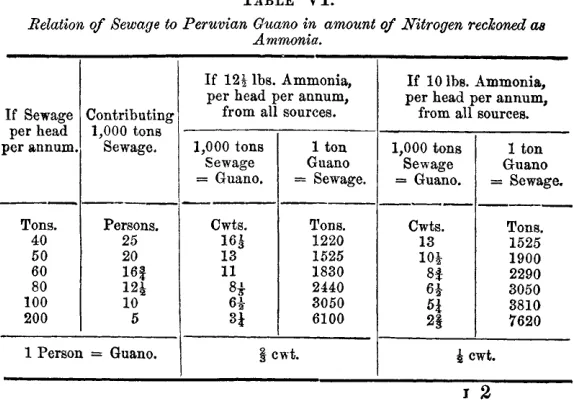
Peruvian guano, This is done in Table VI, which shows the amount of gunno which would supply as much nitrogen reckoned as ammonia as 1,000 tons of sewage of diEerent dilutions, also the number of tons of sewage which would be equal in this respect to 1 ton of guano, and both on the alternative assump- tions of 12+ lbs., and 10 lbs., of ammonia per head per annum. The assumed dilutions are 40, 50, and 60 tons per head per annum, which may be taken to cover the minimum and maximum esti- mated rates of flow for the dry weather sewage of the Metropolis; 80 and 100 tons, which may be taken to represent the range for the average total available sewage,inclusiveof rainfall and subsoil water, and 200 tons, the probable frequent dilution in wet weather.
TABLE VI.
Relation of Sewage to Peruvian Guano in amount of Nitrogen reckoned aa Ammonia.
Contributing
1,000 tons Sewage. ---- Persons. 25 20 163 124 10 5
If 12i lbs. Ammonia, per head per annum, from all sources.
~-
1 Person = Guano.
If 10 lhs. Ammonia, per head per annum, from all sources.
Tons. 1220 1525 1830 2940 3050 6100 1,000 tons
Sewage
= Guano.
Cwts. 164 13 11
--
8% 34 6Qcwts. Tons.
13 1525
lo* 1900
2290
64 3050
54 3810
28 7620
1 ton 1,000 tons 1 ton Guano
1
Sewage Guano= Sewage. = Guano. = Sewage.
4 cwt.
J 2
I
8 cwt.
104
LAWES A N D GILBERT ON THE COMPOSITION, VALUE, Thus, with 12+ lbs. of ammonia, m d the minimum estimated dilution of the dry weather sewage at a rate of 40 tons per head per annum, 1,000 tons of such sewage would only contain nitrogen, reckoned as ammonia, equal to that in about l6$ cwts. of Peruvian guano, or to that in only 13 cwts. if the amount of ammonia per head per annum be reckoned at only 10 lbs. I n other words, in the former case it would require 1,220, and in the latter 1,525, tons of sewage to supply the ammonia (or nitrogen reckoned as ammonia) of 1 ton of guano. I n like manner, taking 80 tons of sewage per head per annum as a mininium estimate for the average sewage, inclusive of rainfall, with 12+ lbs. of ammonia per head per annum, 1,000 tons would represent the nitrogen of 84- cmts., and with 10 lbs., 6+ CW~S., of Peruvian guano; orreckoning 12* lbs. of ammonia per head per annum, 1 ton of
Peruvian guano would represent 2,440 tons, and reckoning 10 lbs.,
it would represent 3,050 tons.
The table also shows that reckoning 124 lbs. of ammonia per head per annum, the sewage of an average individual would annually represent in nitrogen
9
cwt., or reckoning only 10 lbs. per head per annum onlyQ
cwt., Peruvian guano, per head per annum.Crops to which Sewage is most applicable.
Hitherto, on grounds shown to be fully justified, we have, for simplicity of illustration, confined attention to the amount of
nitrogen or ammonia in sewage, as the measure or indication of its composition, and of the theoretical manurial value of its total solid constituents. It is, however, obviously of interest to consider whether or not the mineral or incombustible constituents
of sewage exist in it in sufficient proportion to the ammonia or
nitrogen, for the requirements of the crops to be grown; and, as the phosphoric acid and potassa (the one or the other, or
both, according to circumstances) are, perhaps, the mineral con- stituents most likely to be deficient relatively to the nitrogen, their proportion to the latter in sewage, and invarious crops, may appropriately be referred to in illustration of the point. Table VII shows the proportion of phosphoric acid and potassa to 100
of nitrogen in sewage, according to the mean of ten analyses of
the Rugby sewage, in which the phosphoric acid and the potassa
as well as the ammonia were determined. It also shows what
AND UTILIZATZON OF TOWN SEWAGE. 105
Rugby Sewage
....
may be taken as approximately representing the average propor-
tion of phosphoric acid and potassa to nitrogen in various crops.
Phosphoric Acid.
27
TABLE VII.
Amourat of Phosphoric Acid and Potassn to 100 Nitrogen, in Sewage and in variow,
[n Corn,
loots,&c. Leaves, &c In Straw,
---
In Corn, Roots, &c.
..
..
48 40 28
I 25
17
27 28 42
Meadow-Hay
...
Clover-Hay...
Wheat.....
Barley...
Oats....
Beans...
Mangolds...
Swedes...
Common Turnips.
.
Potatoes...
In Straw, Leaves, &c
----
..
..
42 34 37 46 16 18..
..
..
a . 28 34 25 32 100 82 160 123 [n Total Produce,--
27 23 46 38 30 30 21 26..
I ...
..
108 126 155 123 44 71..
..
Potassa. 42---
I
In Total Produce. 100 52 57 60 65 50 63 117
..
..
It is obvious that since the phosphoric acid of sewage, like the
nitrogen, will be derived almost exclusively from excretal matters and food-refuse, its proportion to the nitrogen will, within com-
paratively narrow limits, be tolerably uniform ; the amount of
potassa, on the other hand, will vary very much according to locality, and be considerably greater where the streets or roads are constructed of potassic minerals than elsewhere.
The table shows that, according to the analyses referred to, the Rugby sewage contained 27 parts of phosphoric acid and
42 parts of potassa, for 100 of nitrogen. It also shows that,
on the average, meadow hay contains almost exactly the same proportion of phosphoric acid to nitrogen as the sewage, but a
much greater proportion of potassa than the latter.'
I n the cereal grains the proportion of phosphoric acid to
*
According to Baron L i e b i g ' s estimates, hay contains 51 parts of phosphoricacid to 100 of nitrogen ; but having collated and averaged the results of numerous independent observers, we can see nothing to lead to the adoption of such a 6gnre ;
whilst direct determinations in a number of samples of each, showed in the Rugby sewaged grass 25, and in the unsewaged 32 parts.