life questionnaire
Atefeh Nezhadmohamad Nameghi1, Masumeh Esmaeili2 Ahmad Borjali3, Fariborz Bagheri4, Abdollah Shafiabadi3
Abstract
The quality of life is mainly measured by multiple conceptual frameworks which neglect the cultural-religious context of the societies. Hence, there is not a unique instrument to assess life quality. The present study strives to develop and validate a quality of life questionnaire in light of Javadi Amoli’s view. In this study, the researcher-made questionnaire has been answered by 400 bachelor students. Javadi Amoli’s books have been consulted for developing the questionnaire. The validity of the questionnaire has been confirmed by content validity, face validity and, construct validity (using factor analysis and measuring correlation of identified components with total questionnaire). After ensuring content validity and consulting Bartlett's test and Kaiser-Mayer-Olkin index, factor analysis has been performed using principal component analysis and varimax rotation. The results oriented toward four dimensions as God, others, self, and nature which explained 36.5% of the variance. The reliability of the questionnaire has been measured using split-half method and Cronbach's alpha, and reported as 0.63 and 0.89, respectively. The reliability of the extracted dimensions has been 0.87, 0.88, 0.80, and 0.81, respectively. Accordingly, findings of the present research acknowledges the questionnaire to be purposeful and efficient.
Keywords:Quality of Life, Questionnaire, Reliability, Validity
Journal of Research & Health
Social Development & Health Promotion Research Center
Vol. 9, No.2, Mar & Apr 2019 Pages: 97- 103 DOI: 10.29252/jrh.9.2.97
Original Article
1. Correspondence to: Department of Counseling, Faculty of Human Sciences, Science and Research Branch, Islamic Azad University, Tehran, Iran
Email: [email protected] 2. Department of Counseling, Faculty of Psychology, University of Allameh Tabatabai, Tehran, Iran
3. Department of Psychology, Faculty of Psychology, University of Allameh Tabatabai, Tehran, Iran
4. Department of Psychology, Faculty of Human Sciences, Science and Research Branch, Islamic Azad, University,Tehran, Iran
Received: 7 Jul 2014 Accepted: 8 Oct 2014
How to cite this article: Nezhadmohamad Nameghi A, Esmaeili M, Borjali A, Bagheri F, Shafiabadi A. Development and validation of islamic quality of life questionnaire. J Research & Health2019; 9(2): 97- 103.
Introduction
The enormous growth of depression, explosive rate of suicide attempts decreased with age, sharp increase in the rate of divorce, deep dissatisfaction with life, and many other psychological problems are irrefutable realities suggesting that the quality of life in the mental dimension (inner well-being) has been departed from human societies [1]. Over the past half century, psychology has been revolved around ill health rather than health as well as the pathology of human function rather than the full understanding of all its dimensions, that
objectively measure in the past three decades [4]. Despite the extensive research, however, there has not yet been a single agreed definition of quality of life. Some researchers have defined the quality of life with an objective approach, and have considered obvious cases related to living standards equivalent to the quality of life in terms of physical health, personal conditions (wealth, living conditions, etc.) social connections, occupational activities, or other socioeconomic factors [5]. In contrast to this approach, there is another approach called the mental approach which equates quality of life with happiness or individual satisfaction and emphasizes on cognitive factors in assessing the quality of life [5]. Between these two objective and subjective approaches, there is another approach called the holistic approach whose theorists believe that quality of life is a complex and multifaceted conception like the life itself [6]. In this approach, physical health, mental health, social relationships, and quality of the living environment are its constructive components. Islam considers a supreme importance for the quality of life of human beings [7]. According to Islam, the health and quality of the human developmental environment mean that humans have a peaceful interaction with their God, with themselves, with their peers, and with nature [8]. Peace in this general sense is one of the greatest human needs for growth and salvation. [9] Therefore, religion provides humans with the information to make life possible and graceful for them in the universe; in other words, to reconcile between man and the world and his life and ego in order to see everything optimistically [10]. Religion has always addressed different existential dimensions of the human being; from the relationship of a human with himself to his relationships with other beings in the world including human and his relationship with his Creator and Lord [11]. Religion has provided the necessary educations and wisely advised for each of these three dimensions. Otherwise stated, Almighty God considers the growth and prosperity of man in the light of the correction of the abovementioned triad relations, and the
salvation of man indebted to it. [12] Javadi Amoli, describing the pure life, asserts that the meaning of pure life is not a clean life in the hereafter [13] rather it is about life in this natural world that ordinary people interact with each other. The believers have a pure life [14]. Therefore, it can be said that the quality of life is important in Islam and it is a necessity in the very mundane life. In Iran, however, conceptual frameworks and quality of life assessment have been limited to the existing approaches; and quality of life has been assessed using the World Health Organization questionnaire and other similar ones. That is while these approaches are not comprehensive since they ignore the religious and cultural context of the communities. Therefore, due to the fact that there is no independent and local questionnaire conforming to cultural and Islamic conditions in Iran, and that the common questionnaires have ignored one of the dimensions of human quality of life, i.e. God, it is necessary to design and develop a valid and reliable Islamic questionnaire on this subject.
Method
This is a survey study whose participants were all bachelor students of Islamic Azad University of Karaj in the 2012-2013 year. Sampling was simple random. That is, 6 students were randomly selected for each item in the quality of life questionnaire summing up to 400 participants. Eight of returned questionnaires were incomplete and thus excluded from the list of questionnaires. One of the points of view expressed about the sample size in factor analysis is that since the basis of this method is a correlation, then at least 100 to 200 participants are sufficient for each purpose. It is also recommended that the minimum sample size is 5 to 10 participants per item [11]. As a result, this study has been conducted on 400 participants.
Implementation: Data was collected and
quality of life is derived from his books. The quality of life means the dimensions addressed in the questionnaire.
a) Review of and research in the books according to his definition of quality of life b) Categorization of concepts related to the quality of life
c) Exploring the dimensions of quality of life The information collected in this section has been divided into four categories: God, oneself, others, nature.
68-items of questionnaire were prepared: At this step, by random combination of items in each dimension, a 68-item questionnaire was prepared, scored based on a 5-point Likert scale (Agree Very Strongly, Agree Strongly, Agree, Disagree, and Disagree Very Strongly). According to the type of question (positive or negative), they were scored from 0 to 4.
The questionnaire was completed: After collecting data about students’ responses and statistical analysis, 3 of the weak items were excluded. The basis for this exclusion was factor analysis.
Results
The first question is: Does the Islamic quality of life questionnaire have content validity? First, all sentences related to the quality of life were identified. In the table below, a few sentences are given for each case. Then, verses were categorized according to the subject and content, out of which 4 dimensions were extracted. In order to evaluate the face validity, the opinions of experts in counseling, psychology and the seminary (Hawza) were used to resolve the problems in the items. The results are presented in Table 1.
Table 1 Dimensions of quality of life
Documentation Dimensions extracted Items
Maintaining mutual respect (Javadi Amoli, 2009, C, p. 326)
Showing love and affection to each other (Javadi Amoli, 2008, A, p. 238) The practice of justice in social life and having fair behaviors
(Javadi Amoli, 2009, E, p. 193)
Treating people with mercy and politeness, not indifference (Javadi Amoli, 2010, H, p. 667)
Helping each other and asking for care and taking care of each other (Javadi Amoli, 2009, D, p. 444)
Others
21, 22, 23, 24, 33, 34, 36, 44, 43, 47, 48, 49, 61, 50, 37,
55, 57
Recognition of God and knowledge of His being. (Javadi Amoli, 2010, A, p. 66)
Obedience and worship of God (Javadi Amoli, 2010, A, p. 66)
Being hopeful and optimistic about God. (Javadi Amoli, 2007, D, p. 220)
God 14, 38, 58, 65, 66, 8, 10, 35, 41, 42, 67, 68, 16, 27
Recognizing one’s real status (what is he) (Javadi Amoli, 2009, C. p. 38) Understanding one’s identity and characteristics (who is he)
(Javadi Amoli, 2005, B, p. 191)
Maintaining individual life and caring for it (Javadi Amoli, 2009, D, p. 265) Attempts to maintain mental and physical health (Javadi Amoli, 2009, p. 125) Not to be cruel to oneself (Javadi Amoli, 2009, G, p. 170)
Opposition to free-will and having self-control (Javadi Amoli, 2009, D, p. 215)
Oneself
2, 4, 6, 7, 15, 13, 11, 12, 31, 17, 25,
18, 54, 60, 59, 9, 13, 28, 39
Understanding the relationship of the universe with God (Javadi Amoli, 2010, A, p. 64)
Learning how to deal with the universe and nature. (Javadi Amoli, 2010, A, p. 69)
Observing the health of the environment. (Javadi Amoli, 2009, G, p. 38) Loving all the creatures in the universe. (Javadi Amoli, 2009, G, p. 233)
Nature 46, 51, 53, 62, 69, 63, 64, 52, 32, 30, 29, 45
Second question: Does the Islamic quality of life questionnaire have construct validity? Factor analysis and correlation of dimensions’
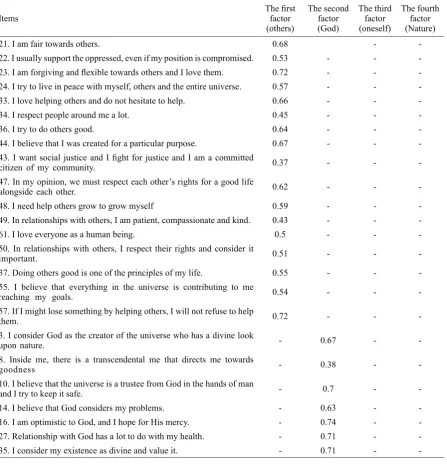
Factor analysis: In the first step, the Kaiser-Mayer-Olkin (KMO) and Bartlett tests were used to check the suitability of the collected data. The KMO value for the correlation matrix of the questions was 0.87 and the Bartlett test value for the adequacy of the questionnaire’s content was 8794.52, which were significant at p<0.0001. After assuring the two above indicators, the items of the questionnaire were analyzed by the main factor methods. The best content combination based on the scree plot and the percentage of variances was the 4-factor matrix. After rotation of the questionnaire's matrix in an orthogonal manner (varimax), the content of each factor was determined based on the factor load of each
question, and after examining the items of each factor, by faculty members, the factors were given names. Special values were identified in all four factors, which, all together, explained 41.5% of the variance of the Islamic quality of life scale. So that the first factor (others) with 17 items had the greatest contribution to the explanation of variance of the Islamic quality of life scale (23.3), followed by the second factor (God) with 12 items (9.23), the third factor (oneself) with 19 items (5.8), and the fourth factor (nature) with 13 items (3.1). After the factor analysis, 7 items that had no factor load on any of the factors were excluded from the questionnaire. The results are presented in Table 2.
Table 2 Results of factor analysis of quality of life questionnaire with factor loads of each item by Varimax rotation method
Items The first factor
(others)
The second factor (God)
The third factor (oneself)
The fourth factor (Nature)
21. I am fair towards others. 0.68 -
-22. I usually support the oppressed, even if my position is compromised. 0.53 - - -23. I am forgiving and flexible towards others and I love them. 0.72 - - -24. I try to live in peace with myself, others and the entire universe. 0.57 - - -33. I love helping others and do not hesitate to help. 0.66 - -
-34. I respect people around me a lot. 0.45 - -
-36. I try to do others good. 0.64 - -
-44. I believe that I was created for a particular purpose. 0.67 - - -43. I want social justice and I fight for justice and I am a committed
citizen of my community. 0.37 - -
-47. In my opinion, we must respect each other’s rights for a good life
alongside each other. 0.62 - -
-48. I need help others grow to grow myself 0.59 - -
-49. In relationships with others, I am patient, compassionate and kind. 0.43 - -
-61. I love everyone as a human being. 0.5 - -
-50. In relationships with others, I respect their rights and consider it
important. 0.51 - -
-37. Doing others good is one of the principles of my life. 0.55 - - -55. I believe that everything in the universe is contributing to me
reaching my goals. 0.54 - -
-57. If I might lose something by helping others, I will not refuse to help
them. 0.72 - -
-3. I consider God as the creator of the universe who has a divine look
upon nature. - 0.67 -
-8. Inside me, there is a transcendental me that directs me towards
goodness - 0.38 -
-10. I believe that the universe is a trustee from God in the hands of man
and I try to keep it safe. - 0.7 -
-14. I believe that God considers my problems. - 0.63 -
-41. I do not receive much support from God. - 0.83 - -42. I do not have a satisfying relationship with God. - 0.81 - -38. Obedience to God is an important aspect of my life. - 0.7 - -58. When I have a close and sincere relationship with God, I feel perfect. - 0.65 - -65. I do not feel much satisfied in my prayers and my private hours
with God. - 0.56 -
-66. I feel God in my life, and I know Him. - 0.61 -
-67. I thank God for the many positive things that exist in my life. - 0.52 - -68. I believe that God loves me and cares for me. - 0.6 - -2. In satisfying the physical demands, I consider their harmony with
the soul. - - 0.62
-4. I can well postpone my tendencies until the appropriate time. - - 0.55 -6. I take good care of myself and protect my health. - - 0.62 -7. I have a mission in life and I have clear goals and values in my life. - - 0.49
-15. I know about my mental and emotional states. - - 0.62
-13. If I enjoy or like something that is harmful to me, I will not go for it. - - 0.55 -11. Generally, I have a good self-control and good will. - - 0.55 -12. I know well what is suitable for my body and soul. - - 0.71 -31. I am not influenced by the words and acts of others and I am not
bothered. - - 0.35
-17. I care for my physical health. - - 0.51
-25. Helping charities is one of the things that I do. - - 0.38 -18. I am usually aware of my inner states at all times. - - 0.56
-54. I am aware of my position as a human being. - - 0.6
-60. I pay attention to my physical and spiritual needs (I know my
physical and spiritual needs well). - - 0.64
-59. I am always careful about what I do to myself. - - 0.53 -9. I value my life, and I regard any harm as a bad and cruel deed. - - 0.41 -13. If I enjoy or like something that is harmful to me, I will not go for it. - - 0.43
-28. I do not do what harms my body. - - 0.53
-39. I do not know much about who I am, where I came from, and where
I will go. - - 0.37
-45. I try to protect the environment and not to pollute it. - - - 0.52 46. I believe that the rights of all beings must be respected. - - - 0.58
51. I disapprove of hurting and hunting animals. - - - 0.53
53. I treat others and the community thoughtfully. - - - 0.49 62. I try not to damage natural resources when using them. - - - 0.59 69. I care for others and I would love to help others develop. - - - 0.51 63. I will not be cruel to others in any circumstances. - - - 0.43 64. I have self-control in my personal habits, like weight control. - - - 0.35 52. I do not harm others, either physically or emotionally. - - - 0.47 32. I feel deep joy when I look at nature and landscapes. - - - 0.41 30. In my everyday life, I will criticize my behavior in comparison to
what I expect myself to be. - - - 0.37
29. I’m usually honest with myself. - - - 0.39
Special value 16.82 5.23 3.6 2.1
Variance 23.3 9.23 5.8 3.1
Total variance 41.5
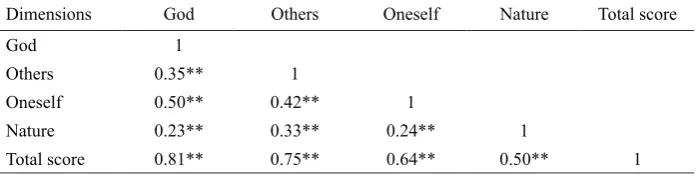
Correlation of dimensions’ and factors’ score with the total score has been used to assess the constructive validity. The Pearson correlation coefficient of each factor is presented in Table 3, at a significance level of 0.01.
Third question: Does the Islamic quality of life questionnaire have reliability?
Reliability has been assessed using split-half Cronbach's alpha methods. According to Cronbach's alpha, the reliability coefficient for the whole questionnaire was 0.89 and using the split-half method, the correlation between the two halves was 0.63. The reliability of each questionnaire dimension is presented in Table 4. Table 3 Correlation between dimensions and the total score of Islamic quality of life questionnaire
Dimensions God Others Oneself Nature Total score
God 1
Others 0.35** 1
Oneself 0.50** 0.42** 1
Nature 0.23** 0.33** 0.24** 1
Total score 0.81** 0.75** 0.64** 0.50** 1
**p<0.01
Table 4 Cronbach’s alpha coefficients for dimensions of Islamic the quality of life questionnaire
Dimensions of quality of life God Others Oneself Nature
Alpha value 0.87 0.88 0.80 0.81
Discussion
One of the areas of research, based on psychological approaches, is to measure the quality of life of individuals. Therefore, there are several tools in this regard, each of which, based on different conceptual frameworks, attempts to describe and build different tools for measuring the quality of life. However, there is no unitary tool agreed upon by all. These tools are used to measure the quality of life in Iran, too, while they are not comprehensive since they have ignored the religious and cultural context of the communities. Also, in those questionnaires, one of the important dimensions of quality of life, that is, spirituality and relationship with God, has not been considered. Therefore, the present study has been conducted to develop and validate a tool for measuring the quality of life based on Islamic pedagogies. The results of this study show that the Islamic quality of life questionnaire has a good validity and reliability. The results of exploratory factor analysis showed that there were four dimensions in the quality of life questionnaire including the dimension of God with 12 items, the dimension of others with 17 items, the dimension of oneself with 22 items, and the dimension of nature with 13
and targeted life) [18]. Due to the lack of a local questionnaire based on Islamic pedagogies in Iran for measuring the quality of life, it appears that the prepared questionnaire in this study can fill the gap. This questionnaire can be used in research aimed at assessing and evaluating the quality of life of university students, or research that assesses the quality of life and related variables with respect to demographic characteristics of university students such as gender and education.
Conclusion
This study aimed to find the perception of life quality from Islamic viewpoint and design a questionnaire based on Islamic teachings. The Islamic viewpoint regards the health and quality of human training as the mankind relationship and peace with his God, his inside, his congeners and the nature around him. Since there was lack of a questionnaire to measure life quality based on this viewpoint, this study endeavored to design such a questionnaire.
Acknowledgments
The authors of the article need to acknowledge the cooperation and assistance of all the loved ones who helped us in this research
Contribution
Study design: ANMN
Data collection and analysis: ANMN, ME, ASh, AB
Manuscript preparation: ANMN, FB
Conflict of Interest
"The authors declare that they have no competing interests."
Funding
The author (s) received no financial support for the research, authorship and/or publication of this article
References
1- Podfigurna-Stopa A, Luisi S, Regini C, et al. Mood disorders and quality of life in polycystic ovary syndrome. Gynecol Endocrinol2015; 31(6): 431-4. 2- Terjesen MD, Jacofsky M, Froh J, DiGiuseppe R. Integrating positive psychology into schools: Implications for practice. Psychol Sch2004; 41(1): 163-72.
3- Seligman MEP, Csikszentmihalyi M. Positive psychology: An introduction. Am Psychol2000; 55(1): 5-14.
4- Hagerty MR, Cummins R, Ferriss AL, et al. Quality of life indexes for national policy: review and agenda for research. Bull Methodol Sociol2001; 71(1): 58-78. 5- Liu L. Quality of life as a social representation in China: A qualitative study. Soc Indic Res2006; 75(2): 217-40.
6- Malkina-Pykh IG, Pykh YA. Quality-of-life indicators at different scales: Theoretical background.
Ecol Indic2008; 8(6): 854-62.
7- Javadi Amoli. Head spring of thought the Quranic prefaces. Vol 4. Qom: Esra; 2003.
8- Javadi Amoli A. Applicable literature. Vol 2. 4th ed. Qom: Esra; 2006.
9- Javadi Amoli A. Head spring of thought the Quranic prefaces Vol 5. Qom: Esra; 2003.
10- Javadi Amoli A. Applicable literature. Vol 1. 5th ed. Qom: Esra; 2006.
11- Javadi Amoli A. Applicable literature. Vol 4. 5th ed. Qom: Esra; 2006.
12- Javadi Amoli A. Islam and International Relations. Qom: Esra, 2005.
13- Javadi Amoli A. Head Spring of Thought the Quranic prefaces. Vol 3. Qom, Esra, 2003.
14- JJavadi Amoli A. Applicable literature. Vol 5. 3rd ed. Qom: Esra; 2007.
15- Dixon j. k. Factor analysis. In: munro BH. Statistical methods for Health care Research. New York: Lippincott; 2001. pp: 303-29.
16- Kavyani M. Prescriptive Islamic life style and its testing instrument. Qom: Research institute of hawzeh and university: 2011.
17- Frisch MB. Quality of life therapy. New Jersey, US: Wiley; 2005.
18- Byock IR, Merriman MP. Measuring quality of life for patients with terminal illness: the Missoula-VITAS quality of life index. Palliat Med1998; 12(4): 231-44.