International Journal of Engineering
J o u r n a l H o m e p a g e : w w w . i j e . i rA New Nonlinear Multi-objective Redundancy Allocation Model with the Choice of
Redundancy Strategy Solved by Compromise Programming Approach
S. J. Sadjadia, A. A. Tofighb,*, R. Soltania
a Department of Industrial Engineering, Iran University of Science and Technology, Tehran, Iran b Materials and Energy Research Center, Karaj, Iran
P A P E R I N F O
Paper history:
Received 28 May 2013
Received in revised form 15 August 2013 Accepted 14 September 2013
Keywords:
Redundancy Allocation Cold-Standby Redundancy Active Redundancy Multi-objective
Compromise Programming
A B S T R A C T
One of the primary concerns in any system design problem is to prepare a highly reliable system with minimum cost. One way to increase the reliability of systems is to use redundancy in different forms such as active or standby. In this paper, a new nonlinear multi- objective integer programming model with the choice of redundancy strategy and component type is developed where standby strategy is of cold type. In the proposed model, system’s reliability is maximized along with minimizing system’s cost and weight. The proposed model contributes to the literature by determining the redundancy strategies concurrently with determining redundancy levels and component types. The multi-objective model is solved using the mathematical compromise programming technique for different Lp metrics and produces different Pareto solutions.
doi:10.5829/idosi.ije.2014.27.04a.05
1. INTRODUCTION1
Reliability optimization is an important field in system engineering which has gained more attentions in recent years. One way to increase systems’ reliabilities is to use redundant units using active or standby strategies. Standby electric generators in hospitals and other public facilities are a typical example of redundancy. As another normal example we can refer to use of electronic gyroscope and mechanical gyroscope in aircrafts [1]. Redundancy allocation is a field through which optimal number of redundant components is determined such that the system’s reliability is maximized. In this paper the redundancy allocation problem (RAP) in systems with serial parallel structures and with choices of redundancy strategy and component type is studied where standby strategy is of cold type. Production system is an example of serial systems [2]. Space exploration and satellite systems achieve high reliability using cold standby redundancy for non-repairable systems [3]. Space inertial reference units are required to accurately monitor critical information for extended mission times without opportunities for repair.
* Corresponding Author Email:[email protected](A. A. Tofigh)
Examples of non-repairable cold standby redundancy in spacecrafts can be found in [4, 5]. Many other systems use cold standby redundancy as an effective strategy to achieve high reliability including textile manufacturing systems [6], carbon recovery systems used in fertilizer plants [7] and active and passive safety systems in road vehicles [8], just to name a few. As an example for active strategy we can mention the serial parallel water desalination system which consists of filters, pumps, reverse osmosis membranes and power commutation equipment blocks in series for each of which there is an option to add redundancy in the form of parallel components.
To show the place of the proposed model, the literature is reviewed and classified into two main categories, where each one consists of single objective or multi-objective models. Note that the main focus is on models which were proposed for each category and less attention is paid to existing solution approaches.
In the area of single objective models with active strategy, Fyffe et al. [9] were the first who proposed a model for RAP where system’s reliability is maximized subject to constraints on cost and weight. Ramirez-Marquez et al. [10] modeled the RAP using max-min approach, where the reliability of the subsystem with
minimum reliability is maximized subject to constraints on cost and weight. Sun and Ruan [11] formulated the RAP such that system’s cost is minimized subject to the requirement of meeting the minimum system’s reliability. They presented an exact algorithm to solve the model.
In the field of multi-objective models with active strategy, Coit and Konak [12] considered a multi-objective RAP where the reliabilities of subsystems are maximized, simultaneously subject to constraints on cost and weight. They presented a multiple weighted objective heuristic to solve the model. Salazar et al. [13] studied three types of reliability optimization problems including redundancy allocation, reliability allocation and reliability-redundancy allocation. Their proposed multi-objective RAP maximizes system’s reliability at the same time of minimizing system’s cost and solved it through NSGAII. Taboada and Coit [14] considered a multi-objective model, which maximizes system’s reliability concurrently with minimizing system’s cost and weight and solved it using NSGA. Taboada and Coit [15] proposed a multiple objective evolutionary algorithm to solve a multi- objective redundancy allocation problem where the objectives were maximizing system’s reliability and minimizing system’s cost and weight. Wang et al. [16]considered a multi-objective RAP to maximize system’s reliability and minimize system’s cost with nonlinear cost and weight and solved the resulted model using NSGAII. Mahapatra [17] presented a bi-objective model, which simultaneously maximized the system’s reliability and entropy considering nonlinear cost constraint. They solved the resulted model using global criterion method.
Soylu and Ulusoy [18] considered the problem of maximizing the minimum subsystem reliability concurrently with minimizing the overall system cost and found the Pareto solutions of this problem by the augmented epsilon-constraint approach for small and moderate sized instances. Then they applied a well-known sorting procedure, UTADIS, to categorize the solutions into preference ordered classes. Khalili-Damghani and Amiri [19] considered an existing multi-objective RAP which involved maximizing system’s reliability and minimizing system’s cost and weight and solved it through a method based on epsilon-constraint and data envelopment analysis.
In the area of single objective RAP with cold standby strategy, Coit [20] studied cold standby redundancy optimization for non-repairable systems and developed a zero-one linear programming model to solve the problem. Coit [21] studied the same redundancy allocation problem where there were redundancy strategy choices for subsystems. In their approach the redundancy strategies were determined prior to redundancy levels. In application of meta-heuristics, Tavakkoli-Moghaddam et al. [22] developed a genetic algorithm to solve the same problem proposed
by Coit [21]. Later, bi or multi-objective version of the mentioned problem was studied by some scholars. Safari [23] and Chambari et al. [24] separately considered a bi-objective model for RAP to optimize reliability and cost of system with choice of redundancy strategy and solved the resulted model through NSGAII. Azizmohammadi et al. [25] considered a multi-objective RAP where the system reliability is maximized while minimizing the system’s cost and volume. They proposed a hybrid multi-objective imperialist competition algorithm to solve the model.
In this paper, a new nonlinear multi-objective integer programming model for redundancy allocation with the choice of redundancy strategy is presented with three contradictory objectives including system’s reliability, cost and weight. As mentioned previously, the first model for RAP with choice of redundancy strategy was proposed by Coit [20] and since then researchers have focused on solution approaches mostly in forms of meta-heuristics. In Coit’s approach, redundancy levels are determined after deciding about redundancy strategies. In this paper, we present a new mathematical model to decide about redundancy strategies concurrently with redundancy levels and component type and it can be directly solved using typical optimization packages. In addition, the mathematical compromise programming approach is implemented for the first time to deal with the proposed multi-objective model.
The rest of the paper is organized as follows. In section 2 the studying problem is described and the proposed mathematical model is presented. Compromise programming technique as a solution procedure is presented in section 3. Experimental results are presented in section 4. Finally, conclusion is presented in section 5 along with some future research directions.
2. PROBLEM DEFINITION AND FORMULATION
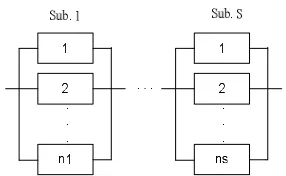
Figure 1. General serial parallel redundancy system
It is apparent that use of redundant component increases system’s cost and weight which is not desirable. Therefore, designers try to minimize system’s cost and weight together with maximizing systems’
reliability. In this section, we propose a multi-objective model involving these objectives, which determines the suitable redundancy strategy, component type and redundancy level in each subsystem.
Assumptions
· The components are in two states of functioning or non-functioning, i.e. binary state.
· Components’ time to failures follow Erlang distribution.
· The standby strategy is of cold type and the standby units do not fail before they are put into operation.
· The switch reliability to cold standby component is assumed to be imperfect.
· There are different component types with different specifications.
· Just one component type can be allocated in each subsystem.
· There is no repair or preventive maintenance.
· The replacement time is negligible.
Decision Variables:
k j i
n,, Number of components of type j used in subsystem i
under strategy k (kÎA,S,N).
k j i
Z,, A binary variable which is one if the component of
type j is used in subsystem i under strategy k and zero otherwise.
j i q
X,, A binary variable which is one if q of the component
of type j is used in subsystem i under standby
strategy.
Parameters
j i,
l , ki,j Scale and shape parameters of Erlang
distribution for component j in subsystem i
) (
, t
rij Reliability of component j available for
subsystem i at time t
) (t
j
d Switch reliability of component j at time t
(imperfect switching)
j i
c, ,wi,j Cost and weight associated with component j
available for subsystem i
The Proposed Mathematical Model
åå å
= = Î
´ = m
i T
j kASN k j i j i i n C Min
1 1 ,, , , , Cost s System' (2)
åå å
= = Î
´ = m
i T
j kASN k j i j i i n W Min
1 1 , , , , , weight s System' s.t. (3) i k l l j i j i j
i i m j T
l t t
t
r ij 1,..., , 1,...,
! ) ( ) exp( ) ( 1 0 , , , , = = -=
å
-= l l (4) i N j i S j i A j
i Z Z i m j T
Z,, + ,, + ,, £1 =1,..., , =1,..., (5)
m i Z
Z
Z i i
i T
j ijN T
j ijS T
j ijA
,..., 1 1 1 ,, 1 ,,
1 ,,
= = +
+
å
å
å
= = = (6) i n q j iq i m j T
X 1 1,..., , 1,...,
max
2 ,,
= = =
å
= (7) i nq qij S
j i s j
i Z q X i m j T
n 1,..., , 1,...,
max 2 , , , , ,
, = ´
å
´ = == (8) i A j i A j i A j
i n n Z i m j T
Z 1,..., , 1,...,
2´ ,, £ ,, £ max´ ,, = = (9)
i N j i N j
i Z i m j T
n,, =1´( , , ) =1,..., , =1,..., (10)
max
1 , , ,,
1 i n n
T
j k ASN k j i £
£
å å
= Î
(11)
ÕÕ
Õ
å
å
å
å
Õ
å
Õ
= = = = -´ = = = = = = ´ l l -´ d + ´ + -´ -´ -= m i T j Z j , i m i T j q k k l l j , i max n q j , i, q j , i i j , i S , j , i T j S , j , i T j n j , i T j A , j , i m i i N , j , ii i,j
Objective function (1) maximizes the reliability of the system, which consists of three terms. The first term multiplies the reliability of those subsystems whose components are in active redundancy. In cases where no component in any subsystem is in active redundancy, i.e. all Zi,j,Aare zero, this term is one, which is neutral in
multiplication.
The second term multiplies the reliability of those subsystems whose components are in cold standby redundancy which itself consists of three parts. The first part is to ensure that in case no component is selected for standby redundancy in a subsystem, the multiplication is not zero. In other words, the value of this part is zero if a component type is selected in standby and it is one otherwise which is neutral in calculating the system reliability. The second and third parts are considered only if Zi,j,Sis one. The second part includes the reliability of the working component and the third part considers between one and ni,j,S-1failures regarding the reliability of the switch. The third term multiplies the reliability of those subsystems that choose no redundancy strategy. When all Zi,j,Nare zero this term
is also one. Objective function (2) and objective function (3) minimizes the system’s cost and weight, respectively. Constraint (4) calculates the reliability of components considering Erlang’s parameters. Constraint set (5) ensures that for each subsystem at most one strategy is selected. Constraint set (6) states that only one component type and strategy is selected for each subsystem. Constraint set (7) declares that for cold standby strategy the number of components can only be a value between 2 and nmax. Constraint set (8) calculates the number of components in subsystems with cold standby strategy. This constraint is equivalent to constraint2´Zi,j,S£ni,j,S£nmax´Zi,j,S i=1,...,m,j=1,...,Ti.
But, for the purpose of calculating the upper limit of the summation in the standby term of the objective function, constraint set (8) is considered in the model. Constraint set (9) indicates that for each subsystem, variable ni,j,A gets value only when type j and strategy A are selected. Its value is at least 2 and at most nmax.
Constraint set (10) ensures that in case of no redundancy the variable ni,j,N gets one only when Zi,j,N is one, and it is zero otherwise. Constraint set (11) indicates that the number of components in each subsystem is at least one and at most nmax. .
3. COMPROMISE PROGRAMMING
Compromise programming is a mathematical programming technique which was originally developed by Zeleny [26, 27]. This method can be used for optimization of multi-objective problems to obtain the optimal
1
S
2
S
3
S
4
S
1
L
2
L
3
L
4
L
Figure 2. Graphical illustration of compromise
programming for two objectives
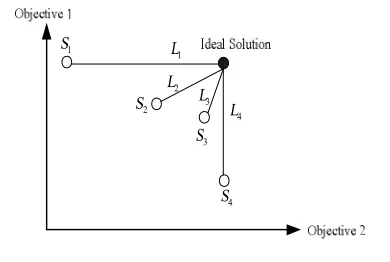
solution and also for comparing the performance of alternatives in multi-criteria decision making analyses. As a matter of fact, the best compromise solution from a set of solutions is selected by a measure of distance called distance metric through which a discrete set of solutions is ranked according to their distance from an ideal solution. To understand how this measure works, consider a bi-objective problem whose both objectives are in maximization form. The ideal solution of this problem is the one which simultaneously maximizes the two objectives. In practical cases, this solution is infeasible due to conflict of objectives. Therefore a compromise must be sought. Figure 2 graphically illustrates the compromise programming. Where, S1 to
S4 are four possible solutions and L1>L4>L2>L3 which
are the distances between each solution and the ideal solution. Therefore, according to Figure 2, S3 is the best
compromise solution where both objectives have equal weights.
Mathematically, compromise programming distance metric is presented in Equation (12).
p n
i
p
i i
i i i
p f f
f f w w L
1
1 )
( ÷÷
ø ö ç
ç è æ
ú û ù ê
ë é
-=
å
= +
-+
(12)
where n is the number of objectives, in this paper n=3, p is a parameter (pÎ1,2,¥),
w
iis the weight of the objective i, fi is the actual value of the objectivefunction i, + i
f and -i
magnitude. As p increases, the importance of the deviations also increases. Similarly,
w
i’s are the weights for various deviations which identify the relative importance of each objective. Apparently, for different values of p in Lp metrics andw
i, different compromise solutions can be obtained. For p = 1, the Lpmetric, i.e. L1, is called Manhattan metric. L2 is called
the Euclidean metric and L¥is the chebychev metric. In all cases the corresponding metric needs to be minimized according to models 2, 3 and 4, respectively for L1, L2 andL¥.
-+ + -+ + -+ + -+ -+ -3 3 3 3 3 2 2 2 2 2 1 1 1 1 1 min f f f f w f f f f w f f f f w s.t.
Constraints of model(1)
(13) . . min 2 3 3 3 3 3 2 2 2 2 2 2 2 1 1 1 1 1 t s f f f f w f f f f w f f f f w ú û ù ê ë é -+ ú û ù ê ë é -+ ú û ù ê ë é -+ + -+ + -+ +
Constraints of model(1)
(14) (1) model in ts constratin other . . min 3 3 3 3 3 2 2 2 2 2 1 1 1 1 1 ¥ -+ + ¥ -+ + ¥ -+ + ¥ £ ú û ù ê ë é -£ ú û ù ê ë é -£ ú û ù ê ë é -D f f f f w D f f f f w D f f f f w t s D (15)
4. COMPUTATIONAL RESULTS
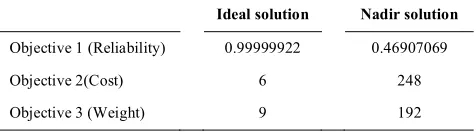
To solve the proposed model using compromise programming, data taken from Taboada and Coit [26] are considered which represent a serial parallel system composed of three subsystems and four or five component choices. In that example the reliabilities of the components are reported as specific values between 0 and 1. To make the example compatible with our proposed model whose components’ lifetimes follow Erlang distribution, the scale and shape parameters are determined such that those reliabilities are obtained. The scale and shape parameters are shown in Table 1 along with components’ costs and weights. Maximum number of allowable components is 8, the reliability of switch equals 0.99 and the mission time is 100 unit of time. To start with compromise programming, ideal and nadir
solutions need to be calculated. From ideal solution, we mean that for a maximization problem the maximum value is achieved and for a minimization problem the minimum value is obtained. These values are obtained through maximizing the reliability objective and minimizing the cost and weight objectives. On the other side, nadir solutions can be obtained by minimizing the problem which is of maximization type and maximizing the problem which has a minimization nature. The nadir solutions are obtained by minimizing the reliability objective and maximizing the cost and weight objectives. The model is solved using GAMS (General Algebraic Modeling System) version 23.8.2 and the nadir and ideal results are presented in Table 2. Solving the proposed model using the compromise programming technique results in different Pareto solutions which depend on the norm of the Lp metric and the weights of
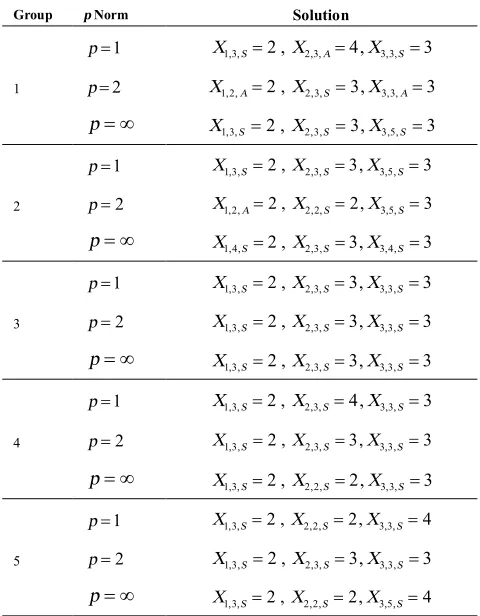
the objectives. The results are presented in Table 3 and Table 4 and also depicted in Figure 3.
TABLE 1. Experimental data
Subsystem 1
Component k l C W
1 1 0.000619 9 9
2 2 0.00499 6 6
3 2 0.00564 6 4
4 1 0.00287 3 7
5 1 0.00328 2 8
Subsystem 2
1 3 0.00665 12 5
2 3 0.01288 3 7
3 1 0.00356 2 3
4 1 0.00415 2 4
5 - - -
-Subsystem 3
1 1 0.000408 10 6
2 2 0.00564 6 8
3 1 0.00328 4 2
4 1 0.00342 3 4
5 1 0.004 2 4
TABLE 2. Ideal and Nadir local optimum solutions
Ideal solution Nadir solution
Objective 1(Reliability) 0.99999922 0.46907069
Objective 2(Cost) 6 248
TABLE 3. Experimental results with different Lp metrics and
weights (R: Reliability, C: Cost, W: Weight, D: Distance) Group W1 W2 W3 p Norm R C W D
1 0.5 0.3 0.2 1
=
p 0.9809 32 26 0.069
2
=
p 0.9618 30 27 0.086 ¥
=
p 0.9765 24 29 0.022
2 0.3 0.5 0.2 1
=
p 0.9765 24 29 0.072
2
=
p 0.9774 24 38 0.091 ¥
=
p 0.9477 21 35 0.031
3 0.4 0.3 0.3 1
=
p 0.9803 30 23 0.068
2
=
p 0.9803 30 23 0.073 ¥
=
p 0.9803 30 23 0.030
4 0.6 0.2 0.2 1
=
p 0.9854 32 26 0.057
2
=
p 0.9803 30 23 0.063 ¥
=
p 0.9854 30 28 0.021
5 0.7 0.2 0.1 1
=
p 0.9896 34 30 0.048
2
=
p 0.9803 30 23 0.059 ¥
=
p 0.9887 26 38 0.017
TABLE 4. The corresponding solutions for the results
presented in Table 3
Group p Norm Solution
1
1
=
p X1,3,S=2, X2,3,A=4,X3,3,S =3
2
=
p X1,2,A=2, X2,3,S=3,X3,3,A=3
¥ =
p X1,3,S =2,X2,3,S =3,X3,5,S=3
2
1
=
p X1,3,S=2,X2,3,S =3,X3,5,S=3
2
=
p X1,2,A=2,X2,2,S=2,X3,5,S=3
¥ =
p X1,4,S=2,X2,3,S =3,X3,4,S=3
3
1
=
p X1,3,S=2,X2,3,S=3,X3,3,S=3
2
=
p X1,3,S=2,X2,3,S=3,X3,3,S=3
¥ =
p X1,3,S=2,X2,3,S=3,X3,3,S=3
4
1
=
p X1,3,S=2, X2,3,S=4,X3,3,S=3
2
=
p X1,3,S=2,X2,3,S =3,X3,3,S=3
¥ =
p X1,3,S=2, X2,2,S =2,X3,3,S =3
5
1
=
p X1,3,S=2,X2,2,S=2,X3,3,S=4
2
=
p X1,3,S=2,X2,3,S=3,X3,3,S=3
¥ =
p X1,3,S=2,X2,2,S=2,X3,5,S=4
Figure 3. Pareto solutions
TABLE 5. L2 norm for Pareto solutions
Sol. L2 Sol. L2 Sol. L2
1 1.177 6 0.8 11 1.041
2 0.814 7 1.041 12 1.183
3 0.829 8 1.041 13 1.489
4 0.829 9 1.041 14 1.041
5 1.248 10 1.252 15 1.451
To decide about the best compromise solution amongst Pareto solutions, first, the objective functions are normalized through Equation (16), where, fmin(x)
i and fmax(x)
i are the minimum and maximum values for
) (x
fi in the Pareto optimal set on condition that all objectives are in minimization form. In other words, the reliability function is multiplied by -1 to be comparable with other objectives. The results for p=2 are shown in Table 5. The results show that solution 6 is the best compromise solution with the lowest L2 norm. The
resulted solution indicates that in order to design a highly reliable system with minimum cost and weight, the designer should set cold standby strategy as redundancy strategy for all subsystems. Redundancy levels should respectively be set to 2, 3, 3. And finally, redundancy types should respectively be considered as type 4, 3 and 4.
n i x f x f
x f x f
i i
i
i , 1,...,
) ( ) (
) ( ) (
min max
min
= "
-(16)
5. CONCLUSION
This paper presents a new nonlinear multi-objective model which maximizes system’s reliability concurrently with minimizing system’s cost and weight. The model involves choices of component types and redundancy strategies which can be in the forms of
0.94 0.96
0.98 1
20 25 30 35 20 25 30 35 40
Weight
active, cold-standby or no redundancy strategy. The main advantage of the proposed model is that the redundancy strategies and redundancy levels can be determined simultaneously. The multi-objective model has been dealt using compromise programming technique with different Lp metrics and results in Pareto
solutions indicating redundancy levels, redundancy strategies and component types. For future research, other mathematical programming technique can be implemented to deal with the proposed model. Furthermore, heuristic and meta-heuristic approaches can be employed to solve large-sized problems. Also, the model can be extended to allow component mixing, i.e. different component types can be allowed in a subsystem [28]. Considering the failure mode and effects analysis for detecting the most trouble making components or subsystems and incorporating it in the redundancy allocation problem is another research area which interested readers can follow [29].
6. REFERENCES
1. Coit, D. W. and Smith, A. E., "Reliability optimization of series-parallel systems using a genetic algorithm", Reliability, IEEE Transactions on, Vol. 45, No. 2, (1996), 254-260, 266. 2. Sadeghi, H., Makui, A. and Heydari, H., "Determining the
periodicity and planned lead time in serial-production systems with dependent demand and uncertain lead time", Uncertain Supply Chain Management, Vol. 1, No. 2, (2013), 87-98. 3. Sinaki, G., "Ultra-reliable fault-tolerant inertial reference unit for
spacecraft", Advances in the Astronautical Sciences, Vol. 86, No., (1994), 239-239.
4. Azaron, A., Katagiri, H., Kato, K. and Sakawa, M., "Reliability evaluation of multi-component cold-standby redundant systems", Applied Mathematics and Computation, Vol. 173, No. 1, (2006), 137-149.
5. Azaron, A., Perkgoz, C., Katagiri, H., Kato, K. and Sakawa, M., "Multi-objective reliability optimization for dissimilar-unit cold-standby systems using a genetic algorithm", Computers & Operations Research, Vol. 36, No. 5, (2009), 1562-1571. 6. Pandey, D., Jacob, M. and Yadav, J., "Reliability analysis of a
powerloom plant with cold standby for its strategic unit",
Microelectronics Reliability, Vol. 36, No. 1, (1996), 115-119. 7. Kumar, S., Kumar, D. and Mehta, N., "Behavioural analysis of
shell gasification and carbon recovery process in a urea fertilizer plant", Microelectronics Reliability, Vol. 36, No. 5, (1996), 671-673.
8. Hojjati-Emami, K., Dhillon, B. and Jenab, K., "Reliability prediction for the vehicles equipped with advanced driver assistance systems (adas) and passive safety systems (pss)",
International Journal of Industrial Engineering Computations, Vol. 3, No. 5, (2012).
9. Fyffe, D. E., Hines, W. W. and Lee, N. K., "System reliability allocation and a computational algorithm", Reliability, IEEE Transactions on, Vol. 17, No. 2, (1968), 64-69.
10. Ramirez-Marquez, J. E., Coit, D. W. and Konak, A., "Redundancy allocation for series-parallel systems using a max-min approach", IIE Transactions, Vol. 36, No. 9, (2004), 891-898.
11. Sun, X.-l., "An exact algorithm for optimal redundancy in a series system with multiple component choices", Journal of
Shanghai University (English Edition), Vol. 10, No. 1, (2006), 15-19.
12. Coit, D. W. and Konak, A., "Multiple weighted objectives heuristic for the redundancy allocation problem", Reliability, IEEE Transactions on, Vol. 55, No. 3, (2006), 551-558. 13. Salazar, D., Rocco, C. M. and Galván, B. J., "Optimization of
constrained multiple-objective reliability problems using evolutionary algorithms", Reliability Engineering & System Safety, Vol. 91, No. 9, (2006), 1057-1070.
14. Taboada, H. and Coit, D. W., "Data clustering of solutions for multiple objective system reliability optimization problems",
Quality Technology & Quantitative Management Journal, Vol. 4, No. 2, (2007), 35-54.
15. Taboada, H. A. and Coit, D. W., "Development of a multiple objective genetic algorithm for solving reliability design allocation problems", in Proceedings of the industrial engineering research conference. (2008).
16. Wang, Z., Chen, T., Tang, K. and Yao, X., "A multi-objective approach to redundancy allocation problem in parallel-series systems", in Evolutionary Computation, Congress on, IEEE. (2009), 582-589.
17. Mahapatra, G., "Reliability optimization of entropy based series-parallel system using global criterion method", Intelligent Information Management, Vol. 1, No. 3, (2009), 145-149. 18. Soylu, B. and Kapan Ulusoy, S., "A preference ordered
classification for a multi-objective max–min redundancy allocation problem", Computers & Operations Research, Vol. 38, No. 12, (2011), 1855-1866.
19. Khalili-Damghani, K. and Amiri, M., "Solving binary-state multi-objective reliability redundancy allocation series-parallel problem using efficient epsilon-constraint, multi-start partial bound enumeration algorithm, and dea", Reliability Engineering & System Safety, Vol. 103, No., (2012), 35-44.
20. Coit, D. W., "Cold-standby redundancy optimization for nonrepairable systems", IIE Transactions, Vol. 33, No. 6, (2001), 471-478.
21. Coit, D. W., "Maximization of system reliability with a choice of redundancy strategies", IIE Transactions, Vol. 35, No. 6, (2003), 535-543.
22. Tavakkoli-Moghaddam, R., Safari, J. and Sassani, F., "Reliability optimization of series-parallel systems with a choice of redundancy strategies using a genetic algorithm", Reliability Engineering & System Safety, Vol. 93, No. 4, (2008), 550-556. 23. Safari, J., "Multi-objective reliability optimization of series-parallel systems with a choice of redundancy strategies",
Reliability Engineering & System Safety, Vol. 108, (2012), 10-20.
24. Chambari, A., Rahmati, S. H. A. and Najafi, A. A., "A bi-objective model to optimize reliability and cost of system with a choice of redundancy strategies", Computers & Industrial Engineering, Vol. 63, No. 1, (2012), 109-119.
25. Azizmohammadi, R., Amiri, M., Tavakkoli-Moghaddam, R. and Mohammadi, M., "Solving a redundancy allocation problem by a hybrid multi-objective imperialist competitive algorithm",
International Journal of Engineering, Vol. 26, No. 9, (2013). 26. Zeleny, M., "Compromise programming", Multiple Criteria
Decision Making, (1973), 262-301.
27. Zelany, M., "A concept of compromise solutions and the method of the displaced ideal", Computers & Operations Research, Vol. 1, No. 3, (1974), 479-496.
28. Soltani, R., Sadjadi, S. J. and Tofigh, A. A., "A model to enhance the reliability of the serial parallel systems with component mixing", Applied Mathematical Modelling, (2013). 29. Razi, F., Danaei, A., Ehsani, A. and Dolati, C., "An fmea
A New Nonlinear Multi-objective Redundancy Allocation Model with the Choice of
Redundancy Strategy Solved by Compromise Programming Approach
S. J. Sadjadia, A. A. Tofighb, R. Soltania
a Department of Industrial Engineering, Iran University of Science and Technology, Tehran, Iran b Materials and Energy Research Center, Karaj, Iran
P A P E R I N F O
Paper history:
Received 28 May 2013
Received in revised form 15 August 2013 Accepted 14 September 2013
Keywords:
Redundancy Allocation Cold-Standby Redundancy Active Redundancy Multi-objective
Compromise Programming.
هﺪﯿﮑﭼ
ﺖﺳاﻪﻨﯾﺰﻫﻦﯾﺮﺘﻤﮐﺎﺑوﻻﺎﺑنﺎﻨﯿﻤﻃاﺖﯿﻠﺑﺎﻗﺎﺑﯽﻤﺘﺴﯿﺳﯽﺣاﺮﻃ،ﻢﺘﺴﯿﺳﯽﺣاﺮﻃردﻢﻬﻣﻞﺋﺎﺴﻣزاﯽﮑﯾ
.
يﺎﻫشورزاﯽﮑﯾ
ﺖﺳارﺎﮐﻪﺑهدﺎﻣآﺎﯾلﺎﻌﻓيﺎﻫﺖﻟﺎﺣرددازﺎﻣءﺰﺟﺖﺳﺎﯿﺳزاهدﺎﻔﺘﺳاﺎﻫﻢﺘﺴﯿﺳنﺎﻨﯿﻤﻃاﺖﯿﻠﺑﺎﻗﺶﯾاﺰﻓا
.
ﮏﯾﻪﻟﺎﻘﻣﻦﯾارد
ﺖﺳاهﺪﺷهدادﻪﻌﺳﻮﺗءاﺰﺟاعﻮﻧبﺎﺨﺘﻧاﺎﺑودازﺎﻣءﺰﺟيﮋﺗاﺮﺘﺳابﺎﺨﺘﻧاﺎﺑﺢﯿﺤﺻدﺪﻋﯽﻄﺧﺮﯿﻏوﻪﻓﺪﻫﺪﻨﭼﺪﯾﺪﺟلﺪﻣ
ﺖﺳا دﺮﺳرﺎﮑﺑهدﺎﻣآعﻮﻧزارﺎﮑﺑ هدﺎﻣآيﮋﺗاﺮﺘﺳا ﻪﮐيرﻮﻃﻪﺑ
.
يدﺎﻬﻨﺸﯿﭘﻪﻓﺪﻫ ﺪﻨﭼلﺪﻣ
،
ارﻢﺘﺴﯿﺳنﺎﻨﯿﻤﻃاﺖﯿﻠﺑﺎﻗ
ﻨﮐ ﯽﻣمﻮﻣﯽﻨﯿﻣارﻢﺘﺴﯿﺳﻪﻨﯾﺰﻫونزووﻢﻤﯾﺰﮐﺎﻣ
ﺪ
.
يﮋﺗاﺮﺘﺳا،ﯽﮕﻧوﺰﻓاحﻮﻄﺳنﺎﻣﺰﻤﻫرﻮﻃﻪﺑلﺪﻣﻦﯾاردﻦﯿﻨﭽﻤﻫ
دﻮﺷﯽﻣﺺﺨﺸﻣءاﺰﺟاعﻮﻧوﯽﮕﻧوﺰﻓا
.
ﻒﻠﺘﺨﻣيﺎﻫمﺮﻧﺎﺑﯽﻠﻣﺎﻌﺗيﺰﯾرﻪﻣﺎﻧﺮﺑﯽﺿﺎﯾرشورﺎﺑﻞﺻﺎﺣﻪﻓﺪﻫﺪﻨﭼلﺪﻣ
ﺖﺳاهﺪﺷﻪﺋاراﻮﺗرﺎﭘيﺎﻫباﻮﺟﻦﯿﺑزاباﻮﺟﻦﯾﺮﺘﻬﺑوهﺪﺷﻞﺣ
.