www.ijiset.com
360
Analytical Study on Seismic Performance of RC Frames
In-Filled With Masonry Walls Using E-Tabs
Anubama M P 1
P
, Gokul Ram HP 2
P
, Karthick BP 3
P
1
P
PG Student, Department Of Civil Engineering, CSI College Of Engineering, Ketti, Ooty.
31TU
P
2
P
Assistant Professor, Department Of Civil Engineering, CSI College Of Engineering, Ketti, Ooty
31TU
P
3
P
HOD, Department Of Civil Engineering, CSI College Of Engineering, Ketti, Ooty.
Abstract
Moderate and severe earthquakes have struck different places in the world, causing severe damage to reinforced concrete structures. Earthquake often effect the bond between the structural elements and masonry in-fills of the building. Masonry in-fills panels have been widely used as interior and exterior partition walls for aesthetic reasons and functional needs. When infill walls are omitted in a particular storey, a soft storey is formed. An infill wall enhances considerably the strength and rigidity of the structure. It has recognized that frames with in-fills have more strength and rigidity in conditions comparison to the bared frames. Hence the studies about the behavior of 3D-RC symmetric frames (G+10) located in seismic zone III is considered for different shape and dimension with and without masonry in-fills.
1.Introduction
The earthquake is a phenomenon that releases high amount of energy in a short time through the earth. Structures designed to resist moderate and frequently occurring earthquakes must have sufficient stiffness and strength to control deflection and prevent any possible collapse. In other words, a structure not only should dissipate a considerable amount of imported energy by ductile behavior, but also it should be able to control the deformations and transfer the force to foundation through enough lateral stiffness in ground motions
From the observations of damages of the past earthquakes, it is hard to digest the loss of greater number of human lives and to the properties. So this is due to the lack of proper design and understanding construction technique among both public and engineering domain. In order to thrive the knowledge on seismology, forums like NICEE-National Information Centre for Earthquake Engineering, NEEE-National Program for
Earthquake Engineering Education has been constituted by the ministry of HRD-Human Research Development, India.
The buildings, which had already been constructed is susceptible to face more seismic risk, due to the increased seismic vulnerability, hence proper evaluation of the building against seismic hazards is absolutely necessary.
The rapid industrialization and increase in population have called for optimum use of scarce land due to which multi-storey building have become inevitable. Apart from dead and live loads, the structures have to withstand lateral forces. Under the action of natural wind and earthquake a tall building will be continually buffeted by gusts and other dynamic forces.
From the extensive review of literature carried out, it has been found that no experimental work on single-bay, multi-storey Reinforced Concrete frame subjected to lateral loading has been done so far. In the project work an analytical work was carried out on a three bay, multi-storey R.C frame with different infill wall locations subjected to lateral loading.
www.ijiset.com
361
Most R.C frame buildings in developingcountries are in-filled with masonry walls. Experience during the past earthquakes has demonstrated the beneficial effects as well as the ill-effects of the presence of infill masonry walls. In at least two moderate earthquake (magnitude 6.0 to 6.5 and maximum intensity VIII on MM scale) in India, RC frame buildings with brick masonry in-fills have shown excellent performance even though most such buildings were not designed and detailed for seismic response.
Experimental and numerical research on the performance of the buildings during severe earthquakes, have indicated that structural over-strength plays a very important role in protecting buildings from collapse. The structural over-strength results from many factors and the most common sources of over-strength are material strength, confinement effect and member geometry and so on. 2. Literature Review
Jaya Prakash Kadali et al(2015) conducted study on static analysis of multistoried RC buildings by using pushover methodology. The frames with number of storey’s 4,6,8 and 10 all having 7 bays are designed and detailed as SMRF and OMRF as per IS 1893. A total of 10 frames are selected by varying number of storey’s, number of bays, infill wall configurations, and design methodology. The designs for SMRF buildings are done using IS13920. The storey height is 3.5m and bay width is 3m, which is same for all frames. The buildings are modeled and Pushover Analysis is performed in SAP. Pushover analysis is a static nonlinear procedure to analyze a building with the increase in the magnitude of loads, the weak links and failure modes of the building are found. Special Moment Resisting Frames (SMRF) are used as seismic force resisting systems in buildings to resist earthquakes. SMRF resist strong earthquake shaking without loss of stiffness or strength. The buildings designed as SMRF perform much better compared to the OMRF building. The ductility of SMRF buildings is almost 10 to 33% more than the OMRF buildings in all cases, the reason being the heavy confinement of concrete due to splicing and usage of more number of stirrups as ductile reinforcement. The base shear capacity of OMRF buildings is 7 to 28% more than that of SMRF buildings.
Md. Rashedul Kabir et al(2015) has determined response of multi-storey regular and irregular buildings of identical weight under static and dynamic loading in context of Bangladesh. 15 storied regular (rectangular, C shape and L-shape)
shaped and irregular (combination of rectangular, C-shape and L-C-shape) C-shaped buildings have been modelled using program ETABS 9.6 for Dhaka (seismic zone 2), Bangladesh. The effect of static load, dynamic load and wind load is analysed. The mass of the each buildings were considered the same. Displacement due to wind load is maximum in all type of buildings. Static and dynamic analysis gives less variation in displacement. The displacement obtained from static analysis is more when compared to dynamic analysis. The displacement increases with storey height. C shaped and L shaped structure has higher displacement. Rectangular and irregular shaped structure show almost similar displacement against wind load as the total mass is constant.
Haroon Rasheed Tamboli et al(2014) presented a paper on “Seismic Analysis Of RC Frame Structure With And Without Masonry Infill Walls”. This paper deals with the frames with three different infill configurations subjected to dynamic loading. The seismic analysis is performed using equivalent lateral force method and equivalent strut method using ETABS software. The parameters discussed were time period, natural frequency base shear and storey drift. This paper results that the in-filled frames increases the storey drift and also infill frame increases the strength and stiffness of the structure
Mohammad H. Jinya et al(2014) studied the seismic behavior of RC frame building is analyzed by performing multi-model static and dynamic analysis. The results of bare frame, masonry infill panel with outer wall opening, and soft storey are discussed. The conclusions made in this study is infill wall( diagonal strut) change the seismic performance of RC building. Storey drift and displacement were decreased. It is suggested that at least soft storey should be provided with outer masonry infill panel to increase stiffness of soft storey.
www.ijiset.com
362
reduced significantly in in-filled frame compared tothe deflection of the frame without infill.
Riza Ainul Hakim et al (2014) published a paper on “Seismic Assessment Of RC Building Using Pushover Analysis”. This paper investigates the building performance on resisting seismic loading. And for the analysis 3D frames were investigated using pushover analysis according to ATC-40. The frames were designed according to design practice that considers only gravity load and the other frame was designed according to the Saudi building code (SBC-301). Analysis is carried out using SAP2000. And from the test results, it was observed that the building designed considering only gravity load was found to be inadequate. And also it was noted that the building designed according to SBC-301satisfies the acceptance criteria according to ATC-40.
Shaharbon P.S et al (2014) conducted a “Study On Behavior Of RC Frame With Infill Walls Under Seismic Loads Using ETABS”. This paper deals with the performance of masonry in-filled RC frames under brick wall condition. Analytical investigations were conducted under cyclic loading. Five different types of models were analyzed with four different in-filled conditions. The parameters studied were time period, natural frequency, base shear and storey drift. The results furnished were in case of open storey frame structure, the storey drift is very large than upper storey that may cause collapse during strong earthquake. And so, infill frames will be better to prefer in seismic region and also it results having a less displacement.
. Kulkarni, P.B et al (2013) suggested a paper on “Linear Static Analysis Of Masonry In-filled RC Frame with and without Opening Including Open Ground Storey”. In this paper, symmetrical frame of building (G+5) located in seismic zone III is considered. With reference to FEMA 273 and ATC 40 the provision of calculation of stiffness of in-filled frames by modeling infill as an equivalent diagonal strut method. And the frames were subjected to linear static analysis performed using STAAD PRO and different parameters were computed. The results obtained from this study was it shows that infill panels increases the stiffness of the structure and while the increase in the opening percentage leads to decrease on the lateral stiffness of in-filled frame.
Md. Irfafanullah et al(2013) conducted a study on “Seismic Evaluation Of RC Framed Buildings With Influence Of Masonry Infill Panel”. This paper deals with study on behavior of RC frames and to observe the effect of masonry infill panel, it is modeled as an
equivalent diagonal strut using ETABS. In order to study, six RC framed buildings with brick masonry in-fills were designed with different configurations, subjected to earthquake loading and comparison of results is made between them. The results observed were, providing infill below plinth and in swastika pattern in the ground floor improves earthquake resistant behavior of the structure when compared to soft storey. And it was concluded that the provision of infill wall enhances the performance in terms of storey displacement and storey control and increase in lateral stiffness.
Mohd Zulham Affandi et al(2012) has assessed an “Evaluation Of Over-strength Factor Of Seismic Designed Low Rise RC Buildings”. Six frame models regular and irregular in elevation, each are designed to gravity load only and designed to resist seismic load with medium ductility and high ductility class. The nonlinear static analysis or also known as pushover analysis (POA) is used to determine the performance of the buildings. Based on their work, the seismic designed building has greater load carrying-capacity, top displacement capacity and ductility supply compared to the gravity load designed buildings and the over-strength factor increases as the ductility supply of the building increases
Mulgund G.V (2012) investigated a paper on “Seismic Assessment Of RC Frame Buildings With Brick Masonry In-fills”. Is this paper deals with five reinforced RC framed building with brick infill were designed for seismic hazard in accordance with is code taking into consideration of effect of masonry. And also investigation has been made to study the behavior of RC frames with various configuration of infill when subjected to dynamic earthquake loading. The comparison is made between the results of bare frame and frame with infill effect. The results furnished were the calculation of earthquake forces by treating RC frames as ordinary frames without regards to infill leads tom under estimation of base shear. Therefore it is essential for the structural system to be selected with in-filled walls.
www.ijiset.com
363
and compared with models. The results concludedthat the infill walls reduce displacement, time period and increases base shear. And so it is essential to consider the effect of masonry infill for the seismic evaluation of moment resisting reinforced concrete frame.
Alessandra Fiore et al (2012) conducted a paper on “The Influence of Masonry Infill on the Seismic Behavior of RC Frame Buildings”. This paper provides a simple tool able to reproduce the effect of in-fills in global and local response of a building under earthquake loads. Finite element analyses were performed comparing the results to experimental data in order to evaluate the local effects of the frame. Two parallel struts are set in each frame according to most significant parameter. The result obtained by this test is partially in-filled building, in order to underline the proposal approach and to compare it to other methods available in codes.
Manos.G.C et al (2012) presented a paper on “The Behavior of Masonry Assemblages and Masonry In-filled RC Frames Subjected to Combined Vertical and Horizontal Seismic Type Loading”. In this study the masonry in-filled reinforced concrete frames are subjected to combined vertical and horizontal loads. And to validate different modeling techniques for the numerical simulation of non linear behavior of masonry joints under shear loading. And also it examined the influence of different forms of interface between the masonry infill and the surrounding RC frame and also examines the influence of stiffness, load bearing capacity. From the analysis it is observed that numerical simulation of masonry in-filled RC frames having their infill repaired with reinforced plasted and there is a increase in stiffness strength and energy dissipation due to presence of partially reinforced masonry in-fills.
Kashif Mahmud et al (2010) presented a paper on “Study The Reinforced Concrete Frame With Brick Masonry Infill Due To Lateral Loads”. This paper studies about the behavior of reinforced concrete frames with brick masonry infill for various parametric changes and their influence in deformation patterns of the frame were observed. And also it deals to find the effect of soft storey on frame structures due to horizontal loading. The analysis of the frame structures is carried out by using ANSYS 5.6. And this analyses results that when the number of bay increases the deflection eventually decreases. And also it is found that when the beam and column size increases the deflection pattern decreases with increased stiffness. And it recommends analyzing the cost-benefit to find out the
relative economy that may be achieved if infill is considered as a structural element.
Hemant B. Kausik et al(2009) suggested a paper on “Effectiveness Of Some Strengthening Options For Masonry Infill RC Frames With Open First Storey”. For this study, several strengthening schemes were evaluated for their effectiveness in improving the performance of buildings, based on non-linear analysis of RC frames. And also some other strengthening schemes were studied by providing additional column, diagonal bracings and lateral buttress in open first storey. From the results obtained, it was concluded that only there was increase in lateral strength of such frames and also found to improve both lateral strength and ductility for improved seismic performance based on methods provided by codes.
Matjaz Dolsek et al (2008) conducted a paper on “The Effect Of Masonry In-fills On The Seismic Response Of A Four Storey Reinforced Concrete Frame”. In this paper the seismic performance assessment of three variants of four storey reinforced concrete frame is carried out that includes bare frame, frame with masonry infill and one with openings and other without them and the frames are subjected to dynamic loading. The results of the analyses indicates that the probability of failure of the in-filled frames with regularly distributed infill is smaller than that of bare frame. And the two in-filled frames, the one with openings in the infill has a higher probability of failure.
Samaresh Paikara et al(2006) published a paper on “Confining Masonry Using Pre-Cast RC Element For Enhanced Earthquake Resistance”. This paper investigated the seismic behavior of confinement schemes on infill walls on URM using RC precast grid elements. For this study Both analytical and experimental work was carried out by finite element model using ABAQUS and experimental work was based on pseudo-static cyclic tests. It was concluded from the experimental results were the grid elements provide guided shearing plane for siding of masonry panels under lateral loads. And thereby increasing the energy dissipation potential of the frames. And it was also observed that the experimental results and analytical results was seen to be matched.
www.ijiset.com
364
concrete frames strengthened by introducing partialin-fills. The test results that partially in-filled RC frame exhibits significantly higher ultimate strength and higher initial stiffness than bare frame. And also it is observed that the aspect ratio of infill wall was increased, the lateral strength and rigidity were also increased. And it shows that the partial infill walls both connected to the column and beam of the frame showed the most successful behavior
C.V.R Murty et al (2000) investigated a paper on “Beneficial Influence of Masonry Infill Walls on Seismic Performance of RC Framed Buildings”. This paper presents some experimental results on cyclic test of RC frames with masonry in-fills and some of the parameters were observed. The specimens tested includes bare frame and frames with in-filled frames with different infill configurations. From the test results it is observed that the masonry in-fills contribute significant lateral stiffness, strength, over all ductility and energy dissipation capacity.
1.2 Analytical model:
G+10 buildings are assumed to be symmetric in plan, and regular in elevation
The frame is designed as per prevailing practice in India. Seismic loads are estimated as per IS 1893 (2002). The dead and live loads are calculated using IS 875 Part 1 (1987) and lateral loads are calculated as per IS 1893(2002).
Four models were considered for study with different infill configurations
Model 1. Fully Rectangular Column Case (1). Bare Frame
Case (2). With soft storey Case (3).Without soft storey. Model 2. Fully Circular Column Case (1). Bare Frame
Case (2). With soft storey Case (3).Without soft storey.
Model 3. Outer Rectangular and Inner Circular Column
Case (1). Bare Frame Case (2). With soft storey Case (3).Without soft storey.
Model 4. Inner Rectangular and Outer Circular Column
Case (1). Bare Frame Case (2). With soft storey Case (3).Without soft storey
Model (1) Fully Rectangular Column Frame
case(1) Bare Frame
Case (2) With soft storey
www.ijiset.com
365
Model (2) Fully Circular Column FrameCase(1) Bare Frame
Case (2) With soft storey
Case(3) Without soft storey
Model (3). Outer Rectangular and Inner Circular Column Frame
Case (1) Bare Frame
Case (2) With soft storey
www.ijiset.com
366
Model (4). Outer Circular and Inner Rectangular Column Frame
Case (1) Bare Frame
Case (2) With soft storey
Case(3) Without soft storey
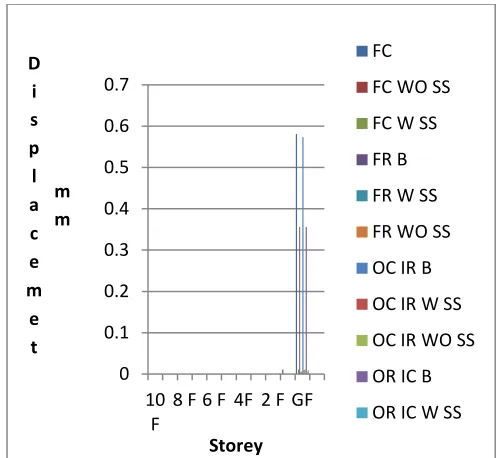
Comparson of parametres
Fig 1.Displacement of the frame
Fig 2.Drift of the frame 0
0.1 0.2 0.3 0.4 0.5 0.6 0.7
10
F 8 F 6 F 4F 2 F GF
D i s p l a c e m e t
m m
Storey
FC FC WO SS FC W SS FR B FR W SS FR WO SS OC IR B OC IR W SS OC IR WO SS OR IC B OR IC W SS
0 0.1 0.2 0.3 0.4 0.5 0.6 0.7
10
F 8 F 6 F 4F 2 F GF
D r i f t
Storey
www.ijiset.com
367
Fig 3.Overturning Moment of the frame
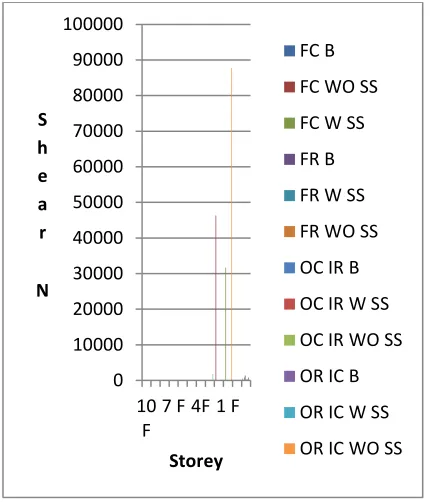
Fig 4.Storey Shear of the frame
Fig 5.Storey Stiffness of the frame
CONCLUSION
• The presence of infill wall can affect the seismic behavior of frame structure to large extend.
• Infill wall increases the strength and stiffness of the structure upto 20%.
• When considering the infill wall the root displacement of the structure reduces and stiffness of the structure increases. The masonry infill wall is more significant in small structures.
• The displacement is found to be more in the structure where the in-fills are not present.
• When the height of the structure increases, the effect of masonry infill wall reduces.
• The storey drift for all models satisfy the permissible limit 0.004*h, where h is the storey height as per IS1893.
• According to relative value of all parameters it can be concluded that provision of infill wall enhances the performance in terms of storey displacement, drift control and increase in lateral stiffness.
0 10000 20000 30000 40000 50000 60000 70000 80000 90000 100000 10
F 7 F 4F 1 F
S h e a r N Storey FC B FC WO SS FC W SS FR B FR W SS FR WO SS OC IR B OC IR W SS OC IR WO SS OR IC B OR IC W SS OR IC WO SS
0 10000 20000 30000 40000 50000 60000 70000 80000 90000 100000
10 F 8 F 6 F 4F 2 F GF
S t i f f n e s s K N / m Storey FC B FC WO SS FC W SS
FR B
FR W SS
FR WO SS OC IR B
OC IR W SS OC IR WO SS OR IC B 0 100 200 300 400 500 600 10
F 9 F8 F7 F6 F 5F 4F 3 F2 F1 FGF B
www.ijiset.com
368
REFERENCES1. Alessandra Fiore, Andriana Netti, Pietro Monaco (2012), “The Influence of Masonry Infill on the Seismic Behavior of RC Frame Buildings” Engineering structures, volume 44, pp:133-145.
2. Book of Earthquake tips by C.V.R Murthy, Indian Institute Of Technology, Kanpur. 3. Haroon Rasheed Tamboli, Umesh.N.Karadi
(October 2014) “Seismic Analysis Of RC Frame Structure With And Without Masonry Infill Walls” Indian Journal Of Natural SciencesVolume 3, Issue 14, pp:1137-1148. 4. Hemant B. Kausik, Durgesh C Rai, Sudhir K
Jain (2009) “Effectiveness of Some Strengthening Options for Masonry Infill RC Frames with Open First Storey” Journal Of Structural Engineering (2009) volume 135, issue 8, pp: 212-220.
5. IS 1893 (Part 1): 2002 Indian Standard Criteria for Earthquake Resistant Design of Structures, Bureau of Indian Standards, New Delhi 110002.
6. Jaya Prakash Kadali, Rathnam M.K.M.V.
January 2015 Static Analysis of
Multistoreyed RC Buildings By Using Pushover Methodology International Journal for Innovative Research in Science & Technology Volume1,Issue 8, pp113-124.1989.
7. Kashif Mahmud, Md.Rashadul Islam, Md.Al-Amin (2010), “Study The Reinforced Concrete Frame With Brick Masonry Infill Due To Lateral Loads” International Journal Of Civil And Environmental EngineeringVolume 10, Issue 4.
8. Kulkarni P.B., Pooja Raut, Nikhil Agarwal (2013), “Linear Static Analysis Of Masonry In-Filled RC Frame With And Without Opening Including Open Ground Storey” International Journal Of Innovative Research In Science, Engineering And TechnologyVolume 2, Issue 6, pp2215-2223
9. Md. Rashedul Kabir, Debasish Sen, Md. Mashfiqul Islam February 2015 “Response of multi-storey regular and irregular buildings of identical weight under static and dynamic loading in context of Bangladesh,” International journal of Civil and Structural Engineering, Volume 5, No 3, , pp 252-260.
10. Md.Irfanullah,
Vishwanath.B.Patil(September 2013), “Seismic Evaluation Of RC Framed Buildings With Influence Of Masonry Infill Panel” International Journal Of Recent Technology And Engineering Volume2, Issue 4, pp 117-120
11. Mohammad H. Jinya (2014), “Seismic Behavior Of RC Frame Building Is Analyzed By Performing Multi-Model Static And Dynamic Analysis”, International Journal Of Research In Engineering And Technology volume 4, issue 5, pp 411-414.
12. Mohd Zulham Affandi, Mohd Zahid, Debbie Robert, Fatehah Shahrin (2012), “Evaluation Of Over-strength Factor Of Seismic Designed Low Rise RC Buildings”, Malaysian Technical Universities Conference On Engineeringvolume 53, pp:48-51.
13. Monos G.C., Soulis V.J.,.Thauampteh J (2012), “The Behavior Of Masonry Assemblages And Masonry In-Filled RC Frames Subjected To Combined Vertical And Horizontal Seismic Type Loading” Advances in engineering softwarepp:35-41.s 14. Mulgund.G, Kulkarni.A.B (2011), “Seismic Assessment Of RC Frame Buildings With Brick Masonry In-fills” International Of Advanced Engineering, Science And Technology Volume 2, Issue 2, pp 140-147. 15. Murty C.V.R, Sudhir.K.Jain (2000),