IJE Transactions B: Applications Vol. 23, Nos. 3 & 4, December 2010 -
215
ANALYTICAL SOLUTION OF THE LAMINAR BOUNDARY
LAYER FLOW OVER SEMI-INFINITE FLAT PLATE: VARIABLE
SURFACE TEMPERATURE
D. D. Ganji
*Department of Mechanical Engineering, Babol Noshirvani University of Technology P.O. Box 484, Babol, Iran
K. Babaei
Department of physics, University of Mazandaran, P.O. Box 47415, Babolsar, Iran [email protected]
M. Khodadadi
Mazandaran Electricity Distribution Network Company, Mazandaran, Sari, Iran Email
*Corresponding Author
(Received: July 12, 2099 – Accepted in Revised Form: November 11, 2010)
Abstract In this paper, the problem of forced convection over a horizontal flat plate under condition of variable plate temperature is presented and the homotopy perturbation method (HPM) is employed to compute an approximation to the solution of the system of nonlinear differential equations governing the problem. This paper provides good supplements to the existing literature and generalizes the previous investigation of the problem under condition of fixed plate surface temperature. It is shown that HPM is accurate and reliable with high acceleration in converging.
Keywords Homotopy perturbation method (HPM); Nonlinear differential equations; Laminar thermal boundary layer; Forced convection ; Horizontal flat plate; Variable surface temperature
ﮑﭼ
ﯿ
هﺪ
ارد ﯾ ﺎﺠﺑﺎﺟﻪﻟﺎﺴﻣ ﻪﻟﺎﻘﻣﻦ ﯾ
ﯽ رﺎﺒﺟا ي ورﺮﺑ ي ﯾ ﻘﻓاﺢﻄﺴﻣ ﻪﺤﻔﺻﮏ ﯽ
ﺎﻫﺎﻣدرد ي حﺮﻄﻣﻪﺤﻔﺻﻒﻠﺘﺨﻣ
اشوروهﺪﺷ لﻼﺘﺧ
ﭘﻮﺗﻮﻤﻫ ﯽ اﺮﺑ ي ﺮﻘﺗباﻮﺟﻪﺒﺳﺎﺤﻣ ﯾﺒ
ﯽ ﺳ ﯿ دتﻻدﺎﻌﻣ ﻢﺘﺴ ﯾ
ﺴﻧاﺮﻔ ﯿ ﻏﻞ ﯿ ﻄﺧﺮ ﯽ ﻣﻪﺘﻓﺮﮔرﺎﮐﻪﺑ ﯽ
دﻮﺷ
.
ﺎﺘﻧ ﯾ ازاهﺪﻣآ ﺖﺳدﻪﺑﺞ ﯾ
ﻘﺤﺗﻦ ﯿ ﻤﮑﺗﻖ ﯿ ارددﻮﺟﻮﻣنﻮﺘﻣ هﺪﻨﻨﮐﻞ ﯾ
ﻣزﻦ ﯿ وهدﻮﺑﻪﻨ ﺳرﺮﺑ
ﯽ ﺎﻫ ي ﻠﺒﻗ ﯽ درﻮﻣرد
اﯾ اﺮﺷردﻪﻟﺎﺴﻣﻦ ﯾ
ﺎﻣد ﻂ ي ﻣﻮﻤﻋ ارﺢﻄﺳﺖﺑﺎﺛ ﯿ
ﻣﺖ ﯽ ﺪﺸﺨﺑ
.
ﺎﺘﻧ ﯾ ﻣنﺎﺸﻧﺞ ﯽ اشور ﺪﻫد لﻼﺘﺧ
ﭘﻮﺗﻮﻤﻫ ﯽ ﺷور ﯽ
ﻗد ﯿ ﻤﻃاﻞﺑﺎﻗوﻖ ﯿ
ﺎﺠﺑﺎﺟﻪﻟﺎﺴﻣردﻻﺎﺑﺖﻗدﺎﺑنﺎﻨ ﯾ
ﯽ ﻣ ﯽ ﺪﺷﺎﺑ
.
1. INTRODUCTION
Most of scientific problems are modeled using differential equations such as ordinary differential equations, partial differential equations, fractional differential equations, algebraic differential equations and integro-differential equations. In general, despite a limited number of cases, most of them do not have analytical solution. The equations which govern the boundary layer problems don’t have exact solutions and require to be solved by semi-exact analytical or numerical methods. Numerical techniques have their merits and demerits in special cases. In the numerical methods, stability and convergence should be
considered so as to avoid divergence or inappropriate results. One of these semi-analytical methods is perturbation method. In this method, a small parameter should be exerted in the equation. Therefore, finding the small parameter and exerting it into the equation are difficulties of this method. Since there are some limitations with the common perturbation method, and also because the basis of the common perturbation method is upon the existence of a small parameter, developing the method for different applications is very difficult[1].
homotopy perturbation method [4,5], and variational iteration method [6–8] introduced by He. Homotopy perturbation method is one of these semi-exact analytical methods [9–21]. The applications of this method in different fields of nonlinear equations, integro-differential equations, Laplace transform, fluid mechanics and heat transfer have been studied by Cai [22], Cveticanin [23], El-Shahed [24], Abbasbandy [25], Siddiqui [20,21] and Ganji [26–28]. In this paper, He’s homotopy perturbation method is applied to the problem of forced convection over a horizontal flat plate under variable surface temperature condition, to obtain an approximate Solution.
In the flow with inertia effects the equations of motion is nonlinear. Fluid flow around a body can be divided into two parts: a thin layer close to the body which the friction forces play an important role in it and the other is the outer layer which is not considered as friction force. It is supposed that friction turns our problem into a boundary layer problem. Viscosity is one of the main sources of friction forces in a flow. The Reynold’s number determines whether a flow is laminar or not. In low Re the flow is laminar but in high Re it is not. So the results of flow based on Re number will be completely different (Figure 2). Applications of boundary layers are in pipe lines, aerodynamics (designing war planes, spacecrafts, etc) and so on.
Nomenclature Nomenclature
HPM homotopy perturbation method NM numerical method
p parameter of homotopy Pr Prandtl number Re Reynolds number T temperature
Ts temperature imposed on the plate
T∞ local ambient temperature
C constant
f dimensionless function of velocity u velocity component in the x direction v velocity component in the y direction y dimensional vertical coordinate
Greek symbols
ν kinematic viscosity α thermal diffusivity θ dimensionless temperature α constant
η dimensionless variable similarity solution
2. BASIC IDEAS OF HOMOTOPY PERTURBATION METHOD
The homotopy perturbation method (HPM) is a combination of the classical perturbation technique and homotopy technique. To explain the basic ideas of the HPM for solving nonlinear differential equations, the following nonlinear differential equation is considered:
( )
( ) 0,
A u
-
f r
=
r
ÎW
(1) subject to the boundary condition of:( ,
/
) 0,
B u u
¶ ¶ =
n
r
ÎG
(2) whereA
is a general differential operator,B
a boundary operator,f r
( )
is a known analytical function,G
is the boundary of domainW
andn
u


denotes differentiation along the normal drawn outwards from
W
. The operatorA
can generally be divided into two parts: a linear part,L
, and a nonlinear part , N . Eq. (1) therefore can be rewritten as follows:( )
( )
( ) 0
L u
+
N u
-
f r
=
(3) In this case the nonlinear Eq. (1) has no “small parameter”, so the following homotopy can be constructed:0
( , ) (1 )[ ( ) ( )] [ ( ) ( ) ( )] 0 H u p = -p L u -L u +p L u +N u -f r = (4)
IJE Transactions B: Applications Vol. 23, Nos. 3 & 4, 2010 -
217
20 1 2
( )
u p =u +pu +p u +L (5-a)
0 1 2
1
lim ( )
p
u
u p
u
u
u
®
=
=
+ + +
L
(5-b) Whenp
® ¥
, Eq. (4) corresponds to Eq. (1), andEq. (5b) becomes the approximate solution of Eq. (1).
3. GOVERNING EQUATIONS
A uniform flow over a semi-infinite flat plate is shown in Figure1. Surface temperature varies with axial distance x according to the following equation:
( )
s
T x T C xa ¥
= + , (6) where C and aare constants and
T
¥ is free stream temperature [29-35].Laminar flow starts at the leading edge of a flat plate and continues until a Reynolds number of about 350,000, depending upon the surface roughness and the degree of turbulence (see App. Figure 2).
Figure 1: Velocity and thermal boundary layers
3.1. Summary of boundary layer equations for steady laminar flow The more general equations for any 2-dimentional flow are given by:
2
0 2
0
dp
u
u
u
u
v
x
y
y
dx
u
v
x
y
r
n
ì æ

+

ö
=

-ï ç


÷

ï è
ø
í


ï
+
=
ï


î
(7)
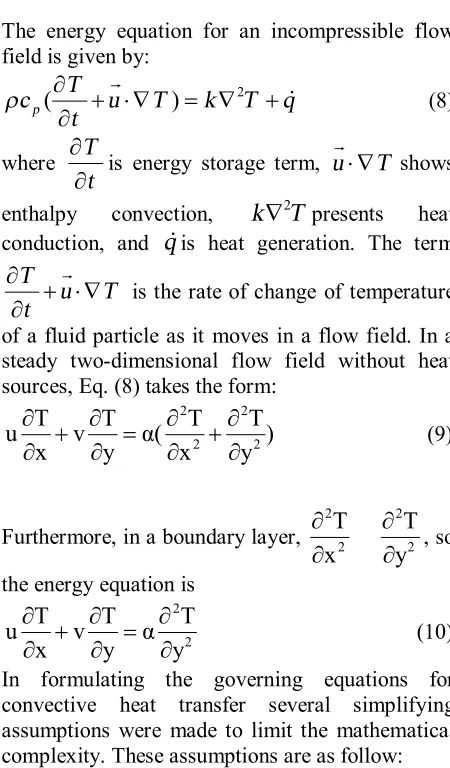
The energy equation for an incompressible flow field is given by:
2
(
)
p
T
c
u
T
k T q
t
r

+ ×Ñ
= Ñ
+

r
&
(8)where
T
t


is energy storage term,u
×Ñ
T
r
shows enthalpy convection,
k T
Ñ
2 presents heat conduction, andq
&
is heat generation. The termT
u
T
t

+ ×Ñ

r
is the rate of change of temperature of a fluid particle as it moves in a flow field. In a steady two-dimensional flow field without heat sources, Eq. (8) takes the form:
2 2
2 2
T
T
T
T
u
v
α
(
)
x
y
x
y


+
=
+


(9)Furthermore, in a boundary layer,
2 2
2 2
T
T
x
y


, sothe energy equation is
2
2
T
T
T
u
v
α
x
y
y


+
=


(10)In formulating the governing equations for convective heat transfer several simplifying assumptions were made to limit the mathematical complexity. These assumptions are as follow: (1) Flow is continuous,
(2) Flow is a Newtonian fluid,
(3) Flow is considered in two-dimension,
(4) Negligible changes in kinetic and potential energy and constant properties are considered.
The additional assumptions leading to boundary layer simplifications are:
(5) Slender surface,
(6) High Reynolds number (Re > 100), and high Peclet number (Pe > 100).
Finally, the following additional simplifications are introduced:
(7) Steady state flow, (8) Laminar flow,
218
- Vol. 23, Nos. 3 & 4, December 2010 IJE Transactions B: Applications The governing boundary layer equations byassuming these conditions and considering constant pressure
(
dp
0)
dx
=
are:u v 0 x y ¶ +¶ = ¶ ¶ , 2 2
y
u
ν
y
u
v
x
u
u


=


+


, (11)
2 2
y
T
α
y
T
v
x
T
u


=


+


,the boundary conditions are as follow:
( , 0) 0, ( , 0) 0, ( , ) , (0, )
u x = v x = u x ¥ =V u¥ y =V¥(11-a) ( , 0) s , ( , ) , (0, )
T x T T C xa T x T T y T
¥ ¥ ¥
= = + ¥ = = (11-b)
3.2. Velocity distribution (Blasius similarity solution method) For this problem, transformation variable η is:
( )
Re
xx
y
ν
x
V
y
y
x,
η
=
¥=
(12)and the velocity u(x, y) is assumed to depend on η according to the following equation:
¥ V u
=
h ¶ ¶f, (13)
From continuity Eq. (11), the velocity is obtained:
=
v
d
y
x
u
ò


-
, (14)from Eq.(12), dy is:
d
η
V
ν
x
dy
¥=
(15)using the chain rule, the derivative
x
u


is expressed
in terms of η ,
dx dη dη du x u = ¶ 
, and using Eq. (12) and (13) the following equation is obtained:
2 2
2
x
u
h
h
d
f
d
x
V
¥-=


(16)Substituting Eq. (15) and (16) into Eq. (14) and rearranging expression gives:
h
h
h
n
d
d
f
d
x
V
¥ò
¥
=
2 22
1
V
v
(17)
Integration by parts gives:
÷÷
ø
ö
çç
è
æ
-=
¥ ¥f
d
df
x
V
h
h
n
2
1
V
v
(18)In addition to
u v
, ,
anddx
du
, the derivatives dy du
and 2
2
dy
u
d
must be expressed in terms of
h
. Using the chain rule and Eq. (12) and (13), we obtain: 2 2y
y
y
h
h
d
f
d
vx
V
V
u
u
¥ ¥=


=


(19) 3 3 2 2y
u
h
n
d
f
d
x
V
V
¥ ¥=


(20)Substituting Eq. (12), (13), and (16)-(20) into momentum Eq. (11) gives:
2
f
¢¢¢
+
f f
¢¢
=
0
(21) Thus, the governing partial differential equations are successfully transformed into an ordinary differential equation. Using Eq. (12)-(18), boundary conditions (11-a) transform into:(0) 0,
(0) 0,
( ) 1
f
¢
=
f
=
f
¢
¥ =
(22)0
(0) 0,
0(0) 0,
0( ) 1,
0(0) 1,
0( ) 0
f
=
f
¢
=
f
¢
¥ =
q
=
q
¥ =
(33-a)1
:
p
0 0 1
1
0
2
f f
f
ì
¢¢
+ =
¢¢¢
ïï
IJE Transactions B: Applications Vol. 23, Nos. 3 & 4, 2010 -
219
3.3. Temperature distribution (Pohlhausen similarity solution method) The solution to energy equation is obtained by the method of similarity transformation. A dimensionless temperature q is defined as:
( )
¥ ¥
-=
T T
T y) T(x, y
x,
θ
s
(23) To solve energy Eq. (11) using the similarity
method, the two independent variables x and
y
are combined into a single variable,h
( , )
x y
. For this problem the correct form of the transformation variableh
is the same as that used in Blasius solution:( )
vx
V
y
y
x,
η
=
¥ (24)
The solution
q
( , )
x y
is assumed to depend onh
so that Eqs. (12)-(18) and (24) gives:(
)
αs
T T
=
¥+
T
-
T
¥θ
=
T
¥+
Cx
θ
(25)dη
dθ
2x
η
Cx Cα
dx dθ
Cx
θ
Cα
x
T α1 α α 1 α ÷
ø ö ç è æ -+ =
+ =

¶ x - x- (26)
d
η
d
θ
ν
x
V
Cx
dy
d
θ
Cx
y
T
=
α=
α ¥

(27)
2 2 α 2 2
d
η
θ
d
ν
x
V
Cx
y
T
=
¥

(28)
substituting Eqs.(26)-(28) into energy Eq. (11) simplifies it to:
1
Pr
Pr
0
2
f
f
q
¢¢
-
a
¢
q
+
q
¢
=
(29)
where
Pr
v
a
=
. Boundary conditions (11-b) become:(0) 1, ( ) 0
q
=
q
¥ =
(30-a) for a =0, the Eq. (29) simplifies to:1
Pr
0
2
f
q
¢¢
+
q
¢
=
(30-b)4. APPLYING HPM TO THE PROBLEM
In this section, the HPM was applied to the nonlinear ordinary differential system (21) and (29). According to the HPM, the homotopy of system (21) and (29) were constructed as follows:
0
0
(1 )[ ] [2 ] 0,
1
(1 )[ ] [ Pr Pr ] 0.
2
p f f p f ff
p q q pq a f q f q
¢¢¢ ¢¢¢ ¢¢¢ ¢¢
- - + + =
ì ï
í - ¢¢- ¢¢ + ¢¢- ¢ + ¢ = ïî
(31)
f
andq
were considered as:2 3
0 1 2 3
2 3
0 1 2 3
f
f
pf
p f
p f
p
p
p
q q
q
q
q
ì = +
+
+
+
í
=
+
+
+
+
î
L
L
(32)by substituting
f
and q from Eq. (32) into Eq. (31), doing some simplification, and rearranging based on powers of p-terms, we have:0
:
p
00
0
0
f
q
¢¢¢=
ì
í ¢¢=
(34-a)
1
(0) 0, (0) 0, ( ) 0, (0) 0, ( ) 0
1 1 1 1f
=
f
¢
=
f
¢
¥ =
q
=
q
¥ =
(35)
2 1 0 0 1
2 0 1 1 0 1 0 0 1
1
1
0
2
2
1
1
Pr
Pr
Pr
Pr
0
2
2
f
f f
f f
f
f
f
f
q
q
q a
q a
q
ì
¢¢¢
+
¢¢
+
¢¢
=
ïï
í
ï ¢¢
+
¢
+
¢
-
¢
-
¢
=
ïî
2:
p
(35-a)
2
(0) 0,
2(0) 0,
2( ) 0,
2(0) 0,
2( ) 0
f
=
f
¢
=
f
¢
¥ =
q
=
q
¥ =
(36)
3 2 0 0 2 1 1
3 0 1 0 2 2 0 1 1 0 2 2 0
1
1
1
0
2
2
2
1
1
1
Pr
Pr
Pr
Pr
Pr
Pr
0
2
2
2
f
f f
f f
f f
f
f
f
f
f
f
q
q
q
q a
q a
q a
q
ì
¢¢¢
+
¢¢
+
¢¢
+
¢¢
=
ïï
í
ï ¢¢
+
¢
+
¢
+
¢
-
¢
-
¢
-
¢
=
ïî
3:
p
(36-a)
3
(0) 0,
3(0) 0,
3( ) 0,
3(0) 0,
3( ) 0
f
=
f
¢
=
f
¢
¥ =
q
=
q
¥ =
by solving Eqs. (33)–(36) with boundary conditions (29-a)–(32-a), we obtain:
(37)
2
0 0.1
f = h
(38)
2 4 5
1 0.052 1.6 10
f = h - ´ - h
(39)
2 4 5 7 8
2 0.020 1.7 10 5.5 10
f = h - ´ - h + ´ - h
(40)
2 4 5 7 8 9 11
3 0.020 1.1 10 8.510 10 1.9 10
f = h - ´ - h + ´ - h - ´ - h
(41)
0
1 0.2
q
= -
h
(42)
3 4 4
1 ( 0.104 Pr 0.417 Pr) 0.033 Pr (8.3 10 Pr 0.003 Pr)
q = - - a h+ a h + ´ - - a h
2
q
andq
3are calculated similarlyThen,
IJE Transactions B: Applications Vol. 23, Nos. 3 & 4, 2010 -
221
5. CONCLUSION
Numerical results are shown in Tables 1 and 2. Also the obtained results of the Homotopy perturbation and numerical methods have been compared in Figures 3 and 4. Clearly, there is a good agreement between the results obtained by using both methods. The results show that the HPM employed to solve the boundary layer equations of the laminar flow over flat plate at variable temperatures provides excellent approximation to the solution of this nonlinear system with high accuracy and acceleration in converging. Contours of dimensionless function of temperature,
q
( , )
x y
, are illustrated in Figures 5-9 for different values of parametersPr
and a. The parametersPr
and a in Figures 7 and 8 have been set for pure water at initial temperature of33
oC.Numerical results are shown in Tables 1 and 2. Also the obtained results of the Homotopy perturbation and numerical methods have been compared in Figures 3 and 4. Clearly, there is a good agreement between the results obtained by using both methods. The results show that the HPM employed to solve the boundary layer equations of the laminar flow over flat plate atvariable temperatures provides excellent approximation to the solution of this nonlinear system with high accuracy and acceleration in converging. Contours of dimensionless function of temperature,
q
( , )
x y
, are illustrated in Figures 5-9 for different values of parametersPr
and a . The parametersPr
and a in Figures 7 and 8 have been set for pure water at initial temperature of33
oC.
6. REFERENCES
1. M. Esmaeilpour, D.D. Ganji, Application of He's homotopy perturbation method to boundary layer flow and convection heat transfer over a flat plate, Physics Letters A 372 (2007) 33–38.
2. J.H. He, Non-perturbative Methods for Strongly Nonlinear Problems, dissertation.de-Verlag im Internet GmbH, Berlin, 2006.
3. J.H. He, New interpretation of homotopy perturbation method, Int. J. Mod. Phys. B 20 (10) (2006) 1141.
4. J.H. He, Homotopy perturbation method for solving boundary value problems, Phys. Lett. A 350 (1–2) (2006) 87.
5. J.H. He, The use of adomian decomposition method for solving the regularized long-wave equation, Chaos Solitons Fractals 26 (3) (2005) 695.
6. J.H. He, Approximate analytical solution for seepage flow with fractional derivatives in porous media, J. Comput. Math. Appl. Mech. Eng. 167 (1998) 57.
7. J.H. He, Approximate solution of nonlinear differential equations with convolution product nonlinearities, Comput. Math. Appl. Mech. Eng. 167 (1998) 69.
(43)
3
2 4 5 6 8 9 11
0
( ) i 0.1743 4.5 10 1.4 10 1.9 10
i
f h f h - h - h - h
=
=
å
= - ´ + ´ - ´(44)
3
3 3 2 2 2 3 3 2 3
0
(Pr, , ) i ( 0.53 Pr 0.36 Pr 0.40 Pr 0.042 Pr 0.18 Pr 0.063 Pr i
q a h q a a a a a a
=
=
å
= - + - - + - +2 3 4 3 3 2 2 4 2
0.016 Pr 0.006 Pr )
h
0.007 Pr
a h
(2 10 Pr 0.007
-a
Pr
0.007
a
Pr
4 10
--
+
+
+ ´
+
-
+ ´
5 3 14 2 2 3 3 4 4 2 2
3 10 Pr 1.9 10
- -a
Pr
0.001 Pr 0.002
a
a
Pr
0.001 Pr )
a
h
(2 10
-a
Pr
- ´
+
´
-
+
-
+ ´
4 2 5 6
2 1 0- a P r 3 1 0- a P r)h
- ´ - ´ +L
For
Pr 1,
=
a
=
0,
and
a
=
0.4
Eq. (40) gives:4 5 7 8 10
(1,0, ) 1 0.349
0.002
1.1 10
2.1 10
q
h
= -
h
+
h
-
´
-h
+
´
-h
(45)
3 3 4 5 6 6 7 7 9 8 10
(1,0.4, ) 1 0.45
0.023
0.002 10
8.6 10
8.8 10
1.4 10
1.1 10
q
h
= -
h
+
h
-
´
-h
- ´
-h
+ ´
h
+ ´
h
- ´
h
8. J.H. He, Variational iteration method – a kind of non-linear analytical technique: some examples, Int. J. Non-Linear Mech. 344 (1999) 699.
9. J.H. He, Homotopy perturbation technique, J. Comput. Math. Appl. Mech. Eng. 17 (8) (1999) 257.
10. J.H. He, A coupling method of a homotopy technique and a perturbation technique for non-linear problems, Int. J. Non-Linear Mech. 351 (2000) 37.
11. J.H. He, X.H. Wu, Construction of solitary solution and compacton-like solution by variational iteration method,
Chaos Solitons Fractals 29 (1) (2006) 108.
12. J.H. He, Periodic solutions and bifurcations of delay-differential equations, Phys. Lett. A 347 (4–6) (2005) 228. 13. J.H. He, Application of homotopy perturbation method to
nonlinear wave equations, Chaos Solitons Fractals 26 (3) (2005) 827.
14. J.H. He, Homotopy perturbation method for bifurcation of nonlinear problems, Int. J. Nonlinear Sci. Numer. Simul.
6 (2) (2005) 207.
15. P.D. Ariel, T. Hayat, S. Asghar, Homotopy perturbation method and axisymmetric flow over a stretching sheet, Int. J. Nonlinear Sci. Numer. Simul.7 (4) (2006) 399. 16. D.D. Ganji, A. Sadighi, Application of He's
homotopy-perturbation method to nonlinear coupled systems of reaction-diffusion equations, Int. J. Nonlinear Sci. Numer. Simul. 7 (4) (2006) 411.
17. M. Rafei, D.D. Ganji, Explicit solutions of Helmholtz equation and fifth-order KdV equation using homotopy perturbation method, Int. J. Nonlinear Sci. Numer. Simul. 7 (3) (2006) 321.
18. A.M. Siddiqui, R. Mahmood, Q.K. Ghori, Thin film flow of a third grade fluid on a moving belt by he's homotopy perturbation method, Int. J. Nonlinear Sci. Numer. Simul. 7 (1) (2006) 7.
19. A.M. Siddiqui, M. Ahmed, Q.K. Ghori, Couette and poiseuille flows for non-newtonian fluids, Int. J. Nonlinear Sci. Numer. Simul. 7 (1) (2006) 15.
20. A. Beléndez, T. Hernández, et al., Application of he's homotopy perturbation method to the duffin-harmonic oscillator, Int. J. Nonlinear Sci. Numer. Simul. 8 (1) (2007) 79.
21. J.H. He, New interpretation of homotopy perturbation method, Int. J. Mod. Phys. B 20 (18) (20 July 2006) 2561.
22. X.C. Cai, W.Y. Wu, M.S. Li, Approximate period solution for a kind of nonlinear oscillator by He's perturbation method, Int. J. Nonlinear Sci. Numer. Simul. 7 (1) (2006) 109.
23. L. Cveticanin, Homotopy–perturbation method for pure nonlinear differential equation, Chaos Solitons Fractals
30 (5) (2006) 1221.
24. M. El-Shahed, Application of He’s homotopy–perturbation method to Volterra’s integro-differential equation, Int. J. Nonlinear Sci. Numer. Simul. 6 (2) (2005) 163.
25. S. Abbasbandy, Application of He’s homotopy perturbation method for Laplace transform, Chaos Solitons Fractals 30 (5) (2006) 1206.
26. D.D. Ganji, M. Rafei, Solitary wave solutions for a generalized Hirota–Satsuma coupled KdV equation by homotopy perturbation method, Phys. Lett. A 356 (2) (2006) 131.
27. D.D. Ganji, A. Rajabi, Assessment of homotopy– perturbation and perturbation methods in heat radiation equations, Int. Commun. Heat Mass Transfer 33 (3) (2006) 391.
28. D.D. Ganji, The application of He's homotopy perturbation method to nonlinear equations arising in heat transfer,
Phys. Lett. A 355 (4–5) (2006) 337.
29. W.M. Kays, M.E. Crawford, Convective Heat and Mass Transfer, 3/e, McGraw–Hill, New York, 1993.
30. A. Bejan, Convection Heat Transfer, Wiley, New York, 1995.
31. Latif M. Jiji , Heat Convection, Springer Berlin Heidelberg New York 2006.
32. Oosthuizen, P.H. and D. Naylor, Introduction to Convection Heat Transfer Analysis , McGraw-Hill, 1999. 33. Schilichting H. Boundary-layer theory. 8th ed.
McGraw-Hill, Inc.; 2004.
34. E. Alizadeh et al., Analytical approximate solution of the cooling problem by Adomian decomposition method,
Communications in Nonlinear Science and Numerical Simulation 14 (2009) 462–472.