doi: 10.3389/fnint.2013.00065
How does morality work in the brain? A functional and
structural perspective of moral behavior
Leo Pascual1
, Paulo Rodrigues1,2
and David Gallardo-Pujol1,3
*
1Department of Personality, University of Barcelona, Barcelona, Spain 2Mint Labs S.L., Barcelona, Spain
3
Institute for Brain, Cognition, and Behavior (IR3C), Universitat de Barcelona, Barcelona, Spain
Edited by:
Gordon M. Shepherd, Yale University School of Medicine, USA
Reviewed by:
Antonio Pereira, Federal University of Rio Grande do Norte, Brazil Alexander J. Shackman, University of Maryland, USA
*Correspondence:
David Gallardo-Pujol, Department of Psychology, University of Barcelona, Passeig de la Vall d’Hebron 171, Barcelona, 08035, Spain e-mail: [email protected]
Neural underpinnings of morality are not yet well understood. Researchers in moral neuroscience have tried to find specific structures and processes that shed light on how morality works. Here, we review the main brain areas that have been associated with morality at both structural and functional levels and speculate about how it can be studied. Orbital and ventromedial prefrontal cortices are implicated in emotionally-driven moral decisions, while dorsolateral prefrontal cortex appears to moderate its response. These competing processes may be mediated by the anterior cingulate cortex. Parietal and temporal structures play important roles in the attribution of others’ beliefs and intentions. The insular cortex is engaged during empathic processes. Other regions seem to play a more complementary role in morality. Morality is supported not by a single brain circuitry or structure, but by several circuits overlapping with other complex processes. The identification of the core features of morality and moral-related processes is needed. Neuroscience can provide meaningful insights in order to delineate the boundaries of morality in conjunction with moral psychology.
Keywords: fMRI, morality, neuroscience, moral judgement, social brain, neuroimaging
“By four-thirty in the morning the priest was all cleaned up. I felt a lot better. I always did, after. Killing makes me feel good. (. . .) It’s a sweet release, a necessary letting go of all the little hydraulic valves inside. (. . .) It has to be done the right way, at the right time, with the right partner—very complicated, but very necessary.”
Dexter, Darkly dreaming Dexter (Jeff Lindsay)
Can immoral behavior sometimes turn out to be moral? What mechanisms underlie morality? The above quotation is taken from a scene in the American TV series “Dexter.” Dexter is a respected employee at the Miami Metro Police Department, and a family man. However, at night Dexter doubles as a covert serial killer, applying his own moral code and murdering assas-sins whom the legal system has failed to condemn or catch. To what extent can a murder be considered necessary or even moral? Dexter’s code includes clear examples of moral paradoxes that are not yet well understood. Does Dexter’s brain work in the same way as the brains of other people? Researchers in moral neuroscience have tried to find domain-specific structures and processes that shed light on what morality is and where it is in the brain, if in fact it is there at all.
In this article, we focus on the history of the scientific study of neuroscience and the ways in which it has approached moral-ity. We briefly review the main brain areas that have recently been associated with morality at both structural and functional levels and then discuss some of the implications of our review. We also speculate about how morality can be studied from the point of view of neuroscience. Here, we did a comprehensive review based on database search and references’ search complemented with
Neurosynth as a tool to conduct reverse and forward inferences (Yarkoni et al., 2011).
WHAT IS MORALITY?
Morality has traditionally been regarded as a code of values guid-ing the choices and actions that determine the purpose and the course of our lives (Rand, 1964). Recently, it has been opera-tionalized as a code of conduct that, given specified conditions, would be put forward by all rational persons (Gert, 2012). From a scientific point of view, the studies by Kohlberg represented a milestone in the psychological study of morality (Kohlberg, 1963, 1984). Kohlberg considered moral reasoning to be a result of cog-nitive processes that may exist even in the absence of any kind of emotions. However, findings in evolutionary psychology (Trivers, 1971; Pinker, 1997) and primatology (Flack and de Waal, 2000) suggested that emotions played a key part in the origins of human morality (e.g., kin altruism, reciprocal altruism, revenge).
Today, there is a general consensus in psychology and phi-losophy in favor of the differentiation of moral processes into two different classes: (1) rational, effortful and explicit, and (2) emotional, quick and intuitive (De Neys and Glumicic, 2008). The controversy remains, though, in how they inter-act. Among current models of moral processes and how they relate to each other, three distinct theories outstand (Greene and Haidt, 2002; Moll and Schulkin, 2009). The “social
intu-itionist theory” (Haidt, 2001) links research on automaticity
(Bargh and Chartrand, 1999) to recent findings in neuroscience and evolutionary psychology. The “cognitive control and
con-flict theory” (Greene et al., 2004) postulates that responses
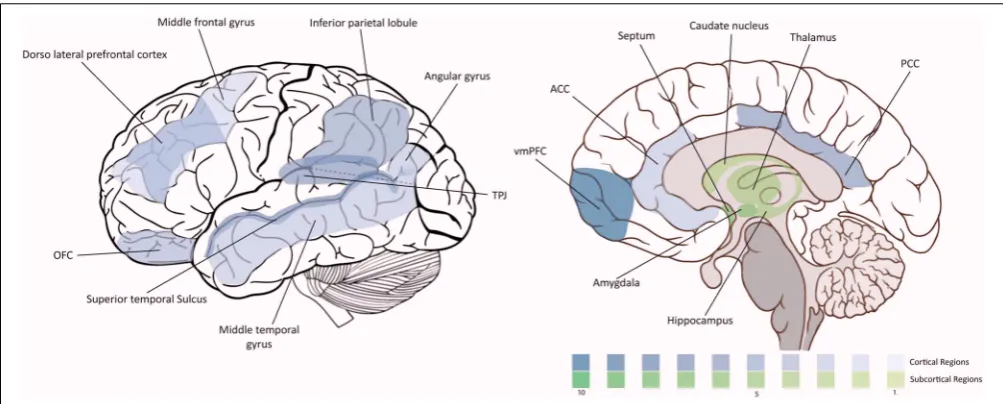
FIGURE 1 | Density of moral neuroscience studies.The intensity of the color is proportional to the number of the citations of the corresponding region in the article.
arising from emotion-related brain areas favor one outcome, while cognitive responses favor a different one (Kahneman and Frederick, 2007; McClure et al., 2007). According to the “
cog-nitive and emotional integration theory,” behavioral choices
can-not be split into cognitive vs. emotional. Complex contextual situations can make behavioral decisions exceptionally difficult (Gottfried, 1999; Moll et al., 2003).
HOW CAN MORALITY BE STUDIED SCIENTIFICALLY?
A variety of methods for exploring morality have been developed, from moral vs. non-moral situations to moral dilemmas (Young and Dungan, 2012). Moral dilemmas are situations in which every possible course of action breaches some otherwise bind-ing moral principle (Thomson, 1985). The two main distinctions between moral dilemmas and judgments that have traditionally been taken into account are: (1) personal dilemmas and judg-ments, as opposed to impersonal ones (Greene et al., 2004); (2) utilitarian moral judgments vs. non-utilitarian ones (Brink, 1986).
These distinctions have led to the development of a variety of paradigms. Probably the most famous ones are the trol-ley paradigm (Thomson, 1985) and the footbridge dilemma (Navarrete et al., 2012). In both the trolley problem and the footbridge dilemma, the choice is between saving five peo-ple at the expense of killing one person or letting five die and one survive (Hauser, 2006; Greene, 2007). However, the latter meets the criteria of a personal dilemma, while the for-mer does not (for extensive reviews of similar moral dilem-mas, see Greene et al., 2004; Koenigs et al., 2007; Decety et al., 2011; Pujol et al., 2011). Other tasks that bring morality under experimental scrutiny present visual sentences or pictures (Greene et al., 2001; Harenski and Hamaan, 2006), or scales and questionnaires that can be used to assess moral behav-ior from a clinical point of view (see Rush et al., 2008 for a review).
THE NEUROANATOMY OF MORALITY
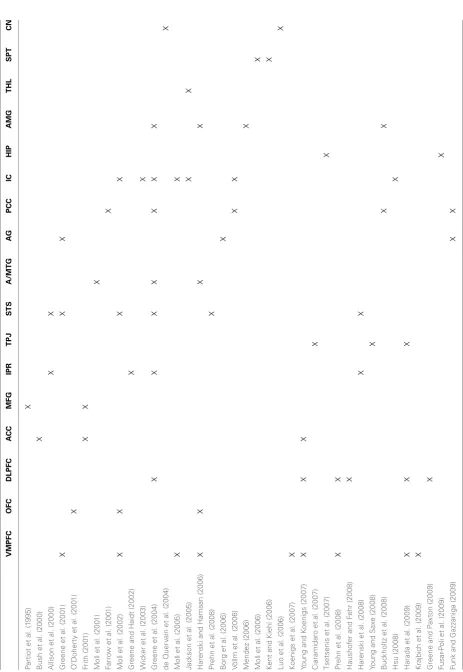
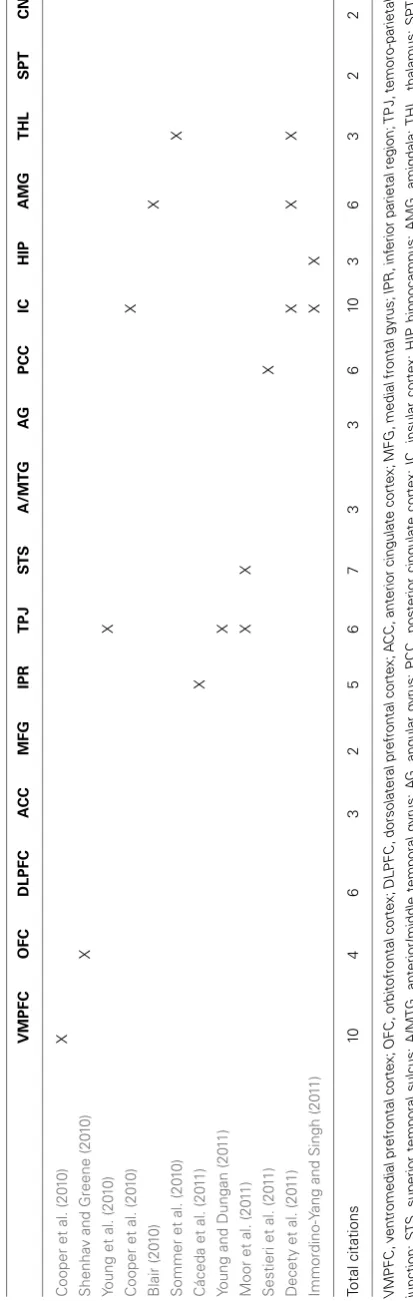
Being a highly complex process, morality involves a highly com-plex neural circuitry. In this section we overview the main brain areas and circuitry that have been associated with it. The “moral brain” comprises a large functional network that includes several brain structures. At the same time, many of these structures over-lap with other regions that control different behavioral processes. We will review them in the following order: (1) the frontal lobe, (2) the parietal lobe, (3) the temporal lobe and insula, and (4) the subcortical structures. The findings are summarized inFigure 1
andTable 1.
FRONTAL LOBE
The ventromedial prefrontal cortex (VMPFC) is consistently engaged in moral judgement (Greene et al., 2001; Moll et al., 2002; Harenski and Hamaan, 2006; Koenigs et al., 2007; Prehn et al., 2008; Harada et al., 2009). VMPFC seems to play a crucial role in the mediation of the emotions engaged during moral pro-cessing (Young and Koenigs, 2007). Patients with VMPFC lesions are reported to be significantly more likely to endorse utilitar-ian responses to hard personal moral dilemmas (Koenigs et al., 2007) and have trouble representing the abstract consequences of their decisions (Krajbich et al., 2009). It is also involved in adher-ence to social norms and values (Moll et al., 2005) and in the integration of representations of others’ intentions with their out-comes during social decision-making (Cooper et al., 2010). The left VMPFC shows higher activation in subjects with lower moral judgment competence when identifying norm violations (Prehn et al., 2008).
T a ble 1 | C ontinued VMPFC OFC DLPFC A CC MFG IPR TPJ S T S A /MTG A G PCC IC HIP AMG THL S PT CN Cooper et al. (20 1 0 ) X Shenha v a nd Greene (20 1 0 ) X Y oung et al. (20 1 0 ) X Cooper et al. (20 1 0 ) X B la ir (2 010 ) X Sommer e t a l. (20 1 0 ) X Cáceda et al. (20 11 ) X Y oung and D ungan (20 11 ) X Moor et al. (20 11 ) XX Sestieri et al. (20 11 ) X Decet y et al. (20 11 ) XX X Immordino-Y a ng and S ingh (20 11) XX To ta l c it a ti o n s 10 4 6 3 2 5 6 7 3 3 6 10 3 6 3 2 2 VMPFC, v entromedial prefront al corte x; OFC, orbitofront al corte x; DLPFC, dorsolateral p refront al corte x; A CC, anterior cingulate c orte x; MFG, m edial front al gyr u s; IPR, inf erior p ariet a l region; TPJ , temoro-pariet a l junction; S T S , superior temporal sulcus; A /MTG, anterior/middle temporal gyr u s; A G , a ngular gyr u s; PCC, posterior cingulate c orte x; IC, insular c orte x; HIP , hippocampus; A MG, a migdala; THL, thalamus; SPT , sept um; CN, caudate nucleus.
of the left OFC has been related to processing of emotionally salient statements with moral value (Moll et al., 2002).Greene et al. (2004) speculated that the orbital and ventromedial pre-frontal cortices seem to be involved in emotionally driven moral decisions, whereas the dorsolateral prefrontal cortex (DLPFC) competes with it, eventually mitigating its responses (Greene et al., 2004). The DLPFC is differentially activated when subjects emit a utilitarian response (Young and Koenigs, 2007). This area is involved in cognitive control and problem-solving (Greene et al., 2004). The DLPFC plays an important role during the judgment of responsibility for crimes and its punishment from a third-party perspective (Haushofer and Fehr, 2008), and also in the analysis of situations that demand rule-based knowledge (Prehn et al., 2008).
Greene and Paxton (2009)related it to lying processes, and others have hypothesized that it may trigger an executive function used to combine predictions based on social norms with inferences about the intent to deceive (Harada et al., 2009).
The anterior cingulate cortex (ACC) is involved in error detec-tion (Shackman et al., 2011). It is activated when subjects generate a utilitarian response (Young and Koenigs, 2007). The ACC, among others, has been implicated in theory of mind (ToM) and self-referential tasks (Frith, 2001), and it has been involved in moral conflict monitoring (Greene et al., 2004, p. 391). The medial frontal gyrus is another frontal region that seems to inter-vene in ToM, and also in other social functions relevant to moral judgment (Amodio and Frith, 2006) and in the integration of emotion into decision-making and planning (Partiot et al., 1995).
PARIETAL LOBE
The inferior parietal region is mainly associated with working memory and cognitive control, and so its recruitment during moral processing might be due to some cognitive engagement (Greene et al., 2004; Harenski et al., 2008; Cáceda et al., 2011). One of its functions, together with the posterior area of the supe-rior temporal sulcus (STS) which we will review below, seems to be the perception and representation of social information that may be crucial for making inferences about others’ beliefs and intentions (Allison et al., 2000) and the representation of personhood (Greene and Haidt, 2002).
The temporo-parietal junction (TPJ) plays a key role in moral intuition and in belief attribution during moral processing in oth-ers (Young and Saxe, 2008; Harada et al., 2009; Young et al., 2010; Moor et al., 2011; Young and Dungan, 2011). The TPJ, as well as the precuneus, is involved in encoding beliefs and integrating them with other relevant features of the action such as the out-come (Young and Saxe, 2008). The right TPJ and the precuneus are active when subjects process prior intentions, while the left TPJ is activated when a subset of social intentions is involved (Ciaramidaro et al., 2007) as well as lying (Harada et al., 2009). The disruption of the right TPJ activity affects the capacity to use mental states during moral judgment (Young et al., 2010). In the dictator game, activation in the TPJ is associated with punishment of the excluders through lower offers (Moor et al., 2011).
TEMPORAL LOBE
[image:4.595.61.268.63.715.2]et al., 2010). Structural abnormalities within this area have even been related to psychopathy (Blair, 2010; Pujol et al., 2011).
One of the main temporal sub-regions involved in moral judgment is the superior temporal sulcus (STS) (Allison et al., 2000; Moll et al., 2002; Greene et al., 2004; Harenski et al., 2008). This structure has been understood as an initial site of social perception (Allison et al., 2000) and has been repeat-edly associated with emotional processing and social cognition (Greene et al., 2004; Harenski et al., 2008). The STS has been described as indispensable for making inferences about others’ beliefs and intentions (Allison et al., 2000). Increased activity of this area is also observed in personal dilemmas compared with other types (Greene et al., 2001). In the dictator game the STS has been found to be activated when subjects applied punishment to the excluders (Moor et al., 2011). The poste-rior STS shows greater activity during justice-based dilemmas than in care-based dilemmas (Harenski et al., 2008). Subjects with lower moral judgment competence showed greater activa-tion in the left posterior STS when identifying norm violaactiva-tions (Prehn et al., 2008).
The anterior/middle temporal gyrus has been also related to moral judgment (Moll et al., 2001; Greene et al., 2004; Harenski and Hamaan, 2006). Angular gyrus engagement has been observed during the evaluation of personal moral dilemmas (Greene et al., 2001; Borg et al., 2006; Funk and Gazzaniga, 2009).
LIMBIC LOBE
The posterior cingulate cortex (PCC) is known to be involved in the processing of personal memory, self-awareness and emo-tionally salient stimuli (Sestieri et al., 2011). It is one of the brain regions that exhibit greater engagement in personal than in impersonal dilemmas (Funk and Gazzaniga, 2009). Its activation has been related to social ability (Greene et al., 2004), empathy (Völlm et al., 2006) and forgiveness (Farrow et al., 2001), and can predict the magnitude of the punishments applied in criminal scenarios (Buckholtz et al., 2008).
The insular cortex is also engaged in moral tasks (Moll et al., 2002; Greene et al., 2004). It exhibits greater activation in first-person and other-first-person experiences of disgust (Wicker et al., 2003). It is associated with emotional processing (Greene et al., 2004), empathic sadness in young subjects (Decety et al., 2011), detection and processing of uncertainty (Cooper et al., 2010) and perception of inequity (Hsu, 2008).
The anterior insular cortex is involved in visceral somatosen-sation, emotional feeling and regulation, and empathy (Immordino-Yang and Singh, 2011). This sub-region is activated during the experiencing of anger or indignation (Wicker et al., 2003; Moll et al., 2005), and when perceiving or assessing painful situations in others (Jackson et al., 2005). Its activation is also correlated with empathy scores (Völlm et al., 2006) and with unfair offers in a ‘ultimatum game’ (Hsu, 2008).
SUBCORTICAL STRUCTURES
The hippocampus is known to be a crucial region for the acquisition and retrieval of fear conditioning (Tsetsenis et al., 2007) and plays a facilitative role in inducing appropriate emotional reactions, in self-related processing during social
emotions (Immordino-Yang and Singh, 2011) and in the processing of emotional facial expressions (Fusar-Poli et al., 2009).
The amygdala is a necessary structure for moral learning (Mendez, 2006). It is involved in the evaluation of moral judg-ments (Greene et al., 2004) and in empathic sadness during morally-salient scenarios (Decety et al., 2011). It can predict pun-ishment magnitude in criminal scenarios (Buckholtz et al., 2008). Its dysfunction has been implicated in the affective deficits in psychopathy (Blair, 2010).
Rating empathic sadness, and perceiving and assessing painful situations has been associated with significant activation changes in the thalamus (Jackson et al., 2005; Decety et al., 2011). Bilateral thalamic activations are also observed when subjects are asked to choose between following a moral rule or a personal desire (Sommer et al., 2010).
The septum is activated while subjects make charitable con-tributions (Moll et al., 2006) and has been associated with psy-chopathy (Kent and Kiehl, 2006). Finally, the caudate nucleus is activated during altruistic punishment (de Quervain et al., 2004) and during the evaluation of morally salient stimuli (Luo et al., 2006).
DISCUSSION AND CONCLUSION
Moral neuroscience is an intricate and expanding field. This review summarizes the main scientific findings obtained to date. Morality is a set of complex emotional and cognitive processes that is reflected across many brain domains. Some of them are recurrently found to be indispensable in order to emit a moral judgment, but none of them is uniquely related to morality. The orbital and ventromedial prefrontal cortices are implicated in emotionally-driven moral decisions, whereas the dorsolateral prefrontal cortex seems to mitigate the salience of prepotent emo-tional responses. These competing processes may be monitored by the anterior cingulate cortex, which is also crucial for ToM. The TPJ and the STS play important roles in the attribution of oth-ers’ beliefs and intentions. The insular cortex is engaged during empathic processes, and seems to be in charge of the evalua-tion of disgust and inequity. Other regions such as the posterior cingulate cortex, the anterior/middle temporal gyrus and the infe-rior parietal lobe seem to play a more complementary role in morality, being recruited in order to accomplish general cognitive processes engaged during the moral tasks proposed (e.g., working memoryor cognitive control). On the other hand, regions like the amygdala seem to play an important role in the processing of emotions involved in moral judgment. Some of the emo-tions processed are more central to morality than others, but all emotions contribute to moral judgment given specific contextual situations.
content of these processes, rather than in specific circuits. Some authors, though, have related morality to basic emotions such
asdisgust(Chapman et al., 2009). Further research is needed in
order to uncover the relationships between basic emotions and morality, as well as basic cognition blocks such as attentional control (van Dillen et al., 2012).
Given that morality is a highly complex process influ-enced by many factors, future studies should take into account individual differences (e.g., personality, genetics, reli-giosity, cultural and socioeconomic level) in order to under-stand the variety of mechanisms that govern it. Genetic factors and environmental-dependent processes during devel-opmental stages may strengthen specific neural circuits that process various moral dimensions (Gallardo-Pujol et al., submitted).
Another important constraint in moral research is the het-erogeneity of the tasks used in different studies to assess morality, which makes the comparison of the different results extremely difficult. Moreover, some of the tasks proposed barely suggest actual daily moral situations and usually require abstract evaluation, a circumstance that may blur the results obtained. The inclusion of innovative techniques such as
immersive virtual environments (Slater et al., 2006; Navarrete et al., 2012) adds apparent validity to moral dilemmas and may facilitate the generalization of results to real-life settings.
All in all, morality is supported not by a single brain cir-cuitry or structure, but by a multiplicity of circuits that overlap with other general complex processes. One of the key issues that needs to be addressed is the identification of the core features of morality and moral-related processes. In this endeavor, neuro-science can provide meaningful insights in order to delineate the boundaries of morality in conjunction with moral psychology.
ACKNOWLEDGMENTS
This manuscript was made possible through the support of a grant from The Character Project at Wake Forest University and the John Templeton Foundation. The opinions expressed in this publication are those of the authors and do not necessarily reflect the views of The Character Project, Wake Forest University or the John Templeton Foundation. The authors declare that the research was conducted in the absence of any commercial or financial relationships that could be construed as a potential conflict of interest.
REFERENCES
Allison, T., Puce, A., and McCarty, G. (2000). Social perception from visual cues: role of the STS region. Trends Cogn. Sci. 4, 267–278. doi: 10.1016/S1364-6613(00)01501-1 Amodio, D., and Frith, C. D. (2006).
Meeting the minds: the medial frontal cortex and social cognition. Nat. Rev. Neurosci.7, 268–177. doi: 10.1038/nrn1884
Bargh, J. A., and Chartrand, T. L.
(1999). The unbearable
auto-maticity of being.Am. Psychol. 54,
462–479. doi: 10.1037/0003-066X. 54.7.462
Blair, R. J. R. (2010). Psychopathy, frus-tration, and reactive aggression: the role of ventromedial prefrontal cor-tex.Br. J. Psychol.110, 383–399. doi: 10.1348/000712609X418480 Borg, J. S., Hynes, C., Van Horn, J.,
Grafton, S., and Sinnott-Armstrong, W. (2006). Consequences, action, and intention as factors in moral judgments: an FMRI investigation. J. Cogn. Neurosci. 18, 803–817. doi: 10.1162/jocn.2006.18.5.803 Brink, D. O. (1986). Utilitarian
moral-ity and the personal point of
view. J. Philos. 83, 417–438. doi:
10.2307/2026328
Buckholtz, J. W., Asplund, C. L., Dux, P. E., Zald, D. H., Gore, J. C., Jones, O. D., et al. (2008). The neu-ral correlates of third-party
pun-ishment.Neuron60, 930–940. doi:
10.1016/j.neuron.2008.10.016 Bush, G., Luu, P., and Posner, M. I.
(2000). Cognitive and emotional
influences in anterior
cingu-late cortex. Trends Cogn. Sci. 6,
215–222. doi:
10.1016/S1364-6613(00)01483-2
Cáceda, R., James, G. A., Ely, T.
D., Snarey, J., and Kilts, C.
D. (2011). Mode of effective
connectivity within a putative
neural network differentiates moral cognitions related to care and
justice ethics.PLoS ONE6:e14730.
doi: 10.1371/journal.pone.
0014730
Chapman, H. A., Kim, D. A., Susskind, J. M., and Anderson, A. K. (2009). In bad taste: evidence for the oral
ori-gins of moral disgust.Science323,
1222–1226. doi: 10.1126/science. 1165565
Ciaramidaro, A., Adenzato, M., Enrici, I., Erk, S., Pia, L., Bara, B. G., et al. (2007). The intentional net-work: how the brain reads varieties
of intentions. Neuropsychologia
45, 3105–3113. doi: 10.1016/
j.neuropsychologia.2007.05.011 Cooper, J. C., Kreps, T. A., Wiebe, T.,
Pirkl, T., and Knutson, B. (2010). When giving is good: ventromedial prefrontal cortex activation for
oth-ers’ intentions.Neuron67, 511–521.
doi: 10.1016/j.neuron.2010.06.030 De Neys, W., and Glumicic, T. (2008).
Conflict monitoring in dual
process theories of reasoning.
Cognition 106, 1248–1299. doi: 10.1016/j.cognition.2007.06.002
de Quervain, D. J., Fischbacher,
U., Treyer, V., Schellhammer,
M., Schnyder, U., and Buck,
A. (2004). The neural basis of
altruistic punishment.Science305,
1254–1258.
Decety, J., Michalska, K. J., and Kinzler, K. D. (2011). The contribution of emotion and cognition to moral sensitivity: a neurodevelopmental
study. Cereb. Cortex 22, 209–220.
doi: 10.1093/cercor/bhr111 Farrow, T. F., Zheng, Y.,Wilkinson, I. D.,
Spence, S. A., Deakin, J. F., Tarrier, N., et al. (2001). Investigating the functional anatomy of empathy
and forgiveness. Neuroreport 12,
2433–2438. doi: 10.1097/00001756-200108080-00029
Flack, J., and de Waal, F. B. M. (2000). “Any animal whatever”: darwinian building blocks of morality in
mon-keys and apes.J. Conscious. Stud.7,
1–29.
Frith, U. (2001). Mind
blind-ness and the brain in autism. Neuron 32, 969–979. doi: 10.1016/S0896-6273(01)00552-9 Funk, C. M., and Gazzaniga, M.
S. (2009). The functional brain
architecture of human
moral-ity. Curr. Opin. Neurobiol. 19, 678–681. doi: 10.1016/j.conb.2009. 09.011
Fusar-Poli, P., Placentino, A.,
Carletti, F., Landi, P., Allen, P.,
Surgu-ladze, S., et al. (2009).
Functional atlas of emo- tional
faces processing: a voxel-based
meta-analysis of 105 functional
magnetic resonance imaging
studies. J. Psychiatr. Neurosci. 34,
418–432.
Gert, B. (2012). The definition of
morality. Stanford Encyclopedia of
Philosophy.Stanford, CA: Stanford University.
Gottfried, K. (1999). Moral calculus
and the bom.Nature401, 117. doi:
10.1038/43571
Greene, J., and Haidt, J. (2002). How (and where) does moral
judg-ment work? Trends Cogn. Sci. 6,
517–523. doi:
10.1016/S1364-6613(02)02011-9
Greene, J. D. (2007). “The secret joke
of Kant’s soul,” inMoral Psychology:
The Neuroscience of Morality: Emotion, Disease, and Development, Vol. 3, ed W. Sinnott-Armstrong
(Cambridge, MA: MIT Press),
35–117.
Greene, J. D., Nystrom, L. E., Engell, A. D., Darley, J. M., and Cohen, J. D. (2004). The neural bases of cognitive conflict and control
in moral judgment. Neuron 44,
389–400. doi: 10.1016/j.neuron.
2004.09.027
Greene, J. D., and Paxton, J. M. (2009). Patterns of neural activity associated with honest and
dis-honest moral decisions. Proc.
Natl. Acad. Sci. U.S.A. 106, 12506–12511. doi: 10.1073/pnas. 0900152106
Greene, J. D., Sommerville, R. B., Nystrom, L. E., Darley, J. M., and Cohen, J. D. (2001). An fMRI investigation of emotional
engage-ment in moral judgengage-ment. Science
Haidt, J. (2001). The emotional dog and its rational tail: a social
intuitionist approach to moral
judgment. Psychol. Rev. 108,
814–834. doi:
10.1037/0033-295X.108.4.814
Harada, T., Itakura, S., Xu, F., Lee, K., Nakashita, S., Saito, D. N., and Sadato, N. (2009). Neural correlates of the judgment of lying: a func-tional magnetic resonance imaging
study.Neurosci. Res.63, 24–34. doi:
10.1016/j.neures.2008.09.010 Harenski, C. L., Antonenko, O., Shane,
M. S., and Kiehl, K. (2008). Gender differences in neural mechanisms
underlying moral sensitivity.
Soc. Cogn. Affect. Neurosci. 3,
313–321. doi: 10.1093/scan/
nsn026
Harenski, C. L., and Hamaan, S. (2006). Neural correlates of regulating neg-ative emotions related to moral
violations.Neuroimage30, 313–324.
doi: 10.1016/j.neuroimage.2005.
09.034
Hauser, M. D. (2006).Moral Minds:
How Nature Designed Our Universal Sense of Right and Wrong.New York, NY: Ecco/HarperCollins Publishers. Haushofer, J., and Fehr, E. (2008).You shouldn’t have: your brain on
others’ crimes. Neuron 60,
738–740. doi: 10.1016/j.neuron.
2008.11.019
Hsu, M. (2008). The right and
the good: distributive justice
and neural encoding of equity
and efficiency. Science 320,
1092–1095. doi: 10.1126/science. 1153651
Immordino-Yang, M. H., and Singh, V. (2011). Hippocampal contribu-tions to the processing of social
emotions. Hum. Brain Mapp. 34,
945–955. doi: 10.1002/hbm.21485 Jackson, P. L., Meltzoff, A. N., and
Decety, J. (2005). How do we perceive the pain of others? A window into the neural processes
involved in empathy.Image Process.
24, 771–779.
Kahneman, D., and Frederick, S. (2007). Frames and brains: elic-itation and control of response
tendencies. Trends Cogn. Sci. 11,
45–46. doi: 10.1016/j.tics.2006.
11.007
Kent, A., and Kiehl. (2006). A
cog-nitive neuroscience perspective
on psychopathy: evidence for
paralimbic system dysfunction.
Psychiatry Res.142, 107–128. doi: 10.1016/j.psychres.2005.09.013 Koenigs, M., Young, L., Adolphs, R.,
Tranel, D., Cushman, F., Hauser,
M., and Damasio, A. (2007).
Damage to the prefrontal
cor-tex increases utilitarian moral
judgements. Nature446, 908–911.
doi: 10.1038/nature05631
Kohlberg, L. (1963). Moral
Development and Identification. Child Psychology: The Sixty-Second Yearbook of the National Society for the Study of Education.Part 1.
Kohlberg, L. (1984). Essays in Moral
Development, Volume I: The Psychology of Moral Development. New York, NY: Harper and Row. Krajbich, I., Adolphs, R., Tranel, D.,
Denburg, N. L., and Camerer, C. F. (2009). Economic games quantify diminished sense of guilt in patients with damage to the prefrontal
cortex.J. Neurosci. 29, 2188–2192.
doi: 10.1523/JNEUROSCI.508
6-08.2009
Lindsay, J. (2004). Darkly Dreaming
Dexter. New York, NY: Vintage Books.
Luo, Q., Nakic, M., Wheatley, T., Richell, R., Martin, A., and Blair, R. J. R. (2006). The neural basis of implicit moral attitude–an IAT study using event-related fMRI. Neuroimage 30, 1449–1457. doi: 10.1016/j.neuroimage.2005.11.005 McClure, S. M., Botvinick, M. M.,
Yeung, N., Greene, J., and Cohen, J. D. (2007). “Conflict monitoring in cognition- emotion competition,” inHandbook of Emotion Regulation, ed J. J. J. Gross (New York, NY: Guilford), 204–226.
Mendez, M. F. (2006). What frontotem-poral dementia reveals about the neurobiological basis of morality. Med. Hypotheses67, 411–418. doi: 10.1016/j.mehy.2006.01.048 Moll, J., de Oliviera-Souza, R., and
Eslinger, P. (2003). Morals and
the human brain.Neuroreport 14,
299–305. doi: 10.1097/00001756-200303030-00001
Moll, J., Eslinger, P. J., and de Oliveira-Souza, R. (2001). Frontopolar and anterior temporal cortex activation in a moral judgment task: prelimi-nary functionalMRI results in
nor-mal subjects. Arq. Neuropsiquiatr.
59, 657–664. doi: 10.1590/S0004-282X2001000500001
Moll, J., Krueger, F., Zahn, R., Pardini, M., Oliveira-souza, R., and Graham, J. (2006). Human fronto – mesolim-bic networks guide decisions about
charitable donation. Proc. Natl.
Acad. Sci. U.S.A.103, 15623–15628. doi: 10.1073/pnas.0604475103 Moll, J., Oliveira-souza, R. De, Eslinger,
P. J., Bramati, I. E., Andreiuolo, P. A., and Pessoa, L. (2002). The neural correlates of moral
sen-sitivity: a functional magnetic
resonance imaging investigation
of basic and moral Emotions 22,
2730–2736.
Moll, J., and Schulkin, J. (2009). Social attachment and aversion in
human moral cognition.Neurosci.
Biobehav. Rev. 33, 456–465. doi: 10.1016/j.neubiorev.2008.12.001 Moll, J., Zahn, R., de Oliveira-Souza, R.,
Krueger, F., and Grafman, J. (2005). Opinion: the neural basis of human
moral cognition.Nat. Rev. Neurosci.
6, 799–809. doi: 10.1038/nrn1768 Moor, B. G., Güro˘glu, B., Op de
Macks, Z. A., Rombouts, S. A., Van der Molen, M. W., and Crone, E. (2011). Social exclusion and punishment of excluders: neural correlates and developmental
tra-jectories.Neuroimage59, 708–717.
doi: 10.1016/j.neuroimage.2011.
07.028
Muller, F., Simion, A., Reviriego, E., Galera, C., Mazaux, J.-M., Barat, M., et al. (2010). Exploring theory of mind after severe traumatic brain
injury.Cortex 46, 1088–1099. doi:
10.1016/j.cortex.2009.08.014
Navarrete, C. D., McDonald, M.
M., Mott, M. L., and Asher, B. (2012). Virtual morality: emotion and action in a simulated
three-dimensional “Trolley Problem.”
Emotion12, 364–370.
O’Doherty, J. O., Kringelbach, M. L., Rolls, E. T., Hornak, J., and
Andrews, C. (2001). Abstract
reward and punishment represen-tations in the human orbitofrontal
cortex. Nat. Neurosci. 4, 95–102.
doi: 10.1038/82959
Partiot, A., Grafman, J., Sadato, N., Wachs, J., and Hallett, M. (1995). Brain activation during the
gen-eration of non-emotional and
emotional plans. Neuroreport 10,
1269–1272.
Pinker, S. (1997).How the Mind Works.
New York, NY: Norton.
Prehn, K., Wartenburger, I., Meriau, K., Scheibe, C., Goodenough, O. R., and Villringer, A. (2008). Individual differences in moral judgment com-petence influence neural correlates
of socio-normative judgments.Soc.
Cogn. Affect. Neurosci.3, 33–46. doi: 10.1093/scan/nsm037
Pujol, J., Batalla, I.,
Contreras-Rodríguez, O., Harrison, B. J., Pera, V., Hernández-Ribas, R., et al. (2011). Breakdown in the brain net-work subserving moral judgment
in criminal psychopathy.Soc. Cogn.
Affect. Neurosci. 7, 917–923. doi: 10.1093/scan/nsr075
Rand, A. (1964). The Virtue of
Selfishness.New York, NY: Penguin Books.
Rush, J. A., First, M. B., and Blacker, D.
(2008). Handbook of Psychiatric
Measures. Washington, DC: American Psychiatric Publishing.
Sestieri, C., Corbetta, M., and
Romani, G. L., and Shulman, G. L. (2011). Episodic memory
retrieval, parietal cortex, and
the default mode network: func-tional and topographic analyses. J. Neurosci. 31, 4407–4420. doi: 10.1523/JNEUROSCI.3335-10.2011 Shackman, A. J., Salomons, T. V., Slagter, H. A., Fox, A. S., Winter, J. J., and Davidson, R. J. (2011). The integration of negative affect, pain and cognitive control in the
cingu-late cortex.Nat. Rev. Neurosci.12,
154–167. doi: 10.1038/nrn2994 Shenhav, A., and Greene, J. D. (2010).
Moral judgments recruit
domain-general valuationmechanisms
to integrate representations
of probability and
magni-tude. Neuron 67, 667–677. doi:
10.1016/j.neuron.2010.07.020 Slater, M., Antley, A., Davison, A.,
Swapp, D., Guger, C., Barker, C., et al. (2006). A virtual reprise of the Stanley Milgram obedience
experiments.PLoS ONE1:e39. doi:
10.1371/journal.pone.0000039 Sommer, M., Rothmayr, C., Döhhnel,
K., Meinhardt, J., Schwerdtner, J., Sodian, B., et al. (2010). How should I decide? The neural corre-lates of everyday moral reasoning. Neuropsychologia 48, 2018–2026.
doi: 10.1016/j.neuropsychologia.
2010.03.023
Thomson, J. J. (1985). The trolley prob-lem.Yale Law J.94, 1395–1415. doi: 10.2307/796133
Trivers, R. L. (1971). The evolution of
reciprocal altruism.Q. Rev. Biol.46,
35–57. doi: 10.1086/406755 Tsetsenis, T., Ma, X. H., Lo Iacono,
L., Beck, S. G., and Gross, C. (2007). Suppression of condition-ing to ambiguous cues by pharma-cogenetic inhibition of the dentate
gyrus.Nat. Neurosci.10, 896–902.
doi: 10.1038/nn1919
van Dillen, L., van der Wal, R., and van den Bos, K. (2012). On the role of attention and emotion in morality: attentional control modulates
unre-lated disgust in moral. Pers. Soc.
Psychol. Bull. 38, 1222–1231. doi: 10.1177/0146167212448485 Völlm, B. A., Taylor, A. N. W.,
Richardson, P., Corcoran, R.,
Stirling, J., McKie, S., et al.
(2006). Neuronal correlates of
theory of mind and empathy: a
functional magnetic resonance
imaging study in a nonverbal
task. Neuroimage 29, 90–98. doi:
10.1016/j.neuroimage.2005.07.022 Wicker, B., Keysers, C., Plailly, J., Royet,
seeing and feeling disgust.Neuron 40, 655–664. doi: 10.1016/S0896-6273(03)00679-2
Yarkoni, T., Poldrack, R., Nichols, T., Van Essen, D., and Wager, T. (2011). NeuroSynth: a new
platform for large-scale
auto-mated synthesis of human
functional neuroimaging data.
Front. Neuroinform. Conference Abstract: 4th INCF Congress of Neuroinformatics.8, 665–670. doi: 10.3389/conf.fninf.2011.08.00058 Young, L., Camprodon, J. A., Hauser,
M., Pascual-Leone, A., and Saxe, R. (2010). Disruption of the right
temporoparietal junction with
transcranial magnetic
stimula-tion reduces the role of beliefs in
moral judgments.Proc. Natl. Acad.
Sci. U.S.A. 107, 6753–6758. doi: 10.1073/pnas.0914826107 Young, L., and Dungan, J. (2011).
Where in the brain is
moral-ity? Everywhere and maybe
nowhere.Soc. Neurosci.7, 1–10. doi:
10.1080/17470919.2011.569146 Young, L., and Dungan, J. (2012).
Where in the brain is
moral-ity? Everywhere and maybe
nowhere.Soc. Neurosci.7, 1–10. doi:
10.1080/17470919.2011.569146 Young, L., and Koenigs, M. (2007).
Investigating emotion in moral cog-nition: a review of evidence from functional neuroimaging and
neu-ropsychology. Br. Med. Bull. 84,
69–79. doi: 10.1093/bmb/ldm031
Young, L., and Saxe, R. (2008). The neural basis of belief encoding and integration in moral judgment. NeuroImage 40, 1912–1920. doi: 10.1016/j.neuroimage.2008.01.057
Conflict of Interest Statement: The
authors declare that the research was conducted in the absence of any commercial or financial relationships that could be construed as a potential conflict of interest.
Received: 29 January 2013; accepted: 10 August 2013; published online: 12 September 2013.
Citation: Pascual L, Rodrigues P and Gallardo-Pujol D (2013) How does