HUMAN RESOURCE AND INFORMATION SYSTEM
(HRIS): FEATURES OF CURRENT SITUATION
Shabnam, Natasha Sahu
ABSTRACT
An information system is a computer - based system that provides both database processing and information for decision-making. Data processing capability refers to the system’s ability to handle and process data's.
According to Hedrickson, 2003, “HRIS can be briefly defined as integrated systems used to gather, store and analyze information regarding an organization’s human resources.”
According to Tannenbaum 1990, “HRIS ,One which is used to acquire, store, manipulate, analyze, retrieve and distribute information about an organization’s human resources.”.
In most situations, an HRIS will also lead to increases in efficiency when it comes to making decisions in HR. This research paper helps to know about how HRIS help the organization to enhance the efficiency of work.
Keywords- Human Resource, Human Resource Information system, HRIS, HRM, HRMS,
I. INTRODUCTION
records into computerized databases. In modern times, HR/payroll systems are able to handle several of HR’s numerous functions. HR Software is now full of features and self-contained— not just the data storage systems we once knew them as. The developed HRIS will help the organization to effectively store employee data more securely and accurately. Modern HRIS systems are now tools that HR Professionals can use on a daily-basis for several purposes. In the past, companies were used to tracking data on paper and spreadsheets. However, with technological advancements many companies have realized the need to implement more sophisticated computerized systems, like Human Resource Information Systems. By moving to HRIS, companies are able to keep more accurate and up-to-date records, allowing them to better prepare for future growth in their companies. In most situations, an HRIS will also lead to increases in efficiency when it comes to making decisions in HR. The decisions made should also increase in quality—and as a result, the productivity of both employees and manages should increase and become more effective.
II. DEFINITION
Kavanagh et al. (1990) defined it as
"a system used to acquire, store, manipulate, analyze, retrieve, and distribute information regarding an organization’s human resources. An HRIS is not simply computer hardware and associated HR-related software. Although an HRIS includes hardware and software, it also includes people, forms, policies and procedures, and data. (p. 29)"
III. OBJECTIVES OF THE STUDY
To understand about how computerized HRIS is more effective than manual system. To understand about human resource information system.
To understand about uses of HRIS in company.
To understand about how enhance the ability of the human resource management to leverage and absorb new and emerging opportunities and challenges in the business horizons.
IV. LITERATURE REVIEW
IV.1 HR INFORMATION SYSTEM-
now shifted from manual ledgers and books to computer hard drives and magnetic tapes. Storage of data became easier and a lot of manual work was removed. HR Management was later seen as a strategic building platform which dealt with the most important resource of any organization. Hence it came to be known as Strategic HR Management (SHRM). The HR Management had total make over when HR Information System was brought into implementation.
IV.2 TRADITIONAL VIEW OF HRIS
HRIS is designed to supply information required for effective management of the organization i.e. for decision making relating to human resource. Human resource departments hold the record of the employees of the organization including personal history, skills and salary etc. The basic level of HRIS is used to help to manage employment relationships within the organization and employees. In previously Companies were used to tracking data on paper and spreadsheets and its take time to manage record properly and its time consuming too.Typical HRIS Record employee information, wage and salary data, review dates, benefits, education and training, attendance, performance data,/ appraisal results etc.
IV.3 MORDEN VIEWS OF HRIS
V. EVALUATION AND DEVELOPMENT OF HRIS
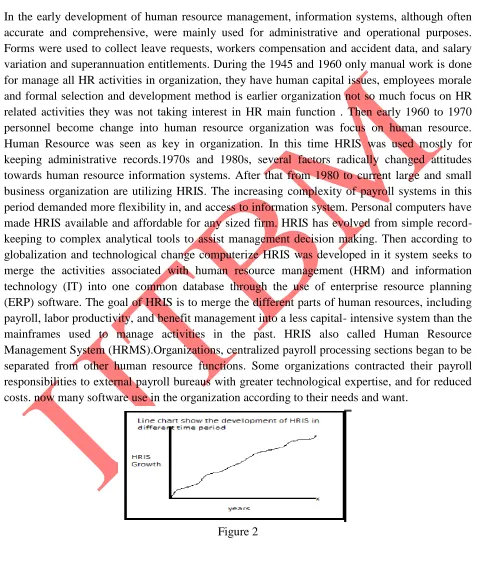
In the early development of human resource management, information systems, although often accurate and comprehensive, were mainly used for administrative and operational purposes. Forms were used to collect leave requests, workers compensation and accident data, and salary variation and superannuation entitlements. During the 1945 and 1960 only manual work is done for manage all HR activities in organization, they have human capital issues, employees morale and formal selection and development method is earlier organization not so much focus on HR related activities they was not taking interest in HR main function . Then early 1960 to 1970 personnel become change into human resource organization was focus on human resource. Human Resource was seen as key in organization. In this time HRIS was used mostly for keeping administrative records.1970s and 1980s, several factors radically changed attitudes towards human resource information systems. After that from 1980 to current large and small business organization are utilizing HRIS. The increasing complexity of payroll systems in this period demanded more flexibility in, and access to information system. Personal computers have made HRIS available and affordable for any sized firm. HRIS has evolved from simple record-keeping to complex analytical tools to assist management decision making. Then according to globalization and technological change computerize HRIS was developed in it system seeks to merge the activities associated with human resource management (HRM) and information technology (IT) into one common database through the use of enterprise resource planning (ERP) software. The goal of HRIS is to merge the different parts of human resources, including payroll, labor productivity, and benefit management into a less capital- intensive system than the mainframes used to manage activities in the past. HRIS also called Human Resource Management System (HRMS).Organizations, centralized payroll processing sections began to be separated from other human resource functions. Some organizations contracted their payroll responsibilities to external payroll bureaus with greater technological expertise, and for reduced costs. now many software use in the organization according to their needs and want.
V.1 RISING AN HRIS: SYSTEM DEVELOPMENT LIFE CYCLE (SDLC)
In every organization the person who involve for HRIS development they apply these steps and then work on HRIS.
VI. RESPONSIBILITY OF HRIS IN COMPANIES
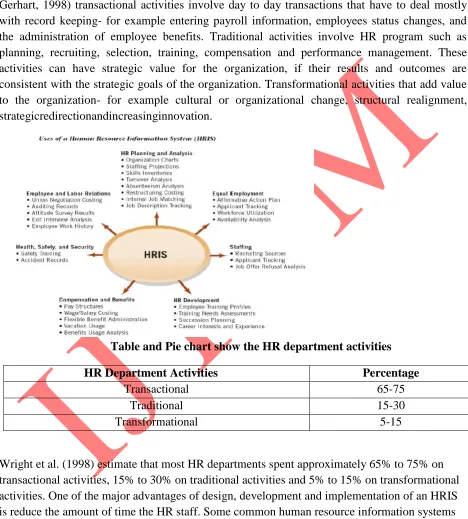
All this program involve multiple activities and these HR activities can be classified into three broad categories : transactional, traditional and transformational (Wright, Mc Mahan, snell,& Gerhart, 1998) transactional activities involve day to day transactions that have to deal mostly with record keeping- for example entering payroll information, employees status changes, and the administration of employee benefits. Traditional activities involve HR program such as planning, recruiting, selection, training, compensation and performance management. These activities can have strategic value for the organization, if their results and outcomes are consistent with the strategic goals of the organization. Transformational activities that add value to the organization- for example cultural or organizational change, structural realignment, strategicredirectionandincreasinginnovation.
Table and Pie chart show the HR department activities
HR Department Activities Percentage
Transactional 65-75 Traditional 15-30 Transformational 5-15
Benefits administration: This system manages employee fringe benefit packages Job applicant tracking: This system keeps track of applicants for jobs with the business.
VII. BENEFITS OF HRIS IN COMPANIES
With an appropriate HRIS, Human Resources staff enables employees to do their own benefits updates and address changes, thus freeing HR staff for more strategic functions. Additionally, data necessary for employee management, knowledge development, career growth and
development, and equal treatment is facilitated.
Finally, managers can access the information they need to legally, ethically, and effectively support the success of their reporting employees. Specific benefits of such systems include:
Faster information process Greater information accuracy
Improved planning and program development Enhanced employee communications
Reduction in cost of stored data in HR More transparency in the system
More meaningful career planning &counseling at all levels. Better ability to respond to environmental changes.
VIII. SECURITY OF HRIS
The privacy of employee information has become a major issue in recent years. With identity theft becoming a common problem, employees are becoming more sensitive about who sees their personal information, and the security it is kept in. By making sure employee information that is kept in the HRIS is relevant to the company and making sure there is limited access (password protection) to such information, companies can make its employees more secure with the safety of their information. Whether electronic or paper, employee files deserve to be treated with great care. Establishing security and end-user privileges calls for a balance of incorporating, HR policy, system knowledge and day-to-day operations.