https://doi.org/10.5194/gmd-11-1799-2018 © Author(s) 2018. This work is distributed under the Creative Commons Attribution 4.0 License.
Crossing the chasm: how to develop weather and climate
models for next generation computers?
Bryan N. Lawrence1,2,3, Michael Rezny4, Reinhard Budich5, Peter Bauer6, Jörg Behrens7, Mick Carter8,
Willem Deconinck6, Rupert Ford9, Christopher Maynard8, Steven Mullerworth8, Carlos Osuna10, Andrew Porter9, Kim Serradell11, Sophie Valcke12, Nils Wedi6, and Simon Wilson1,2,8
1Department of Meteorology, University of Reading, Reading, UK 2National Centre of Atmospheric Science, Reading, UK
3STFC Rutherford Appleton Laboratory, Didcot, UK 4Monash University, Melbourne, Australia
5Max Planck Institute for Meteorology, Hamburg, Germany 6ECMWF, Reading, UK
7DKRZ, Hamburg, Germany 8Met Office, Exeter, UK
9STFC Hartree Centre, Daresbury Laboratory, Daresbury, UK 10ETH, Zurich, Switzerland
11Barcelona Supercomputing Center, Barcelona, Spain
12Centre Européen de Recherche et de Formation Avancée en Calcul Scientifique, Toulouse, France
Correspondence:Bryan N. Lawrence ([email protected]) Received: 4 August 2017 – Discussion started: 5 September 2017
Revised: 28 March 2018 – Accepted: 4 April 2018 – Published: 8 May 2018
Abstract.Weather and climate models are complex pieces of software which include many individual components, each of which is evolving under pressure to exploit advances in com-puting to enhance some combination of a range of possible improvements (higher spatio-temporal resolution, increased fidelity in terms of resolved processes, more quantification of uncertainty, etc.). However, after many years of a relatively stable computing environment with little choice in process-ing architecture or programmprocess-ing paradigm (basically X86 processors using MPI for parallelism), the existing menu of processor choices includes significant diversity, and more is on the horizon. This computational diversity, coupled with ever increasing software complexity, leads to the very real possibility that weather and climate modelling will arrive at a chasm which will separate scientific aspiration from our ability to develop and/or rapidly adapt codes to the available hardware.
In this paper we review the hardware and software trends which are leading us towards this chasm, before describing current progress in addressing some of the tools which we
and individuals adopting new interdependencies and ways of working.
1 Introduction
Weather and climate models have become ever more com-plex as a consequence of three main drivers: more comput-ing capacity, greater understandcomput-ing of important processes, and an increasing mathematical ability to simulate those pro-cesses. The first of these has been based on incremental progress using “more of the same”, with extra computing ca-pacity coming from a combination of faster clock speeds and accessible parallelism. This capacity has allowed more sci-ence areas or processes (“components”) to be assembled to-gether, each of which is supported by an expert community who have built and evolved their codes based on adding pa-rameterisations or increasing the amount of direct numerical simulation (of “resolved” processes).
In general, these components are within or work with one or two key dynamical “cores” which solve the Navier–Stokes equations to simulate fluid flow in the domain of interest (generally the atmosphere and/or ocean). A complex soft-ware infrastructure exists to “join” the components and ex-ploit the parallelism. Developing, maintaining, and executing these models is extremely challenging, with leading codes having hundreds of thousands to millions of lines of code (Alexander and Easterbrook, 2015) supported by large teams of software engineers and scientists over very long timescales (Easterbrook and Johns, 2009), often with a lack of useful code management tools (Méndez et al., 2014).
In the years ahead, the “more of the same” approach will break down as trends in computer architectures suggest that a plethora of heterogeneous and complex computing plat-forms will be the method of providing more capacity. The “free lunch” arising from faster clock speeds and easily ac-cessible parallelism is over: more capacity will require ex-ploiting more complex computer architectures and exploring new routes to parallelism. This will occur even as the science codes themselves become more complex and demanding. It is likely we will see new computing hardware arrive and be deployed on a timescale of (at most) years, while, if we carry on as we are, the fundamentals of our code will be changing on decadal timescales at best. This mismatch of timescales is problematic: what if we simply cannot migrate our weather and climate codes in the interval between finding out about a new computer architecture and its retirement?
In this paper we assert that the challenge ahead can be thought of as analogous to the problem of bridging a vast chasm, for which neither a single leap nor a set of small safe steps are practicable. The chasm exists between our sci-ence aspirations and the underlying hardware. Our existing approach of incremental advances may be a dead end given that no one group has the resources to take a single giant leap.
While we appreciate that some readers may see this analogy of a chasm as hyperbole, particularly given that the commu-nity has safely navigated several previous transitions in com-puting, we believe this time the size of the codes which need to evolve, coupled with the pressures to keep up scientific (and operational) productivity at the same time, mean that new approaches are necessary. We do believe the problem is tractable, and the way forward involves a better separation of concerns between science, infrastructure, and platform-dependent code, the development of a set of well-defined tools in each area, and clear and appropriate interfaces and use cases for the tools. With such a separation of concerns, the problem of crossing the chasm is reduced to a series of (coding) spans between stable platforms (tools and libraries). Rapid evolution in any one area (science code or computer architecture) is isolated from other parts of the system.
In this paper we look at the implications of some of the different sources of complexity ahead and some of the areas in which stable platforms might be possible. In doing so we summarise some of the recent progress in relevant tools and components. We conclude that in the final analysis, like get-ting across any great chasm, the solutions which will need to underpin our future models will involve large community ef-forts in engineering and standardisation; they will not be built and/or sustained by relatively small groups acting alone, es-pecially groups with the prime purpose of advancing science as opposed to software.
2 Complexity
There are scientific and societal drivers to continuing to im-prove the fidelity of weather and climate simulations. These increases in fidelity are achieved by adding more important processes, but also by increasing ensemble sizes and improv-ing the quality of the simulation of existimprov-ing processes. The latter is accomplished by using higher resolution, better nu-merics, and better-quality initial and/or boundary conditions (that is, making better use of observational data, including the use of data assimilation). In general, better numerics leads to increasing numerical complexity associated with, for ex-ample, unstructured and extruded meshes, multiple meshes, multi-grid methods, and higher-order mixed finite-element methods. Better initial conditions arise from complex mathe-matical assimilation techniques. (Larger ensemble sizes and higher resolution lead to large volumes of data; indeed it is clear that handling exabytes of data will be a problem for the community before it has to deal with computers capable of exaflops, but data handling is not the topic of this paper.) Many of these axes of improvement involve “scientific busi-ness as usual”, but in the remainder of this section we address areas in which ongoing incremental improvement is unlikely to be productive.
complexity: more cores per socket, multiple threads per core, the changing nature of a core itself, complicated memory hi-erarchies, and more sockets per platform. In the future any given platform may assemble compute, memory, and storage in a unique assemblage of components, leading to major code development and maintenance problems associated with the increasing need for engineering resources to exploit poten-tial performance, particularly in energy efficient, robust, and fault-tolerant ways. We review these issues and some of the consequences for weather and climate modelling in Sect. 2.1 (“hardware complexity”) below.
Given this background, numerical teams have been look-ing at computlook-ing trends and maklook-ing algorithmic choices aimed at efficient execution on future platforms. Amongst such choices are horizontally explicit methods (which are more likely to exploit only neighbour communications) and horizontally semi-implicit or implicit schemes (often with solvers requiring more extended communication, potentially across all processors). The balance of compute time (poten-tially more in explicit methods) vs. communication time (po-tentially more in implicit methods), and hence overall execu-tion time, will vary depending on the algorithmic implemen-tations and how they interact with the capability of the hard-ware. Hence, the best mathematical methods to use at any given time are going to be slaves to the nature of the hardware and the implementation quality, which will be problematic if the hardware is changing quicker than the mathematics and its implementation. We do not further consider the mathe-matics here, beyond highlighting the importance of facilitat-ing the ability to quickly translate improvements in mathe-matics to efficient usable code – one specific application of the separation of concerns we advocate.
One aspect of such usability will be the ability for the mathematics to be transposed into code which addresses con-currency at many more levels than we have done in the past, and this is happening while we are adding more and more physical processes and model components. We discuss this aspect of the problem in Sect. 2.2 (“Software complexity”) by introducing exemplars of component and software com-plexity and how they are handled in current models, before briefly summarising the impact of process complexity on the need for parallelism in Sect. 2.3 (“Where is the concur-rency?”).
2.1 Hardware complexity
Significantly, after many years of “computational similar-ity” based on “multi-core” Intel or Intel-like X86 systems, the future looks far more heterogenous than ever. There are a plethora of new architectures available, from evolutions of X86 with more complex vector processing units, such as the now terminated Intel Many Integrated Core (MIC, or “many-core”) line, to new ARM server chips and/or radically different architectures based on graphical processing units (GPUs). More exotic processor families are emerging too:
from field programmable gate arrays (FPGAs) to new tech-nologies such as Google’s Tensor Processing unit (Jouppi et al., 2017). At the time of writing, one vendor alone, Cray, is offering very different nodes in their HPC line: multi-core CPU alone, many-core nodes, or nodes which combine CPUs with GPUs.
This proliferation of architectures is a direct consequence of the limitations of physics and power constraints in sil-icon: substantial year-on-year increases in clock speed are no longer possible, and increased compute capacity has to come from innovation in what is on the chip rather than how fast it goes. An additional driver is that the technol-ogy choices which arise are driven by economics, not the needs of the HPC community. Further, for big machines, power constraints dominate thinking, with existing CPU ar-chitectures consuming too much power. The US exascale programme has set a goal of 20 MW for an exaflop ma-chine, but this would not be achievable with current tech-nology (Kogge, 2015), leading to more pressure on hardware change – change which is likely to require lower power pro-cessors and more of them.
With more cores per chip comes a requirement for more memory, which cannot be met by current technology trends, particularly memory with low latency and high bandwidth. The hardware solutions being offered include a range of types of memory, each with their own characteristics requir-ing new techniques to manage and control memory interfer-ence between different cores, agents, and applications that share the memory system (Mutlu, 2015). Whether caching algorithms will provide the appropriate performance or pro-grammers will need tools to directly manipulate data in these systems is not known. Further, this “near memory” is now being coupled with large fast storage “close” to the comput-ing (so-called “burst buffers”), leadcomput-ing to nested hierarchies in a spectrum from “memory” to “archive” and new problems (and opportunities) for the workflow around applications.
In most modelling groups, the “modeller” currently has to have full knowledge of how the entire software stack works with the hardware even if implementation details are buried in libraries. The new architectures present the “full-stack” modeller with many challenges: can one code to ex-ploit the parallelism and the memory? Is there sufficient par-allelism in the code itself to exploit the architecture? How can one obtain performance data upon which to make in-formed choices? Can one code to exploit multiple different architectures (and maintain that code)?
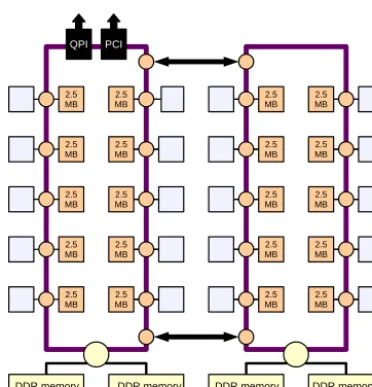
2.5 MB 2.5 MB 2.5 MB 2.5 MB 2.5 MB 2.5 MB 2.5 MB 2.5 MB 2.5 MB 2.5 MB 2.5 MB 2.5 MB 2.5 MB 2.5 MB 2.5 MB 2.5 MB 2.5 MB 2.5 MB 2.5 MB 2.5 MB PCI QPI
DDR memory DDR memory DDR memory DDR memory
(a) Schematic of a single socket Intel XEON 20 core Broadwell processor (typically two of these to a CPU node, mixed nodes may
have one of these and an accelerator in another socket).
Core 2 x VPU
Core 2 x VPU 1 MB
L2 hub Up to 36 tiles MCDRAM
(near memory) MCDRAM(near memory) MCDRAM
(near memory) MCDRAM(near memory)
D D R 4 (fa r m em or y) D D R 4 (fa r m em or y) PCI express Dead silicon
(two or more tiles)
(b) Schematic of Intel MIC Knights Landing processor node with 38 tiles (36 usable), each containing two cores with two
vector processing units and sharing a 1 MB L2 cache.
Figure 1.Architectural heterogeneity: a schematic comparison
be-tween an Intel Broadwell CPU socket (two sockets to a node, joined locally by the quick path interconnect, QPI) and an Intel Knights Landing MIC node. Notable differences include the two-dimensional mesh linking cores and memory (near and far) on the MIC node (with up to 16 GB of near memory L3 cache) and the bidirectional full ring on the CPU linking the cores (and support-ing up to 50 MB shared L3 cache). The most important difference, however, is the number of cores: approximately 20 to a socket or 40 to a CPU node and up to 72 on the MIC node. (Not shown in this diagram is the 256 MB L2 cache in the Broadwell cores and their internal vector processing units.)
Today, at the most fundamental level, modellers rely on the compiler to hide most of these details, but with the advent of coding for GPUs (of which more below), it has become clear that the better one can express parallelism in the high-level (e.g. Fortran) code, the better job the compiler can do even on traditional CPUs. Traditionally (say 10 years ago), in a weather or climate model one had two levels of concur-rency in mind associated with shared and distributed mem-ory.
– Shared memory concurrency involves organising the code so the compiler could be pre-fetching memory while doing calculations, i.e. worrying about loop or-der and organising loops or array declarations to en-able the efficient use of vector hardware. This requires “good coding practice”, either gleaned by direct knowl-edge about how compilers and hardware work or simply by edict: e.g. “always code nested loops with the inner-most loop using the left-hand index1, and never mind
why”.
– Distributed memory concurrency typically requires ex-plicit handling in the science code. Processes (typically on different nodes) cooperate on a common task util-ising memory, which is partitioned across nodes (“do-main decomposition”), and exchange updates using the message passing interface (MPIs; Gropp et al., 1996, ideally using libraries that vendors have optimised for their interconnects).
With the advent of the multi-core CPU (moving from dual core, to quad core, to now 20+core) the modeller had to
be-come aware of strategies to exploit the fact that the processor local cores shared memory and were connected together with lower latency and higher bandwidth than the interconnect be-tween processor sockets and nodes.
In most codes now we see one of two strategies: either MPI is still used across both nodes and node-local cores, or MPI is used in conjunction with OpenMP (Dagum and Menon, 1998). In the latter case OpenMP is used to run
someparallel threads on a core (“hyper threading”) or
par-allel threads on a socket, but the threads are sharing mem-ory, and directives are used to identify where this can occur. However, this strategy of mixing explicit library calls (MPI) and compiler directives (OpenMP) does not always work bet-ter than MPI alone, not least because vendor implementa-tions of MPI can implement on-node “messages” with highly optimised libraries exploiting shared memory with perfor-mance that can be hard to beat. Conversely, MPI decomposi-tion cannot be changed without paying a synchronisadecomposi-tion and data movement penalty, whereas OpenMP can exploit the dy-namic scheduling of work and better handle load balancing
around (for example) physics parameterisations such as pre-cipitation. Hence, the modeller following a hybrid approach has many issues to consider: how many parallel threads per node (between zero and the number of hyper-threads sup-portable on the node) and what parts of the code can take advantage of this technique? There is a balance to be struck which depends on knowledge of the code, the hardware, and the quality of the vendor-supplied compilers and libraries, and this balance needs to be re-evaluated for each architec-ture and model version.
Other programming models, such as the partitioned global address space (PGAS), try to address the problem of the lo-cality of memory with a single abstraction to address both shared and distributed memory. Implementations include the C extension, Unified Parallel C, Coarray Fortran, Chapel, and the (Open)SHMEM library. However, all of these suffer from lack of adoption and lack of universal availability, both of which contribute to the lack of wide use.
OpenMP also provides task concurrency, through which pools of threads are allocated amongst a set of tasks that can be done concurrently. However, in climate and weather mod-els, this feature is not widely used.
Now our hypothetical modellers are dealing with at least two levels of concurrency, probably a new directive syntax for declaring what parts of the code can use OpenMP or a completely different programming model (PGAS). They may also be having to deal with multiple languages (e.g. some combination of C++or Fortran and C) to best use the
hardware and libraries available.
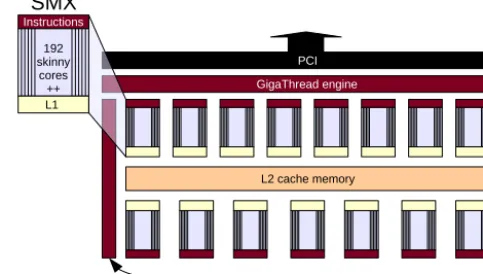
Most processors have vector units, and the trend is for these to grow both in size (width) and number in new pro-cessors. This provides another hardware feature that needs to understood and exploited and further complicates the task of model development. Then of course there are GPUs, which many think of as “big fat vector processing units”, but ones for which the needed levels of data parallelism are very high and out-of-order memory fetches are very expensive. How-ever, a cursory look at Fig. 2 shows that GPU architectures are themselves complex, with sophisticated memory hierar-chies and onboard methods of thread management.
The big difference between the CPU architectures (whether multi-cores or many-cores such as MIC) and the GPUs is the amount of intelligence (complexity providing extra instruction-level parallelism and caches to hide mem-ory latency) in the cores and on the package around the cores and how accessible that intelligence is to the programmer (or how easily it can be exploited by the compiler without ex-posing hardware concepts to the high-level code). In CPUs, much of the silicon is devoted to supporting complexity in the algorithm (branching multiple instructions, for example) and in GPUs, much of the silicon is devoted to doing the same thing to lots of data. However, the compiler directives that support this parallelism are still rather different and conform to differing, rapidly evolving, and sometimes poorly defined standards, so the programmer potentially has to understand
L2 cache memory L1
Instructions
192 skinny
cores
++ GigaThread engine
PCI
SMX
Memory controllers
Figure 2.High-level schematic of an NVIDA Kepler GPU (adapted
from NVIDIA, 2012). Up to 15 streaming multiprocessor (SMX) units share a 1.5 MB common dedicated L2 cache, and up to six memory controllers allow access to main memory. Thread control exists across the entire chip (the GigaThread engine) and in each SMX. The SMX units include 192 single precision cores, 64 dou-ble precision cores and other special function units, and an internal interconnect so that blocks of 32 threads can be managed internally. They also include 64 KB of L1 memory that can be configured in a combination of shared memory or L1 cache, and 48 KB of read-only L1 memory.
not only both hardware architectures, but also how best to exploit them. Requiring all modellers to have detailed hard-ware knowledge – and keep such knowledge up to date – is obviously not a tenable proposition.
Compounding all these difficulties is the fact that future processors are likely to have to operate at both low power and high processor counts; both factors are likely to lead to increased node failure rates. Existing software tools expect perfectly reliable hardware, with checkpointing as the only viable strategy to deal with hardware failure, so there will be a need for new mechanisms for handling hardware failure, which will undoubtedly add further complexity to the hard-ware programming environment.
2.2 Software complexity
Weather and climate models traditionally differ primarily in three areas:
1. the duration of a simulation (days vs. years),
2. component complexity (climate models typically in-clude more components associated with longer-timescale processes), and
3. how they are initialised (weather models by complex data assimilation systems and climate models by very long duration “spin-up” runs for components with poor observational coverage).
with the advent of seasonal prediction. But for the purposes of the discussion here, what they have in common is more important anyway:
1. the importance of executing the model at a satisfactory speed (e.g. a year per day);
2. multiple interconnected but often independently devel-oped sub-models (oceans, atmospheres, wave models, etc.), sometimes with extra versions to provide nested grids and or local refinement;
3. an interconnection framework or coupler (to exchange information amongst model components);
4. at least one component with an expensive dynamical core (atmosphere and/or ocean), with
5. a significant number of physics routines (radiation, mi-crophysics, clouds, gravity waves etc.);
6. an internal diagnostics system (to accumulate variables or calculate extra diagnostics beyond the prognostic variables carried in the model components);
7. systems to manage ensemble methods (for the extra simulations needed to address uncertainty); and 8. an I/O subsystem (to manage efficient input and output). These common attributes can be linked together in very com-plex ways.
At the high level, Alexander and Easterbrook (2015) showed some permutations of how large components can be coupled together in eight Earth system models and at the same time indicated the relative complexity of the key com-ponents. In general, the most complexity was found in the atmospheres of these models, although some Earth system models of intermediate complexity (EMICs) were dominated by oceans. The relative distribution of complexity also dif-fered significantly between models aiming at the chemistry thought to be significant in coming decades and those aim-ing at longer-timescale processes associated with the carbon cycle.
The interconnection between all the large-scale compo-nents requires a specialised framework and/or coupler to pro-vide methods for exchanging fields between components. Valcke et al. (2012) provide a comparison of coupling tech-nologies used in CMIP5, but it is interesting to note that of the six technologies discussed in this paper, only two (ESMF; Theurich et al., 2015, and OASIS, Craig et al., 2017) have any widespread use, and many large institutes feel it neces-sary to build their own coupling systems.
One key piece of software complexity arises from the a pri-ori necessity to find parallelism within the large components such as the atmosphere and oceans of any but the lowest-resolution models. With only a handful of large-scale com-ponents and machines with hundreds to thousands of nodes,
exploiting the machine efficiently requires splitting compo-nents across nodes exploiting “domain decomposition” – splitting the multi-dimensional (potentially all of longitude, latitude, and height) space into “domains”, each of which is integrated forward each time step on just one node (with the necessity of passing information between nodes after each time step so that “cross-domain” differences can be calcu-lated).
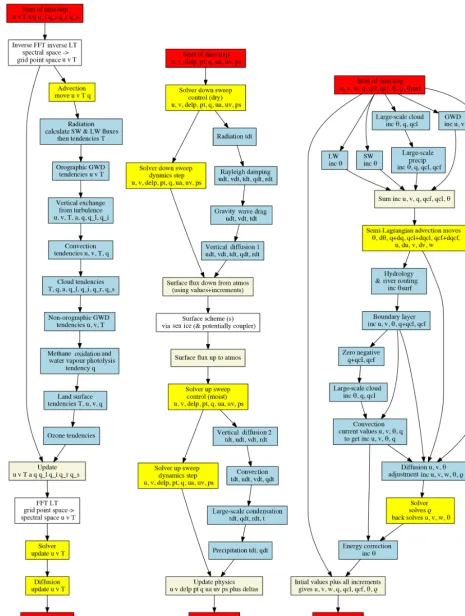
The relationship between the dynamics and physics within an atmosphere is also complex, with even more scope for different arrangements of data flow between internal com-ponents and processes. Figure 3 provides a glimpse into the interplay of dynamics and physics in three different atmo-sphere components from the ECMWF Integrated Forecast System, IFS (IFS 41R1; https://www.ecmwf.int/en/forecasts/ documentation-and-support, last access: 29 April 2018), the GFDL HiRAM (2012 public release; https://www.gfdl.noaa. gov/hiram/, last access: 29 April 2018; Zhao et al. , 2009), and the Met Office UM (v6.6; Davies et al., 2005). This fig-ure describes the flow of data associated with model prog-nostics within a model time step.
IFS is a spectral transform model. The key property of such a model is that due to the properties of the Lapla-cian operator, equations for vorticity, divergence and diffu-sion can be easily calculated in spectral space, with advec-tion and physics calculated on a grid distributed in physi-cal space. The model exploits two time levels and a semi-implicit, semi-Lagrangian time-stepping routine. The time step begins with variables held in spectral space, which are then converted back to grid point space for the physics to be executed sequentially, after which they are converted back to spectral space via a fast Fourier transform (FFT) in longitude and a Legendre transform (LT) in latitude to spectral space, for which the Helmholtz equation resulting from the semi-implicit time stepping is solved and horizontal diffusion is computed.
processes are integrated using the latest state calculated se-quentially using the incremented versions.
It can be seen that these three examples show rather dif-ferent methodologies. The first two use semi-implicit time stepping and the last explicit time stepping; as a consequence they have quite different communications patterns. The data layouts are very different, at least for the dynamics: IFS uses spectral transforms which necessarily means data ma-nipulation between spectral and grid point space. Each has their own take on how to organise the sequence of physi-cal processes and involve many independent pieces of code, each of which could need configuration and compiler- or even hardware-specific optimisation to take advantage of any given hardware environment.
Figure 3 does not describe actual code blocks or expose details of the internal time splitting, and it is important to note that any implicit parallelism shown may not be mirrored in the model code. Nonetheless, there are important differences in information flow which will feedback on opportunities for concurrent parallelism. For example, the UM does not use the updated state of the variables for the slow physical pa-rameterisations so they could be calculated in parallel, and some subcomponents, e.g. radiation, are expensive enough that they may not be executed at every time step. Such sub-components are large enough to treat, in terms of concur-rency, in the same way as full model components. Balaji et al. (2016) show results from experiments with the same code family as HiRAM, doing exactly that. Their results show that this extra concurrency can be exploited in a range of ways (to shorten the radiation time step or to speed up model inte-grations, albeit with a potential increase in resources used). However, the actual performance of the necessary changes, both in terms of the effect on simulation quality and speed, will differ with the different model approaches to informa-tion flow.
Model formulations also take a range of approaches to pro-viding diagnostic, ensemble, and I/O services, with no com-mon practice as far as we are aware beyond some emerg-ing community use of the XIOS I/O server (http://forge. ipsl.jussieu.fr/ioserver/wiki, last access: 29 April 2018). I/O servers provide a method of offloading (primarily) output to one set of processors to happen in parallel with computa-tions happening on other processors. XIOS provides an XML interface which allows not only output offloading, but also some diagnostic processing en route, and work is underway to extend it to support ensemble management as well.
2.3 Where is the concurrency?
The most obvious paradigm for concurrency in weather and climate models is the domain decomposition introduced above, exploiting MPI, but clearly there are multiple levels of parallelism being provided by the hardware and/or ex-ploitable in the software:
1. vectorisation within a GPU core or accelerator (using compiler directive languages such as OpenACC), with or without
2. vectorisation within a CPU core (handled by the com-piler, but only if the code is prepared appropriately, pos-sibly by embedding explicit compiler directives); 3. shared parallelism across CPU and accelerators and/or
GPUs (e.g. see Mittal and Vetter, 2015);
4. threading providing shared memory concurrency within nodes or sockets (e.g. by inserting OpenMP directives in code);
5. distributed memory concurrency across nodes, either by – utilising MPI (traditional “domain decomposition”; directly or with a library such as YAXT or GCOM) or
– exploiting an implementation of a partitioned global address space, such as Coarray Fortran (e.g. Mozdzynski et al., 2012, or language-neutral inter-faces, such as GPI; Grünewald and Simmendinger, 2013);
6. component concurrency, whether using a framework such as ESMF or handled manually with, for example, OpenMP tasks (e.g. Balaji et al., 2016);
7. coupled model components either
– as part of coupled model executed independently and concurrently using a coupler such as OASIS or executed together and concurrently using a frame-work (Valcke et al., 2012) or
– concurrent models running as part of a single exe-cutable ensemble, handcrafted (e.g. Bessières et al., 2016) or via a framework such as the GFDL flexi-ble modelling system used in Zhang et al. (2007); and
8. I/O parallelism (using an I/O server such as XML I/O Server, XIOS, or a parallel I/O library such as parallel NetCDF; Li et al., 2003).
Most of these levels of parallelism require decisions as to where and how the code should be refactored and/or restruc-tured to take advantage of them, and it may not be possible to utilise them all in one code stack, not least because on any given platform implementations may not exist or they may be poorly implemented (in terms of performance or feature coverage).
these modes of concurrency is that the former involve organ-ising codes to take advantage of single instruction multiple data (SIMD) hardware (such as vector units), and the latter involve higher-level assemblages interacting, mainly using the multiple programme multiple data (MPMD) pattern (ex-cept for the distributed memory options, which utilise the sin-gle programme multiple data, or SPMD, paradigm). We do not categorise threading (4) as either fine- or coarse-grained concurrency, since in practice from a programmer point of view it can be used following either mode (e.g. to parallelise loops in the same way as one parallelises them for a vec-tor processor or to provide extra models of parallelisation for domain decomposition).
The current best practice for addressing these modes of concurrency is to
1. code for hierarchies of parallelism (loops, blocks, do-mains),
2. use standard directives (OpenMP or OpenACC), 3. optimise separately for many-core GPUs, and
4. try to minimise the code differences associated with ar-chitectural optimisations.
However, this is no longer seen as a long-term successful strategy, at least on its own, because the strategies needed for different architectures may be fundamentally different (e.g. for memory optimisations). With the advent of exas-cale systems, entirely new programming models are likely to be necessary (Gropp and Snir, 2013), potentially deploying new tools, or even the same tools (MPI, OpenMP), to deliver entirely new algorithmic constructs such as thread pools and task-based parallelism (e.g. Perez et al., 2008). Weather and climate models will undoubtedly target such systems, so their disruptive influence is likely to necessitate the wider use of these new programming models.
3 Progress
None of the domains of complexity listed above were unex-pected: the clock-speed free lunch was over before the end of the first decade of the current millennium, and models have always been evolving by adding processes and more so-phisticated mathematics in their dynamical cores. Since the first vector registers in supercomputers, the pursuit of concur-rency has been the key to running fast models, and the tran-sition from massively parallel complex cores to even more massively parallel simpler cores with smaller local memory began with the BlueGene (e.g. Dennis and Tufo, 2008) and has accelerated with GPU entering mainstream computing.
Early work with GPUs began with computationally inten-sive physics modules for which it was clear that different approaches may be possible in different components, and
some of the first investigations into the use of new archi-tectures took this route by rewriting particular components; e.g. Michalakes and Vachharajani (2008) and Hanappe et al. (2011). The latter rewrote (in another language) the radia-tion code in a widely used fast low-resoluradia-tion climate model for a custom chip – an effort which took 2.5 person years and delivered a significant speed-up on the new processor over the original version. However, although this rewrite achieved significant speed-ups even in the CPU version, it is no longer being actively used, primarily because of the downstream technical and scientific burden associated with assimilating and maintaining (both technically and scientifi-cally) a rewrite in another language. This downstream burden is one of the main issues associated with re-engineering code: if the code “owner” is not engaged, then rewrites are unlikely to survive.
By contrast, Fuhrer et al. (2014b), in a partnership be-tween meteorologist code owners and computer scientists, have rewritten ab initio the dynamical core of the COSMO weather forecasting model using a domain-specific language approach (see Sect. 3.1), and it is now operational on a hybrid CPU–GPU machine. Their team is now working on exten-sions into the physics. One of the lessons learned was that, as with the Hanappe et al. (2011) experience, rewriting for good GPU performance resulted in speed-ups on the CPU as well.
Govett et al. (2014, 2017) have compared and contrasted several generations of compiler implementations of Ope-nACC and OpenMP on a range of hardware using their next generation Non-hydrostatic Icosahedral Model (NIM). While they have successfully implemented a single-source code model which supports a range of hardware platforms, their experiences exposed multiple compiler issues and de-pended on ab initio design constraints on their Fortran source code (e.g. basic language constructs and minimal branching). Like Fuhrer et al. (2014b) their initial work has concentrated on the dynamical core, and one suspects that this code can-not be easy to maintain – examples show that in places the number of directives in a code block exceed the number of lines of Fortran. This would be consistent with the observa-tion that wide disparities in coding effort between the vari-ous directive-based approaches exist (e.g. see Memeti et al., 2017, for a comparison of coding effort in terms of lines of code). The NIM work on radiation codes yielded less than compelling results (Michalakes et al., 2016) as memory bot-tlenecks were identified, demonstrating that more work was needed on invasive and time-consuming refactoring to ready codes for emerging hardware. Experience in other groups also suggests that unless this work is carried out by paral-lelisation experts, gains in performance may be outweighed by the introduction of subtle errors that can be very difficult to find and fix.
used to investigate the performance of OpenIFS, but the port-ing involved is not straightforward, and it is clear that the full benefit of the new programming model cannot be exploited starting from the code – the developer needs to begin with a deep knowledge of the algorithm (as opposed to its expo-sition in legacy code) to fully exploit any benefits accruing from a new programming approach.
Fu et al. (2016) took another approach in a directed port of an entire model, in this case the much larger code of the Community Atmosphere Model. This work involved exten-sive refactoring and optimisation, albeit with a conscious ef-fort to minimise manual refactoring (and downstream main-tenance issues) and mainly relying on source-to-source trans-lation tools. In this case, because the target platform (the Sun-way TaihuLight supercomputer) is constrained in memory performance, much of the effort was on minimising mem-ory footprints. Without this work, the unique architecture of the TaihuLight would not have been fully utilised; with it, a speed-up of a factor of 2 was possible. Notable in their list of key activities was the design of tools to manage the process: a loop transformation tool and a memory footprint analysis and reduction tool.
All these approaches were effectively addressing fine-grained parallelism in some way or other without address-ing coarser-grained concurrency, and they all involved var-ious levels of “intrusion” into code, from adding or chang-ing codes to complete rewrites or translations. Such changes all risk the ongoing evolution of the codes – it is important that codes remain easy to work with so the scientific content can continue to evolve. All found that performance improve-ments were modest, primarily because weather and climate codes do not have “hot spots” that can be identified and opti-mised. Typically, the low-hanging fruit of such optimisation has already been harvested, and this with the complicated inter-relationships between dynamics and physics discussed in Sect. 2.2 coupled with the sheer number of geophysical processes involved has led to very “flat” codes. For example, the atmosphere component of a current climate model run-ning using 432 MPI tasks, has no subroutines that take more that 5 % of runtime except for halo exchanges (more below). Only 20 of the 800+subroutines involved take 1 % or more
of the runtime! However, despite the fact that performance improvements were modest, in all but the earliest work the lessons learned form the basis of ongoing endeavours.
The obvious solution to these problems is to attempt a sep-aration of concerns to break the overarching modelling prob-lem into more discrete activities and somehow address the flat computational profile within that paradigm. In most of the remainder of this section we introduce a range of cur-rent activities which span the breadth of weather and climate modelling that are aimed at some part of such a separation of concerns which we (and the institutions, projects, and part-nerships we represent) are applying in the context of weather and climate modelling.
All are activities carried out in the context of wanting to address four primary aspects of modelling:
1. ensuring model quality (the models available are meet-ing the advancmeet-ing scientific requirements),
2. delivering performance (in simulated years per wall-clock day),
3. supporting portability (so that they can run on all the relevant platforms currently in use or likely to be in use in the foreseeable future without excessive lead times associated with porting), and
4. productivity (the ability to work with the codes from a scientific perspective by changing algorithms, adding processes, etc., in a reasonable period of time and with-out inadvertently compromising on the reliability and/or accuracy of code).
We conclude the “Progress” section with a brief review of how this work complements related work in other disciplines.
3.1 Domain-specific languages
As discussed above, much parallelisation in weather and cli-mate codes is delivered by individuals constructing or modi-fying code-using libraries (such as MPI) and directives (such as OpenMP); this is despite decades of research into paral-lelising tools. The dominant reason for this is that humans can inspect an algorithm, and with knowledge of the hard-ware, further exploit domain-specific knowledge to reason about how to improve performance, but the domain-specific knowledge is not available to generic parallelisation tools. The result is that humans currently deliver science code that performs much better than that produced by generic tools (although this is not the case with compilers, which gener-ally produce vectorised assembly code which performs better than that produced by humans)
So what are the domain-specific characteristics which are being exploited by the humans? Not surprisingly, they de-pend on the domain – the narrower the domain, the more a priori knowledge is available. Some of the earliest exam-ples of this approach include the use of kinetic preprocessors for atmospheric chemistry. These take reaction specifications and generate code for specific processors (e.g. Linford et al., 2009).
Extending these ideas more widely means taking advan-tage of the knowledge that weather and climate models typically employ difference, volume, or finite-element discretisations of the underlying equations. As a consequence,
– operations are performed over a mesh,
– many operations are independent of each other, allow-ing for data parallelism,
– operations at a mesh point, volume, or element can ei-ther be computed locally or depend on neighbouring el-ements (leading to nearby neighbour – stencil–
com-munication patterns), and
– reductions are required for convergence and/or conser-vation (leading to requirements for global communica-tion).
In addition, the meshes themselves typically – have fixed topologies,
– are structured or semi-structured (quasi-uniform), – have resolution in the vertical which is much smaller
than the horizontal (leading to 2-D+1-D meshes rather
than full 3-D meshes), and
– have data structured or unstructured in the horizontal and structured in the vertical.
We can further note that
– dynamical cores are mostly independent in the vertical, and
– physics (parameterisations) are mostly independent in the horizontal.
These characteristics fundamentally affect how to effi-ciently parallelise a code. For example, one would parallelise a 3-D finite-element model of an engine, which would typ-ically be unstructured in all dimensions, very differently to a finite-element model of an atmosphere. In the latter case optimisations can make use of the knowledge that one direc-tion – the vertical – is typically more structured and has lower dimensionality.
Domain-specific languages (DSLs) provide constructs that are suitable for the domain in question, rather than be-ing general purpose. This approach can lead to a more in-tuitive (higher-level) interface for scientific programmers, since they will be dealing with a much simpler, more con-strained language (in comparison with general-purpose lan-guages). It can also lead to a better separation of concerns between the algorithmic description (using the DSL) and op-timisation. For example, weather and climate codes in the form described above have two main communication pat-terns: nearest neighbour (stencil) accesses and global reduc-tions. Therefore, the optimisation scheme associated with such a DSL need only understand and reason about these two forms of communication pattern.
DSLs are not necessarily designed for entire communities; they can be targeted at particular requirements within com-munities. For example, there are two exemplars of the DSL approach currently in use by the weather and climate com-munity.
– GridTools (Fuhrer et al., 2014a), which was initially for the COSMO consortium. The GridTools project in-cludes a wide range of activities, some of which are discussed further below, but the DSL component of the work has evolved from an earlier DSL (Fuhrer et al., 2014b and Leutwyler et al., 2016).
– PSyclone, which was for a new UK model – LFRic. PSyclone has evolved from the Gung Ho dynamical core project (Ford et al., 2013).
Each has been expressly developed to separate the science specification from the hardware optimisation so that the sci-ence writer only needs to write the scisci-ence code, with sep-arate implementation and optimisation for parallelism. This allows the science to be written once, with (potentially mul-tiple) implementations tailored to particular architectures in such as way that they do not intrude on the maintainability (and evolution) of the science code. Both groups are already exploiting this potential to separately target different archi-tectures (see e.g. the discussion in Sect. 3.2 below).
Both GridTools and PSyclone make use of domain-specific embedded languages (DSELs); i.e. their languages are embedded within an existing language, C++and Fortran
respectively. In both cases this choice was made as it was felt that the combination of available tools and community famil-iarity bought important benefits, but clearly different choices as to those benefits were made.
They also differ in their original target domains. The origin of GridTools was a DSL designed for a finite-difference reg-ular latitude–longitude local area model, whereas PSyclone was designed for a finite-element model with an irregular mesh. However, the GridTools formalism is being extended to support irregular finite-difference models and PSyclone is being extended to support regular finite-difference models.
The approach to optimisation in the two systems is also quite different. In GridTools a particular back end (optimised by an HPC expert) is chosen and the science description is mapped to that particular back end via C++templates. In
PSyclone, an HPC expert specifies a recipe of optimisations which are then used by Psyclone to process the DSL input to produce code optimised for a particular architecture.
Despite these differences, both approaches rely on HPC expertise to deliver architecture-dependent performance. The DSL approach expedites the separation of concerns in such a way that computational experts can concentrate on the opti-misation for given hardware, allowing different individuals to concentrate on different parts of the problem (e.g. Schulthess, 2015).
importance of “growing their market” to maintain this incen-tive, but this is a complex issue (see Sect. 4.2).
3.2 Weather and climate dwarfs
As already noted, many components within weather and cli-mate models have very flat computational profiles, but one approach to dealing with this is to identify “mini-apps” (anal-ogous to the so-called Berkely dwarfs; Asanovic et al., 2006), which are exemplars of patterns in the code (e.g. common communication behaviours), so that performance issues can be investigated (or predicted) by using a small code base, typically a fraction of the size of the larger code (Her-oux et al., 2009). When combined with a DSL approach, lessons learned from investigating mini-apps could be ex-ploited more widely within the codes with minimal human intervention.
The ESCAPE (Energy-efficient Scalable Algorithms for Weather Prediction at Exascale; http://www.hpc-escape.eu, last access: 29 April 2018) project is investigating this ap-proach for weather and climate with a specific focus on energy efficiency and emerging processor technology. ES-CAPE initially defined dwarf categories (Table 1) which ad-dress key aspects of such models by including key compo-nents of the ECMWF spectral model IFS, its semi-implicit time-stepping formulation, and the semi-Lagrangian advec-tion scheme. These allowed for an investigaadvec-tion of aspects of both global and limited-area prediction in the context of wave, ocean, and land surface components.
The IFS model takes one approach to the discretisation of prognostic partial differential equations and their evo-lution in time defined on a grid. However, alternative dis-cretisations are also realised with a finite-volume approach, which added dwarfs related to the advection scheme (Kühn-lein and Smolarkiewicz, 2017) and a 3-D grid-point-based el-liptic solver (Smolarkiewicz et al., 2016), explored with both structured and unstructured grids. Two further dwarfs have also been chosen as representatives of the (many) physics pa-rameterisations in models – a cloud microphysics and radia-tion scheme (Mengaldo, 2014; Geleyn et al., 2017). Different dwarfs would probably be necessary for other dynamics for-mulations such as those introduced in Sect. 2.2.
The computational performance challenges are fundamen-tally different between dwarfs just like their functional sep-aration within an Earth system model. For example, spectral transforms are very memory and communication bandwidth intensive. Three-dimensional elliptic solvers are compute in-tensive and affected to a greater extent by communication latency. The semi-Lagrangian advection scheme is also com-munication intensive and depending on implementation may suffer from load-balancing issues. All three of these dwarfs have limited scalability because they involve data transfer and computations of global or regional fields, which is oppo-site to the nearest-neighbour principle. By contrast, param-eterisations for cloud microphysics and radiation are very
compute intensive but scalable, as they are applied to indi-vidual vertical columns that can be distributed across both threads and tasks in chunks aligned with the available mem-ory. Hence, performance enhancement options need to be ex-plored differently for each dwarf based on the range of avail-able processor types and considering that all these processes need to be present in an Earth system model.
For each dwarf, ESCAPE targets performance on exist-ing and emergexist-ing processor technologies (specifically Intel Xeon, Xeon Phi, and NVIDIA GPGPU and a novel tech-nique employing optical interferometry particularly suitable for Fourier transforms), but it is also targeting programming methodologies. Of necessity this involves comparing mod-ified and existing MPI and OpenMP implementations with new OpenACC- and DSL-based implementations (the latter using GridTools).
3.3 Data models
The earliest weather and climate models discretised equa-tions using a grid with one data point per cell. This led to easy data layouts, with data contiguous in memory, and rela-tively straightforward algorithms to find vectorisation. Mod-ern grids and meshes are more complicated, not always struc-tured, and often with multiple points per cell. Finite-element methods add additional complexity: instead of points repre-senting values associated with each cell, basis functions are defined within each cell, and field “values” are established by parameters per cell known as “degrees of freedom (DOFs)”, which for each basis function establish how the field varies
withinthe cell. These DOFs are then associated with mesh
entities such as volumes, surfaces, edges, and vertices. There is no established convention or standard for layout in memory of these more complicated grids and meshes or how the various cell entities are associated with each cell. The current best practice is tightly coupled to knowledge of the grid being used; the ECMWF IFS model, for exam-ple, has a data structure designed specifically for the reduced Gaussian grids which arise from exploiting the spectral trans-forms used in the dynamical core (Hortal and Simmons, 1991). But the spectral transform method may no longer be attractive on future architectures due to its inherent all-to-all global communication pattern, and this is recognised in the exploration of alternative approaches via the extra dwarfs discussed above. Some of these other approaches rely on nearest-neighbour communication patterns and may even be applied to unstructured grids, leading to the requirement for different data structures to get maximum performance, po-tentially with different variants depending on the target hard-ware!
mod-Table 1.The ESCAPE dwarfs – a set of mini-apps providing a sample of characteristic behaviours of weather and climate model subcompo-nents. The “D” category dwarfs are related to the dynamics, the “I” dwarf is general purpose, and the “P” dwarfs represent physics-related issues.
D Spectral transform; SH Spherical harmonics based transform to facilitate semi-implicit solvers on the sphere. D Spectral transform; biFFT A 2-D Fourier spectral transform for regional model applications.
D Advection; MPDATA A flux-form advection algorithm for sign preserving and conservative transport of prognostic
variables and species.
I 3-D interpolation; LAITRI Interpolation algorithm representing a wide class of interpolation and remapping uses in NWP and climate.
D Elliptic solver – GCR An iterative solver for the 3-D elliptic problem arising in semi-implicit time-stepping algo-rithms.
D Advection – semi-Lagrangian An implementation of the semi-Lagrangian advection algorithm.
P Cloud microphysics; CloudSC Cloud microphysics scheme from IFS, an exemplar of a range of physical parameterisations.
P Radiation scheme; ACRANEB2 An exemplar radiation scheme used in regional NWP modelling.
+ xy() : Iterator + size() : Integer
<<constructor>> Grid( name : String )
<<constructor>> Grid( configuration : Config )
Grid
+ xy( n : Integer ) : PointXY
UnstructuredGrid
+ xy( i : Integer, j : Integer) : PointXY + nx( j : Integer ) : Integer + ny() : Integer
StructuredGrid
+ x( i : Integer ) : Real + y( j : Integer ) : Real + nx() : Integer + ny() : Integer
RegularGrid
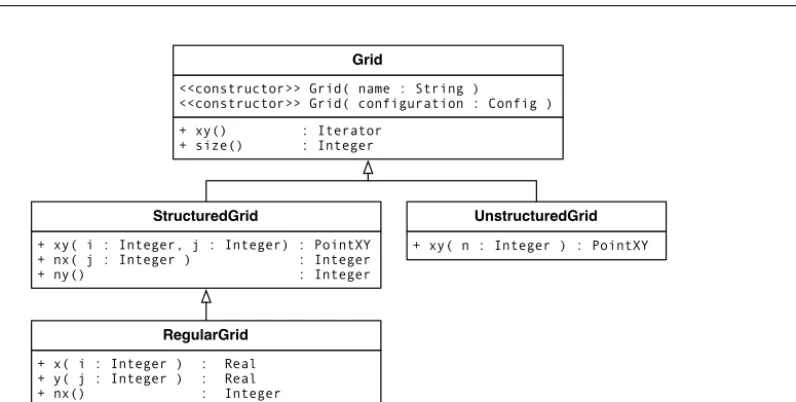
Figure 4.Object orientation and theGridclasses supported in Atlas. Specific model grids can be constructed as instances of one of these
classes. For example, the current ECMWF high-resolution (9 km) octahedral reduced Gaussian grid is an instance of theStructuredGrid, but can be referred to by the name Ø1280, which it inherits from theGridclass.
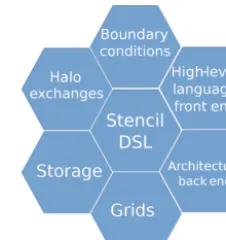
ern Fortran interface designed to be maintainable and non-intrusively adapt to emerging hardware technologies and pro-gramming models. This is achieved by a design with a clear separation of concerns that, for example, provides a clean interface for exploitation by a DSL and allows multiple back ends for actual field data storage: a CPU back end and a GPU back end with the capability to synchronise with each other seamlessly.
The Atlas library provides a toolkit of functionalities rang-ing from low-level field containers to high-level mathemati-cal operators and remapping operators. One example of the Atlas object-orientated design is the way that the grid struc-tures are designed and exploited. We have already noted in Sect. 3.1 that weather and climate models have common properties that can be exploited, and grid type is one such common property, although the grids used vary, with regular grids, reduced Gaussian, icosahedral, and cubed-sphere grids all in common use. As a consequence, Atlas provides a
clas-sification of grid objects and supports their configuration for different model variants at different resolution via simple res-olution parameters. Figure 4 shows how such grid objects can be constructed as specialisations of common characteris-tics with resolution parameters. More specific grids may be added non-intrusively by exploiting the object-orientated de-sign.
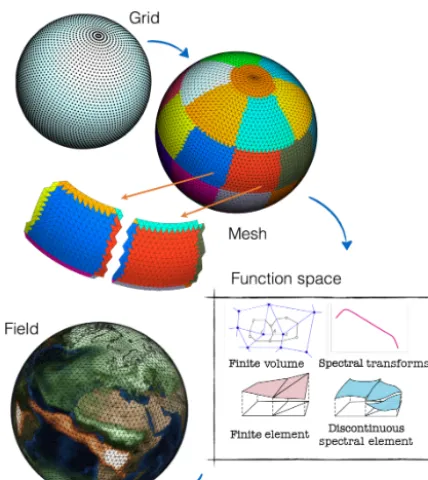
Figure 5 sketches how theseGridobjects can be used in
a workflow to configure how memory structures can be set up using Atlas. AMeshGeneratorcan, using a givenGrid,
gen-erate a parallel distributedMesh. AMeshpartition provides
an unstructured ordering of nodes that connected through lines (also called edges) form two-dimensional elements (tri-angles or quadrilaterals). Connectivity tables essentially link elements, edges, and nodes. Atlas further provides function-ality to grow eachMeshpartition with a halo so that
Figure 5.Conceptual workflow on how to use Atlas with most ap-plications.
Using a Grid or a Mesh, a FunctionSpace can be created,
which sets up how fields are discretised and parallelised.
A NodeColumns FunctionSpace is available to describe
for every node of a horizontal mesh a contiguous-in-memory structured vertical column. A Spectral FunctionSpace
de-scribes a field with spectral coefficients. Additional
Func-tionSpacetypes can be created to describe discretisation for
continuous or discontinuous spectral element methods (e.g. Marras et al., 2016).
Within ESCAPE, Atlas is being used as the foundation for the evolution of the NWP and climate dwarfs. As a conse-quence Atlas acquired improved mesh-coarsening strategies, a GPU-capableFielddata storage, and support for regional
grids with projections and checkerboard domain decomposi-tion. Clean interfaces in both Atlas and GridTools are being used to exploit Atlas memory storage to allow GridTools to compute stencil operations on unstructured meshes.
3.4 MPI libraries, coupling, and I/O
All methods of coarse-grained parallelisation which do not use global address spaces exploit the MPI paradigm, whether it is managing domain decomposition, coupling components, or exploiting I/O servers.
Exploiting MPI directly is difficult, and models typically exploit some sort of middleware library such as Generalised COMmunications (GCOM) used by the Met Office UM or YAXT (Yet Another eXchange Tool; https://doc.redmine. dkrz.de/yaxt/html/da/d3c/concept.html, last access: 29 April 2018) under testing for use in ICON. Such tools can simplify
Figure 6.The influence of using a library to manage MPI
com-munications for domain decomposition: experiences using YAXT to replace the existing ECHAM usage of MPI in a T63L47 model. The YAXT optimised library (green) can lead to factors of 10 im-provement in the time taken to do transpositions of data over simple implementations (blue) and factors of 2 over manual optimisation (red, which was effectively an aggregation of multiple transposi-tions into bigger messages). In this case the two main optimisatransposi-tions in YAXT were avoiding additional data copies by the usage of MPI data types and reordering of messages to avoid congestion, with the latter becoming more important with higher core counts.
the usage of MPI and therefore make the performance poten-tial of data layout and data independence accessible (see e.g. Fig. 6).
The complexity of data transpositions and MPI communi-cations increases in the context of coupling, and these also need to be understood in terms of how best to obtain perfor-mance. Many groups are investing in coupling tools, such as the OASIS coupler widely exploited in Europe. Recognising that there is much to be learnt from these various activities, the community has held a series of workshops on coupling, which led to the identification of a range of parameters which influence coupling and can be used in a benchmarking strat-egy (Table 2).
With these characteristics in mind, the IS-ENES2 project established a programme of investigation into coupling per-formance by developing some stand-alone components suit-able for coupling tests and carried out some initial investi-gations testing the impact of the number of cores per com-ponent, the grid sizes, the grid aspect ratios and orientations, and having different numbers of cores for different compo-nents.
benchmark-Table 2.A set of characteristics that influence coupler performance.
Grid type of the coupled components Grid size of the coupled components Number of processes for each component Layout of the components on the available cores Number of fields exchanged between the components Disparity in the grids between components
Scheduling of the components and coupling
ing environment; future work will focus on learning lessons from comparisons of performance (Valcke et al., 2017).
3.5 Tools to support porting, optimisation, and performance portability
Automatic code-parsing tools provide a route to code migra-tion (e.g. Fu et al., 2016, as discussed above), but their effi-ciency depends on the internal models of how codes are and can be organised, in particular the presence or absence of pre-existing manual optimisations, which if not understood by the tool, can require significant manual effort to remove (before and/or after the use of the tool).
It is clear that achieving performance requires a compre-hensive understanding of what existing model components or dwarfs are doing, and performance portability requires de-signing code that will still have performance on alternative architectures. With the complexity of modern codes, this can no longer be efficiently done with access to simple timing information, and more complicated information needs to be gathered and presented for analysis by developers. Such in-formation is normally provided by performance tools.
Performance tools can provide the support and the free-dom to the developer to view all the different levels of concurrency (from the hardware counters underpinning fine-grained concurrency to the load-balancing involved in coarse-grained concurrency). While it is possible to collect a vast amount of information by relinking entire codes to performance monitoring libraries, results are often enhanced by manually identifying hot spots and extracting additional trace information, and automatically generated call trees can be enhanced by additional instrumentation.
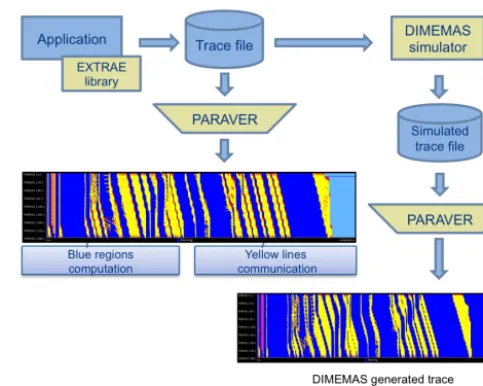
In particular, like automatic code migration tools, the tools which generate trace files, such as the EXTRAE library un-derpinning the generation of trace files for PARAVER or DIMEMAS, depend on an internal understanding of the pro-gramming models in use in the target codes. It is this un-derstanding that allows them to automatically trap library calls and read hardware counters without code invasion, but it is precisely because of this dependence on generalised programming models that extra manual intervention can be necessary to capture domain-dependent information in trace files.
Figure 7.Understanding model performance on existing machines
generally requires instrumenting the model code to output “trace” information that can be analysed and visualised by a dedicated ap-plication. This information can also be used, when combined with machine information, to predict performance (issues) on alterna-tive architectures. This figure depicts the use of PARAVER (Labarta et al., 2005) for collecting trace information and DIMEMAS (Gon-zalez et al., 2011) for simulating performance on alternative archi-tectures.
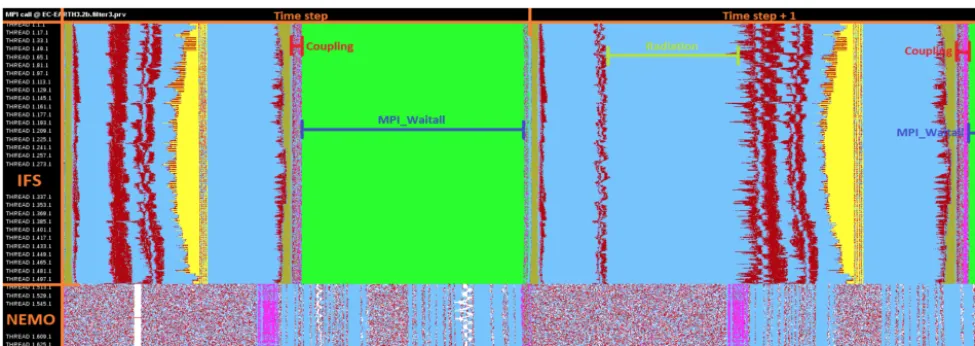
The resulting trace files can be analysed directly to help improve performance on any given architecture and also be used to predict performance on alternative architectures (see Fig. 7). Any extra levels of invasive alteration of code add further levels of programming complexity, and even with in-tuitive analysis tools (see e.g. Fig. 8), considerable time and expertise is required to interpret the outputs. However, the regular use of such tools by DSL developers and those eval-uating dwarfs is one route to maximising the benefit of these tools without the community needing to gather the relevant expertise.
3.6 Related work
Weather and climate computing is not alone in facing these problems. For example, the notion of DSLs as a solution has a tried and tested heritage – examples include the Kokkos ar-ray library (Edwards et al., 2012), which like GridTools uses C++ templates to provide an interface to distributed data
ex-Figure 8.Example trace information generated with EXTRAE used to analyse high-resolution coupling in EC-Earth. This view shows MPI calls during the execution (one colour per call). Top: 512 MPI tasks for the IFS atmospheric model. Bottom: 128 MPI tasks for the NEMO ocean model. This fine-grained performance information yields information as to how to get better performance out of coarse-grained concurrency.
pertise has a primary role to play, but this expertise can be better deployed by supporting DSLs than entire code bases.
The mini-app or dwarf approach we describe above is also starting to become more widely prevalent, mainly because it provides a tractable route to both predict performance and develop and test performance optimisations for new hard-ware. Its applicability to weather and climate modelling fol-lows directly from the fact that the source of the methodology was in disciplines for which similar flat multiphysics pro-files were involved. The concept of attempting to represent a cross section of applications or application characteristics is becoming well recognised (e.g. Martineau et al., 2016), and others are investigating applicability to environmental models (e.g. Stone et al., 2012) and noting the importance of representativeness in the selection of the mini-apps.
Problems of establishing appropriate data structure, gen-erating meshes, and simplifying the related interfaces and workflows are prevalent across all communities addressing the solutions to partial differential equations, whether on a sphere or not, with decades of relevant research for de-ployment on parallel computers. More recently, work on data structures has begun to address cache awareness and the use of space filling curves (e.g. Günther et al., 2006), and a wide range of mesh generators are available. The issue for weather and climate modelling is not so much what relevant work there is, but how best to establish domain-specific tooling which yields scientific and software development productiv-ity across the communproductiv-ity.
Further up the software stack, model couplers, frame-works, and I/O servers are all tools for which the domain specificity dominates, although many communities have analogous problems. Tools for evaluating code performance are common across communities, with important related
work in the establishment of standards for trace file formats (e.g. the Open Trace Format; Knüpfer et al., 2006) and com-mon notations for adding directives for extra performance-related information.
4 Discussion
We have introduced a range of modes of hardware and soft-ware complexity, requirements for concurrency, and recent progress in addressing the evolution and performance of weather and climate codes. We have done this in the context of wanting to ensure model quality, keep and improve perfor-mance, sustain portability (in the face of the Cambrian explo-sion in computing), and maintain productivity – the continual increase in the scientific capability of the models.
In our discussion we address these requirements and their dependency on current trends in complexity. It will be seen that we contend that progress cannot be maintained on the existing trajectory, so in the final part of the discussion we outline our manifesto as to what the community needs to do.
4.1 Requirements
forecasts in a particular time window or to reach a requisite number of simulated years per day for climate.
It is not so well known that quality is also often compro-mised for productivity and portability. One of the reasons for the popularity of the Weather Research and Forecasting model (WRF; Skamarock et al., 2005) is that it is easy to modify and run, and this productivity–portability benefit out-weighs the use of alternative models even when they are per-ceived to deliver better-quality weather simulations.
Until recently, given the dominance of X86 systems, per-formance has been relatively independent of platform; once compiler differences have been negotiated, getting the best performance has been mostly about understanding how to ex-ploit processor decomposition given the interconnect and ig-nored by much of the modelling community, except by those with the most demanding applications (typically in weather predictions in tight wall-clock time windows or in long, com-plex, or high-resolution climate runs). Nonetheless, perfor-mance also involves the need to optimally fill machines (or execute large ensembles), so optimising performance can also mean addressing throughput rather than speed (Balaji et al., 2017), meaning that performance optimisation should not only be about good fast code, but also about evaluating speed for a variety of situations within a large potential pa-rameter space (e.g. processor decomposition and placement). Portability, which is the ability to migrate codes between architectures and achieve acceptable performance (with con-fidence that the code is delivering the same scientific results; e.g. Baker et al., 2015) is very important, whether to ensure that codes can be executed on many platforms by a wide community or to ensure that the codes will work on future architectures. In many groups it is seen as one of the most im-portant considerations (e.g. Norman et al., 2017). However, as we have seen, obtaining ideal performance on multiple architectures with the same code is problematic, so perfor-mance portability is always a compromise. In fact, it has been said that “the real goal is probably better labelled maintain-ability than strict portmaintain-ability” (Norman et al., 2017, again).
The difficulty we now face is the fact that because of the oncoming heterogeneity, even vendors are suggesting that the community is facing a world in which one can only have two of the three factors of performance, portability, and produc-tivity – a happy compromise is no longer possible. While this is again to some extent hyperbole, it is certainly true that much more effort needs to be devoted to achieving these simultaneously and that quite major changes in approach (e.g. the use of DSLs) are needed: so it is the amount of effort needed, the change in approaches required, and the timescales in play that lead to the “cliff edge chasm” motif for this paper.
4.2 Making progress
To make progress in the science, existing weather models are being extended to seasonal and decadal scales by
run-ning with additional components (ocean, sea, and land ice), and existing climate models are confronting the need to start from prescribed initial conditions and run at increased res-olution. New models are being developed, but the existing timescales from development to production science serving large communities are currently of the order of a decade. All these models need to exploit all the avenues of concurrency outlined in Sect. 2.3 and at the same time support multiple architectures. How then can we make progress?
There are essentially four strategies to sustaining a mod-elling programme:
1. develop a model and all the supporting components from scratch,
2. build a particular piece or pieces of a model and utilise components and/or infrastructure from elsewhere, 3. utilise someone else’s model, but tinker with some
as-pects of it, or
4. simply configure and run models developed elsewhere. Which strategy is most appropriate depends primarily on the resources and skill sets available and the productivity pos-sible. Only a handful of groups can afford the first strategy, and the further down the list one goes, the less control one has over the future trajectory that is possible for that mod-elling programme because of the external dependencies.
Risks range from not being able to move fast enough to meet science goals, to having key capability removed be-cause the external group has chosen either to do something completely different or change key aspects of the interfaces upon which the model depends. In the worst case, hav-ing outsourced some capability, the internal group may no longer have the capability to replace that capacity. Mainly for these reasons, large (primarily) national modelling en-deavours prefer to keep as much development as possible in house. However, looking forward, it is not obvious that even large national groups have the internal resources toboth
keep up a production line of incremental model improve-ments associated with meeting near-term scientific (and/or operational) requirements and identify and take the
requi-site steps necessary to develop codes which can hit qual-ity+performance+portability+productivity requirements
using next generation computing, particularly when the latter is unlikely to be achievable with small steps. Thisis
recog-nised in some large institutions; for example, the Met Office is investing in OASIS, NEMO, and XIOS, all of which have replaced or will replace internal developments.