R E S E A R C H
Open Access
Bayesian aggregation versus majority vote in the
characterization of non-specific arm pain based
on quantitative needle electromyography
Andrew Hamilton-Wright
1,2,3*, Linda McLean
1*, Daniel W Stashuk
4, Kristina M Calder
1Abstract
Background:Methods for the calculation and application of quantitative electromyographic (EMG) statistics for the characterization of EMG data detected from forearm muscles of individuals with and without pain associated with repetitive strain injury are presented.
Methods:A classification procedure using a multi-stage application of Bayesian inference is presented that characterizes a set of motor unit potentials acquired using needle electromyography. The utility of this technique in characterizing EMG data obtained from both normal individuals and those presenting with symptoms of“ non-specific arm pain”is explored and validated. The efficacy of the Bayesian technique is compared with simple voting methods.
Results:The aggregate Bayesian classifier presented is found to perform with accuracy equivalent to that of majority voting on the test data, with an overall accuracy greater than 0.85. Theoretical foundations of the technique are discussed, and are related to the observations found.
Conclusions:Aggregation of motor unit potential conditional probability distributions estimated using quantitative electromyographic analysis, may be successfully used to perform electrodiagnostic characterization of“non-specific arm pain.” It is expected that these techniques will also be able to be applied to other types of electrodiagnostic data.
Background
It is generally accepted that non-specific arm pain (NSAP) is caused by physical exposures in the work-place including repetitiveness, awkward postures, and high forces, and this condition is commonly reported in the workplace [1]. In a 2-year prospective population based cohort study with retrospective assessment of exposures at work, Macfarlaneet al [2] found mechani-cal factors moderately increased the risk of NSAP, with repetitive motion being the most important factor for the onset of pain. However, a study by Walker-Bone et al [3] found that individuals with NSAP were no more likely to develop a known pathology, such as hand-wrist tendonitis from repetitive keyboard work, than indivi-duals without underlying forearm pain, suggesting that
the diffuse pain felt in NSAP is not simply a precursor to a more clearly defined musculoskeletal condition.
Despite known risk factors, little is known about the pathology of NSAP, where the diffuse pain noted in the forearm of affected individuals lacks any clear diagnostic criteria. In fact, the Harrington criteria [4] define non-specific forearm pain as a pain in the forearm that fails to meet the diagnostic criteria for other specific diag-noses and/or diseases.
It is not clear whether NSAP is a musculoskeletal or neuromuscular condition. Some authors believe that chronic pain conditions like NSAP and trapezius myal-gia are associated with damage within the muscle [5-10], whereas others believe it is caused by neuropathic changes [11-14]. In some muscles affected by chronic overuse conditions, an increased proportion of “ragged red”fibers have been identified on biopsy as compared to healthy control subjects, and researchers have there-fore suggested that the origin of this condition is
* Correspondence: [email protected]; [email protected]
1School of Rehabilitation Therapy, Queen’s University, Kingston, Ontario,
Canada
associated with mitochondrial damage to the Type I fibers [15-17], however these results have not been con-clusive, with similar damage noted in individuals who perform repetitive tasks but who are pain free. Other researchers have found indications that chronic muscle pain in the wrist flexor group (also referred to as NSAP) may be neuropathic in nature [11-14]. In particular, Greening et alspeculate that NSAP affecting the wrist flexor muscles is neuropathic in origin, based on observed changes in median nerve function [11,12,18].
Quantitative electromyography
Quantitative electromyographic (EMG) data can be used to obtain reproducible and robust characteriza-tions of the signature signal structures obtained from individual motor units (MUs) [19,20]. Through signal decomposition techniques applied to a needle-detected EMG signal, it is possible to observe the repeated occurrence of motor-unit potentials (MUPs) from the pool of motor units active during a given muscle con-traction. The series of such potentials is referred to as a motor-unit potential train, or MUPT; these data may be used to characterize both the average shape of a MUP as well as to estimate the firing pattern of its generating MU. In addition, by combining data simul-taneously acquired using surface and needle electro-des, it is possible to correlate the data from these sources and obtain an estimate of the surface repre-sentation of the MUP (called an SMUP template) related to each MUPT. The SMUP is determined by using the firing times of the main spike of each indi-vidual MUP firing within a MUPT and relating these to the potential observed at a surface electrode overly-ing the needle uptake volume. By consideroverly-ing a “ win-dow” based on the needle-triggered firing, a template of the mean observed voltage may be constructed by ensemble averaging the voltages for each sample across the window associated with each firing. This will produce a template, seen at the surface electrode, of the average voltage shape related to the needle-observed MUP.
Through aggregate analysis of the MUPTs detected during a contraction, or set of contractions, it is possible to obtain information about the active MUs within a muscle. This work provides an analysis of the informa-tion obtained through an aggregainforma-tion approach.
The MUPTs considered were detected in the forearm muscles of individuals with and without NSAP. By using a simple, statistically based, Bayesian classification algo-rithm, we wished to explore the degree to which esti-mates of the multidimensional distributions of features used to represent MUPTs may be used to classify sets of MUPTs, and to differentiate subjects with NSAP from pain free subjects.
Each MUPT may be considered to have a characteri-zation. In this work, a MUPT characterization is defined as a set of two conditional probabilities: that of being detected in a muscle of a subject with NSAP and that of being detected in a muscle of a subject free of pain. If we maintain our understanding of this MUPT character-ization in purely probabilistic terms, then by considering a set of MUPTs detected from the same muscle we may estimate the overall conditional probability that the muscle is from a subject with NSAP versus the probabil-ity that the subject does not. This overall conditional probability will be based on more evidence than is avail-able by analysis of an individual MUPT. Each MUPT contributes its conditional probability as a weighted vote toward each possible class labelling.
Bayesian aggregation has been used in several fields [21-25], including various medical and clinical applica-tions [26,27]. Pfeiffer [28,29] first proposed Bayesian aggregation as a technique for combining the clinical information available from the analysis of multiple motor unit potentials. Bayesian aggregation considersa
priori information about data distribution shapes and
relative numbers of occurrence and combines it with specific sampled data values to produce an overall char-acterization. Our intention here is to explore this tech-nique in relation to the poorly understood problem of NSAP, and evaluate the utility of the Bayesian technique.
NSAP is of interest in a diagnostic sense as the under-lying pathophysiology is unknown; we therefore propose a test that is discriminative for this condition. Based on quantitative EMG data analysis, it is hoped that some insight into the morphological differences seen in MUPTs detected in muscles of subjects with NSAP, and thus its pathophysiology, may be obtained.
This situation is not restricted to NSAP. One must, in fact, assume that this problematic condition may be pre-sent in any type of diagnostic data related to a process with variable involvement. As involvement proceeds, it may be expected that more and more of the data obtained in a sample may indicate a specific condition, however it is unlikely that all samples may be consid-ered unequivocally indicative of the condition, except in very extreme cases.
Methods
Data collection
Ethics approval for this study was obtained from the Queen’s University Health Sciences Research Ethics Board. Electromyographic (EMG) data were collected from 17 volunteers with signs and symptoms consistent with NSAP, as well as a normative group of 40 volunteers.
A clinical examination was performed and used to make demographic comparisons between the groups, to verify correct group assignment, and to verify that sub-jects had no signs or symptoms of cervical radiculopathy and/or other repetitive strain injury such as carpal tun-nel syndrome, deQuervain’s tendonitis, or medial epi-condylitis. The screening examination consisted of a neurologic examination of the upper extremities, includ-ing myotome testinclud-ing, dermatome (light touch, pin prick) testing, and assessment of the deep tendon reflexes at the C5 to C8 levels. Cervical spine range of motion was tested in sitting to ensure that cervical movements did not reproduce the forearm symptoms. The movements tested included flexion, extension, lateral flexion, rota-tion, and combined extension with lateral flexion. These movements were held at the end of the available range of motion for 10 seconds. Three repetitions of maximal handgrip strength (Jamar Dynamomter, Sammons Pre-ston Inc., Model # 5030J1; in position 2) and maximal pinch grip strength (Baseline Evaluation Instruments, 60# mechanical pinch gauge, model # 12-0201) were measured bilaterally with the elbow flexed to 90 degrees, and with the wrist held in neutral between flexion and extension, respectively.
For the participants in the NSAP group, several other parameters were recorded and were used as a basis for comparison for other samples not presented here. See [30] for details.
A pressure algometer (model PTH-AF 2, Pain Diag-nostic and Treatment Corporation, Great Neck, NY 11021, USA) was used to measure pain pressure thresh-old (PPTh) and pain tolerance (PPtol). The device con-sists of an analog force gauge fitted with a disc-shaped rubber tip (1 cm2). The range of the gauge is 0-10 kg, with increment markings at 0.1 kg. Measurements were made at the nail bed of the third digit (D3), over the
bellies of the extensor carpi radialis brevis (ECRB) mus-cle, the flexor carpi radialis (FCR) musmus-cle, the biceps brachii (BB) muscle and the triceps brachii (TB) muscle. Pain tolerance scores (PPtol) were normalized to the amount of pressure subjects could withstand having applied to the nail bed on D3 of the affected (or tested) limb.
Subjects who were assigned to the NSAP group experienced pain on palpation of the ECRB muscle and complained of forearm pain during wrist extension activities performed at work or in their leisure activities, but resisted wrist extension with elbow extension as described above did not reproduce their signs and symptoms. We did not include any subjects who had signs or symptoms that could be attributed to lateral epicondylitis (i.e.; pain on resisted extension of digit 2 or 3, or pain on passive wrist flexion with the elbow extended). Control subjects had no pain on resisted wrist extension, passive wrist flexion, or palpation of the lateral epicondyle or the ECRB muscle. Subjects in the control group did not perform repetitive wrist motions at work or during their leisure time. Both subject groups excluded individuals with known cardiovascular, meta-bolic (diabetes) or neurologic disorders. All subjects provided informed consent prior to participation.
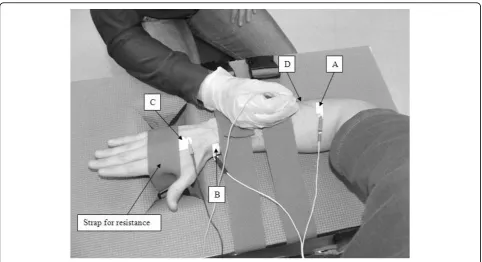
For the electromyographic evaluation, subjects were seated in a straight back chair with the elbow of the dominant arm flexed at 90° and their forearm pronated and resting on a custom-built table (Figure 1). Adjusta-ble straps attached to the bottom of the testing taAdjusta-ble were passed through an opening and secured around the dorsum of the hand to provide resistance during the isometric extension contractions. Surface electrodes (Ag/AgCl; Kendall-LTP, Chicopee, Massachusetts, cut in half to measure 1 × 3 cm) were placed on the tested limb, and subjects were asked to perform a three second maximum voluntary contraction (MVC) of their wrist extensors with verbal encouragement provided through-out. The peak root mean square (RMS) value calculated over contiguous one second intervals of the surface EMG attained during the MVC was determined. This value represented the maximal voluntary EMG produced by the subjects, termed maximal voluntary effort, or MVE. The RMS values of all subsequent contractions were expressed as a percentage of this value, and are referred to as the %MVE-RMS.
cm distal to the cubital crease. Using the cathode por-tion of a stimulating probe, with the train rate of the sti-mulator set at 10 pps, and the stimulation duration set at 1 ms [33], the cathode was moved over the muscle belly until the motor point region was determined. The skin above the motor point, the radial styloid process and the dorsum of the hand of the test limb was cleaned with rubbing alcohol prior to electrode placement. The active electrode was positioned over the motor point of the ECRB and the reference electrode was placed over the radial styloid process to form a monopolar config-uration, as described in [19]. A full-sized surface elec-trode (2 cm by 3 cm) was positioned on the dorsum of the hand to act as the common reference. A disposable concentric needle (Model 740 38-45/N; Ambu
®
Neuro-line, Baltorpbakken, Ballerup, Denmark) electrode was inserted approximately 2 cm deep underneath the active surface electrode.AcquireEMG algorithms running on a Neuroscan Comperio EMG system (Neurosoft, Sterling, VA) were used to acquire the needle and surface EMG data during 30 s intervals as in [34]. The needle position was adjusted until the average peak acceleration of the MUPTs detected during a low-level contraction (5-10% MVE) was above 30 kV/s2 [33]. Once a suitable needle position was found, the operator stabilized the needle manually and then asked the subject to hold a desired contraction force for 30 s. Subjects were provided with a visual bar graph and a numerical value that
corresponded to their force output (%MVE-RMS) for feedback. Following each contraction the needle was moved (medially, laterally, superficially and/or deeper) so that MUPTs from different portions of the muscle would be sampled in an effort to record from a large representative pool of motor units. Each subject per-formed repeated contractions until at least 30 MUP trains were obtained. The contraction force was varied between 5-20% of MVE. A 2-minute rest period was provided between contractions.
The acquisition settings used were as reported in [30]: micro (needle) data were bandpass filtered between 10 Hz-10 kHz and then sampled at 31250 samples/second; macro (surface) data were a bandpass filtered between 5 Hz-5 kHz and sampled at 3125 samples/second.
EMG decomposition
Needle-detected EMG data from all contractions were decomposed using the DQEMG program of Stashuk [32-34], which calculates a set of quantitative EMG summary statistics for each MUPT acquired during each muscle contraction. These measures describe the MUP shape and MU firing behaviour of each MU sampled from the muscle [35], and such parameters have been shown to be relevant in determining the type (myo-pathic vs. neuro(myo-pathic) of disease involvement [28,29].
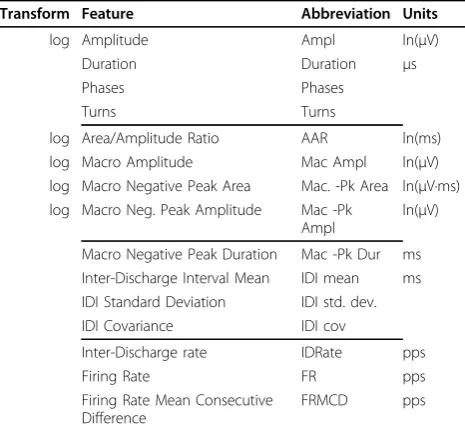
The DQEMG program produces a number of mea-sures; the features used are listed in Table 1. These measures are common quantitative EMG parameters,
the definition and collection of which are described in [19,35-37].
For some features, as noted in Table 1, logarithmic mapping was done in an attempt to provide a data dis-tribution more closely approximating a Gaussian distri-bution, as many of the feature values stem from a multiplicative relationship between several underlying processes, causing their combined distribution to resem-ble an exponential distribution. Peak-to-peak amplitude is, for instance, a function of both the size and number of the active muscle fibres as well as the distance between these fibres and the electrode surface. As these factors combine multiplicatively, the distribution of observed values from a collection of fibres is extremely skewed, more closely describing an exponential distribu-tion than a Gaussian one; the log of these values was therefore used to mitigate skewness. As skewness has serious implications for the classifier discussed later, this is expected to improve classifier performance; this hypothesis was confirmed through a set of preliminary experiments performed while preparing the data.
In the case of these log-transformed features, all calcu-lations shown here were done with the log-transformed values.
Data distribution construction and cross-validation In total, 266 MUPTs were collected from the 17 subjects with NSAP and 1168 MUPTs were collected from the 40 control subjects. Each subject’s EMG data set is hen-ceforth referred to as a muscle study. Each muscle study
is represented by the collection of the MUPTs extracted from EMG data detected from the same muscle during contractions performed on the same occasion. As the objective during data collection was to have at least 30 separately identifiable MUPTs for each muscle study, the number of contractions per study varied from sub-ject to subsub-ject.
As mentioned in the introduction, the data in the NSAP class contains several samples that would and should be considered normative, greatly increasing the difficulty of the characterization task. One of the major outcomes of this analysis is to show to what degree it is possible to aggregate the information from MUPTs with a variety of individual characterizations, across a set of MUPTs, to produce a correct overall characterization of a muscle as being either NSAP or normative.
In order to establish performance estimates, the avail-able MUPT data were organized into 10 cross-validation pools, constructed to preserve the underlying groupings of the data collection process. These pools were con-structed by iterating down the lists of NSAP and norma-tive studies, placing data from each subsequent study into the next cross-validation pool in round-robin fash-ion. This strategy ensures that all of the MUPTs col-lected from the same muscle remained together for purposes of aggregation as described below, while also ensuring that each pool contained studies from both Normative and NSAP characterized data. Enforcing the presence of data from both characterization classes in all testing sets controlled potential bias arising from the fact that there are significantly more normative than NSAP contractions in the training data.
The cross-validation pools where then used to con-struct experimental data sets such that the data in each pool were used only once for testing, with training data obtained by combining all other pools. Results were cal-culated across all pools, allowing average performance to be calculated. In light of the discussion in [38] and [39], full leave-one-out cross-validation was not used, as the cited works indicate that 10-fold cross-validation should provide an estimate of performance with less bias that that provided by full leave-one-out cross-validation.
Classifier construction
A discriminant function providing the minimum-error-rate for two classes may be represented as
k lnp
x|k
ln (Pk). (1) This encodes a distance measure (δ) that provides the minimum error rate discriminant for class kof some K total classes for a given input vector,x, given the condi-tional probability of the observation ofx given classωk as well as the overalla prioriprobability of occurrenceTable 1 Features Studied and their Units.
Transform Feature Abbreviation Units
log Amplitude Ampl ln(μV)
Duration Duration μs
Phases Phases
Turns Turns
log Area/Amplitude Ratio AAR ln(ms)
log Macro Amplitude Mac Ampl ln(μV)
log Macro Negative Peak Area Mac. -Pk Area ln(μV·ms) log Macro Neg. Peak Amplitude Mac -Pk
Ampl
ln(μV)
Macro Negative Peak Duration Mac -Pk Dur ms Inter-Discharge Interval Mean IDI mean ms IDI Standard Deviation IDI std. dev.
IDI Covariance IDI cov
Inter-Discharge rate IDRate pps
Firing Rate FR pps
Firing Rate Mean Consecutive Difference
FRMCD pps
of samples from classωk. Here we make no assumption regarding class probabilities, and assume that allωkare equally probable.
If the distribution of feature values follows a Gaussian distribution, then a Bayesian discriminant function provides optimal separation between classes [[40] pp. 37-41], and a “Normal Density Discriminant Function” (NDDF) classifier may be constructed using
k t
k k
t k w
x x W x w x
0, (2)where
W S
w S m
m S m S
k
k k k
k k
k
w k k k k P
1
2
1
2 2
1
0
,
ln
ln ,
in which the variablesSk,mkand P(ωk) refer, respec-tively, to our estimates of the covariance matrix and mean vector and relative probability of occurrence of classkof K classes (in this case, K = 2: Normative and NSAP). In the above equations, X-1 indicates the matrix inverse operation, and |X| indicates the calculation of the determinant.
This formulation is simply the discriminant function constructed from (1) using the general multivariate nor-mal density
p
d
t x
S
x m S x m
1
2 2 12
1
2
exp (3)
in whichdis the dimensionality (the number of input features) in the problem. As can be seen in (2), this fac-tor drops out in the construction of the discriminant through the application of the natural logarithm.
The discriminant of (2) can therefore be seen as pro-viding a measure of similarity to a Gaussian distribution, and is therefore equivalent to calculating the relative distance to each mean using the Mahalanolbis distance
r (xm S)t 1(xm). (4)
In (4), r provides the distance from the mean of a Gaussian (Normal) distribution in units of standard deviation, implying that the Mahalanolbis distance may then be directly used as a z-score to relate a given point to its expected probability of occurrence in the related distribution. In fact this produces the same classification results as (2).
In order to apply the above equations, the mean and covariance are calculated using all of the MUPTs avail-able for training separated by class. The per-class mean and covariance may then be calculated directly from these groups. Mean values were calculated individually for each feature; covariance data was calculated using these per-feature means.
As mentioned above, the relative probability of occur-rence of each class, P(ωk), was set to 0.5 (or“no infor-mation”) to establish a uniform prior probability estimate.
Aggregation of classifier results
Applying the NDDF classifier as described will produce an estimate of the characterization for each MUPT. Such a characterization does not take into account the fact that further information is available, specifically that MUPTs collected from the same muscle may be consid-ered as a set in order to produce a muscle characteriza-tion, in which each MUPT supports (or refutes) a specific characterization of that muscle. Individual MUPTs can be considered to be associated with infor-mation that is meaningful only in the collective sense; by collecting such information together; it is possible to use aggregation to account for the presence of norma-tive MUPTs in NSAP data.
Further, the characterization of individual MUPTs is not as meaningful as the characterization of a muscle as a whole. This implies that while individual MUPTs col-lected from a single contraction may, or may not, show indications of NSAP that may be preferentially affecting only some motor units of a muscle, it is the overall diag-nosis of NSAP that need concern us here. If there is indeed such variable expression of disease state, aggrega-tion of the individual MUPT outcomes should allow an overall diagnosis to be made, in spite of this variation in outcome associated with the individual MUPT samples.
Independent MUP analysis
The first calculation done examines the results of the NDDF classifier as run independently on each MUPT, producing a total of 1434 characterizations. This analysis was performed for two reasons: the accuracy of the clas-sification system when no muscle-level knowledge is used provides the minimum accuracy we would expect from aggregation, and additionally, it is these NDDF measures that will be used to produce the aggregate results to be compared.
Vote-based aggregation
A simple and obvious aggregation strategy to aggregate the 1434 MUPT results into descriptions of the 57 mus-cular studies is to apply a simple majority vote scheme. We therefore simply examine all MUPTs sampled from a muscle and count, for each class, the number of MUPTs for which that class was indicated as having a maximum conditional probability. The class label that had the majority count was then applied to all MUPTs in the contraction. In cases of a tie, one of the labels was randomly chosen.
Note that this strategy does not take into account the magnitude of the difference in conditional probability used to choose the winning class; the smallest of mar-gins produces a vote of the same weight as a unity probability.
Bayesian aggregation
The magnitude of difference in probability may be further taken into account through further leveraging of our assumption that the class distributions may be defined as conditional probability distributions following a Gaussian curve, and using the relative probabilities found in an aggregate calculation of the joint probability of association across all MUPTs studied.
This may be easily calculated once we realize that the formulation of (1) allows us to combine the joint prob-abilities of observation of several x values, as it is equivalent, within a scale factor, of either
k k k
k k
p P
P p k P k
p i P i
x x
x x x
x
| ,
| |
| or
i
K
1
. (5)
In particular, the second formulation here indicates that in order to produce an aggregation of the joint probabilities across a series of MUPT samples x1, x2,... xn, we may simply multiply together all of theδkvalues obtained for each sample within the same class to obtain an estimate of the joint probabilityΔk,i.e.;
k k i
i n
k n
p
x x x x1
1 2
| , , (6)
As the normalization required to turn (6) into a true probability is the same for each class considered, it need not be considered when constructing the aggregate dis-criminant, as its effect will simply be to scale each prob-ability by the same value. To calculate a relative
probability therefore we need simply multiply the values for each discriminant obtained from (2) as shown in (6) without a need to normalize the result. We will then use the highestΔkvalue to indicate the class association. Mean NDDF discriminant
As a final strategy, a mean distance across all MUPTs in a contraction was calculated for a given class, by calcu-lating an average of the distances determined by the NDDF classifier. This mean value was then computed for each class, resulting in a measure describing the average distance of the MUPTs in a given contraction from each class. The contraction was then assigned to the“closest”class based on this average distance.
Results
Sample demographic information
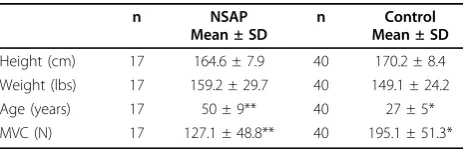
The demographic information of both samples is pre-sented in Table 2. The clinical questionnaire and clinical evaluation outcomes for the NSAP group are presented in Table 3. The upper limb tension test with radial bias (ULTT3) revealed that none of the NSAP subjects had a positive test.
Distribution parameter estimate stability
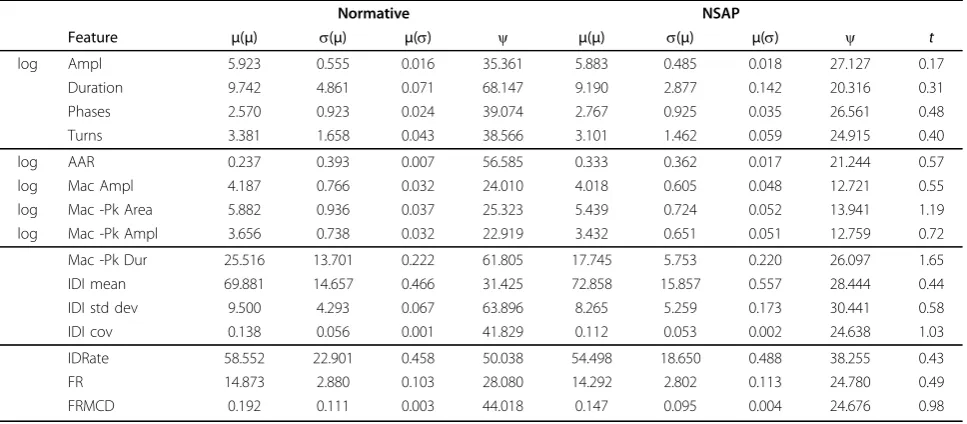
Table 4 reports the variability of the mean and coeffi-cient of variation for each of the features described in Table 1.
Columns indicated ass(μ) contain the standard devia-tion of the mean values obtained over each feature in a given class, calculated over the 10 cross-validation tests. Conversely, columns markedμ(s) show the average of the per-feature standard deviations, again independently for each feature. Together, these values may be used to get an estimate of the variability in the mean values obtained for the various Normative and NSAP
Table 2 Demographic Data.
n NSAP
Mean ± SD
n Control
Mean ± SD
Height (cm) 17 164.6 ± 7.9 40 170.2 ± 8.4
Weight (lbs) 17 159.2 ± 29.7 40 149.1 ± 24.2
Age (years) 17 50 ± 9** 40 27 ± 5*
distributions tested, and relate these to the variability of the distributions themselves, noting that all that is shown is the feature-independent variability, and not the inter-feature dependence found in a full covariance matrix.
To that end, the columns marked ψshow the coeffi-cient of variation, which is the ratio of the standard deviation of the mean of a feature versus the mean variability of the feature overall, or
ii. (7)
This statistic measures the dispersion of the probabil-ity distribution of the feature values.
The final column in Table 4 is atvalue calculated by taking the difference between the mean values and nor-malizing by the mean standard deviation values weighted by the degrees of freedom (d.f.) introduced by the tests, or
t i
Normative
iNSAP
iNormative iNSAP
i
d.f. d.f..
,
(8)
where the number of degrees of freedom is 10, based on the 10× cross-fold validation. This measure provides a means of identifying the contribution to classification relative to the Normal classifier, but does not measure the information content of the feature if the assumption of Normal distribution is violated. Note that it is clear
Table 3 Clinical evaluation outcomes from the Disability of arm shoulder and hand (DASH) questionnaire, SF-36 eight domain scores, ULTT3 (number of positive tests, pain threshold scores (values in brackets are normalized to third nail bed; D3), grip and pinch-grip strength for the NSAP group.
n NSAP Mean ± SD
DASH
Disability score 16 23.83 ± 12.96
Work module 15 35.22 ± 31.59 Sport/art module 9 68.06 ± 29.22
SF-36
Physical functioning 15 82.00 ± 18.01 Role physical 16 62.50 ± 38.76 Bodily pain 16 57.38 ± 18.75 General health 16 73.12 ± 20.04 Vitality 16 61.56 ± 18.86 Social functioning 16 84.38 ± 17.38 Emotional role 16 83.33 ± 32.20 Mental health 16 76.50 ± 16.58
ULLT3 (n positive) 16 0
Pain Threshold (kg/cm2)
D3 16 12.87 ± 5.95
ECRB 16 5.78 ± 3.49 (45%) FCR 16 9.18 ± 5.06 (71%) BB 16 9.08 ± 4.74 (71%) TB 16 8.28 ± 5.02 (64%)
Grip strength (kg) 16 33.95 ± 13.06
Pinch grip strength (kg) 16 9.41 ± 3.89
Table 4 Distributions Obtained of Features Studied.
Normative NSAP
Feature μ(μ) s(μ) μ(s) ψ μ(μ) s(μ) μ(s) ψ t
log Ampl 5.923 0.555 0.016 35.361 5.883 0.485 0.018 27.127 0.17
Duration 9.742 4.861 0.071 68.147 9.190 2.877 0.142 20.316 0.31
Phases 2.570 0.923 0.024 39.074 2.767 0.925 0.035 26.561 0.48
Turns 3.381 1.658 0.043 38.566 3.101 1.462 0.059 24.915 0.40
log AAR 0.237 0.393 0.007 56.585 0.333 0.362 0.017 21.244 0.57
log Mac Ampl 4.187 0.766 0.032 24.010 4.018 0.605 0.048 12.721 0.55
log Mac -Pk Area 5.882 0.936 0.037 25.323 5.439 0.724 0.052 13.941 1.19
log Mac -Pk Ampl 3.656 0.738 0.032 22.919 3.432 0.651 0.051 12.759 0.72
Mac -Pk Dur 25.516 13.701 0.222 61.805 17.745 5.753 0.220 26.097 1.65
IDI mean 69.881 14.657 0.466 31.425 72.858 15.857 0.557 28.444 0.44
IDI std dev 9.500 4.293 0.067 63.896 8.265 5.259 0.173 30.441 0.58
IDI cov 0.138 0.056 0.001 41.829 0.112 0.053 0.002 24.638 1.03
IDRate 58.552 22.901 0.458 50.038 54.498 18.650 0.488 38.255 0.43
FR 14.873 2.880 0.103 28.080 14.292 2.802 0.113 24.780 0.49
FRMCD 0.192 0.111 0.003 44.018 0.147 0.095 0.004 24.676 0.98
that no single feature, in and of itself, is sufficient to determine between Normative and NSAP values.
Classification accuracy
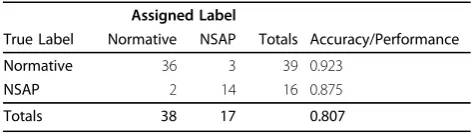
Tables 5 through 8 are set up as confusion matrices describing the results of independent MUPT classifica-tion, vote based aggregaclassifica-tion, Bayesian aggregation and mean NDDF discriminant respectively.
Each table contains a header and summary row. The central rows of the table are set up in the following way:
•each row is labelled with the true characterization, •the first two columns indicate the number of charac-terization with the true label into each of the possible characterization labels,
•the“Totals”column shows the number of elements in each true class, and
• “per-class accuracy” is the fraction of the elements that was correctly labelled for each class. Considering NSAP as a“positive test outcome,” and Normative as a “negative test outcome”, the per-class accuracies for the NSAP and Normative classes are, respectively, the esti-mates of the sensitivity and specificity of the classifier; the overall accuracy of the classifier is simply the sum of the per-class accuracy values divided by the number of classifications made.
The bottom of the table displays overall statistics. Totals are tallied for each column, which indicate the number of samples assigned to each target class; in the case of Table 5 these are MUPTs, in the remaining tables these are muscles.
The value at the foot of the “Per-class accuracy” col-umn is simply the product of all of the per-class accu-racy values assigned, and is termed“Performance.”This was chosen as an overall performance statistic as it equally weights the contribution to overall performance by each class while providing a metric that can be used to compare the different classification schemes. It should be pointed out that although this metric is [0···1] bounded, the multiplicative relationship between the ele-ments does mean it is non-linear (though monotonically increasing).
Table 5 indicates the results of analysis using the NDDF classifier when classifying each MUPT indepen-dently (i.e.; discarding the knowledge that for a set of MUPTs sampled from a muscle all the MUPTs come
from the same muscle, and thus must have the same characterization). These results show that, as a baseline, approximately 3/4 of the individual MUPT characteriza-tions have a maximum conditional probability that matches the true muscle characterization.
An analysis of the same underlying data is shown in Table 6, but with an aggregate label calculated using the voting aggregation as presented above. Immediately apparent from this table is the fact that aggregate deci-sion making results in a much higher degree of accu-racy: the poorest per-class accuracy is 0.875 based on best-vote-takes-all.
Bayesian aggregation provides somewhat different values, shown in Table 7, which indicates that the increase in accuracy is similar to that in the voting scheme.
Table 8, displaying the mean NDDF classification, shows that this technique is severely biased toward Nor-mative, achieving an accuracy of roughly only 2 in 3 on NSAP data.
An analysis of the significance of these results was cal-culated using McNemar’s test [41,42]. This test was con-structed by examining the pair-wise differences between the same contractions as evaluated by each test. Four groups were constructed, containing the counts of: the instances for which both classifiers were correct; the instances for which both were incorrect; those for which
Table 5 NDDF (Independent)/10 fold cross-validation (MUPTs)
Assigned Label
True Label Normative NSAP Totals Accuracy/Performance
Normative 900 268 1168 0.771
NSAP 73 193 266 0.726
Totals 973 461 0.559
Table 8 Mean NDDF/10 fold cross-validation (contractions)
Assigned Label
True Label Normative NSAP Totals Accuracy/Performance
Normative 38 1 39 0.974
NSAP 5 11 16 0.688
Totals 43 12 0.670
Table 6 NDDF + vote/10 fold cross-validation (contractions)
Assigned Label
True Label Normative NSAP Totals Accuracy/Performance
Normative 36 3 39 0.923
NSAP 2 14 16 0.875
Totals 38 17 0.807
Table 7 NDDF + Bayes/10 fold cross-validation (contractions)
Assigned Label
True Label Normative NSAP Totals Accuracy/Performance
Normative 34 5 39 0.872
NSAP 1 15 16 0.938
there was an improvement in classification by the sec-ond classifier (i.e.; the first classifier was wrong, but the second was correct); and those for which there was a degradation (first was correct, the second was wrong).
The McNemar test relates the association between the changes in “treatment” (here the change in classifier) and the change in outcome (termed “discordant pairs”). With no association, the two discordant pairs should be equal, and a c2 value can then be calculated from two discordant pairsaand busing
2 1
2
, (9)
calculated using 1 degree of freedom.
Table 9 provides the number of improved and degraded discordant pairs, as well as the 2-tailedp-value and, c2 . As can be seen in this table, there are no sig-nificant differences between any groups in these data.
Discussion
The clinical assessment showed there were no strength differences between the individuals with and without NSAP; in fact the groups were very similar other than the fact that the individuals with forearm pain scored higher on measures of pain and disability, had a lower tolerance to pressure applied to their ECRB muscle and their triceps muscle. Other than non-specific symptoms of pain, therefore, there were no features on examina-tion that would suggest that the individuals with NSAP had either myopathy or neuropathy.
Classification outcome
The power of Bayesian aggregation would lead us to expect that the results in Table 7 would provide a sig-nificantly higher performance than the simple voting results shown in Table 6. The fact that this is not the case is very instructive regarding the estimation of the underlying data distribution. Such an expectation rests upon the assumption that the Bayesian aggregation has access to useful and correct information describing both the Normative class and the NSAP class; which in turn is based on the assumption that both of these are in fact Gaussian distributions.
The fact that muscle characterization based on indivi-dual MUPT characterizations performed quite well (i.e., 75% accuracy on MUPT analysis) lends a great deal of
support to this premise, as poor results are found when using this classification scheme on significantly skewed distributions. The evidence here is that although the dis-tributions are centrally limited, the assumption of a Gaussian distribution is not well founded in this case, though the limitations of this assumption are not severe. One potential weakness stems from the amount of data available to estimate distribution parameters. Although the method of estimation used is optimal given a Gaussian distribution [[40], pp. 36], insufficient data will provide an unstable estimate. The stability of our parameter estimates as shown in Table 4 indicate not only that the mean values calculated are relatively stable, but that the variance in these estimates are sig-nificantly smaller than the per-feature standard devia-tions associated with each feature.
Essentially, the conclusion that may be reached based on our observations is that although the Bayesian aggre-gation technique using sets of MUPTs substantially increases classification accuracy (relative to unaggre-gated data), the assumption of a Gaussian distribution to describe the data limits its effectiveness; there is no more information, on average, available in the estimate of distribution shape and Bayesian aggregation than is available through aggregate voting.
The outlier detection methods introduced in [43] and applied and discussed in [44,45] are relevant here as it is exactly these outliers that contribute to the ability of the Bayesian estimator to determine that these muscles are not normative. The inference applied here limits the extent to which outlier following will be performed, ensuring that the outlier-based classifications are appro-priately weighted by the observation of normative MUPTs. If appropriate probabilities are available for the Bayesian estimator, it may be expected that this will pro-vide an excellent mechanism for determining when enough MUPTs have been observed, allowing the central question of [45] to be explored in a probabilistic sense.
This observation in turn supports the idea that with a better understanding of the true data distribution, a bet-ter Bayesian estimator may be produced. The authors intend to apply an event-based treatment introduced in earlier work [36] to these data, providing an analysis that is free from the assumption of a Gaussian distribution.
The measure of stability (column markedψ in Table 4) provides insight into the variability of the means of the
Table 9 McNemar Test Results on Classifier Performance
Classifiers Improved Degraded 2-tailedp-value c2 Odds Ratio Confidence Interval
MICD+Bayes -vs- MICD+mean 4 4 0.72 0.125 1.00 0.189 ... 5.37
MICD+Bayes -vs- MICD+vote 2 1 1.00 0.125 2.00 0.104 ... 118
two classes relative to the class variances; when compared with the t values shown in the right-most column of Table 4 we see that there is significant information pre-sent in these columns. We may therefore conclude that though our assumption of a Gaussian distribution does not accurately reflect the underlying distribution of the data for all of the reasons mentioned above, there is sig-nificant information content in these data that will allow decisions to be made. Further, we can estimate, based on these data, which features are likely to be the most infor-mative overall, and further exploration of these features in a non-parametric analysis is warranted.
We intend therefore to proceed to an analysis of these data using stronger, non-parametric techniques to ascer-tain whether a better classification may be obascer-tained then the already-strong performance obtained here.
Conclusions
In support of the findings of [28,29], MUPT classifica-tion performance may be improved through the applica-tion of Bayesian aggregaapplica-tion, however the degree of improvement may be limited to that obtained through simpler means, such as majority vote.
The limitation in the performance improvement observed is not related to an inability to estimate distribu-tion parameters because of a lack of data; instead, limita-tions are apparent because of assumplimita-tions of distribution shape that do not reflect the true MUP morphological and MU firing pattern changes occurring due to involvement.
An investigation into more appropriate methods to examine the distribution of involved versus normative data should allow Bayesian aggregation to achieve improved characterization accuracy.
Acknowledgements
Funding for this project was received from the Canadian Foundation for Innovation, the Ontario Innovation Trust and the Workplace Safety and Insurance Board (WSIB) of Ontario.
Author details
1
School of Rehabilitation Therapy, Queen’s University, Kingston, Ontario, Canada.2Math and Computer Science, Mount Allison University, New
Brunswick, Canada.3Computing and Information Science, University of
Guelph, Ontario, Canada.4Department of Systems Design Engineering,
University of Waterloo, Ontario, Canada.
Authors’contributions
All authors consulted and collaborated throughout the study. LMcL conceived of the initial idea, while AH-W carried out the experimental procedure, developed all related Matlab©programs and drafted the manuscript. KMC collected the data and performed initial statistical analyses. All authors participated in the study design, and read and approved the final manuscript.
Competing interests
The authors declare that they have no competing interests.
Received: 25 June 2008 Accepted: 15 February 2010 Published: 15 February 2010
References
1. Urwin M,et al:Estimating the burden of musculoskeletal disorders in the community: the comparative prevalence of symptoms at different anatomical sites, and the relation to social deprivation.Ann Rheum Dis
1998,57(11):649-55.
2. Macfarlane GJ, Hunt IM, Silman AJ:Role of mechanical and psychosocial factors in the onset of forearm pain: prospective population based study.BMJ2000,321(7262):676-9.
3. Walker-Bone K, Cooper C:Hard work never hurt anyone: or did it? A review of occupational associations with soft tissue musculoskeletal disorders of the neck and upper limb.Ann Rheum Dis2005,64(10):1391-6. 4. Harrington JM,et al:Surveillance case definitions for work related upper
limb pain syndromes.Occup Environ Med1998,55(4):264-71. 5. Larsson SE,et al:Muscle changes in work-related chronic myalgia.Acta
Orthop Scand1988,59(5):552-6.
6. Larsson B, Libelius R, Ohlsson K:Trapezius muscle changes unrelated to static work load. Chemical and morphologic controlled studies of 22 women with and without neck pain.Acta Orthop Scand1992,63(2):203-6. 7. Hagg G:Static workloads and occupational myalgia: a new explanation
model.Electromyographical KinesiologyElsevierAnderson P, Hobart DJ, Danoff JV 1991, 441-444.
8. Larsson SE,et al:Chronic trapezius myalgia. Morphology and blood flow studied in 17 patients.Acta Orthop Scand1990,61(5):394-8.
9. Larsson B,et al:Mechanical performance and electromyography during repeated maximal isokinetic shoulder forward flexions in female cleaners with and without myalgia of the trapezius muscle and in healthy controls.Eur J Appl Physiol2000,83(4-5):257-67.
10. Dennett X, Fry HJ:Overuse syndrome: a muscle biopsy study.Lancet
1988,1(8591):905-8.
11. Greening J,et al:The use of ultrasound imaging to demonstrate reduced movement of the median nerve during wrist flexion in patients with non-specific arm pain.J Hand Surg2001,26(5):401-6, discussion 407-8. 12. Greening J, Lynn B, Leary R:Sensory and autonomic function in the
hands of patients with non-specific arm pain (NSAP) and asymptomatic office workers.Pain2003,104(1-2):275-81.
13. Greening J, Dilley A, Lynn B:In vivo study of nerve movement and mechanosensitivity of the median nerve in whiplash and non-specific arm pain patients.Pain2005,115(3):248-53.
14. Greening J:Workshop: clinical implications for clinicians treating patients with non-specific arm pain, whiplash and carpal tunnel syndrome.Man Ther2006,11(3):171-2.
15. Larsson SE,et al:Muscle changes in work-related chronic myalgia.Acta Orthop Scand1988,59(5):552-6.
16. Larsson B, Libelius R, Ohlsson K:Trapezius muscle changes unrelated to static work load. Chemical and morphologic controlled studies of 22 women with and without neck pain.Acta Orthop Scand1992,63(2):203-6. 17. Larsson SE,et al:Chronic trapezius myalgia. Morphology and blood flow
studied in 17 patients.Acta Orthop Scand1990,61(5):394-8.
18. Greening J,et al:Reduced movement of median nerve in carpal tunnel during wrist flexion in patients with non-specific arm pain.Lancet1999,
354(9174):217-8.
19. Stashuk DW:Quantitative Electromyography.2002, 311-348, Brown et al. 20.
20. Brown WF, Bolton CF, Aminoff MJ, (Eds):Neuromuscular Function and DiseasePhiladelphia: W.B. Saunders 2002.
21. West M:Bayesian aggregation.J Royal Stat Soc1984,147(4):600-607. 22. Clemen RT, Winkler RL:Combining probability distributions from experts
in risk analysis.Risk Analysis1999,19(2):187-203.
23. Rosqvist T:Bayesian aggregation of experts’judgements on failure intensity.Rel Eng Sys Safety2000,70(3):283-289.
24. Budescu DV, Yu H-T:To Bayes or not to Bayes? A comparison of two classes of models of information aggregation.Decision Analysis2006,
3(3):145-162.
25. Barutcuoglu Z, De Coro C:Hierarchical shape classification using Bayesian aggregation.Shape Modeling and Applications2006, 44-48.
26. Lipscomb J, Parmigiani G, Hasselblad V:Combining expert judgement by hierarchical modeling: an application to physician staffing.Manag Sci
1998,44(2):149-161.
27. Kononenko I:Inductive and Bayesian Learning in Medical Diagnosis.
28. Pfeiffer G, Kunze K:Discriminant Classification of Motor Unit Potentials (MUPs) Successfully Separates Neurogenic and Myopathic Conditions.
Electroenceph Clin Neurophys1995,97(5):191-207.
29. Pfeiffer G:The diagnostic power of motor unit potential analysis: an objective Bayesian approach.Muscle Nerve1999,22(5):584-591. 30. Calder K, Stashuk DW, McLean L:Motor Unit Potential Morphology
Differences in Individuals with Non-Specific Arm Pain and Lateral Epicondylitis.J NeuroEng and Rehab2008,5:1-11.
31. Calder K, Stashuk DW, McLean L:Physiological Characteristics of Motor Units in thebrachioradialismuscle across fatiguing low-level isometric contractions.J Electromyogr Kinesiol2008,18(1):2-15.
32. Stashuk DW, Paoli GM:Robust supervised classification of motor unit action potentials.Med Biol Eng Comput1998,36:75-82.
33. Stashuk DW:Decomposition and quantitative analysis of clinical electromyographic signals.Med Eng & Phy1999,21(6):389-404. 34. Stashuk DW:EMG signal decomposition: How can it be accomplished
and used?J Electromyogr Kinesiol2001,11(3):151-173.
35. Brown WF:The Physiological and Technical Basis of Electromyography
Butterworth 1984.
36. Hamilton-Wright A, Stashuk DW:Clinical characterization of electromyographic data using computational tools.Symposium on Computational Intelligence In Biology, (CIBCB’06), Toronto2006. 37. Stashuk DW, Doherty TJ:Normal Motor Unit Action Potential.2002,
311-348, Brown et al. 20.
38. Kohavi R:A study of cross-validation and bootstrap for accuracy estimation and model selection.Proc. 14th Int. Joint Conference on Artificial Intelligence, (IJCAI-95)Montréal, Québec, Morgan Kaufmann 1995, 1137-1143. 39. Nadeau C, Bengio Y:Inference for the Generalization Error.Machine
Learning2003,52(3):239-281.
40. Duda RO, Hart PE, Stork DG:Pattern ClassificationWiley, 2 2001. 41. McNemar Q:Note on the Sampling Error of the Difference Between
Correlated Proportions of Percentages.Psychometrika1947,12(2):153-157. 42. Durkalski VL, Palesch YY, Lipsitz SR, Rust PF:Analysis of Clustered
Matched-Pair Data.Statistics in Medicine2003,22(15):2417-2428.
43. Stålberg E, Bischoff C, Falck B:Outliers, a way to detect abnormality in EMG.Muscle & Nerve1994,17(4):392-399.
44. Podner S:Usefulness of an increase in size of motor unit potential sample.Clinical Neurophysiology2004,115(7):1683-1688.
45. Podner S:Comparison of different outlier criteria in quantitative anal sphincter electromyography.Clinical Neurophysiology2005,
116(8):1840-1845.
doi:10.1186/1743-0003-7-8
Cite this article as:Hamilton-Wrightet al.:Bayesian aggregation versus
majority vote in the characterization of non-specific arm pain based on quantitative needle electromyography.Journal of NeuroEngineering and
Rehabilitation20107:8.
Submit your next manuscript to BioMed Central and take full advantage of:
• Convenient online submission
• Thorough peer review
• No space constraints or color figure charges
• Immediate publication on acceptance
• Inclusion in PubMed, CAS, Scopus and Google Scholar
• Research which is freely available for redistribution