Selva Kumar.S
et al
, International Journal of Computer Science and Mobile Applications,
Vol.6 Issue. 4, April- 2018, pg. 130-135
ISSN: 2321-8363
Impact Factor: 5.515
An Analysis of Different Ethnic Age
Group Estimation from Facial Images
Selva Kumar.S
a,
Muthukumar.S
b,
Gayathri Devi S
b, Pasupathi P
ca
Department of IT/CS, SRNYCAS, Tenkasi, Tamilnadu, India b
Department of CSE, VVIT, Tamilnadu, India c
Department of CS, SVCAS, Tamilnadu, India
a, b, c
Corresponding Authors
*Address correspondence to the authors at the emails: [email protected], [email protected], [email protected], [email protected]
Abstract: Today’s intelligent systems in this digital era, require a high demand for Internet and multimedia computing that focuses images mostly. Images contain human conveys valuable information. Especially, Face is a prolific information source through which people can effortlessly extract many kinds of useful information from a face image, such as identity, expression, emotion, gaze, gender, age, etc. But, automatic detection by computers is still a herculean task. The automatic extraction of most of the useful information has been extensively studied in several research areas including multimedia, HCI, computer vision, pattern recognition, machine learning and neural networks. Images containing faces has received a great attention over the last few years, because of its applications in all the domains. Based on the analysis of the information contained in the face images, there are a lot of research efforts in processing of human face images that tries to build a fully automated system. It is confident that the outcome this proposal definitely supports the future prospective researchers to have a clear vision on age group estimation from facial frontal images.
Keywords: Medical Imaging, Image Forensics, Face detection, Feature extraction, Skin detection, Video processing, Bio-metrics.
1. INTRODUCTION
In this modern world, cognitive vision plays vital role where making machines to think and act like human beings. For this objective, the artificial system needs to perform the high-level tasks of understanding and interacting with the physical world, it needs, among other things, to be able to perceive, represent and reason about its environment. Computer vision uses visual perception to observe the world analogous to the visual system in humans that allows individuals to assimilate information from the environment based on the visible light reaching the eye. However, knowing person’s age just by looking at old or recent pictures for them is often a bigger challenge. Human face characteristics change with time which reflects major variations in appearance. The age progression signs displayed on faces are uncontrollable and personalized such as hair whitening, muscles dropping and wrinkles [2].
2. MOTIVATION
All the human faces form a class of fairly similar objects. Each face consists of the same facial components in the same geometrical configuration with slightly varying sizes. The facial age estimation problem shares similarities with the age progression problem. Age progression is the prediction of the future facial appearance of a subject based on images showing his/her previous facial appearance; whereas face estimation estimate age / age group from the facial features/ appearance [1][2]. Both age estimation and age progression need to take into account age-related facial deformations encountered during the
lifetime of a subject.In recent years, age as an attribute related to human faces is being increasingly studied and there has been
Selva Kumar.S
et al
, International Journal of Computer Science and Mobile Applications,
Vol.6 Issue. 4, April- 2018, pg. 130-135
ISSN: 2321-8363
Impact Factor: 5.515
3. CHALLENGES IN AGE GROUP ESTIMATIONIn age estimation, problem of estimation of pose or shape is severely under-constrained due to many factors such as: the image formation process, occlusions, changes in appearance, and the complexity of the human body structure itself. There were several challenges encountered when attempting to develop a methodology, because face images can demonstrate a wide degree of variation in both shape and texture. Appearance variations are caused by individual differences, the deformation of an individual face due to changes in expression and speaking, as well as lighting variations [1][2]. While developing a system for human age estimation entails characterizing certain attributes that are inherent to human faces such as (i) the 3D structure of human faces, (ii) the reflective properties of facial skin[3] color, wrinkles, landmarks etc., (iii) the uniqueness of different facial features of human, (iv) the global and local configuration of facial features, etc. in combination with scene-centric and hardware specific attributes such as illumination, lighting conditions, environment and viewpoint. (v) Age estimation systems, often encounter facial images of individuals taken from real-life conditions, where facial appearances are affected by the inter play of multiple factors such as pose, facial expressions, races, occlusions, etc. make it more even more difficult [3][4]. [vi] Limited inter-age group variation: In certain cases, differences in appearance between adjacent age groups are negligible, causing difficulties in the process of age estimation. This problem is escalated when dealing with mature subjects.[vii] Diversity of aging variation: Both the rate of aging and type of age-related effects differ for different individuals. For example the amount of facial wrinkles may be significantly different for different individuals belonging to the same age group. As a result of the diversity of aging variation, the use of the same age estimation strategy for all subjects may not produce adequate performance. Several factors could influence the aging process including race, gender and genetic traits. For this reason different age estimation approaches may be required for different groups of subjects.[viii] Physiological factors: The Face detection problem is particularly challenging as age depends on many factors, some of them are visual and many others are non-visual such as ethnic background, living style, working environment, health condition and social life. For instance, the effects of ultraviolet radiation, usually through exposure to sunlight, may cause solar aging which is another strong cause for advanced signs of face aging. In particular, Stone stated that aging can be accelerated by smoking, genetic predisposition, emotional stress, disease processes, dramatic changes in weight, and exposure to extreme climates [5]. [ix] Visual features: The visual features that can help in evaluating age such as people’s facial features are affected by pose, lighting and imaging conditions [1]. [x] Gender: Males and females may have different general discriminative features displayed in images due to the different extent in using makeup, accessories and cosmetic surgeries which increase the negative influence of individual differences. [xi] Benchmark Database: The difficulty of acquiring large-scale databases, which covers enough age range with chronological face aging images, makes the estimation tasks more difficult to achieve. Although, Artificial Intelligence based image mining can help the data collection, it is usually hard or even impractical to collect a large database of large amount of subjects providing a series of personal images across different ages[2].These difficulties can be overwhelmed by employing simplifying assumptions and domain specific knowledge, or by engineering the environment appropriately.
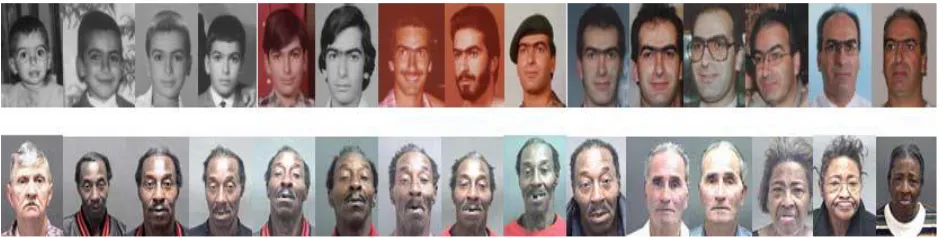
Fig. 1.Some facial images from the FG-NET (top) and MORPH-II (bottom) databases.
4. PROPOSED METHODOLOGY
Selva Kumar.S
et al
, International Journal of Computer Science and Mobile Applications,
Vol.6 Issue. 4, April- 2018, pg. 130-135
ISSN: 2321-8363
Impact Factor: 5.515
PHOG and LGBP. After the feature extraction stage, classification with multiclass support vector machines (SVM), age grouping with multiple support vector regression are done. Finally, age group of the input face image, is estimated automatically using the prominent features. In the literature, different approaches have been proposed to characterize facial their physical description. For instance, Collins et al., [82] proposed a gender recognition approach by combining HOG and LHSV features within a SVM classifier. Galdi et al [83] used gaze analysis for gender and age categorization by extracting features from a sequence of eye images, using AdaBoost and SVM classifiers. Specifically, for age recognition, Ge et al., [84] presented an approach that uses HOG, SIFT and LBP descriptors in a prediction system, which uses a regression model with a multi-view canonical correlation analysis. Dong et al [85] proposed a deep learning based framework, which extracts related visual features from a set of face images for age-group prediction. Facial images are used for the classification of age groups and the classification is done mostly using Local Descriptors. One way to achieve the texture classification in gray scale images is to use the texture descriptors to build several local descriptions of the facial image and concatenate them into a global description. These local feature based methods are more robust against variations in pose or illumination than holistic methods. Holistic description of a face using texture methods is not reasonable since texture descriptors tend to average over the image area [86]. Momeni -K et al., demonstrated that anatomical information is highly correlated with the physical features [87]. Most of the approaches only consider image descriptors which are not directly related with the anatomical structure of the face and just attempt to extract one feature at a time. Hence, there is a doubt whether a single feature information could be useful to decide the facial representation fully. All the selected global (AAM, GIST and GLCM) and local descriptors (LBP, PLBP, LPQ, PLPQ, LGBP and PHOG) are applied in every cropped and normalized skin region, and once the local features of every region have been extracted independently, the feature vectors are concatenated into a single vector. In addition, several combinations between different techniques are performed in an attempt to capture unique advantages of each descriptor. Score level and Feature-level fusion has been successfully applied in images, to avail the fused feature descriptor. Since, the local feature vector extracted by the LBP, PLBP, PHOG, LPQ, PLPQ and LGBP is high dimensional, only the principal components are chosen with the PCA. The z-score is then applied to normalize the lower dimensionality features. The fusion of features, is built up through the concatenation of the normalized feature vectors. Aging differs according to the age groups of a person. Wrinkles are usually found in senior and advisor subjects, while geometric features normally change during childhood and adulthood. The Hybrid fused feature using the two-stage age prediction based on age-group specific classifiers separate groups more precisely. It has shown good results and better ability to deal with these age-related adopted hybrid facial features.
5. EXPERIMENTS AND DISSCUSSION
The performance of an age group estimation system, with respect to both accuracy and computational speed, is not solely based on feature extraction algorithms, but also with gender and ethnicity. More importantly, some local features are not varied with pose, facial expression variations and lighting direction, but others vary with age progression. Additionally, evidences from proved that hybrid features are more appropriate for machines to recognize human faces than holistic ones.
Table: 1 Different Ethnicity Comparison
Accuracy (%)
S.No
Age Group Asian Black Hispanic Middle White
1
Child
94.1
99.9
99.9
100
99.9
2
Teen
93.66 99.5
99.9
97.6
99.7
3
Young
94.1
97.45 95
97.6
99.6
4
Middle
75.15 92.3
80
90
94.9
5
Senior
76.11 92.3
77.5
88.5
95
Selva Kumar.S
et al
, International Journal of Computer Science and Mobile Applications,
Vol.6 Issue. 4, April- 2018, pg. 130-135
ISSN: 2321-8363
Impact Factor: 5.515
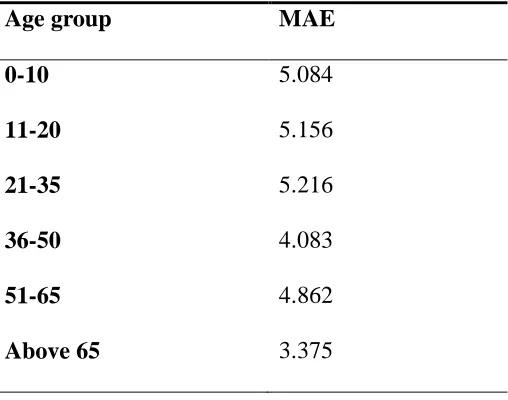
Table 2. MAE on different age group
Age group
MAE
0-10
5.084
11-20
5.156
21-35
5.216
36-50
4.083
51-65
4.862
Above 65
3.375
Table 3. Failure rate of proposed scheme
For age group estimation, there are concrete ways to evaluate the performance of different algorithms. The output of an age group estimation can be an estimate of the exact age group range of a person. Considering the results of this research, the following discussion points can be drawn. Accuracy is appreciably good even multiple features taking computation time. The accuracy of the system improved with increased number of features that are contributing towards classification. This proposal achieved equally good or better accuracy with significantly reduced dimension. With dimension reduction and selective hybrid features on region of interest are applied, thus the processing time is less and hence the system is fast enough.
6. CONCLUSION
The performance of proposed scheme may affect and deteriorate the performance include pose, image quality, lighting conditions, gender and age difference. Number of experiments are conducted in the cited studies to define the effect of each factor. Based on the results, the proposed approach is suitable for human age-group estimation in real time. Since the time taken on average is 28 milliseconds, which is appropriate in the context of real-time performance. For measuring the performance of age estimation algorithm MAE and CS is used. It is usually based on the mean average error (MAE) between real and estimated ages and Cumulative Score (CS) that shows the number of test cases, which have an absolute error smaller
Measure
Estimation
TPR (Correct Detection)
94.5%
FPR (Wrong Group
Estimation)
0.1%
FNR (Failure)
5.4%
Selva Kumar.S
et al
, International Journal of Computer Science and Mobile Applications,
Vol.6 Issue. 4, April- 2018, pg. 130-135
ISSN: 2321-8363
Impact Factor: 5.515
than a given threshold. In the case of age-group, age estimation errors usually refer to the percentage of correct classifications. Analysis carried out on previous research in facial age estimation and hybrid techniques with shape, appearance, texture and skin features adapted to the facial aging problem. Overall, the proposed method performs the best with MAE of 3.14and accuracy of 96.17 respectively. Also, it gives good results in both gender of different races. Overall, evaluation shows that this proposed scheme is better to the state of the art for facial age group estimation.
REFERENCES
[1] Arumugam P, Muthukumar Subramanyam, Selvakumar S, Gayathri, “Human Age Group Prediction from Unknown Facial Image”, International Journal of Advanced Research in Computer Science and Software Engineering, Volume 7, Issue 5, May 2017.
[2]. Mannu Nandal, Dr. Rakesh Joon, “Face Recognition and Age Progression Using Support Vector Machine and ORL Database: A Reviews”, International Journal for Technological Research in Engineering Volume 4, Issue 8, April-2017ISSN:2347-4718.
[3]. Narayanan Ramanathan, Rama Chellappa, Soma Biswas, “Computational methods for modeling facial aging: A survey”, Journal of visual languages and computing, 20, 131-144, 2009.
[4]. Narayanan Ramanathan, Rama Chellappa and Soma Biswas, “Age progression in human faces: A survey”, Visual Languages andComputing, 2009. [5]. Yun Fu,Guo dong Guo, Senior Member, Thomas S. Huang, “Age Synthesis and Estimation via Faces: A Survey”, IEEE Transaction on Pattern analysis and Machine Intelligence, vol.32, No.11, November 2010.
[6] Mannu Nandal “, A Novel Technique for Enhancing the Face Recognition and Age Progression,” International Journal for Technological Research in Engineering, Volume 4, and Issue10, ISSN: 2347 -4718, June-2017.
[7]. Aashmi, Sakshi Sahni, Sakshi Saxena, “Survey: Techniques for Aging Problems in Face Recognition,” International Journal of Computer Science and Information Technology, Vol. 4, No. 2, pp. 82-88 82 ISSN 2230-7621August 2014,
[8]. Petra Grd, “Two-Dimensional Face Image Classification for Distinguishing Children from Adults Based on Anthropometry, Social sciences, Information and Communication sciences,2015.
[9]. Fares Alnajar, “Automatic Age and Gaze Estimation under Uncontrolled Condition", ISBN 978-94-6182-648-0, 2016.
[10]. Kwon, Y.H., Lobo N.D.V, “Age Classification from Facial Images”, In: Proceeding of the IEEE Computer Society Conference on Computer Vision and Pattern Recognition CVPR 1994, pp.762-767, 1994.
[11]. Horng, W.B., Lee, C.P., Chen, C.W., “Classification of Age Groups Based on Facial Features”, Tamkang Journal of Science and Engineering .4(3). PP.183-192, 2001.
[12]. Lanitis A., Draganova C., Christodoulou C.,“Comparing Different Classifierfor Automatic Age Estimation, IEEE Transation on System”, Man and Cybernetics. 34(1). PP. 621-628, 2004.
[13]. Kalamani, D and Bala Suramanie, p., “Age Classification Using Fuzzy Lattice Neural Network”, Proceeding of the Sixth Intenational Conference on Intelligent System Design and Application. 3. October 2006. PP.225-230, 2006.
[14]. Xin Geng, Zhi-Hua Zhou, Smith-Miles, “Automatic Age Estimation Based on Facial Aging Patterns”, IEEE Transaction on Pattern Analysis and Machine Intelligence, Vol 29, NO.12, December 2007.
[15]. Y.Fu and T.S. Huang, “Human Age Estimation with Regression on Discrimitive Aging Manifold”, IEEE Trans. Multimedia, vol. 10, no. 4, pp. 578 -584,. June 2008.
[16]. Ueki, (2008), “Class Distance Weighted Locality Preserving Projection for Automatic Age Estimation”, 2nd IEEE International Conference on Biometrics: Theory, Application and Systems. Arlington, September 29th to October 1st 2008. IEEE.PP. 1 -5.
[17]. Zhuang, X., (2008), “Face Age Estimation Using Patch-Based Hidden Markov Model Supervectors”, International Conference on Pattern Recognition. Tampa, December 8th to IEEE.PP.1-4, December 11th 2008.
[18]. Shen L.L. and JI, Z. (2008), “Modelling Geometric Features for Face Based Age Classification”, Proceedings of the Seventh International Conference on Machine Learning and Cybernetics Kunming, July 12th to July 15th 2008. IEEE. pp. 2927-293, 2008.
[19].BEN, S., SU, G., WU, Y., “A Two-Step Selective Region Ensemble for Facial Age Estimation, Advanced Intelligent Computing Theories and Applications. With Aspects of Artificial Intelligence”, Lecture Notes in Computer Science. 5227. pp. 622-632, 2008.
[20]. Guo, (2008), “Image-based Human Age Estimation by Manifold Learning and Locally Adjusted Robust Regression”, IEEETransactions on Image Processing. 17 (7). pp. 1178-1188.
Selva Kumar.S
et al
, International Journal of Computer Science and Mobile Applications,
Vol.6 Issue. 4, April- 2018, pg. 130-135
ISSN: 2321-8363
Impact Factor: 5.515
[22]. Qi and Zhang (2009), “Age Classification System with ICA Based Local Facial Features Advances in Neural Networks”, Lecture Notes in Computer Science. 5552. pp. 763-772.
[23]. Geng and Smith-Miles, K. (2009), “Facial Age Estimation by Multilinear,” Subspace Analysis International conference on Acoustics, Speech and Signal Processing. Taipei, April 19th to April 24th 2009. IEEE. pp. 865-868.
[24]. Guo, G (2009), “Human Age Estimation Using Bio-inspired Features”, Conference on Computer Vision and Pattern Recognition, Miami, June 20th to June 25th 2009. IEEE. pp. 112-119.
[25]. Ricanek, K. JR., Wang, Y., Chen, C., Simmons, S.J. (2009) Generalized Multi-Ethnic Face Age-Estimation. International Conference on Biometrics: Theory, Applications and Systems.Washington, September 28th to September 30th 2009. IEEE. pp. 1-6.
[26].Long, Y. (2009), “Human Age Estimation by Metric Learning for Regression Problems Sixth”, International Conference on Computer Graphics, Imaging and Visualization. Tianjin, August 11th to August 14th 2009. IEEE. pp. 343-348
[27]. Gao, F. and AI, H. (2009), “Face Age Classification on Consumer Images with Gabor Feature and Fuzzy LDA Method, Advances in Biometrics”, Proceedings of the Third International Conference on Biometrics. Alghero, June 2nd to June 5th 2009. pp. 132-14.
[28]. Luu, K., Ricanek, K. JR., Bui, T.D., Suen, C.Y. (2009), “Age Estimation using Active Appearance Models and Support Vect or Machine Regression”, 3rd International Conference on Biometrics: Theory, Applications, and Systems Washington, September 28th to September 30th 2009. IEEE. pp. 1-5.
[29]Turaga, P., Biswas,S,Chellapa., R. (2010), “ The Role of Geometry in Age Estimation”, IEEE International Conference on Acoustics Speech and Signal Processing. Dallas, March 14th to March 19th 2010. IEEE. pp. 946-949.
[30]. Chang, K.Y., Chen, C.S., Hung, Y.P. (2010), “A Ranking Approach for Human Age Estimation Based on Face Images”, International Conference on Pattern Recognition. Istanbul, August 23rd to August 26th. IEEE. pp. 3396-3399.
[31]. Luu, K., Bui, T.D., Suen, C.Y., Ricanek, K. JR. (2010), “Combined Local and Holistic Facial Features for Age-Determination”. 11th International Conference on Control, Automation, Robotics and Vision. Singapore, December 7th to December 10th. IEEE. pp. 900 -904
[32]. Zhang, Y. and Yeung, D.Y. (2010), “Multitask Warped Gaussian Process for Personalized Age Estimation”, IEEE Conference on Computer Vision and Pattern Recognition. San Francisco, June 13th to June 18th 2010. IEEE. pp. 2622-2629.
[33]. Zhai, C.M., Qing Y., JI-Xiang, D. (2010), “Age Estimation of Facial Images Based on an Improved Non-negativeMatrix Factorization Algorithms. Advanced Intelligent Computing Theories and Applications. With Aspects of Artificial Intelligence pp. 670-676.
[34]. Duong, C.N., Quach, K.G., Luu, K., LE, H.B. Ricanek K. (2011), “Fine Tuning Age-estimation with Global and Local Facial Features”, 36th International Conference on Acoustics, Speech and Signal Processing. Prague, May 2011.
[35]. Hajizedah, M.A., Ebrahimnezhad, H. (2011), “Classification of Age Groups from Facial Image Using Histograms of Oriented Gradients”, 7th Iranian Machine Vision and Image Processing. Tehran, November 16th to November 17th 2011. IEEE. pp. 1 -5.
[36]. Lu, J. and Tan Y.P. (2011), “Fusing Shape and Texture Information for Facial Age Estimation”, IEEE International Conference on Acoustics, Speech and Signal Processing. Prague, May 22nd to May 27th 2011. pp. 1477-1480.
[37]. Selvi, V.T. And Vani, K. (2011), “Age Estimation System using MPCA”, International Conference on Recent Trends in Information Technology. Chennai, June 3rd to June 5th 2011. IEEE. pp. 1055-1060.
[38]. Chang, K.Y., Chen, C.S., Hung, Y.P. (2010), “A Ranking Approach for Human Age Estimation Based on Face Images”, International Conference on Pattern Recognition. Istanbul, August 23rd to August 26th. IEEE. pp. 3396-3399.
[39]. Zhan, C., Li, W., Ogunbona, P. (2011), “Age Estimation Based on Extended Non-Negative Matrix Factorization”, International Workshop on Multimedia Signal Processing. Hangzhou, October 17th to October 19th 2011. pp. 1-6.
[40].Chang, K.Y., Chen, C.S., Hung, Y.P. (2011), “Ordinal Hyperplanes Ranker with Cost Sensitivities for Age Estimation”, IEEE Conference on Computer Vision and Pattern Recognition. Providence, June 20th to June 25th 2011. IEEE. Pp.585-592.
[41]. Nkengne, A., Tenenhaus, A., Fertil, B. (2011), “Age Prediction Using a Supervised Facial Mode”,International Symposium on Biomedical Imaging: From Nano to Macro. Chicago, March 30th to April 2nd 2011. IEEE. pp. 1183 – 1188.