Published online October 27, 2014 (http://www.sciencepublishinggroup.com/j/ijiis) doi: 10.11648/j.ijiis.s.2014030601.19
ISSN: 2328-7675 (Print); ISSN: 2328-7683 (Online)
A new method to detect circles in images based on genetic
algorithms
Navid Khalili Dizaji
1, *, Nazila Masoudi
1, Aidin Sakhvati
21
Department of Mechatronics Engineering, Tabriz Branch, Islamic Azad University, Tabriz, Iran 2
Department of Electrical Engineering, Tabriz Branch, Islamic Azad University, Tabriz, Iran
Email address:
[email protected] (Navid K. D.), [email protected] (Nazila M.), [email protected] (Aidin S.)
To cite this article:
Navid Khalili Dizaji, Nazila Masoudi, Aidin Sakhvat. A new Method to Detect Circles in Images Based on Genetic Algorithms. International Journal of Intelligent Information Systems. Special Issue: Research and Practices in Information Systems and Technologies in Developing Countries. Vol. 3, No. 6-1, 2014, pp. 49-55. doi: 10.11648/j.ijiis.s.2014030601.19
Abstract:
Object detection is one of the key issues in digital image processing. Over the years, many algorithms have been created for detecting meaningful objects on the image which are based on specific characteristics of object or complex mathematical methods. Circle detection is one of these types of methods. One of the best methods for circle detection on digital images and discussion of machine vision is the Hough transform. The Hough transform can be described as the transformation of a point in the x-y-plane to the parameter space. Parameter space can be defined by the shape of the object. Using the special character of each image in space, we are able to retrieve and extract the image circle. Importantly, this method is time consuming and a large amount of memory is required for the image. The undesirable features have reduced the popularity of this method. The idea of using genetic algorithm for detecting a circle in the picture is very attractive and functional. This method can be used in Robot Soccer, targeting systems and iris recognition. In this method, accuracy and speed are among important parameters. For example, in the case of robot, it should detect ball in monochromatic and sometimes crowded areas (due to accumulation of other bots around the ball). Using a genetic algorithm for circle detection on images, Hough transform weaknesses have been removed. It also increases the computation speed and accurate detection of circle. In this paper, the Hough transform method will be presented and then we will describe the process of implementing genetic algorithms to find a circle in the picture.Keywords:
Hough Transform, Image Processing, Digital Image1. Introduction
A common problem in determining the location is the number or the orientation of specific objects in image. For example, it can be the determination of direct roads in aerial imagery. This problem can be solved using the Hough transform for these lines. Most interesting, objects have other forms such as circle, oval or any other shape. Despite the enhancement of Hough transform complexity along with increasing the number of parameters required to describe the desired shape, Hough ordinary transform can be used on any shapes [2].
Circular Hough transform algorithm is summarized as follows [2]:
1 Find the edges
2 For each edge point "Hough transform begins»
3 A circle of radius r centered at the edge point is drawn and all the coordinates the circumference of the circle
passes will be increased.
4 Maximum points are found in the storage. “The Hough transform will be finished"
5 Found parameters (r, a, b) are determined on the original image in accordance to the maximum points.
2. Hough Transform for Circle Detection
2.1. Parametric Display
50 Navid Khalili Dizaji et al.: A new Method to Detect Circles in Images
Figure 1. Showing a line in Cartesian coordinates
The relation is an equation for the straight Cartesian coordinate system where ‘a’ and parameters. Since the line perpendicular to infinite value leading to infinite volume of Hough transform of line does not use this relation. displaying the line as above, the line the parameter be displayed as below:
sin
b sin θρ ⇒ y
cos θ sin θ x
→ ρ x. cosθ y. sin θ
Equation 1. Parameter space
In this case, the parameter space includes called limited volume
(
) (
2)
22
x
a
y b
r
=
−
+ −
Equation 2. limited volume
Circle in Cartesian coordinates can be expressed
.cos
= +
x
a
r
θ
y
= +
b
r.sin
θ
Equation 3. Circle in Cartesian coordinates
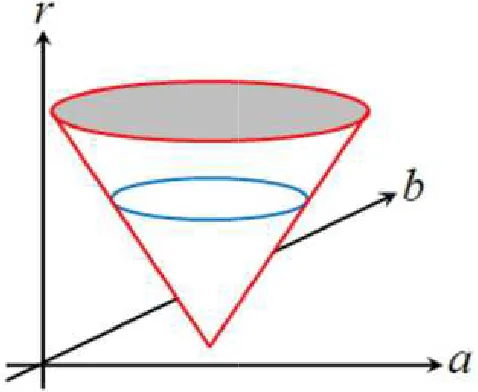
Compared to lines, circles in parameter expressed more easily because circle parameters directly sent to the parameter space. In the above and ‘b’ are coordinates of the circle center along of ‘x’ and ‘y’. ‘r’ is the radius of the circle. of above equation is as follows:
It is clear that the parameter space of the parameter space of the line is . With increasing
: A new Method to Detect Circles in Images Based on Genetic Algorithms
coordinates
straight line in a and ‘b’ are the line the vector x has an of ‘a’ and ‘b’, the relation. Instead of parameter space can
x sin θ ρ
includes and which is
2 2
x
a
y b
expressed as follows:
coordinates
parameter space can be parameters can be above equation, ‘a’ along the center line Parametric display
the circle is and the increasing the number of
parameters required to describe size enhancement of the parameter transform complexity increases. space of the circle, the radius is this space [2].
Figure 2. The parameter space of the circle
2.2. Storage
The process of finding the circle transform is as follows:
First of all, all edges in the image relevance to the Hough transform of edge detection such as Sobel
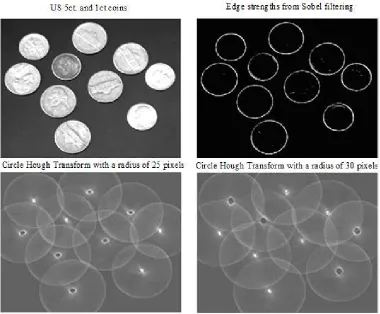
Figure 3. Conversion of a circle from
space (right) for constant radius
Furthermore, at each edge point, point is drawn with desired radius. parameter space in such a way z-axis model the components respectively. In coordinates circumference of the circle, matrix equal sizes with parameters space, edge points of the original image drawing the circles with desired amounts in the storage. After numbers presenting the number unique coordinate. Therefore, selected intelligently based on centers of the circles in the original
Based on Genetic Algorithms
describe the desired shape and the R parameter space, the Hough increases. To simplify the parameter is recorded as a fixed number in
circle after the Hough transformation
circle in an image using Hough
image are identified. It has no transform and all preferred technique
Sobel and Kenny can be used [3].
from the x-y area (left) to the parameter
Figure 4. Example of the storage operation using actual data which shows the Hough transform for two radius values
2.3. Hough Transformation Algorithm
The process flow of Hough transformation algorithm is enumeratedas below:
I. Find the edges
II. For each edge point "Hough transform begins»
III.A circle of radius r centered at the edge point is drawn and all the coordinates the circumference of the circle passes will be increased.
IV.Maximum points are found in the storage. “The Hough transform will be finished"
V. Found parameters (r, a, b) are determined on the original image in accordance to the maximum points.
3. Implementation
According to the algorithm presented in the previous section, the algorithm implementation can be conducted. However, before this, few points should be considered.
3.1. How can the Data be Stored
F If the radius is not fixed, the three-dimensional storage array can grow very fast in terms of stored data. The size of this array depends on the number of radius values and more importantly the size of the image. The computational cost to compute all the circles associated with the edge points will increase with the edge point’s enhancement. The number of
edge points is usually a function of image size. The calculation of total time of Hough transform for circles of large images with a lot of edge points can reach the unbridled amount of time rapidly.
3.2. How to Draw a Circle in the Discrete Space
A circle in the discrete space can be drawn using the Equation 3. However, the problem is. How to choose the discrete values with resolution of ? One solution is to use high resolution of and make the values rounded. But it may lead to draw the edge pixels more than once or, in the case of large radius values, it may lead to lack of pixels. The other solution is to round sine and cosine after multiplying the values by radius.
To ensure that all pixels are drawn, resolution of must be high. This will increase the computational cost. One method that can reduce computing cost is the quick calculation of values for sine and cosine functions using a lookup table. Although the discussed methods are feasible, but there are still better solutions [4].
52 Navid Khalili Dizaji et al.: A new Method to Detect Circles in Images
appropriate when the center of the circle is the storage data.
3.3. How can the Circle be Found from the Transform Data
Although this discussion is not related transform, but it is useful for circles information from the storage data. If there is no information number of circles and their radiuses, this process cumbersome. One approach is to find the planes each corresponding to a specific radius Figure 5.
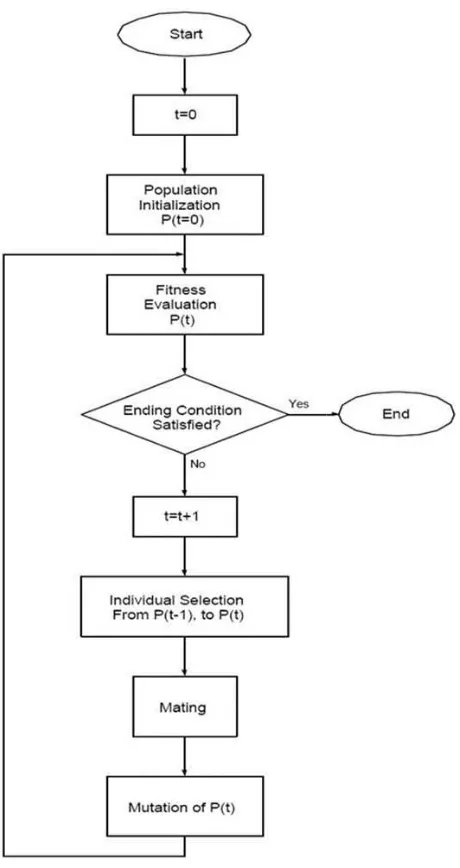
Figure 5. Block diagram of a simple Genetic Algorithm
If the height of the peaks are equal number of edge pixels of the circle with peaks coordinates may correspond to the center In the case of incomplete circle or oval shape, the circle can be displayed with a height less of the edge pixels. Eventually, if there is
: A new Method to Detect Circles in Images Based on Genetic Algorithms
is to be found from
the Hough
related to the Hough information extraction information about the process will be very the peaks of a and b radius as shown in
Algorithm (SGA)
compared to the with a certain radius, center of this circles. shape, the center of less than the number is any difficulty in
peaks determining, data storage
4. Genetic Algorithm
Genetic Algorithm (GA) is computer science and artificial optimal solution for the searching Algorithm is one of the Evolutionary inspired by science of biology sudden selection, natural selection briefly stated that Genetic Algorithm technique which uses genetic problem solving. Most of the “struggle for survival” is used, our mind. However, to rest strongest was not always the winner. size and power, dinosaurs have having generation during a quite weaker creatures have continued nature chooses the bests not only is more correct to say the nature best. In the law of natural selection, limited to some population's features. Those who do not possess gradually disappear over time. certain kind of people which are the rest of the colony. In normal improve more and have a relatively welfare will lead to longer life intelligence is inheritable, the number will be more in the next generation trend continues, you will see becomes smarter over the generations. simple mechanism has managed people of community. In addition, community is constantly increasing
Thus, we can see that the nature generation in terms of different mechanism; gradual elimination reproduction of optimal species. represented as binary 0 and 1, display it. Evolution is started
and repeated in subsequent generations. the fittest is selected not the
problem is shown by a list of parameters or genome. Generally, chromosomes simple string of data. Other types used. At first, several features create the first generation. During feature is evaluated and the fitness fitness function. Typically the number of possible connections It indicates the possibility of children combined together with this possibility. connection creates the child
generation. These are done until for response in the generation
Based on Genetic Algorithms
storage can be paved.
is a searching technique in artificial intelligence to find the searching issues [5]. Genetic Evolutionary Algorithms which is such as inheritance, mutation, selection and composition. It is Algorithm (GA) is a programming genetic evolution as a model of the time, when the term of used, its negative value comes to assured, you can think that winner. Despite their massive have ceded the survival game and quite natural process, while much continued their lives. It seems that the only based on the size. In fact, it nature chooses the fittest not the selection, having descendant is species which have the best possess these characteristics will time. For example, suppose a are much more intelligent than normal conditions, these people will relatively higher welfare. This life and better reproduction. If number of intelligent offspring generation of that community. If this see that our sample population generations. In this way, a natural managed to remove low-intelligent addition, the average intelligence of increasing [5].
to change the new children. Genetic algorithms and small transition probability which is Based on this possibility, child chromosomes changed or mutated.
The next step is to create a second community. It is conducted by genetic (Chromosomes connected to each other and on the selection processes and production of For each individual, a pair of parents selections are in such a way that the best selected so that the weakest elements have selected to prevent achieving the local response. creates a new generation of chromosomes from previous generation. The whole process the next generation. Pairs are selected for third generation population comes to existence
This process is repeated until we reach the Terminating conditions of genetic algorithms 1 To reach a fixed number of generations.
2 Allocated funds to be finished (computation money).
3 One person (the produced child) to be minimum (lowest) criteria.
4 To reach the highest degree of children to yield better results.
5 Manual inspection. 6 High combinations.
Figure 5 shows a flowchart of a simple Genetic (SGA) [5].
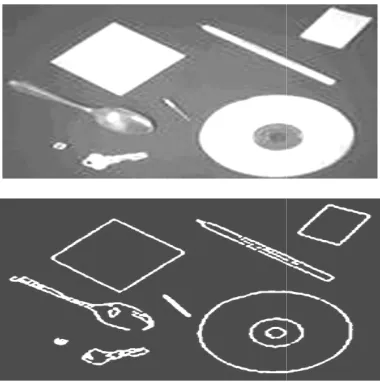
Stored as a binary two level matrix. To with the width of a pixel, Gaussian edge detection.
Figure 6 shows the Gaussian operator image [6, 7].
Figure 6. Input image (upper) and a binary image
detection operator
5. Circle Detection Using the
Algorithm
According to the quadratic equation, each
algorithms have a fixed about 0.2 or less. chromosomes are randomly
second generation of genetic operators and changed) based of selected features. is selected. The
best elements are have the chance to be response. This process which is different process is repeated for combination. The existence and so on.
the last stage. algorithms include [5] generations.
(computation time /
be found who meet
children process and not
Genetic Algorithm
To extract the edges detection.
output for a gray
of the Gaussian edge
Genetic
each circle can be
passed from three points in the terms, given the coordinates of circle passing through it and extract these three points have the potential be in a row). Preprocessed images study. These images have been extracted edge points of the binary image called v, with the following structure.
V = {V_1,V_2,…,V_m
Equation 4. Edage
Where ‘m’ is the total number should be noted that the number varies in accordance to the image listing the Edge values in the array each edge pixel Vi should be changing any addresses form 1 using three indicators of i1, i2 and
circle passing through the three the potential to detect circle in candidates which have the potential the initial population production
5.1. Type of Representation
Each individual circle can be on a chromosome (Figure 7). In edge points of the image in the genes it place in the edge array V (Figure chromosome has address of three V which are stored in three sequential
Equation 5. Genotype
Figure 7. A chromosome contains three gene to describe the circle edge
pixel
! "! # $! %! "%! # $!
4 ' $(#"% "$)
Equation 6. Transformations
"0
+
2# - .)2# / .)
4
'
- .('
"/ ".Equation 7. Transformations
According to the above equations, function with input edge indices
the image edge space. In simple of three points, we can make a extract the circle equation (If potential to form a circle and not to images have been used in our extracted by MATLAB and All image should be stored in an array
structure.
{V_1,V_2,…,V_m }
Edage array
number of edge points in the image. It number of edge pixels in the image image size and texture. When array V, the coordinates (xi, yi) of
stored in the edge vector. By 1 to ‘m’ to a binary form and and i3 for the edge points, the
points Vi1 and Vi2 and Vi3 has
the image. A number of triple potential to solve circle is used for production in algorithm.
be revealed by three edge pixels In this method, the address of genes is stored in accordance to (Figure 8). In this case, each three edge points in the edge array sequential genes.
Genotype circle equation
A chromosome contains three gene to describe the circle edge
"$!) 2'" "$(
"$!) 2#"% "$)
) # % $)'" "$(
TransformationsX -2 " -2 # . 2 " . 2) / 2 " / 2 # . 2 " . 2)
0
(
.( #
/ .)
"- ".Transformations Y
54 Navid Khalili Dizaji et al.: A new Method to Detect Circles in Images
Figure 8. The number of each gene points out a cell
The coordinates of the edge pixels are recorded in this
Each circle is coded to three edge points phenotype surface of each circle is indicated parameters of X0 and Y0 and r. is coordinate the circle and r is circle radius. For conversion to Phenotype, the following equations are used. and radius of the circle passing through the are estimated using the following equation
Equation 8. Transfer function
With T transfer function, the circle of each discrete space can be easily estimated.
5.2. Fitness Function
To calculate the fitness of each chromosome, the circle passing through the edge pixels of should be computed using the T transfer function 7 and 8). Actually we should obtain three and r. Then, coordinates of the edge points computed. The number of these points is designated and shown as. Function of is a number of which apply in the coordinates of the circle three points. Our goal is to make the C value maximum value. The larger the value, the better circle candidate is. The optimization process due to the number of generations or the threshold fitness. With regard to the issue, each of these employed. In this paper, the number of generations condition of the algorithm [9, 10].
5.3. Selection Operator
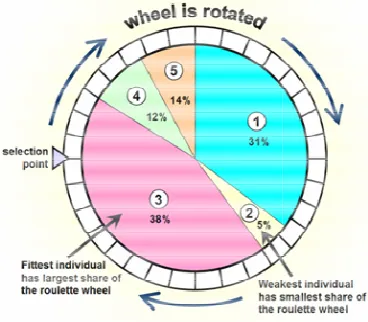
Figure 9. The Roulette Wheel [8
: A new Method to Detect Circles in Images Based on Genetic Algorithms
address of the array V. this cell.
points of the image. The indicated by three coordinate of the center of conversion of Genotype used. In fact, center the three edge points
[8].
each chromosome in a
chromosome, coordinates of of the chromosome function (equation 6, three parameters of, points in V should be
designated as test set of Matrix V points circle passing through value close to the better the answer for process can be stopped threshold value of the these methods can be generations is the stop
8]
At this stage, an appropriate chromosomes are selected based used in the next stage. Chromosomes can be selected several times Chromosomes with low fitness For this step, the selection method roulette wheel model of weighted surface of wheel is divided into equal to the population members. is appropriate to the fitness value the wheels circulate to be stopped point specifies the selected chromosome. roulette wheel.
This type of selection increases chromosomes in the population
fitness value of the population increased population.
5.4. Blending Operator
At this stage, cross operator chromosomes with Pc probability chromosomes with their combinations. single point blending is used.
5.5. Mutation Operator
In this paper, the mutation rate this step, the mutation is done
with Pm probability. Each chromosome with a same probability and
collection is substituted. The following table shows genetic algorithm for circle detection
Table 1. Parameters of the genetic algorithm
an image
Parameter
Population size Crossover probability Mutation probability Number of elite individuals Selection method Crossover method Population size
6. Discussion and Conclusion
In this paper, a method for
proposed. To this end, the characteristics transform method and genetic
With improving the estimation method percentage of detection can be
issue is the dependence of the classification network to the collection combination example, with a big number of neurons will be reduced and it causes the threshold value in the images. the composition of the sample.
Based on Genetic Algorithms
appropriate number of paired based on their fitness level to be Chromosomes with high fitness values during the production phase. fitness values may not be selected. method of random pairs is used as a weighted ranking. In this model, the into segments whose number is members. The surface of each section value of each chromosome. Then stopped in a point accidentally. This chromosome. Figure 9 shows the
increases the number of optimal population over time so that the average increased compared to the past
operator acts on the parent probability and produces new combinations. In this paper, the
rate operator of 20% is used. In on displacement chromosome chromosome is randomly selected a random chromosome of V
the parameter values of the detection problem [10].
algorithm for circle detection problem in
Value
100 0.5 0.2 2
Roulette wheel Crossover 100
Conclusion
help to improve process because, in this method, all features of feature extraction phase have been used.
In some cases, where the preprocessing is done in windows with linear functions, weights convolution of the input layer of genetic algorithm with image can be used to speed up.
References
[1] Tahir Rabbani and Frank van den Heuvel,“Efficient Hough transform for automatic detection of cylinders in point clouds.” in Proceedings of the 11th Annual Conference of the Advanced School for Computing and Imaging ,The Netherlands, June 2005.
[2] Just Kjeldgaard Pedersen, Simon,“ Circular Hough Transform.” Aalborg University, Vision, Graphics, and Interactive Systems. November 2007.
[3] B. Jahne, H. Scharr, and S. Körkel, “Principles of filter design,”In Handbook of Computer Vision and Applications. Academic Press, 1999.
[4] Bresenham, J. E. (1), “Algorithm for computer control of a digital plotter,” IBM Systems Journal, pp25–30 January 1965.
[5] Bies, Robert R, Muldoon, Matthew F., Pollock, Bruce G, Manuck, Steven, Smith, Gwenn, Sale, Mark E, “A Genetic Algorithm-Based, Hybrid Machine Learning Approach to Model Selection,”Journal of Pharmacokinetics and Pharmacodynamics, pp 196–221, 2006.
[6] G. Eason, B. Noble, and I. N. Sneddon, “On certain integrals of Lipschitz-Hankel type involving products of Bessel functions,” Phil. Trans. Roy. Soc. London, vol. A247, pp. 529–551, April 1955.
[7] G. Kendall and G. Whitwell, “An evolutionary approach for the tuning of a chess evaluation function using population dynamics,” In Proceedings of the 2001 Congress on Evolutionary Computation, pp 995–1002. IEEE Press, World Trade Center, Seoul, Korea, 2001.
[8] Shah, S.M.; Thaker, C. S, Singh, D, “ Multimedia based fitness function optimization through evolutionary game learning,”Emerging Trends in Networks and Computer Communications (ETNCC), 2011 International Conference, page(s): 164- 168,2011.
[9] H.A.Rowley, S.Baluja, T.Kande, “Rotation invariant neural network-based face detection,” Computer Science Technical Report, CMU-CS-97-201, CMU, Pittsburgh, 1997.
[10] H.Schneiderman, “T.Kande. Probabilistic modeling of local appearance and spatial relationships for object recognition,”IEEE Conference on Computer Vision and Pattern Recognition, 45-51, Santa Barbara, 1998.