ISSN: 2306-9007 Alhrrah, Almutairr & Alzeer (2015) 245
I
www.irmbrjournal.com March 2015I
nternationalR
eview ofM
anagement andB
usinessR
esearchVol. 4 Issue.1
R
M
B
R
Indicators of E-Learning Platforms in Riyadh City
Universities: A Comparative Study
ABDULAZIZ I. ALHRRAH
Department of Geography, College of Arts, King Saud University, Saudi Arabia Email: [email protected]
AMAIR N. ALMUTAIRR
Department of Geography, College of Arts, King Saud University, Saudi Arabia
NASSER M. ALZEER
Department of Geography, College of Arts, King Saud University, Saudi Arabia
Abstract
Developing universities have established a promising E-Learning Platform initiative in order to enhance access to education services and information to its students. This study examines the development of E-Learning Platform in Riyadh City Universities (RCU), and compared between privet and government sector. This paper proposes evaluate and comparative model for E-Learning platform between Government and private sector in RCU, the E-Learning platform solution selection is a multiple criteria decision-making problem that needs to be addressed objectively taking into consideration the relative weights of the criteria for university. We formulate the quoted multi criteria problem as a decision hierarchy to solving problem. In this paper we will show the general evaluation strategy and compared between privet and government sector obtained results using our model to evaluate e-learning platforms. The results of comparison models are outlined as follows: Total weights of the proposed framework in management feature is 16.25/25, in collaborative feature is 7.75/10, in adaption learning path is 7.63/10 and in interactive learning object is 4.75/5. In this study an evaluation model was applied on Government University like KSU, IMAMU, NAUSS and PNBAU, Private University like PSU, DAU, YU and FU. Then, the results were compared with each other. The total weighs Government University of KSU was 41. While the total weights of IMAMU, NAUSS and PNBAU was 37, 32and 37. The total weighs private University of FU was 40. While the total weights of PSU DAU and YU was 38, 38 and36 respectively. The total weights of all features in Government University are 147/200, Private University are 152/200.
Key Words: E-Learning, E-Learning Platform, LCMS, GIS, AHP, Multiple Criteria Decision Making, LMS, GS, PS.
Introduction
Saudi Arabia and recently spent hundreds of millions of dollars to improve the educational system in the country, and higher education in particular. These improvements include the construction of a new state-of-the-art, universities, and institutions that have a higher competing around the world (Aljabre 2012).
ISSN: 2306-9007 Alhrrah, Almutairr & Alzeer (2015) 246
I
www.irmbrjournal.com March 2015I
nternationalR
eview ofM
anagement andB
usinessR
esearchVol. 4 Issue.1
R
M
B
R
seven days and twenty-four hours a day. E-learning and the arrival of more educated, and it ensures that the learning environment, which is independent of time and place. Geographic information system (GIS) integrates hardware, software, and data for capturing, managing, analyzing and displaying all forms of geographically referenced information. Can be integrated GIS technology in the e-learning platform and GIS allows us to view, understand, question, interpret, and visualize data in many ways that reveal relationships, patterns and trends in the form of balls, reports and graphs in the RCU (Akkoyunlu et al 2008).
The main objective of this research is to assess the comparative model for E- learning platform between the government and the private sector in the RCU, and choose the solution of e-learning platform is the problem of multi-criteria decision that you need to address the objective taking into account the relative weights of the criteria the university.
Related Work
Many overview of the research described the e-learning platform as technical, and provides a brief overview of LCMS, and discussed the background of e-learning, and to identify the caller definition LCMS. We can define the e-learning applications on the Internet, which allows the instructor-based learning content standards for communities of learners to offer. Brooks, providing high popularity of these systems, they tend to be the minimum navigation and awareness of collaborative features, and students often find themselves learning in a vacuum, without a sense of what the rest of the learning community.
Z. Du et al, 2010, propose interactive and collaborative e-learning platform that combines the advantages of LMS and social programs through the integration of social programs with the LMS. Platform linking the network of users, of course, with his / her social network and knowledge. As a result, it is useful for users to build their network of social and personal network of knowledge during the process (Zhao et al 2004).
Yan-qing, ) 2008) The assessment index system based on the Anti-Hunger Programme was established web
platform evaluation. Students discussed centered teaching model, which both teachers and students support assessment platform. After the initial implementation of the teaching model in one academic year, and found some problems, so suggested to improve the teaching model (Yan and Hua 2008).
Amalou, 2006, Suggested guideline for the development of an educational institution wants to create an environment based e-learning, and the development of teaching methods on the network, to accelerate the development of online courses or develop the resource center for collaborative work with other institutions project. And seen the need to implement e-learning platforms as a first step towards achieving these goals earlier. Being a prior study of long-term project, and this is the beginning of the report by addressing the needs and ask key questions before taking any step (Amalou 2006).
Colace, (2006) Stated in his paper, and e-learning platform must provide effective educational organization contents, and must be relevant to the content to the user who benefit Colace (2006). Stenalt, M. Hvid, Godsk, Mikkel, 2007, Showing platforms in most cases overly austere and functional, supplementing the learning situation by being neutral containers or mediators of communication and learning materials. Considered in the development and design of websites, and the introduction of e-learning 2.0 local survey we say that in order to accommodate the future needs to focus on e-learning platforms needs to be an aesthetic perspective rather than addressing mainly usability and functionality (Stenalt et al 2007).
ISSN: 2306-9007 Alhrrah, Almutairr & Alzeer (2015) 247
I
www.irmbrjournal.com March 2015I
nternationalR
eview ofM
anagement andB
usinessR
esearchVol. 4 Issue.1
R
M
B
R
main focus is on adaptation issues. As a result of the evaluation shows that the platform Moodle outperforms all other platform also got the best rating in the category of adaptation (Graf and Beate 2004).
These resources may be interoperable in a specific platform and are not compatible with others. Therefore, the media should unite on the basis of known standards such as IMS World Federation of learning and SCORM (Sharable Content Object Reference Model).
Riyadh City Universities (RCU)
Site: Occupies Riyadh is derived from the geographical location of the Kingdom, which mediates the continents of the world attitude. This website and get another dimension to the center of the Kingdom of being located in the eastern part of the Arabian Peninsula, at latitude (38.24) degrees north and longitude (43.46) degrees east longitude, and height of about 600 meters above sea level.
Area: In half a century, Riyadh was transformed from a small town surrounded by walls into a modern city. -Scale urban area in the first and second phases (1782) square kilometers, which is more than many states area, with an area three times the size of Singapore, for example. It covers the first phase of the urban boundary limits of the current city (about 632 square kilometers), while the second phase, which covers the remaining space area (1,150 square kilometers), and the total developed area of about 950 square kilometers. This reflects the significant expansion witnessed in Dubai, after it emerged from the walls, to become part of the three largest urban areas in the Kingdom, with the cities of the metropolitan area of Mecca and Jeddah in Makkah region, region, urban cities in Dhahran and Dammam and Khobar in the Eastern Province.
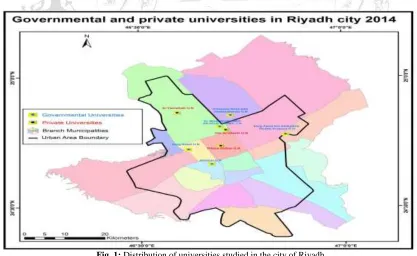
Population: Total population of the UK in the year 1421 (20846884 people), and a number of Saudi citizens whom (15588805 people) make up (74.8%) of the total population, and stay non-Saudis and the number (5,258,079 people) make up (25.2%) of the total population. It is estimated that the total number up the Kingdom's population in 1424 to about 23 million people, almost (http://vb.tgareed.org/t/317446/). Figure 1 shows the locations that private universities selected to conduct this paper are:
ISSN: 2306-9007 Alhrrah, Almutairr & Alzeer (2015) 248
I
www.irmbrjournal.com March 2015I
nternationalR
eview ofM
anagement andB
usinessR
esearchVol. 4 Issue.1
R
M
B
R
1. King Saud University (KSU(:Establishing Saudi Arabia’s first university was a response to the
educational and professional needs of a young nation. Abdulaziz Al-Saud, proclaimed the King in 1932, and began laying the foundations for modernizing his country and establishing an educational system. In 1953, Saud, the eldest son of Abdulaziz, acceded to the throne upon his father's death. He would soon institute the Council of Ministers and establish the Ministry Education.
2. Al - Imam Muhammad ibn Saud Islamic University (IMAMU):Teaching Sharia knowledge prevailed
most regions in Saudi Arabia before opening up government-run schools and Sharia institutes. Teaching was conducted at mosques and houses of scholars, who taught a lot of judges. His eminence Sheikh Mohammed Ibrahim Al-Sheikh – May Allah show mercy to him - and his brothers played a major role in disseminating knowledge of Sharia in Riyadh and the neighboring areas.
3. Naif Arab University for Security Sciences (NAUSS(: The idea of establishing the Naif Arab University
for Security Sciences, with a first conference of the leaders of the Arab police and security in the city of Al Ain, United Arab Emirates during the period from 18-21/12/1972 The Conference adopted a resolution with the number (17) which read as follows: (the cost Director-General of the Arab Bureau of Criminal Police to prepare a study on the feasibility of the establishment of the Institute for Research on the Arab level, the police and the studies that include the study of the project such as this requires the Institute and his expertise and funds to study and presentation of the next conference).
4. Princess Nourah Bin Abdulrahman University (PNBAU): Princess Nora University girl Abdul Rahman
is located in the city of Riyadh. Was Opened in the era of the Custodian of the Two Holy Mosques King Abdullah bin Abdul Aziz on October 29, 1429/29 October 2008 AD, and is considered the first university in Saudi Arabia, and especially for girls. Was renamed from Riyadh University for Girls to become the Princess Nora University girl Abdel-Rahman for girls. And accommodate about 60 thousand college student Mmichkl more than 60% of high school graduates. The university was to transfer its permanent campus.
5. Prince Sultan University (PSU):PSU was originally founded in 1999 in the Prince Sultan College for eligibility, but, in 2003, announced the Ministry of Higher Education to be a university. Was inaugurated by His Royal Highness Crown Prince Sultan bin Abdul Aziz Al Saud, who is the Deputy Prime Minister and Minister of Defense and Aviation and Inspector General. PSU is a non-profit organization founded in Riyadh by Riyadh Philanthropic Society for Science and licensed by the Ministry of Higher Education. Prince Sultan University is the first private university in Saudi Arabia.
6. Dar Al Uloom University (DAU): Strive to be a model of excellence in providing quality education and
support locally and globally, and keep up with the times. We at the DAU our part in the economic development and cultural, intellectual and spiritual, and to contribute to the production of knowledge and the development and dissemination, as well as producing quality graduates are able to fill their space in the society and contribute to the national development process.
7. Yamamah University (YU(:Al Yamamah College (YC) was established in May 2001 by Al-Khudair
family as their second major contribution to education in Saudi Arabia after establishing the first private school in Riyadh in 1957. Authorized as an institution of higher learning by the Ministry of Higher Education, Al Yamamah College opened its doors to male students in September 2004 and to female students in September 2006. Since then, the college has established itself at the forefront of educational innovation and excellence in the Kingdom.
ISSN: 2306-9007 Alhrrah, Almutairr & Alzeer (2015) 249
I
www.irmbrjournal.com March 2015I
nternationalR
eview ofM
anagement andB
usinessR
esearchVol. 4 Issue.1
R
M
B
R
achieve excellence and success board of trustees, which represents the founders of local and international are fully committed to a message university.
Al-Faisal University, began her career with four colleges are business, engineering, medicine and science, provides educational programs and world-class quality at the level of undergraduate and graduate to the elite of outstanding students of both sexes, the university also gives the opportunity for the Saudis and non-Saudis to join them.
E-Learning Platforms
E-learning platform is a software that helps walking distance and open education. This type of program consists of a set of tools for key users of the three - the teacher, the learner and administrator. It also contains a process that is the educational content distance consulting, individualize learning and teaching the main purpose. In this system, the teacher creates a model of educational content, including the individual of his education, including multi-media educational resources and the follow up his student activities. Students consult the teacher online or download educational contents that are recommended to them, and to organize themselves and display the workflow, and do exercises, auto evaluate themselves and submit their reports to correct.
Teachers and students to communicate individually or in groups, and the creation of themes for discussion and cooperation on common tasks as well as update the content and availability (Amalou 2006). For the most part of the modern e-learning platform can be considered organized into three basic components of the College: Learning Management System (LMS) and learning content management system (LCMS) and there is a set of tools for the distribution of the contents of the training and interaction. LMS and integrate all aspects of the management of educational activities on the line. We can offer services that allow the definition of content management, paying particular to create, import and export interest. A set of tools represents all services that manage teaching and interactions between users. In what follows, after he described in detail the characteristics of LCMS, LMS, and there is a set of tools, and will be determined by the technological and educational requirements of the application of distance learning, in order to identify the basic features of the evaluation model (Lanzilotti 2007).
E-learning platform has to meet certain rules platforms in order to be effective, and besides, some of the platforms can be really effective only in some site-defined. It is clear that this is a problem multi-criteria decision-making. So the first step is to adjust the interest rate positions, and in this paper we consider the following cases: ECDL course and a golf blended University, a professional training course. In the following paragraphs will describe in more detail the specific site. Even now, the first step is to determine the hierarchy of the AHP. Obviously, in this case, the first level is to choose the best platform for the site specific e-learning. The second level consists of the features that have in the account, and the four main technological features and, in particular, we have introduced:
Management.
Collaborative approach.
Management and enjoyment of educational interactive objects.
Adaptation of the learning path.
It is clear that each feature include, in their determination, some sub-features. In order to test our approach we have chosen the following platforms in the public sector:
• King Saud University • IMAMU
ISSN: 2306-9007 Alhrrah, Almutairr & Alzeer (2015) 250
I
www.irmbrjournal.com March 2015I
nternationalR
eview ofM
anagement andB
usinessR
esearchVol. 4 Issue.1
R
M
B
R
And chose the following platforms in the private sector:
• PSU • DAU • YU • FU
Now we can describe the proposed approach for different scenarios details. We should outline that is obtained from the different scenarios of situations and realistic analysis. In particular, we have considered the scenarios that are in our university. The first involves the selection of e-learning courses talent ECDL platform. In this case, the platform has to support the layers consist of thirty students. These students are not really familiar with the computers in the world. "Thus, the advantage of ease of use should be carefully evaluated and (Colace 2006).
Research Methodology
Methodology of this research study is qualitative and it involves the use of qualitative data, such as documents and data participant observation and analysis of the case study. And directs the framework of this study of best practices in building LCMS, literature review and suggestions by some experts. The case studies to help in the construction of the proposed framework.
Research methodology shows the relationship between the research problem, and review of the literature and the method of data collection. Based research methodology of this study on the data collected in the investigation of cases of "real life", which is relevant to the research problem. Instrument was reviewed by AHP e-learning evaluation model, proposed by Francesco Colace in 2006 to determine the content and face validity. Evaluation Form Four key features of evaluation, management, and collaborative approach, and management of interactive learning objects and adaptive learning path.
Selecting the Sampling Method
Samples collected from the design through the selection of a sufficient number of elements of the Regional Coordination Unit. Then, those samples were studied to understand the characteristics or properties of these samples to be able to present the properties or other features of RCU.
The sample was selected as a sufficient number of elements were selected from four government and four private universities in this study randomly from the university, where the government has been selected 4 and 4 private universities using LCMS, eight selected universities to scan through the Internet. These eight universities are four governments such as the University of King Saud University, IMAMU, NAUSS and PNBAU, private university such as PSU, DAU, and YU FU. The varied responses, which represents a different university. Rule of sampling involves selecting the university, which is the most useful or put in a better position to provide the required information. Often used purposeful sampling to improve the representation. In this regard, all selected universities agree to this research to the selection criteria of selection.
Collection Method
ISSN: 2306-9007 Alhrrah, Almutairr & Alzeer (2015) 251
I
www.irmbrjournal.com March 2015I
nternationalR
eview ofM
anagement andB
usinessR
esearchVol. 4 Issue.1
R
M
B
R
In addition to these sources, was to consult a variety of sources to identify literature on blended learning systems, especially in secured and we can learn from the definition. Then it was used for printed documents, such as books, journals, magazines, newspapers, published and unpublished documents, letters, reports and program Google Earth, GIS, and e-mail messages to provide a range of data about the experience Regional Coordination Unit in the e-learning platform. The documents include: e-mail messages, and educational analysis for MIS curriculum in the city of Riyadh, user manual MIS Online, meetings of the Technical Committee reports, meeting and geographic information systems and reports on the stages of completion reports. Sent by e-mail with the developers of e-learning systems such as Robert developer of educational technology.
In this study, the use of methods of research and analysis, compared to the current situation and the Regional Coordinating Unit and compared to e-learning between the government, universities and the private sector platforms in the city of Riyadh.
Management Index
Management Index = IM = Obtained Value for the supported
Tools / Max Value.
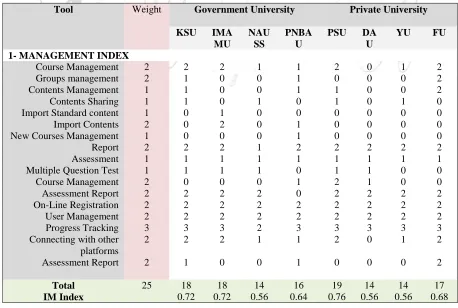
This indicator aims to compared how many of the services for the management of students and their progress in different platformsbetween privet and government sector. In Table 1 we show the results that were obtained. In this table refers to the weight of the column the relative importance of this feature.
Table 1:Total weights of management feature for the compare between privet & government sector in RCU
Tool Weight Government University Private University
KSU IMA
MU
NAU SS
PNBA U
PSU DA
U
YU FU
1- MANAGEMENT INDEX
Course Management 2 2 2 1 1 2 0 1 2
Groups management 2 1 0 0 1 0 0 0 2
Contents Management 1 1 0 0 1 1 0 0 2
Contents Sharing 1 1 0 1 0 1 0 1 0
Import Standard content 1 0 1 0 0 0 0 0 0
Import Contents 2 0 2 0 1 0 0 0 0
New Courses Management 1 0 0 0 1 0 0 0 0
Report 2 2 2 1 2 2 2 2 2
Assessment 1 1 1 1 1 1 1 1 1
Multiple Question Test 1 1 1 1 0 1 1 0 0
Course Management 2 0 0 0 1 2 1 0 0
Assessment Report 2 2 2 2 0 2 2 2 2
On-Line Registration 2 2 2 2 2 2 2 2 2
User Management 2 2 2 2 2 2 2 2 2
Progress Tracking 3 3 3 2 3 3 3 3 3
Connecting with other platforms
2 2 2 1 1 2 0 1 2
Assessment Report 2 1 0 0 1 0 0 0 2
Total 25 18 18 14 16 19 14 14 17
ISSN: 2306-9007 Alhrrah, Almutairr & Alzeer (2015) 252
I
www.irmbrjournal.com March 2015I
nternationalR
eview ofM
anagement andB
usinessR
esearchVol. 4 Issue.1
R
M
B
R
In this section, emerged the PSU as the leader position of 19 in the universities with a value of 0.76, while Management Index in KSU and IMAMU position 18 in the universities with value of 0.72. In FU position 17 in universities with value 0.68. In NAUSS, DAU and YU of less ranking universities position of 14 in the universities with a value of 0.56 Table 1 above.
Comparing the Proposed Framework with other Platforms
Francesco Colace in E-learning AHP evaluation model evaluated four features. Next, we will evaluate the
four e-learning system platforms in the Riyadh city university (Government University: KSU, IMAMU,
NAUSS and PNBAU, Private University: PSU, DAU, YU and FU), after this evaluation, we will display the total weights of these platforms. Then, we will compare these weights with the proposed framework weights. After this evaluation, we will display the total weights of these platforms. Then, compared these weights between Government and private sector in RCU
Collaborative Index
IC = Obtained Value for the supported tools / Max Value
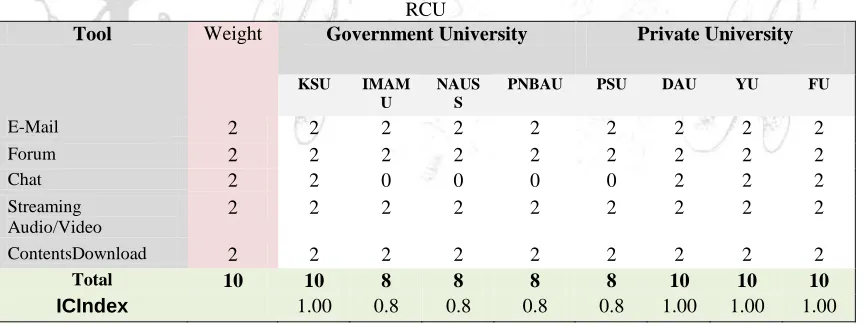
This indicator of this index aims compared to how many services "cooperative" in different platforms in the RCU. Services platform that allows for interaction between students and / or teachers. In Table 2 we show the results that were obtained. In this table, the column indicates the weight the relative importance of this feature.
Table 2: Total weights of collaborative feature for the compared between privet and government sector in RCU
Tool Weight Government University Private University
KSU IMAM U
NAUS S
PNBAU PSU DAU YU FU
E-Mail 2 2 2 2 2 2 2 2 2
Forum 2 2 2 2 2 2 2 2 2
Chat 2 2 0 0 0 0 2 2 2
Streaming Audio/Video
2 2 2 2 2 2 2 2 2
ContentsDownload 2 2 2 2 2 2 2 2 2
Total 10 10 8 8 8 8 10 10 10
ICIndex 1.00 0.8 0.8 0.8 0.8 1.00 1.00 1.00
In this section, emerged the KSU, DAU, YU and FU as the leader position of 10 in the universities with a value of 1.00, while collaborative Index in IMAMU, NAUSS PN, BAU and RCU position 8 in the universities with value of 0.8.
Adaption of User's Formative Learning Path Index
LPI = Obtained Value for the supported tools / Max Value
ISSN: 2306-9007 Alhrrah, Almutairr & Alzeer (2015) 253
I
www.irmbrjournal.com March 2015I
nternationalR
eview ofM
anagement andB
usinessR
esearchVol. 4 Issue.1
R
M
B
R
Table 3: Total weights of Adaptation feature for the compared between privet and government sector in
RCU
Tool Weight Government University Private University
KSA IMAM U
NAUS S
PNBAU PSU DAU YU FU
Progress Tracking 2 2 1 2 2 2 2 2 2
User Groups management
2 2 1 1 2 2 2 2 2
Report 2 2 2 1 2 2 2 2 2
Assessment 1 1 1 1 1 1 1 1 1
Multiple Question Test 1 1 1 0 0 1 1 0 1
Assessment Report 2 0 0 0 1 2 1 0 0
Total 10 8 6 5 8 10 9 7 8
LPA Index 0.8 0.6 0.5 0.8 1.00 0.9 0.7 0.8
In this section, emerged the PSU as the leader position of 10 in the universities with a value of 1.00, while adaptation Index in PNBAU position 8 in the universities with value of 0.8. In DAU position 9 in universities with value 0.9. In NAUSS and IMAMU of less ranking universities position of 5 and 6 in the universities with a value of 0.5 and 0.6, Table 1 above.
Management and Enjoyment of Interactive Learning Objects
MIO = Obtained Value for the supported tools / Max Value
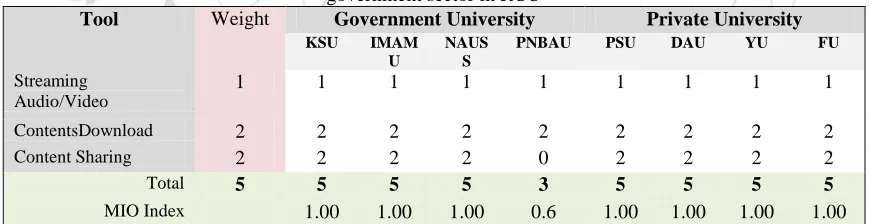
This objective of this indicator to assess the many services to manage and enjoy interactive learning objects in different platforms. Table 4 provides you with a set of results that have been obtained. In this table, the column weight indicates the importance of this feature.
Table 4: Total weights of interactive learning objects feature for the compared between privet and government sector in RCU
Tool Weight Government University Private University
KSU IMAM U
NAUS S
PNBAU PSU DAU YU FU
Streaming Audio/Video
1 1 1 1 1 1 1 1 1
ContentsDownload 2 2 2 2 2 2 2 2 2
Content Sharing 2 2 2 2 0 2 2 2 2
Total 5 5 5 5 3 5 5 5 5
MIO Index 1.00 1.00 1.00 0.6 1.00 1.00 1.00 1.00
In this section, emerged the KSU, IMAMU, NAUSS, PSU, DAU, YU and FUas the leader position of 5 in the universities with a value of 1.00, while interactive learning objects Index .In PNBAU of less ranking universities position of 3 in the universities with a value of 0.6, Table 1 above.
Analyzing Results of E-Learning Platform in RCU
ISSN: 2306-9007 Alhrrah, Almutairr & Alzeer (2015) 254
I
www.irmbrjournal.com March 2015I
nternationalR
eview ofM
anagement andB
usinessR
esearchVol. 4 Issue.1
R
M
B
R
University Ranking Rank
Change
Government University
KSU 41 -9
IMAMU 37 -13
NAUSS 32 -18
PNBAU 37 -13
Total 147 -53
Private University
PSU 38 -12
DAU 38 -12
YU 36 -14
FU 40 -10
Total 152 -48
0 5 10 15 20 25 30 35 40 45
Fig. 2: Displays a comparison between GU and PU platform
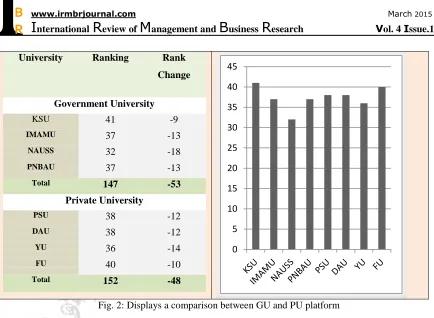
Top model to assess the weight of (50) points. The proposed collection of frame (50 points), this value is compared between the government and private universities. Government University collected the largest number of points (41) points. Moreover, the results of Figure 2 shows that the blackboard model platforms collected the largest number of points (41) points. It turns out that high KSU collection points (41) points. This value is equal to the highest weight in the evaluation model. NAUSS collecting the least amount of points (32) points. This value is less than the King Saud University, in IMAMU (13) points, NAUSS (12) and PNBAU (13). View University, which brought together high-FU points (40) points. This value is equal to the highest weight in the evaluation model. PS DAU and collecting the least amount of points (38) points. This value is lower than the FU in PS, DAU (12) points and YU (14). Shows the process of comparing meets the objectives of the proposed framework.
ISSN: 2306-9007 Alhrrah, Almutairr & Alzeer (2015) 255
I
www.irmbrjournal.com March 2015I
nternationalR
eview ofM
anagement andB
usinessR
esearchVol. 4 Issue.1
R
M
B
R
Figure 3, shows the comparison sites approach allows not only to evaluate the programs, but to test them in the ID of the site by the application. In fact, the minutes of very good results in the first signatories of eight platform while it's still not true. In fact, in five cases each department or collaborative tools are not very important.
The results obtained confirm that the difference between commercial and open source platforms in general is still very high, but we have shown a way as is the case in some cases this is not true. In this case can indicate the use of a cheaper platform.
Conclusion
The main objective of this paper is to evaluate and comparative model for E-Learning platform between Government and private sector in RCU. The compared process is based on e-learning model evaluation platform. It is proposed that this model by Francesco Colas in 2006. Evaluation model was assessed four main features management, and collaborative approach, management interactive learning objects and adaptive learning path).
Involves every feature, in their determination, and some sub- features. The results of comparison models are outlined as follows: Total weights of the proposed framework in management feature is 16.25/25, in collaborative feature is 7.75/10, in adaption learning path is 7.63/10 and in interactive learning object is 4.75/5. In this study an evaluation model was applied on Government University like KSU, IMAMU, NAUSS and PNBAU, Private University like PSU, DAU, YU and FU.
Then, the results were compared with each other. The total weighs Government University of KSU was 41. While the total weights of IMAMU, NAUSS and PNBAU was 37, 32and 37. The total weighs private University of FU was 40. While the total weights of PSU DAU and YU was 38, 38 and36 respectively. The total weights of all features in Government University are 147/200, Private University are 152/200.
References
Akkoyunlu B., & Yılmaz, M. (2008). Türetimci çoklu ortam öğrenme kuramı,“Generative multimedia learning environment”, Hacettepe University, Journal of Education, 183-193.
Aljabre, Abdulaziz, (2008). An Exploration of Distance Learning in Saudi Arabian Universities: Current Practices & Future Possibilities, International Journal of Business, Humanities & Technology, Vol. 2 No. 2.
Amalou, Djamal, (2006). Technical and pedagogical comparative study of e-learning platforms for open and distance learning, JYVÄSKYLÄ university of applied sciences.
Colace F., Santo M.D., (2006). Pietrosanto A, “Evaluation Models for E-Learning Platform: an AHP approach”, 1 84084 Fisciano (SA), Italy , Conference.
Graf, Sabine, (2002). Fostering Adaptively In E-Learning Platforms: A Meta-Model Supporting Adaptive Courses, This research has been funded by the Austrian Federal Ministry for Education, Science, and Culture, and the European Social Fund (ESF) under grant 31.963/46-VII/9/.
Graf, Sabine andv, Beate, (2004). An Evaluation of Open Source E-Learning Platforms Stressing Adaptation Issues, This research has been funded by the Austrian Federal Ministry fo Education, Science, and Culture, and the European Social Fund (ESF) under grant 31.963/46-VII/9/2002.
Graf Sabine; Beate List, (2004). An Evaluation of Open Source E-Learning Platforms Stressing Adaptation Issues,
http://vb.tgareed.org/t/317446/
Lanzilotti R., Ardito C., Costabile M. F,“eLSE (2007). Methodology: a Systematic Approach to the e-Learning Systems Evaluation”.
ISSN: 2306-9007 Alhrrah, Almutairr & Alzeer (2015) 256
I
www.irmbrjournal.com March 2015I
nternationalR
eview ofM
anagement andB
usinessR
esearchVol. 4 Issue.1
R
M
B
R
Evaluation Index System and Evaluating Platform”,International Conference on Computer Science and Software Engineering.
Zhao Du, Xiaolong Fu, Can Zhao, Qifeng Liu and Ting Liu, (2010). Interactive and Collaborative E-Learning Platform with Integrated Social Softwareand E-Learning Management System.