_____________________________________________________________________________________________________
*Corresponding author: E-mail: [email protected];
(Past name: British Journal of Pharmaceutical Research, PastISSN: 2231-2919, NLM ID: 101631759)
Assessment of Effective Operational Parameters on
Removal of Amoxicillin from Synthetic Wastewater
Using Electrocoagulation Process
Davoud Balarak
1, Kethineni Chandrika
2*and Marzieh Attaolahi
31
Department of Environmental Health, Health Promotion Research Center, Zahedan University of Medical Sciences, Zahedan, Iran. 2Department of Biotechnology, Koneru Lakshmaiah Education Foundation, Vaddeswaram, Guntur,
AP, India. 3
Student Research Committee, Zahedan University of Medical Sciences, Zahedan, Iran.
Authors’ contributions
This work was carried out in collaboration among all authors. All authors read and approved the final manuscript.
Article Information
DOI: 10.9734/JPRI/2019/v29i130227
Editor(s):
(1)Dr. Rafik Karaman, Professor, Department of Bioorganic Chemistry, College of Pharmacy, Al-Quds University, Jerusalem, Palestine.
Reviewers: (1)Ravi Bansal, Jiwaji University, India. (2) Pardon Kusaziwa Kuipa, Lupane State University, Zimbabwe. Complete Peer review History:http://www.sdiarticle3.com/review-history/50457
Received 19 May 2019 Accepted 31 July 2019 Published 08 August 2019
ABSTRACT
In this study, efficiency of electrocoagulation (EC) process with aluminum electrodes for treatment of Amoxicillin (AMO) from synthetic solution has been studied and concluded. This experiment was conducted in a batch system with a volume of 1 L that had been equipped with four aluminum electrodes. The effect of operating parameters, such as voltage, time of reaction, initial AMO concentration, KCl concentration and pH on the AMO removal efficiency was investigated. In optimum condition (pH 7, voltage 60 V, electrolysis time 75 min, KCl concentration 3 g/L), electrocoagulation method was able to remove 98.8% of AMO antibiotics from synthetic solution. In addition, it is found that an increase in the applied voltage the speed of the treatment significantly. However, simultaneous increase of electrode and energy consumption was observed. The method was found to be highly efficient and relatively fast compared to conventional existing techniques and also, it can be concluded that the electrocoagulation process has the potential to be utilized for the cost-effective removal of AMO from water and wastewater.
Keywords: Amoxicillin; electrocoagulation; aluminum electrodes.
1. INTRODUCTION
Pollution of water resources by different pollutants is nowadays a global environmental issue [1]. Traditionally, the impact of chemical pollution has focused almost exclusively on the conventional priority pollutants [2]. However, the growing use of pharmaceuticals worldwide, classified as the so-called emerging pollutants, has become a new environmental problem, which has raised great concern among scientists in the last few years [3,4].
Most of these pharmaceuticals commonly in use are antibiotics which are defined as chemical compounds with antibacterial properties [5,6]. In recent years, the undue use of these antibiotics in human and veterinary medicine are widespread and consequently, the possibility of environmental matrices contamination with these compounds increased [7,8]. Therefore, the use of antibiotics and growth hormones has a significant effect on the quality of surface and groundwater [9].
Amoxicillin (AMO) is a drug belonging to the class of semi-synthetic b- lactam antibiotic that has a broad spectrum against both Gram-negative and Gram-positive bacteria [10]. AMO is one of the top-priority human and veterinary pharmaceuticals, and should receive greater attention in the management of environmental systems in Iran due to its high consumption [11]. AMO belongs to a group of drugs that are predominantly excreted in an unmetabolized form, and some investigations have reported that AMO might present a possible chronic risk in the aquatic environment [12,13].
Even low concentrations of pharmaceuticals released from the environmental matrix into water can pose serious environmental damages. Thus, it is of great importance to develop some efficient and cost-effective treatment technologies to remove such compounds [14, 15].
Various techniques such as ozonation, photo-Fenton process, photo electro-catalytic degradation, ion exchange and adsorption have been employed for the removal of antibiotics from aqueous solution and Pharmaceutical wastewater [16-18].
Electrocoagulation (EC) process is an alternative of the conventional coagulation process in which
coagulant agents are generated in situ through the dissolution of a sacrificial anode by applying current between the anode–cathode electrodes [19,20]. The electrocoagulation process has several advantages that make it attractive for treating various contaminated streams [21,22]. In the past decades electrocoagulation has been applied for the treatment of many kinds of wastewater [23]. The pollutant is coagulated by aluminum hydrates or hydroxides produced from the sacrificial anode [24].
An examination of the chemical reactions occurring in the EC process shows that the main reactions occurring at the aluminum electrodes are [25]:
The present work was carried out to study the removal of AMO by EC with aluminum electrodes from synthetic wastewater. Wastewater parameters, such as reaction time, high salt concentration, voltage, initial concentration of AMO, and pH, were also investigated to examine their effects on the AMO.
2. MATERIALS AND METHODS
At present study all chemicals including AMO, sodium hydroxide (NaOH), concentrated sulfuric acid (H2SO4) and potassium chloride (KCl) were used as analytical grade. Analytical grade AMO was obtained from Sigma Aldrich Co. The chemical structure of AMO (CAS number: 26787-78-0, molecular weight: 365.4 g/mol, Molecular Formula C16H19N3O5S, Solubility in water: 3430 mg/L at 20°C and Henry’s law constant: 27.3 L.atm/mol at 20°C) is shown in Fig. 1. A stock AMO solution was obtained by dissolving 1 g of AMO, (99%), in deionized distilled water and dilute to 1000 mL.
injecting solution into the EC reactor. The chloride salt added to the solution can also prevent the formation of the oxide layer on the anode and therefore reduce the passivation problem of the electrodes. Also, the pH of influent solution was adjusted to a desired value [3,5,7 and 9] using H2SO4 and NaOH solutions
(0.1 M).
Fig. 1. Chemical structure of the used AMO
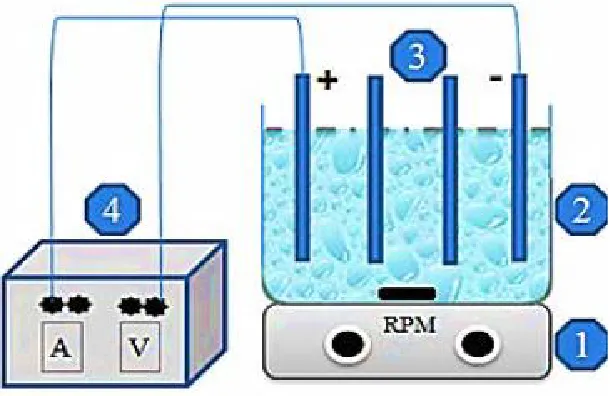
Experiments were performed in a bipolar batch reactor (Fig. 2), with aluminum electrode installed parallel to each other. Only the outer electrodes were connected to the power source, and anodic and cathodic reactions occurred on each surface of the inner electrode when the current passed through the electrodes. The Plexiglas cell as electrolytic reactor having dimensions of 12.5 cm×12.5 cm×15 cm with a working volume of about 1 L was used to conduct the experiments, and a magnetic stirrer was applied for mixing (100 rpm). Aluminum sheets with the dimensions of 0.12 m× 0.12 m × 0.0025 m were also used as electrodes.
Between two tests, electrolytic cell (including the electrodes) was cleaned with 15% (W/V) hydrochloric acid solution. The gap between the anode and cathode was 2.5 cm. A Single- output Adjustable DC Power Supply (MPS-3005D) was used as the power supplier. Retention time, pH, voltage, and initial AMO, KCl concentrations were selected as parameters. At different time intervals, the samples were taken from the reactor and centrifuged for 10 min at 3600 rpm before analysis. The concentration of AMO in a solution was measured using an HPLC (C18 ODS column) with a UV detector 2006 at a wavelength of 190 nm. The mobile phase was a mixture of buffer phosphate with pH= 4.8 and acetonitrile with a volumetric ratio of 60/40 with an injection flow rate of 1 mL/min. The equation used to calculate the AMO percent recovery in the treatment experiment was [26]:
% R=( )× 100
Where: Co and Ce are initial and equilibrium
concentration respectively in (mg/L). Electric energy consumption was also calculated using the commonly used equation [27]:
E=
Where E is the energy consumption (KWh/m3), U is the applied voltage (V), I is the current intensity (A), T is the EC time (h), and V is the volume of the treated wastewater (L).
3. RESULTS AND DISCUSSION
Fig. 3 the relation between the percentage removal of AMO and initial solution concentration. The percentage removal was gradually decreased from 98.82 to 74.3% as the AMO concentration increased from 10 to 100 mg/L. This may be attributed to the fact that at a constant current density the same amount of aluminum ions passes to the solution at different AMO concentrations [28]. Consequently, the formed amount of complex aluminum hydroxide was insufficient to coagulate the greater number of AMO molecules at higher AMO concentrations [29]. On the other hand, the decrease in removal efficiency with increasing initial AMO concentration may be attributed to requiring more coagulant when increasing levels of pollutant [30].
The EC time is a significant parameter which has a vital importance and influence on the performance of EC process [28]. In this experiment the effect of time was studied at constant distance 2.5 cm. Fig. 3 illustrates the effect of retention time on the removal of AMO at
neutral pH. In this process, EC involves two stages which are destabilization and
aggregation. The first stage is usually short, whereas the second stage is relatively long. Results show that the efficiency start to be significant at the treatment time of 60 minutes but the maximum efficiency was obtained at a
treatment time of 90 minutes. EC time has significant improvement in removal efficiency. It is assumed that the more time consumed, the more production rate of hydroxyl and AMO ions on the electrodes [31].
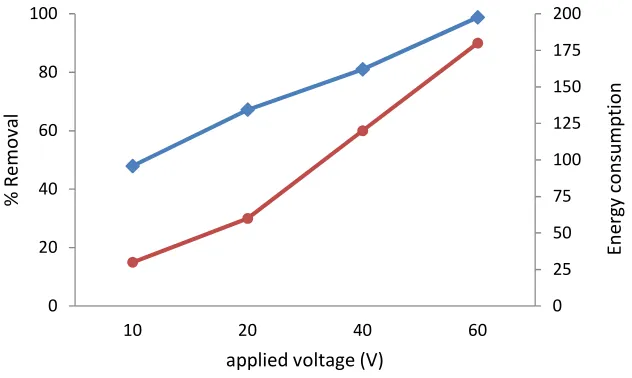
In all electrochemical processes, the applied voltage is one of the important parameters to control reaction rate in electrochemical reactors. As shown in Fig. 4, removal efficiencies of the studied AMO improved with an increase in voltage. In fact, at low voltages, less aluminum hydroxides were produced, thus the lower removal efficiencies; however, production of aluminum hydroxides improved as the voltage increased, which raised the removal efficiencies [32]. Furthermore, the number of bubbles produced on the surfaces of the electrodes increased and the bubbles became smaller as the current density rose [33]. Consequently, the effective surfaces of the bubbles as well as their residence time increased, improving the AMO removal efficiencies [31]. This variable determines the extent of coagulant production, also adjusting the number of hydrogen gas bubbles produced, hence influencing the removal percentages of the pollutants [34]. It can be seen from Fig. 5 that energy consumption was found to increase with increasing the applied voltage. An increase in applied voltage from 10 to 60 V causes an increase in energy consumption from 30 to 180 kWh/m3.
Fig. 3. Effect of initial AMO concentration and reaction time on removal efficiency (voltage: 60 V, pH: 7, d=2.5 cm, KCl = 2.5 g/L)
0 20 40 60 80 100
10 20 30 45 60 75 90 100
R
em
o
va
l e
ff
ic
ie
n
cy
(
%
)
Electrolysis time (min)
Fig. 4. Effect of reaction time on the AMO removal efficiency (voltage: 60 V, C0: 10 mg/L, pH: 7, d=2.5 cm, KCl = 2.5 g/L)
Fig. 5. Energy consumption during electrocoagulation process (C0: 10 mg/L, reaction time: 75 min, pH:7, d=2.5 cm, KCl = 2.5 g/L)
Fig. 6 clearly shows that the AMO removal increases as the KCl concentration of the feed solution raises from 0.5 to 3 g/L. As shown in Fig. 6, the efficiency of AMO removal increased from 65.4% to 98.8% after 75 min of EC process. It’s been confirmed that the existence of carbonate or sulfate ions would lead to the precipitation of Ca2+ or Mg2+ ions that form an insulating layer on the surface of the electrodes [35]. This insulating layer increases the potential between electrodes which in turn decreases the current efficiency significantly [36]. The addition of KCl results in chloride ions which in turn could significantly
reduce the adverse effect of other anions. In addition, increase in chloride anions leads to a rise in conductivity which in turn decreases the power consumption [37].
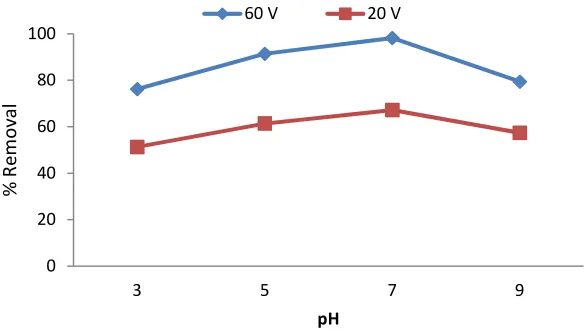
It has been established that the pH has a considerable influence on the performance of EC process. Therefore, pH [3,5,7 and 9] was examined as one of the main variables affecting removal of AMO from synthetic solutions. The results are shown in Fig. 7; the efficiency of AMO removal was low either at low pH or at high pH. The average AMO removal increased from 0
20 40 60 80 100
10 20 30 45 60 75 90 100
R
em
o
va
l e
ff
ic
ie
n
cy
(
%
)
Electrolysis time (min)
10 V 20 V 40 V 60 V
0 25 50 75 100 125 150 175 200
0 20 40 60 80 100
10 20 40 60
%
R
em
o
va
l
applied voltage (V)
En
er
gy
co
n
su
m
p
ti
o
Fig. 6. The effect of KCl concentration on AMO removal by electrocoagulation (voltage: 60 V, C0: 10 mg/L, reaction time: 75 min, pH:7, d=2.5 cm)
Fig. 7. Effect of pH on removal efficiency of AMO (t=75 min, C0=10 mg/L, d=2.5 cm, KCl = 2.5 g/L, voltage: 60 V)
76.2.0% to 98.2.0% when the pH was increased from 3 to 7. Further increasing the pH to 9 resulted in a reduction of AMO removal efficiency to 79.4%. This behavior was attributed to the amphoteric character of aluminum hydroxide which does not precipitate at very low pH [24]. Moreover, high pH leads to the formation of Al(OH)4, which is soluble and useless for
adsorption of AMO [25]. Therefore, further increase of the influent pH would decrease the AMO removal efficiency.
4. CONCLUSION
In this research, the removal efficiency of EC process by means of aluminum electrodes for Removal of AMO in batch system was studied. The results showed that the highest AMO
removal efficiency was 98.8%, at the optimized conditions of pH of 7, initial AMO concentration of 10 mg/L, voltage of 60 V, electrolysis time of 75 min and distance of approximately 2.5 cm. The removal efficiency increased with the increase in KCl concentration. It can be concluded that the EC process by aluminum electrodes is an efficient method for reactive AMO removal from colored solutions.
CONSENT
It is not applicable.
ETHICAL APPROVAL
It is not applicable. 0
20 40 60 80 100
0.5 1 1.5 2 2.5 3
R
em
o
va
l e
ff
ic
ie
n
cy
(
%
)
KCl (g/L)
0 20 40 60 80 100
3 5 7 9
%
R
em
o
va
l
pH
ACKNOWLEDGEMENTS
The authors would like to acknowledge from Zahedan University of medical sciences for the support this study (Project Number: 9442).
COMPETING INTERESTS
Authors have declared that no competing interests exist.
REFERENCES
1. Garoma T, Umamaheshwar SH, Mumper A. Removal of sulfadiazine, sulfamethizole, sulfamethoxazole, and sulfathiazole from aqueous solution by ozonation. Chemosphere. 2010;79:814–820.
2. Gulkowsk A, Leung HW, So MK, Taniyasu S, Yamashita N. Removal of antibiotics from wastewater by sewage treatment facilities in Hong Kong and Shenzhen, China. Water Res. 2008;42:395-403. 3. Balarak D, Mostafapour FK, Azarpira H.
Adsorption isotherm studies of tetracycline antibiotics from aqueous solutions by maize stalks as a cheap biosorbent. Inter J Pharm Tech. 2016;8(3):16664-16675. 4. Rostamian R, Behnejad H. A comparative
adsorption study of sulfamethoxazole onto graphene and graphene oxide nanosheets through equilibrium, kinetic and thermodynamic modeling. Process Safety and Environmental Protection. 2016;102: 20-29.
5. Balarak D, Mostafapour FK, Bazrafshan E, Saleh, Tawfik A. Studies on the adsorption of amoxicillin on multi-wall carbon
nanotubes. Water Science and
Technology. 2017;75(7):1599-1606. 6. Choi KJ, Kim SG, Kim SH. Removal of
antibiotics by coagulation and granular activated carbon filtration. J Hazard Mater. 2008;151:38–43.
7. Balarak D, Mostafapour FK, Joghataei A. Experimental and Kinetic Studies on Penicillin G Adsorption by Lemna minor. British Journal of Pharmaceutical Research. 2016;9(5):1-10.
8. Aksu Z, Tunc O. Application of biosorption for Penicillin G removal: Comparison with activated carbon. Process Biochemistry. 2005;40(2):831-47.
9. Balarak D, Mostafapour FK and Joghataei A. Kinetics and mechanism of red mud in adsorption of ciprofloxacin in aqueous
solution. Bioscience Biotechnology Research Communications. 2017;10(1): 243-250.
10. Balarak D, Mahdavi Y, Maleki A, Daraei H, Sadeghi S. Studies on the removal of amoxicillin by single walled carbon
nanotubes. British Journal of
Pharmaceutical Research. 2016;10(4):1-9. 11. Putra EK, Pranowoa R, Sunarsob J,
Indraswatia N, Ismadjia S. Performance of activated carbon and bentonite for adsorption of amoxicillin from wastewater: Mechanisms, isotherms and kinetics. Water Res. 2009;43:2419-2430.
12. Balarak D, Mostafapour FK, Joghtaei, A. Thermodynamic analysis for adsorption of amoxicillin onto magnetic carbon
nanotubes. British Journal of
Pharmaceutical Research. 2017;16(6): 1-16.
13. Adrianoa WS, Veredasb V, Santanab CC, Gonçalves LRB. Adsorption of amoxicillin on chitosan beads: Kinetics, equilibrium and validation of finite bath models. Biochemical Engineering Journal. 2005; 27(2):132-37.
14. Balarak D, Mahdavi Y, Mostafapour FK. Application of Alumina-coated carbon nanotubes in removal of tetracycline from aqueous solution. British Journal of Pharmaceutical Research. 2016;12(1): 1-11.
15. Ji L, Chen W, Duan L and Zhu D. Mechanisms for strong adsorption of tetracycline to carbon nanotubes: A comparative study using activated carbon and graphite as adsorbents. Environ. Sci. Technol. 2009;43(7):2322–2327.
16. Gao J, Pedersen JA. Adsorption of sulfonamide antimicrobial agents to clay minerals. Environ. Sci. Technol. 2005; 39(24):9509-16.
17. Peterson JW, Petrasky LJ, Seymourc MD, Burkharta RS, Schuilinga AB. Adsorption and breakdown of penicillin antibiotic in the presence of titanium oxide nanoparticles in water. Chemosphere. 2012;87(8);911–917.
18. Chafi M, Gourich B, Essadki AH, Vial C, Fabregat A. Comparison of
electrocoagulation using iron and aluminum electrodes with chemical coagulation for the removal of a highly soluble acid dye. Desalination. 2011;281: 285-292.
of high COD. Environ Prog. 2003;22:57-65.
20. Mollah MY, Schennach R, Parga JR, Cocke DL. EC science and applications. J Hazard Mater. 2001;84:29-41.
21. Kamaraj R, Vasudevan S, Evaluation of electrocoagulation process for the removal of strontium and cesium from aqueous solution. Chem. Eng. Res. Des. 2015;93: 522-530.
22. Vasudevan S, Lakshmi J. Effects of alternating and direct current in electrocoagulation process on the removal of cadmium from water – A novel approach. Sep Purif Technol. 2011;80:643-651.
23. Khandegar V, Saroha AK.
Electrocoagulation for the treatment of textile industry Effluent–A review. J Environ Manage. 2013;128:949-963. 24. Barışçı S, Turkay O. Optimization and
modeling using the response surface methodology (RSM) for ciprofloxacin removal by electrocoagulation. Water Sci Techno. 2016;73:1673-1679.
25. Parsa JB, Panah TM, Chianeh FN. Removal of ciprofloxacin from aqueous solution by continuous flow electro-coagulation process. Korean J Chem Eng. 2016;33:893-901.
26. Sengil IA, Ozacar M. The decolonization of C.I. reactive black 5 in aqueous solution by electrocoagulation using sacrificial iron electrodes. J Hazard Mater. 2009;161(2-3): 1369–76.
27. Daneshvar N, Khataee AR, Amani Ghadim AR, Rasoulifard MH. Decolorization of C.I. Acid Yellow 23 solution by electrocoagulation process: investigation of operational parameters and evaluation of specific electrical energy consumption (SEEC). J Hazard Mater. 2007;148(3):566-72.
28. Larue O, Vorobiev E, Vu C, Durand B. electrocoagulation and coagulation by iron of latex particles in aqueous suspensions. Sep Purif Technol. 2003;31(2):177-92. 29. Can OT, Bayramoglu M, and Kobya M.
Decolorization of reactive dye solutions by
electro-coagulation using aluminum electrodes. Ind Eng Chem Res. 2003; 42(14):3391-6.
30. Basiri Parsa J, Rezaei Vahidian H,
Soleymani AR, Abbasi M. Removal of acid brown 14 in aqueous media by electrocoagulation: Optimization
parameters and minimizing of energy consumption. Desalination. 2011;278(1-3): 295–302.
31. Nadi H, Alizadeh M, Ahmadabadi M, Yari AR, Hashemi S. Removal of reactive dyes green, orange, and yellow from aqueous solutions by peanut shell powder as a natural adsorbent. Arch Hyg Sci. 2012; 1(2):41-47.
32. Song Sh, He Z, Qiu J, Xu L, Chen J. Ozone assisted electrocoagulation for decolonization of CI reactive black 5 in aqueous solution: An investigation of the effect of operational parameters. Sep Purif Technol. 2007;55(2):238-45.
33. Can OT, Kobya M, Demirbas E,
Bayramoglu M. Treatment of the
textile wastewater by combined
electrocoagulation. Chemosphere. 2006; 62(2):181-7.
34. Bayramoglu M, Eyvaz M, Kobya M. Treatment of the textile wastewater by electrocoagulation: Economical evaluation. Chem Eng J. 2007;128(2-3):155-61. 35. Kobya M, Bayramoglu M, Eyvaz M.
Techno-economical evaluation of
electrocoagulation for the textile wastewater using different electrode connections. J Hazard Mater. 2007; 148(1-2):311-8.
36. Nouri J, Mahvi AH, Bazrafshan, E. Application of electrocoagulation process in removal of zinc and copper from
aqueous solutions by aluminum
electrodes. In J Environ Res. 2010;4(2): 201-208.
37. Zazouli MA, Taghavi M. Phenol removal
from aqueous solutions by
electrocoagulation technology using iron electrodes: Effect of some variables. Journal of Water Resource and Protection, 2012;4(11):980.
© 2019 Balarak et al.; This is an Open Access article distributed under the terms of the Creative Commons Attribution License (http://creativecommons.org/licenses/by/4.0), which permits unrestricted use, distribution, and reproduction in any medium, provided the original work is properly cited.
Peer-review history: