Amanpreet Singh
et al
, International Journal of Computer Science and Mobile Applications,
Vol.2 Issue. 9, September- 2014, pg. 9-14 ISSN: 2321-8363
©2014, IJCSMA All Rights Reserved, www.ijcsma.com 9
Pitch Based Raag Identification from
Monophonic Indian Classical Music
Amanpreet Singh
1, Dr. Gurpreet Singh Josan
2 1Student of Masters of Philosophy, Punjabi University, Patiala, [email protected]
2Assistant Professor, Department of Computer Science, Punjabi University, Patiala
Abstract
The Indian classical music is one of the oldest forms of music in the world. The Raag is the soul of Indian classical music. The Raag is the logical arrangement of the musical notes i.e. the different pitch of the sound. This system can listen to a sound clip that have the basic structure of the Raag i.e. the Aaroh and Avroh, played by a musical instrument like Musical Keyboard, Mandolin and Harmonium in it and recognize the Raag along with other Raag information. In addition to this the various samples from different musical instruments are analysed and accuracy of the system is calculated. It also shows the performance of the system on various instruments. The overall results of above 80% accuracy shows that the overall performance of the system meets the desired objective.
Keywords: Raag identification, Indian classical music, pitch detection
1.
Introduction
Indian classical music is one of the oldest and richest forms of music in the world. It has its roots in ancient religious vedic hymns, tribal chants, devotional music, and folk music. Indian classical music is melodic in nature. The most important point is that movements in Indian classical music are one note at a time basis. This progression of sound patterns with time is the most important contributor to the tune and rhythm of the presentation, and so to the melody. [13].
The Swar is the sound generated when a strip or string is vibrated at certain frequency. There are total 12 Swars with 7 names:
Saa Re Gaa Maa Paa Dhaa Nee
sw ry gw mw pw Dw nI
The Re, Gaa, Dhaa and Nee have their one Komal Swar each.Maa have 1 Teevar Swar. Raag, the soul of Indian classical music, is the logical arrangement of the musical notes. The Ascent and Descent of the Raag is called Aaroh and Avroh respectively.
Amanpreet Singh
et al
, International Journal of Computer Science and Mobile Applications,
Vol.2 Issue. 9, September- 2014, pg. 9-14 ISSN: 2321-8363
©2014, IJCSMA All Rights Reserved, www.ijcsma.com 10
2.
The Raag Identification
The main tool for Raag Identification is developed in Java. The main idea behind its working is to get the pitch of different notes played in the given sound from their frequencies and identify the note equivalent to that pitch. This data generates a sequence of notes, is then used to match the Raag from the database.
The Redix 2 Cooley Tukey‟s Fast Fourier Transformation is used to identify the pitch of the sound recorded in mono channel wave file. The list of Raags is stored in Microsoft Access database. Identified series of notes is matched with database, if found then relative Raag information is displayed.
The different samples of Wave files are recorded with the sound of Harmonium, Mandolin and keyboard. From the different samples of sounds with different Raags are tested and corresponding figures are explored.
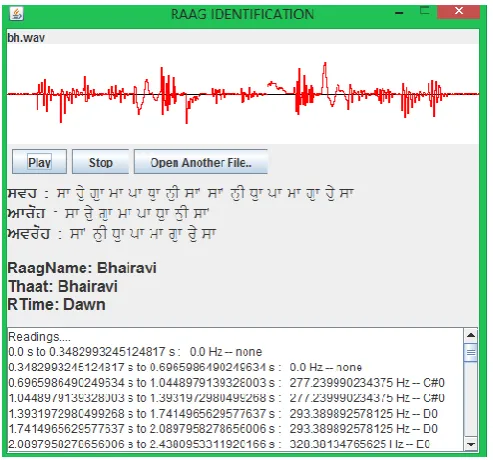
The main interface contains area where the Swars identified in the selected clip are displayed along with the waveform of the selected clip is, play and stop buttons to play and stop selected clip. The Aaroh, Avroh and other Raag information is displayed if Raag is identified found frequencies.
Fig 1: The Main main interface of Raag Identification.
2.1
The Main working Algorithm
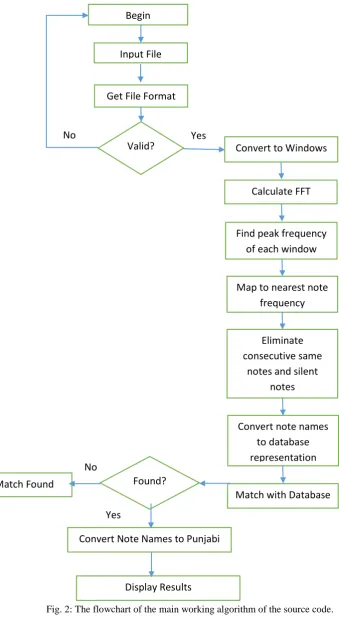
1. Create windows of the selected wave file, get Frequencies of the waveform using FFT of each window and draw waveform.
2. Find peak frequencies of each window.
3. Remove duplicate consecutive frequencies to get distinct series of frequencies.
4. Convert those frequencies to the corresponding notes by matching frequency of the note or the nearest possible note along with the Swar.
5. Make further corrections and adjustments. 6. Match found series of notes with database.
Amanpreet Singh
et al
, International Journal of Computer Science and Mobile Applications,
Vol.2 Issue. 9, September- 2014, pg. 9-14 ISSN: 2321-8363
©2014, IJCSMA All Rights Reserved, www.ijcsma.com 11
Fig. 2: The flowchart of the main working algorithm of the source code.
Begin
Input File
Get File Format
Valid?
Convert to Windows
Map to nearest note
frequency
Find peak frequency
of each window
Calculate FFT
Eliminate
consecutive same
notes and silent
notes
Convert note names
to database
representation
Match with Database
Found?
No Match Found
Convert Note Names to Punjabi
Display Results
No
Yes
No
Amanpreet Singh
et al
, International Journal of Computer Science and Mobile Applications,
Vol.2 Issue. 9, September- 2014, pg. 9-14 ISSN: 2321-8363
©2014, IJCSMA All Rights Reserved, www.ijcsma.com 12
2.2
The Redix 2 Cooley Tukey Algorithm and The calculation of FFT
For this firstly the data is divided in parts, separating in even and odd gives best result, so is done. Using FFT the data from time domain to frequency domain is converted and then again even and odd parts are merged back. Before applying this the windows are created one by one of the given sample to calculate FFT. The windows are the small portion of the sample sound on which the note will be identified one by one. The window size is kept 2048.
2.3
The Audio File
The Wave File (.Wav) samples are used with configuration 44100Hz, 16bit and mono channel. These files are recorded from different sources like harmonium, Keyboard and mandolin in normal but least noisy environment. These files contains different samples of different Raags to be identified.
2.4
Conversion to Notes from Frequencies
The standard A note frequency is 440.The octaves are considered to be 6. From note A the frequency is gathered by the formula 440*2i/12 , Where i =octave*12+[current note]. So corresponding to the frequency the note with the minimum distance from the calculated frequency in matched.
2.5
Matching Raag from the Database
The Access Database contains the Raag information according to Aaroh Avroh of the Raag and other necessary information. The notes found from frequencies are in western nomenclature, now needs to be converted in Indian classical form and also in Punjabi. The notes are represented in western, database, English Notation and Punjabi representation of notes respectively are shown below:
3.
Tests and Results
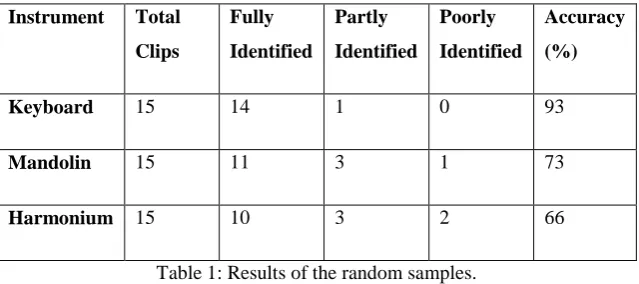
The system finally is tested with the three instruments the Harmonium, Mandolin and Musical Keyboard. The various samples from all the systems are tested on the system. If the system identifies all the notes if the sample, it leads to identification of correct Raag, otherwise the Raag will not be identified if even one note is incorrectly identified. In the table below random 15 samples of each instrument are tested on the system:
Instrument Total
Clips
Fully
Identified
Partly
Identified
Poorly
Identified
Accuracy
(%)
Keyboard 15 14 1 0 93
Mandolin 15 11 3 1 73
Harmonium 15 10 3 2 66
Table 1: Results of the random samples.
The keyboard gives the maximum full identification accuracy because it was recorded by using direct cable without any external disturbance. Harmonium gives lesser accuracy as compared to others. Because the harmonium has two reads of Swars in it. These reads sometimes becomes mismatched and up or down from standard range of Swars by usage and is not easy to retune it and even recognize it. This problem leads to little less accuracy of the system from Harmonium as compared to other systems. Another reason is the external disturbance if recorded in normal environment and the sound of wooden keys (very rare).
Amanpreet Singh
et al
, International Journal of Computer Science and Mobile Applications,
Vol.2 Issue. 9, September- 2014, pg. 9-14 ISSN: 2321-8363
©2014, IJCSMA All Rights Reserved, www.ijcsma.com 13
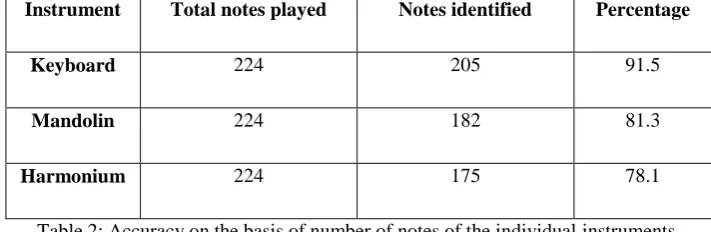
10 of the samples contained 16 notes, 3 had 12 and 2 played 14 notes. The difference is because the Raags have different Jaatis, so have different number of notes. The table below represents the number of notes identified correctly combining all three categories fully identified, partly identified and poorly identified, and their percentage from the all 224 notes for each instrument separately.
Instrument Total notes played Notes identified Percentage
Keyboard 224 205 91.5
Mandolin 224 182 81.3
Harmonium 224 175 78.1
Table 2: Accuracy on the basis of number of notes of the individual instruments.
The overall accuracy of the system leads to: (91.5+81.3+78.1)/3 = 83.63%
The overall calculated accuracy tells that it provides over 80% overall accuracy when tested on all three instruments. The figures are quite good on the random samples recorded in the normal environment.
4.
Conclusion
The system presented here is totally focusing on Indian classical music, recognizes the Raag from the clip containing Aaroh and Avroh of the Raag using FFT. The system demonstrate that the Raag recognition is possible with the real time instruments recorded in sample clips. The facts and figures shows that the system is good enough for this level of work. There are many difficulties in implementing and working with real time clips which are in wave form. Because the clip is wav not the midi so if there is some other noise along with the music been recorded, means unnecessary sound from environment, results to inaccurate results. So the noise free environment is required while recording the clip to produce accurate results. This system recognize Raag only when the Aaroh and Avroh is played in the clip continuously. In the future the system can be extended to recognize the Raag from the „Pakad‟ of the Raag, partly played Raag or even from the composition. Another extension of the system can be to increase the accuracy of the system by recognizing and eliminating the external disturbance.
References
[1] Parag Chordia, Jagadeeswaran Jayaprakash and Alex Rae. “Automatic Carnatic Raag Classification” Journal of the Sangeet Research Academy (Ninaad), 2009.
[2] Automatic Raag Classification of Pitch-tracked Performances Using Pitch-class and Pitch-class Dyad Distributions Parag Chordia International Computer Music Conference Proceedings vol. 2006
[3] Parag Chordia and Alex Rae (2007), Raag Recognition Using Pitch-Class and Pitch-Class Dyad Distributions, In Proceedings of the 8th International Conference on Music Information Retrieval. Vienna, Austria. September 23-27
[4] Parag Chordia, Alex Rae. "Raag vidya: Real-time Raag Recognition for Interactive Music." In Proc. of the 2008 International Conference on New Interfaces for Musical Expression (NIME) (2008)
[5] Soubhik Chakraborty*, Sandeep Singh Solanki, Sayan Roy, Shivee Chauhan, Sanjaya Shankar Tripathy and Kartik Mahto, A Statistical Approach to Modelling Indian Classical Music Performance, CoRR (2008) [6] M.S. Sinith, K. Rajeev Hidden Markov Model based Recognition of Musical Pattern in South Indian Classical Music, IEEE International Conference on Signal and Image Processing, Hubli, India 2006
[7] Amruta Vidwans and Preeti Rao , Identifying Indian Classical Music Styles using Melodic Contours , FRSM 2012 - 18-19 January, 2012, KIIT College of Engineering, Gurgaon , 2012
Amanpreet Singh
et al
, International Journal of Computer Science and Mobile Applications,
Vol.2 Issue. 9, September- 2014, pg. 9-14 ISSN: 2321-8363
©2014, IJCSMA All Rights Reserved, www.ijcsma.com 14
[9] Guo Yi, "A Compositional Automatic Music Transcription System for Computersynthesized Music", IJACT:, Vol. 4, No. 6, pp. 165 ~ 173, 2012
[10] Ajay Kapur, Graham Percival, Mathieu Lagrange, George Tzanetakis, Pedagogical Transcription For Multimodal Sitar Performance , ISMIR, 2007
[11] De la Cuadra, Patricio; Master, Aaron; Sapp, Craig ,Efficient Pitch Detection Techniques for Interactive Music , International Computer Music Conference Proceedings , vol. 2001
[12] Wolfgang Hess, Pitch determination of speech signals: algorithms and devices, Springer-Verlag, 1983. [13] B.C. Deva, Indian Music, Indian Council for Cultural Relations, New Delhi (1980).
[14] B.C. Deva, The Music of India: A Scientific Study, Munshiram Manoharlal Publishers Pvt. Ltd., New Delhi (1981).