ISSN: 2306-9007 Salleh & Haat (2014) 307
I
www.irmbrjournal.com March 2014I
nternationalR
eview ofM
anagement andB
usinessR
esearchVol. 3 Issue.1
R
M
B
R
Audit Committee and Earnings Management: Pre and Post
MCCG
NIK MOHAMAD ZAKI NIK SALLEH
Faculty of Management Multimedia UniversityEmail: [email protected]
Tel: 603-83125708
MOHD HASSAN CHE HAAT
Faculty of Management and Economics Universiti Malaysia Terengganu
Email: [email protected]
Tel: 609-6684198
Abstract
The purpose of this study is to examine the effectiveness of audit committee in constraining earnings management after the revised MCCG among listed firms on Bursa Malaysia. Specifically, the study explores how audit committee impacted earnings management before and after the revision of MCCG in 2007. This study is important because it is among the pioneer empirical evidences to compare the effectiveness of audit committee characteristics in mitigating earnings management between the pre and post revised MCCG periods. The sample for this study was drawn from 280 companies listed on Bursa Malaysia in 2005, 2006, 2008 and 2009. The audit committee characteristics include size, independence, expertise, frequency of meetings and activity disclosure. The discretionary accrual was estimated using the Modified Jones Model (1995) which was used to proxy for earnings management. The empirical results on audit committees play an important and effective role in reducing earnings management after the revision of MCCG. After controlling for firm size, board size and leverage, the study found that audit committee size and audit committee that had meetings with external auditor without the presence of executive directors at least twice a year showed a significant association with earnings management. Overall, these findings called for further examination into the roles of audit committee in mitigating earnings management.
Key Words: Audit committee, earnings management, expertise, activity disclosure, Malaysian Code of Corporate Governance (MCCG).
Introduction
ISSN: 2306-9007 Salleh & Haat (2014) 308
I
www.irmbrjournal.com March 2014I
nternationalR
eview ofM
anagement andB
usinessR
esearchVol. 3 Issue.1
R
M
B
R
practices, and more specifically earnings, has been widely cited as one of the major benefits of companies establishing audit committees (Blue Ribbon Committee, 1999; Ramsay, 2001). Their recommendations called for audit committees to be more effective in overseeing the financial reporting process.
According to Malaysian Code on Corporate Governance (MCCG) 2007, an audit committee must be composed of a majority of independent non-executive directors who are neither officers nor employees of the company. This committee should represent the owners and not the management. The major dealings between the independent auditors and the governing body should be done through the audit committee. As mentioned in the revised MCCG 2007, the audit committee should meet with the external auditors without executive board members present at least twice a year. This encourages a greater exchange of free and honest views and opinions between both parties. This also means that this committee acts as a communication link among management, auditors and the governing body.
In late 1990s, Malaysian government realized that there is an increasing need of a good corporate governance and accountability in corporate sectors. One of the main sources of the Corporate Governance reforms agenda in Malaysia is from the Malaysian Code on Corporate Governance (MCCG) by Finance
Committee on Corporate Governance1. Recognition of corporate governance in Malaysia was significantly
evidenced by the release of the MCCG by the Committee in March 2000. The principles underlying the report focus on four areas including: board of directors, director’s remuneration, shareholders and accountability and audit. While on 1 October 2007, the revised MCCG has been released in order to improve the quality of the Boards of the public-listed companies (PLCs) by putting the criteria for qualification, strengthening the audit committee and internal audit function of PLCs. These significant improvements may further strengthen corporate governance practices in line with the developments in the domestic and international capital markets.
The revised code strengthens the regulations on the role of audit committees to ensure that they provide an effective check on company managers. The new rules cover the composition of audit committees, the frequency of meetings and the need for audit committee members to attend continuous training to keep abreast with developments in relevant financial and other related developments. These new rules are in line with the recommendations by Blue Ribbon Committee (1999) that the audit committee should be comprised of at least three directors who are independent and financially literate or become financially literate within a reasonable period of time after his appointment to the audit committee.
Literature Review and Hypotheses
Audit Committee Size and Earnings Management
The revised MCCG 2007 states that “The board should establish an audit committee comprising at least three members, a majority of whom are independent. All members of the audit committee should be non-executive directors.” It is hoped that by including the above criteria in the audit committee, greater
resources and talents of independent members will be able to execute the task in overseeing the financial reporting process. However, previous studies provide mixed findings on the impact of audit committee size on earnings management. Xie et al. (2003) and Davidson et al. (2005) find no association between size of audit committee and earnings management. On the other hand, Yang and Krishnan (2005) find that there is a significant negative relationship earnings management which suggests that larger audit committee may mitigate the earnings management activity in a firm. Furthermore, Wan Ismail et al., (2009) document that audit committee size was positively associated with earnings quality. They argue that a larger audit committee has more resources and capabilities, and thus is better in performing the required duties. Thus, the following hypothesis is developed:
1 The other sources are Capital Market Master Plan (CMP) by Securities Commission and Financial
ISSN: 2306-9007 Salleh & Haat (2014) 309
I
www.irmbrjournal.com March 2014I
nternationalR
eview ofM
anagement andB
usinessR
esearchVol. 3 Issue.1
R
M
B
R
H1: The effectiveness of the size of audit committee in constraining earnings management is higher after
the revision of MCCG.
Audit Committee Independence and Earnings Management
The audit committee must also be independent in order to carry out their duty in protecting the shareholders’ interest. Those statements are supported by the argument published by The Blue Ribbon
Committee (1999, p. 1079) that “…a director without any financial, family, or other material personal ties
is more likely to be able to evaluate objectively the propriety of management’s accounting, internal control and reporting practices”. Even in Malaysia, the concern regarding the issue of audit committee independence has been pointed out in the revised MCCG 2007 and the Listing Requirements of Bursa Malaysia which specifies that all listed companies must have audit committees comprising three members of whom a majority shall be independent.
Empirical studies that support the importance of audit committee independence in mitigating earnings management can be found in many of prior studies. Davidson et al. (2005) and Klein (2002) find that an audit committee which comprises of a majority of independent directors is negatively related with earnings management. On the other hand, Xie et al. (2003) find that audit committee independence has no relationship with discretionary accruals. This finding is contrasting to Bedard et al. (2004) and Saleh et al., (2007) who argue that the presence of fully independent an audit committee directors has a negative relationship with discretionary accruals thus, reduces earnings management practices.
Based on the arguments discussed above, the following hypothesis is proposed:
H2: The effectiveness of the presence of majority independent directors in audit committee in constraining
earnings management is higher after the revision of MCCG.
Audit Committee Expertise and Earnings Management
The audit committee members should possess the necessary expertise in order to fulfill their responsibilities in monitoring internal control and overseeing the firm’s financial reporting process. Consistent with this view, the revised MCCG states that “All members of the audit committee should be financially literate and at least one should be a member of an accounting association or body. The revised Code strives to strengthen the role of audit committees by requiring the committees to comprise fully of non-executive directors. In addition, all its members should be able to read, analyse and interpret financial statements so that they will be able to effectively discharge their functions.”
Based on the above statement, it can be concluded that an audit committee member who is financially literate is the one who possess the accounting and finance knowledge and with relevant years of experience in practice. Financial literacy is defined as the ability to read and understand financial statements whereas financial expertise refers to previous employment experience in finance/accounting or professional certification in accounting or finance (McDaniel et al., 2002).
ISSN: 2306-9007 Salleh & Haat (2014) 310
I
www.irmbrjournal.com March 2014I
nternationalR
eview ofM
anagement andB
usinessR
esearchVol. 3 Issue.1
R
M
B
R
Bédard et al. (2004) find that the audit committee that comprises financial expert member is negatively associated with discretionary accruals. In addition to financial expertise, DeZoort (1998) find that members with experience in auditing made internal control judgement more like auditors than do members without such experience. DeZoort and Salterio (2001) report that audit committee members with greater audit-reporting knowledge will show more support for the auditor in a dispute with client management than will members with less audit-reporting knowledge. In terms of business-specific expertise, Bedard et al. (2004) argue that being independent directors on the company’s board will allow them to develop their monitoring competencies by accumulating the knowledge of the company’s operation and activities. However, they find no significant association between the firm-specific expertises of audit committee members with earnings management. Based on these arguments the following hypotheses are proposed:
H3a: The effectiveness of audit committee members with accounting and financial expertise in constraining
earnings management is higher after the revision of MCCG.
H3b: The effectiveness of audit committee members with audit expertise in constraining earnings
management is higher after the revision of MCCG.
H3c: The effectiveness of audit committee members with business-specific expertise in constraining
earnings management is higher after the revision of MCCG.
Frequency of Meetings and Earnings Management
Prior researchers argue that an audit committee that meets more frequently will be more effective in overseeing and monitoring the financial activities such as the preparation and reporting the firm’s financial information. This argument is consistent with the statement published by the revised MCCG 2007. It states that “The finance director, the head of internal audit and a representative of the external auditors should normally attend meetings. Other board members may attend meetings upon the invitation of the audit committee. However, the committee should meet with the external auditors without executive board members present at least twice a year.”
Previous researches provide mixed findings on the relationship between earnings management and the frequency meeting between audit committee and the management team. Bédard et al. (2004) and Davidson et al. (2005) find no association between frequency of meetings and earnings management. However, Xie et al. (2003) report that there is a negative association between audit committee meetings and earnings management. While Collier and Gregory (1999) and Song and Windram (2000) find that the frequency of meetings has a significant positive association with audit committee effectiveness. Therefore, based on these findings, the following hypothesis is proposed:
H4: The effectiveness of audit committee that has meetings with external auditor without the presence of
executive directors at least twice a year in constraining earnings management is higher after the revision of MCCG.
Disclosure of Audit Committee Activities and Earnings Management
The disclosure related to activities of audit committee should increase the corporate transparency. The revised MCCG 2007 states that “the board should disclose in an informative way, details of the activities of audit committees, the number of audit meetings held in a year, details of attendance of each director in respect of meetings, and the details of relevant training attended by each director”.
ISSN: 2306-9007 Salleh & Haat (2014) 311
I
www.irmbrjournal.com March 2014I
nternationalR
eview ofM
anagement andB
usinessR
esearchVol. 3 Issue.1
R
M
B
R
H5: The firm that discloses audit committee activities increases the effectiveness of the audit committee in
constraining earnings management after the revised MCCG.
Earnings management
There are various methods that have developed by researchers to test for earnings management. For examples, the assessment of accounting policy changes (Sweeney, 1994), specific accounting transactions (McNichols and Wilson, 1988) and discretionary accruals (Jones, 1991).
This study uses discretionary accruals which was developed by Jones (1991) and later being modified by Dechow, Sloan and Sweeney (1995) which is known as modified Jones model. The model partitioned accruals into a discretionary component and nondiscretionary component form total accruals. As a result the following model is used to determine the total accruals.
TACit/Ait-1 = αi[1/Ait-1] + β1i[(∆REVit - ∆ARit)]/ Ait-1 + β2i [PPEit/ Ait-1] + εit (1)
Where :
TAC = total accruals for firm j in year t;
∆REV = Change in the revenues (sales) or the revenue in year t less revenue in year t-1 for
firm j;
∆AR = Change in accounts receivables or the receivable in year t less receivable in year t-1
for firm j;
PPE = the gross properties, plants and equipments in year t for firm j;
TA = total assets in year t-1 for firm j.
J = 1,2,…, N – firm index
T = 1,2,…, T – year index for the years included in the estimation periods for firm j
The modified Jones model (1995) is run cross-sectionally based on the industry-year combinations to estimate non-discretionary and discretionary accruals. The estimated coefficients αj, β1j, β2j and β3j are firm
specific parameters are then used to estimate non-discretionary accruals:
NDAit= ai[1/Ait-1] + b1i[∆REVit- ∆ARit/Ait-1] + b2i[PPEit/Ait-1] (2)
The discretionary accruals are then obtained by:
DAit = TACit/Ait-1 – NDAit (3)
Control Variables
There are several determinants of discretionary accruals that have been used in the literature with respect to
earnings management. The first control variable is board size (BRDSIZE). A general argument in
organization management literature states that increase board size can restrain the board ability to function properly and initiate strategic actions. In support of this, Kao and Chen (2004) find that earnings management is particularly more profound in larger board size.
The second variable is firm size (FIRMSIZE). Large companies may engage in income-decreasing earnings
management in order to mitigate political pressure (Watts and Zimmerman, 1986). There is a negative relationship between abnormal accrual and firm size which is measured with the natural logarithm of total assets (Klien, 2002; Piot and Janin, 2007).
ISSN: 2306-9007 Salleh & Haat (2014) 312
I
www.irmbrjournal.com March 2014I
nternationalR
eview ofM
anagement andB
usinessR
esearchVol. 3 Issue.1
R
M
B
R
risk that some debt covenants will be breached (Smith and Warner, 1979) and the higher the cost of debt financing (Piot and Janin, 2007). There is a positive relation between abnormal accruals and the debt-to-equity ratio (Watts and Zimmerman, 1986).
Data and Methods
Sample selection
The sample for this study is based on 280 companies listed on the Bursa Malaysia in 2009. Consistent with Hashim and Devi (2008) due to different statutory requirements, all banks, insurance and unit trust firms which are under finance category are excluded from the sample size. Moreover, they possess unique and different working capital structure (Klein, 2002). Financial data for the study are obtained from the Emerging Market Information Service (EMIS) database, whereas non-financial data such as board diversity, audit committee composition, etc. are extracted manually from the respective annual report.
Regression Model
The following regression equations are adopted to test the hypotheses.
DAC = α + β1ACSIZE + β2ACIND + β3ACACC + β4ACAUD + β5ACBUS + β6ACMEET+β7ACDISC
+ β8BRDSIZE +β9FIRMSIZE + β10LEV + ε (4)
Where:
DAC = The discretionary accruals estimated using the Modified Jones Model
ACSIZE = The number of directors on the board.
ACIND = Proportion of independent directors on audit committee
ACACC = Proportion of directors on audit committee with accounting and finance knowledge
ACAUD = Proportion of directors on audit committee with audit knowledge
ACBUS = Proportion of directors on audit committee with business-specific knowledge
ACMEET = The number of audit committee meetings for the year with external auditors without the
presence of executive board member
ACDISC = “1” if the audit committee disclosure has disclosed all the information, “0” otherwise.
BRDSIZE = The number of directors on the board
FIRMSIZE = Log of assets at the beginning of the year
LEV = Ratio of total liabilities to total assets
Empirical Analysis
Descriptive Statistics
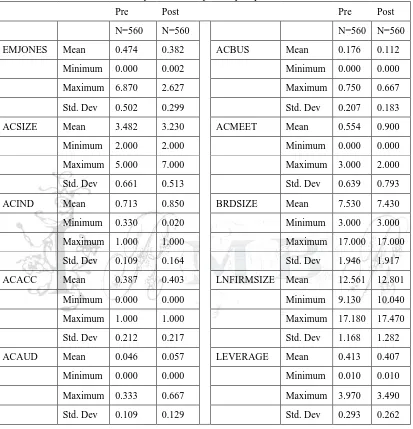
It is observed that for earnings management variable derived from the modified Jones model, the mean for EMJONESpost (0.382) is less than the mean for EMJONESpre (0.474). Table 1 shows that the average value of audit committee size in pre revised MCCG period was 4.000 and decreased to 3.000 members in the post period. However, the maximum number of members in audit committee (ACSIZE) increased from 5.000 members to 7.000 members. Other variables such as ACIND, ACACC, ACAUD, ACMEET and ACDISC shows an increasing mean value in the post revised MCCG compared to in the pre revised MCCG.
ISSN: 2306-9007 Salleh & Haat (2014) 313
I
www.irmbrjournal.com March 2014I
nternationalR
eview ofM
anagement andB
usinessR
esearchVol. 3 Issue.1
R
M
B
R
more firms were responding in positive ways to disclose their activities in an informative way as recommended by the revised MCCG 2007.
Table 1 Descriptive Statistics of Continuous Variables (independent variables and control variables) for pooled data in pre and post period.
Pre Post Pre Post
N=560 N=560 N=560 N=560
EMJONES Mean 0.474 0.382 ACBUS Mean 0.176 0.112
Minimum 0.000 0.002 Minimum 0.000 0.000
Maximum 6.870 2.627 Maximum 0.750 0.667
Std. Dev 0.502 0.299 Std. Dev 0.207 0.183
ACSIZE Mean 3.482 3.230 ACMEET Mean 0.554 0.900
Minimum 2.000 2.000 Minimum 0.000 0.000
Maximum 5.000 7.000 Maximum 3.000 2.000
Std. Dev 0.661 0.513 Std. Dev 0.639 0.793
ACIND Mean 0.713 0.850 BRDSIZE Mean 7.530 7.430
Minimum 0.330 0.020 Minimum 3.000 3.000
Maximum 1.000 1.000 Maximum 17.000 17.000
Std. Dev 0.109 0.164 Std. Dev 1.946 1.917
ACACC Mean 0.387 0.403 LNFIRMSIZE Mean 12.561 12.801
Minimum 0.000 0.000 Minimum 9.130 10.040
Maximum 1.000 1.000 Maximum 17.180 17.470
Std. Dev 0.212 0.217 Std. Dev 1.168 1.282
ACAUD Mean 0.046 0.057 LEVERAGE Mean 0.413 0.407
Minimum 0.000 0.000 Minimum 0.010 0.010
Maximum 0.333 0.667 Maximum 3.970 3.490
Std. Dev 0.109 0.129 Std. Dev 0.293 0.262
Table 2: Descriptive Statistics of Independent Variables (Dichotomous Variables) for pooled data in pre and post period
Pre N=560 PostN=560
Dichotomous Variable 0 1 0 1
ACDISC 32 528 21 539
ISSN: 2306-9007 Salleh & Haat (2014) 314
I
www.irmbrjournal.com March 2014I
nternationalR
eview ofM
anagement andB
usinessR
esearchVol. 3 Issue.1
R
M
B
R
Table 3: Correlation Statistics for All Variables for Pre Revised MCCG for years 2005 and 2006 (N=560)
E
MJONE
S
AC
SIZ
E
AC
IND
AC
A
C
C
AC
AUD
AC
B
US
AC
ME
E
T
AC
DI
S
C
B
R
D
SIZ
E
L
NFI
R
MSI
Z
E LEV
EMJONES 1
ACSIZE .001 1
.989
ACIND .017 .019 1
.691 .661
ACACCFIN -.016 .169**
-.043
1
.702 .000 .312
ACAUD .043 .009 .033
-.294**
1
.306 .825 .432 .000
ACBUS .023 .125**
-.037
-.243**
.018 1
.581 .003 .378 .000 .677
ACMEET .047 -.007 .026 -.015 .025 -.036 1
.267 .875 .537 .722 .551 .394
ACDISC .042 .088*
-.012
.070
-.021
.015 .093* 1
.323 .038 .776 .098 .628 .716 .028
BRDSIZE .097* .191** .060 .006 .067 .048 .013
-.004
1
.022 .000 .159 .886 .114 .257 .756 .919
LNFIRMSIZE -.063 .056 .062 -.072
-.044
.005 .129**
-.006
.255** 1
.133 .184 .144 .090 .294 .898 .002 .889 .000
LEV .253** .042 .021 -.008 .033 .055 .035 .056 .108* .117** 1
ISSN: 2306-9007 Salleh & Haat (2014) 315
I
www.irmbrjournal.com March 2014I
nternationalR
eview ofM
anagement andB
usinessR
esearchVol. 3 Issue.1
R
M
B
R
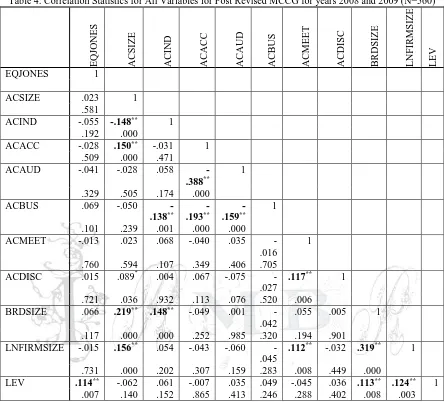
Table 4: Correlation Statistics for All Variables for Post Revised MCCG for years 2008 and 2009 (N=560)
E QJONES AC SIZ E AC IND AC A C C AC AUD AC B US AC ME E T AC DI S C B R D SIZ E L NFI R MSI Z E LEV
EQJONES 1
ACSIZE .023 1
.581
ACIND -.055 -.148** 1
.192 .000
ACACC -.028 .150** -.031 1
.509 .000 .471
ACAUD -.041 -.028 .058
-.388**
1
.329 .505 .174 .000
ACBUS .069 -.050
-.138** -.193** -.159** 1
.101 .239 .001 .000 .000
ACMEET -.013 .023 .068 -.040 .035
-.016
1
.760 .594 .107 .349 .406 .705
ACDISC .015 .089* .004 .067 -.075
-.027
.117** 1
.721 .036 .932 .113 .076 .520 .006
BRDSIZE .066 .219** .148** -.049 .001
-.042
.055 .005 1
.117 .000 .000 .252 .985 .320 .194 .901
LNFIRMSIZE -.015 .156** .054 -.043 -.060
-.045
.112** -.032 .319** 1
.731 .000 .202 .307 .159 .283 .008 .449 .000
LEV .114** -.062 .061 -.007 .035 .049 -.045 .036 .113** .124** 1
.007 .140 .152 .865 .413 .246 .288 .402 .008 .003
Table 3 and 4 shows Pearson correlation coefficients between earnings quality, audit committee effectiveness and control variables in the pre and post revised MCCG periods. The variables that improved in negative correlation with EMJONES were ACIND (.017 to -.055), ACACC (-0.016 to -0.028), ACAUD (0.043 to -0.041), ACMEET (0.047 to -0.013). The strong negative correlation between ACIND and ACSIZE is consistent with the decrease in ACSIZE. On the other hand, there was a positive correlation between ACACC and ACSIZE. ACAUD showed a negative correlation with ACACC which indicates that both variables are substitute with each other. ACDISC showed a positive correlation with ACMEET which implies that a firm which conducted more meetings may also disclose more of their activities in the annual report.
Table 5 Matched-pairs t-tests comparing earnings management in the years pre and post revised MCCG for 560 firms
Mean t df Sig(2-tailed)
EMJonesPre 0.474
4.597 559 0.000
ISSN: 2306-9007 Salleh & Haat (2014) 316
I
www.irmbrjournal.com March 2014I
nternationalR
eview ofM
anagement andB
usinessR
esearchVol. 3 Issue.1
R
M
B
R
Table 5 shows the results of the parametric matched-pairs t-test performed to compare the earnings management variables in the pre and post revised MCCG. For the earnings management computed from the modified Jones (1995), the mean for EMJonespost (0.382) was less than the mean for EMJONESpre (0.474) and the difference in the means was significant at the 0.000 level or 1 percent. Therefore the result suggests that the earnings quality derived from modified Jones (1995) was significant higher after the revision of MCCG in 2007.
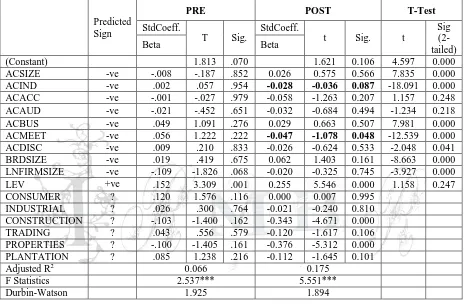
Table 6:Regression estimates of earnings quality variables on audit committee effectiveness and control
variables for 280 Malaysian listed firms in pre and post revised MCCG
Predicted Sign
PRE POST T-Test
StdCoeff.
T Sig.
StdCoeff.
t Sig. t
Sig (2- tailed)
Beta Beta
(Constant) 1.813 .070 1.621 0.106 4.597 0.000
ACSIZE -ve -.008 -.187 .852 0.026 0.575 0.566 7.835 0.000
ACIND -ve .002 .057 .954 -0.028 -0.036 0.087 -18.091 0.000
ACACC -ve -.001 -.027 .979 -0.058 -1.263 0.207 1.157 0.248
ACAUD -ve -.021 -.452 .651 -0.032 -0.684 0.494 -1.234 0.218
ACBUS -ve .049 1.091 .276 0.029 0.663 0.507 7.981 0.000
ACMEET -ve .056 1.222 .222 -0.047 -1.078 0.048 -12.539 0.000
ACDISC -ve .009 .210 .833 -0.026 -0.624 0.533 -2.048 0.041
BRDSIZE -ve .019 .419 .675 0.062 1.403 0.161 -8.663 0.000
LNFIRMSIZE -ve -.109 -1.826 .068 -0.020 -0.325 0.745 -3.927 0.000
LEV +ve .152 3.309 .001 0.255 5.546 0.000 1.158 0.247
CONSUMER ? .120 1.576 .116 0.000 0.007 0.995
INDUSTRIAL ? .026 .300 .764 -0.021 -0.240 0.810
CONSTRUCTION ? -.103 -1.400 .162 -0.343 -4.671 0.000
TRADING ? .043 .556 .579 -0.120 -1.617 0.106
PROPERTIES ? -.100 -1.405 .161 -0.376 -5.312 0.000
PLANTATION ? .085 1.238 .216 -0.112 -1.645 0.101
Adjusted R2 0.066 0.175
F Statistics 2.537*** 5.551***
Durbin-Watson 1.925 1.894
Table 6 presents main results of the regression that examine the effect of audit committee effectiveness on earnings quality. The model is run separately for the pre and post MCCG periods. According to Pallant (2007) the comparison information can be determine by looking at Beta under Standardised Coefficients. This is because these values for each of the different variables have been converted to the same scale for the purpose of comparison.
Table 6 shows that audit committee independence (ACIND) in the post revised MCCG period was more effective in constraining earnings management compared to pre revised MCCG. The coefficients in pre revised MCCG period showed positive coefficients (0.002) whereas in post revised MCCG period it showed a negative coefficient of -0.028 and significant at 0.10 level. As for the ACACC, the size of negative coefficient in the post revised MCCG period (-0.058) was larger than in pre revised MCCG period (-0.001) An explanation of such result is that the presence of audit committee members with accounting knowledge after the revised MCCG contributed to the reduction of earnings management even though it is
not significant. ACAUD showed that the size of coefficient was slightly greater in the post revised MCCG
ISSN: 2306-9007 Salleh & Haat (2014) 317
I
www.irmbrjournal.com March 2014I
nternationalR
eview ofM
anagement andB
usinessR
esearchVol. 3 Issue.1
R
M
B
R
recommendation stated in the revised MCCG that requires the audit committee to have meetings with external auditors without the presence of executive directors at least twice in a year was an effective constraint for the earnings management to occur in listed firms. In addition, ACDISC showed negative coefficient (-0.026) compared to positive coefficient (0.009) in the pre revised MCCG.
Conclusion
This study examines the effect of audit committee effectiveness on earnings quality which is proxied by earnings management in Malaysian listed firms on Bursa Malaysia. The study covers 280 firms in 2005, 2006, 2008 and 2009. This study provides new evidences on the association between earnings quality and corporate governance mechanisms in Malaysia after the implementation of the Malaysian Code of Corporate Governance. It is revealed that audit committee effectiveness characteristics such as audit committee expertise, audit committee independence, audit committee disclosure and frequency of meetings are variables that showed negative association with earnings management after the revised of MCCG. This indicates that the MCCG has achieved its aim to improve the quality of audit committee and strengthen it in order to make audit committees more effective. The study provides feedback to the policymakers such as Securities Commissioner and Bursa Malaysia on the amendments that they recommended in the revised MCCG and Bursa Malaysia Listing Requirement respectively. The findings of the study will certainly make a significant contribution towards an understanding of the audit committee effectiveness effect on financial reporting quality.
References
Bédard, J., Chtourou, S.M., Courteau, L. (2004). The effect of audit committee expertise, independence, and activity on aggressive earnings management. Auditing: A Journal of Practice & Theory, 23(2), 13-35.
Blue Ribbon Committee. (1999). 'Report and recommendations of the Blue Ribbon Committee on
improving the effectiveness of corporate audit committees', The Business Lawyer, 54 (2), 1067-1095.
Collier, P. & Gregory, A. (1999). Audit committee effectiveness and agency costs. Journal of Accounting
and Public Policy, 18, 311-332.
Davidson, R., Goodwin-Stewart, J. and Kent, P. (2005). Internal governance structures and earnings
management. Accounting and Finance, 45 (2), 241-268.
Dechow, P., Sloan, R.G. & Sweeney, A.P. (1995). Detecting earnings management. The Accounting
Review,70 (April), 193-225.
DeZoort, F. (1998). An analysis of experience effects on audit committee members' oversight judgements.
Accounting Organisations and Society, 23(1), 1-21.
DeZoort, Todd and Salterio, Steven E. (2001). The effects of corporate governance experience and
financial reporting and audit knowledge on audit committee members' judgments. Auditing: A Journal
of Practice & Theory. Available at SSRN: http://ssrn.com/abstract=276690. Accessed on 18 March 2009.
Dhaliwal, Dan S., Naiker, Vic and Navissi, Farshid. (2006). Audit committee financial expertise, corporate
governance and accruals quality: An empirical analysis. Available at SSRN:
http://ssrn.com/abstract=906690. Accessed on 13 March 2009.
Hashim, H.A, Devi, S.S. (2008).
http://www.afaanz.org/openconf-faanz2008/modules/request.php?module=oc_proceedings&action=view.php&a=Accept as
Forum&id=382. Accessed on 5 May 2010.
Hossain, D.M., Khan, A. R. (2006). Audit committee: a summary of the findings of some existing
literature. The Cost and Management, 34(5), 40-57.
Jones, J. (1991). Earnings management during import relief investigations. Journal of Accounting
Research, Autumn, 29(2), 193-228.
ISSN: 2306-9007 Salleh & Haat (2014) 318
I
www.irmbrjournal.com March 2014I
nternationalR
eview ofM
anagement andB
usinessR
esearchVol. 3 Issue.1
R
M
B
R
Klien, A. (2002). Audit Committee, board of director characteristics, and earnings management. Journal of
Accounting and Economics, 33, 375-400.
Lapointe-Antunes, Pascale; Cormier, Denis; Magnan, Michel; Gay-Angers, Sophie. (2006). On the
relationship between voluntary disclosure, earnings smoothing and the value-relevance of earnings:
The case of Switzerland. European Accounting Review, 15(4), 465-505.
Malaysian Code on Corporate Governance, 2000, Finance Committee on Corporate Governance, Securities Commission, Kuala Lumpur.
Malaysian Code on Corporate Governance, 2007, Finance Committee on Corporate Governance, Securities Commission, Kuala Lumpur.
McDaniel L., R. D. Martin and L. A. Maines. (2002). Evaluation financial reporting quality: The effects of
financial expertise vs. financial literacy. The Accounting Review, 77(Supplement), 139-167.
McNicholas, M., and P. Wilson. (1988). Evidence of earnings management from the provision for debts.
Journal of Accounting Research, 26 (Supplement), 1-31.
Piot, C., and Janin, R. (2007). External auditors, audit committees and earnings management in France.
European Accounting Review, 16(2), 429-454.
Ramsay, I. (2001). Independence of Australian Company Auditors: Review of Current Australian
Requirements and Proposals for Reform. Commonwealth of Australia, Canberra.
Saleh, N. M., Iskandar, T. M., & Rahmat, M. M. (2007). Audit committee characteristics and earnings
management: evidence from Malaysia. Asian Review of Accounting, 15(2), 147-163.
Smith, N., V. Smith and M. Verner. (2006). Do women in top management affect firm performance? A
panel study of 2,500 Danish firms. International Journal of Productivity and Performance
Management, 55, 569-593.
Song, J. and Windram, B. (2000). The effectiveness of audit committees: Experience from UK, Napier University Business School, Edinburgh.
Sweeny, A. (1994). Debt-covenant violation and managers’ accounting responses. Journal of Accounting and Economics, 17, 281-308.
Wan Ismail, Wan Adibah, Dunstan, Keitha L. and Van Zijl, Tony. (2009). Earnings quality and corporate governance following the implementation of Malaysian code of corporate governance.
http://ssrn.com/abstract=1543524. Accessed on 5 February 2012.
Wats, R. L., and Zimmerman, J. L. (1986). Positive Accounting Theory. Englewood Cliffs, NJ: Prentice Hall.
Whittington, O.R. and K. Pany. (2001). Principles on auditing and other assurance services. (Boston: Irwin McGraw-Hill).
Xie, B., W. N. Davidson, and P. J. DaDalt. (2003). Earnings management and corporate governance: The
role of the Board and the audit committee. Journal of Corporate Finance, 9(3), 295–316.