www.mojet.net
The Development of Teaching and
Learning in Bright-Field Microscopy
Technique
Yulita Hanum P Iskandar [1], Nurul Ethika Mahmud [2], Wan Nor Amilah Wan Abdul Wahab [3], Noor Izani Noor Jamil [4], Nurlida Basir [5]
[1] [email protected] Pusat Pengajian Siswazah Pernigaan
[2] Pusat Pengajian Sains Kesihatan
[3] Pusat Pengajian Sains Kesihatan
[4] Pusat Pengajian Sains Kesihatan
[5] Pusat Sains dan Teknologi, Universiti Sains Islam
ABSTRACT
E-learning should be pedagogically-driven rather than technologically-driven. The objectives of this study are to develop an interactive learning system in bright-field microscopy technique in order to support students’ achievement of their intended learning outcomes. An interactive learning system on bright-field microscopy technique was developed in CD-ROM format which included various elements: text, images, animations, video, and audio. Thirty first-year biomedicine students in Universiti Sains Malaysia attended a 3-hour fixed laboratory session for conventional teaching and learning for bright-field microscopy technique. All subjects then answered a set of questionnaires. Subjects were provided with multimedia teaching and learning materials. After the task, all the subjects were given the second set of questionnaires to measure their level of acceptance and satisfaction with the interactive learning system. It is anticipated that the interactive learning system in bright-field microscopy technique would be suitable as a supporting learning aid for the laboratory or
practical session.
Keywords: Teaching, Learning, Bright-Field, Microscopy Technique
INTRODUCTION
In the 21st century, the application of multimedia in teaching and learning is growing, offering an alternative way to convey information. It has altered how teachers teach and how students learn. Many academic institutions commit themselves to integrate multimedia in teaching and learning because they believe in its effectiveness as an alternative approach to traditional teaching and learning. One of the most rapidly changing and exciting areas of education in the world today is the development of computer-based teaching materials, especially interactive learning systems.
E-learning initiatives in Malaysia are being undertaken mainly by higher educational institutions (Raja Maznah Raja Hussain, 2004). In a conventional practical session, the students have insufficient class hours. Students only have about 3 hours of class per week, including listening to a briefing and performing their experiments. All are very time- consuming in a conventional practical session (Bhargava, 2009), leaving insufficient time for them. Students require sufficient time, repetitions to comprehend all steps and applications at each level of protocol in microscopy technique.
A student’s competency in laboratory techniques and experiments may also be unsatisfactory because of the insufficient practical hours (Short & Tomlinson, 1979). Students lack motivation and find difficulty remembering the entire process of laboratory techniques due to only one session of the practical class. They therefore need materials such as interactive learning systems to assist them in their self-learning.
The lack of interaction between students and lecturers or students and lab instructors during practical sessions (Davidowitz & Rollnick, 2003), mainly due to a large class size, has been encountered in a conventional laboratory setting. At one time, students have no opportunity to ask questions to the lecturer or lab instructor; nor do they have time to do exercises or quizzes during a practical session. Therefore, technology-assisted learning using an interactive learning system was proposed to instruct students in the practical learning of bright-field microscopy technique. The
www.mojet.net interactive learning system combines elements of media into the learning environment; text, image, sound, animation and video which are delivered and controlled by the computer (Vaughn, 1993), thus providing a powerful new tool for education and can greatly enhance teaching and learning effectiveness (Shuman, 1998; Mohle, 2001).
CONVENTIONAL TEACHING AND LEARNING
Typical elements in the conventional teaching and learning practices are the curriculum content, learning activities, and its implementation. The curriculum content is usually fixed and presented in linear and sequential ways. Typical learning activities involve segmented and fragmented learning tasks to facilitate student understanding. Many of the learning outcomes from conventional teaching have long been recognized as insufficient and unsatisfactory (Oliver, 1999).
A laboratory or practical session is an essential component of undergraduate education in the life sciences. The laboratory provides one of the best opportunities for active learning as laboratory classes are designed to teach concepts through experiential learning (Ayob, Hussain, Mustafa, & Shaarani, 2011). In conventional practical sessions, students have to attend the session based on a fixed schedule (Islam, Chittithaworn, Rozali, & Liang, 2010) and they are provided with hands-on experiences of real tasks (Moreno-Ger et al., 2010). Students would refer to textbooks or any other reference books containing information on the particular subject.
Most practical sessions are taught in face-to-face interactions between students and the instructor (Azzawi & Dawson, 2007). An instructor is present in the class to teach and assist students to acquire knowledge and academic skills. At the same time, the students listen to the instructor, write down the main points and other important facts. Therefore, the students may feel more comfortable if they can communicate immediately and interact directly with their instructors about any difficulties they are facing.
Problems in Conventional Teaching and Learning
Since conventional teaching and learning involve instructions, face-to-face traditional classrooms, together with lecture notes and text books for delivering information to learners who have to attend classes based on a fixed schedule, learners depend on text books or reference books containing information on certain subjects. The lecturers or instructors are present in the classroom, and their role is to impart the necessary knowledge and academic skills to students (Islam et al., 2010). But the conventional teaching and learning process means students have insufficient class hours. For example, in the microscopy class, students only have about 3 hours of class per week, consisting of lectures, briefing sessions and performing laboratory experiments. All are time-consuming and yet there is insufficient time allocated for them. Acquisition of laboratory skills requires sufficient time, repetition to comprehend all theories and applications at each level of protocol (Sancho et al., 2006).
Furthermore, the number of students in a class is very large; this would generate more noise and, as a result, some activities such as listening to the lecturer are curtailed. Because of the large class size, students lack interaction with their lecturer or instructor during practical sessions (Sancho et al., 2006).
In addition, large classes may cause several problems; it is not easy for instructors to ensure that all students are concentrating on the course materials. Instructors will also have a hard time dealing with students on an individual basis and interacting with them to answer their queries or evaluate their understanding. The chances to give quizzes, assignments, and any extra work to the students will also be reduced. As such, students need to enhance their regulated-self learning by gaining easy access to different materials or information resources.
INTERACTIVE TEACHING AND LEARNING
The practice over centuries with conventional learning methods has been where students attend classes with books, lecture notes or other hard copy materials with a lecturer explaining the content of studies. Technology advances now enable interactive and electronically based learning such as e-learning using CD-ROMs, internet, Web Portal, E-book, video, audio, and animation to get materials across to the students (Islam et al., 2010).
Any form of interface between the user and the medium may be considered interactive. Interactive media is not limited to electronic media or digital media. Our proposed interactive learning system refers to products and services on a computer-based system which respond to user actions by presenting content such as text, graphics, animation, video audio, and so forth. Many institutions have been using computer-based materials such as e-learning materials, which can be found in companies, schools, and universities. The trend is moving toward blended learning where computer-based activities are integrated with practical sessions or lectures (Taradi, Taradi, Radić, & Pokrajac, 2005).
www.mojet.net Interactive learning systems can enhance a student’s competency in laboratory techniques and can also solve the problems arising in conventional learning methods such as difficulty to standardize techniques across multiple lab sessions. They also promote successful learning outcomes (Maldarelli et al., 2009). Interactive learning systems allow students to use resources to circumvent difficulties in conventional learning methods; these resources include simulations, virtual laboratories, tutorials, assignments, quizzes, and other multimedia content (Sancho et al., 2006).
The interactive learning system courseware being developed can be uploaded into Moodle (Moodle, 2012), a learning management system (LMS) used for complementing face-to-face courses or delivering courses completely online. This product has revolutionized the learning process in the Microbiology course, by offering an advanced and user-friendly solution for encouraging student-lecturer collaboration. The system comes with a toolbox full of online teaching techniques that facilitate and enhance the proven teaching principles and traditional classroom activities. A rich interactive learning system content allows the student to get better motivated and to engage in the learning process. The student can use many images, videos, and animations in the system.
As a medium for learning laboratory technique, tutorials based on interactive learning system programs offer a number of potential advantages over conventional microscopic classes. However, given a choice between computer-based tutorials, microscope-computer-based practical classes, or a combination of both, the majority of students prefer the combined approach (Grossman & Grossman, 2008). Therefore, it is important to carefully design and implement the content of teaching and learning materials in order to meet the requirement for teaching and learning in higher education.
PROPOSED INTERACTIVE LEARNING SYSTEM
The proposed interactive learning system has been designed with pedagogy in mind and fully supports different learning styles. Pedagogy is the holistic science of education. It is also occasionally referred to as the correct use of instructive strategies. Even though interactive learning systems have been used widely in Malaysia and are available in many academic disciplines, only a minority are designed specifically within the narrow scope of laboratory techniques.
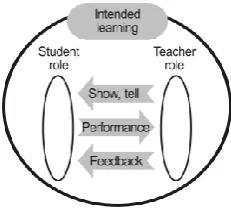
Most of the current developed interactive learning system systems are very useful and can be applied to the teaching and learning process but there is a certain lack of teaching and learning component such as the lecturer-student interaction. Interaction with the instructor and other students is important in learning (Laurillard, 1998). Much can be learned from other students such as personal experiences which impact learning. But the current interactive learning system is lacking in student-instructor interaction. The proposed courseware is composed of the main components of teaching and learning as illustrated in Figure 1.
Figure 1: Model of teaching and learning (Gilbert & Gale, 2008)
The biology microscopy which can be defined as the investigation with microscope (Merriam-Webster, 2013) is seen as valuable because it provides “hands-on” experience of real examples of slides, rather than the ideal images seen on the computer. The best approach was considered to be using interactive learning system to provide the basic information, followed by a conventional practical class (Grossman & Grossman, 2008). One major reason for the lack of relationship between students and interactive learning system (ILS) is it does not involve human contact at all as compared to face-to-face instruction. Therefore, the disadvantages of the ILS are already being solved in the proposed courseware through the use of message boards, chat rooms and emails to enable learners to communicate with others.
DESIGN AND IMPLEMENTATION
Task Analysis of Bright Field Microscopy Technique
www.mojet.net The contents in bright-field microscopy technique were analyzed and illustrated in Table 1. There were three topics involved in the interactive learning system; (i) Principles, (ii) Components, and (iii) Functions and Applications in bright-field microscopy technique.
Table 1
: Task analysis for Bright-field Microscopy Technique
Section 1: INTRODUCTION
LO 1.1: State the general principle and application of different types of microscopes. LO 1.2: Description on brief history, use, and technique of Bright-field microscope.
Section 2: PRINCIPLES
LO 2.1: Explain the properties of light (wavelength and resolution) in affecting our ability to visualize objects using a light microscope.
LO 2.2: Explain properties of light (light and object) in affecting our ability to visualize objects using a light microscope.
Section 3: COMPONENTS
LO 3.1: Identify all parts of a compound microscope. Section 4: APPLICATIONS & FUNCTIONS
LO 4.1: State the function of each of the component.
LO 4.2: Comprehend each level in the protocol of bright-field microscopy.
LO 4.3: Correctly set up and focus the microscope following a step-by-step procedure. LO 4.4: Correctly use all lenses (dry and immersion).
LO 4.5: Handle, clean and store the microscope properly.
Contents of all three instructional methods were analogous. By minimizing differences in the contents, there was a greater chance of finding more effective methods of instruction that are more effective in terms of the degree of original learning and retention. The instructional content and wording in each method were as similar as possible; only the presentation method was changed. The text handout and standard multimedia consisted only of instructional material. In the simulation multimedia, the instructional material was preceded by a virtual meeting that created a problem-solving context for the learner.
Courseware Flowchart
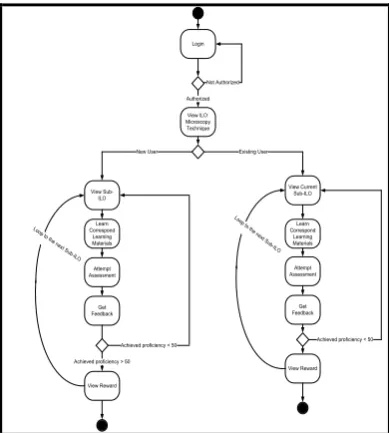
Figure 2 shows the flowchart of the interactive learning system courseware in bright-field microscopy technique for the users. Students need to login into the courseware by clicking the ‘enter’ button. After entering the courseware, students will view the learning outcomes of the first section in the module. The courseware will show the content and students will get the information from the courseware. After the students have finished the first section, they will attempt an assessment and then view the feedback. After the evaluation, students will view reward and can go to the next section of the module.
www.mojet.net Login View ILO: Microscopy Technique Authorized Not Authorized View Sub-ILO Learn Correspond Learning Materials Attempt Assessment Get Feedback View Reward Achieved proficiency > 50
New User
Achieved proficiency < 50
Existing User Learn Correspond Learning Materials Attempt Assessment Get Feedback View Reward Achieved proficiency < 50 View Current
Sub-ILO
Loop to the next Sub
-ILO
Loop to the next
Sub-ILO
Figure 2: Courseware flowchart for the proposed interactive learning system
Graphical User Interface
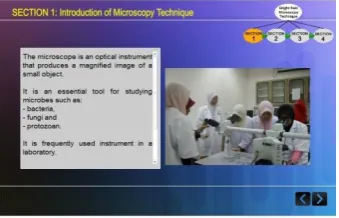
Bright-field interactive learning system was developed according to specific features and it has a graphical user interface. Content were organised around four topics: the introduction, components, principles, and the application and functions of microscopy technique. Text was the main mode of presenting information for example in Figure 5. Each screen was incorporated with a back and next button. According to this figure, there was a small graphical diagram on the top-right side of each screen which displays each section in the courseware.
The use of carefully selected colour scheme was effective for attracting attention and motivating learning (Lee & Boling, 1999). It is recommended to use neutral grey or pastels for the background since they recede optically, or cool colours such as blue as they create a calm feeling. Dark colour fonts on light backgrounds or vice versa were used as shown in all figures. This colour choice needs to be consistent within the program. Basically white, blue, black and occasionally red colours were used for the text. It was comfortable to the eyes and user-friendly (MacDonald, 1990).
The animations and videos were included in Figure 6 to teach facts or concepts and demonstrate principles. Animations and videos as graphical images were expected to help students to visualize a dynamic process that was difficult or impossible for them to visualize on their own, and would thus facilitate learning tasks. It could also capture attention and provide dynamic explanations and demonstrations (Pellone, 1995). Animations and videos were incorporated with play, pause, stop, repeat and also the speed of change buttons. Students were expected to perform well when auditory explanations were combined with visual instructions.
Figure 7 and
Figure 8 show the interface of a quiz. The quiz consisted of five questions. It was prepared to provide feedback for each question and at the end of the quiz the results will be displayed.
Figure 3: Main screen
www.mojet.net Figure 4: Screen of the overall sections in the courseware
Figure 5: Screen of intended learning outcomes
Figure 6: Screen of main content
Figure 7: Screen of quiz
Figure 8: Screen of evaluation
www.mojet.net
Implementation
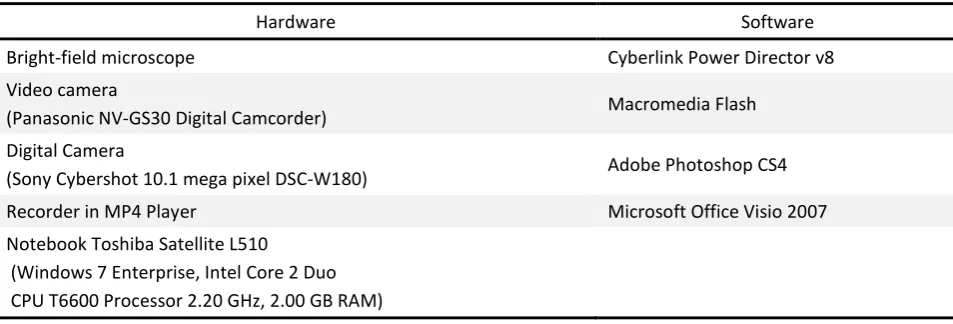
All plans generated in the courseware design section were implemented and structured by using the following
development tools (see Table 2):
Table 2: Development Tools
Hardware Software
Bright-field microscope Cyberlink Power Director v8
Video camera
(Panasonic NV-GS30 Digital Camcorder) Macromedia Flash Digital Camera
(Sony Cybershot 10.1 mega pixel DSC-W180) Adobe Photoshop CS4
Recorder in MP4 Player Microsoft Office Visio 2007
Notebook Toshiba Satellite L510
(Windows 7 Enterprise, Intel Core 2 Duo CPU T6600 Processor 2.20 GHz, 2.00 GB RAM)
Some difficulties surfaced during the development of the interactive learning system. Creating a user-friendly and interactive learning system module in the form of a stand-alone CD-ROM is a tedious and complex task. A developer requires multiple levels of design and development efforts and skills. Challenges include selecting content, devising appropriate screen designs, commonly accepted user-interfaces, clear directions for access and courseware and application software appropriate for courseware development, as well as appropriate digital multimedia elements (Baharuddin et al., 2006).
EVALUATION
Participants
All first-year students in the Biomedicine Program of the academic session 2011/2012 in the School of Health Sciences, Universiti Sains Malaysia (USM) were enrolled in this study. A convenient sampling design was used in this study because of time constraints. All subjects had attended a 3-hour fixed laboratory session of bright-field microscopy technique with a conventional teaching and learning method in the first semester, academic session 2011/2012.
Sample Size
The required number of participants to be recruited for given effect sizes, alpha levels, and power values is calculated by using G*Power software (Erdfelder, Faul, & Buchner, 1996). The effect size expresses whether the difference observed is a difference that matters. The larger the effect size, the easier it to see there is a difference between the two means being compared. Effect sizes from 1 to 2 are typical for exploratory study. For this study, the effect size was set to 1.5. The value of alpha (α) was .05, and the required power was 0.8. The program calculated the expected sample size as n = 18. Therefore, the minimum number of subjects needed for this study to detect an effect size of 1.5 with 80% power was 18.
Instruments
A 5-point Likert-type scale questionnaire was used as a data collection instrument in order to obtain students’ satisfaction level before and after using the interactive learning system in bright-field microscopic technique. The survey was adapted from the Centre for Innovative Education (CINE), Multimedia University, Malaysia. The validity and reliability of the questionnaires were established (Teoh & Neo, 2007).
The questionnaires were divided into two parts; part 1 consisted of five point Likert-type scales and close-ended questions while part 2 contained one open-ended questions requesting students to express their views in full statements or to write comments. In part 1, the Likert-scale scores from 1 to 5 were Strongly Disagree (1), Disagree (2),
www.mojet.net Neutral (3), Agree (4), and Strongly agree (5).
Each student was also provided with the developed interactive learning system on bright-field microscopic technique in the form of CD-ROM. The activity was carried out in a computer laboratory in the School of Health Sciences, USM.
Experimental Procedure
All of the students had attended a fixed laboratory session of bright-field microscopy technique for 3 hours using the conventional teaching and learning method. During a class break, the students involved were explained on the nature of the study and the survey that were going to be performed. It was emphasized that student participation was voluntary and their responses would be kept unanimous and confidential. The students were given the instruction of this experiment.
The students were invited to answer each question in the first set of questionnaire form regarding satisfaction level on previous (conventional) method of teaching and learning. After completing the questionnaires, the students were provided a CD-ROM and a guideline on how to play and use the interactive learning system. They were instructed to start the lesson using the interactive learning system tool. After they have finished studying the contents of the interactive learning system, they were invited again to answer another set of similar questionnaires to evaluate on their satisfaction of using the interactive learning system. After they have finished answering the questions, they will get a reward.
RESULTS
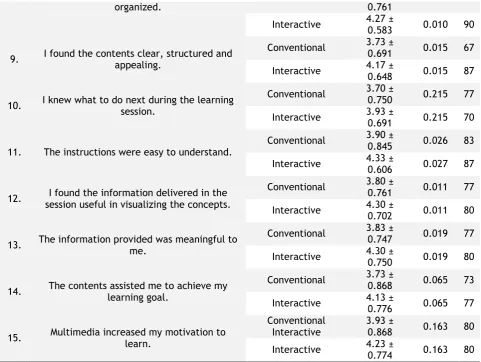
Table 3 shows the analysis of students’ responses on each questionnaire in part 1. The results were expressed in mean and SD based on agreement level to the given statement as well the percentage of students who agreed and strongly agreed with the statements.
Table 3:
The analysis of Questionnaire A and B
Num Questions Methods (learning system)
Agreement Level Mean ± SD Value p %
1. I found the learning session interesting and engaging.
Conventional 3.93 ± 0.740 0.133 77 Interactive 4.20 ± 0.610 0.133 83
2. I found the session useful for learning.
Conventional 4.17 ± 0.648 0.673 93 Interactive 4.23 ± 0.568 0.673 87
3. From the start it was clear what I was going to do in the practical session. Conventional
3.57 ±
0.679 0.003 93 Interactive 4.07 ± 0.583 0.003 80
4. learning outcomes of the session were. From the start it was clear what the
Conventional 3.63 ± 0.765 0.081 60 Interactive 3.93 ± 0.521 0.082 77
5. I know better about the subject after the session.
Conventional 3.90 ± 0.662 0.362 87 Interactive 4.07 ± 0.740 0.362 77
6. right amount of information obtained. Generally there was just the Conventional
3.43 ±
0.728 0.059 60 Interactive 3.83 ± 0.874 0.059 63
7. Important information or key concepts were easy to identify.
Conventional 3.80 ± 0.805 0.006 73 Interactive 4.30 ± 0.535 0.007 90 8. Generally the content was clear and logically Conventional 3. 80 ± 0.010 77
www.mojet.net
organized. 0.761
Interactive 4.27 ± 0.583 0.010 90
9. I found the contents clear, structured and appealing. Conventional
3.73 ±
0.691 0.015 67 Interactive 4.17 ± 0.648 0.015 87
10. I knew what to do next during the learning session. Conventional
3.70 ±
0.750 0.215 77 Interactive 3.93 ± 0.691 0.215 70
11. The instructions were easy to understand.
Conventional 3.90 ± 0.845 0.026 83 Interactive 4.33 ± 0.606 0.027 87
12. session useful in visualizing the concepts. I found the information delivered in the Conventional
3.80 ±
0.761 0.011 77 Interactive 4.30 ± 0.702 0.011 80
13. The information provided was meaningful to me. Conventional
3.83 ±
0.747 0.019 77 Interactive 4.30 ± 0.750 0.019 80
14. The contents assisted me to achieve my learning goal.
Conventional 3.73 ± 0.868 0.065 73 Interactive 4.13 ± 0.776 0.065 77
15. Multimedia increased my motivation to learn.
Conventional Interactive
3.93 ±
0.868 0.163 80 Interactive 4.23 ± 0.774 0.163 80
Table 4 and
Table 5
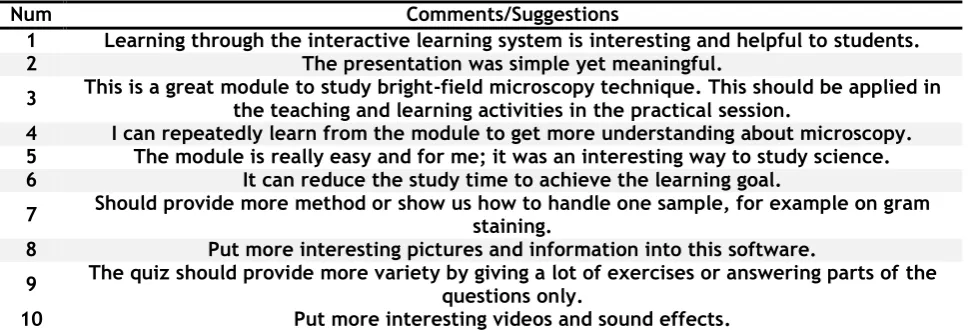
illustrate the list of comments and suggestions (unedited) that students had written in Part B of the questionnaire to improve the effectiveness of both teaching and learning methods.Table 4
: Comments and Suggestions for conventional practical session
Num Comments/Suggestions
1 which will help us to understand about the bright-field microscopy technique much more Divide the learning group into smaller groups and each group has their own microscope, clearly.
2 I think the practical session on the microscope was not enough with only being learnt in one or two sessions [sic]. Need extra lesson to make sure the theory and the practical lesson become easier to understand.
3 The practical session on bright-field microscopy technique was interesting and easy to understand. 4 There are once only we exposure to this practical session. I think need more time or day to understand about microscopy [sic]. 5 Interesting and meaningful. Should improve in explaining more briefly about it during practical session. Give more guidelines.
6 Need more visual instruction.
7 Do a step-by-step demonstration with given hands-out to each student. 8 Most microscopes are not in a good conditions [sic], the lens were infected. 9 For the students who do not know how to use the microscope and will learn how to use it, the instructions need to be followed by pictures to make the learning session easier. 10 The laboratory instructor should encourage students to involve themselves in the experiments
www.mojet.net Table 5:
Comments and Suggestions for multimedia session
Num Comments/Suggestions
1 Learning through the interactive learning system is interesting and helpful to students.
2 The presentation was simple yet meaningful.
3 This is a great module to study bright-field microscopy technique. This should be applied in the teaching and learning activities in the practical session. 4 I can repeatedly learn from the module to get more understanding about microscopy. 5 The module is really easy and for me; it was an interesting way to study science. 6 It can reduce the study time to achieve the learning goal.
7 Should provide more method or show us how to handle one sample, for example on gram staining. 8 Put more interesting pictures and information into this software.
9 The quiz should provide more variety by giving a lot of exercises or answering parts of the questions only.
10 Put more interesting videos and sound effects.
DISCUSSION
This study has indicated that interactive teaching material can be developed in order to achieve learning outcomes. Students can learn at their own place, time and pace; interactively and perform self-learning. Thus it makes learning a highly personalized, independent, and a rewarding experience. This study can be an initial move toward improvement of the methodology used in the teaching and learning process.
The students’ satisfaction with using the interactive learning system was very positive. Students agreed that the instructions were easy to understand; at the same time they found that the important information or key concepts were easy to identify. According to Table 3, the highest mean for the agreement response is 4.33 with 87% of the students agreeing with the statement which is “the multimedia increased my motivation to learn”. Some of the favourable comments were derived from examples in Table 3, “I can repeatedly learn from the module to understand more about microscopy” and “It is better than to study manually because this is much more interesting and meaningful”.
According to Table 3, there was a significant difference (p < .05) in the student satisfaction level between a conventional practical session compared to interactive learning system session on bright-field microscopy technique (Question 3, 7, 8, 9, 11, 12, and 13).
For question 3, students were informed clearly what they were going to do in the module from the start. For question 7, students found that important information or key concepts were easy to identify in the module. For question 8, students felt that generally the content was clear and logically organized. For question 9, students found the content clear, structured and appealing. For question 11, students felt the instructions were easy to understand. For question 12, students found the information delivered in the module useful in visualizing the concepts.
The highest percentage of satisfaction level in conventional practical learning session was obtained for questions 2 and 3 (93.3%). The highest percentage of satisfaction level after the use of interactive learning system on bright-field microscopy technique was obtained for Questions 8 and 9 (90.0%). Students found that the important information or key concepts were easy to identify and generally the content was clear and logically organized.
According to Table 4, most students suggested an increase in the frequency of practical session. They thought the practical session on bright-field microscopy was not enough to benefit from in just one or two sessions. Extra lessons are needed to make sure the theory and the practical lessons become easier to understand. Students also need a step-by-step demonstration with hand-outs given to each student.
The practical session should be held more than once and more guidance to each student is needed so that no students are left behind during the practical session. More laboratory assistants must be added to guide students because of the large class size. More practical sessions are needed and students should be a given a microscope each for activities involving observing specimens on the slide. This will help them to acquire the expertise and know how to use it correctly. Students also commented that the instructions needed to be complemented by pictures to facilitate learning.
www.mojet.net According to Table 5, all positive comments indicate that the students were satisfied with this interactive learning system. Besides, some suggestions were given in order to improve the effectiveness of the ILS in bright-field microscopy technique.
Students were satisfied with the interactive learning system and hoped it will be applied in the teaching and learning during the practical session. Students thought that the module presentation was simple yet meaningful and helpful because they can repeatedly learn from the module to get more understanding about microscopy. The module can reduce the study time to achieve the learning goal. They suggested the inclusion of more interesting pictures in this module. Other than that, a few students requested an increase in the number of questions in the quiz.
Overall, the results show that many students prefer to learn bright-field microscopy technique with an interactive learning system module that provides a challenging quiz and video demonstration than the conventional practical session. Interactive learning systems increase student motivation for learning. Such systems can help students in their self-learning and can be an aid in teaching and learning. Baharuddin et al. (2006) pointed out that lecturers or laboratory instructors should indeed become facilitators to learning by guiding and helping students to access, organise and obtain information to seek solutions to problems. Their support is essential for students in using an interactive learning system.
CONCLUSION
From the results and discussion of this research, it can be concluded that an interactive learning system in bright-field microscopy technique is suitable as a supporting learning aid for students. Students perceive that an interactive learning system is capable of enhancing learning of the subject.
Multimedia applications are becoming more prevalent in teaching and learning. Advances in multimedia technology allow information to be presented in an unlimited variety of choices, besides providing interactivity. The introduction of multimedia technology alone is not enough to improve teaching and learning; multimedia design is also important. The most effective media combinations should be used to convey information. Therefore we believe the interactive courseware developed can overcome the conventional teaching and learning issue of high dependence on the text books. The interactivity and good design can convey the information to be delivered and attract students’ attention. This study has indicated that interactive teaching materials can be developed to achieve the intended learning outcomes. Students with different learning abilities can learn interactively and perform self-assessment at their own place, time and pace without restriction. Thus it makes learning a highly personalized, independent, and rewarding experience. This study can be an initial move toward improving the methodology used in the conventional teaching and learning process for the laboratory session.
Some difficulties surfaced during development of the interactive learning system. Creating a user-friendly and interactive learning system module in the form of stand-alone CDROMs is a complex task. A developer requires multiple levels of design and development efforts and skills. Challenges include selecting content and designing appropriate screen designs, commonly accepted user-interfaces, clear directions for access and system and application software that are appropriate for courseware development, as well as appropriate digital multimedia elements (Baharuddin, et al., 2006). It is important to ensure multimedia systems work effectively in terms of transferring knowledge to users. This is especially true if the multimedia applications are to replace existing forms of conventional practical sessions. Rather, an interactive learning system can be a very useful alternative for teaching and learning laboratory technique and for self-assessment especially in cases where conventional practical sessions are impractical.
In future, a field study will be conducted on students of the School of Health Sciences to assess the effectiveness of using multimedia interactive courseware with larger study or experimental groups. The results from the study will be investigated to see the strengths and weaknesses with the newly-proposed multimedia system. Future improvements will be re-evaluated using the same or different groups of study. Eventually interactive learning systems as teaching and learning materials will be proposed for certain courses or parts of courses.
ACKNOWLEDGEMENTS
The authors would like to thank Universiti Sains Malaysia for funding this research under the “Incentive Grant.”
REFERENCES
Ayob, A., Hussain, A., Mustafa, M. M., & Shaarani, M. F. A. S. (2011). Nurturing Creativity and Innovative Thinking through Experiential Learning. Procedia - Social and Behavioral Sciences, 18(0), 247-254.
www.mojet.net Azzawi, M., & Dawson, M. M. (2007). The Effectiveness of Lecture-Integrated, Web-Supported Case Studies in Large Group Teaching. Biocsience Education Journal, 10.
Baharuddin, A., Maizah, H. A., Shiong, K. B., Mohamad Bilal, A., Jamalludin, H., & Zaidatun, T. (2006). Learning “Goal Programming” Using an Interactive Multimedia Courseware: Design Factors and Students’ Preferences. Malaysian Online Journal of Instructional Technology (MOJIT), 3(1), 85-85.
Bhargava, A. (2009). Teaching Practice for Student Teachers of B.Ed Programme:Issues, Predicaments & Suggestions. Turkish Online Journal of Distance Education-TOJDE, 10(2).
Davidowitz, B., & Rollnick, M. (2003). Enabling metacognition in the laboratory: A case study of four second year university chemistry students. Research in Science Education, 33(1), 43-69.
Erdfelder, E., Faul, F., & Buchner, A. (1996). GPOWER: A general power analysis program. Behavior Research Methods, Instruments & Computers, 28(1), 1-11.
Gilbert, L., & Gale, V. (2008). Principles of E-learning Systems Engineering. Chandos.
Grossman, H., & Grossman, V. (2008). Use of interactive multimedia programs for pathology e-learning: Strengths and weaknesses. 360-362.
Islam, A., Chittithaworn, C., Rozali, A. Z., & Liang, H. (2010). Factors Affecting E-Learning Effectiveness in a Higher Learning Institution in Malaysia. Jurnal Pendidikan Malaysia, 35(2), 51-60.
Laurillard, D. (1998). How Can Interactive Multimedia Enhance Learning? Paper presented at the IV Congresso RIBIE, Brasilia.
Lee, S. H., & Boling, E. (1999). Screen design guidelines for motivation in interactive multimedia instruction: A survey and framework for designers. Educational Technology, 39(3), 19-26.
MacDonald, L. W. (1990). Using colour effectively in displays for computer-human interface. Displays, 11(3), 129-141.
Maldarelli, G. A., Hartmann, E. M., Cummings, P. J., Horner, R. D., Obom, K. M., Shingles, R., & Pearlman, R. S. (2009). Virtual Lab Demonstrations Improve Students’ Mastery of Basic Biology Laboratory Techniques. Journal of Microbiology and Biology Education, 10.
Merriam-Webster. (2013), from http://www.merriam-webster.com/dictionary/microscopy
Moreno-Ger, P., Torrente, J., Bustamante, J. n., Fernández-Galaz, C., Fernández-Manjón, B., & Comas-Rengifo, M. D. (2010). Application of a low-cost web-based simulation to improve students practical skills in medical education. International Journal of Medical Informatics, 79(6), 459-467.
Oliver, R. (1999). On-line teaching and learning: New roles for participants, 2012, from
http://www.monash.edu.au/groups/flt/1999/online.html
Pellone, G. (1995). Educational software design: a literature review. Australian Journal of Educational Technology, 11, 68-84.
Raja Maznah Raja Hussain. (2004). eLearning in Higher Education Institutions in Malaysia Retrieved from
http://ldms.oum.edu.my/oumlib/sites/default/files/file_attachments/odl-resources/4322/elearning-higher.pdf
www.mojet.net Sancho, P., Corral, R., Rivas, T., Gonzalez, M. J., Chordi, A., & Tejedor, C. (2006). A blended learning experience for teaching microbiology. American Journal of Pharmaceutical Education, 70(5), 120.
Short, A., & Tomlinson, D. (1979). The design of laboratory classwork: A programme in physiology and pharmacology for medical students in Nottingham. Studies in Higher Education, 4(2), 223-242.
Shuman, J. E. (1998). Multimedia in Action: International Thomson Publishing.
Taradi, S. K., Taradi, M., Radić, K., & Pokrajac, N. (2005). Blending problem-based learning with Web technology positively impacts student learning outcomes in acid-base physiology. Advances in Physiology Education, 29(1), 35-39.
Teoh, S. P., & Neo, T. K. (2007). Interactive Multimedia Learning: Students’ Attitudes and Learning Impact in an Animation Course. The Turkish Online Journal of Educational Technology, 6(4), 28-37.
Vaughn, T. (1993). Multimedia: Making it work. New York: McGraw-Hill.