ISSN: 2306-9007 Sothan (2016) 688
I
www.irmbrjournal.com June 2016I
nternationalR
eview ofM
anagement andB
usinessR
esearchV
ol. 5 Issue.2R
M
B
R
A Study on Correlation between Leader-Member Exchange
and Employee Creativity: The Impacts of Knowledge Sharing
and Organizational Commitment
YOEUNG SOTHAN
School of Marketing Management, Liaoning Technical University, Huludao 125105, China
Author Email: [email protected]/[email protected]
Tel: +8618342912986/ +85586663826
Abstract
The purpose of the study was developed and tested the model of the correlations between leader-member exchange (LMX), knowledge sharing, employee creativity, and organizational commitment. The study was conducted on 17 hotels operating in Cambodia, international and local hotels chain (four and five star hotels). A survey design with simple sizes of 342 respondents from managerial and non-managerial employees was adopted. The questionnaire was developed by using a-5 point Likert scale. The structural equation model (SEM) in AMOS 21.0 and hierarchical regression analysis in SPSS 20.0 were applied to test research hypotheses. The results indicated that leader-member exchange had positive and significant influence on knowledge sharing and employee creativity, respectively; knowledge sharing had not only positively significant influence on employee creativity, but also partially mediated on relationship between leader-member exchange and employee creativity; and organizational commitment was also positively significant moderation on relationship between knowledge sharing and employee creativity, too. The findings are to fulfill the gap of literature and empirical study.
Key Words: Leader-Subordinate Relationships, Knowledge Sharing, Creativity, Employees Commitment, Hotel Organization, Cambodia.
Introduction
ISSN: 2306-9007 Sothan (2016) 689
I
www.irmbrjournal.com June 2016I
nternationalR
eview ofM
anagement andB
usinessR
esearchV
ol. 5 Issue.2R
M
B
R
products, processes, and approaches (Shalley & Gilson, 2004). Although the level of creativity required and the significant of creativity can differ depending on the tasks‟ performance or job in question, most leaders would agree that there is pool, in almost every job, for subordinates to be more creative. Furthermore, because individual creativity provides the foundation for organizational or team creativity and innovation and these have also been linked to company performance and survival, too (Farr & West, 1990), it is very important, if not critical, that employees are creative in their work place. While a fair amount is known about personality characteristics associated with creative individuals, there is an increasing need for a greater understanding of the contextual factors that may enhance or discourage employees‟ creativity as well as the interaction between personal characteristics and the work environment. Moreover, it is a significant to identify the role that leader-member exchange (LMX), and their knowledge-sharing can be the key play into encouraged employee creativity behavior. That is, most employers and leaders would say that they would like their employees to be more creative.
LMX theory asserts that high quality leader-member relationships should motivate subordinates to commit to groups‟ and leaders‟ goals. The perceived fairness can promote greater feelings of trust which also motivates employees‟ knowledge sharing and creativity. Hence, organizational leaders carefully notice the need to facilitate knowledge creation and sharing processes to promote creativity and innovation among workers (Farzaneh Hassanzadeh, 2014). Thus, it is important to understand employees‟ behavior of sharing their knowledge and creative work in their work place. In this study, we attempts to examine the role of leader-member exchange relationships in facilitating knowledge sharing and promoting creativity to employees, respectively; the mediating role of knowledge sharing on correlation between leader-member exchange and employee creativity; and final moderating role of organizational commitment on relationship between knowledge sharing and employee creativity in hotel industry.
Literature Review and Hypotheses Development
The Effect of Leader-Member Exchange on Knowledge Sharing and Employee Creativity
Leader-member exchange (LMX) is part of a study of leadership that was examined during the last three decades. LMX model is defined as a transactional approach, “describes how leaders use their designated power by organization to form relationships change with different various subordinates” (Yukl, 1989). Many years ago, the relationship between leaders and subordinates can be called a LMX and has become another new structure of leadership style. The main principles of the LMX theory is that associated with the transition between a leader and a member of which affect the outcome of several parts, or an organization. LMX has been determined that the difference in quality of relationship between the leaders and their colleagues, which can be obtained ranging from low quality to high quality. Scholar research categorized the relationship leaders could have with their subordinates into two groups: the in-group “high-quality exchange” and the out-group “low-quality exchange” (Fisk & Friesen, 2012). Likewise, Graen and Uhl-Bien (1998) stated the value of high-quality leader-member relationships in organizations. Moreover, a high-quality exchange relationship requires both parties to accept their mutual interests and agree to pursue shared superordinate goals. High-quality exchanges include partnering between colleagues, in which individuals step further than formal organizational roles to achieve desired goals (Fisk & Friesen, 2012; Graen & Uhl-Bien, 1998). On the other word, low-quality relationship exchanges leaders and subordinates closely obey their respective organizational roles while trust, respect, and feeling of obligations between members and leaders are near to the ground (Barbuto Jr & Gifford, 2012).
ISSN: 2306-9007 Sothan (2016) 690
I
www.irmbrjournal.com June 2016I
nternationalR
eview ofM
anagement andB
usinessR
esearchV
ol. 5 Issue.2R
M
B
R
demonstrated that the best unique predictor of knowledge sharing, when compared to personality, tenure, team incentives, or goal commitment, is empowering leadership (Carmeli et al., 2011). Therefore, it can be said that high quality LMX relationships may help promote knowledge sharing, so that the first hypothesis is proposed as following:
Hypothesis 1: Leader-member exchange has positive influence on knowledge sharing.
Leaders are the most influential promoters of employee creativity at the work place. According to LMX theory, leader-member relationship could consider as a dyadic relationship which forms over time by negotiations. Based on theories, scholars have specified a number of reasons for a positive relationship between LMX and creativity. For instance, high-quality relationships enforce more creativity compared to low-quality relationships because employees are more concentrated on their challenging and difficult tasks in the work place. In addition, in high-quality relationships, employees take higher risks, higher task-elated recognition, support, and appreciation (Tierney, Farmer, & Graen, 1999). Furthermore, previous researchers have suggested that LMX is beneficial for innovation because enjoying a good LMX relationship is accompanied by encouraging climate perceptions. High-quality LMX encourages a social climate which motivates a creative work involvement (Scott & Bruce, 1994). Employees enjoy a high-quality LMX relationship, and to reciprocate engage in open and creative work processes. While previous study (Volmer, Spurk, & Niessen, 2012) focused on relationship between LMX and creative work in the high-technology firms in Germany, the study analyzed this relationship in a less knowledge intensive context. Based upon these rationales, the second hypothesis is proposed as following:
Hypothesis 2: Leader-member exchange has positive influence on employee creativity.
The Effect of Knowledge Sharing on Employee Creativity
Deliberately encouraging factors were influence the behavior of employees. The purpose of this was very influential person to express the possibility that he or she will perform the behavior. However, the kind of incentives encouraged employees to participate in a particular activity or reason for employees‟ participation in the activities of the organization (Godin & Kok, 1996). Knowledge sharing behavior is likely to be driven in a similar way to help promote and difficult behavior by providing rewards to encourage and put pressure on employees (Pepall, Richards, & Norman, 2005). In addition, it pointed out that the behavior of the employees shared their knowledge could be important, especially by focusing on increasing autonomous motivation (Gagné, 2009). According to Gagné (2003) stated that autonomous motivation was encouraged through better enforcement and management while could demonstrate motivation and satisfaction reactor and attracting employees to work willingly.
The empirical studies concerned with the sharing of knowledge and information inside and by the team process also showed that the development of the team did not have good results in the implementation of the coordinated better (Carley, 1997). In the term of “resource-based” of company, knowledge of employees was considered to be the most strategically significant resource. By the knowledge sharing, employees could coordinate relevant information to others across the team or organization (Bartol & Srivastava, 2002), and knowledge sharing between and among individuals and departments in the organization was regarded as a crucial process (van den Hooff & De Ridder, 2004).
Therefore, past studies have concluded that the main function of the sharing of knowledge is that maintaining a mechanism for inter-unit personnel to continue its creativity and innovation. In addition, learning with the individuals involved, not only to learn from past experiences, but also the sharing of knowledge and understanding of current mediation to individuals in organizations. Based on the rationales, the third hypothesis is proposed in this study as following:
ISSN: 2306-9007 Sothan (2016) 691
I
www.irmbrjournal.com June 2016I
nternationalR
eview ofM
anagement andB
usinessR
esearchV
ol. 5 Issue.2R
M
B
R
The Mediating Effect of Knowledge Sharing
Mediation effects occur when one part represents the relationship of the exogenous variables to the mediator and when the other part represents the relationship of the mediator to the endogenous variables. So that, many scholars have studied about knowledge sharing acts as intermediation of mediating role (Ma, Cheng, Ribbens, & Zhou, 2013; Nelson & Cooprider, 1996; Tong, Tak, & Wong, 2015). Ma et al. (2013) examined the relationship between ethical leadership and employee creativity through mediating effect of knowledge sharing. Madhoushi, Sadati, Delavari, Mehdivand, and Mihandost (2011) proposed that knowledge management acts as a mediator between entrepreneurial orientation and innovation performance. Knowledge sharing plays an important mediating role between organizational culture and job satisfaction (Tong et al., 2015). Furthermore, Farzaneh Hassanzadeh (2014) examined how LMX affects employees‟ creative work involvement through knowledge sharing. In this study, the preceding hypotheses H1 and H3 link the relationships between: (a) leader-member exchange and knowledge sharing; (b) knowledge sharing and employee creativity. Thus, the discussion proposes that leader-member exchange influences on employee creativity via their knowledge sharing and the fourth hypothesis is proposed as following:
Hypothesis 4: Knowledge sharing is positively mediated on the relationship between leader-member exchange and employee creativity.
The Moderating Effect of Organizational Commitment
Organizational commitment refers to characteristics of an employee‟s relationship with organization and reduces the likelihood that he/ she will leave it (Allen & Meyer, 1990). Therefore, the organizational commitment is the concept that represents the relationship between an employee and organization. Managers can benefit by understanding the expected advance of the commitment in the workforce becomes the cause, they can initiate an intervention when the problem occurred. The study showed that awareness of the organizational commitment provided extensive insight into how the organization's commitment with regards to fixed purposes, which was related to the intentions to leave (Yousef, 2000). The organizational commitment is the same, then, there will be linked to be no turnover (Lo, Ramayah, Min, & Songan, 2010). Employees with understanding of organizational commitment are likely to engage in good behavior and more willing to accept change of unit (Iverson & Buttigieg, 1999; Meyer et al., 2012).
According to Allen and Meyer (1990) found that organizational commitment had the three-component model, namely affective, continuance and normative commitment. The definitions of these dimensions were described as, “The affective component of organizational commitment refers to the employee's emotional attachment to, identification with, and involvement in the organization. The continuance component refers to commitment based on the costs that the employee associates with leaving the organization. The normative component refers to the employee's feelings of obligation to remain with the organization.” The important feature of this model was that all three dimensions had implication over performance or withdrawal. The stronger the employee commitment, the stronger the intention of employee to stay, share the knowledge, and create new idea for their work places.
Many studies have tested this theory and succeed by providing the evidence of a link between attitude and perceived norms, aware of the intentions and behavior. When applied to share knowledge, this theory predicts that the link between attitudes about the sharing of knowledge, aims to share knowledge and genuine sharing of knowledge (Cabrera & Cabrera, 2005; Kim & Hunter, 1993). Reasoned action theory demonstrated that, in order to affect a knowledge-sharing, they must first determine the factors that influence people's attitudes towards sharing. Similarly, some authors have specifically investigated the relationship between commitment and knowledge sharing.
ISSN: 2306-9007 Sothan (2016) 692
I
www.irmbrjournal.com June 2016I
nternationalR
eview ofM
anagement andB
usinessR
esearchV
ol. 5 Issue.2R
M
B
R
commitment. Extending these insights to creativity, we may expect that although organizational commitment generally is beneficial to creativity, beyond a certain point it gradually adds less to an individual‟s commitment to generate creative solutions to work problems. Creativity, by definition, involves the development of new ideas, and creativity in applied settings is not so much about idea generation unbound by practical concerns but about the generation of ideas that serve goal-directed needs. Accordingly, we argue that under conditions of high commitment has a relationship with creativity: the stronger commitment the higher creativity of employees. As such, organizational commitment can be used to predict the relationship between knowledge sharing and employee creativity. Based on discussion above, this study, therefore, proposes the fifth hypothesis as following:
Hypothesis 5: Organizational commitment is positively moderated the relationship between knowledge sharing and employee creativity.
Theoretical Framework
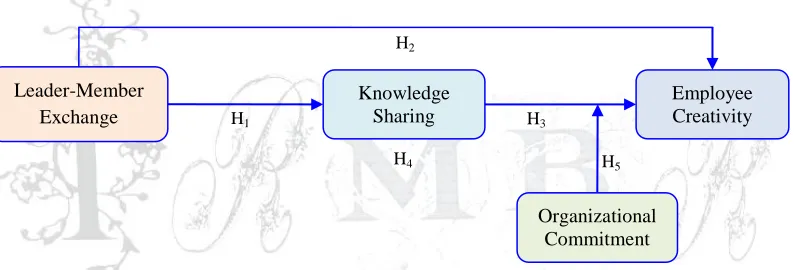
Based on the literature review and hypotheses development, the research model for this study is shown in Figure 1. Overall, the present model is expected to contribute to an understanding of how leader-member exchange effects on knowledge sharing and their employee creativity; knowledge sharing plays key role as mediation; and organizational commitment serves as moderation in four and five star hotels in Cambodia.
Figure 1 Proposed Research Framework of This Study
Research Methods
Sample and Procedure
The sample was drawn from employees, supervisors, assistant managers, and managers of four and five star hotels operating in Cambodia. Primary data collection referenced investment destination was conducted through a personal interview technique, which involved two stages. First, e-mail was sent to appointment with HRM managers to discuss about dateline for doing conduct survey. Second, questionnaire survey was given to respondents with explanations. The purposive sampling technique (Cooper & Schindler, 2014) was adopted to select respondents relationships. The questionnaire was distributed to 17 hotels and 590 respondents and total of 353 respondents were responded to the survey questionnaire. However, 11 respondents had to be excluded because their responses were unusable. Finally, a total of 342 respondents from 17 hotels were determined to be usable. The effective responsive rate or yielding was 57.97 percent (342/590). As suggested by Saunders, Saunders, Lewis, and Thornhill (2011), given that the appropriate response rate for “hand-delivered” questionnaires has been found to range between 30 percent and 50 percent, this response rate was viewed as adequate.
Organizational Commitment Knowledge
Sharing
Employee Creativity
Leader-Member
Exchange (LMX)
H1
H2
H3
ISSN: 2306-9007 Sothan (2016) 693
I
www.irmbrjournal.com June 2016I
nternationalR
eview ofM
anagement andB
usinessR
esearchV
ol. 5 Issue.2R
M
B
R
Demographic Information
The following is the basic information for respondents: Of the respondents, 59.94 percent are males, and over 85 percent are older than 24. About 31.87 percent finished high school, 17.54 percent had an association‟s degree, 43.57 percent hold a bachelor‟s degree, and 7.02 percent graduated master‟s degree. About 10.23 percent of respondents are tenured less than 1 year and 16.96 percent of respondents are tenured more than 7 years. In addition, 59.94 percent of respondents are male, and this study suggests that female occupies job lower positions than males despite the equal tenure policy being applied for all organizations in Cambodia.
Measurement Scales
Leader-member exchange (LMX):Five items of LMX adopted by Margaretta (2007), which related to the
statement: “The leader has enough confidence in me that he/ she would defend and justify this decision if I were not to do so.”
Knowledge sharing: We adopted five items developed from Margaretta (2007) for this study, which related to the statement: “I will try to share this expertise from my education or training.”
Employee creativity: Six items of employee creativity‟s questionnaire were operated by Lee and Veasna (2013), which related to the statement: “Employees come up with new and practical ideas.”
Organizational commitment: We measured using three dimensions developed by Allen and Meyer (1990) which consisted of a total of 10 items, as following:
(1) Affective Commitment contained four items related to the statement: “I really feel as if this hotel‟s problems are my own.”
(2) Continuance Commitment contained three items related to the statement: “Staying with this hotel
is a necessity as much as a desire.”
(3) Normative Commitment contained three items related to the statement: “I believe in the value of
remaining loyal to one hotel.”
We adopted a counterbalancing question order with the survey questions arranged non-sequentially to reduce the effect of self-generated validity (Podsakoff, MacKenzie, Lee, & Podsakoff, 2003). To survey in the Cambodian context, original items were translated into Khmer language (Cambodian) by following Brislin‟s (1980) translation-back-translation procedure to validate the meanings of measurement items. All items of questionnaire were measured on a-5 point Likert scale (i.e., from 1=strongly disagree to 5=strongly agree). The Cronbach‟s alpha reliability for this study is addressed in Table 1.
Data Analysis and Results
Measurement Model Analysis
ISSN: 2306-9007 Sothan (2016) 694
I
www.irmbrjournal.com June 2016I
nternationalR
eview ofM
anagement andB
usinessR
esearchV
ol. 5 Issue.2R
M
B
R
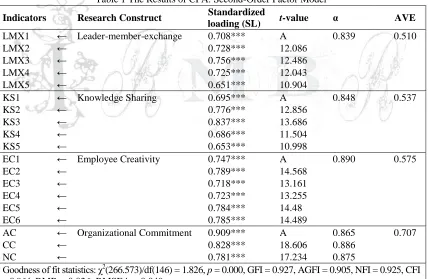
acceptable: Chi-square/degree of freedom (χ2/df) < 2; Goodness-of-fit (GFI) > 0.90, and Adjusted Goodness-of-fit (AGFI) > 0.90; Root Mean Square Residual (RMR) < 0.05, and p-value > 0.05 (can see in Appendix-2). If needed, some indicators were eliminated due to low factor loading or a possibility of high correlation with other indicator variables (Tabri & Elliott, 2012). The second order models, then, was conducted to analyze the fitness of research constructs which contained multiple factors (i.e., leader-member exchange, knowledge sharing, employee creativity, and organizational commitment) as shown in Table 1 and Figure A5 (Appendix-2). The results of the second-order model were satisfied the threshold as suggested by Hair, Black, Babin, and Anderson (2010); Koufteros et al. (2009), and Chi-square/degree of freedom (χ2/df) < 2; Goodness-of-fit (GFI) > 0.90, and Adjusted Goodness-of-fit (AGFI) > 0.90; Root
Mean Square Residual (RMR) < 0.05.
In confirmatory factor analysis (CFA) and structural equation modeling (SEM), the suggestion that “more is better” both in terms of number of cases (sample size=N) and the number of indicators per factor has still not been substantiated. Accordingly, Bowerman, O'Connell, and Orris (2004) proposed that the appropriate number of respondents should be at least 196. Similarly, structural equation modeling requires a minimum of 200 respondents for effective parameter estimation (Hair et al., 2010). In turn, this study consisted of 4-latent variable (i.e., leader-member exchange, knowledge sharing, employee creativity, and organizational commitment) and 26-questionnaire item, as listed in the measurement scales and Appendix-1. Therefore, based on the above discussions, the valid respondents for this study were 342 respondents.
Table 1 The Results of CFA: Second-Order Factor Model
Indicators Research Construct Standardized
loading (SL) t-value α AVE
LMX1 ← Leader-member-exchange 0.708*** A 0.839 0.510
LMX2 ← 0.728*** 12.086
LMX3 ← 0.756*** 12.486
LMX4 ← 0.725*** 12.043
LMX5 ← 0.651*** 10.904
KS1 ← Knowledge Sharing 0.695*** A 0.848 0.537
KS2 ← 0.776*** 12.856
KS3 ← 0.837*** 13.686
KS4 ← 0.686*** 11.504
KS5 ← 0.653*** 10.998
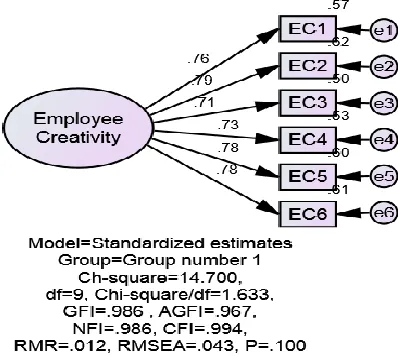
EC1 ← Employee Creativity 0.747*** A 0.890 0.575
EC2 ← 0.789*** 14.568
EC3 ← 0.718*** 13.161
EC4 ← 0.723*** 13.255
EC5 ← 0.784*** 14.48
EC6 ← 0.785*** 14.489
AC ← Organizational Commitment 0.909*** A 0.865 0.707
CC ← 0.828*** 18.606 0.886
NC ← 0.781*** 17.234 0.875
Goodness of fit statistics: χ2(266.573)/df(146) = 1.826, p = 0.000, GFI = 0.927, AGFI = 0.905, NFI = 0.925, CFI
= 0.964, RMR = 0.026, RMSEA = 0.049
Note: N= 342; A= Parameter regression weight is fixed at 1.000; *** p-value < 0.001; ** p-value < 0.01; *p-value < 0.05; and significant level at t-value > 1.96; AVE = Average Variance Extracted.
ISSN: 2306-9007 Sothan (2016) 695
I
www.irmbrjournal.com June 2016I
nternationalR
eview ofM
anagement andB
usinessR
esearchV
ol. 5 Issue.2R
M
B
R
and provide services directly to individuals and not to the other firms). Majumder (2012) collected 88 employee responses from 20 private commercial banks in Bangladesh. Hon et al. (2013) used multi-source data from a total of 265 full-time Chines employees working in hotel industry in Beijing, China, in order to analyzed hypotheses in their study. So that, a total of 342 valid questionnaires were determined to be usable for this study, and SEM and hierarchical regression analysis were used to test the hypothesized relationships. Moreover, due to the fact that research framework contains multiple factors of each research construct in order to fit into the latent research constructs, we then averaged the mean scores of organizational commitment to analyze the overall appropriateness of the second order CFA (see Table 1 and Apendix-2) and SEM (see Figure A6), respectively. The results shown in Table 1 indicated that there is overall goodness-of-fit satisfied the relevant threshold (i.e., χ2(266.573)/df(146) = 1.826, p = 0.000, GFI = 0.927, AGFI = 0.905, NFI = 0.925, CFI = 0.964, RMR = 0.026, RMSEA = 0.049). These results demonstrated that our research model held good fit to the data, with adequate convergent validity and construct reliability (Hair et al., 2010). The descriptive statistics, including the means, standard deviations, and correlations among the research variables are reported in Table 2. Convergent validity was demonstrated, as the average variance extracted (AVE) values for all research constructs was higher than the suggested threshold value of 0.50 (Fornell & Larcker, 1981). Discriminant validity was determined by comparing the square root of the AVE with the Pearson correlations among the constructs (see Table 2). All AVE estimated from Table 1 can be seen to be greater than the corresponding inter-construct square correlation estimated in Table 2.
Table 2 Descriptive Statistics and Correlation Matrix among Research Constructs
Research Constructs Mean Std.
Deviation 1 2 3 4
1. Leader-Member Exchange 4.347 0.623 0.714
2. Knowledge Sharing 4.368 0.639 0.523** 0.733
3. Employee Creativity 4.300 0.638 0.557** 0.660** 0.758
4. Organizational Commitment 4.334 0.569 0.494** 0.412** 0.470** 0.841
Note: N= 342; ** Correlation is significant at the 0.01 level (2-tailed); * Correlation is significant at the 0.05 level (2-tailed); Pearson Correlation Test is used; Square root of AVE appears as bold numbers along with diagonal.
Finally, the results shown in Table 2 indicated that correlations among the research variables exceeded 0.50, which suggested higher relative correlations; therefore, a CFA was conducted to assess the distinctiveness of the research variables for leader-member exchange (LMX), knowledge sharing, employee creativity, and organizational commitment, respectively.
Hypotheses Testing
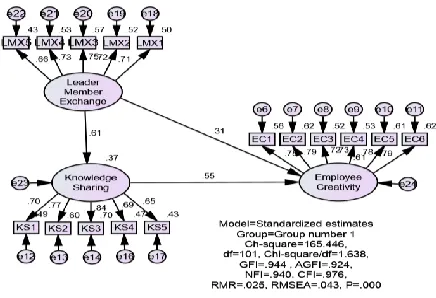
To test the hypotheses H1, H2, H3, and H4, structural equation modeling (SEM) was applied using the likelihood estimation method. The latent variables were adopted in order to proceed with SEM (Anderson & Gerbing, 1988). The results illustrated that the model fit statistics were acceptable: χ2(165.446)/df(101) =
1.638, p = 0.000, GFI = 0.944, AGFI = 0.924, NFI = 0.940, CFI = 0.976, RMR = 0.025, RMSEA = 0.043
(see Table 3 and Figure A6), indicating that the proposed model was satisfactory (Hair et al., 2010).
The SEM path coefficients showed leader-member exchange (LMX) to be positively significant related to knowledge sharing (γH1 = 0.609; t = 8.374; p < 0.001), and employee creativity (γH2 = 0.306; t = 4.695; p <
0.001), respectively. Knowledge sharing is not only found to be positively and significantly related to employee creativity (βH3 = 0.555; t = 7.584; p < 0.001), but also positively mediated the relationship
between leader-member exchange and employee creativity (γH4 = 0.338; z = 5.550; p < 0.001). Therefore,
ISSN: 2306-9007 Sothan (2016) 696
I
www.irmbrjournal.com June 2016I
nternationalR
eview ofM
anagement andB
usinessR
esearchV
ol. 5 Issue.2R
M
B
R
Table 3 The Results of Coefficient Path Relationships
Path Relationships Standardized
Coefficient t-value
H1: Leader-Member Exchange → Knowledge Sharing 0.609*** 8.374
H2: Leader-Member Exchange → Employee Creativity 0.306*** 4.695
H3: Knowledge Sharing → Employee Creativity 0.555*** 7.584
Mediating effect z-test
H4: Leader-Member Exchange → Knowledge Sharing → Employee Creativity 0.338*** 5.550
Goodness of fit statistics: χ2(165.446)/df(101) = 1.638, p = 0.000, GFI = 0.944, AGFI = 0.924, NFI = 0.940,
CFI = 0.976, RMR = 0.025, RMSEA = 0.043
Note: N= 342; *** p-value < 0.001; ** p-value < 0.01; *p-value < 0.05; and significant level at t-value > 1.96.
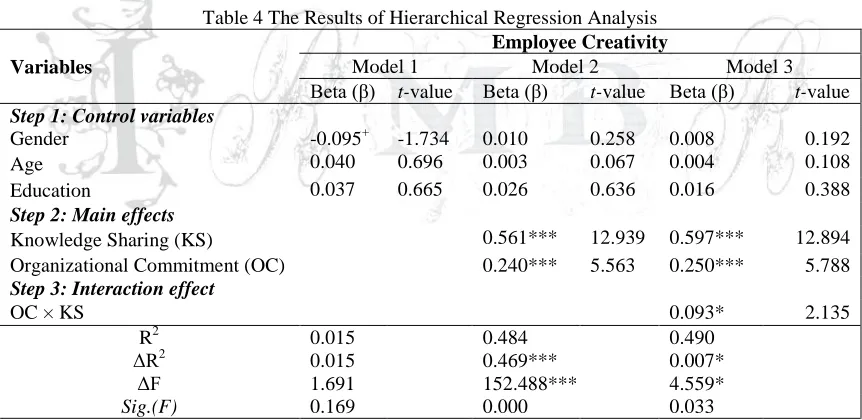
In addition, to test moderating effect (hypothesis H5), hierarchical regression analysis was adopted in this study. The use of a hierarchical regression can allow the retention of the continuous nature of variables without losing information or reducing the power to detect interaction effects (Aiken, West, & Reno, 1991; Cohen, Cohen, West, & Aiken, 2013; Crown, 1998). However, there is the possibility that variables might correlate with each other (high multicollinearity) (Lee & Sukoco, 2010), so a centering method was applied to reduce these effects (Fox, Spector, & Miles, 2001; Frazier, Tix, & Barron, 2004), and all independent variables were averaged as mean-centered. The cutoff criteria for hierarchical regression should be R-square (R2) > 0.10, and marginal change of ΔR2 and F-value (ΔF) should be significant at t-value > 1.96 with p -value < 0.05, suggested by Keith (2015); Byrne (2013); and Hair et al. (2010).
Table 4 The Results of Hierarchical Regression Analysis
Variables
Employee Creativity
Model 1 Model 2 Model 3
Beta (β) t-value Beta (β) t-value Beta (β) t-value
Step 1: Control variables
Gender -0.095+ -1.734 0.010 0.258 0.008 0.192
Age 0.040 0.696 0.003 0.067 0.004 0.108
Education 0.037 0.665 0.026 0.636 0.016 0.388
Step 2: Main effects
Knowledge Sharing (KS) 0.561*** 12.939 0.597*** 12.894
Organizational Commitment (OC) 0.240*** 5.563 0.250*** 5.788
Step 3: Interaction effect
OC × KS 0.093* 2.135
R2 0.015 0.484 0.490
ΔR2 0.015 0.469*** 0.007*
ΔF 1.691 152.488*** 4.559*
Sig.(F) 0.169 0.000 0.033
Note: N=342; An Enter Method was used to produce the results; ***p-value < 0.001; **p-value < 0.01; *
p-value < 0.05; +p-value < 0.10; significant level at t-value > 1.96.
ISSN: 2306-9007 Sothan (2016) 697
I
www.irmbrjournal.com June 2016I
nternationalR
eview ofM
anagement andB
usinessR
esearchV
ol. 5 Issue.2R
M
B
R
Figure 2 The Results of Hypothesized Model
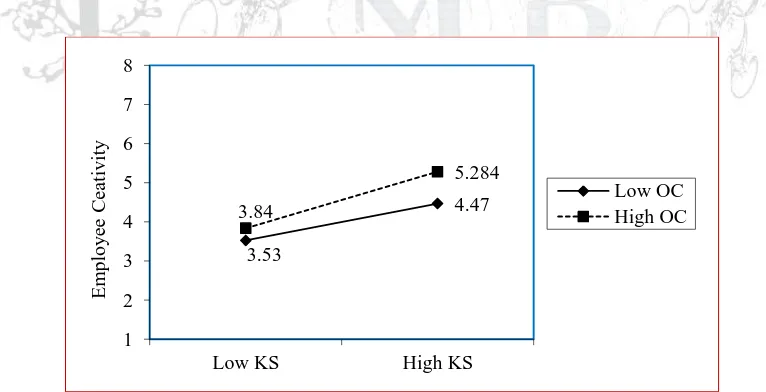
The procedure of Aiken et al. (1991) and Cohen et al. (2013) are described as following. Figure 3 demonstrated that the moderating effect of organizational commitment on relationship between knowledge sharing and employee creativity. The figure indicated that employee creativity in this sample slope with higher levels of organizational commitment (i.e., Ŷ = 5.284), and higher knowledge sharing tended to achieve the highest level of employee creativity. As predicted, employee creativity with higher level of knowledge sharing but lower level of organizational commitment (i.e., Ŷ = 4.47) tended to have lower level of employee creativity. However, in this study, employee creativity with higher level of organizational commitment (i.e., Ŷ = 3.84) but lower level of knowledge sharing tended to have the lower level of employee creativity. Employee creativity with low level of organizational commitment (i.e., Ŷ = 3.53) and lower level of knowledge sharing tended to have the lowest level of knowledge sharing. Those with the lower levels of organizational commitment and lower levels of knowledge sharing also exhibited lower levels of employee creativity. These results suggested that the organizational commitment can enhance employee creativity in situations in which there is higher knowledge sharing.
Figure 3 Two-way Interaction
Discussion and Implication
A total of five hypotheses were developed in this study. The structural equation model and hierarchical regression analysis were adopted to test the hypotheses. These hypotheses were tested with the results as shown in Table 5. As shown in Table 5, the discussion of findings from testing the hypotheses is presented in the following:
3.53
4.47 3.84
5.284
1 2 3 4 5 6 7 8
Low KS High KS
E
m
p
lo
y
ee
C
ea
tiv
ity
Low OC High OC Organizational
Commitment Knowledge
Sharing
Employee Creativity
Leader-Member
Exchange (LMX)
0.609***
0.306***
0.555***
ISSN: 2306-9007 Sothan (2016) 698
I
www.irmbrjournal.com June 2016I
nternationalR
eview ofM
anagement andB
usinessR
esearchV
ol. 5 Issue.2R
M
B
R
Table 5 The Empirical Results of Hypotheses Testing
Hypotheses development Results
H1: Leader-member exchange has positive influence on knowledge sharing. Supported
H2: Leader-member exchange has positive influence on employee creativity. Supported
H3: Knowledge sharing has positive influence on employee creativity. Supported
H4: Knowledge sharing is positively mediated on the relationship between leader-member exchange and employee creativity.
Partially Supported
H5: Organizational commitment is positively moderated the relationship between knowledge sharing and employee creativity.
Supported
The results of this study indicated that LMX makes significantly positive contributions to knowledge sharing and employee creativity, respectively. These results are in line with Farzaneh Hassanzadeh (2014), who reported LMX to be positively and significantly related to knowledge sharing and creative work environment in insurance companies; and concluded that leaders in the organization are in positions to help overcome the fare knowledge sharing among employees by enforcing a context of cooperation and structure of organization. So that leaders will be effective in a variety of cross-cultural environments and can be assigned to hotel assignments of varying complexity. The present study also revealed that leaders contribute to knowledge sharing and positive creativity of their subordinates in hotel industries, which are highly valuable for organizations and crucial for individual career development. Moreover, the research findings also demonstrated that the direct relationship between knowledge sharing and employee creativity was found in this study. The findings of this study conclude that greater use of knowledge sharing would push the employees more committed to create new idea for developing the product or service of the hotel industry, Cambodian context. This finding goes along with the prior studies, such as Nonaka, Von-Krogh, and Voelpel (2006) which concluded that the critical function of knowledge sharing is that of maintaining an inter-organizational mechanism for employees‟ on-going innovation. The result also illustrated that knowledge sharing only partially mediates the relationship between leader-member exchange and employee creativity. This finding is consistent with the previous studies, such as Farzaneh Hassanzadeh (2014) which found that knowledge sharing was partially mediated between LMX and creative work involvement. In conception, the high quality of LMX (supervisor-employee relationships) promotes creativity of employees and perceived expectation of leader impact on individual‟s creative involvement at work place. Finally, organizational commitment is positively and significantly moderated the relationship between knowledge sharing and employee creativity was found in this study. The result shown in Figure 3 indicated that employees are more creative with high levels of organizational commitment and knowledge sharing and in contrast, employees are less creative when low levels of organizational commitment and knowledge sharing. That is, hotel organization can enhance employee‟s commitment to share their knowledge for creating involvement at work place.
An extension of the research framework of LMX and knowledge sharing to employee creativity; mediating effect of knowledge sharing; and moderating effect of organizational commitment may provide significant contributions to both organizations and academics by offering them valuable directions that contributes to helping employees complete their knowledge and assignments effectively. Based on the results of this study, it is assumed that LMX plays very critical roles in enhancing employees‟ knowledge sharing and their creativity. This study also suggests leaders should build positive relationship with subordinates who can to foster their employees‟ willingness to share knowledge to team and organization. Moreover, leaders can motivate and enhance employees‟ knowledge and their creativity so that they are more willing to learn, share, and face knowledge challenges in order to be better adjusted and to achieve higher performance in their work place through their creativity.
ISSN: 2306-9007 Sothan (2016) 699
I
www.irmbrjournal.com June 2016I
nternationalR
eview ofM
anagement andB
usinessR
esearchV
ol. 5 Issue.2R
M
B
R
future research. First, this study was examined to 17-four and five star hotel industries in Cambodia area and can‟t be extended to other companies in different industry. Second, questionnaire distributed to the same source, which may have the common method bias. Third, it was lack of literature review and empirical studies of the mediation of knowledge sharing and moderation of organizational commitment to support this study. Therefore, in the future research can try to collect data from others industries and countries to compare this results.
However, this study can prove that LMX plays as key roles in hotel organization to increase their employees‟ willingness to share their knowledge and create new idea for producing the hotels‟ products and services.
Acknowledgements
The author gratefully thanks enlightening comments and suggestions by Professor Li Baoku, Ph.D. who serves as a proofreading at Liaoning Technical University and anonymous reviewers from IRMBR which
noticeable improved the quality of this manuscript.
References
Aiken, L. S., West, S. G., & Reno, R. R. (1991). Multiple regression: Testing and interpreting interactions: Newbury Park, Sage. CA.
Allen, N. J., & Meyer, J. P. (1990). The measurement and antecedents of affective, continuance and
normative commitment to the organization. Journal of occupational psychology, 63(1), 1-18.
Anderson, J. C., & Gerbing, D. W. (1988). Structural equation modeling in practice: A review and
recommended two-step approach. Psychological bulletin, 103(3), 411.
Barbuto Jr, J. E., & Gifford, G. T. (2012). Motivation and leader-member exchange: Evidence counter to similarity attraction theory. Leadership & Entrepreneurship| Virginia Beach, VA, 18.
Bartol, K. M., & Srivastava, A. (2002). Encouraging knowledge sharing: The role of organizational reward systems. Journal of Leadership & Organizational Studies, 9(1), 64-76.
Bowerman, B. L., O'Connell, R. T., & Orris, J. B. (2004). Essentials of business statistics (3rd ed.). New York: McGraw-Hill/Irwin.
Brislin, R. W. (1980). Translation and content analysis of oral and written material. Handbook of cross-cultural psychology, 2(2), 349-444.
Byrne, B. M. (2013). Structural equation modeling with AMOS: Basic concepts, applications, and
programming: Routledge.
Cabrera, E. F., & Cabrera, A. (2005). Fostering knowledge sharing through people management practices.
The International Journal of Human Resource Management, 16(5), 720-735.
Carley, K. M. (1997). Extracting team mental models through textual analysis. Journal of Organizational
Behavior, 18(s 1), 533-558.
Carmeli, A., Atwater, L., & Levi, A. (2011). How leadership enhances employees‟ knowledge sharing: the intervening roles of relational and organizational identification. The Journal of Technology Transfer, 36(3), 257-274.
Cohen, J., Cohen, P., West, S. G., & Aiken, L. S. (2013). Applied multiple regression/correlation analysis for the behavioral sciences: Routledge.
Cooper, D. R., & Schindler, P. S. (2014). Business research methods (12th ed.). New York: McGraw-hill Crown, W. H. (1998). Statistical models for the social and behavioral sciences: Multiple regression and
limited-dependent variable models (1st ed.). United States of America: Greenwood Publishing Group.
ISSN: 2306-9007 Sothan (2016) 700
I
www.irmbrjournal.com June 2016I
nternationalR
eview ofM
anagement andB
usinessR
esearchV
ol. 5 Issue.2R
M
B
R
Farzaneh Hassanzadeh, J. (2014). Leader-member exchange, Creative work involvement: The Importance
of knowledge sharing. Iranian Journal of Management Studies, 7(2), 391-412.
Fisk, G. M., & Friesen, J. P. (2012). Perceptions of leader emotion regulation and LMX as predictors of followers' job satisfaction and organizational citizenship behaviors. The Leadership Quarterly, 23(1), 1-12.
Fornell, C., & Larcker, D. F. (1981). Evaluating structural equation models with unobservable variables
and measurement error. Journal of marketing research, 39-50.
Fox, S., Spector, P. E., & Miles, D. (2001). Counterproductive work behavior (CWB) in response to job stressors and organizational justice: Some mediator and moderator tests for autonomy and emotions.
Journal of Vocational Behavior, 59(3), 291-309.
Frazier, P. A., Tix, A. P., & Barron, K. E. (2004). Testing moderator and mediator effects in counseling
psychology research. Journal of counseling psychology, 51(1), 115.
Gagné, M. (2003). The role of autonomy support and autonomy orientation in prosocial behavior
engagement. Motivation and emotion, 27(3), 199-223.
Gagné, M. (2009). A model of knowledge‐sharing motivation. Human Resource Management, 48(4),
571-589.
Godin, G., & Kok, G. (1996). The theory of planned behavior: a review of its applications to health-related behaviors. American journal of health promotion, 11(2), 87-98.
Graen, G. B., & Uhl-Bien, M. (1998). Relationship-based approach to leadership: Development of Leader–
Member Exchange (LMX) theory of leadership over 25 years: Applying a multi-level multi-domain
perspective.
Hair, J. F., Black, W. C., Babin, B. J., & Anderson, R. E. (2010). Multivariate data analysis (7th ed.). New Jersey: Pearson Prentice Hall.
Hon, A. H. (2011). Enhancing employee creativity in the Chinese context: The mediating role of employee
self-concordance. International Journal of Hospitality Management, 30(2), 375-384.
Hon, A. H., Chan, W. W., & Lu, L. (2013). Overcoming work-related stress and promoting employee creativity in hotel industry: The role of task feedback from supervisor. International Journal of Hospitality Management, 33, 416-424.
Iverson, R. D., & Buttigieg, D. M. (1999). Affective, normative and continuance commitment: can the
„right kind‟of commitment be managed? Journal of Management Studies, 36(3), 307-333.
Jafri, M. H. (2010). Organizational commitment and employee's innovative behavior: A study in retail sector. Journal of Management Research, 10(1), 62.
Keith, T. Z. (2015). Multiple Regression and Beyond: An Introduction to Multiple Regression and
Structural Equation Modeling (2nd ed.). New York: Routledge.
Kim, M.-S., & Hunter, J. E. (1993). Relationships Among Attitudes, Behavioral Intentions, and Behavior A
Meta-Analysis of Past Research, Part 2. Communication research, 20(3), 331-364.
Koufteros, X., Babbar, S., & Kaighobadi, M. (2009). A paradigm for examining second-order factor
models employing structural equation modeling. International Journal of Production Economics,
120(2), 633-652.
Lee, L.-Y., & Sukoco, B. M. (2010). The effects of cultural intelligence on expatriate performance: The
moderating effects of international experience. The International Journal of Human Resource
Management, 21(7), 963-981.
Lee, L.-Y., & Veasna, S. (2013). The Effects of Social Exchange Perspective on Employee Creativity: A Multilevel Investigation. Psychology Research, 3(11), 660.
Lo, M.-C., Ramayah, T., Min, H. W., & Songan, P. (2010). The relationship between leadership styles and
organizational commitment in Malaysia: role of leader–member exchange. Asia Pacific business
review, 16(1-2), 79-103.
Lu, L., Leung, K., & Koch, P. T. (2006). Managerial knowledge sharing: The role of individual,
interpersonal, and organizational factors. Management and Organization Review, 2(1), 15-41.
Ma, Y., Cheng, W., Ribbens, B. A., & Zhou, J. (2013). Linking ethical leadership to employee creativity:
Knowledge sharing and self-efficacy as mediators. Social Behavior and Personality: an international
ISSN: 2306-9007 Sothan (2016) 701
I
www.irmbrjournal.com June 2016I
nternationalR
eview ofM
anagement andB
usinessR
esearchV
ol. 5 Issue.2R
M
B
R
Madhoushi, M., Sadati, A., Delavari, H., Mehdivand, M., & Mihandost, R. (2011). Entrepreneurial
orientation and innovation performance: The mediating role of knowledge management. Asian
Journal of Business Management, 3(4), 310-316.
Majumder, M. T. H. (2012). Human resource management practices and employees‟ satisfaction towards private banking sector in Bangladesh. International Review of Management and Marketing, 2(1), 52-58.
Margaretta, H. (2007). Multilevel Investigation of Employee’s Knowledge Sharing: A Case of a
Telecommunication Company in Indonesia(Master's thesis). National Cheng Kun Univeristy, Taiwan Meyer, J. P., Stanley, D. J., Jackson, T. A., McInnis, K. J., Maltin, E. R., & Sheppard, L. (2012). Affective,
normative, and continuance commitment levels across cultures: A meta-analysis. Journal of
Vocational Behavior, 80(2), 225-245.
Nelson, K. M., & Cooprider, J. G. (1996). The contribution of shared knowledge to IS group performance.
MIS quarterly, 409-432.
Nonaka, I., Von-Krogh, G., & Voelpel, S. (2006). Organizational knowledge creation theory: Evolutionary paths and future advances. Organization studies, 27(8), 1179-1208.
Pepall, L., Richards, D. J., & Norman, G. (2005). Industrial organization: contemporary theory and practice: Thomson/South-Western.
Podsakoff, P. M., MacKenzie, S. B., Lee, J.-Y., & Podsakoff, N. P. (2003). Common method biases in behavioral research: a critical review of the literature and recommended remedies. Journal of Applied Psychology, 88(5), 879.
Saunders, M. N., Saunders, M., Lewis, P., & Thornhill, A. (2011). Research methods for business students
(5th ed.). India: Pearson Education
Scott, S. G., & Bruce, R. A. (1994). Determinants of innovative behavior: A path model of individual
innovation in the workplace. Academy of Management journal, 37(3), 580-607.
Shalley, C. E., & Gilson, L. L. (2004). What leaders need to know: A review of social and contextual factors that can foster or hinder creativity. The Leadership Quarterly, 15(1), 33-53.
Tabri, N., & Elliott, C. M. (2012). Principles and practice of structural equation modeling. Canadian Graduate Journal of Sociology and Criminology, 1(1), 59-60.
Tierney, P., Farmer, S. M., & Graen, G. B. (1999). An examination of leadership and employee creativity: The relevance of traits and relationships. Personnel Psychology, 52(3), 591-620.
Tong, C., Tak, W. I. W., & Wong, A. (2015). The Impact of knowledge sharing on the relationship between organizational culture and Job satisfaction: The perception of information communication and technology (ICT) practitioners in Hong Kong. International Journal of Human Resource Studies, 5(1), 19-47.
Van den Hooff, B., & De Ridder, J. A. (2004). Knowledge sharing in context: the influence of organizational
commitment, communication climate and CMC use on knowledge sharing. Journal of knowledge
management, 8(6), 117-130.
Van Dyne, L., Jehn, K. A., & Cummings, A. (2002). Differential effects of strain on two forms of work
performance: Individual employee sales and creativity. Journal of Organizational Behavior, 23(1),
57-74.
Volmer, J., Spurk, D., & Niessen, C. (2012). Leader–member exchange (LMX), job autonomy, and creative
work involvement. The Leadership Quarterly, 23(3), 456-465.
Yousef, D. A. (2000). Organizational commitment: a mediator of the relationships of leadership behavior
with job satisfaction and performance in a non-western country. Journal of Managerial Psychology,
15(1), 6-24.
Yukl, G. (1989). Managerial leadership: A review of theory and research. Journal of Management, 15(2),
ISSN: 2306-9007 Sothan (2016) 702
I
www.irmbrjournal.com June 2016I
nternationalR
eview ofM
anagement andB
usinessR
esearchV
ol. 5 Issue.2R
M
B
R
Appendix
Appendix-1 Index Questionnaires
Leader-Member Exchange (α = 0.839; AVE = 0.510)
(1) I usually know where I stand with the leader.
(2) The leader understands this problems and needs.
(3) The leader has enough confidence in me that he/ she would defend and justify this decision if I
were not to do so.
(4) The leader recognizes this potential.
(5) The leader often consults me on strategic decisions.
Knowledge Sharing (α = 0.848; AVE = 0.537)
(1) I will try to share this expertise from my education or training.
(2) I will share this expertise or know-how from work in the future.
(3) I will share this work reports and official documents.
(4) I will always provide this manuals, methodologies and models.
(5) I always provide this know-where or know-whom at the request.
Employee Creativity (α = 0.890; AVE = 0.575)
(1) Employees come up with new and practical ideas.
(2) Employees exhibit creativity on the job.
(3) Employees often have a fresh approach to problems.
(4) Employees promote and champion ideas to others.
(5) Employees develop new ideas and knowledge.
(6) Employees develop new ideas and knowledge.
Organizational Commitment
Affective commitment (α = 0.865; AVE = 0.618)
(1) I really feel as if this hotel‟s problems are my own. (2) I do feel “emotionally attached” to this hotel. (3) I do feel like “part of the family” at this hotel. (4) I do feel a strong sense of belonging to this hotel.
Continuance commitment (α = 0.886; AVE = 0.725)
(1) Staying with this hotel is a necessity as much as a desire.
(2) It would be very hard for me to leave this hotel right now.
(3) It would be too costly for me to leave this hotel in the near future.
Normative commitment (α = 0.875; AVE = 0.708)
(1) I believe in the value of remaining loyal to one hotel.
ISSN: 2306-9007 Sothan (2016) 703
I
www.irmbrjournal.com June 2016I
nternationalR
eview ofM
anagement andB
usinessR
esearchV
ol. 5 Issue.2R
M
B
R
Appendix-2 Index Figures
Figure A1 CFA: First-Order Model of Leader-Member Exchange
Figure A2 CFA: First-Order Model of Knowledge Sharing
ISSN: 2306-9007 Sothan (2016) 704
I
www.irmbrjournal.com June 2016I
nternationalR
eview ofM
anagement andB
usinessR
esearchV
ol. 5 Issue.2R
M
B
R
Figure A4 CFA: First-Order Model of Organizational Commitment
Figure A5 CFA: Second-Order Model of the Overal