ISSN 2373-7662 (Print) 2373-7670 (Online) Copyright © The Author(s). 2014. All Rights Reserved. Published by American Research Institute for Policy Development DOI: 10.15640/ijn.v1n2a2 URL: http://dx.doi.org/DOI: 10.15640/ijn.v1n2a2
Development and Preliminary Testing of an on-Line Continuing Education Program for Adjunct Clinical Nursing Faculty
Kimbery Silver Dunker1
Abstract
Background: Almost 80,000 applicants were denied admission to nursing programs due to faculty shortage (2013). Clinical adjuncts are hired to teach, creating a need for competency based orientation and formal mentorship. Methods: The purpose was to pilot an online self-paced Continuing Education Program for Adjunct Clinical Nursing Faculty (CEP-ACNF) program based on the National League for Nursing Nurse Educator;the Quality and Safety in Nursing Education; and Nurse of the Future competencies. The goal was providinginformation and strategies fostering successful role transition for clinical educators. The eight modules include knowledge in nursing education and guidance for clinical settings. Results: The CEP-ACNF was piloted with 63 faculty members over a semester. Demographics, pre-test, posttest, and evaluations were gathered. Improvements to the CEP-ACNF are based on the pilot. Results demonstrated improvement in faculty competency as evaluated through pre and posttest scores. Participants identified the need for formal mentorship in conjunction with the CEP-ACNF.
Keywords: Nursing Faculty, On-line, Orientation, Mentorship, Competencies, QSEN
1. Background and Significance
High quality candidates for nursing faculties are difficult to find, resulting in a faculty shortage (American Association of Colleges of Nursing [AACN], 2008).This shortage makes it difficult for schools of nursing programs to educate nurses in sufficient numbers to contribute to satisfying the need for health care professionals in a variety of positions for young men and women (Jones, 2010; Saad, 2009).
1
DNP, RN, UMASS Graduate School of Nursing Worcester, 55 Lake Ave North, Worcester MA
01655. Email: [email protected], Office: 856-3056, Cell: 937-369-3601, Fax:
The nursing profession has been consistently rated in Gallup polls as highest among several professions for honesty and ethics (Jones, 2010), contributing to the desire of any individuals to earn a degree in nursing. However,79,659 qualified nursing applicants were denied admission into associate and baccalaureate degree nursing programs in 2012-2013 (AACN,2013). Furthermore, 60.9% (n=414) of nursing programs responding to an AACN survey on the faculty shortage citedthe need for 1-29 (average 2.0 FTE) full-time nursing faculty to meet the demands of enrollment (AACN, 2014). The nursing faculty shortage wascited as the primary reason for decreased student enrollments in nursing programs (AACN, 2014), with other reasons including lack of clinical sites, classroom space, and budget constraints (AACN 2009; Ganley & Sheets, 2009).
Ultimately, due to the insufficient number of nursing faculty, nursingprograms are unable to accept more students, which creates long entry waiting lists. Nursing faculty shortage is a serious problem (National League for Nursing [NLN], 2006; 2007; 2009). Academic institutions understand this issue and continue to identify ways to increase enrollments. Faculty are essential to providing quality nursing education and a severe lack of qualified faculty members affects all aspects of nursing enrollment, education, and the quality of nursing programs. Attracting more nurses to teach is imperative. However, finding nurses to teach who are not already infull-time positionsand are available, competent, and flexiblecontinues to be a barrier in recruiting more nurses into academia (West, et al., 2009). Other barriers may include lack of satisfied work environments, workload requirements, and work environment (Bittner& O’Conner, 2012). These are just a few factors that impact the nursing faculty shortage and continue to be barriers for academic institutions torecruit full-time for nursing faculty.
2. Assumptions
In order to swiftly increase the number of nurses entering academia as faculty members, nursingeducation programs must develop strategies to help these novices learn to become educators. Ultimately the goals are to entice these nurses to earn master’s or doctoral degrees and to become full-time faculty (West, et al., 2009). In order to be successful in this undertaking, programs need to shift their focus to faculty development, competency, and scholarly growth in order to help educate these professionals as teaching experts (Kia, 2004).
Not only do we need to increase the number of faculty, but also change the environment of nursing education into one that is nurturing and caring (Schumacher, et al., 2008). For this reason, another solution is to foster and create healthy work environments as a goal to recruit and retain nursing faculty (Brady, 2010).The national league for nursing developed The healthful work environment tool kit©(NLN, 2007).The tool kit and addresses the following nine work-related areas: salaries, benefits, workload, collegial environment, role preparation and professional development, scholarship, institutional support, marketing and recognition, and leadership (2007). Overall, in order to attract nurses to teach in academic institutions, they must be provided with the tools necessary to be successful (Dattilo, Brewer, & Streit, 2009).
3. Orientation and Mentorship
There is limited research on orientation programs for clinical or adjunct faculty. Gazza & Shellenbarger(2005), identified mentoring and orientation as essential for successful enculturation of new staff. However, many faculty members who are hired to teachclinical groups receive only onsite orientation at the clinical agencies(Belle-Schreiber & Morto, 2009). A number of authors have addressed orientation and mentorship programs for full-time faculty who are new to the educator or professor role. However, no literature could be found whose authors discussed orientation for the transition from nurse to nurse educator for the part-time adjunct faculty role.
Another consideration is that ideally experienced nurse professors are available to provide orientation and mentorship to the new faculty.
Making themselves available to mentor and support thenext generation of nursing faculty may view these responsibilities as agift to the profession before they retire. “The future of nursing education, in part, is reliant on how effectively experienced faculty can encourage new professionals to consider nursing education as a viable career option” (Dattilo, et al., 2009, p. 367). Novice nurse educators and seasoned faculty can bring strengths to a nursing program. To preserve the profession, efforts must be made to complement each other’s differences and capitalize collaboratively on the strengths each individual can bring to the faculty unit.
4. Competencies for Nursing Faculty
There are three national initiatives that the principal investigator considered for this project. To ensure nursing faculty competency, the NLN’s task group identifiedeight core competencies for nurse educators (2005). These competencies delineatebehaviors for nurse educators, focused primarily on the academic setting. The NLN competencies include: facilitate learning; facilitate learner development and socialization; use assessment and teaching strategies; participate in curriculum design and evaluation of program outcomes; function as a change agent and leader; pursue continuous quality improvement in the nurse educator role; engage in scholarship; and function within the educational environment. According to the NLN task group, these “ . . .core competencies embody the knowledge, skills and attitudes required of nurse educators and reflect the complexity and richness” (NLN, 2005, p.1) of nursing practice.
These competencies are designed for the advanced practice nurse educator who has earned a master’s degree and is currently teaching full-time in academia. Furthermore: “The competencies are broad in scope, not prescriptive, and do not speak to the curricular content, they may be of limited use to guide faculty in curricular development” (Ruland & Leuner, 2010, p. 249).
For this reason, the elements within the competencies are essential and should be included in the orientation for all faculty members including clinical adjunct nurse faculty who may precept or in other ways contribute to the education ofstudents in nursing.
In 2008, the NLN identified orienting, preparing, and mentoring new clinical faculty as pressing issuesfor clinical nursing education. Although identified as a primary topic of discussion,the report did not discuss how individuals should be oriented as clinical faculty, and what strategies are necessary to help specifically adjunct clinical faculty transform into competent faculty members(NLN, 2009).In concluding the faculty report, the NLN authors agree that full-time academic faculty members need orientation;however the specific needs for clinical adjunct faculty and strategies to orient them to their new role were not discussed.
Inresponse to the Institute of Medicine (IOM) report in 2005 the QSEN (Quality and Safety Education for Nurses) competencieswere developed. The Robert Wood Johnson Foundation (RWJF) funded identification and development of the competencies with the overall goals to address the challenge in preparing future nurses with the knowledge, skills and attitudes necessary to continuously improve the quality and safety of the healthcare systems in which these educators work (QSEN, 2012).
Therefore, all clinical faculty members,as extensions of their academic institutions, must be oriented on how to address the competencies prior to bringing students intoclinical settings.
However, in the nursing education literature, nospecific orientation plan existsthat includes education about these competencies for clinical adjunct faculty.
In 2006, the Massachusetts Department of Higher Education (DHE) and the Massachusetts Organization of Nurse Executives (MONE) created Nurse of the Future (NOF) Competencies, and identified core competencies and the knowledge, attitudes, and skills associated with developing future nurses to practice patient safety and improve patient care. These competencies resulted in the creation of practice partnerships between nursing education and practice settings. The ten competencies include patient centered care, professionalism, informatics and technology, evidence-based practice (EBP), leadership, systems-evidence-based practice, safety, communication, teamwork and collaboration, and quality improvement (Nurse of the Future Nursing Core Competencies, 2006). Like the QSEN competencies, the goal is to infuse these into nursing curriculumsboth in theory and clinical practice. Therefore, including the NOF competencies in orientation of clinical faculty is essential.
5. Clinical Faculty Development and Orientation
Information in the literature is scarce on how to provide adjunct clinical faculty with the tools necessary to teach. There is much debate on the minimal education and preparation for clinical faculty members (Bartels, 2007), but little information on specifics of orientation.
One school developed a clinical institute composed of one full orientation day, a three-credit master’s course, and a semester of mentored clinical instruction, as well as hospital orientation.
This institute was funded through grant money used to fund mentorships for the new educators to promote growth in the clinical instructor role. This institute was established for full-time faculty and did not address part time adjunct clinical faculty (Bell-Schriber & Morton, 2009).
Authors of another article discussed clinical faculty orientation comprised of a 16-hour unit orientation wherein the faculty members were partnered with staff members and given a self-learning guide to assist them in their orientation. This model also included a two-day orientation presentation, including discussion of educational, operational, legal, and ethical considerations when instructing students. Although 81% of the faculty were satisfied with their orientation, it did not address competency based needs for the faculty and did not provide or outline ongoing support through the entire semester (Hutchinson, et al., 2011).
6. On-line RN Faculty Development Continuing Education Program (CEP-ACNF)
The on-line RN faculty development continuing education program (CEP-ACNF) was designed to provide information and develop the skills of new clinical adjunct faculty for teaching in clinical setting settings. The purpose of this pilot was to evaluate the CEP-ACNFfor effectiveness through offering a free on-line clinical faculty development program in a self-paced format.
The primary aim of this pilot was to inviteexperienced nurse faculty to complete the CEP-ACNF program and evaluate the modules, content, and information. Eight clinical nursing faculty modules were designed and created to provide novice clinical faculty with a beginning foundation as they transition into their new role.
The priority content within the modules was developed based on the triad of competencies: the National League for Nursing (2005) Nurse Educator Competencies, National League for Nursing (2005); the Quality and Safety in Nursing Education (QSEN)
Competencies; (IOM, 2005); and Nurse of the Future (NOF)Core Competencies (2006). Table
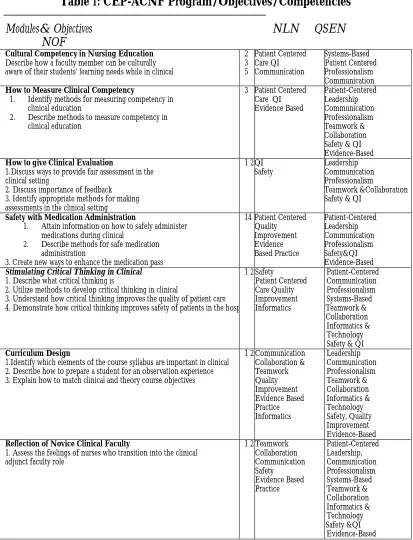
one presents the CEP-ACNF program modules, objectives, and the NOF, QSEN, and NLN competencies these address.
Table 1: CEP-ACNF Program/Objectives/Competencies
Modules& Objectives NLN QSEN
NOF
Cultural Competency in Nursing Education
Describe how a faculty member can be culturally aware of their students’ learning needs while in clinical
2 3 5 Patient Centered Care QI Communication Systems-Based Patient Centered Professionalism Communication
How to Measure Clinical Competency
1. Identify methods for measuring competency in
clinical education
2. Describe methods to measure competency in
clinical education
3 Patient Centered Care QI Evidence Based Patient-Centered Leadership Communication Professionalism Teamwork & Collaboration Safety & QI Evidence-Based
How to give Clinical Evaluation
1.Discuss ways to provide fair assessment in the clinical setting
2. Discuss importance of feedback 3. Identify appropriate methods for making assessments in the clinical setting
1 2 3QI
Safety
Leadership Communication Professionalism Teamwork &Collaboration Safety & QI
Safety with Medication Administration
1. Attain information on how to safely administer
medications during clinical
2. Describe methods for safe medication
administration
3. Create new ways to enhance the medication pass
14 Patient Centered Quality Improvement Evidence Based Practice Patient-Centered Leadership Communication Professionalism Safety&QI Evidence-Based
Stimulating Critical Thinking in Clinical
1. Describe what critical thinking is
2. Utilize methods to develop critical thinking in clinical
3. Understand how critical thinking improves the quality of patient care 4. Demonstrate how critical thinking improves safety of patients in the hospital
1 2 4 6 8Safety
Patient Centered Care Quality Improvement Informatics Patient-Centered Communication Professionalism Systems-Based Teamwork & Collaboration Informatics & Technology Safety & QI
Curriculum Design
1.Identify which elements of the course syllabus are important in clinical 2. Describe how to prepare a student for an observation experience 3. Explain how to match clinical and theory course objectives
1 2 3 4 5 6 7 8Communication
Collaboration & Teamwork Quality Improvement Evidence Based Practice Informatics Leadership Communication Professionalism Teamwork & Collaboration Informatics & Technology Safety, Quality Improvement Evidence-Based
Reflection of Novice Clinical Faculty
1. Assess the feelings of nurses who transition into the clinical adjunct faculty role
1 2 3 4 5 6 7 8Teamwork
Note. NLN = National League of Nursing Nurse Educator; QSEN = Quality and Safety in Nursing Education; NOF = Nurse of the Future; QI = Quality improvement aNumbers refer to the eight NLN competencies: 1) facilitate learning,2) facilitate learner development and socialization,3) use assessment and teaching strategies,4) participate in curriculum design and evaluation of program outcomes,5) function as a change agent and leader,6) pursue continuous quality improvement in the nurse educator role,7) engage in scholarship, and 8) function within the educational environment
The modules are meant to be stand-alone and may be completed in any orderso that the faculty member can complete them as topics and issues arise in the clinical setting. Therefore, faculty who participated in the pilot decided in which priority they completed the modules based on their own clinical experiences as novice faculty members. Lastly, each module contains video vignettes, whichare short-segmented,and allow the individual to complete the module in an efficient manner, while clearly understanding the content within the module.
7. Implementation of the RN Nursing Faculty Development Continuing Education Program (CEP-ACNF)
The purpose of this pilot was to evaluate the CEP-ACNF for effectiveness and also to offer 7.5 AACN approved continuing education credits to faculty who participated. Faculty members were invited to participate in the pilot of the CEP-ACNF by word of mouth and utilizing the snowball effect. Because no inclusion or exclusion criteria were maintained for this pilot, as a result individuals who were recruited were mainly experienced nursing faculty.
After faculty registered for the CEP-ACNF, they were prompted tocomplete an anonymous demographic information intake form and take a pretest. The anonymous demographic information was gathered solely to assess the knowledge gained, make improvements to the project, and elicit feedback on the program.By completing the demographic worksheet and pre-test, consent to participate in the pilot was implied.
8. Findings from the Pilot Study
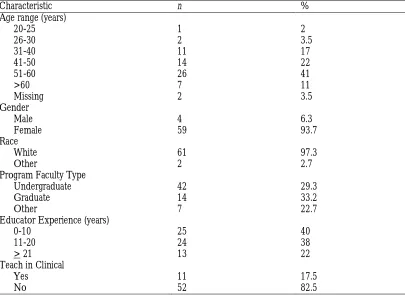
The feedback from evaluations, and the pre and posttestswasassessed to ensure that the program was effective in providing clinical faculty with orientation and essential information to transition into the clinical faculty role. The aggregate data were examined to be displayed only as educational materials for conferences and papers to address the topics of this clinical faculty development program. The final sample size was 63 nurse educators is included on Table 2.The sample was homogeneous in several socio-demographic variables including: female gender (93.7%);Caucasian (87.3%); age < 50 (49.2%); and age > 51 years (50.7%). Table 2 presents the analysis of the demographics, frequencies, and percentages.
Table 2: Demographic Characteristics of Participating Nursing Faculty
Characteristic n %
Age range (years)
20-25 1 2
26-30 2 3.5
31-40 11 17
41-50 14 22
51-60 26 41
>60 7 11
Missing 2 3.5
Gender
Male 4 6.3
Female 59 93.7
Race
White 61 97.3
Other 2 2.7
Program Faculty Type
Undergraduate 42 29.3
Graduate 14 33.2
Other 7 22.7
Educator Experience (years)
0-10 25 40
11-20 24 38
> 21 13 22
Teach in Clinical
Yes 11 17.5
No 52 82.5
It was, however, a good way to elicit feedback from experienced faculty, which helped to provide insights into the design of the CEP-ACNF.
However, in the future use of the CEP-ACNF,it would be important to conduct a second pilot utilizing inclusion and exclusion criteria for this target population. The CEP-ACNF was created and designed for novice clinical faculty and evaluation by this population of nurse educators would be essential in choosing the next cohort of participants.
The pre and posttest measurement tool was created for this pilot study and content validity was established with a convenience sample of five clinical faculty members who reviewed and critiqued the tools. These reviewers offered comments and suggestions for changes that were adopted in the final version of the measurement tool. Reliability for this tool will be determined by utilization of this measurement tool and reported through the ongoing research on this topic. In this pilot, the pretest and posttest scores were analyzed. There was a significant difference between pretest scores (M = 83) and post-test scores (M = 95) among the 63 study participants (t = .01, p = .01).
The CEP-ACNF wasa first attempt to provide faculty withfree on-line continuing education units, materials, and information to help them transition into the clinicalfaculty role. The feedback for this course was positive. Firstly, faculty appreciated that it was accessible on-line and offered as free continuing education. This allowed academic institutions to utilize the CEP-ACNF without adding a costly expense to their orientation. It also provided new faculty vital information to help them as they transition into their role.
9. Limitations
The most important limitation was that the video vignettes were difficult to download and choppy when played. As a result, many participants were unable to view the vignettes including essential components of the module. This feedback was discovered early, and the developer was able to fix the streaming of the vignettes on
the university server. This appeared to resolve the problem. Furthermore, the Adobe©
This resulted in negative feedback from many of the participants that appears on the final evaluation forms and through a variety of e-mails sent to the developer of the program.
However, because this was a small pilot, the developer was able to promptly answer and resolve many of these technical issues.
Lastly, the instrument developed for the pre and post tests underwent testing for construct validity, but more reliability testing should be performed for use of this instrument in future studies and implementation of the program as part of preparation of adjunct faculty members. Although there were some significant findings the pre and post test,, factor analysis of the instrument will be performed in the future.
10. Recommendations
When implementing the CEP-ACNF, recommendations include inviting novice faculty members to participate in the continuing education orientation. This faculty cohort will likely provide useful feedback on the content of each module. That feedback will then be evaluated and utilized to determine in which order the competency modules should be completed. That feedback will then be evaluated and utilized to determine in which order the competency modules should be completed. For replication and improvement of the CEP-ACNF, the Kirkpatrick (1959) evaluation model will be used to evaluate the 1) reaction of the participants, 2) learning of the participant’s 3) behavior changes of the participant’s 4) effectiveness of the CEP-ACNF. Furthermore, the developer of the pretest and posttest evaluations will further assess these tools for reliability and validity.
In the future, when using the measurement tools, the developer of the pretest and posttest evaluations will assess these measurement tools for reliability and validity.
The ideal is to create a formal faculty mentoring program to provide ongoing guidance so novice teachers can achieve a high level of knowledge, understanding, and acquire the requisite skills for this clinical role.
11. Conclusions
While many institutions continue to hire and utilize adjunct clinical faculty, it is imperative that the faculty receive an orientation to ensure that they become competent as qualified extensions of the nursing program. If we are successful in providing orientation, mentorship, and development for these faculty members, the results will be successful student growth and instruction. Students who receive clinical instruction from adjunct faculty will not only gain needed clinical knowledge,but also the educational instruction reflecting the academic institutions’ missions, visions, values, and goals. Ultimately, if adjunct faculty members feel supported and guided in their transition, they will continue to teach each semester and possibly accept full-time appointments at the institutions, lessening the nursing faculty shortage.
References
American Association of Colleges of Nursing. (2009).New AACN data confirm that too few nurses are entering the healthcare workforce. Retrieved from
http://www.aacn.nche.edu/news/articles/2009/workforcedata.
American Association of Colleges of Nursing. (2013). Enrollment and graduation in baccalaureate and graduate programs in nursing. Retrieved from
http://www.aacn.nche.edu/research-data
American Association of Colleges of Nursing. (2014). Special survey on vacant faculty positions for academic year.Retrieved from http://www.aacn.nche.edu/leading-initiatives/research-data/vacancy13.pdf
American Association of Colleges of Nursing. (2014). QSEN Learning Module Series. Retrieved from http://www.aacn.nche.edu/qsen/module-series
Bartels, J.E. (2007). Preparing nursing faculty for baccalaureate-level and graduate-level nursing programs: role preparation for the academy. Journal of Nursing Education,46(4), 154-158.
Barger, D. (2004). An academic-service partnership. Ideas that work. Journal of Professional Nursing,20(2), 97-102.
Belle-Schreiber, M., & Morto, A. (2009). Clinical instruction: train the trainer. Nurse Educator,34(2), 84-87.
Creech, C. (2008). Are we moving toward an expanded role for the part-time faculty? Nurse Educator, 33(1), 31-34.
Gaberson, K., & Oermann, M. (2007). Clinical teaching strategies in nursing. New York: Springer Publishing Company.
Gangley, B., & Sheets, I. (2009). A strategy to address the nursing faculty shortage. Educational Innovations, 48 (7), 401-405.
Gazza, E., & Shellenbarger, T. (2005). Successful enculturation. Nurse Educator, 30(6), 251-254.
Hutchinson, P., Tate, M., Torbeck, J., & Smith, E. (2011). Know worries! A clinical faculty orientation model. Nurse Educator,36(2), 59-61
Jones, J. (2010). Nurses top honesty and ethics list for 11th year; lobbyists, car salespeople, members of Congress get the lowest ratings. Gallup Economy. Retrieved from http://www.gallup.com/poll/145043/nurses-top-honesty-ethics-list-11-year.aspx Kia, J. (2004). Bridging the gap: creating faculty development opportunities at a large medical
center. The Journal of Continuing Education in Nursing, 35(1), 24-26. Kirkpatrick DL. Techniques for evaluating training programs.J ASTD. 1959;11:1-13.
Kirkpatrick DL. Evaluating Training Programs: The Four Levels. 2nd ed. San Francisco, CA: Berrett-Koehler Publishers; 1998.
National League for Nursing (2005). Core competencies of nurse educators with task statements. Retrieved from www.nln.org/profdev/ corecompetencies.pdf
National League for Nursing. (2006, 2007). Nursing education research: Annual survey of Schools of Nursing, Academic Year 2006-2007 Executive Summary. New York: Author.
National League for Nursing (2008). NLN think tank on transforming clinical nursing education. April 14-15, 2008, Indianapolis, Indiana, 1-24.
National League for Nursing. (2009). NLN Annual nursing data review documents: Application, admission, enrollment, and graduation rates for all types of pre-licensure nursing programs. New York: Author.
Nurse of the Future Core Competencies (2010). Building the framework for the future of nursing education and practice. Massachusetts Department of Higher Education Nursing Initiative, 1-49.
Ruland, J.& Leuner, J. (2010). Master’s programs preparing nurse educators what is the current state of affairs? Nurse Educator,35(6), 248-253.
Saad, L. (2009). Medical career seen as best choice for young men, women. Retrieved from http://www.gallup.com/poll/122087/Medical-Careers-Seen-Best-Choice-Young-Men-Women.aspx
Schumacher, G., Risco, K., & Conway, A. (2008). The Schumacher model: fostering scholarship and excellence in nursing and for recruiting and grooming new faculty. Journal of Nursing Education, 12, 571-575.