http://ijessr.com Page 46 ASSESSMENT OF ANDROID-BASED LEARNING MEDIA WITH PROJECT-BASED
LEARNING (PJBL) MODEL IN SENIOR HIGH SCHOOLS
Uswatun Chasanah, Baedhowi and Dewi Kusuma Wardani
Universitas Sebelas Maret, Surakarta, Indonesia.
ABSTRACT
This research aimed to find out the feasibility of the use of Android-based learning media with project-based learning (PjBL) model in economics learning at senior high schools (SMA). This research is descriptive qualitative. This research described the result results of some experts on the android-based media with project-based learning model before used in the learning process. The research subjects were 5 experts consisting of: (1) a material expert, (2) a media expert, (3) a linguist, and (4) 2 (two) practitioners. The data were collected using expert validation questionnaires on the android-based learning media with project-based learning model. The data of the expert validation questionnaires were analysed using the Likert scale. The result of the material expert validation was 95%, the media expert validation 96%, the linguist validation 95%, the first practitioner validation 93%, and the second practitioner validation 96%. The conclusion is that Android-based learning media with project-based learning is feasible to use as a media in economics learning at senior high schools.
KEYWORDS:feasibility, assessment, android media, project based learning.
INTRODUCTION
21st century is the era of information and technology. Holmberg, Fransson, and Fors (2018, p.60) explained that nowadays ICT (Information and Communication Technologies) is a supporting media for teachers to reach learning objectives, carry out learning process, and represent the knowledge produced. Hence, it can be concluded that technology sophistication is inevitable in 21st century education now. Lindquist and Long (2011, p.224) added that educational technology can help students in addressing various problems in learning and can be developed in accordance to the student need. Due to today's rapid development of Information and Communication Technology (ICT), learning sources have to make adjustment to it from conventional to ICT-based learning sources. Learning sources are the whole components of the instructional system, specifically designed or utilized for learning activities (Warsita, 2008, p.58). Learning success really depends on the teacher's accuracy in utilizing technology to fit the learning objectives and, specifically, to create meaningful learning for students (Wankel & Blessinger, 2015, p.5). Teachers can use a variety of learning media in accordance with the needs and learning objectives to be achieved.
http://ijessr.com Page 47
can enhance experience in professional skills used in preparation for entering the workforce (Fitzsimons & Turner, 2013; Fernandes, 2014; Maskall & Cotterell, 2011). This can be seen from learning activities supported by student creativity (Arcidiacono, Yang, Trewn & Bucciarelli, 2016) in regulating learning, controlling and organizing their activities, and increasing the their personal competency development.
Fielman (1997) argued that combining media and models is necessary when the learning process takes place to stimulate students' interest in learning and understanding the information conveyed. In addition to providing opportunities for students as the centre of learning, Project Based Learning models can increase student participation, interest, confidence, motivation and fun learning (Maskall & Cotterrell, 2011; Goldstein, 2016). Activities in the Project-Based Learning model also increase knowledge related to their project work performance and generate self-reflection after learning activities (Law & Chuah, 2004; Maskall & Cotterrell, 2011). Project activities will result in meaningful activities that encourage student creativity and learning outcomes in achieving learning objectives.
Based on the conditions in the field, the number of mobile-phone student users has grown rapidly. Almost all have used mobile phones. This is indicated by the survey results of SMA N 5 Surakarta that out of 167 respondents, only 16 respondents stated that they did not have a smartphone or tablet. Meanwhile, of 151 respondents in SMA N 8 Surakarta,, 146 use Android-based mobile phones. Most students use mobile phones only for calling, SMS, playing songs or videos, accessing social media (Facebook, Twitter, Blackberry Messenger, Line, Instagram, and Path), and even for playing games.
Based on the conditions in the field, this research developed an Android-based learning media with a PjBL model to encourage students to use more useful technology, so that their potentials can develop. Prior to its use in the learning process, the android-based learning media needs to be assessed by competent experts. The purpose of this assessment is to get appropriate learning media to use in developing students' potentials. The novelty of this research is the development of an android-based learning model with the Project-Based Learning (PjBL) model for the economics subject because there was no previous research on this topic.
ANDROID-BASED LEARNING MEDIA
http://ijessr.com Page 48
learning media are very useful for assisting students in improving their ability to think, explaining information or knowledge obtained, making the atmosphere of learning more real with the existence of case questions, and increasing the student interest and learning outcomes (Khairunnisak, 2015, p.09).
The research conducted by Farahani (2012, p.03) showed that tablet applications and smart tablets will be very effective for subject matter. This is based on the following observations: (a) A well-designed smartphone/tablet application was quite intuitive and easy to use; (b) There is an opportunity to create content for mobile apps effortlessly; (c) Applications for learning can be used interactively and involve the use of common technology; (d) A thoughtfully designed application can help consolidate important learning concepts; (e) Apps can facilitate adjustments/personalization to meet different learning styles; (f) They facilitate learning 'every time', 'everywhere' because of their inherent mobility and web access; (g) The apps meet a short attention span by presenting a logical unit of content in one screen at a time; (h) The apps can be designed to facilitate learning using wise use of text, graphics, audio, video, and animation; (i) The apps can be designed to make the students explore by including various related content and to provide support for non-linear navigation.
Android applications can be developed through some software including Flash, Ulead, or Power Point. In principle, Android Applications are the same as Interactive Learning Multimedia. The difference is only in the form of dimensions and the application of hardware. To create an optimal Interactive Learning Multimedia, there must be several principles of development to be taken into account; they are (Mayer R.E, 2009): 1) Multimedia Principles, 2) Spatial Contiguity Principles, 3) Temporal Contiguity Principle, 4) Coherence Principles, 5) Modality Principles, 6) Redundancy Principles, and 7) Personalization Principles. The stated principles lead to optimal combination of text, images, videos, and animations in making android applications.
PROJECT-BASED LEARNING (PjBL)
Project-based learning is a learning model and teaching developed for activities such as thinking, problem solving, creativity, access to data, performance, revising, questioning, negotiating, and working both individually and cooperatively based on the lesson scenario to solve real problems (Ciftci, 2015).
Project-based learning is one method that gives students the opportunity to participate in PjBL learning environment, makes them take responsibility for their own learning, and develops them in comprehending and making information. In project-based learning, students build and direct their own learning, develop their creativity, and prefer to solve the problems they face in cooperation and life in the classroom.
http://ijessr.com Page 49
This research is descriptive quantitative. This research described the result results of some experts on the android-based media with project-based learning model before used in the learning process. The research subjects were 5 experts consisting of 1 material expert, 1 media expert, 1 linguist, and 1 expert practitioner. The data were collected using expert team validation questionnaires on Android Learning Media with the Project-Based Learning (PjBL) Model. The data of the expert validation questionnaires were analysed using the Likert scale. They were then analysed by calculating the percentage of statement items through the response score given by the experts, as shown in table 1 below.
Table 1. Response Question Scores
No Question Criteria Statement Score
1. Very Good (SB) 4
2. Good (S) 3
3. Not Good (TB) 2
4. Not Very Good 1
Source: Adapted from Riduwan (2012: 13)
The results of expert judgments are based on the question scale above, which were processed using the formula proposed by Sudjana (2009: 133) as follows:
The scores obtained from assessment results carried out by all experts were then converted and given criteria as described in table 2 below:
Table 2. Score Interpretation Criteria
r value Interpretation
81% - 100% Very Feasible
61% - 80% Feasible
41% - 60% Quite Feasible
21% - 40% Infeasible
0% - 20% Not Very Feasible
Source: Adapted from Riduwan (2012: 13)
RESULTS AND DISCUSSION
http://ijessr.com Page 50
instruments. The language aspects were assessed by the Indonesian Language lecturer using language validation instruments. The last, the economics teacher practitioner expert assessed the relevance of Android-Based Learning Media with the Project-Based Learning (PjBL) model in economics learning. The expert validation results carried out are as follows:
Table 3. Recapitulation of Validation Results of Learning Media Expert
No Aspects ∑ ni ∑ N Score % Criteria
1 Readability 28 28 100 Very Good
2 Interface Quality 29 32 91 Very Good
3 Program Management Quality 25 25 100 Very Good
Total Score 82 85 96% Very Good
Source: The Results of Data Processing, 2018
Based on table 3 about the recapitulation of the validation results of the learning media expert, it is known that the readability aspect obtains 100%, the interface quality aspect 91%, and the program management quality aspect 100%. Overall, the learning media expert validation aspect obtains 96%. The score is interpreted with the acquisition score of 81% -100% with a very feasible category. Thus, it can be said that this Android-based economics learning application is declared feasible because, according to BSNP 2017, the feasibility aspects of instructional media include the media ease of use, the attractive display of the media, and the effectiveness of media use in supporting student learning.
Table 4. Recapitulation of Validation Results of Learning Material Expert
No Aspects ∑ ni ∑ N Score % Criteria
1 Conformity of Material to KI &
KD 15 16 94 Very Good
2 Material Accuracy 10 12 83 Very Good
3 Learning Material Support 11 12 92 Very Good
4 Material Update 8 8 100 Very Good
5 Presentation Technique 12 12 100 Very Good
6 Presentation Support 12 12 100 Very Good
7 Learning Delivery 8 8 100 Very Good
Total Score 76 80 95% Very Good
Source: The Results of Data Processing, 2018
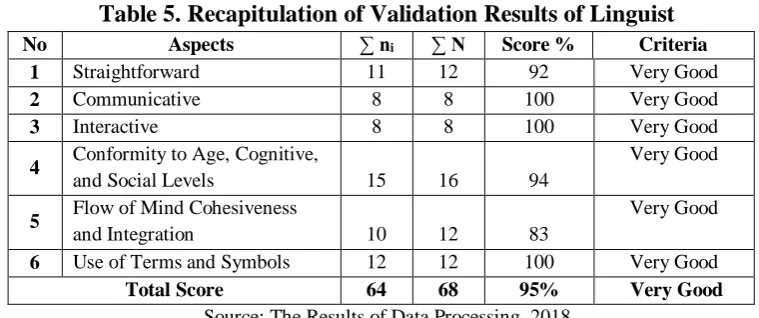
http://ijessr.com Page 51 Table 5. Recapitulation of Validation Results of Linguist
No Aspects ∑ ni ∑ N Score % Criteria
1 Straightforward 11 12 92 Very Good
2 Communicative 8 8 100 Very Good
3 Interactive 8 8 100 Very Good
4 Conformity to Age, Cognitive,
and Social Levels 15 16 94
Very Good
5 Flow of Mind Cohesiveness
and Integration 10 12 83
Very Good
6 Use of Terms and Symbols 12 12 100 Very Good
Total Score 64 68 95% Very Good
Source: The Results of Data Processing, 2018
Based on table 5 about the recapitulation of the validation results of the linguist, it is known that the straightforwardness aspect obtains 92%, communicativeness aspect 100%, interactiveness aspect 100%, aspect of conformity with age, cognitive, and social levels 94%, aspect of flow of mind cohesiveness and integration 83%, and aspect of the use of terms and symbols 100%. Overall, the linguist validation aspect obtains 95%. The score is between 81% -100% with a very feasible category. This Android-based economics learning application is declared feasible because, according to BSNP 2017, the aspects assessed in learning media include straightforwardness and communicativeness, interactiveness, conformity to the language rules and the term-use accuracy in supporting student learning.
Table 6. Recapitulation of Validation Results of Economics Teacher Practitioner 1
No Aspects ∑ ni ∑ N Score
%
Criteria
1 Syllabus 7 8 88 Very Good
2 LESSON PLAN 19 20 85 Very Good
3 Student Worksheet 11 12 92 Very Good
4 Teaching Material 15 16 94 Very Good
5 Assessment Instrument 11 12 92 Very Good
Total Score 61 68 93% Very Good
Source: The Results of Data Processing, 2018
http://ijessr.com Page 52
because, according to BSNP 2017, the aspects assessed include the media ease of use, media display quality, and effectiveness of media that have supported the student learning.
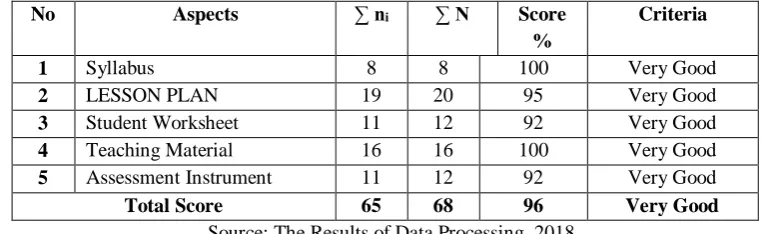
Table 7. Recapitulation of Validation Results of Economics Teacher Practitioner 2
No Aspects ∑ ni ∑ N Score
%
Criteria
1 Syllabus 8 8 100 Very Good
2 LESSON PLAN 19 20 95 Very Good
3 Student Worksheet 11 12 92 Very Good
4 Teaching Material 16 16 100 Very Good
5 Assessment Instrument 11 12 92 Very Good
Total Score 65 68 96 Very Good
Source: The Results of Data Processing, 2018
Based on table 7 about the recapitulation of validation results of the second learning instrument expert, it is known that the syllabus aspect obtains 100%, lesson plan aspect 95%, student worksheet aspect 92%, teaching material aspect 100%, and assessment instrument aspect 92%. Overall, the second learning instrument expert validation aspect obtains 96%. The score is between 81% -100% with a very feasible category. Therefore, Android-based economics learning application is declared feasible because, according to BSNP 2017, the aspects assessed include the media ease of use, media display quality, and effectiveness of media that have supported the student learning.
The analysis of the learning instrument expert indicates that there are several revisions by adding links related to learning and also material sources. Then, the analysis of the economic learning material expert suggested correcting writing errors. Based on the analysis of the linguist, there are several revisions needed, namely: 1) The language used must conform with the level of development of students' thinking so as not to cause errors in interpreting the message given; 2) Errors in EYD, punctuation, and letters need to be improved; 3) Accuracy in writing scientific/foreign names and grammar must be in accordance with Indonesian language rules. The analysis of the language practitioner suggests several revisions, namely: 1) The assessment techniques must conform to competencies to be achieved; and 2) The questions on the student worksheet must support the achievement of learning objectives.
CONCLUSION
http://ijessr.com Page 53
so it is feasible to be tested and used in the learning process even though there are revisions to be made as suggestions from the experts to produce learning models that are suitable with the learning objectives using Android-based media with the Project-Based Learning (PjBL) model.
REFERENCES
Arcidiacono Gabriele., Yang Kai., Trewn, JayanT., & Bucciarelli, Luca. (2016). Application of Axiomatic Design for Project-Based Learning Methodology. Procedia-CIRP Vol 53, pp.166-172 Arsyad, A. (2014). Media Pembelajaran (Learning Media). Jakarta: PT Raja Grafindo Persada. Ciftci, Sabahattin. (2015). The Effects of Using Project-Based Learning in Social Studies Education to Students' Attitudes towards Social Studies Courses. Procedia - Social and Behavioral Sciences Vol. 186, 1019 – 1024.
Farahani,A., Subramanya,S,R. (2012). Point-of-View Article on: Design of a Smartphone App for Learning Concepts in Mathematics and Engineering. Emerald Group Publishing Limited, International Journal of Innovation Science, Vol. 04 (03), pp.173-184
Fernandes. (2014). Preparing graduates for professional practice: finsings frm a case study of Project-based Learning, Procedia - Social and Behavioral Sciences, Vol 139, pp.219-226.
Fielman, T. (1997). Pengantar Media Digital (Introduction to Digital Media). Routledge New York. Fitzsimons, John and Turner, Rebecca. (2013). Integrating project‐based learning into an undergraduate programme using Web 2.0 and videoconferencing. Journal of Applied Research in Higher Education, Vol. 5 Issue: 1,pp. 129-140.
Gerlach dan Ely (1971). Teaching & Media: A Systematic Approach. Second Edition, by V.S. Gerlach & D.P. Ely, 1980, Boston, MA: Allyn and Bacon. Copyright 1980 by Pearson Education. Jones, G., H. (2017). Mental Health Student Nurses’ Satisfaction with Problem Based Learning: a qualitative study. The Journal of Mental Health Training, Education and Practice. 12(2): 77-89. Khairunnisak. (2015). Penggunaan Media Kartu Sebagai Strategi Dalam Pembelajaran Membaca Permulaan: Studi Kasus di Madrasah Ibtidaiyah Negeri Rukoh, Banda Aceh (Use of Media Cards as a Strategy in Beginner Reading Learning: A Case Study at Madrasah Ibtidaiyah Negeri Rukoh, Banda Aceh). Jurnal Pencerahan. 9(2): 66-82.
Maskall, J. & Cotterel, S. (2011). A Project-based Approach to research skills development in first year undergraduates. Planet, Vol 24 (1), pp. 22-29.
Mayer, R. E. (2009). Multimedia Learning: Prinsip-Prinsip dan Aplikasi (Multimedia Learning: Principles and Application). Surabaya: ITS Press.
Riduwan. 2012. Skala Pengukuran Variabel – Variabel Penelitian (Variable Measurement Scale – Research Variables). Bandung): Alfabeta.