SHIV SHAKTI
International Journal of in Multidisciplinary and
Academic Research (SSIJMAR)
Vol. 4, No. 1, February 2015 (ISSN 2278 – 5973)
Issues and Challenges in Designing of a Routing Protocol
for Multi-hop Wireless Mesh Networks
Pushpender* Dr. Sohan Garg
CSE, Shri VenkateshwaraUniversityGajraula CSE, C.C.S. University Meerut
India India
Dr. Surender
CSE, Shri VenkateshwaraUniversityGajraula India
Abstract— Wireless Mesh Network is the most likely technology due to its less installation cost and easily deployable. Here, data is delivered hop by hop from one node to another. The routing in wireless networks is a big challenging issue because of several routing attacks taken out in such networks. Wireless Mesh Networks (WMNs) are dynamically self-organized and self-configured networks that employ multi-hop communications to transmit data traffic to and from Internet entry points. WMNs are comprised of three types of nodes: access points, mesh routers, and mesh clients. In mesh networks, traffic between mesh nodes and the Internet is routed over mesh gateways. In this paper, a survey on routing protocols, challenges in routing and applications in wireless mesh networks is conducted. Also we have explained several metrics and design concepts for routing protocols in WMNs. This paper mainly point out the several routing problems in designing the routing techniques for aWMN.
Keywords— Routing Challenges, Issues, Wireless Mesh Networks, self-organizing, ad-hoc networks, AODV, DSR,
Impact Factor = 3.133 (Scientific Journal Impact Factor Value for 2012 by Inno Space Scientific Journal
Impact Factor)
Global Impact Factor (2013)= 0.326 (By GIF)
Indexing:
I. INTRODUCTION
Wireless Mesh Networks (WMNs), consisting of wireless access networks interconnected by a wireless backbone, present an attractive alternative. Compared to optical networks, WMNs have low investment overhead and can be rapidly deployed. The wireless infrastructure is organizing, self-optimizing, and fault tolerant. It can extend IP connectivity to regions otherwise unreachable by any single access technology. Many companies, such as Nokia, Microsoft, Motorola and Intel, are actively promoting wireless mesh networks as a full IP solution. Initial field tests have demonstrated WMN’s tremendous potential and market value. WMNs combine concepts from a diverse set of existing and emerging wireless technologies, including cellular technologies, ad hoc networks, and sensor networks. The application of research results from these areas could greatly contribute to the development, implementation, and growth of wireless mesh networks. WMN demands a different approach to routing from conventional wireless access networks. It has much more in common with the ad hoc and sensor network fields. However, the overall properties of the individual nodes and the overall network are very different in many ways. Therefore, it is unclear exactly how applicable these approaches are to a WMN. This paper addresses the issue of routing in a WMN, by considering the specific characteristics of a WMN.
II. ROUTING PROCESS INWMN
To select a routing path in WMNs, the routing algorithm needs to consider possible unreliable network topology due to the multi-hop wireless environment. In addition, the routing path selection is intertwined with resource allocation, interference avoidance and rate adaptation across multiple hops. Mobility in WMNs is less challenging than in MANETs, which is an advantage for designing protocols for WMNs and makes the performance of a routing protocol tractable in a multi-hop wireless mesh environment. However, as compared to MANETs, WMNs have other challenges for routing protocol design. Routing in wireless mesh networks has been a highly popular research topic during the last decade. Whereas many routing function objectives are the same as in the of wired networks and the Internet, wireless mesh networks add several new dimensions that make the problem less straightforward and more interesting at the same time. As a result, although experience and wisdom gained by wired networks have guided the first steps in the wireless domain, in many cases there was need for novel approaches andsolutions.
A. A Survey for Routing Protocols inWMNs
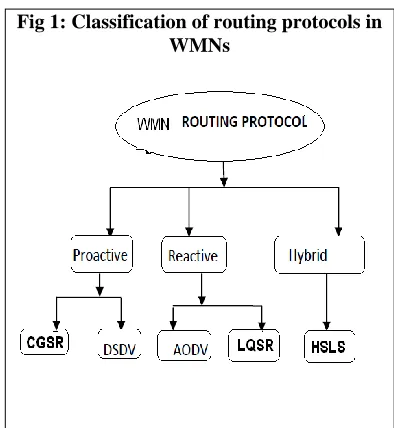
Routing algorithm etc.
B. Reactive RoutingProtocol
AODV:A Reactive RoutingProtocol
A node that has a route to the destination with a higher sequence number than the one specified in the RREQ unicasts a route reply (RREP) packet back to the source.
Upon receiving the RREP packet, each intermediate node along the RREP routes updates its next-hop table entries with respect to the destination node, dropping the redundant RREP packets and those RREP packets with a lower destination sequence number than one previously seen. When an intermediate node discovers a broken link in an active route, it broadcasts a route error (RERR) packet to its neighbors, which in turn propagate the RERR packet up-stream towards all nodes that have an active route using the broken link. The affected source can then re-initiate route discovery if the route is stillneeded.
AODV Properties:
AODV does not attempt to maintain routes from every node to every other node in the network; Routes are discovered on an as-needed basis and maintained only as long asnecessary.
AODV is loop free at all times, even while repairing brokenlink.
AODV is able to provide unicast, multicast and broadcast communicationability. AODV currently utilizes only symmetric links between neighboring nodes. AODV is
capable of operating on both wired and wirelessmedia.
Route tables are used by AODV to store pertinent routinginformation.
AODV is able to maintain both unicast and multicast routes even for nodes in constantmovement.
C. Routing Metrics for Designing ofProtocols
In this section we describe routing metrics proposed for wireless mesh networks. Firstly, we discuss topology- based metrics. The main advantage of topology-based routing metrics is their simplicity. Examples of relevant topological information are the number of neighbors of each node, and the number of hops and/or paths towards a particular destination. The metrics almost always take into account connectivity information that becomes available locally by the routing protocol, without
requiring additional passive or active measurements. In general, the topology definition in wireless networks is less straightforward than in wired networks. First of all, links are physically broadcast. The link definition between two nodes is a soft definition; a link is said to exist as long as the one node is within the transmission range of the other, which is a function of the sender node transmit power, the reception sensitivity of the receiving node and the propagation environment. In fact, varying the transmit power of nodes lies at the heart of the topology control function, an important tool for engineering wireless meshnetworks[5].
Another complication in wireless mesh networks is related to the link asymmetry. Although node X may receive successfully packets from node Y, it may well be that node Y cannot receive packets of node X. The reason is different interference levels at the neighborhood of the two nodes. This asymmetry has to be taken into account when making routing decisions, in particular for bidirectional traffic (e.g., TCP traffic).
Ad hoc networks usually use the hop count as a routing metric. This metric is appropriate for ad hoc networks because new paths must be found rapidly, whereas high-quality routes may not be found in due time. This is important in ad hoc networks because of user mobility. In WMNs, the stationary topology benefits quality-aware routing metrics. The first metric proposed for WMNs is the expected transmission count (ETX). ETX is the expected number of transmissions a node requires to successfully transmit a packet to a neighbor. To compute ETX, each node periodically broadcasts probes containing the number of received probes from each neighbor. The number of received probes is calculated at the last T time interval in a sliding-window fashion. A node A computes the ETX of the link to a node B by using the delivery ratio of probes sent on the forward (df) and reverse (dr) directions. These delivery ratios are, respectively, the fraction of successfully received probes from A
announced by B and the fraction of successfully received probes from B, at the same T interval. The ETX of link AB is 1/(df × dr). The ETX computation considers both forward and reverse directions because of data- and ACK-frame transmission. The chosen route is the one with the lowest sum of ETX along the route to the destination. The number of broadcast probes in an n node network is
O(n). The minimum loss (ML) metric also is based on probing to compute the delivery ratio. Rather than calculating ETX, ML finds the route with the lowest end-to- end loss probability. Thus, ML is not additive as ETX is. Instead, ML multiplies the delivery ratios of the links in the reverse and forward directions to find the best path. The authors of ML argue that the use of multiplication reduces the number of route changes, improving network performance[5].
III.PROBLEMS AND CHALLENGES INROUTING
A routing protocol can be formulized as an optimization problem: given any source and destination, finding a routing path that achieves the best performance, subject to a number of constraints such as network topology and interference [3].
Although the optimization objectives vary from one routing algorithm to another, it must obey the
optimality principle, i.e., if an intermediate Node R is on the optimal path pX, Y from Node X to Node Y, then the optimal path pR, Y from R to Y must be on the same route of pX, Y . Based on this principle, optimal paths from all sources to a destination form a sink tree, rooted at the destination. It should be noted that a sink tree is not necessarily unique, because there exist multiple routing paths from the same source to the same destination, but achieving the same performance. As a result, a routing protocol is equivalent to a process of discovering different sink trees and utilizing such trees to form a routing path for any source and destination. However, in reality the problem of routing is much more complicated, especially when a Multi-hop wireless network like WMN is concerned. Below is a summary of the factors that make routing a more challenging task than just finding routing paths based on sinktrees.
•The network topology can be variable and inconsistent. The major reasonsinclude:
topology by different nodes in the same network.
– Similar to link variations, the network topology can also be changed due to node mobility or other node activities such as joining or leaving thenetwork.
•Depending on the performance goal in routing, it may not be possible to determine a routing path solely based on the network topology. The typical scenariosinclude:
– The routing metric is more than just a topology parameter. For example, if only hop count is considered, routing path selection is only concerned with the network topology. However, as other routing metrics are considered, e.g., the delay, the routing path selection is not only related to the network topology, but is also affected by interference from nodes without being on the selected routing paths. Such routing metrics cause two complications: (1) selection of one routing path is coupled with that of another routing path; (2) determining routing path is coupled with resource allocation mechanisms including channel allocation, medium access control, power control, and soon.
– Routing path selection has to consider traffic distributions in the network in order to achieve load balancing. However, traffic distribution is also a result of routing. Thus, load balancing and routing are closely coupled with each other. Concerning WMNs this problem is much more complicated, because the traffic loads of a link impacts multiple links in the interferencerange.
• There may not be an optimal solution for a given routing problem. As explained before, routing is
coupled with many other functions such as resource allocation schemes. In addition, the selection of one routing path may be dependent on another one. Considering such a complicated optimization problem with potential conflict constraints, an optimal solution may not be available. When routing is considered under the framework of optimization, it is usually formulized as a global or centralized optimization problem. Such a methodology is not applicable to a practical routing protocol. Thus, there is another challenging issue for routing: how to design a distributed routing algorithm to approximate the optimization solution of a global routingalgorithm.
A. Principles For Designing a RoutingProtocol
In order to resolve the above challenging issues, some principles need to be considered in the design of routing protocols [3].
• Maintaining a consistent and stable networktopology.
• Performing dynamic and adaptiverouting.
• Developing new routingmetrics.
• Considering tradeoff between cross-layer design and single-layersolution.
• Deriving distributed algorithms forrouting.
• Ensuring scalability inrouting.
• Adaptively supporting both mesh routers and meshclients.
IV.ROUTING PROTOCOLSDESIGNING
The design of routing protocols for WMNs is still an active research area for several reasons:
• New routing metrics need to be discovered and utilized to improve the performance of routing protocols. The most frequently used metrics so far for routing protocols include hop count and link quality. However, they are far from satisfying the need of routing for WMNs because finding an optimal route depends on various design objectives and network characteristics ofWMNs.
• For mobile ad hoc networks (MANETs), the major concern for routing is high mobility in all nodes; complicated procedures are needed to support such mobility. However, such complexities are not necessary in WMNs, because mesh routers usually have minimal mobility. Thus, efficient and lightweight routing protocols need to be developed to achieve satisfactory performance inWMNs.
• The routing protocols for other multi-hop wireless networks treat the underlying MAC protocol as a
• The requirement on power efficiency is much different between WMNs and mobile ad hoc networks. In a WMN, nodes in the backbone have no constraint on power consumption, while client nodes usually desire the support of a power- efficient routing protocol. Such differences imply that the routing protocols designed for mobile ad hoc networks may not be appropriate forWMNs.
A. Criteria and Evaluation for routing Protocols andmetrics
1) Criteria for Categorization: Routing protocols can be broadly distinguished based on four criteria [2]: routing philosophy, network organization, location awareness and mobilitymanagement.
Routing philosophy: Routing approaches can be viewed as proactive, reactive, or hybrid. In proactive routing protocols, paths are established regardless of the willingness of a node to transmit data. In reactive (on demand) routing protocols, routing processes are initiated upon requests. In hybrid routing protocols, some of the nodes may implement a proactive routing protocol and others a reactive routingprotocol.
Network organization: In a flat organization, all the nodes have the same role in the routing process whereas in a hierarchical organization, some nodes may have specialized functions. For example, in wireless sensor networks, cluster-based routing protocols entail the elections of super nodes (cluster heads) responsible for data gatheringoperations.
Location awareness: Routing protocols may or may not use localization systems embedded in the network nodes to obtain locationinformation.
Mobility management: A WMN must manage the mobility of user nodes throughout the network. As they move, user devices change their point of attachment to the network, connecting to the access point with which they have the strongest signal. Mobility raises several issues, similar to those known in both wired and cellular networks. In MANETs, mobility management has been integrated into the routing process in order to cope with highly mobile nodes. In wired and cellular networks, routing and mobility management have been defined separately although complementarymechanisms.
2) Performance Metrics: Depending on the network characteristics, the routing protocols can focus on optimizing one or more performance metrics. The following is a non-exhaustive list including the most commonly usedmetrics:
Hop Count: Number of hops between the source and thedestination.
Expected Transmission Count (ETX): This metric is more specific to wireless communications. It accounts for data loss due to medium access contention and environmental hazards, and considers the number of retransmissions needed to successfully transmit a packet over alink.
Expected Transmission Time (ETT): This metric is an enhancement of ETX as it further includes the bandwidth of the link in its computation. This is of particular interest when different network technologies are used (IEEE 802.11a and IEEE 802.11b for instance) in order to favor channel diversepaths.
Energy consumption: A node energy level can be considered as a routing metric if some nodes are energy- constrained and their involvement in the routing process can lead to path failure if they suffer from energy depletion. This problem is particularly important in MANETs andWSNs.
Path availability/reliability: These metric estimates the percentage of time a path is available. Node mobility effect can be captured by this metric. It is particularly important inMANETs.
B. How to design a WMN routing protocol?
To capture the essence of what has been discussed so far, the following questions must be posed to help guide the design of an efficient routing protocol suitable for wireless mesh networks [2].
as the degree of node mobility is not high, has shown the advantage of using the expected transmission time to account for link capacity and loss rate in the routing decision. Conversely, when the degree of node mobility is high, minimizing the hop count is still the most sensible decision.
What hardware technologies will be used? Technologies such as directional antennae have been considered in ad hoc networks. However due to user mobility they required complicated solutions. This option can be considered in wireless mesh networks, depending on deployment scenarios and the feasibility of line-of-sight communications. However, this will considerably change the network’s properties, as link properties and network connectivity will be impacted. This may demand a drastic re-thinking of routing approaches, as links and interactions between links must be re-considered.
Proactive or reactive routing protocol? Or hybrid? Even though the presence of a fixed wireless backbone seems to favor a proactive routing protocol, real-world experiments conducted as part of the MIT Roofnet project have revealed the impact of changing network conditions on the routing protocols. In some cases, the number of updates could not be disseminated fast enough due to the contention of control traffic with data traffic, leading to non-optimal routing decisions. A hybrid routing protocol seems a more sound approach given that the wireless backbone will not suffer from node outages at a nearly or the same frequency as in MANETs or sensor networks.
Link or path optimization? Considering the impact of the network environment on the routing decision, it is not clear if it is preferable to find an optimal path or use a local optimization strategy based on optimallinks.
Integrated Routing and Mobility Management? Current IP mobility is separate from the underlying IP routing protocol, but uses it in order to tunnel packets to their destination. However, micro mobility protocols such as Cellular IP and Hawaii have implemented custom routing functionality. Ad hoc protocols take this even further by integrating all mobility mechanisms within the context of the routing protocol. Handling this (ad hoc) level of mobility is not needed when devising a routing protocol for WMNs. However, as user mobility is an integral part of the network, the routing and mobility management must either be integrated, or must interact effectively with each other[2].
V. APPLICATIONS
Mesh networks may involve either fixed or mobile devices. The solutions are as diverse as communication needs, for example in difficult environments such as emergency situations, tunnels, oil rigs, battlefield surveillance, high speed mobile video applications on board public transport or real time racing car telemetry. An important possible application for wireless mesh networks is VoIP. By using a Quality of Service scheme, the wireless mesh may support local telephone calls to be routed through the mesh.
Some current applications [1]:
U.S. military forces are now using wireless mesh networking to connect their computers, mainly ruggedized laptops, in fieldoperations.
Electric meters now being deployed on residences transfer their readings from one to another and eventually to the central office for billing without the need for human meter readers or the need to connect the meters withcables.
The laptops in the One Laptop per Child program use wireless mesh networking to enable students to exchange files and get on the Internet even though they lack wired or cell phone or other physical connections in theirarea.
constellation to operate with far fewer earth stations that would be required for 66 traditional communications satellites[1].
VI.CONCLUSION
Wireless Mesh Network has several issues regarding routing. Mostly the protocols used for ad-hoc networks are also used in wireless mesh networks. Routing in multi-hop wireless networks has always been a challenging research avenue. Previous works in this area have focused on ad hoc networks. However, the disparity between mesh and ad hoc networks is significant enough to question then suitability of ad hoc routing protocols for mesh networks. Existing routing protocols have been categorized. We argue that new routing protocols specifically adapted for WMNs are needed. In the field of wireless mesh networks, a set of design questions have been raised. These questions require further investigations, and consideration in the development of protocols for WMNs. In this paper, we have discussed several design concepts regarding routing protocols in WMNs. We hope that this paper will help in shaping future research in this area by providing a more concise view and problem definition, design requirements and constraints, and suggestions for possible researchdirections.
REFERNCES
[1]www.wikipedia.com
[2]Sonia Waharte, Raouf Boutaba, Youssef Iraqi, Brent Ishibashi,” Routing protocols in wireless mesh networks: challenges and designconsiderations”,Springer, Multimed Tools,July,2006,pp.285– 303.
[3]Ian F. Akyildiz, Dr XudongWang,” Wireless Mesh Networks, A John Wiley and Sons, Ltd, Publication,2009.
[4] Georgios Parissid Merkourios Karaliopoulos, Rainer Baumann, ThrasyvoulosSpyropoulos,” Routing metrics for Wireless Mesh Networks”, Computer Engineering and Networks Laboratory, ETH Zurich,Switzerland.