http://mojem.um.edu.my
1
Corresponding Author:
Faculty of Postgraduate Studies, Universitas Indraprasta,
PGRI Jakarta, Indonesia
E-mail:
ABSTRACT
This study aims to draw up a work program and guidelines for the state vocational high schools. This research used a mixed method (quantitative and qualitative) with SWOC analysis. Qualitative methods were used to obtain components of strengths, weaknesses, opportunities, and challenges through group interviews, observation, and the previous year's program documents. The sample consisted of 150 personnel involving the head of departments, school supervisors, headmasters, teachers, administration staff, guardianship of student organizations, alumni representatives, and parent representatives. Quantitative data collection was conducted through instrument in the form of questionnaires using a model of Likert scale. The obtained data were then grouped into components of the strengths, weaknesses, opportunities, and challenge of the schools. All of those components are tested first on their validity and reliability with 100 personnel as a sample of quantitative analysis. These four components are then analysed by quantitative Factor Analysis method based on Internal Factor Analysis Summary (IFAS) and the External Factor Analysis Summary (EFAS) to get the resultant value. The resultant value was then filled into Cartesian diagrams resulting in the organization’s position. The final result of the research is: The stages of strategic planning in the Indonesian vocational high schools, dominant factors of the schools at present conditions based on the resultant calculation, and the future strategic planning for vocational high schools in Indonesia. It is hoped that the result of this study can be beneficial for the policy-maker, stake holder, school principals, and other researchers in related fields.
Keywords: Strategic Planning, SWOC Analysis, School Program, Technical & Vocational Education, Indonesia
APRIL 2019, VOLUME 7, ISSUE 2, 1 - 26
E-ISSN NO: 2289 – 4489
https://doi.org/10.22452/mojem.vol7no2.1
ENHANCING STRATEGIC PLANNING OF SCHOOL PROGRAM
THROUGH SWOC ANALYSIS
http://mojem.um.edu.my
2
INTRODUCTIONSchools are the centre of learning activities for students under the guidance of competent teachers in various fields of study. As an institution, the school is led by a principal, and he or she must have a work program in organizing educational activities in a broad sense. These programs or activities are stated in the school guidance which is planned and agreed upon every year through meetings that involve the whole school staffs and stake holders. In order for education implementation to happen, aspects such as characteristics, aspirations and needs of the community where education services are carried out should be focused on. (Darnalita, 2014). Annual work plan and budget of the school are usually carried out based on the medium-term plan, but currently; most schools have not yet compiled their own work plan (Setiyaningwati, 2015). Many schools are not able to implement teaching and learning activities optimally such as hiring teachers or developing learning facilities and infrastructure due to financial problems (Nuryeti, 2018). Therefore, the school program should be annually revised according to the vision and mission of the school by creating a conducive learning environment and maximizing available resources. The school therefore should sought to create a learning environment that was responsive to the needs of children growing up in a digital, information-rich, connected era prizing creativity, innovation, and resourcefulness (Salen, 2017).
In Indonesia, the education office in every province has the task of carrying out the management and organization of formal education, non-formal education, as well as informal education. Every school would have different strategies in achieving the vision and mission that then become the main goal of the school. The results of the research at three schools in Bantul Jogjakarta, Indonesia showed that schools with different visions and missions must consequently have different school programs in order to produce excellent graduates (Kurniadi & Sugiyono, 2016). The school principal plays an important role in defining the strategy by adopting a strategy that has already been used in other schools and proved to be successful. To find out about the principal's ability as a leader at school, the performance of daily activities and role functions inherent in his position as a school principal can be observed. A school principal has a very broad and complex duty; therefore they often have a fairly high tenacity to reach optimal performances. They should be able to not only deliver the role of an educator, but also as an education manager in implementing administration, teachers’ proponent, leader of the teachers, innovator, and motivator. Principals with mastery of this competency will make a good impact on their work performance. In running an educational institution, the principal needs to devise strategic planning in order to achieve the specified goal. Planning is defined as a process of setting objectives and determining what should be done to achieve those plans. It is a decision-making activity through which managers’ act to ensure the future success and effectiveness of their institutions and departments as well as themselves (Farah, 2013). Leadership development and collaborative relationships between schools, parents, and communities, via schools or organizing groups, can increase internal capacity and change the culture of the school to address issues that are rooted in local conditions, interests, and values (Maier, Daniel, Oakes, & Lam, 2017). A strategic organization is an organization that has a clear purpose, and realistic as well as able to optimize the potential of the organization and resources adaptive towards the dynamics of environmental change. In running an educational institution, the principal needs to devise strategic planning to achieve the specified goal (Muzakkar, 2014). Planning helps educational managers to anticipate problems and opportunities, to think forward and to contribute efficacy of other managerial functions (Farah, 2013). As part of the continuous professional development for the school heads, onsite mentoring is proposed in order to support the school heads in their school transformation initiative (Subitha, 2016).
http://mojem.um.edu.my
3
indeed made but it is not fundamental, and not systematically done within the framework of improving the quality of education. In accordance with the regulation from the Ministry of Education (Regulation of The Minister of National Education of The Republic of Indonesia, 2007) i.e. a school principal should be competent in crafting the school development, making plan systematically such as coordinating all programs either vertically or horizontally in the form of the school as the organizational culture. In addition, a school principal should encourage effective learners, empowerment members of the school community such as teachers, students, parents, cleaning service and security unit. This is based on the Government Regulation Number 19/2017, Article 54(1) which stated that the workload of the Chief Education Unit is to perform managerial, entrepreneurial development, and to supervise the teachers and educational personnel (The President of the Republic of Indonesia, 2017). State vocational high schools are required to be able to improve the quality of education and to maintain the "achievement" that had been accomplished. Based on problems described, the research questions of this study are:1) What are the stages of strategic planning in Indonesian vocational high schools?
2) What dominant factors do the schools have at present conditions based on the resultant calculation? 3) What is the strategic planning for school future curriculum in Indonesia?
THEORETICAL FOUNDATION
This study is guided by SWOC (strengths, weaknesses, opportunities, and challenges) analysis. This analysis strategy has a similar name, namely SWOT (strengths, weaknesses, opportunities, and threats). It is a concept that determines the selection that lies down the important issues for the future of the organization. In choosing a strategy that fits to an organization profile, we can see it from the rank in which the organization currently stands. The organization can establish strategies to be taken based on the matrix of COWS (Challenge, Opportunities, Weaknesses, and Strengths) which is another term for SWOC. The organization's current rank is determined from the conclusion of IFAS and EFAS. Information needed for data collection of the organization condition is gathered through Environmental Scanning such as Internal factor analysis summary (IFAS) which consist of strengths and weaknesses and external factor analysis summary (EFAS) which consist of opportunities and challenges (Wheelen & Hunger, 2012). Strategic choice is associated with vision, mission, objectives and the external and internal analysis of the organization; an organization is willing to make strategic choices. This is to say that an organization is able to choose its ‘theory of how to obtain a competitive advantage’. The next step of strategic management process is implementation of strategy. Choosing a strategy means nothing if that strategy is not implemented (Gürel & Tat, 2017). SWOC analysis will be implemented in the preparation program of the school.
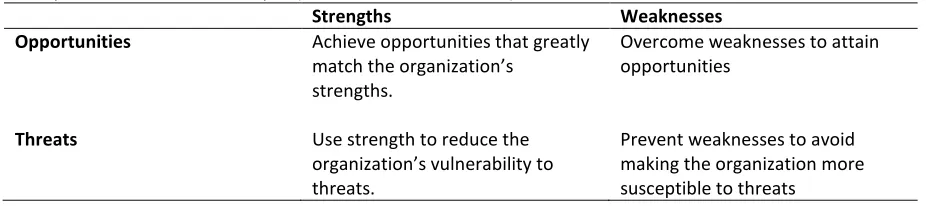
In SWOT analysis, aspects of strengths and weaknesses of an organization are identified by examining the elements in its environment while environmental opportunities and threats are determined by examining the elements outside its environment. In this sense, SWOT analysis is a strategic planning tool used to evaluate the strengths, weaknesses, opportunities and threats of an organization. It provides information that is helpful in matching the organization’s resources and capabilities to the competitive environment in which it operates (Figure 1).
http://mojem.um.edu.my
4
After the identification of strengths, weaknesses, opportunities and threats, we do the identification of internal and external environmental factors to determine the choice of strategy of organization program. Based on that calculation of the identification, it will then be determined which strategy the organization obtained in implementing the planning. The implementation also impacts the decision-making regulation, especially from the moment the participation and delegation of employees increase, due to the implementation of strategic actions as previously formulated (Neis, Pereira, & Maccari, 2017).LITERATURE REVIEW
Strategic Planning
In order to achieve stabilization policy at school and to enhance school performances objectively, there is a need to make improvement on the resources and management method through the use of strategic planning. Strategic planning is a system of institutions and management instruments whose purpose is to direct activity of management bodies at all levels in order to achieve long-term goals of socioeconomic development and providing necessary resources. Development of strategic planning as well as the general development of scientific thought in the field of strategic studies took place mainly in the USA and countries of Western Europe and was caused by new requirements that were set to management by owners of large companies (Novak, 2015).
School Program
The school agenda for one year has to be implemented by all members of the organization at school including educators and non-academic staff. Members of schools are any individual who serves in the teaching-learning process at schools such as students, educators, and educational personnel who carry out basic tasks and functions of the learner (Hermiyanty, Salmawati, & Oktavian, 2016). School programs are implemented in order to achieve the vision and mission of the school which has been drawn up and agreed upon in advance. A school must have a vision that are recognized by the staff members as a common direction of growth, something that inspires them to be better (Gabriel & Farmer, 2009). The dominant activities listed in the work programs of the school for example learning activities are implemented by the teacher, but other activities are also crucial to achieve the objectives of the organization of the school. The school program may vary from one school to others even if they are in the same vocational school specialization. The principal formulates a strategy or method in planning based on the achievements of the previous program in planning basic needs to consider the strength of school resources. So, the target is always adjusted according to the real ability in realizing the plan. Therefore, each school’s program might be different from others (Salamun, 2018).
http://mojem.um.edu.my
5
deals with more people than any other person. The school principal has relations with parents, teachers, students, and non-teaching staffs in the school (Farah, 2013).In drawing up the activities as school-based management in Indonesia, we will require an analysis of need, resource support, the potential of the school, and analysis of teaching and learning activities as general activities that must exist in every school and work program’ schedule. School Based Management provides opportunities for principals, teachers, and students to innovate and improvise at school, related to issues of curriculum, learning, managerial, etc. that grow from the activities, creativity, and professionalism they possess. The complexity of the problems faced by schools in Indonesia will be an obstacle in the implementation of school autonomy at once (Lazwardi, 2018). The role of an SBM teacher has changed from a narrow perspective of managing the classroom, to a wider and a broader outside-the-classroom involvement in assisting to work with other colleagues and external stakeholders towards the attainment of the school’s vision and mission (Mollootimile & Zengele, 2015).
The preparation of school work program which involves all stake holders is carried out at the end of the lesson. In the meeting, there will be a discussion about the preparation of the forthcoming work program. The discussion is divided into several commissions, namely the commission for the curriculum, the student, infrastructure field, areas of cooperation relations, administration, the field of the budget revenues and expenditures of the school, field personnel and staffing, as well as public areas. It is the principal’s structured plan to promote the school through good programs but unfortunately, not all school principals have the capacity as representant of the school to bring change in their environment through school programs. School principals in most instances are appointed, not elected to their post, so they are not “democratic” leaders. There is little doubt that principals are the gate keepers of change in their schools (Sharan & Tan, 2008).
SWOC Analysis
SWOC analysis can be understood as another concept of the SWOT analysis. It is a concept in determining the selection of important strategic issues for the future of an organization. Strategic planning is a disciplined effort to produce fundamental decisions and actions that shape and guide the organization, what organizations do and why your organization should do (Bryson, 2004). SWOC analysis comprises the acronym for strengths, weaknesses, opportunities, and challenges. Four of these components are analysed on the basis of environment as internal and external factors (Wheelen & Hunger, 2012). In SWOT analysis, aspects of strengths and weaknesses of an organization are identified by examining the elements in its environment while environmental opportunities and threats are determined by examining the elements outside its environment (Gürel & Tat, 2017).
http://mojem.um.edu.my
6
and the corresponding strategic elements for each of them are determined, in case that future scenario occurs (Quiceno et al., 2019)METHODOLOGY Research Design
This study aims to draw up a school program and guidelines for next school program focusing on strategic planning and applied a mixed-method research design. Qualitative methods were used to gather information on strengths, weaknesses, opportunities and challenges of vocational high schools. In order to collect data, group interviews were done at specific, scheduled times with interview guidelines and predetermined themes. The results of the interviews were then compiled and compared with the results of school observations in the form of information on strengths, weaknesses, opportunities and challenges of school conditions (Refer to Table 3).
Quantitative methods were used in validating and proving the reliability of research instrument. The subsequent part of this research was accomplished by quantitative methods, i.e., to analyse the data valid for analysis with SWOT analysis.Strategy implementation is the sum total of the activities and choices required for the execution of a strategic plan. It is the process by which objectives, strategies, and policies are put into action through the development of programs, budgets, and procedures. Although implementation is usually considered after the strategy has been formulated, implementation is a key part of strategic management. Strategy formulation and strategy implementation should thus be considered as two sides of the same coin (Wheelen & Hunger, 2012).
Population and Sampling
The population for this study was selected state vocational high schools in six sub-districts (Cilincing, Koja, Penjaringan, Tanjung Priok, Pademangan, Kelapa Gading) in the Province of Jakarta, Indonesia. This research used the sampling method, specifically, purposive sampling, which helps the researchers, determine the criteria regarding which respondents can be selected as samples (Elsye, 2018). Sample for a qualitative approach was used purposively from three randomly chosen schools, which involved its head of departments, school supervisors, headmasters, teachers, administration staffs, guardianship of student organizations, alumni representatives, and parent representatives. Meanwhile, qualitative data collection was done with purposive sampling from three randomly chosen schools involving head of departments, school supervisors, headmasters, teachers, administration staff, guardianship of student organizations, alumni representatives, and parent representatives as many as 150 people. The research sample was then divided into five focus group discussions. Data for this research was then collected through these steps: 1) formulating of questions that contain important issues as interview guidelines, 2) listing of the prospective group members to be invited for group discussion, 3) preparation of venue, time and other facilities for discussions, and finally, 4) determining the roles and responsibilities of group members, especially the research team, such as moderators. The researcher then analysed the process, objectives and discussion material (Ibrahim, 2015).
http://mojem.um.edu.my
7
Instrument
The information in determining the instrument of identification is gathered through group interviews, observation, and the previous year's program document analysis (Ibrahim, 2015). Then the questionnaire was designed based on Scan and Assess External Environment: Natural, Societal, and Task and then Scan and Assess Internal Environment: Structure, Culture, and Resources (Wheelen & Hunger, 2012).) Meanwhile, observation is an activity that involves the senses such as hearing, sight, taste, and touch, based on the facts of empirical events, to answer any doubts of the data (Hasanah, 2016). The questions were then discussed through school meeting involving headmasters, head of department, school supervisors, teachers, administration staffs, guardianship of student organizations, alumni representative, and parent representative. Furthermore, the instruments obtained were tested through a validity and reliability test (Table 1) before identifying Internal Factor Analysis Summary (IFAS) and External Factor Analysis Summary (EFAS). Data collection techniques were carried out using research instruments in the form of questionnaires. The scale used for strength-weakness variables, and opportunities-challenges is the Likert Scale. It has five categories of answer choices, namely: strongly agree; agree; neutral; disagree; and strongly disagree. Alternative answers are weighted values 5 - 1 for significant statements, and weights values 1 - 5 for negative statements. The instrument was tested at first before being used in research. This study was also conducted with a questionnaire, to get information about the strengths, weaknesses, opportunities, and challenges in these institutions which associated with eight national standards of education (Rangkuti, 2015). Before its validation, the number of items in the questionnaire of strength-weakness was 21 items with 3 items of invalid numbers. In the questionnaire of opportunities-challenge is 20 items, the number of invalid items is 2. Invalid items are not used in research (Sugiyono, 2017). The questionnaire is divided into two parts, namely strength-weakness, and opportunities-challenges variables, with each part consisting of 18 items, as seen in Table 3 and Table 4.
Validity and Reliability
The validity of instrument items was determined by comparing the amount of rxy obtained with the critical price r Pearson's Product Moment at n = 20. (n is number of respondents). Since r count> r table, then the instrument item is valid and was used for data collection. Conversely, if r count <r table, then the item becomes invalid and was not used in the study. In the critical price table Pearson's table Product Moment is known to be 0.360 for n = 20 with α = 0.05. Each valid instrument has 18 items.
The validity test of strength-weakness instruments was performed with the help of Microsoft Excel. After calculating the validity of the instrument, the results made known that out 20 items, there were 2 invalid items. Thus, the number of items was valid and only 18 items were used in the research. Reliability of the items of valid instruments was then analysed by Cronbach Alpha technique. The calculation of the instrument reliability coefficient was only done after the invalid items were not used in the study. The reliability calculation of 18 strength-weakness variable instruments was obtained by = 0.919. The reliability calculation of the opportunities- challenges of 18 items instrument was obtained by = 0.921. The calculation is done using the help of the Excel For Windows program. Thus, = 0.60. which shows that the reliability statistics for each of the variables to be reliable.
Table 1
Reliability Statistics for each of the Variables
Variable N Cronbach’s Alpha Result
Strengths-Weaknesses Opportunities- Challenge
18 18
0.919 0.921
http://mojem.um.edu.my
8
Data Collection ProcedureThe study’s data collection was divided into two parts; using qualitative method to obtain IFAS and EFAS components and quantitative method. After the validity and reliability test, 100 copies of research instruments were distributed. The distribution was done by inviting all participants to the state vocational school in order to take the research instrument and get information on how to answer the instruments. The instruments that have been filled were then returned to the state vocational school 2 weeks later. Out of the 100 copies that have been given to schools, 70 have been collected at the appointed time because they represented elements of school, while the other 30 copies represented elements out of school and was collected 3 weeks after the appointed time.
Two-by-Two Matrix: SWOT Analysis
During the analysis, the current conditions of the school were noted with Internal Factor Analysis Summary (IFAS) in order to get all information about the circumstances that counts as a strength in internal school. Additionally, all existing weaknesses in the internal school at this time were also noted. Then the analysis of the condition of the current External Factor Analysis Summary (EFAS) i.e. noted that all circumstances into which can be opportunities in external schools, and all the circumstances that become a challenge in external schools. SWOT analysis can help organizational managements to uncover opportunities to then transform it into advantage. By understanding its weaknesses, threats can be managed and eliminated. To examine an organization and its competitors through SWOT Analysis, strategies that help distinguish a company from competitors can be formulated (Gürel & Tat, 2017).
Table 2
Two-by-Two Matrix: SWOT Analysis (Source: Gürel & Tat, 2017).
Strengths Weaknesses
Opportunities
Threats
Achieve opportunities that greatly match the organization’s
strengths.
Use strength to reduce the organization’s vulnerability to threats.
Overcome weaknesses to attain opportunities
Prevent weaknesses to avoid making the organization more susceptible to threats
After the analysis of IFAS and EFAS, the resultant value was obtained with Cartesian diagram. From the Cartesian picture, the positioning organization is then obtained which will constitute as strategies for program plans of an organization.
The proposed strategic planning process model will serve as a guide for mapping out a strategic plan along with activities for aligning and implementing open educational resources. Together, it can connect strategic planning to universities’ sustainable effectiveness and success in the long term.
FINDING
Stages of the Strategic Planning
http://mojem.um.edu.my
9
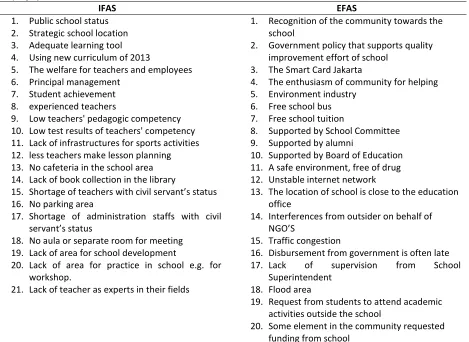
findings of this study are adjusted to those 10 stages of strategic planning. There are ten steps in the stages of the strategic planning, which are: 1. Initiate and agree on a strategic planning process, 2. Identify organizational mandates, 3. Clarify organizational vision and values, 4. Assess the external and internal environment to comprehend the strength, weakness, opportunities and threats, 5. Identification of the strategic issue, 6. Formulate strategies to manage the issues, 7. Review and adopt the strategies or the strategic plan, 8. Formulating a strategic location for managing some issues 9. Develop and effective implementation process, and 10. Reassess strategies and the strategic planning process (Bryson, 2004). The results of qualitative research are the main data that will be processed based on 10 stages of strategic. Here is the result of the qualitative data as shown in Table 3.Table 3
Grouping of IFAS and EFAS
IFAS EFAS
1. Public school status 2. Strategic school location 3. Adequate learning tool 4. Using new curriculum of 2013
5. The welfare for teachers and employees 6. Principal management
7. Student achievement 8. experienced teachers
9. Low teachers' pedagogic competency 10. Low test results of teachers' competency 11. Lack of infrastructures for sports activities 12. less teachers make lesson planning 13. No cafeteria in the school area 14. Lack of book collection in the library
15. Shortage of teachers with civil servant’s status 16. No parking area
17. Shortage of administration staffs with civil servant’s status
18. No aula or separate room for meeting 19. Lack of area for school development
20. Lack of area for practice in school e.g. for workshop.
21. Lack of teacher as experts in their fields
1. Recognition of the community towards the school
2. Government policy that supports quality improvement effort of school
3. The Smart Card Jakarta
4. The enthusiasm of community for helping 5. Environment industry
6. Free school bus 7. Free school tuition
8. Supported by School Committee 9. Supported by alumni
10. Supported by Board of Education 11. A safe environment, free of drug 12. Unstable internet network
13. The location of school is close to the education office
14. Interferences from outsider on behalf of NGO’S
15. Traffic congestion
16. Disbursement from government is often late 17. Lack of supervision from School
Superintendent 18. Flood area
19. Request from students to attend academic activities outside the school
20. Some element in the community requested funding from school
Study of Strategic Planning of State Vocational High Schools
Initiate and agree on a strategic planning process
http://mojem.um.edu.my
10
Identify organizational mandatesA mandate is realised by those who can confer legitimacy or afford resource access to the event, or when events themselves have a position of monopoly or legitimacy in a field (Kulkarni, 2018). The formal mandate of the principal of state vocational high school is from constitution of Republic Indonesia no. 20/2003 about the system of national education. The primary goal of state vocational high school is to be the host of high school level education which has special vocational courses in business and management. The primarily competence of graduated students of state vocational high school is students with the knowledge and skills to be able to work in the business world or in the world of industry.
Clarify organizational vision and values
A vision statement provides stakeholders with a picture of what their ideal school and students will look like if educators are successful in working together to achieve that vision (Gurley, Collins, & Peters, 2014). Based on previous documents and discussions with stakeholders, the agreed formulation of the vision of state vocational high schools is: creating vocational schools that have global competitiveness based on faith and piety with values of honesty, hard work, mutual respect, and sincerity.
Assess the external and internal environments to identify strengths, weaknesses, opportunities, and threats.
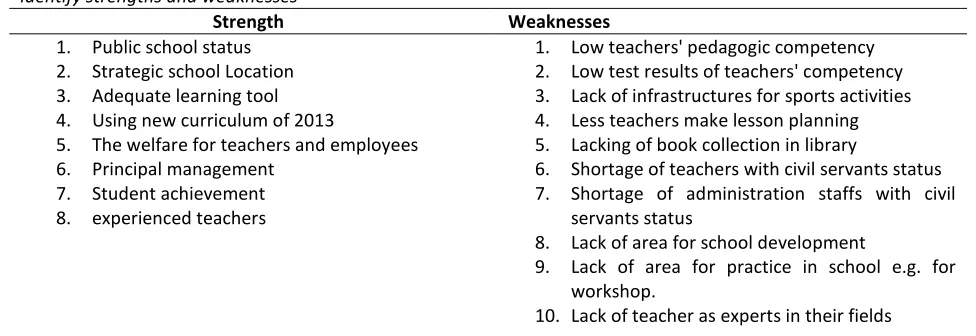
The overview of current school condition- The following is the analysis of the components contained in the school, based on observations, school programs documents and interviews with stake holders, principal of state vocational high school, vice principal, teachers, educational personnel, school committee. To obtain information that is indispensable in the preparation of the company's strategic planning, survey of SWOT Balance Score Card Development Tools is required (Rangkuti, 2015). Strength is something positive for the organization. Strengths of an organization are essentially positive attributes or abilities unique to the organization, which in some ways enhance the organization’s ability to achieve its objectives. Weaknesses are something that are not positive for the organization and are simply internal negative attributes or perhaps inabilities unique to the organization. In some way, it could have led (or will probably lead) to the organization’s failure to achieve its objectives (Katsioloudes, 2002). Internal environments of identify strengths and weaknesses can be seen in Table 4.
Table 4
Identify strengths and weaknesses
Strength Weaknesses
1. Public school status 2. Strategic school Location 3. Adequate learning tool 4. Using new curriculum of 2013
5. The welfare for teachers and employees 6. Principal management
7. Student achievement 8. experienced teachers
1. Low teachers' pedagogic competency 2. Low test results of teachers' competency 3. Lack of infrastructures for sports activities 4. Less teachers make lesson planning 5. Lacking of book collection in library
6. Shortage of teachers with civil servants status 7. Shortage of administration staffs with civil
servants status
8. Lack of area for school development
9. Lack of area for practice in school e.g. for workshop.
http://mojem.um.edu.my
11
Opportunities is an endorsement from outside of your organization to achieve the goal, therefore, opportunities
should be identified. Strategists must make an attempt to identify as many relevant opportunities as is feasible. As already mentioned, opportunities are external to the organization, and are defined as any factor or situation that might be expected to aid the organization’s efforts to achieve their objectives. Challenge is an obstacle from outside your organization from achieving the goal. Bryson (2004) states that challenges are outside factors or situations that can affect your organization hastily. Thus, making it harder for the organization to fulfil its mission in meeting its mandates, or create public value. Another view on "challenge" is that it is synonymous with "threat". Threats are external to the organization, and can be any factor or situation, which might be expected to hinder efforts to achieve their objectives (Katsioloudes, 2002). External environments to identify opportunities and challenge can be seen in Table 5.
Table 5
Identify opportunities and challenges
Opportunities Challenges
1. Recognition of the community towards the school 2. Government policy that supports quality
improvement’s effort of school 3. The Jakarta Smart Card
4. The enthusiasm of community for helping 5. Environment industry
6. Free school bus 7. Free school tuition
8. Supported by School Committee 9. Supported by alumni
10. Supported by Board of Education 11. A safe environment, free of drug
1. Unstable internet network
2. Interferences from outsider on behalf of NGOS 3. Traffic congestion
4. Disbursement from government is often late 5. lacking of supervision from School
Superintendent 6. Flood area
7. Request from students to attend academic activities outside the school
Identification of strategic issue
http://mojem.um.edu.my
12
Table 6Synthesis External Environmental Factors
NO. Key success factors Probability of Success Attractive Power Probability of Happening A Damaged Power O C
H M L H M H M L H M
A. Political and law
1 Recognition from the
community towards the school v v v v v
2
Government policy that supports quality improvement of school
v v v v v
3 Free school bus v v v v v
4 The Smart Card Jakarta v v v v v
5
Request from students to attend academic activities outside the school.
v v v v v
B. Economy
1 Environment industry v v v v v
2 Free school tuition v v v v v
C. The Socio-Cultural 1 Disbursement from the
government is often late v v v v v
2 The enthusiasm of community
for helping v v v v v
3 Supported by the School
Committee v v v v v
4 Supported by alumni v v v v v
5 A safe environment, free of
drug v v v v v
6 Supported by Board of
Education v v v v v
7 Lacking of supervision from
school superintendent v v v v v
8 Interferences from outsiders
on behalf of NGOS v v v v
9 Flood area v v v v v
D Technology
1 Traffic congestion v v v v v
2 Unstable internet network v v v v v
http://mojem.um.edu.my
13
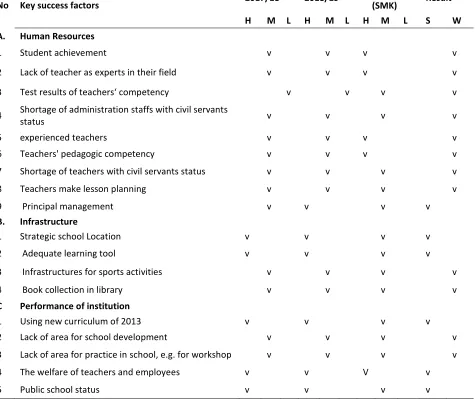
socio-cultural factors, there are 9 components of social culture, namely 5 opportunities and 4 challenges; and there are 2 component technology with 0 opportunity and 2 challenges. Therefore, the total opportunities are 10 components, and 8 components of challenge factors.Identification of Internal Environmental Factors - Identification of environmental factors of internal state vocational high school ABC consists of human resources, infrastructure, and performance institutions, then key factors associated with eight national standards of education with weighting range from low (L), medium (M), and high (H). Development of analysis is done on a periodic basis based on the previous years, namely the year 2017/2018 and 2018/2019 and compared to the influence of the identification of environmental factors as internal competitors. To improve quality of performance, competitors can be a partner of cooperation in the future as seen in Table 7.
Table 7
Synthesis Internal Environmental Factors
No Key success factors 2017/18 2018/19
Competitor
Result (SMK)
H M L H M L H M L S W
A. Human Resources
1 Student achievement v v v v
2 Lack of teacher as experts in their field v v v v
3 Test results of teachers‘ competency v v v v
4 Shortage of administration staffs with civil servants
status v v v v
5 experienced teachers v v v v
6 Teachers' pedagogic competency v v v v
7 Shortage of teachers with civil servants status v v v v
8 Teachers make lesson planning v v v v
9 Principal management v v v v
B. Infrastructure
1 Strategic school Location v v v v
2 Adequate learning tool v v v v
3 Infrastructures for sports activities v v v v
4 Book collection in library v v v v
C Performance of institution
1 Using new curriculum of 2013 v v v v
2 Lack of area for school development v v v v
3 Lack of area for practice in school, e.g. for workshop v v v v
4 The welfare of teachers and employees v v V v
http://mojem.um.edu.my
14
Internal environmental analysis shows that state vocational high school ABC Jakarta has 9 components of human resources in the Human Resource factor. There are 1 power (s) and 8 weaknesses (w), in component infrastructure factors there are 4 components with 2 strength (s) and 2 weaknesses (w), There are five components of the performance institution with 3 strengths (s) and 2 weaknesses (w). So, the strength of IFAS consist of a total 6 components, and 13 component factors of weaknesses. Formulating strategies to manage the issue
Identify the strategic issues facing the organization strength- To know the power level of determination
(Strengths), it can be done as the following. For example, if S1 management (principal) is more important than S2 (location), then the box under S2 is marked (X), if a location is more important than principal management then marked (O). In determining rank of strengths see Table 8.
Table 8
Determining rank of strengths
No. Strengths 1 2 3 4 5 6 Total
S1 S2 S3 S4 S5 S6 X
1 S1. Principal management x x x x X 5
2
S2. Strategic school location 0 0 0 X 1
3
S3. Adequate learning tool x x 0 2
4 S4. Using new curriculum of 2013
x 0 1
5 S5. Welfare of teachers and employees
0 0
6 S6. Public school status
Vertical Blank (0) 0 0 1 1 1 3
Horizontal Cross (X) 5 1 2 1 0 0
Total 5 1 3 2 1 3
Rank I V III IV VI II
The result of the compiled element sequentially strengths are: principal management, public school status, adequate learning tool, using new curriculum of 2013, strategic school location, and welfare of teachers and employees.
http://mojem.um.edu.my
15
Table 9Determining rank of weaknesses
No. Weaknesses 1 2 3 4 5 6 7 8 9 10 11 12 Total
W 1 W 2 W 3 W 4 W 5 W 6 W 7 W 8 W 9 W 10 W 11 W 12 X 1 W1 Student achievement 0 x x x 0 x x x x x x 9
2 W2 Lack of teacher as
experts in their field x x 0 0 x 0 x x x x 7
3 W3 Test results of
teachers ‘s competency x 0 0 0 0 x x x x 5
4
W4 Shortage of
administration staffs with civil servants status
0 0 0 0 x 0 x x 3
5 W5 An experienced
teacher 0 0 0 x x x x 4
6 W6 Teachers' pedagogic
competency x x x x x x 6
7 W7 Shortage of teachers
with civil servants status x x x x x 5
8 W8 Teachers make lesson
planning x x x x 4
9 W9 Sports Infra-
structures 0 0 0 0
10 W10 Book collection in
library x x 2
11 W11 Lack of area to
school development 0 0
12
W12 Lack of area for practice in school, e.g workshop
0
Vertical Blank (0) 0 0 0 0 3 5 3 4 1 2 1 2
Horizontal Cross (X) 9 7 5 3 4 6 5 4 0 2 0 0
Total 9 7 5 3 7 11 8 8 1 4 1 2
Rank Ii V vii ix vi i iii Iv Xi viii xii x
http://mojem.um.edu.my
16
Opportunities- To find out if the determination of the levels of opportunities can be done, it can be tested out as the following: For example, if O1 is more important than the O2 then under the O2 box, it should be marked (X), if it is not as important, it should be marked (O). Refer to Table 10 to see rank of opportunity.Table 10
Determining rank of Opportunity
No. Opportunity
1 2 3 4 5 6 7 8 9 10 11 Total
O1 O2 O3 O4 O5 O6 O7 O8 O9 O10 O11 X
1
O1 Recognition of the community towards the school
x X 0 x 0 0 x x 0 x 6
2
O2 Government policy that supports quality improvement of school
X 0 x 0 0 x x 0 x 5
3 O3 Free school bus 0 0 0 0 x x 0 x 3
4 O4 The Smart Card
Jakarta x 0 x x x x x 6
5 O5 Environment
industry 0 0 x x 0 x 3
6 O6 Free school tuition x x x x x 5
7 O7 The enthusiasm of
community for helping
x x x x 4
8 O8 Supported by the
School Committee x 0 x 2
9 O9 Supported by alumni 0 x 1
10 O10 A safe environment,
free of drug x 1
11 O11 Supported by the
Board of Education 0
Vertical Blank (0) 0 0 0 3 1 5 4 0 0 6 0
Horizontal Cross (X) 10 8 4 10 1 0 7 4 3 2 0
Total 10 8 4 13 2 5 11 4 3 8 0
Rank iii iv Vii i x vi ii vii
i ix v xi
The result of the compilation element sequentially opportunities are: Jakarta Smart Card, enthusiasm of the community for registration, the recognition of the community, government policy of supporting quality improvement efforts, a safe environment free of drug, free school tuition, free school bus services, supported by the School Committee, supported by alumni, environment industry, supported by the Board of Education.
http://mojem.um.edu.my
17
then it should be marked with (O). The criteria is important when the possibilities and urgently of the problems are considered more important. Refer to Table 11 in order to see the rank of challenges.Table 11
Determining rank of challenges
The result of the element of the challenges are: Disbursement of government is often late, lacking of supervision from school superintendent, unstable internet network, request students to attend academic activities outside the school, flood area, traffic congestion in Jakarta, and interferences from outsiders on behalf of the NGOs.
Review and Adopt the Strategies
Internal Factor Analysis Summary (IFAS)- In this era of globalization, the organization is required to have a
competitive advantage so that it is able to harness and bring together the factors which have strengths and thus, minimize its weaknesses. After making observations on the internal strategic factors, then researchers may explain analysis results and summarize it in a table called a summary analysis of strategic factors or Internal Factor Analysis Summary (IFAS). According to Wheelen & Hunger (2012), the preparation carried out by IFAS gives weighting and rating for each strategic factor which is internal. The IFAS is used for the Strength rating of 1 to 5, and the weakness use rating of -1 to-5, as seen in Table 12.
no. Challenges 1 2 3 4 5 6 7 total
c1 c2 c3 c4 c5 c6 c7 x
1
C1 Request of students to attend academic activities outside the school
0 0 x X x 0 3
2 C2 Disbursement of government
is often late X x X x X 5
3 C3 Lacking of supervision from
school super- intendent x X x X 4
4 C4 Interferences from outsiders
on behalf of NGOS 0 0 0 0
5 C5 Flood x 0 1
6 C6 Traffic congestion 0 0
7 C7 Unstable internet network 0
Vertical Blank (0) 0 1 1 0 1 1 4
Horizontal Cross (X) 3 5 4 0 1 0 0
Total 3 6 5 0 2 1 4
http://mojem.um.edu.my
18
Table 12Internal Factor Analysis Summary (IFAS)
No Strengths Weights Rating Weights x
Rating
1 Principal Management 0.07 5 0.35
2 Public school status 0.06 4 0.24
3 Adequate learning tool 0.06 4 0.24
4 Using new curriculum of 2013 0.06 3 0.18
5 Strategic school location 0.05 3 0.15
6 Welfare of teachers and employees 0.05 3 0.15
The amount of strength 0.35 1.31
No Weaknesses Weights Rating Weights X
Rating
1 Teachers' pedagogic competency 0.07 -4 -0.28
2 Student achievement 0.06 -4 -0.24
3 Shortage of teachers with civil servants’ status 0.06 -3 -0.18
4 Teachers make lesson planning 0.06 -5 -0.30
5 Lack of teacher as experts in their fields 0.06 -4 -0.24
6 Sufficient experienced teachers 0.06 -4 -0.24
7 Results of teachers’ competency 0.06 -3 -0.18
8 Book collection in library 0.05 -3 -0.15
9 Shortage of administration staffs with civil
servants status 0.05 -2 -0.10
10 Lack of area to practice in school 0.04 -3 -0.08
11 Sports Infrastructures 0.04 -2 -0.08
12 Lack of area for school development 0.04 -3 -0.12
The amount of weaknesses 0.65 -2.19
strength + weaknesses 1 -0.88
http://mojem.um.edu.my
19
External Factor Analysis Summary (EFAS)- The results of observation and identification of external factors are
analysed and summarized in the table of summary analysis of strategic factors into the External Factor Analysis Summary (EFAS), (Wheelen & Hunger, 2012). The drafting is done by giving the weights and rating for each factor. For external strategic factors opportunities, the number were given positive signs (1 to 5), while for factors challenges, it is given the negative sign (-1 to -5). The results of the multiplication of weights and rating are the external strategic factors. The results are as shown in Table 13.
Table 13
External Factor Analysis Summary (EFAS)
No Opportunities Weights Rating Weights X Rating
1 Jakarta Smart Card 0.07 5 0.35
2 Enthusiasm of community for registration 0.07 5 0.35
3 Community recognition 0.06 4 0.24
4 Government Policy of supporting quality 0.06 4 0.24
5 A safe environment free of drug 0.06 4 0.24
6 Free school tuition 0.06 3 0.18
7 Free school bus 0.06 3 0.18
8 Supported by School Committee 0.06 3 0.18
9 Supported by alumni 0.05 3 0.15
10 Environment industry 0.05 3 0.15
11 Supported by Board of Education 0.04 3 0.12
Amount of Opportunities 0.64 2.38
No Challenges Weights Rating Weights X Rating
1 Disbursement of Government is often late 0.8 -5 -0.40
2 Lacking of supervision from school
superintendent 0.7 -4 -0.28
3 Unstable internet network 0.06 -3 -0.18
4 Request from students to attend academic
activities outsides the school 0.06 -3 -0.18
5 Traffic congestion 0.5 -3 0.15
6 Interferences from outsiders on behalf of
NGOs. 0.4 -3 0.12
Amount of Challenge 0,36 -1.31
http://mojem.um.edu.my
20
The results of the analysis of the EFAS in the Table above shows that out of the 11 factors opportunities, calculation using program Expert Choice produces a number of weights of 0.64 after multiplied by the value of the respective rating and obtained the amount of 2.38. Opportunities with 6 factors challenge have a total weight of 0.36 once multiplied by the respective value rating which then obtained the number of challenges -1.31. The result of the sum of the opportunities and challenges is 1.07.
Based on the results of the analysis of IFAS and EFAS, the rank of the state vocational high school ABC in Jakarta can be determined graphically. The summary results of the IFAS and EFAS can be seen in Table 14.
Table 14
Result of IFAS and EFAS
IFAS and EFAS results retrieved the resultant, IFAS =-0.63 and EFAS 1.29, then the resultant filled into a Cartesian diagram, as shown in Figure 2.
Figure 2. Positioning state vocational high school
Based on Figure 2, the positioning of state vocational high school is on quadrant II, which means that the influential factors which are dominant in program activity strategy is an opportunity against weaknesses (W-O) whereas other factors can be ignored because its influence is relatively insignificant or less dominant. The results of an analysis of the dominant factors for the preparation of the work programs, namely WO area, is in quadrant II. In determining the position of the results of the SWOT analysis, the point X coordinates with the internal conditions and Y coordinates with the external conditions (Wahida, 2015). SWOC analysis results from the strategies above that need to be considered by the state vocational high school is the opportunities which is owned to eliminate or reduce existing weaknesses. Meanwhile strategy SO, SC, and WC is less dominant in the determination of the work programs. Opportunities and weaknesses of the school are showed in Table 14, which is also the answer to research question number 2.
IFAS EFAS
Strength 1.31 Opportunities 2.38
Weaknesses -2.19 Challenge -1.31
The resultant -0.88 The resultant 1.07
Opportunity (2.38)
Weaknesses (-2,19) Strength1,31
http://mojem.um.edu.my
21
Table 14A list of Opportunities and Weaknesses of State Vocational High Schools
Opportunities (O) Weaknesses (W)
O1. Jakarta Smart Card
O2. Community’s enthusiasm in helping O3. Community’s recognition
O4. Government policy of supporting quality improvement efforts
O5. A safe environment free of drug O6. Free school tuition
O7. Free school bus
O8. Supported by School Committee
O9. Alumni who care about state vocational high school ABC
O10. Environment industry
O11. Supported by Board of Education
W1. Teachers' pedagogic competency W2. Student achievement
W3. Shortage of teachers with civil servants’ status W4. Teachers make lesson planning
W5. Lack of teacher as experts in their field W6. Sufficient experienced teachers W7. Results of teachers’ competency W8. Lack of book collection in library
W9. Shortage of administration staffs with civil servants’ status
W10. Lack of area to practice in school W11. Sports infrastructures
W12. Lack of area for school development
Formulating a strategic location for managing some issues
In accordance with a strategy that is retrieved, the strategic issues include the following:
1. How to take advantage of the availability of the Jakarta Smart Card, free school tuition, free school bus, a safe environment free of drug, and program from alumni which is supported by the community as one of the stakeholders of the school?
2. How to take advantage of the recognition from the society, and enthusiasm of community who sign up to help the school to find an area for sports activities, and school development?
3. How to take advantage of government policy in improving the quality of education to actualize the synchronization between the programs administered by school with government programs, with the fulfilment of the needs of the field of study, and to improve teachers' pedagogic competency, to get teachers with civil servants’ status, and enhancing the role of the experienced teacher?
4. How to take advantage of opportunities being in the environmental industry and support School Committee to actualize the cooperation that benefits both sides, within the framework of pedagogic competence to improve teachers’ competences, preparation of lesson plan, analyse the problem, and increased program supervised by the principal?
5. How to take advantage of government policy in improving the quality of education concerning the Board of Education and alumni, in order to meet the completeness of facilities, infrastructure, to get book collection in library, broader perspective of the development of the school, and to overcome the shortage of administration staffs with civil servants’ status?
6. And finally, how to take advantage with support from Board of Education in solving the problem of shortage of teachers as experts in their field to upgrade teachers’ competency?
Developing an effective implementation process, Operational Strategy
http://mojem.um.edu.my
22
Strategic planning for Indonesian Vocational High Schools- Strategic planning for school future curriculum are
programmes that can be developed to improve the schools’ condition. Those programmes are the answer to research question number 3.
There are many programmes that can be done in implementing strategic planning for schools’ future curriculum. For example, organizing a workshop with related parties and experts in line with the vision, mission, and goals to conform with government policy to increase the quality of education, disseminating the vision, mission, goals, and school programs to all stakeholders. Schools’ infrastructures should be improved to support the program and learning activities in accordance with the advancement of technology and information. The cooperation with the local community should be optimized to facilitate the educational needs and to obtain the support of the local community. School alumni should be invited to encourage friendship between the alumni and the students alongside forming a school alumni forum. Stability of the environment can be improved through coordination with the regional leadership of the congress. The professionalism of the teachers can be improved by partnering with the environment industry, institutions and universities.
In addition to that, the school can also consider partnering with state vocational schools in the neighbourhood or exploring possibilities of cooperating with other schools of vocational school-level in Jakarta in both areas of academics and non-academics. The quality of educational service can be improved by finding sponsors to fund for education. The students can participate in the competitions organized by educational institutions as well as non-educational institution. Aside from that, the school can also hold a try out exam as preparation for the national final examination. In the framework of the professional teachers, the school can hold a hard-wired class in supervision and raise issues on the lack of teachers and schools’ infrastructure needs to the Ministry of Education’s office
Reassessment the strategies and the strategic planning process
In the process of next year’s program planning, the organization has to reassess all the strategies that have been made to assist the organization in evaluating whether programmes that has been implemented met its target or not. It is important to reflect in order to prepare for the next year’s programmes so that any weaknesses in its implementation can be identified. The school’s future work programmes should also consider components in the previous years’ work programs to identify which activities have not yet been held.
DISCUSSION
http://mojem.um.edu.my
23
Another relevant study concerning the use of SWOT analysis in educational field is the research from Thamrin and Pamungkas (2017) with the title, A Rule Based SWOT Analysis Application. The authors provided a software application that may facilitate stakeholders of faculties in a university to conduct SWOT analysis faster and easier. The application is web-based and provides question-answer system that allow users to reveal facts and conditions of their faculties. The system adopts the assessment criteria of standard accreditation system for the Indonesian higher education institution. The system is also able to produce an objective analysis based on real situations. The output of the system is potentially reliable based on the expert opinion. However, parts of the system still need to be improved. Just like the present study, this research by Thamrin and Pamungkas (2017) used mixed method (qualitative and quantitative) to formulate strategy planning.The research of Sakdiah and Arpenas (2018), The Analysis of SWOT Management and Students’ Interest towards College of Teacher Training and Education Muhammadiyah (STKIP-M) in Sungai Penuh also used mixed method. The authors find the position matrix called an internal-external matrix which shows that the position of STKIP-M Sungai Penuh is located in cell 1. This position describes that STKIP-M Sungai Penuh possesses high level of strength as well as a high level of threat. However, the results of the study were different compared to the present research. This is due to their school position being influenced by the dominant factor of strength and threat, while the present research produces dominant factors of opportunity and weaknesses.
IMPLICATION
In terms of practical implications, future studies are expected to be able to replicate SWOC analysis in improving organizational programs since the results of SWOC analysis are more directed and contains cumulative thoughts from people who are experienced in their respective fields. Certain schools in Indonesia create school programs only by copying the previous programs since it is easier and cheaper, and this kind of mind set must be changed so that the quality of education in Indonesia can become more directed. Indonesians tend to wait for directions from above (top down), hence, why the Indonesian government through the regional government in this case should instruct the preparation of school programmes through planning strategies among others by using SWOC or SWOT analysis.
In order to improve the schools’ programmes, steps such as identifying of technological management systems already in use, reviewing school’s or district’s technology budget and making recommendations regarding the technology budgetary process. In addition to that, other steps that can be suggested would be describing existing technology systems in school, suggesting ways that those systems could be improved, proposing a timeline for on-going evaluation and improvement of technology systems identification of opportunities to advocate for technology and including the identification of appropriate personnel to act as school representatives in an effort to provide leadership experiences for qualified staff (Connor, Farley, & Wise, 2010).
CONCLUSION
Based on the analysis of SWOC above, the state vocational high schools lie in quadrant II which shows that these schools have good external opportunities, but there are still some weaknesses on its internal factors. It is expected that these schools could be better developed by improving its internal factors, namely by reducing factors of weakness into strength to trigger factors and school performance.
http://mojem.um.edu.my
24
the academic year 2018/2019 and 2019/2020, it is expected that this will increase the school position or shift it from the position of the quadrant II to quadrant I, that are supported by strength opportunities.Strategic planning has been compiled in order to be understood well by the individual associated with the operational activities of the organization and used as a guide in carrying out all activities of the organization. It needs socialization of vision, mission and school programs in order to have equalization of perception among stakeholders to achieve a commitment. Educators and educational staffs of state vocational high school should implement school programmes consistently and with a high commitment in order to be able to compete with the growth of leading schools in areas of Jabotabek (Jakarta, Bogor, Tangerang, Bekasi) in Indonesia.
REFERENCES
Bryson, J. M. (2004). Strategic planning for public and non-profit organization. A guide to strengthening and sustaining organizational achievement. USA: Jossey-Bass.
Connor, B. M., Farley, D. A, & Wise, G. A. (2010). School administrators and technology. Meeting the standards. Maryland: University Press of America.
Darnalita, S. F. (2014). Efforts to improve the implementation of the principal management based development laboratory in junior high school. Journal of Educational Administration, 2(1), 696 ‐ 831.
David, F. (2011). Strategic management concept and cases. Boston: Prentice Hall.
Elsye, E. (2018). Qualitative Research Sampling Techniques. Journal of Nursing Management, 2(1), 12-19
Farah, A. I. (2013). School management: Characteristics of effective principal. Global Journal of Human Social Science Linguistics & Education, 2(10), 168–173.
Gurley, K., Collins, L., & Peters, G. B. (2104). Mission, vision, values, and goals: An exploration of key organizational statements and daily practice in schools. Journal of Educational Change, 16(2), 1-19
Gabriel, J. G., & Farmer, P. C. (2009). How to help your school thrive without breaking the bank. USA: ASCD Express.
Gürel, E., & Tat, M. (2017). SWOT analysis: A theoretical review. Journal of Personality and Social Psychology, 1(1), 1188–1197.
Hasanah, H. (2016). Observation techniques. Journal at-Taqaddum, 8(1), 21-27.
Hermiyanty,H., Salmawati, L., & Oktavian, F. (2016). Evaluation of the implementation of the program clean and healthy primary school in the town of Palu. Jurnal Preventif, 7(1), 13-20.
Hunger, T. L. W., & Hunger, J. D. (2012). Strategic management and business policy. USA: Pearson Education.
Ibrahim, I. (2015). Qualitative research methods. Indonesia: Alfabetha Publisher.
Katsioloudes, M. I. (2002). Global strategic planning: Cultural perspectives for profit and nonprofit organizations. USA: Philadelphia.
http://mojem.um.edu.my
25
Kulkarni, M. (2018). Discursive work within weak field mandate events: The case of a conference on assistivetechnologies for persons with disabilities. IBM Management Review, 30, 291-304.
Lazwardi, D. (2018). Implementation of school-based management. Journal of Islamic Education, 8(1), 1-18.
Lizasoain, A., Tort, L. F., Gomez, M. M., Leite, J. P., Miagostovich, M. P., & Victoria, M. (2015). Creating the School Development Plan. In Creating the School Development Plan. Cambridge International Examination.
Maier, A., Daniel, J., Oakes, J., & Lam, L. (2017). Community schools as an effective school improvement strategy: A review of the evidence. Palo Alto, CA: Learning Policy Institute.
Minister of National Education of The Republic of Indonesia. (2007). Regulation of the Minister of national education of the Republic of Indonesia Number 13 Year 2007 About Standard School Head. Pub. L. No. 13, 9 (2007). Indonesia.
Mollootimile, B., & Zengele, T. (2015). The advent of school based management in the 21st century. Journal Social Sciences, 10(2), 172-184.
Muzakkar, M. (2014). The principal's performance in improving the quality of graduates at the state Madrasah Tsanawiyah Meureubo. Jurnal Ilmiah Islam Futura, 14(1), 110–13
Neis, D. F., Pereira, M. F., & Maccari, E. A. (2017). Strategic planning process and organizational structure: Impacts, confluence and similarities. Brazilian Business Review (English Edition), 14(5), 479–492.
Novak, I. (2015). Application of methodology of strategic planning in developing national programmes on development. Theoretical and Scientific Journal, 2(1), 56-63.
Nuryeti, Y. (2018). The influence of the government policy implementation toward the management of the school program and school budget in creating effectiveness of responsibility report about the use of the financial budget of the school. Khazanah Akademia,2(1), 94-104.
Quiceno, G., Álvarez, C., Ávila, R., Fernández, Ó., Franco, C. J., Kunc, M., & Dyner, I. (2019). Scenario analysis for strategy design: A case study of the Colombian electricity industry. Energy Strategy Reviews, 23, 57-68.
Rangkuti, F. (2015). Swot balanced scorecard. Jakarta: Gramedia Pustaka Utama.
Salamun, S. (2018). Improve the ability of principals in drafting the work plan of the school through the method focus group discussion at assisted Lamongan high school year 2016. Scientific Journal of Social Studies, 4(1), 61-70.
Salen, K. (2017). Designing a place called school: A case study of the public school quest to learn. She Ji: The Journal of Design, Economics, and Innovation, 3(1), 51–64.
Sakdiah, H., & Arpena. (2018). The analysis of SWOT management and students’ interest toward STKIP Muhammadiyah Sungai Penuh. Journal Education and Training Teacher, 3 (1), 31-40
http://mojem.um.edu.my
26
Sharan, S., & Tan, I. G. C. (2008). Organizing schools for productive learning. Netherlands: Springer.Shu-Hsiang, C., Jaitip, N., & Anac, D. J. (2015). From vision to action – a strategic planning process model for open educational resources. Procedia - Social and Behavioral Sciences,174, 3707–3714
Somantri, M. (2014). Education planning. Bogor: IPB Press.
Steiss, A. W. (2003). Strategic management for public and nonprofit organizations. New York: Marcel Dekker
Subitha, G. V. (2016). Effective school leadership program: A study of practitioners’ perception in Indian context. Malaysian Online Journal of Educational Management, 4(1), 44–63.
Subiyantoro, E. (2014). AHP decision support system with the software expert choice. Indonesia: Center for the Development and Empowerment of Educators and Educational Staffs in the Fields of Automotive & Electronics
Sugiyono. (2017). Statistics for research. Indonesia: CV. ALPFABETA
Susilawati, E. (2016). SWOT analysis of the implementation of online ICT training for teachers. Journal of Education and Culture,1(3), 349-363.
Thamrin, H., & Pamungkas, E. W. (2017). A rule based SWOT analysis application: A case study for Indonesian higher education institution. Procedia Computer Science, 116, 144–150.
The President of the Republic of Indonesia. (2005). Government’s regulation of the Republic of Indonesia. About Education Standards. Pub. L. No. 32, 16 (2013). Indonesia.
The President of the Republic of Indonesia. (2008). Changes to the government regulation. Pub. L. No. 19, 9 (2017). Indonesia.
Wahida, A. M. (2015). Business development on payus fish (Elops hawaiensis) cracker business of UD. Sumber Rezeki District of Gunung Anyar Tambak, Surabaya, East Jawa. Jurnal ECSOFiM, 3(1), 39–47.