INTRODUCTION
Dyeing is a process not only of mass transfer but also one in which interaction in different degree between dye and fibre take place. Thus, the inclusion of thermodynamic sorption data is essential1,2. The application of physical chemistry to dyeing process led to the concept of “dyeing affinity”. That is the free-energy change accompanying dye adsorption process, as a measure of the strength of dye-fibre bonding3,4.
The standard heat of dyeing, ΔH0 represents the total change in enthalpy of the system during dyeing as a result of molecular interactions at any point within the system. Both the solution phase and the fibre phase contribute to DH0. And from the values of ΔH0, one hopes to learn something of the values of the forces of attraction between dyes and fibres and the manner in which these forces of attraction between dyes and fibres
Thermodynamic Absorption Parameters of
Disazo Dyes derived from P-aminophenol and
4-Aminobenzoic Acid on Polyester Fibre and Nylon 6 Fibre
J. O. OTUTU
Department of Chemistry, Faculty of Science, Delta State University, PMB 1, Abraka, Delta State, (Nigeria).
(Received: April 25, 2012; Accepted: May 28, 2012) ABSTRACT
The thermodynamic absorption parameters of a series of disazo dyes derived from p-aminophenol and 4-aminobenzoic acid on polyester and nylon 6 substrates are described. It was found that the dyes generally have higher affinities for the polyester fibre than for the nylon 6 fibre. The values of Δm0, ΔH0, and ΔS0 in the two dye-fibre systems suggest that the hydrogen bonding
mechanism is operative in the dye-fibre binding forces. The very high values of correlation coefficients showed that the rate curves fit the experimental data perfectly. The results of the study also showed that certain intrinsic properties such as planarity and molecular volume could be more useful in interpreting activation energy of diffusion data.
Key words: Disazo dyes, diffusion coefficient, Activation energy, polyester and nylon 6 fibres.
are influenced by the chemical structure of the dyes and the fibre; since ΔH0 is influenced by every single molecular interaction both in the solution and in the fibre phases5,6,7. Similarly, the standard entropy of dyeing ΔS0, is a much more subtle aspect of the dyeing process that has to do with the ordering or the dispersal of molecules within the system.
In a study involving a fabric blend, the kinetics of dyeing process was reported of polypropylene polyster fibre blends using disperse dye C. I. Disperse Blue 568. Wherein the dye uptake, dyeing rate constants, diffusion coefficients and activation energy of PP/PET blend were investigated.
to decane, as the number of carbon atoms increases, the standard affinity (-Δm0) decreased. Also the diffusion coefficient (D) of the dye decreased and the activation energy (ED) increased with increasing number of carbon atoms in the alkane.
Although, many papers described the thermodynamic parameters of monoazo dyes and other dye types on cellulose, proteins and polyamide fibres and to some extent on polyester fibres, very few comparable investigations have been made with disazo disperse dyes on synthetic polymer – fibres. Hence, in this present study, the thermodynamic absorption parameters of disazo disperse dyes prepared in [10] are described. We also examined the kinetics of the dyes on nylon 6 substrate.
Preparation of dye dispersion
The previously prepared dyes as described in the above sub-section were formulated to be applied to PET and nylon 6 fabrics. The composition of the dye dispersions comprised dispersing agent. Diwatex 40P (moderately sulphonated Kraft lignin, 20% on the weight of the dye) and N, N-dimethylformamide (DMF). The dispersions were prepared by dissolving each dye (0.40 g) in 8 mL of DMF and adding dispersing agent to the mark (100 mL).
Determination of Standard Affinity, Heat of Dyeing and Entropy of Dyeing.
Nine tightly closed test-tubes were placed in a thermostated dyebath-set at 363 K and 373 K respectively. Ten milliliters of dye liquor was placed in each test-tube to give 10 percent shade with a liquor ratio 80:1. Absorbance readings were taken on a camspsec spectrophotometer. 0.04 g of polyester (terelyene) fabric (100%) sample obtained from Multichem (Nigeria) which was not pretreated, was placed in each test-tube and covered. Timing started when the temperature of the dye liquor equilibrated with the dyebath and the bath was left to stand for six hours. After, the concentration of dye, [C]s, remaining in the dyebaths was measured in a 10 mm cell by the spectrophotometric method. The dyed samples were rinsed thoroughly with deionised water. The above procedure was repeated for the dyeing of nylon 6 fabrics at 353 K, and 363 K respectively at
pH 4, adjusted with 2% acetic acid.
The standard affinity Δµo, (J/mol) measured at 363 k and 373 k was calculated using Eqn 111.
...(1)
Where R is the gas constant (8.317 J/mol K), T the absolute temperature (K), [C]f the concentration of the dye on the fibre at equilibrium (g/kg), [C]s, the concentration of dye in the dyebath at equilibrium (g/L).
The heat of dyeing ΔHo (J/mol) was calculated in accordance with Eqn 212, 13.
...(2)
Were T1 and T2 are the absolute temperatures 1 and 2 and Δµo
1 and Δµ o
2 (J/mol) are the standard affinities at T1 and T2 respectively.
Finally, Eqn 3 was used to find the entropy of dyeing, ΔSo (J/mol)14.
Δµo= ΔHo – TΔSo ...(3)
Determination of diffusion (Sorption) coefficient and Activation energy of diffusion
Nine identical dyebaths (round bottomed flasks) were prepared and eleven 0.05g nylon 6 fabric samples were used. Dye dispersion was placed in each flask to give 20 percent shade at a liquor ratio 20:1. The dyeing system was maintained at pH 4.0 using 2% acetic acid.
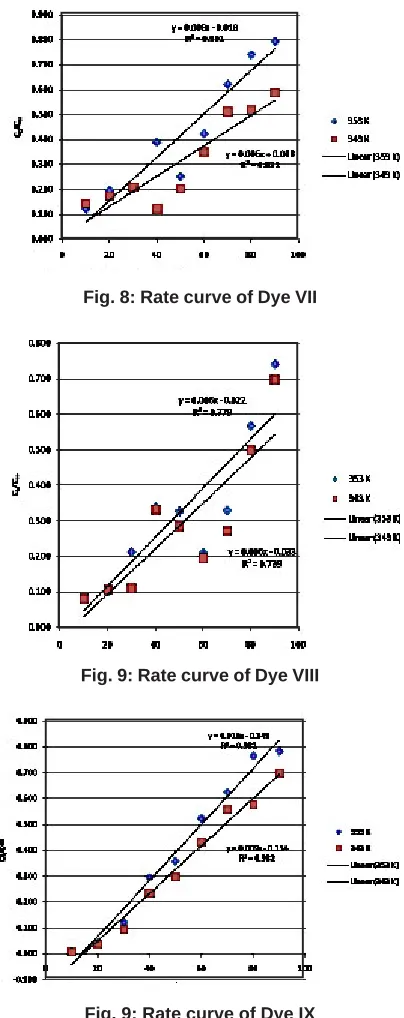
with warm water and allowed to dry at room temperature. The absorbances of the dyes were measured after striping the dyed fabric samples with formic acid at λmax (400 nm) in a 10 mm quartz absorption cell campsec uv/vis spectrophotometer. The absorbance at 10min intervals were [C]t, and the absorbance after six hours of dyeing were [C]¥. All measurements of dye solution were conducted at room temperature and graphs of Ct/C¥ against t1/2 were plotted from where the slopes were obtained. The diffusion coefficients (D) were calculated using Eqn 415.
...(4)
The activation energy of diffusion ED was calculated using Eqn 516.
...(5)
Note that the difference in the temperatures of study for polyester and nylon is due to the type of fibre. For example, polyester is more crystalline in structure than nylon hence it requires higher temperatures for dyeing to take place.
RESULTS AND DISCUSSION
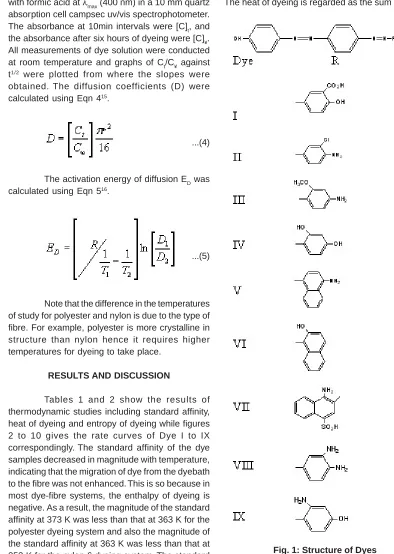
Tables 1 and 2 show the results of thermodynamic studies including standard affinity, heat of dyeing and entropy of dyeing while figures 2 to 10 gives the rate curves of Dye I to IX correspondingly. The standard affinity of the dye samples decreased in magnitude with temperature, indicating that the migration of dye from the dyebath to the fibre was not enhanced. This is so because in most dye-fibre systems, the enthalpy of dyeing is negative. As a result, the magnitude of the standard affinity at 373 K was less than that at 363 K for the polyester dyeing system and also the magnitude of the standard affinity at 363 K was less than that at
353 K for the nylon 6 dyeing system. The standard Fig. 1: Structure of Dyes
Table 1: Thermodynamic data of dyes I – IX on polyester fabrics ΔΔΔΔΔ µo(J/mol) at ΔΔΔΔΔHo ΔΔΔΔΔSo
Dye 363 K 373 K (J/mol) (JK-1/mol-1)
I -10953 -10309 -34333 -64
II -10938 -7833 -280603 -311
III -11877 -4474 -123671 -740
IV -10615 -6674 -153668 -394
V -10740 -3430 -276083 -731
VI -9007 -8966 -10482 -4
VII -1049 -8640 -77230 -184
VIII -9945 -8683 -55854 -126
IX -7536 -4066 -133500 -347
Table 2: Thermodynamic data of dyes I – IX on polyester fabrics ΔΔΔΔΔ µo(J/mol) at ΔΔΔΔΔHo ΔΔΔΔΔSo
Dye 353 K 373 K (J/mol) (JK-1/mol-1)
I -10048 -3803 -230499 -625
II -10150 -7071 -118839 -308
III -11523 -7549 -151834 -397
IV -10446 -8279 -86939 -217
V -3925 -2370 -58833 -136
VI -10389 -6625 -72669 -176
VII -6026 -1823 -154391 -420
VIII -10259 -8841 -60308 -142
IX -11044 -5803 -196042 -524
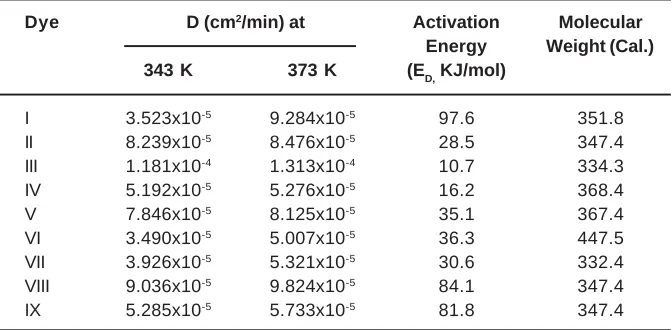
Table 3: Diffusion Coefficient (D) and Activation Energy of Diffusion Data of Dyes on Nylon 6 Fabrics
Dye D (cm2/min) at Activation Molecular Energy Weight (Cal.)
343 K 373 K (ED, KJ/mol)
I 3.523x10⁻⁵ 9.284x10⁻⁵ 97.6 351.8
II 8.239x10⁻⁵ 8.476x10⁻⁵ 28.5 347.4
III 1.181x10⁻⁴ 1.313x10⁻⁴ 10.7 334.3
IV 5.192x10⁻⁵ 5.276x10⁻⁵ 16.2 368.4
V 7.846x10⁻⁵ 8.125x10⁻⁵ 35.1 367.4
VI 3.490x10⁻⁵ 5.007x10⁻⁵ 36.3 447.5
VII 3.926x10⁻⁵ 5.321x10⁻⁵ 30.6 332.4
VIII 9.036x10⁻⁵ 9.824x10⁻⁵ 84.1 347.4
Fig. 6: Rate curve of Dye V Fig. 7: Rate curve of Dye VI Fig. 4: Rate curve of Dye III Fig. 5: Rate curve of Dye IV
Fig. 3: Rate curve of Dye II Fig. 2: Rate curve of Dye I
of formation of the various bonds, such as hydrogen bonds and ionic bonds, holding dye and fibre together. A decrease in the value of ΔHo means that more dye can be retained in the fibre, that is the interaction between dye and fibre is increased.
Fig. 9: Rate curve of Dye IX Fig. 9: Rate curve of Dye VIII Fig. 8: Rate curve of Dye VII
is quite high for both substrates and the dyes which gave decreased enthalpy of dyeing were more than compensated for by the corresponding increase in entropy. For instance, dye (II) in the polyester dye-fibre system gave a decreased enthalpy of -9007 J/ mol but its entropy increased to -4J/mol.
Similarly, in dye (V), the nylon 6 dye-fibre system gave a decreased heat of dyeing of -58833 J/mol and a corresponding increase in entropy of -136 J/mol. This tends to corroborate the recent work done on the physico-chemical properties of monoazo dyes on synthetic-polymer-fibres10. However, the values of Δµo for the PET dye-fibre system are higher than those of the nylon 6 dye-fibre system except dyes (VI), (VII) and (IX). This suggests that the dyes generally have higher affinities for the polyester fibre than for the nylon 6 fibre.
The values found for the diffusion coefficient (Table 3) on nylon 6 fibre show that the higher the temperature, the higher the coefficient of diffusion. This indicates that at high temperatures, there is greater loosening up of the fibre structure, thus creating more spaces for easier diffusion of dye molecules.
Activation Energy of Diffusion (ED)
molecular volume apart from molecular weight could be very important in analyzing activation energy of diffusion data. These agreed with that reported in the literatures14,16.
CONCLUSIONS
The dyeing properties of a series of disazo dyes were studied thermodynamically and kinetically on PET and nylon 6 substrates. In the thermodynamic study, it was found that the dyes generally have higher affinity for the polyester fibre than for the nylon 6 fibre. On the other hand, there were changes in the ΔHo and ΔSo in the two dye-fibre systems. The values of the ΔSo were negative which do not favour dyeing. However, the ΔHo
values were higher which suggests that it is the only driving force for dyeing to occur. The values of the Δµo, ΔHo, and ΔSo and also the presence of the –OH and –NH2 in the dye structures indicate that the hydrogen bonding mechanism is involved in the dye-fibre binding forces.
The values of activation energy of diffusion did not show any general trend, however, certain intrinsic properties of the dye molecules such as planarity and molecular volume could be more useful in interpreting activation energy of diffusion data for nylon 6 substrate. Further work in this area and that of the kinetics of PET fibre could prove to yield beneficial results.
REFERENCES
1. Venkataraman, K., The Chemistry of Synthetic Dyes. New York, Academic Press, (1974).
2. Otutu, J. O., Ossai, E. K., Jatto, E. O., Synthesis and Physicochemical Properties of monoazo disperse dyes from 3-aminophenol. J. Chem. Soc. Nig. 32(2): 81-99 (2007). 3. Bird, C. L. & Boston, W. S., The Theory of
Coloration of Textiles. Society of Dyers and Colourists, Bradford, (1975).
4. Abrahavt E. V., Dyes and Their Intermediates. London. Edward Arnold Pub. Ltd, (1977). 5. Mcgregor, R., Theory of Dyeing. Journal of
Society of Dyers and Colourists, 83(1): 57-58 (1967).
6. Dar uwalla, E. H. in The Chemistr y of Synthetic Dyes Eds. Venkatavaman, New York, Academic Press, (1974).
7. Kan, C. W., Chan, K., Yuen, C. W. M. and Miao, M. H., Plasma modification in Wool fibre Effect on the dyeing properties. Journal of Society of Dyers and Colourists, 114(5): 61-65 (1998).
8. Anna, U., Eva, B., Janka, O., Randovan, T. and Anton M., Kinetics of dyeing process of blend polypropylene/polyester fibres. Dyes and pigments, 72(2): 212-216, (2007).
9. Kim, T., Son, Y., Lim, Y., Thermodynamics analysis of 1, 4-diaminoanthraquinone adsorption on polyethylene terephthalate in alkane media; Dyes and pigments, 72(2): 246 – 250, (2007).
10. Otutu, J. O., Okoro, D. and Ossai, E. K., Preparation of Dis-azo dyes derived from p-aminophenol and their fastness properties for synthetic polymer-fibres. J. Appl. Sci.8(2): 334-339 (2008).
11. Giles, C. H., Laboratory Course in Dyeing, Pp. 134, (1974).
12. Peters, L., In The Theory of Coloration of Textiles; Eds. Bird C. L. and Boston W. S. Society of Dyers and Colourists, Bradford, (1975).
13. Giles, C. H., Laboratory Course in Dyeing, Bradford, Soc. Dyers and Colourists (SDC) Pp. 138, (1974).
14. Yakubu, M. K., Ph.D Thesis, Ahmadu Bello University, Zaria, Nigeria, (2000).
15. Venkataraman, K., The Chemistry of Synthetic Dyes: New York Academic Press, Pp. 131-132, (1974).