This is an open access journal, and articles are distributed under the terms of the Creative Commons Attribution-Non Commercial-ShareAlike 4.0 License, which allows others to remix, tweak, and build upon the work non-commercially, as long as appropriate credit is given and the new creations are licensed under the identical terms.
© 2019 Journal of Advanced Pharmacy Education & Research | Published by SPER Publication 70
Health care system in the USSR (through the example of the
Kirov region)
Zemfira Vilenovna Gallyamova
1*, Vera Evgenievna Batyukova
2, Veronika Yurievna Malakhova
2, Elena
Vladimirovna Fomenko
31Elabuga Institute (branch) of Kazan (Volga Region) Federal University, Kazanskaya street, 89, Elabuga, Republic of Tatarstan, 424604, Russia, 2Financial University under
the Government of the Russian Federation, 125167, Moscow, Leningradsky prospect, 49, Russia, 3All-Russian state University of justice (RPA of the Ministry of Justice),
117638, Moscow, ul Azovskaya, 2, korp., Russia.
Correspondence: Zemfira Vilenovna Gallyamova. Elabuga Institute (branch) of Kazan (Volga Region) Federal University, Kazanskaya street, 89, Elabuga, Republic of Tatarstan, 424604, Russia. Email: [email protected].
ABSTRACT
Using the example of the Kirov Region, the Soviet health care in 1920–1930s was analyzed. The structure of health care covering all
areas of the population’s life and forming all constituents of traditional medicine was shown. The territorial and administrative organization of the health care system was considered, and the main stages of its development were identified. The impact of the
Bolsheviks’ power formation on the principles of the state’s social policy was considered. The statistics of medical care in various industries were given. The interrelation between the provision of the population with medical services and the priorities of the state economic policy were determined. An obvious gap was revealed between the medical care of the rural and urban population, in favor of the latter. It was noted that this phenomenon was due to the general line of the Soviet leadership when the village was a supplier of agricultural products and labor rather than an object of investments. It was shown that in the context of growth rates of industrial development, the medical support system was incorporated into the structure of industrial production and became its integral part. The ideological nature of the social state policy was analyzed. The party basis of the organization and functioning of medical care was described.
Keywords: collectivization, industrialization, health care, medical care, social policy, state priorities
Introduction
The period of the 1930s that was deeply analyzed in the national and foreign historiography is still a relevant subject of study. The problematics of Stalinism as a social phenomenon have attracted not only professional historians but also political scientists, philosophers, economists, and members of the general public. Health is on a continuum—one does not arrive at good health
accidentally. Personal health begins before birth and continues
throughout a person’s life.[1] Even the subject of the variety of
approaches and estimates given to this phenomenon, the discussion of this topic, the multiplicity of study approaches, and estimates of this period turns around the recognized fact –
forming a command-administrative system based on the hierarchical feature on this chronological segment. Considering that the improvement of health literacy has an effective role in promoting health status and utilization of health services, and on the other hand due to the high incidence of heart diseases and a considerable economic burden that can impose these diseases to individuals and the society, the investigation of the quality of life as one of the treatment outcome measurements and factors affecting it in these people can help to identify the problems related to current programs of treatment and care of these diseases and also discover the points required for intervention.[2]
Over recent years, the topic of the Soviet health care has been the basis of numerous studies. The Soviet health care has been considered in various contexts: a review of historiography on the
Access this article online
Website: www.japer.in E-ISSN: 2249-3379
How to cite this article: Zemfira Vilenovna Gallyamova, Vera Evgenievna Batyukova, Veronika Yurievna Malakhova, Elena Vladimirovna Fomenko. Health care system in the USSR (through the example of the Kirov region). J Adv Pharm Edu Res 2019;9(4):70-75.
social policy,[3] the village as an object of medical care,[4] the ratio
of social expenditures for the needs of the city and the village in the state budget,[5] organization of medical care in remote regions
of the country,[6, 7] and development of the regional human resources’ management system.[8] The structure of health care in
the industrial area has been analyzed in detail in the work of S.N. Rusakov.[9] In the foreign historiography, Soviet health care has
been considered in the context of the sociology of labor and professionalism of human resources.[10-12]
New techniques and devices are introduced to the market annually.[13] The purpose of the article was to consider the basics
of forming the healthcare system during industrialization and to identify the principles of organizing social security for the population in the context of the active modernization of industry.
Methods
Methodologically, the study was based on the theoretical views of modern national and foreign historians on the priority of the socio-economic policy of the USSR in the 1920–1930s.[11, 14-17] In
general, the scientific basis of the study consisted of the principles of historicism, systematicity, and objectivism. During the analysis, the comparative-historical method was widely used. Based on it, the ratio of social expenditures in the urban and rural environment was determined. This method made it possible to reveal the huge gaps in the social security of the village and the hamlet. The comparative chronological method allowed consistently considering the evolution of the health care system in the 1920–1930s. The method of quantitative analysis made it possible to objectively see the ratio of the expenditures for medical care for rural and urban residents and to determine the proportion of expenditures for the industrial sector.
Results
In the 1917–1930s, the public health care in the Vyatka Governorate (later the Kirov Region) was formed in several stages. At various times, the health care center was moved around the region depending on territorial changes. Thus, until 1929, the central public health authority in the area was the Governorate Public Health Department. When the Vyatka Governorate was taken in the Nizhny Novgorod Territory, the center was located in the Gorky Territory Public Health Department. Since 1934, when the Kirov Region was founded, the central public health authority was the Territory Public Health Department (later renamed to the Regional Public Health Department). The local public health authorities – district public health departments – were subordinated to it.
In 1937, the structure of the Kirov Regional Public Health Department was as follows:
1. General sector: It dealt with records management on circulars and orders of upper organizations.
2. Construction sector: Its functions included the construction of medical, therapeutic, prophylactic, and nursery institutions in the region.
3. Mother and infancy sector: organizing sanatorium-preventive childcare centers, and accounting of sanitary-preventive measures for childcare centers. 4. HR sector. It was responsible for HR, recorded
information about graduates, kept personal medical records, collected information on sanitary courses, and kept records on the nursing HR.
5. The sector of medical education: It was responsible for the professional development of medical employees. 6. Medical statistics sector: It collected information on
medical colleges and schools.
7. Medical sector: It compiled an annual review on the health care in the region, and kept records on the number of fixed beds and information about the number of doctors, the degree of concentration, etc. 8. Sanitary and epidemiological sector: It recorded
sanitary-preventive measures in the region, and performed educational activities on epidemic diseases. 9. Drugstore management: It supplied medicines to
pharmaceutical institutions of the region.
10. Sanitary and epidemic department-Institute of Epidemiology and Microbiology: Its functions included the registration of epidemic diseases in the region and the development of sanitary-preventive measures. 11. Regional Department of Physical Education Control.
The development of the public health care system in the Vyatka Governorate (later the Kirov Region) from 1917 to the late 1930s has made it possible to define the following stages. The first one (from 1917–1921) has been characterized mainly as a period of combating epidemics and hunger. The second period (from 1923–1927) coincided with the transition to new construction. It can be described as a period of strengthening the existing medical institutions and the emergence of new ones. During this period, the inter-territory congresses on topical medical issues were held for the first time.[18] Free treatment was
introduced. In-patient medical care was expanded. The number of out-patient clinics increased. The measures to protect motherhood and infancy were taken. Mother and child homes, as well as child and infancy houses, were established. This was
when the slogan “Employees’ health care depends on the employees themselves” appeared. In total, for the period of 1917–1927 the number of hospitals and medical institutions had increased by 20%, and fixed beds by 13%.[18]
The third period (since 1927) is the period when the public health care started being planned. During this period, the priority task of Soviet medicine was to ensure production. This is the example of how the tasks of medicine were considered during this period
(taken from the local mass media): “medical employees must
focus their attention and power on the problems of morbidity and traumatism among the workers involved, above all, in the leading industries, as well as on the problem of improving the health and everyday life of the workers for them to be actively and efficiently involved in the struggle for fulfilling the national
economic plan”.[19] “It is entirely obvious that we, medical
Gallyamova et al.: Health care system in the USSR (through the example of the Kirov region)
party, in particular, to fulfill the tasks of improving the labor. It
is important to organize the worker’s cultural rest”.[19] This is the
reason for defining the primary problems associated with
occupational diseases (professional dermatosis), as “... the ones
of great importance in the overall national economic aspect that occupy one of the first places among other causes of temporary disability, and markedly affecting the implementation of the
professional plans of our industry” (Ibid). Such approach surely
has been derived from the local interrelation between the public health care and the party goals, in particular, the decrees of the Central Committee of the All-Union Communist Party (b) “On Medical Care for Workers and Peasants”. According to it, medical care for workers has considered a priority: “all health
care turned around to the production and became a considerable national economic factor that did it best to contribute to fulfilling
the general plan of the national economy”.[20] At that moment,
the public health care centers at large industrial enterprises of the region became the driver of public health care. The functions of
health care centers were to account for the workers’ morbidity
and changes in labor productivity. Thus, the medical care in this period went beyond traditional therapeutic activities. It became an integral part of the production by its tasks and functions. The priority of servicing the heavy industries in 1934 has been shown in the table below (Table 1 has been compiled by using the data from Elkin I.V.[19]
Table 1: Medical Support of Main Industries in the Kirov Region.
Industry Number of enterprises
Number of public health
care centers
Number of doctors
Manufacturing
engineering 34 80 97 Chemical 5 9 11 Metallurgical 11 12 8
Leather 14 9 10
Other - 8 54
According to Table 1, the most favorable situation in terms of medical care was in manufacturing engineering, where at one enterprise there were two-three health care centers and three doctors, on average. In the chemical and metallurgical industries, on average, there was one health care center and one doctor per enterprise. The situation in the leather industry was less favorable. Here one-third of enterprises did not have any health care centers, and five enterprises did not have any doctors. In 1932, the number of medical visits per worker averaged from 9.5 to 10, 6.6 per urban resident.[19]
The public health care was formed in the territory in accordance with the above instructions, namely, the work according to the principle of differentiated social services. In the context of the forced industrialization, this fully complied with the spirit of the times. Human health was considered as a factor in ensuring productivity. One of the objectives of public health care in this period was to actively involve female labor in production. As a result, the construction of nurseries was widely developed. From
1929 to 1934, the number of nursery institutions in the region increased by 92.5%. In some industries, the nursery service was as follows: manufacturing engineering – 75 %, chemical – 74.3 %, ferrous metallurgy – 61.5 %, and textile – 55.2 %.[20]
Regional medical journals raised the issues on the optimal use of female labor in the production. Thus, in 1934, the Gorky
Medical Journal published the article “On Implementing Female Labor at the Molotov Automobile Plant”. The main idea of the article was “to prove that a woman of the Gorky Automobile
Plant is not less, and sometimes more valuable and economically
more profitable than a man”.[20] The short maternity leave caused
mass media to raise the problem of ensuring high-quality artificial feeding of babies.[21] In order to define the factors that had an
impact on productivity, public health authorities used questionnaires and survey methods in industries. In order to popularize sports in the working environment, in 1933, medical control units were organized in the region. In 1933, 89 medical control units were established. One hundred doctors worked there.[21]
The primary service of the industry, ensuring the optimal functioning of the productive forces with medicine, became one of the components of Stalin’s public health care. It is necessary to
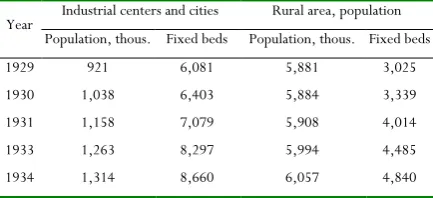
note that the differentiated approach to medical care has been clearly manifested in the provision of health services to rural residents. If to consider the situation on organizing medical care in the territory as a whole, it was possible to see a considerable gap between the city and the village in terms of the number of fixed beds. According to the below table, there was 0.6 fixed bed per one urban resident, while there was 0.05 fixed bed per one rural resident on average. At the same time, the number of rural residents in the territory exceeded the number of urban residents by five times. The number of fixed beds in the city exceeded the number of fixed beds in the village by 1.9 times in 1931 and 1.7 times in 1934 (Table 2 was compiled according to the data from Gleserov Z. Ya.).[20]
Table 2: In-patient Medical Care for the Population in the Kirov Region in the first half of the 1930s.
Year Industrial centers and cities Rural area, population Population, thous. Fixed beds Population, thous. Fixed beds 1929 921 6,081 5,881 3,025 1930 1,038 6,403 5,884 3,339 1931 1,158 7,079 5,908 4,014 1933 1,263 8,297 5,994 4,485 1934 1,314 8,660 6,057 4,840
urban population in the region was 14.86%. In general, the indicators of providing the urban population with fixed beds in the Kirov Region were quite high – 9.15 per 1,000 people, while in the RSFSR it was 7.5. However, due to the inadequate provision of the rural population with fixed beds, 40 % of fixed beds in urban hospitals were meant for rural residents. This reduced the number of fixed beds per 1,000 urban residents down to 5.5. The number of fixed beds in the village per 1,000 residents averaged 1.44, i.e., almost four times less than in the city. There was also a huge gap between the city and the village in providing medical care. While in Kirov there were 16.2 doctors per 10,000 thousand residents and in other cities, there were 9.1 doctors. In rural areas, this number was 0.76, i.e., above 16 times lower than in Kirov and nine times in other cities (GAKO, f. R-2248. Inventory 1, case 77, l. 71; overleaf). At the same time, there was a considerable remoteness of the village from medical care and its uneven distribution: 60 % of the total number of doctors worked in regional centers. In general, this situation in the territory was determined by the weak medical care in it. The Kirov Region was among the laggards in terms of the main indicators of health care in the RSFSR. Nevertheless, the priority of the city in providing medical care and its residual principle in the village were obvious. The transfer of resources from the agrarian to the industrial sector determined the regularity of this phenomenon. The local public health system was controlled by party committees at various regional levels. They responded to many issues from the ideological propaganda among medical HR to direct work in hospitals, medical and preventive measures, HR issues, etc. However, at the same time, propaganda issues were among the most important ones. Thus, at the meeting held on May 5, 1939, the Kirov City Committee of the All-Union Communist Party (b) analyzed the work of the City Public Health Department and noted some improvements in its work (expansion of the nursery network, improvement of maternity homes, providing of free treatment in mud baths, etc.). It also mentioned the main shortcomings of the work performed by the City Public Health Department, including the insufficient mass educational work among medical HR, and the lack of criticism and self-criticism (GASPI, F. 1293, Inventory 1, case 1, Sheets 50 – 52). Only after this, the deficiencies directly related to the public health were noted: doctors’ rudeness
towards ill people, insufficient sanitary control over the city streets, etc.
In general, considering the primary party organizations as agents of the government policy, it was possible to define the following sequence through the example of party committees at health care departments:
center → regional committees → municipal committees →
district committees → party committees at the management structures of medical institutions (regional public health authorities, municipal public health authorities, and district public health authorities) → management structures of medical institutions (regional public health authorities, municipal public health authorities, and district public health authority).
Thus, public health authorities, being the lower link in the system of the ideological government policy, fulfilled the functions to locally implement it in the relevant area. This situation was typical for all branches of public life. The work of party committees in the system of medical institutions can be divided into two parts. The first one (the current) aimed at organizing political circles at medical institutions, agitation, and propaganda activities (wall newspapers and political books), organizing socialistic competitions, and movements of shock-worker movement. In 1938, 355 people (65 % of the total number) took part in the socialistic competitions of the party organizations of the Kirov Regional Public Health Authority, including 147 persons enrolled as shock workers, and 33 persons as excellent workers (GASPI, F. 1898, Inventory 1, Case 6, Sheet 30). The second part of the work performed by the party committees in the public health care system was to communicate the decisions of the Central Committee of the party and other goals to the employees of the system of medical institutions. In this case, employees of the institutions were to demonstrate the
counter-initiative. Thus, in 1938, due to the release of the “Short Course
in the History of the All-Union Communist Party (B.)”, the
meeting of the intelligentsia of the regional medical institutions of the regional public health service expressed the desire to study
a short course in order to “... improve the political level and use it at work” (GASPI, F. 1898, Inventory 1, Case 6, Sheet 33). The campaigns to combat sabotage across the country could not help but had an impact on assessing a number of local events by the party committees. The actions of the nurse Melchakova from the Kotelnichesky maternity hospital who gave opium to seven children for them “not to cry” were regarded as sabotage (GASPI,
F. 1898, Inventory 1, Case 6, Sheet 35). As noted at the meeting of the party committee at the regional public health authority,
“the case cannot be considered as negligence, this fact should be
considered as political, and there is no guarantee that this fact is
an act of sabotage”. A nutrient mixture given in Kirov to a child
and containing a 0.5 % solution of mercuric chloride, poisoning of six children with henbane in the kindergarten of the Khalturinsky Area were considered in the same way.
“The high mortality in the Kirov nurseries and in many infant
homes indicates that in our region the enemies of the people
carry out their subversive work in the mother and infancy sector”
(GASPI, F. 1898, Inventory 1, Case 6, Sheet 37; overleaf). There were assumptions of sabotage in 1938 when people were poisoned in the canteen of the Machine Construction Plant (GASPI, F. 1898, Inventory 1, Case 1, Sheet 39).
The issue of how true this belief was is the subject of a separate study. However, the very fact of identifying child mortality and
poisoning in catering establishments with the enemies’ intrigues
gave a clear picture of the atmosphere of the era.
Results
Gallyamova et al.: Health care system in the USSR (through the example of the Kirov region)
Union, the village was the only source of industrialization. Collectivization has been considered in the context of the well-thought social and economic state policy that provided for the creation of a mechanism for transferring human and material resources from the agrarian to the industrial sector. As a rule, modern historiography has shown this issue in a tragic context. Regional studies have been published on the methods and effects of the collectivization policy in grain procurement areas. In particular, these were the works of Oskolkov [22] and
Kondrashin.[23] According to the authors, the hunger that took
the lives of millions of peasants had become the direct consequence of the collectivization policy. The work of Karavaeva [5] has been devoted to the apparent distortions of the
socio-economic policy of the state towards the active development of the industry to the disadvantage of the village. The author analyzed the state budget to show the evolution of allocations for the needs of agriculture and industry. The author came to the conclusion that while at the first stage of industrialization, investments in the agrarian and industrial sectors were approximately the same, subsequently the village was practically not financed (p. 36). Fitzpatrick [16] had the same
point of view. The author noted practically the rightlessness of peasants and drew a parallel between the status of peasants on collective farms and serfdom law (p. 145). The analysis of the regional material through the example of the public health care system also revealed the priorities of the socio-economic policy of the state as the creation of a powerful technical base of medical services in the industrial sector. Agriculture was practically not socially secured.
Conclusion
The analysis of the public health care formation in the Kirov Region in the 1920–1930s showed that the medical services provided to the population were organized according to the government policy, and were clearly guided by the tasks set by the party. This determined the following factors in the social security system:
1. A close relationship between public health care and production. The main task of the public health care in the context of modernization was to serve the production, as a guarantee of the optimal functioning of the productive forces (human health as a factor of production).
2. Priority maintenance of industrial centers to the disadvantage of the village (social differentiation of medical care).
3. Party authorities in the structure of public health authorities as agents of the government policy.
Thus, the work of the party authorities in the public health care system made it possible to follow the implementation of the main provisions of the government policy of this period. This was clearly seen in the formulation of priorities, involving priority services for industrial production, as well as in the leading role of the party authorities in the public health care structure. The
forced tempos of industrialization caused the introduction of administrative-command methods in all areas of public life, including social life. This meant the confirmation of the final principle of the directive economy to the problems of the social area and the standard of life. At the same time, the forced tempos of modernization were directly related to the productive potential of direct executors, and as a result, it raised the need to improve the educational level and the living conditions of the masses. In this sense, certain progress in everyday life and a certain civilizational shift were of the components of the forced industrialization. Changes in the living conditions of the population should have been expressed in the elimination of unemployment and the inclusion of women in production. At the same time, the proclamation of universal social security in the 1930s was of great ideological importance.
References
1. Setia S, Singh S, Mathur A, Makkar DK, Aggarwal VP. Health care and geomedicine: a review. World Journal of Environmental Biosciences. 2017; 6(1): 1-3. 2. Marzangi A, Ahangarzadeh Rezaei S, Ghareagaji Asl R.
Health literacy and its relation to the quality of life in people with heart disease. International Journal of Pharmaceutical and Phytopharmacological Research.
2018;8(3): 25-32.
3. Kim MYu, Kuzoro KA. Social Policy of the Soviet Government (the 1930s) in the National and Foreign Historiography. Bulletin of the Tomsk State University. 2010; 334: 64-67.
4. Samsonenko TA. Formation and Development of the Rural Health Care System in the USSR in the 1930s. Power. 2015; 5: 146-151.
5. Karavaeva IN. Formation of the Financial Foundation of Soviet Industry on the Eve of the Second World War. Bulletin of the Institute of Economics of the Russian Academy of Sciences. 2012; 2: 26-36.
6. Knyazkina TA. Activities of Mobile Medical Groups in the Far North-East of the USSR. Bulletin of the Tambov University. 2018; 23(176): 177-184.
7. Sarycheva TV. Organization of the Regional Research Room of Medical Control in Western Siberia and Its Activities in the 1930s. Bulletin of Siberian medicine. 2015; 14(4): 119-124.
8. Knyazkina TA. HR Policy in Health Care in the Far North-East of the USSR in 1920-1940. Ocucumene. Regional Studies. 2016; 3: 91-97.
9. Rusakov SN. Evolution of the Soviet Legislation in the Area of Health Care of the Industrial Working Class. Bulletin of the Vyatka Humanitarian University. 2012; 12: 92-96.
11. Kivinen M. Progress and Chaos. Sociological Analysis of the Past and Future of Russia. Saint Petersburg: Academic Project; 2001.
12. Pasti S. Russian Journalist in the Context of Changes. St. Petersburg Media. Tampere: Tampere University Press; 2004.
13. Gholami M. Evaluating the curriculum for B.S. of radiologic technology in Iran: an international comparative study. Entomology and Applied Science Letters. 2018;5(3): 48-59.
14. Shpotov BA. American Business and the Soviet Union in the 1920-1930s: Labyrinths of Economic Cooperation. Moscow: Librokom; 2013.
15. Khlevnyuk OV. Khozyain. Owner. Stalin and the Approval of the Stalinist Dictatorship. Moscow: ROSSPEN; 2010.
16. Fitzpatrick Sh. Everyday Stalinism: Social History of Soviet Russia in the 1930s: the Village. Moscow: ROSSPEN; 2001.
17. Osokina EA. Gold for Industrialization: Torgsin. Moscow: ROSSPEN; 2009.
18. Vyatsko-Vetluzhskiy Territory. No. 8. The Volga Region Congress on Combating against Skin and Epidemic Diseases, Kazan. Vyatka-Vetluzhsky Territory, Vyatka: 1st type-lithography of Governorate Council of National Economy; 1926.
19. Elkin IV. To Forming the Second Scientific and Medical Five-Year Plan. Gorky Medical Journal. 1933; 9-10. Gorky: Gorky Regional Publishing House; 1933. 20. Glezerov ZYa. Health Care in the Gorky Territory and
the Main Tasks in 1934. Gorky Medical Journal. 1934; 6-7. Gorky: Gorky Regional Publishing House; 1934. 21. Boginsky SN. 15 years of Health Care in the Gorky
Region. Gorky Medical Journal. 1933; 7-8. Gorky: Gorky Regional Publishing House; 1933.
22. Oskolkov EN. Golod 1932/33 g. Hunger in 1932-1933. Grain Procurement and Famine in 1932-1933 in the North Caucasus Region. Rostov-on-Don: Publishing House of the Rostov University; 1991.