Modeling and Simulation of 3-Phase Voltage and
Current Source Inverter using MATLAB/SIMULINK
for Various Loads
Braj Kishor Verma
Assistant Professor, SRMGPC, Lucknow,
Dr. Anurag Tripathi
Assistant Professor, IET, Lucknow
Abstract –In today’s world inverters are used to convert a single or multiple phase AC voltages from a DC supply source. Various types of inverters such as 1-phase inverters and 3-phase inverters are used for various industrial applications. Inverter comes in two categories which is voltage source inverter (VSI) and current source inverter (CSI). In this paper work simulation of three phase VSI and CSI is performed using MATLAB/SIMULINK. THD is compared in voltage and current waveform and analyzed in different load conditions.
Keywords – Inverter, VSI, CSI, THD, MATLAB/
SIMULINK.
I.
I
NTRODUCTIONWITH the development of power electronic technology, the inverter has been widely applied in many fields. The inverter is therefore attracting attention of the researchers. An inverter is a contrary transformation device of a rectifier, whose function is to change AC into DC [5]. According to the property of the DC side power supply, the inverter is divided into the voltage-source inverter and the current-source inverter.
Voltage Source Inverter (VSI) has small or negligible impedance for dc source. In other words, a VSI has stiff dc voltage source at its input terminals. The easiest dc voltage source for a VSI may be a battery bank, which may consist of several cells in series-parallel combination. Solar photovoltaic cells can be another dc voltage source. An ac voltage supply, after rectification into dc will also passed as a dc voltage source. A voltage source is called stiff, if the source voltage magnitude does not depend on load connected to it. All voltage source inverters may be stiff voltage supply at the input.
Voltage source inverters can be described according to different criterions. They can be described according to number of phases they output. Accordingly there is Single-phase Voltage Source Inverter, Three-Single-phase Voltage Source Inverter.
Thyristor-based current–source inverters (CSIs) have been traditionally used in high-power motor drives and utility power systems applications because of their topological and operational advantages [1], [2]. Due to the economical and reliable characteristics of the thyristors, the CSI topologies based on thyristors have performance merits such as simplicity, ruggedness, cost effectiveness, and very low switching losses [3], [4]. Due to all these features, the thyristor-based CSIs have been, so far, the favorable power converter topology in high-power
high−power rating. However, the thyristor-based CSI has intrinsic drawbacks because the thyristors cannot be turned off by the gating signals. Therefore, external devices and circuits are required to turn the thyristors off by applying reverse-biased voltages, as well as transfer reactive energies of inductive loads after turning off the thyristors. Typical forced commutated thyristor-based CSIs are the autosequentially commutated inverters (ASCIs) based on commutation circuits with six ac capacitors and six high-power diodes.
II.
M
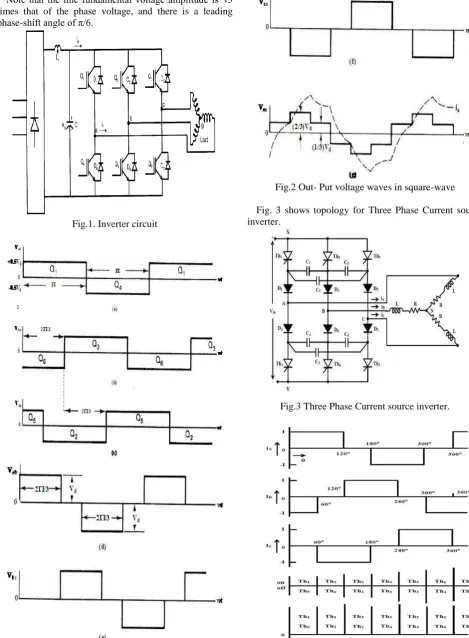
ODELINGThree-phase bridge inverters are widely used for ac motor drives and general-purpose ac supplies. Fig. 1 shows the inverter circuit, and Fig. 2 explains the fabrication of the out- put voltage waves in square-wave, or six-step, mode of operation. The circuit consists of three half-bridges, which are mutually phase-shifted by 2π√3 angle to generate the three-phase voltage waves. The input de supply is usually obtained from a single-phase or three-phase utility power supply through a diode-bridge rectifier and LC or C filter, as shown. The square-wave phase voltages with respect to the fictitious de center tap can be expressed by Fourier series as
νao =
2𝑉d
𝜋 [cosωt− 1
3 cos3ωt +
1
5 cos5ωt −..] (1)
νbo =
2𝑉d
𝜋 [ cos(ωt − 2𝜋
3) − 1
3 cos3 (ωt − 2𝜋
3) + 1 5 cos5(ωt − 2𝜋
3) −…….] (2) νco =
2𝑉d
𝜋 [ cos(ωt + 2𝜋
3) − 1
3 cos3 (ωt + 2𝜋
3) + 1 5 cos5(ωt + 2𝜋
3) −…….] (3) Where Vd = DC supply voltage. The line voltages can therefore be constructed from Equations (4)-(6) as
νab = νao − νbo = 2 3 𝑉d
𝜋 [ cos(ωt + 𝜋 6) +0 −
1
5 cos5 (ωt + 𝜋 6) − 1
7 cos7(ωt + 𝜋
6) −…….] (4) νbc = νbo − νco
= 2 3 𝑉d
𝜋 [cos(ωt − 𝜋 2) +0 −
1
5 cos5 (ωt − 𝜋 2) − 1
7 cos7(ωt − 𝜋
2) +…….] (5) νca = νco − νao
= 2 3 𝑉d
𝜋 [cos (ωt + 5𝜋
6) +0 − 1
5 cos5 (ωt + 5𝜋
6) − 1
7 cos7(ωt + 5𝜋
Copyright © 2014 IJECCE, All right reserved Note that the line fundamental voltage amplitude is √3
times that of the phase voltage, and there is a leading phase-shift angle of π/6.
Fig.1. Inverter circuit
Fig.2 Out- Put voltage waves in square-wave Fig. 3 shows topology for Three Phase Current source inverter.
Fig.3 Three Phase Current source inverter.
The output current (phase) waveforms are shown in Fig. 3. In this circuit, six thyristors, two in each of three arms, are used, as in a three-phase VSI. Also, six diodes, each one in series with the respective thyristor, are needed here, as used for single-phase CSI. Six capacitors, three each in two (top and bottom) halves, are used for commutation. It may be noted that six capacitors are equal, i.e. C1= C2=…. = C6 =C. The diodes are needed in CSI, so as to prevent the capacitors from discharging into the load.
III.
S
IMULATION ANDR
ESULTSCurrent Source Inverter (CSI)
RL load
Fig.5. FFT of Line voltage before filter
Fig.6. FFT of Line voltage after filter
Motor Load
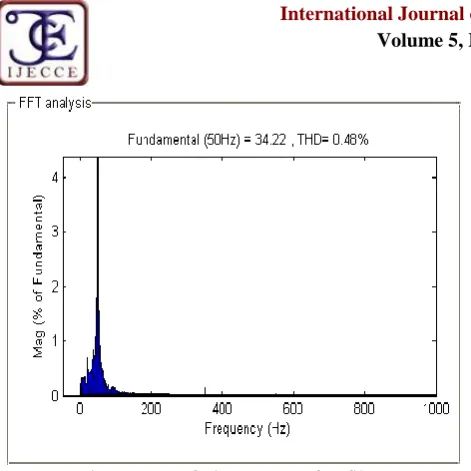
Fig 7 and Fig 8 shows the FFT analysis of Line voltage and current of CSI with motor load before filter. THD of line voltage before filter is 113.61% and current is 16.51%
Fig.8. FFT of Line voltage before filter
Fig.9. FFT of Line current before filter
Copyright © 2014 IJECCE, All right reserved Fig.11. FFT of Line current after filter
Voltage Source Inverter (VSI)
RL Load
Fig.12. Line Voltage before filter with RL load
Fig 13 Line Voltage after filter with RL load
Fig.14. FFT of line voltage after filter
Motor Load
Fig.14 shows the waveform of line voltage before filter with motor load.
Fig.15. Line Voltage before filter with motor load Fig.15 shows the waveform of line voltage after filter with motor load.
Fig.17. FFT of Line voltage before filter Fig.18. FFT of Line voltage after filter
IV.
C
OMPARISONTable 1: THD comparison of VSI and CSI for RL and MOTER Load S.No Type of
inverter
Type of Load
Filter parameter Voltage
THD (%)
Current THD (%) Inductor (mH) Capacitor (µF)
1 VSI RL Load 150 17 3.28 3.28
2 VSI Motor Load 10 300 3.24 3.62
3 CSI RL Load 10 1000 4.29 0.80
2 CSI Motor Load 400 1000 1.84 0.48
V.
C
ONCLUSIONSimulations of the Voltage source inverter (VSI) and Current source inverter (CSI) with RL and motor loading condition are presented. Simulations have been done using MATLAB/SIMULINK toolbox. The results with RL and motor load are analyzed and THD comparison is done with different loads. Performance of both CSI and VSI is compared. THD results are shown to validate the performance of the system.
R
EFERENCES[1] B. Odegard, C. A. Stulz, and P. K. Steimer, “High-speed, variable-speed drive system in megawatt power range,” IEEE Ind. Appl. Mag., vol. 2, no. 3, pp. 43–50, May/Jun. 1996.
[2] H. L. Hess, D. M. Divan, and Y. Xue, “Modulation strategies for a new SCR-based induction motor drive systems with a wide speed ranges,” IEEE Trans. Ind. Appl., vol. 30, no. 6, pp. 1648–
1655, Nov./Dec. 1994.
[3] H. Mok, S. K. Sul, and M. H. Park, “A load commutated inverter-fed induction motor drive system using a novel DC-side commutation circuit,” IEEE Trans. Ind. Appl., vol. 30, no. 3, pp. 736–745, May/Jun. 1994.
[4] S. Kwak and H. A. Toliyat, “A novel hybrid solution for load commutated inverter-fed induction motor drives,” IEEE Trans. Ind. Appl., vol. 41, no. 1, pp. 83–90, Jan./Feb. 2005.
[5] F. J. Liu, “Sine wave inverter”, Beijing: The Science Press, 2002. [6] Mecke R., Riefenstahl U., A New topology of current source
inverter with in IGBT for high power, EPE '99 Lausanne.
[7] D. C. Lee, D. H. Kim, and D. W. Chung, Control of PWM current source converter and inverter system for high performance induction motor drives, IEEE IECON proc., in Taipei, 1996.
[8] Klonne A., Fuchs W.F., High dynamic performance of a PWM
[9] N. Mohan, T. M. Undeland, and W. P. Robbins, Power Electronics, 2nd ed. New York: Wiley, 1995.
[10] Cengelci, E., Sulistijo, U., Woo, O., Enjeti, P., Teodorescu, R., and Blaabjerg, F.: „A new medium-voltage PWM inverter topology for adjustable-speed drives,’ IEEE Trans. Indust. Appl.,
1999, 35, pp. 628–637.
[11] Celanovic, N. and Boroyevich, D.: „A comprehensive study of point voltage balancing problem in three-level neutral-point-clamped voltage source PWM inverters‟, IEEE Trans. Power Electron., 15, (2), pp. 242–249.
[12] Y.Zhao, T.A.Lipo, “Space vector PWM control of dual three-phase induction machine using vector space decomposition,”
IEEE Trans. On Industry Applications, vol. 31, no. 5, 1995, pp. 1100-1109.
[13] O.Ojo, G.Dong, “Generalized discontinuous carrier-based PWM modulation scheme for multi-phase converter-machine systems,” Proc. IEEE Ind. Appl. Soc. Annual Meeting IAS, Hong Kong, 2005, CD-ROM paper IAS38p3.
[14] F. Wang, “Multi-level PWM VSIs,” IEEE Ind. Appl. Mag., vol. 10, no. 4,pp. 51–58, Jul./Aug. 2004.
[15] F. Wang, “Sine-triangle versus space-vector modulation for three-level PWM voltage-source inverters,” IEEE Trans. Ind. Appl., vol. 38, no. 2, pp. 500–506, Mar./Apr. 2002.
A
UTHOR’
SP
ROFILEBraj Kishor Verma
is working in Electrical Engg. Department as Assistant Professor in Shri Ramswaroop Memorial Group of Professional colleges (SRMGPC), Lucknow, (U.P.) India.