Alparslan Birdane
1, A–F, Huseyin U. Yazici
1, A–F, Yuksel Aydar
2, A, D, F,
Kadir U. Mert
1, B, C, F, Muharrem Masifov
1, B, C, F, Taner Ulus
1, B, C, F,
Yuksel Cavusoglu
1, A, D–F, Necmi Ata
1, A, D–F, Bilgin Timuralp
1, A–FEffectiveness of Cardiac Simulator on the Acquirement
of Cardiac Auscultatory Skills of Medical Students
Wpływ symulatora kardiologicznego na nabycie umiejętności
osłuchowych przez studentów medycyny
1 Department of Cardiology, Medical School of Osmangazi University, Eskişehir, Turkey 2 Department of Anatomy, Medical School of Osmangazi University, Eskişehir, Turkey
A – research concept and design; B – collection and/or assembly of data; C – data analysis and interpretation;
D – writing the article; E – critical revision of the article; F – final approval of article; G – other
Abstract
Background. Cardiac simulators have been developed as an alternative training model in order to improve the car-diac auscultation skills of medical students. The effectiveness of the carcar-diac simulator’s use in carcar-diac auscultatory training is presently not yet well established.
Objectives. The authors aimed to investigate whether the use of a cardiac simulatorcan improve the auscultation skills of medical students.
Material and Methods. The students taking the auscultation training on the cardiac simulator were grouped as Group A and the students not taking the auscultation training on the cardiac simulator were grouped as Group B (before). The students in Group B (before) were grouped as Group B (after) after receiving the auscultation tra-ining on the cardiac simulator. The percentages of accurate diagnoses for the tested heart murmurs were compared between Group A and Group B (before), and between Group B (before) and Group B (after).
Results. The rate of making correct diagnoses of normal heart sounds was similar in all the groups (Group A, Group B (before), and Group B (after)). By contrast, the percentage of accurate diagnoses for the tested heart mur-murs was notably improved among the students in Group A with respect to Group B (before) (p < 0.01). Similarly, the rate of correct diagnoses for the tested heart murmurs was markedly higher among the students in Group B (after) than in Group B (before) (p < 0.01).
Conclusions. The use of a cardiac simulatoras a training tool can improve the auscultation skills of medical stu-dents quickly and efficiently (Adv Clin Exp Med 2012, 21, 6, 791–798).
Key words: cardiac simulator, auscultation skills, medical training.
Streszczenie
Wprowadzenie. Symulatory kardiologiczne służą jako alternatywny model szkolenia w celu poprawy umiejętności osłuchiwania serca przez studentów medycyny. Skuteczność symulatora kardiologicznego jako pomocy dydaktycz-nej w szkoleniu osłuchiwania serca nie została jeszcze w pełni ustalona.
Cel pracy. Autorzy mieli na celu zbadanie, czy użycie symulatora kardiologicznego może poprawić umiejętności osłuchiwania serca przez studentów medycyny.
Materiał i metody. Studenci biorący udział w szkoleniu osłuchiwania serca za pomocą symulatora zostali włączeni do grupy A. Studenci niebiorący udziału w szkoleniu osłuchiwania serca za pomocą symulatora zostali włączeni do grupy B (przed). Studenci z grupy B (przed) zostali włączeni do grupy B (po) po odbyciu szkolenia osłuchiwania serca za pomocą symulatora. Odsetek poprawnych rozpoznań badanych szmerów serca porównywano między grupą A i grupą B (przed) oraz między grupą B (przed) i grupą B (po).
Wyniki. Odsetek stawiania poprawnych diagnoz normalnych tonów serca był podobny we wszystkich grupach; grupa A, grupa B (przed) i grupa B (po). Odsetek poprawnych rozpoznań dla badanych szmerów serca znacznie się
Adv Clin Exp Med 2012, 21, 6, 791–798 ISSN 1899–5276
OrIGINAl pApErS
Ideal medical education is expected to have medical students acquire the skills of physical ex-amination and use them effectively during their stay in medical school and after their graduation. However, the availability of patients with physical exam findings identifying a particular disease is unfortunately limited in several places [1]. In ad-dition, the time allocated to bedside and physical examinations of patients has been reduced with the development of high-tech health technologies; consequently, medical students have fewer chanc-es and lchanc-ess time to improve their skills of physical examination during their stay in medical schools. Cardiac auscultation is clearly an inevitable part of a physical examination in the diagnosis of heart diseases [2, 3]. However, medical students’ acqui-sition of cardiac auscultatory skills during their routine medical training is not competent in gen-eral [4, 5].The accessibility of patients with basic cardiac murmurs might be inadequate and the number of educators teaching cardiac auscultatory skills can also be few while the number of students taking cardiac auscultatory training might be ex-cessively high. Nevertheless, the major drawback in cardiac auscultatory training is the inadequate time allocated for the teaching of necessary skills. The use of a simulator can minimize this setback in cardiac auscultatory training.
Cardiac simulators have been developed as an alternative training model in order to improve the cardiac auscultatory skills of medical students [6, 7].The use of cardiac simulators can become a main training tool, particularly in medical schools with an inadequate number of patients. Utilization of cardiac simulators for improving cardiac aus-cultatory skills was started at the end of the 1960s. For this purpose, problem-based learningmodels, electronic stethoscopes and computer programs have been built and used up to today [8–10]. Nev-ertheless, the effectiveness of cardiac simulators in cardiac auscultatory training is controversial. While some studies show that the use of them im-proves cardiac auscultatory skills [10–12], others indicate that the use of them does not develop aus-cultatory skills [13, 14]. Consequently, the effec-tiveness of cardiac simulator use in cardiac auscul-tatory training is not yet well established presently. Therefore, in the present study the authors aimed to investigate whether the use of an auscultation
model capable of generating heart murmurs near to real strengthens the cardiac auscultatory skills of medical students.
Material and Methods
In the present study, 130 fifth-year medical students attending their cardiology internship at the Department of Cardiology during the semes-ters of 2009–2010 and 2010–2011 and 60 patients receiving treatment at the same department were prospectively included. Each patient in the pres-ent study was auscultated by 8–10 studpres-ents doing their cardiology internship as part of their medical education (each cardiology internship group con-sisted of 8–10 students). The students were asked to auscultate the patients using their own stetho-scope (3M™ littmann® Classic II S.E.
Stetho-scope), 49 patients with murmurs owing to mitral stenosis, aortic insufficiency, pulmonary artery stenosis or ventricular septal defect and 11 patients with normal heart sounds and no murmurs. The main features of students and patients enrolled in the study are illustrated in Table 1. While pa-tients with prominent murmurs were included in the current study, patients with mild murmurs were excluded from the present study. prominent murmurs were defined as murmurs greater than 1 according to levine’s scale. Each student was al-lowed to auscultate only the patients arriving at the hospital during his/her cardiology internship. Both the students and the patients included in the current study were informed as to the nature of the study and their written consent was also obtained. The present patients were picked among the pa-tients diagnosed with cardiac pathologies detected echocardiographically. Auscultation training was given to the medical students by a cardiology spe-cialist during a 2h lecture using an auscultation model. The medical students auscultated their patients right after they had completed their car-diac auscultatory training program. During the training, the students were allowed to auscultate various heart sounds and murmurs generated by the model. The students taking the auscultation training on the cardiac simulator were designated as Group A and the students not taking the aus-cultation training on the cardiac simulator were
zwiększył wśród studentów w grupie A w odniesieniu do grupy B (przed) (p < 0,01). podobnie odsetek poprawnych rozpoznań badanych szmerów serca był znacznie większy wśród studentów w grupie B (po) niż w grupie B (przed) (p < 0,01).
Wnioski. Wykorzystanie symulatora kardiologicznego jako pomocy dydaktycznej może szybko i sprawnie popra-wić umiejętności osłuchiwania serca przez studentów medycyny (Adv Clin Exp Med 2012, 21, 6, 791–798).
designated as Group B (before). The students in Group B (before) did not receive any training oth-er than routine theoretical and practical training during a cardiology internship. The students were randomly divided into these groups according to the last digit of their internship number. The stu-dents whose internship number ending with an odd digit were grouped as Group A and the stu-dents whose internship number ending with even digits were grouped as Group B (before). The stu-dents in Group B (before) were asked to auscultate the patients once again after receiving the auscul-tation training on the ausculauscul-tation model. These students were then designated as Group B (after). Moreover, each student was asked to auscultate each of his/her patients within 10 minutes and to fill out the forms containing various heart mur-murs right after the auscultation. The rate of cor-rect diagnosis for given murmurs was compared between Group A and Group B (before), and be-tween Group B (before) and Group B (after).
The auscultation model used in the present study was able to generate heart sounds and mur-murs remotely controllable with the help of a re-mote stethoscope (NASCO auscultation trainer and smartscope™). The model was designed to produce discrete heart sounds and murmurs per-taining to 12 different conditions (normal, aortic regurgitation, pulmonary artery stenosis, mitral stenosis, holosystolic, mid-systolic, S3 gallop, S4 gallop, systolic click, atrial septal defect, patent ductus arteriosus and ventricular septal defect) on its anterior chest wall at six different sites. The model was able to imitate heart murmurs near to real quality and to generate the murmurs on the area very like to real human anatomy.
Statistical Analysis
Continuous variables were stated as mean ± SD; categorical variables were expressed as per-centages. The comparisons between Group A and Group B (before) were done using a Chi-square test. The McNemar test was used to compare. Group B (before) and Group B (after). A p < 0.05 was considered to be statistically significant. Sta-tistical analyses were performed using SpSS 16.0 (SpSS Inc., Chicago, Il).
Results
Normal Heart Sounds
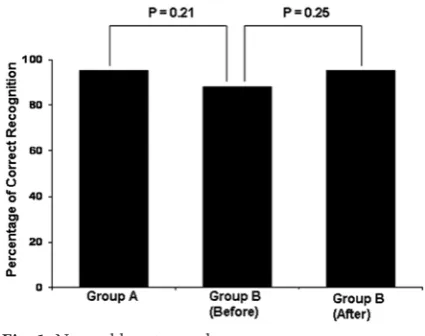
Eighty-four students auscultated 11 patients with normal heart sounds. Half of the students (n = 42) were in Group A and the other half (n = 42) belonged to Group B (before). The rate of making correct diagnoses of normal heart sounds was higher in all the groups; Group A, Group B (before), and Group B (after). Moreover, the au-thors noted no significant difference between Group A and Group B (before), and between Group B (before) and Group B (after) (p > 0.05) concerning the rate of making correct diagnoses of normal heart sounds (Fig. 1).
Mitral Stenosis
A total of 116 students auscultated 14 pa-tients diagnosed with mitral stenosis (MS). Half of the students (n = 58) were in Group A and the other half (n = 58) belonged to Group B (before). The rate of precise identification for MS mur-mur was markedly higher among the students in Group A compared to those in Group B (before) (48.3% vs. 18.9%, p < 0.001). likewise, the rate of
Table 1. Main features of students and patients enrolled in the study
Tabela 1. Główne cechy studentów i pacjentów włączonych do badania
Students (Studenci) (n = 130)
age (years)
gender (male) (n, %)
Mean ± SD (Średnia ± SD) 22.3 ± 3.7 80 (61.5) patients (pacjenci) (n = 60)
age (years)
gender (male) (n, %) cardiac murmurs (n, %) normal heart sounds mitral stenosis aortic insufficiency pulmonary artery stenosis ventricular septal defect
67.3 ± 8.7 42 (70)
11 (18.4) 14 (23.3) 14 (23.3) 14 (23.3) 7 (11.7)
Fig. 1. Normal heart sounds
precise identification for MS murmur was signifi-cantly higher among the students in Group B (af-ter) in comparison to those in Group B (before) (58.6% vs. 18.9%, p < 0.001) (Fig. 2).
Aortic Insufficiency
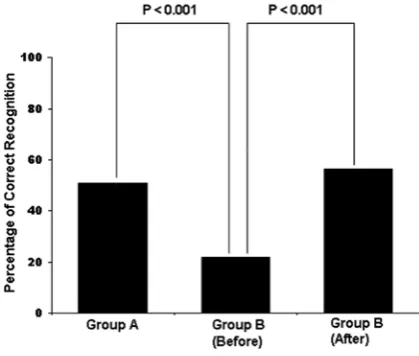
Similarly, a total of 110 students auscultated 14 patients diagnosed with aortic insufficiency (AI). Half of the students (n = 55) were in Group A and the other half (n = 55) belonged to Group B (be-fore). The rate of precise identification for AI mur-mur was noticeably higher among the students in Group A compared to those in Group B (before) (50.9% vs. 21.8%, p = 0.001). likewise, the rate of precise identification for AI murmur was signifi-cantly higher among the students in Group B (af-ter) in comparison to those in Group B (before) (56.3% vs. 21.8%, p < 0.001) (Fig. 3).
Pulmonary Artery Stenosis
likewise, a total of 120 students auscultated 14 patients diagnosed with pulmonary artery stenosis (pAS). Half of the students (n = 60) were in Group A and the other half (n = 60) belonged to Group B (before). The rate of precise identifi-cation for pAS murmur was considerable higher among the students in Group A compared to those in Group B (before) (76.6% vs. 45%, p < 0.001). The rate of precise identification for pAS murmur was also notably elevated among the students in Group B (after) in comparison to those in Group B (before) (88.3% vs. 45%, p < 0.001) (Fig. 4).
Ventricular Septal Defect
For the study of this defect, 100 students aus-cultated 7 patients diagnosed with ventricular sep-tal defect (VSD). Half of the students (n = 50) were in Group A and the other half (n = 50) belonged to Group B (before). The rate of precise identifi-cation for VSD murmur was substantially higher among the students in Group A compared to those in Group B (before) (66% vs. 32%, p = 0.001). The rate of precise identification for VSD murmur was notably increased as well among the students in Group B (after) in comparison to those in Group B (before) (72% vs. 32%, p < 0.001) (Fig. 5).
Systolic Murmur
A total of 220 auscultations were performed on 21 patients with systolic murmur owing to the presence of pAS or VSD. Half of the auscul-tations (n = 110) were performed by the students in Group A and the other half (n = 110) were carried out by the students in Group B (before). The rate of making correct diagnoses for systolic
Fig. 2. Mitral stenosis
Ryc. 2. Zwężenie zastawki dwudzielnej
Fig. 3. Aortic insufficiency
Ryc. 3. Niewydolność aorty
Fig. 4. pulmonary aortic stenosis
murmur was notably higher among the students in Group B (after) in relation to those in Group B (before) (61.1% vs. 24.8%, p < 0.001) (Fig. 7).
Discussion
In the present study, the authors investigated the role of the cardiac auscultation model on the acquisition of cardiac auscultatory skills for iden-tifyingnormal heart sound and murmurs arising due to MS, AI, pAS, and VSD by medical students. Overall, the current study indicated that the cardi-ac auscultatory skills of fifth-year medical students attending their cardiology internship were not sat-isfactorily efficient and the use of a cardiac simula-tor during the cardiac auscultasimula-tory training mark-edly improved their cardiac auscultatory skills.
Cardiac auscultatory skills are not easy to ac-quire [2, 3]. The time allocated for bedside exami-nation has notably decreased at today’s hospitals due to the heavily increased number of patients seeking healthcare and markedly decreased hospi-tal stays [15, 16].Cardiac auscultatory training to medical students is mostly delivered by residents whose cardiac auscultatory skills to define heart sounds and murmurs correctly are also shown to be not so effective [17]. Consequently, the cardiac auscultatory training provided to students is not quantitatively and qualitatively effective. More-over, cardiac auscultatory training after gradua-tion is also rarely offered to healthcare profession-als whose cardiac auscultatory skills are reported to be not at the desired level during their medical education [18]. Overall, the cardiac auscultatory skills of medical students are not at desired levels and need to be improved.
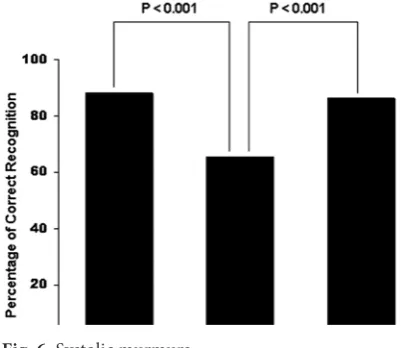
murmur was elevated in Group A in comparison to those in Group B (before) (88.2% vs. 65.5%, p < 0.001). Moreover, the authors also noted that the percentage of correct diagnoses for systolic mur-mur was significantly higher among the students in Group B (after) in relation to those in Group B (before) (86.3% vs. 65.5%, p < 0.001) (Fig. 6).
Diastolic Murmur
A total of 226 auscultations were performed on 28 patients with diastolic murmur owing to the presence of MS or AI. Half of the ausculta-tions (n = 113) were completed by the students in Group A and the other half (n = 113) were carried out by the students in Group B (before). The per-centage of making correct diagnoses for diastolic murmur was increased in Group A compared to those in Group B (before) (56.6% vs. 24.8%, p < 0.001). Furthermore, the authors noticed that the percentage of correct diagnoses for diastolic
Fig. 5. Ventricular septal defect
Ryc. 5. Ubytek przegrody międzykomorowej
Fig. 6. Systolic murmurs
Ryc. 6. Szmery skurczowe
Fig. 7. Diastolic murmurs
The rate of appropriately diagnosing diastolic murmurs (MS and AI) among the set of all mur-murs was the lowest while the percentage of cor-rect identification of systolic murmurs were rela-tively better among the medical students. While the percentage of the students correctly diagnosing the murmurs owing to MS and AI was 18.9% and 21.8%, the rate of identifying the murmurs due to pAS and VSD was 45% and 32%, respectively, before the cardiac simulation training. Similar to present observations, earlier studies have report-ed that the cardiac auscultatory skills of mreport-edical school students and general practitioners were not adequately effective [9, 10, 19]. Although no consensus exists regarding the rate for proficient cardiac auscultatory skills in medical education, these rates are markedly under the expected lev-els for medical school students. In most hospitals, physicians prefer to use high tech medical devices to diagnose diseases rapidly instead of dedicating longer times for physical examination during the training of medical students [15]. The time spent for the diagnosis and treatment of a disease is in-herently critical for not only patients but also doc-tors [20]. Increased hospital expenses are another reason forcing physicians to obtain a rapid diag-nosis. Therefore, an inadequate physical skill of medical students is a significant problem of today’s medical education. Alternative approaches are needed to improve the physical diagnostic skills of medical students. The use of medical simulators can help improve, at least in part, the diagnostic skills of medical students.
Cardiac auscultatory training completed at the bedside with real patients or using a cardiac simu-lator model increases cardiac auscultatory skills in short term memory; however, the effectiveness of this skill is unfortunately lost in long term memo-ry [21].repetition of cardiac auscultatory training is required to maintain the effectiveness of cardiac auscultatory skills for long periods of time. The phrase “practice makes perfect” is utterly true for maintaining the cardiac auscultatory skills of phy-sicians over time. A recent study reports that five hundred repetitions of cardiac auscultation can considerably improve auscultatory proficiency in recognizing basic cardiac murmurs by medical students [22]. long term repetitions of cardiac auscultations on patients are undesirable for them and not possible in general. Since cardiac simula-tors are easily accessible, reliable, and capable of generating basic heart sounds and murmurs, their use as a medical education tool can be practical. The most notable feature of the cardiac simulator is its repeatability for training purpose.
Overall, in the present study the use of cardiac simulators during cardiac auscultatory training
significantly increased the cardiac auscultatory skills of medical students. Among the cardiac aus-cultatory skills, cardiac simulator training mark-edly improved the percentage of making correct diagnoses of systolic and particularly diastolic murmurs. Detection of diastolic murmurs is dif-ficult since cardiac pathologies generate diastolic murmurs characterized by lower frequencies. In the present study, the authors noted that the use of a simulator in cardiac auscultatory training significantly increased the percentage of accurate identification of diastolic murmurs (about 25% prior to simulator training and over 50% after the simulator training). This improvement in the skills of the students suggests that the use of a simula-tor during auscultasimula-tory training is useful for the progression of the skills needed for correct diag-nosis of diastolic murmurs, which are known to be harder than systolic murmurs to identify [9]. All of the students who joined the present study agreed to receive cardiac auscultatory training on the simulator and successfully completed the training course. The students asking for further repetitions on the simulator were later provided with cardiac auscultatory training; however, these were not recorded.
Moreover, learning by doing is shown to be a powerful pedagogical technique in medical edu-cation since it combines the five main senses; nev-ertheless, repeated auscultations of the patients by numerous medical students can often bother patients, and consequently the students. An aus-cultation model capable of making heart murmurs near to real supports the improvement of the car-diac auscultatory skills of medical students and can serve as a complementary medical training tool. Overall, the present study indicates that the use of a proper auscultation model is easier, practi-cal and efficient in the auscultatory training of the medical students.
Although the authors did not quantitatively measure the effects of cardiac simulator training on the medical students, they observed that the students were well oriented to auscultation and showed effective contact with the patients, support-ing the notion that the use of a cardiac simulator in cardiac auscultation training can strengthen the cardiac auscultatory skills of the students and help medical students become effective specialists.
pa-tients suffering from various heart valve diseases and congenital anomalies, e.g. VSD, is lower than before. Therefore, the reduction in the number of the patients having cardiac murmurs can create a problem during the auscultation training of the medical students. The use of cardiac simulators can help overcome this problem and serve a com-plimentary role in the training of the medical stu-dents.
Simulation-based medical training has been shown to quickly increase the skills of physical examination of medical students and enhances the concentration of teachers and trainees for the relevant issue [26, 27].Similarly, the cardiac aus-cultatory skills of the medical students to correctly identify murmurs were markedly lower prior to the simulator-based cardiac auscultatory training and were considerably enhanced after the cardiac auscultatory training on the simulator. Overall, while the rate of precise identification of systolic murmurs increased two fold, diastolic murmur identification increased three fold. Besides, the use of simulation models in medical education enables the training of medical students and strengthen-ing of their practical skills without havstrengthen-ing to have contact with real patients or in the absence of ap-propriate patients [28].
In conclusion, the present study indicated that
the cardiac auscultation skills of medical students are weak and the use of a cardiac simulator can improve their auscultation skills rapidly and ef-fectively.
Study Limitations
The authors are aware of the fact that there are some limitations in the present study. One of them was that, while they studied the effectiveness of simulator-based cardiac auscultatory training on the certain pathologies causing murmurs, they did not include some other pathologies in the pres-ent study; therefore, it is hard to apply the prespres-ent data to all of the murmurs generated by various cardiac pathologies. Nonetheless, simulator-based cardiac auscultatory training improved the skills of the medical students for all of the pathologies included in the present study, indicating that this training is likely to increase the skills required for correct identification of other types of murmurs. The completion of this study in only one center in-stead of multiple centers is the other setback of the current study. repeating the present study with the participations of multiple centers with a larger number of participants is needed to determine the actual effectiveness of simulator-based cardiac auscultatory training.
References
[1] Good ML: patient simulation for training basic and advanced clinical skills. Med Educ 2003, 37, Suppl 1, 14–21.
[2] Shaver JA: Cardiac auscultation: a cost-effective diagnostic skill. Curr probl Cardiol 1995, 20, 441–530.
[3] March SK, Bedynek JL Jr, Chizner MA: Teaching cardiac auscultation: effectiveness of a patient-centered teach-ing conference on improvteach-ing cardiac auscultatory skills. Mayo Clin proc 2005, 80, 1443–1148.
[4] Mangione S, Nieman LZ: Cardiac auscultatory skills of internal medicine and family practice trainees. JAMA 1997, 278, 717–722.
[5] Issenberg SB, McGaghie WC, Hart IR, Mayer JW, Felner JM, Petrusa ER, Waugh RA, Brown DD, Safford RR, Gessner IH, Gordon DL, Ewy GA: Simulation technology for health care professional skills training and assess-ment. JAMA1999, 282, 861–866.
[6] Kneebone RI, Scott W, Darzi A, Horrocks M: Simulation and clinical practice: strengthening the relationship. Med Educ 2004, 38, 1095–1102.
[7] Woolliscroft JO, Calhoun JG, Tenhaken JD, Judge RD: ‘Harvey’: the impact of a cardiovascular teaching simula-tor on student skill acquisition. Med Teach 1987, 9, 53–57.
[8] Adamowski T, Frydecka D, Kiejna A: Introduction to problem Based learning as a Teaching Method Through Exploring problem Situations. Adv Clin Exp Med 2006, 15, 2, 373–378.
[9] Stern DT, Mangrulkar RS, Gruppen LD, Lang AL, Grum CM, Judge RD: Using a multimedia tool to improve cardiac auscultation knowledge and skills. J Gen Intern Med 2001, 16, 763–769.
[10] Issenberg SB, Petrusa ER, McGaghie WC, Felner JM, Waugh RA, Nash IS, Hart IR: Effectiveness of a computer-based system to teach bedside cardiology. Acad Med 1999, 74, 93–95.
[11] Ko PY, Scott JM, Mihai A, Grant WD: Comparison of a modified longitudinal simulation-based advanced car-diovascular life support to a traditional advanced carcar-diovascular life support curriculum in third-year medical students. Teach learn Med 2011, 23, 324–330.
[12] Issenberg SB, McGaghie WC, Gordon DL, Symes S, Petrusa ER, Hart IR, Harden RM: Effectiveness of a cardiol-ogy review course for internal medicine residents using simulation technolcardiol-ogy and deliberate practice. Teach learn Med 2002, 14, 223–228.
[13] Oddone EZ, Waugh RA, Samsa G: Teaching cardiovascular examination skills: results from a randomised con-trolled trial. Am J Med 1993, 95, 389–396.
[15] Kroenke K, Omori DM, Landry FJ, Lucey CR: Bedside teaching. South Med J 1997, 90, 1069–1074.
[16] LaCombe MA: On bedside teaching. Ann Intern Med 1997, 126, 217–220.
[17] Westman EC, Matchar DB, Samsa GB: Accuracy and reliability of apical S3 gallop detection. J Gen Intern Med 1995, 10, 455–457.
[18] Lam MZ, Lee TJ, Boey PY, Ng WF, Hey HW, Ho KY, Cheong PY: Factor influencing cardiac auscultation pro-ficiency in physician trainees. Singapore Med J 2005, 46, 11–14.
[19] Vukanovic-Criley JM, Criley S, Warde CM, Boker JR, Guevara-Matheus L, Churchill WH, Nelson WP, Criley JM: Competency in cardiac examination skills in medical students, trainees, physicians, and faculty: a mul-ticenter study. Arch Intern Med 2006, 166, 610–616.
[20] Davidoff F: Time. Ann Intern Med 1997, 127, 483–485.
[21] Sverdrup Ø, Jensen T, Solheim S, Gjesdal K: Training auscultatory skills: computer simulated heart sounds or additional bedside training? A randomized trial on third-year medical students. BMC Med Educ 2010, 18, 3.
[22] Barrett MJ, Lacey CS, Sekara AE, Linden EA, Gracely EJ: Mastering cardiac murmurs: the power of repetition. Chest2004, 126, 470–475.
[23] Tleyjeh IM, Abdel-Latif A, Rahbi H, Scott CG, Bailey KR, Steckelberg JM, Wilson WR, Baddour LM: A sys-tematic review of population-based studies of infective endocarditis. Chest 2007, 132, 1025–1035.
[24] Tibazarwa KB, Volmink JA, Mayosi BM: Incidence of acute rheumatic fever in the world: a systematic review of population-based studies. Heart 2008, 94, 1534–1540.
[25] Gersony WM: Natural history and decision-making in patients with ventricular septal defect. prog pediatr Cardiol 2001, 14, 125–132.
[26] Pugh CM, Obadina ET, Aidoo KA: Fear of causing harm: use of mannequin-based simulation to decrease student anxiety prior to interacting with female teaching associates. Teach learn Med 2009, 21, 116–120.
[27] Schuwirth LW, van der Vleuten CP: The use of clinical simulations in assessment. Med Educ 2003, 37, 65–71.
[28] Langhan TS: Simulation training for emergency medicine residents: time to move forward. CJEM 2008, 10, 467–473.
Address for correspondence:
Huseyin U. Yazici Department of Cardiology
Medical School of Osmangazi University Eskişehir
Turkey
Tel.: +90 222 239 2979–3700 E-mail: [email protected]
Conflict of interest: None declared