R E S E A R C H A R T I C L E
Open Access
Development, inter-rater reliability and
feasibility of a checklist to assess
implementation (Ch-IMP) in systematic reviews:
the case of provider-based prevention and
treatment programs targeting children and youth
Margaret Cargo
1*, Ivana Stankov
1, James Thomas
2, Michael Saini
3, Patricia Rogers
4, Evan Mayo-Wilson
5and Karin Hannes
6Abstract
Background:Several papers report deficiencies in the reporting of information about the implementation of interventions in clinical trials. Information about implementation is also required in systematic reviews of complex interventions to facilitate the translation and uptake of evidence of provider-based prevention and treatment programs. To capture whether and how implementation is assessed within systematic effectiveness reviews, we developed a checklist for implementation (Ch-IMP) and piloted it in a cohort of reviews on provider-based prevention and treatment interventions for children and young people. This paper reports on the inter-rater reliability, feasibility and reasons for discrepant ratings.
Methods:Checklist domains were informed by a framework for program theory; items within domains were generated from a literature review. The checklist was pilot-tested on a cohort of 27 effectiveness reviews targeting children and youth. Two raters independently extracted information on 47 items. Inter-rater reliability was evaluated using percentage agreement and unweighted kappa coefficients. Reasons for discrepant ratings were content analysed.
Results:Kappa coefficients ranged from 0.37 to 1.00 and were not influenced by one-sided bias. Most kappa values were classified as excellent (n = 20) or good (n = 17) with a few items categorised as fair (n = 7) or poor (n = 1). Prevalence-adjusted kappa coefficients indicate good or excellent agreement for all but one item. Four areas contributed to scoring discrepancies: 1) clarity or sufficiency of information provided in the review; 2) information missed in the review; 3) issues encountered with the tool; and 4) issues encountered at the review level. Use of the tool demands time investment and it requires adjustment to improve its feasibility for wider use.
Conclusions:The case of provider-based prevention and treatment interventions showed relevancy in developing and piloting the Ch-IMP as a useful tool for assessing the extent to which systematic reviews assess the quality of implementation. The checklist could be used by authors and editors to improve the quality of systematic reviews, and shows promise as a pedagogical tool to facilitate the extraction and reporting of implementation characteristics.
Keywords:Complex interventions, Children and youth, Provider-based interventions, Systematic reviews, Process evaluation, Implementation, Theory-driven reviews, Checklist development
* Correspondence:[email protected] 1
Spatial Epidemiology and Evaluation Research Group, School of Population Health, University of South Australia, Adelaide, Australia
Full list of author information is available at the end of the article
Background
The evaluation of complex interventions seeks to determine not only whether prevention and treatment interventions work but ‘what works in which circumstances and for whom?’ This phrase was originally coined by Pawson and Tilley [1] to reflect the logic of inquiry of the realist para-digm aimed at unpacking how interventions work to gener-ate outcomes. Intervention mechanisms (i.e., how, why) and intervention modifiers (e.g., for whom, in which cir-cumstances) are evaluated in the postpositivist paradigm using statistical mediation and moderation, respectively [2–4]. Despite between paradigm differences in the logic of inquiry there is a shared understanding on the need to pro-vide context-relevant explanatory epro-vidence beyond the main intervention effect. It is therefore crucial for evalua-tions to provide information on how programs were imple-mented and the factors influencing implementation. Understanding aspects of intervention implementation falls into the domain of process evaluation [5]. Process evalu-ation is an important component of an overall evaluevalu-ation because it can help explain negative, modest and positive intervention effects, provide insight into the causal mecha-nisms of change including the conditions under which mediators are activated, and unpick those aspects of a multi-method/format (i.e., structured vs unstructured) intervention contributing to hypothesised intermediate and longer term outcomes [6–12]. At a minimum, it is recommended that process evaluations include information on reach, dose delivered, dose received, fidelity, recruitment and the contextual factors that influence implementation [12]. Contextual factors can be proximal (e.g., organizational resources, leadership) or distal to the program (e.g., geo-graphic location). The inclusion of information on inter-mediate variables leading to hypothesised outcomes, formative/pre-testing procedures, and quality assurance measures is also recommended [12].
To situate implementation and the factors influencing implementation in relation to hypothesised change pro-cesses there has been an increasing reliance on the use of conceptual models, logic models or theory-driven ap-proaches in evaluation [13] and systematic reviews [14].
Despite the importance of understanding ‘ implementa-tion in context’, intervention descriptions and process evaluation measures are poorly reported in medicine, so-cial and psychological interventions [15–17], social work [18] and for a broad range of occupational health, public health and health promotion interventions [11, 19–21]. These deficiencies inhibit the translation and uptake of evidence by decision-makers with a mandate to improve specific outcomes or practices and additionally have spurred the development of reporting guidelines in pri-mary studies. Current foci include the development of an extension of the Consolidated Standards of Reporting tri-als Statement for Social and Psychological Interventions
(CONSORT-SPI) [22], the Oxford Implementation Index [23] and the Template for Intervention Description and Replications (TIDieR) [24]. Recently, a call was made for guidance on the process evaluation of complex public health interventions [10].
Although reviewers are constrained by reporting limi-tations in primary studies, guidance on the process evaluation of complex interventions would be informed by studies aimed at understanding the approaches, methods and tools used by reviewers to address aspects of intervention delivery and the factors influencing implementation. Such work may highlight exemplary practices and provide insight into the issues that need to be considered in guidance development.
Collaborators of the Campbell Collaboration Process and Implementation Methods Sub-Group (C2-PIMS) (http://www.campbellcollaboration.org/) undertook a re-view of systematic rere-views to understand how rere-viewers approached implementation within their reviews. This study provides us with an opportunity to contribute to the development of methodological guidance on the process evaluation of complex interventions on this topic. The study casted an ‘implementation in context’ lens on un-derstanding how complex interventions work to achieve their intended outcomes, in order to enable us to poten-tially detect Type III error or implementation failure, whether partial or complete, to be factored into explana-tions of intervention effectiveness [13].
integral to the delivery of these programs [28, 29]. They play a key role in influencing children and youth’s know-ledge, attitudes, beliefs and behaviours through direct inter-action or by intervening on the environments (i.e., home, school) that shape children and youth’s development.
In the absence of a checklist to assess the degree to which process and implementation issues have been taken into account, a checklist for implementation (Ch-IMP) was developed. This is one of the first studies to tackle the issue of implementation at the systematic review level. This paper reports on the development of the checklist, its inter-rater reliability, reasons for discrepant ratings and feasibility of the checklist to assess ‘implementation in context’for sys-tematic reviews focusing on the delivery of provider-based prevention and treatment programs targeting children and youth. Implications for the future use of process evaluation checklists and guidance development are discussed.
Methods
Part one: checklist development and pretesting Theoretical framework
The Ch-IMP captured whether implementation measures and processes were assessed within provider-based child and youth prevention and treatment reviews and, if so, which measures and processes were addressed and how they were addressed. Reviews may not consider implementation at all or may pinpoint one or more dimensions which may be reported qualitatively, descriptively or in the meta-analyses. The checklist was designed to identify a broad range of
dimensions within these programs and assess how included dimensions were integrated within reviews.
Chen’s conceptual framework [30] for program theory was selected as the framework to inform the development of the Ch-IMP for multiple reasons. First, other models feature implementation but they tend to focus on a specific aspect of implementation (i.e., fidelity) [31–34]. Chen’s framework, on the other hand, is comprehensive and features process evaluation and the contextual factors influ-encing implementation. The framework also features pro-viders as central to program delivery which corresponds with the study focus on the implementation of provider-based prevention and treatment interventions targeting children and youth. The framework is supported by open systems theory which recognises that context shapes imple-mentation and program outcomes. This fits with the notion of complex interventions as applied in health, medicine, education, social work, criminal justice and psychology.
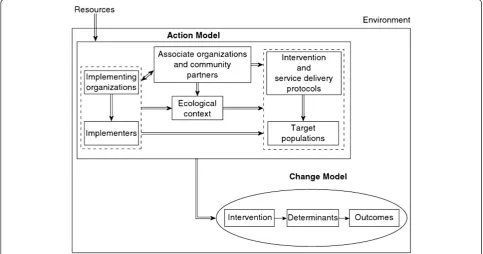
In Chen’s framework (Fig. 1) the action model supporting the prevention or treatment intervention must be implemented appropriately in order to activate the transformation process in the program’s change model. The action model articulates what the program will do to bring about change in children and youth outcomes. For example, if a change model for a given intervention is de-signed to increase children’s levels of physical activity by changing perceived social norms for physical activity and opportunities to engage in physical activity, the action model stipulates what the intervention will do to activate
the change model. Will the intervention include school-based activities only? Will parents be engaged? Will teachers receive training? Will the school collaborate with external agencies? Which agencies, how and why? Who will the intervention target and why? The action model provides the justification for these choices and clarifies what the program will do (i.e., program operations) to in-crease behaviour change related to physical activity.
Action model: The action model is the program plan that supports the delivery of provider-based child and youth pre-vention interpre-ventions. It considers the day-to-day planning for arranging staff, resources, settings and support organiza-tions so the intervention delivers its services to targeted children and youth. For the purposes of the Ch-IMP, the ac-tion model is comprised of the child or youth prevenac-tion or treatment intervention, target population (i.e., children, youth or their caregivers), implementers (i.e., teachers, mentors, community volunteers, professionals), implement-ing organization (i.e., school, community organization), associate organizations and community partners (i.e., be-tween a school and a non-profit agency) and ecological context (i.e., intervention strategies may implicate delivery in school, community or clinical settings).
The prevention or treatment intervention is supported by (1) an intervention protocol that outlines the orientation, structure and content of the intervention and the nature of children, youth or parents’exposure to the content and (2) a service delivery protocol that operationalises the steps that need to be taken to implement the intervention in the field [30]. Intervention heterogeneity can be assessed in re-lation to core strategies, elements, activities, components or types; these will vary according to the specific intervention.
For the studies included in our review in which the Ch-IMP was tested, children and youth are the target population or ultimate target group designated to benefit from the program. Some programs, however, act on more than one level and involve more than one type of participant (e.g., parents, siblings, and target children) [35]. This was one of the factors contributing to a more complex level of the review.
Providers (implementers) are integral to program delivery and are recruited for their qualifications (e.g., clinical psychologists, speech therapists) or relevant previous experi-ences or interest (e.g., volunteers, mentors). Providers may attempt to deliver interventions as they were originally de-signed but can encounter obstacles to delivery according to pre-specified criteria. For some types of programs (i.e., child and youth mentoring programs), pre-existing provider char-acteristics such as age, gender and ethnicity are important considerations. For example, cultural identification plays a role in the engagement of young people from minority or Indigenous populations [36].
The implementing organization is the lead organization responsible for providing resources to deliver the
program. For child and youth prevention and treat-ment programs, the impletreat-menting organization may be a school, non-profit organization or community organization, for example. These organizations may provide a range of supports such as training their staff (e.g., teachers, counsellors, and volunteers), technical assistance, feedback mechanisms and monitoring.
Partnerships may be established between implementing or-ganizations and associate oror-ganizations and community part-nersthathaveastakeorinterestintheintervention.
If linkage with these entities is not properly established it could compromise access to the target population (e.g., re-ferrals from local police to community mentoring organization) or volunteers (e.g., mentoring organization with educational institutions). Specialised programs may be externally developed and implemented either by external providers or staff in the implementing organization who are trained by the external agency (i.e., pregnancy preven-tion program implemented in schools by an external agency). Partnerships with associate organizations and the community can lead to interaction effects including collab-orative advantage and the achievement of outcomes that neither organization could have achieved on their own [37]. Where associations with external organizations are not identified, assumptions may be made about the role of the implementing organization in program delivery.
The ecological context reflects the broader social systems within which children, youth and their caregivers receive or engage with the intervention. Interventions may be imple-mented in one or more settings (e.g., school, community, organization, home). Operating procedures, the formality of procedures, organizational norms and power structures may vary across settings and influence program delivery and the responsiveness of the target population to the intervention.
Program implementation: Chen’s framework suggests that the intervention effect is ajoint effectof implementing the intervention and implementing the factors in the ac-tion model.
The first component of this joint effect pertains to
implementing the interventionwhich is captured through
provided in the intervention and service delivery protocols specifies the nature of intended program delivery, which is the essence of many definitions of fidelity. These defini-tions can range from ‘faithful replication,’ to ‘the degree to which specified procedures are implemented as planned’ [38]. Some definitions of fidelity, however, are broader and include adherence, exposure or dose, qual-ity of delivery, participant responsiveness and program differentiation [31].
The second component of the joint effect pertains to implementing the factors in the action model. These fac-tors–implementing organization, implementer, associate organizations and community partners, target population, ecological setting–are defined in the preceding section. From a programmatic perspective, information on the fac-tors influencing implementation can be found in the inter-vention and service delivery protocols, which include the conceptual model, program theory or logic model under-pinning the program. For example, a program manual may specify that the implementing organization is required to offer a specific type of training for implementers to deliver a multi-component clinical intervention to children.
Change model: The change model specifies how implementation of the intervention and elements of the action model bring about the primary outcome through a set of intermediate impacts. The change model can be articulated in an a priori program theory or conceptual model that outlines how the program will activate the change pathways; it can also be depicted graphically in a logic model [13]. Specifying the mediators in the causal pathway(s) is key to the change model. The change model can have a single or multiple outcome pathways depicting one or more mediators depending on the characteristics of the intervention, participant and other factors at play in the implementing system [39].
Environment: Contextual factors external to the action model can shape how programs are planned (positively, negatively or neutral), implemented and received. Usually, programs are initiated through re-sources acquired from the external environment which lead to the development of an action model. These may include aspects of the geographic environment, histor-ical period, polithistor-ical environment and include broader social norms, for example. Contextual factors may be identified in the theoretical assumptions of the inter-vention protocol and potentially the risk assessment of a project management plan.
Checklist item selection
In line with the broader program theory orientation of Chen’s framework [30], the checklist assessed aspects of the action model, program implementation, change model and environment.
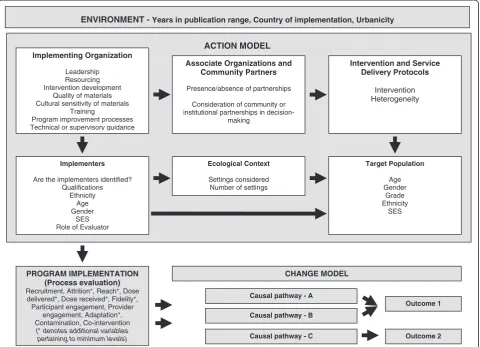
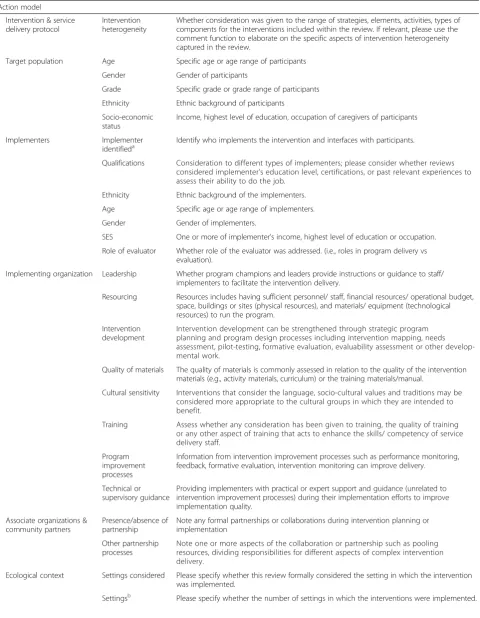
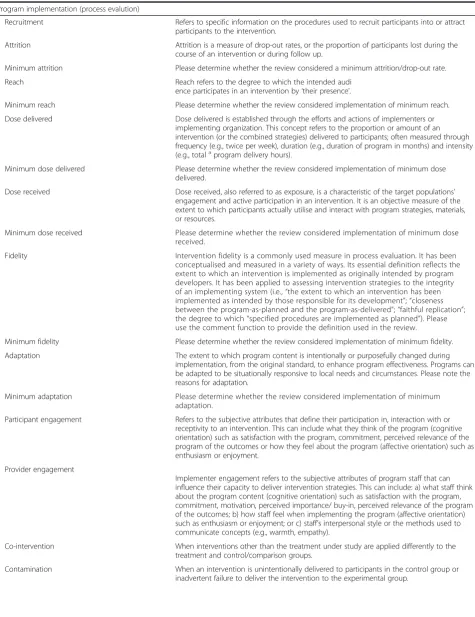
Table 1 provides the definitions for each item in the action model, program implementation, change model and environment (Fig. 2). Stem questions are framed as one of the following:‘Was the [item] considered?’,‘Has the review considered aspects of [item]?’,‘Does the re-view consider [item]?’Given the study focus on imple-mentation, items are concentrated in the former two domains. Questions were derived from documents re-trieved from a review of the published and grey litera-tures. More specifically, published articles were obtained from an information retrieval project that ex-amined how process evaluation and theory-driven eval-uations were indexed in Medline, Embase, Psychinfo and Eric electronic databases. This led to the retrieval of a large pool of articles which provided the basis for the development of the checklist. In addition, websites of systematic review organizations were reviewed. The worldwide web was searched for grey literature. Au-thors’ broad-based experiences conducting evaluations and systematic reviews of provider-based prevention and treatment programs for children and youth facili-tated the identification of grey literature and seminal works in theory-driven evaluation/reviews, process evaluation, and contextually sensitive provider-based in-terventions. The following documents from the relevant content areas and agencies informed the development of the checklist: implementation/process evaluation lit-erature [8, 12, 31, 38, 40–43] theory-driven evaluation literature [13, 30, 34, 44, 45] systematic review literature [46, 47] reporting guidelines and recommendations [48–52], the Cochrane Collaboration [53, 54], the EPPI-Centre [55], the Society for Prevention Research [56] the U.S. Centres for Disease Control and Prevention Community Guide [57].
A draft version of the checklist was trialled by three raters on three provider-based prevention and treat-ment reviews (two raters completed all three reviews and one rater completed one review within this set), and iteratively revised through discussion, and input from members of the C2-PIMS. Raters provided open-ended comments for each question to capture the adequacy of the response scale, and identify any issues with the defi-nitions or wording of questions.
Part two: piloting the checklist Study selection
Data collection instrument
The pilot version of the Ch-IMP comprised 47 items and captured; 1) variables pertaining to elements of the action model (n = 25); 2) whether reviews articulated change models supported by a broader intervention model or theory (n = 2); 3) variables pertaining to ele-ments of the process evaluation (n = 17); 4) dimensions of the environment (n = 3); 5) variables unique to each re-view; 6) open-ended comments for each question (from study raters); and 7) issues, challenges and implications for the key domains as articulated by review authors and iden-tified by study raters.
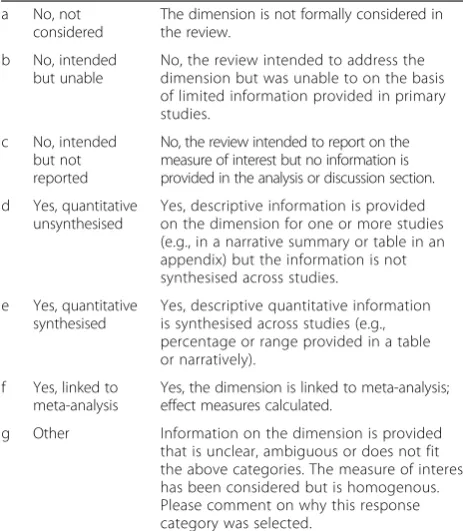
Of the 47 questions, 43 questions utilised a 7 category nominal scale (Table 2), one question utilised an alternate 7 category nominal scale, two questions utilised a 4 category nominal scale, and one question utilised a dichotomous yes/no scale. The latter three variations in the scale are noted in the footnote of Table 1. The 7 category response scale was designed to identify variables‘not considered’in the review, those that reviewers intended to extract information about but could not due to reporting limitations in primary studies
(i.e.,‘intended but unable’) and variables which reviewers intended to extract but did not report on within the review (i.e.,‘intended but not reported’). The scale was also designed to identify gaps in reporting in primary studies and to pro-vide some indication on whether implementation was formally considered within reviews. Any occurrence of a variable was considered as present, but if there was only one mention in an in-text narrative summary or summary table in the appendix of the review, the variable was re-ported at the descriptive‘quantitative unsynthesised’level. If information on a variable was present and synthesised across primary studies in the review, it was coded as de-scriptive ‘quantitative synthesised’ whilst information linked to meta-analysis was coded as ‘linked to meta-analysis’. Information on variables that did not fit into these categories was coded as ‘other’and a comment was provided to justify this selection.
Data extraction
Two researchers independently reviewed and extracted the information from the 27 reviews. Information was Implementing Organization
Leadership Resourcing Intervention development
Quality of materials Cultural sensitivity of materials
Training
Program improvement processes Technical or supervisory guidance
Associate Organizations and Community Partners
Presence/absence of partnerships
Consideration of community or institutional partnerships in
decision-making
Intervention and Service Delivery Protocols
Intervention Heterogeneity
Implementers
Are the implementers identified? Qualifications
Ethnicity Age Gender
SES Role of Evaluator
Target Population
Age Gender
Grade Ethnicity
SES Ecological Context
Settings considered Number of settings
PROGRAM IMPLEMENTATION (Process evaluation)
Recruitment, Attrition*, Reach*, Dose delivered*, Dose received*, Fidelity*, Participant engagement, Provider
engagement, Adaptation*, Contamination, Co-intervention
(* denotes additional variables pertaining to minimum levels)
CHANGE MODEL
ACTION MODEL
ENVIRONMENT - Years in publication range, Country of implementation, Urbanicity
Causal pathway - A
Causal pathway - B
Causal pathway - C
Outcome 1
Outcome 2
Table 1Domains and items within each domain for the Checklist for Implementation (Ch-IMP)
Action model
Intervention & service delivery protocol
Intervention heterogeneity
Whether consideration was given to the range of strategies, elements, activities, types of components for the interventions included within the review. If relevant, please use the comment function to elaborate on the specific aspects of intervention heterogeneity captured in the review.
Target population Age Specific age or age range of participants
Gender Gender of participants
Grade Specific grade or grade range of participants
Ethnicity Ethnic background of participants
Socio-economic status
Income, highest level of education, occupation of caregivers of participants
Implementers Implementer
identifieda Identify who implements the intervention and interfaces with participants.
Qualifications Consideration to different types of implementers; please consider whether reviews considered implementer’s education level, certifications, or past relevant experiences to assess their ability to do the job.
Ethnicity Ethnic background of the implementers.
Age Specific age or age range of implementers.
Gender Gender of implementers.
SES One or more of implementer’s income, highest level of education or occupation.
Role of evaluator Whether role of the evaluator was addressed. (i.e., roles in program delivery vs evaluation).
Implementing organization Leadership Whether program champions and leaders provide instructions or guidance to staff/ implementers to facilitate the intervention delivery.
Resourcing Resources includes having sufficient personnel/ staff, financial resources/ operational budget, space, buildings or sites (physical resources), and materials/ equipment (technological resources) to run the program.
Intervention development
Intervention development can be strengthened through strategic program planning and program design processes including intervention mapping, needs assessment, pilot-testing, formative evaluation, evaluability assessment or other develop-mental work.
Quality of materials The quality of materials is commonly assessed in relation to the quality of the intervention materials (e.g., activity materials, curriculum) or the training materials/manual.
Cultural sensitivity Interventions that consider the language, socio-cultural values and traditions may be considered more appropriate to the cultural groups in which they are intended to benefit.
Training Assess whether any consideration has been given to training, the quality of training or any other aspect of training that acts to enhance the skills/ competency of service delivery staff.
Program improvement processes
Information from intervention improvement processes such as performance monitoring, feedback, formative evaluation, intervention monitoring can improve delivery.
Technical or supervisory guidance
Providing implementers with practical or expert support and guidance (unrelated to intervention improvement processes) during their implementation efforts to improve implementation quality.
Associate organizations & community partners
Presence/absence of partnership
Note any formal partnerships or collaborations during intervention planning or implementation
Other partnership processes
Note one or more aspects of the collaboration or partnership such as pooling resources, dividing responsibilities for different aspects of complex intervention delivery.
Ecological context Settings considered Please specify whether this review formally considered the setting in which the intervention was implemented.
Table 1Domains and items within each domain for the Checklist for Implementation (Ch-IMP)(Continued)
Program implementation (process evalution)
Recruitment Refers to specific information on the procedures used to recruit participants into or attract participants to the intervention.
Attrition Attrition is a measure of drop-out rates, or the proportion of participants lost during the course of an intervention or during follow up.
Minimum attrition Please determine whether the review considered a minimum attrition/drop-out rate.
Reach Reach refers to the degree to which the intended audi
ence participates in an intervention by‘their presence’.
Minimum reach Please determine whether the review considered implementation of minimum reach.
Dose delivered Dose delivered is established through the efforts and actions of implementers or implementing organization. This concept refers to the proportion or amount of an intervention (or the combined strategies) delivered to participants; often measured through frequency (e.g., twice per week), duration (e.g., duration of program in months) and intensity (e.g., totalaprogram delivery hours).
Minimum dose delivered Please determine whether the review considered implementation of minimum dose delivered.
Dose received Dose received, also referred to as exposure, is a characteristic of the target populations’ engagement and active participation in an intervention. It is an objective measure of the extent to which participants actually utilise and interact with program strategies, materials, or resources.
Minimum dose received Please determine whether the review considered implementation of minimum dose received.
Fidelity Intervention fidelity is a commonly used measure in process evaluation. It has been conceptualised and measured in a variety of ways. Its essential definition reflects the extent to which an intervention is implemented as originally intended by program developers. It has been applied to assessing intervention strategies to the integrity of an implementing system (i.e.,“the extent to which an intervention has been implemented as intended by those responsible for its development”;“closeness between the program-as-planned and the program-as-delivered”;“faithful replication”; the degree to which“specified procedures are implemented as planned”). Please use the comment function to provide the definition used in the review.
Minimum fidelity Please determine whether the review considered implementation of minimum fidelity.
Adaptation The extent to which program content is intentionally or purposefully changed during implementation, from the original standard, to enhance program effectiveness. Programs can be adapted to be situationally responsive to local needs and circumstances. Please note the reasons for adaptation.
Minimum adaptation Please determine whether the review considered implementation of minimum adaptation.
Participant engagement Refers to the subjective attributes that define their participation in, interaction with or receptivity to an intervention. This can include what they think of the program (cognitive orientation) such as satisfaction with the program, commitment, perceived relevance of the program of the outcomes or how they feel about the program (affective orientation) such as enthusiasm or enjoyment.
Provider engagement
Implementer engagement refers to the subjective attributes of program staff that can influence their capacity to deliver intervention strategies. This can include: a) what staff think about the program content (cognitive orientation) such as satisfaction with the program, commitment, motivation, perceived importance/ buy-in, perceived relevance of the program of the outcomes; b) how staff feel when implementing the program (affective orientation) such as enthusiasm or enjoyment; or c) staff’s interpersonal style or the methods used to communicate concepts (e.g., warmth, empathy).
Co-intervention When interventions other than the treatment under study are applied differently to the treatment and control/comparison groups.
extracted on hard copy and uploaded into EPPI-Reviewer [58]. An instruction guide was developed concurrently to support application of the checklist and used to guide the ex-traction process. The items in the Ch-IMP that correspond with domains in Chen's framework are shown in Fig. 2.
For example, the rater would read the review and search for information pertaining to the target variable “intervention development” defined as the following in the code book:
The rater would check one box in the checklist (below) and add open ended comments to the question in the open space in the box.
Table 2Seven-category response scale used for 45 of 47 items in the checklist for implementation (Ch-IMP)
a No, not considered
The dimension is not formally considered in the review.
b No, intended but unable
No, the review intended to address the dimension but was unable to on the basis of limited information provided in primary studies.
c No, intended but not reported
No, the review intended to report on the measure of interest but no information is provided in the analysis or discussion section.
d Yes, quantitative unsynthesised
Yes, descriptive information is provided on the dimension for one or more studies (e.g., in a narrative summary or table in an appendix) but the information is not synthesised across studies.
e Yes, quantitative synthesised
Yes, descriptive quantitative information is synthesised across studies (e.g., percentage or range provided in a table or narratively).
f Yes, linked to meta-analysis
Yes, the dimension is linked to meta-analysis; effect measures calculated.
g Other Information on the dimension is provided that is unclear, ambiguous or does not fit the above categories. The measure of interest has been considered but is homogenous. Please comment on why this response category was selected.
Table 1Domains and items within each domain for the Checklist for Implementation (Ch-IMP)(Continued)
Change model
A priori change modelc The Change Model links intervention strategies to a sequence of short, intermediate and longer-term observable and intended outcomes. This sequencing of outcomes is re-ferred to as anoutcome chain. It specifies what needs to change within people or their environments (short to intermediate term impacts) for the longer-term intervention outcome to be achieved. The Change Model explains how and why the change in partic-ipants happens. Assess whether the review provides a description of how the interven-tions work to achieve outcomes with consideration to the activities and strategies that are intended to bring about change. Some reviews will include multiple Change Models.
Logic diagram usedc Please specify whether the review provides a graphical depiction of how each intervention works to achieve its short, intermediate and long-term outcomes. These diagrams are also referred to as‘logic models’or‘theory of change’diagrams. The sequence of outcomes (short term to long-term) should be linked to intervention strategies or activities.
Environment (external context)
Years Years in which primary studies were published. Can be used as a proxy measure for historical/ period effects.
Country Name of county of program delivery. May act as a proxy for political climate, availability of resources, social norms.
Regions or areas within countries Areas and regions within countries may be specified and may include remoteness or urbanicity indices (e.g., rural, remote/metropolitan, northern/southern). May act as a proxy for access to resources or some other measure.
a
Stem Question: Are the implementers clearly identified–dichotomous Yes or No response scale
b
7 category nominal response scale: 1, 2, 3, 4, 5+, Not specified, Unclear
c
4 category nominal response scale: No, Yes (articulation clear), Yes (articulation unclear), Other
Was any consideration given to intervention development?
In the case of the target variable ‘fidelity’the reviewer would examine the systematic review for information corresponding to the following definition provided in the code book, and follow the same process.
The information was uploaded to EPPI-Reviewer when the domain was complete or when the review was complete. Given the length of the checklist and the fact that the information in the reviews did not always appear in the order of the checklist, the raters found it helpful to complete the ratings on hard copy prior to uploading the information. A screen shot of EPPI-Reviewer below illustrates the fi-delity measure with a link to highlighted text in the review. Comments could be added for the selected response using the info box.
Data analysis
Inter-rater reliability analysis assessed consistency among raters for each of the 47 items. The unweighted kappa statistic was used to correspond with the 7 category nominal response scale. Reporting the kappa statistic alone is appropriate when the marginal totals in the tables are relatively balanced. However, when the preva-lence of a given response is either very high or low, the kappa value may indicate a low level of reliability even though the observed proportion of agreement is high [59, 60]. Because paradoxical values of kappa may occur due to a skewed distribution, we report the percentage agreement between raters and AC1 statistic. The latter is considered a more robust measure of agreement on the basis that it is less influenced by differences in response category prevalence [60]. Following Cichetti and Sparrow [61], kappa values were rated as fair (0.40–0.59), good (0.60–0.74) or excellent (0.75–1.0). Kappa values below 0.40 indicate poor agreement. Analyses were conducted using WinPEPI. Reasons underlying discrepant ratings were documented and content analysed for categories and sub-categories using NVivo qualitative software.
Results and discussion Reliability
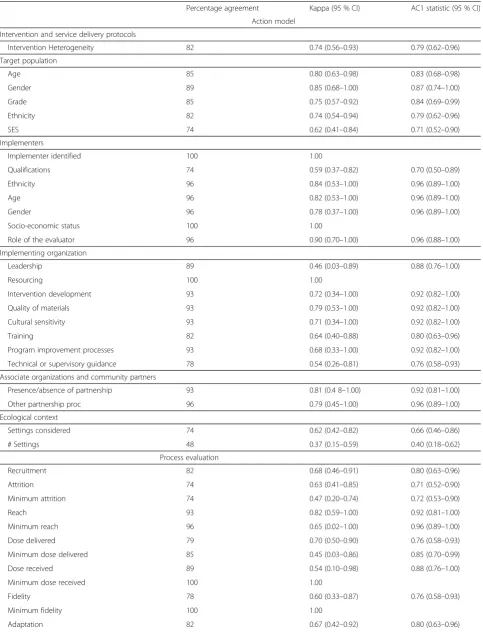
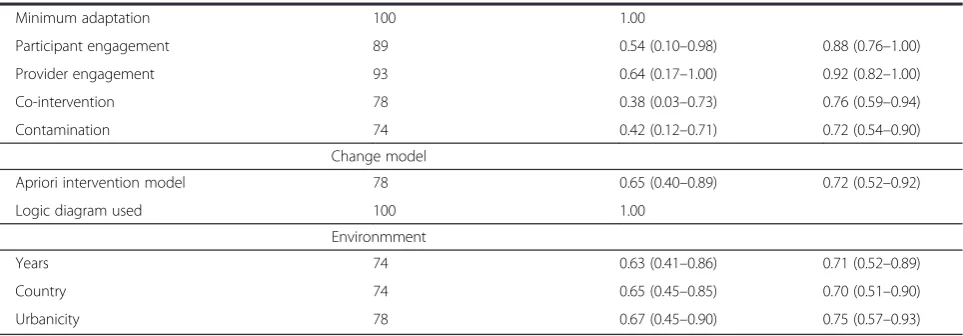
Table 3 displays results for percentage agreement between the two raters, kappa coefficients with 95 % confidence intervals, and AC1 coefficients for the 47 items in the Ch-IMP. Twelve tables are shown in Fig. 3 to illustrate the nature of disagreements between raters.
Inter-rater agreement ranged from 48 to 100 % Kappa coefficients ranged from 0.37 to 1.00. The majority of kappa values were classified as excellent (n = 18) or good (n = 17) with fewer items falling into the fair (n = 6) or poor (n = 2) categories. The prevalence-adjusted coeffi-cients, deemed more robust to the influence of response category prevalence, indicates good or excellent agree-ment for all items in which percentage agreeagree-ment was high and the kappa coefficient was low.
Was fidelity assessed, that is, the degree to which interventions are implemented as intended by its developers?
Table 3Inter-rater reliability results for 47 items in the checklist for implementation (Ch-IMP) (n = 27 reviews)
Percentage agreement Kappa (95 % CI) AC1 statistic (95 % CI)
Action model
Intervention and service delivery protocols
Intervention Heterogeneity 82 0.74 (0.56–0.93) 0.79 (0.62–0.96)
Target population
Age 85 0.80 (0.63–0.98) 0.83 (0.68–0.98)
Gender 89 0.85 (0.68–1.00) 0.87 (0.74–1.00)
Grade 85 0.75 (0.57–0.92) 0.84 (0.69–0.99)
Ethnicity 82 0.74 (0.54–0.94) 0.79 (0.62–0.96)
SES 74 0.62 (0.41–0.84) 0.71 (0.52–0.90)
Implementers
Implementer identified 100 1.00
Qualifications 74 0.59 (0.37–0.82) 0.70 (0.50–0.89)
Ethnicity 96 0.84 (0.53–1.00) 0.96 (0.89–1.00)
Age 96 0.82 (0.53–1.00) 0.96 (0.89–1.00)
Gender 96 0.78 (0.37–1.00) 0.96 (0.89–1.00)
Socio-economic status 100 1.00
Role of the evaluator 96 0.90 (0.70–1.00) 0.96 (0.88–1.00)
Implementing organization
Leadership 89 0.46 (0.03–0.89) 0.88 (0.76–1.00)
Resourcing 100 1.00
Intervention development 93 0.72 (0.34–1.00) 0.92 (0.82–1.00)
Quality of materials 93 0.79 (0.53–1.00) 0.92 (0.82–1.00)
Cultural sensitivity 93 0.71 (0.34–1.00) 0.92 (0.82–1.00)
Training 82 0.64 (0.40–0.88) 0.80 (0.63–0.96)
Program improvement processes 93 0.68 (0.33–1.00) 0.92 (0.82–1.00)
Technical or supervisory guidance 78 0.54 (0.26–0.81) 0.76 (0.58–0.93)
Associate organizations and community partners
Presence/absence of partnership 93 0.81 (0.4 8–1.00) 0.92 (0.81–1.00)
Other partnership proc 96 0.79 (0.45–1.00) 0.96 (0.89–1.00)
Ecological context
Settings considered 74 0.62 (0.42–0.82) 0.66 (0.46–0.86)
# Settings 48 0.37 (0.15–0.59) 0.40 (0.18–0.62)
Process evaluation
Recruitment 82 0.68 (0.46–0.91) 0.80 (0.63–0.96)
Attrition 74 0.63 (0.41–0.85) 0.71 (0.52–0.90)
Minimum attrition 74 0.47 (0.20–0.74) 0.72 (0.53–0.90)
Reach 93 0.82 (0.59–1.00) 0.92 (0.81–1.00)
Minimum reach 96 0.65 (0.02–1.00) 0.96 (0.89–1.00)
Dose delivered 79 0.70 (0.50–0.90) 0.76 (0.58–0.93)
Minimum dose delivered 85 0.45 (0.03–0.86) 0.85 (0.70–0.99)
Dose received 89 0.54 (0.10–0.98) 0.88 (0.76–1.00)
Minimum dose received 100 1.00
Fidelity 78 0.60 (0.33–0.87) 0.76 (0.58–0.93)
Minimum fidelity 100 1.00
Our inter-rater reliability results indicate paradoxical values of kappa as reflected in the high percentage agreement rates and low corresponding kappa coeffi-cients. A limitation of the kappa statistic is that it is affected by category prevalence. For example, the per-centage agreement for the ‘leadership’ target variable in the implementing organization was high (89 %) with 23 agreements rated as “not considered” yet the kappa coefficient was fair with a very wide confidence interval (κ= 0.46, 0.03–0.89). In this instance and many others, as evident in Table 3, the kappa over-estimates chance agreement, thus reducing the estimated kappa value. If this paradox is present, an interpretation based exclu-sively on the kappa value may be misleading. Although there is no consensus on which specific statistics to re-port, there is consensus that statistics adjusting for prevalence must be reported in conjunction with kappa values [60, 62].
The wide confidence intervals for the kappa coeffi-cients are of concern. At the time we conducted this study, 27 reviews met the inclusion criteria. It is recom-mended that sample sizes should not consist of less than 30 comparisons as the standard error is sensitive to sample size. Although confidence intervals can be calculated for studies with small sample sizes, these are likely to be wide, resulting in kappa values of 0.40 or less, which indicate poor or no agreement. Examination of the confidence intervals for the kappa coefficients shows that 18 items indicate poor agreement or no agreement. The AC1 coefficients, on the other hand, are above 0.40 in all confidence intervals except for the ecological settings variable.
The 7 category response scale is a variation and elabor-ation of the three-level categoriselabor-ation of yes/done, no/not done or can’t tell/unclear often used in checklists [63–65]. Because the goal of this study was to inform the develop-ment of guidance by understanding how the target vari-ables in the action model, change model, environment
and implementation were represented in the reviews, we elaborated on the‘no’and‘yes’response categories, specif-ically to gain this insight. Elaboration of this scale is shown in Table 2.
Although the unweighted kappa coefficients are wide-ranging and some are influenced by prevalence bias, the majority of prevalence-adjusted coefficients are in the acceptable range. In light of the lack of consensus on which prevalence adjusted statistic to use, we are cautiously optimistic about the pilot findings on inter-rater reliability and look to the qualitative data to provide insight into the basis for disagreements. These results should be interpreted in the context of the single data source of Campbell Collaboration reviews that was utilised.
Sources of disagreement
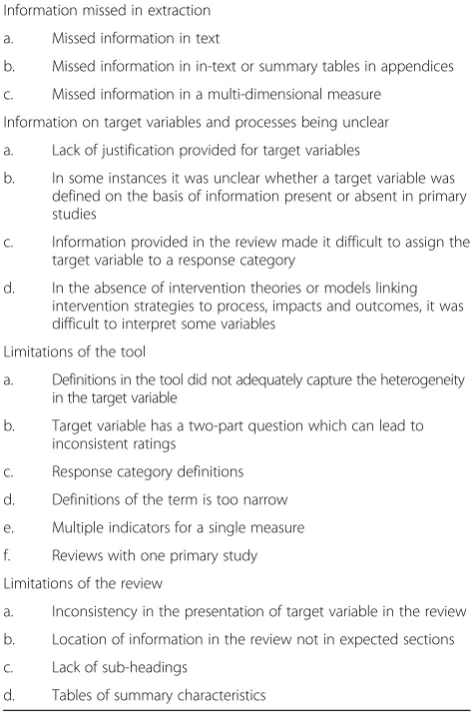
As shown in Table 4, and highlighted below, the reasons for scoring discrepancies were related to: 1) information missed during the extraction; 2) issues with clarity or sufficiency of information provided in the review; 3) issues encountered with the tool; and 4) issues encoun-tered at the level of the review.
One rater missing an occurrence of a target variable was a strong contributor to discrepant scoring. This was attributed to use of a 7 category response scale (Table 2) which included the response category ‘quantitative unsynthesised’ to capture any occurrence of a target variable in the in-text narrative summary or summary table in the appendix of the review. This issue is illustrated in Fig. 3.2–3.4 and 3.7–3.10. For example, one review of narrative summaries for 44 primary studies spanned 40 pages [66] and one rater missed information reported on the target variable, ‘leadership.’This contributed to one of the coding discrepan-cies observed in Fig. 3.4. It should be noted that the frequency of endorsement for categories 2 and 3 was very low. As shown in Fig. 3.1, 3.5–3.8, 3.10 and 3.12 these variables also were Table 3Inter-rater reliability results for 47 items in the checklist for implementation (Ch-IMP) (n = 27 reviews)(Continued)
Minimum adaptation 100 1.00
Participant engagement 89 0.54 (0.10–0.98) 0.88 (0.76–1.00)
Provider engagement 93 0.64 (0.17–1.00) 0.92 (0.82–1.00)
Co-intervention 78 0.38 (0.03–0.73) 0.76 (0.59–0.94)
Contamination 74 0.42 (0.12–0.71) 0.72 (0.54–0.90)
Change model
Apriori intervention model 78 0.65 (0.40–0.89) 0.72 (0.52–0.92)
Logic diagram used 100 1.00
Environmment
Years 74 0.63 (0.41–0.86) 0.71 (0.52–0.89)
Country 74 0.65 (0.45–0.85) 0.70 (0.51–0.90)
coded as‘not considered’by one rater which contributed to discrepant ratings.
The lack of clarity and definition in target variables and processes proved problematic. In some instances it was unclear whether a target variable was defined on the basis of information present or absent in primary stud-ies. The statement, “As these programs were relatively simple, none of the evaluators reported problems with implementation of the program” [67] led one rater to query whether this assessment was based on the consist-ent reporting of fidelity in primary studies or because none of the studies reported problems. Coding discrep-ancies in participant engagement and provider engage-ment emerged in multi-level studies, such as parenting programs in which parents received a provider-based program and outcomes were assessed on both parents and children [68]. The target population was interpreted differently and led to ratings of ‘not considered’ and ‘quantitative synthesised’by the two raters (Fig. 3.9). We additionally found that process evaluation measures were operationalized differently in reviews. For example, depending on the program, dose delivered can be
operationalised as the number of educational sessions delivered per week, program duration [69, 70] or in a school feeding program, it can reflect the percentage recommended daily allowance for energy [71]. Con-versely, for non-standardised interventions such as multi-systemic therapy, where clients are referred to treatments based on their initial assessment [35], dose delivered varied according to participant and family exposure to specific intervention components. The presence of intervention models in these reviews may have facilitated interpretation of outcome and process evaluation measures.
As might be expected with a pilot study, some issues were encountered with the tool. Definitions for eco-logical setting captured differences in broad setting types (i.e., home, school) but did not adequately capture within-setting variation. For example, some school-based reviews looked at how outcomes for children varied ac-cording to special classes or regular classes. Further-more, our definitions for co-intervention, contamination and fidelity could have been more inclusive to capture the diversity of terms used across the reviews. Some re-views referred to implementation problems [69, 70] which were coded as fidelity (linked to meta-analysis) by one rater and not considered by the second rater, as illustrated in Fig. 3.8. Discrepant ratings for contamin-ation and co-intervention were influenced by the use of different terms, for example program differentiation [72] and performance bias [72–74]. This led to differences in coding of ‘not considered’for one rater and quantitative synthesised for the second rater (Fig. 3.10). The litera-ture indicates that these terms can span aspects of co-intervention and contamination. We additionally found that many reviews used multiple dose delivered mea-sures which were coded as ‘other’ by both raters (Fig. 3.11). The checklist is not good for assessing multiple measures of the same target variable; these measures may be expressed differently within the review (i.e., one measure may be quantitative synthesised and a second measure linked to meta-analysis). We also found that the checklist does not work well for reviews com-prising only one study due to limited heterogeneity [1] and subsequent differential ratings of ‘not considered’or ‘other’for some variables.
Finally, review level issues contributed to scoring discrepancies. In some instances, the specification of variables changed within the review. For example, a par-enting review initially targeted females and males (as parents) but excluded fathers as stated in the discussion section [68]. Discrepancies also arose due to the location of information in the review. In some cases, information on target variables, like country, appeared for the first time within the discussion instead of the methods or re-sults sections. The presentation and/or organization of Table 4Reasons for inter-rater disagreement
Information missed in extraction
a. Missed information in text
b. Missed information in in-text or summary tables in appendices
c. Missed information in a multi-dimensional measure
Information on target variables and processes being unclear
a. Lack of justification provided for target variables
b. In some instances it was unclear whether a target variable was defined on the basis of information present or absent in primary studies
c. Information provided in the review made it difficult to assign the target variable to a response category
d. In the absence of intervention theories or models linking intervention strategies to process, impacts and outcomes, it was difficult to interpret some variables
Limitations of the tool
a. Definitions in the tool did not adequately capture the heterogeneity in the target variable
b. Target variable has a two-part question which can lead to inconsistent ratings
c. Response category definitions
d. Definitions of the term is too narrow
e. Multiple indicators for a single measure
f. Reviews with one primary study
Limitations of the review
a. Inconsistency in the presentation of target variable in the review
b. Location of information in the review not in expected sections
c. Lack of sub-headings
information in reviews contributed to scoring discrepan-cies by making it easier for a rater to miss information. This can be seen in Fig. 3.1, 3.2 and 3.12 where one rater has scored ‘quantitative synthesised’or ‘linked to meta-analysis’and the other rater has selected a different cat-egory (i.e., not considered, quantitative unsynthesised or quantitative synthesised). To this end, it would have been helpful for reviews to use subheadings such as ‘process evaluation’ to clearly identify relevant variables of interest [71]. Furthermore, consistent extraction of in-formation from primary studies, within summary tables, could greatly have improved clarity relating to the avail-ability of information relating to target variables. Clear identification of these variables can provide insight into what information reviewers are looking for and thus whether the absence of such information is due to its omission in primary studies or if it represents a report-ing issue at the review-level.
The reasons for discrepant scoring underscore the need for two reviewers to extract information from pri-mary studies. This is particularly important at the pilot stage of tool development so the reasons underpinning the discrepancies can be used to improve the tool and the review process.
Feasibility
The Ch-IMP was developed as part of a larger project aimed at understanding how systematic reviewers address implementation in effectiveness reviews. This was seen as an important starting point for developing guidance to as-sist reviewers in addressing implementation. This resulted in the use of a 7 category response scale to detect varia-tions in implementation assessment and the factors influ-encing implementation. As shown in Table 2, response categories 2 (i.e., intended to assess but unable) and 3 (i.e., intended to assess but not reported in primary study) were designed to identify reporting issues in primary studies and at the review-level. Category 4 was designed to pick up any occurrence of a target variable in the review. In addition, the checklist was designed to capture open-ended com-ments on each question and domain, and identified review-specific measures. These comments and measures are not reported in this study, but contributed to the over-all response burden of the tool. The majority of reviews re-quired 4–6 h to complete using the checklist. The length of time was influenced by the level of detail (i.e., narrative summaries, number of tables and appendices), the organization/presentation of material (i.e. headings, sub-headings, definition of and consistent use of terms) and the media utilized for data entry. For the latter, both paper and software (i.e., EPPI-Reviewer) were used. The initial Ch-IMP contained 85 variables. The response burden led to the extraction of a core set of 47 variables from the full set. Questions not included in this report pertain to whether
variables listed in Table 2 were considered in the search strategy, inclusion/exclusion criteria, sensitivity analysis and risk of bias.
The feasibility of the checklist would be improved by streamlining the response scale from a 7 category to a 3 category (yes, no, other) response scale, improving the definitions corresponding to the domains and elements of Chen’s framework, improving the instruction guide and having raters enter extracted information in only one platform (i.e., paper or software).
Conclusions
Pilot results suggest that the 47 item Ch-IMP is a prom-ising checklist for assessing the extent to which system-atic reviews of provider-based prevention and treatment programs targeting children and youth have considered the impact of implementation variables. We hope that further evaluations using the checklist may draw atten-tion to the importance of addressing implementaatten-tion in effectiveness reviews and that it may be used by re-viewers to facilitate the systematic extraction and report-ing of these measures and processes. To our knowledge this is the first theoretically-informed implementation checklist for complex interventions. Chen’s conceptual framework for program theory [30] was the basis for the development and application of the checklist. The appli-cation of the checklist was tested on a narrow sub-set of complex interventions, specifically provider-based pre-vention and treatment programs geared for children and youth as the target population. We argue that all of the domains are important to the checklist (i.e., action model, change model, implementation and external environment) but that elements within some domains (i.e., implementers) and specific measures (i.e., provider engagement and target population grade) will need to be dropped or adapted for the review of non-provider (i.e., exclusively technology or self-help interventions) or policy-based interventions (i.e., taxation) and interven-tions that are not focused on children or youth as the target population Because the checklist was developed as part of a broader project aimed at gaining insight into the assessment of implementation in systematic reviews, a 7 category response scale was used to detect variations in implementation assessment and reporting. This re-sponse scale, however, may be less useful for reviewers interested in examining whether certain process evalu-ation measures have been considered using a 3-level nominal scale (i.e., yes, no, other) and may need to be adapted for wide-scale use.
process evaluation target variable suggests a need for a comprehensive glossary with clear examples that illus-trate the application of terms. For example, the gloss-ary needs to recognise that some process evaluation measures such as dose delivered and dose received will have program-specific operationalisations. Such a glossary should also be sensitive with regards to the reasons for differing terminology; for example, some interventions will be tailored intentionally for specific situations, and the language of “implementation fidelity” would be inappropriate when describing such practice. Second, given inconsistencies in the reporting of implementation in reviews and the use of different definitions, we recommend that two raters extract information from primary studies. Third, we recom-mend a checklist with fewer than seven response cat-egories, particularly if there is little interest in pinpointing the gaps between what reviewers intended to assess in their reviews and what they were not able to report due to reporting limitations in primary studies. The time required to complete such a fine-grained assessment can compromise reliability by contributing to rater response burden. Fourth, a priori intervention models with clearly defined and situated variables may help reduce the uncertainty in inter-preting process evaluation measures and the factors in-fluencing implementation in reviews. Finally, the presentation and layout of reviews such as the use of subheadings (i.e. process evaluation, how interventions might work), the definition of terms, and consistent reporting of information in summary tables, may re-duce discrepant ratings and differential interpretation of results. This would also make it easier to pinpoint the nature of reporting limitations in primary studies by making transparent the discrepancies between what reviews intended to measure and what information was not available in primary studies. This paper is the first in a set of papers that will be used to support the de-velopment of guidance to assess implementation in ef-fectiveness reviews; subsequent papers will report on pilot results from application of the Ch-IMP, elaborate on program implementation findings and adaptation of the tool for primary studies. Future adaptations of the tool will be informed by usability testing to improve the efficiency of the tool.
Additional file
Additional file 1:Campbell Collaboration systematic reviews included in the review of reviews.(PDF 211 kb)
Abbreviations
C2:Campbell Collaboration; C2-PIMS: Campbell Collaboration Process and Implementation Methods Subgroup; C2-RIPE: Campbell Collaboration
Reviews of Intervention and Policy Effectiveness; Ch-IMP: Checklist for Implementation.
Competing interests
The authors declare that they have no competing interests.
Authors’contributions
MC and KH conceived the designed the study. MC and IS co-developed the tool with extensive input from KH, MS, JT, PR. MC, IS, and KH was involved in the pre-testing of the tool. MC and IS completed the extractions. MC conducted the analyses and drafted the first draft of the manuscript. All authors were involved in critiquing the manuscript and manuscript revisions. All authors read and approved the final manuscript.
Acknowledgements
The study was supported by a University of South Australia, Division of Health Sciences, Research Development Grant and an Australian Research Council Future Fellowship Award to MC.
Author details
1Spatial Epidemiology and Evaluation Research Group, School of Population Health, University of South Australia, Adelaide, Australia.2Evidence for Policy and Practice Information and Co-ordinating (EPPI) Centre, Social Science Research Unit, UCL Institute of Education, University College London, London, UK.3Factor-Inwentash Faculty of Social Work, University of Toronto, Toronto, Canada.4Centre for Applied Social Research, RMIT University (Royal Melbourne Institute of Technology), Melbourne, Australia.5Johns Hopkins Bloomberg School of Public Health, Baltimore, MD, USA.6Methodology of Educational Sciences Research Group, Faculty of Psychology and Educational Sciences, KU Leuven, Leuven, Belgium.
Received: 25 April 2014 Accepted: 20 May 2015
References
1. Pawson R. Realistic evaluation. London: Sage Publication Ltd; 1997. 2. Dishman RK, Motl RW, Saunders R, Felton G, Ward DS, Dowda M, et al.
Self-efficacy partially mediates the effect of a school-based physical-activity intervention among adolescent girls. Prev Med. 2004;38(5):628–36. 3. Lehto R, Maatta S, Lehto E, Ray C, Te Velde S, Lien N, et al. The PRO GREENS
intervention in Finnish schoolchildren–the degree of implementation affects both mediators and the intake of fruits and vegetables. Br J Nutr. 2014;112(7):1185–94.
4. van Nassau F, Singh A, Cerin E, Salmon J, van Mechelen W, Brug J, et al. The Dutch Obesity Intervention in Teenagers (DOiT) cluster controlled implementation trial: intervention effects and mediators and moderators of adiposity and energy balance-related behaviours. Int J Behav Nutr Phys Act. 2014;11(1):158.
5. Rossi PH, Lipsey MW, Freeman HE. Evaluation. A systematic approach. 7th ed. Thousand Oaks: Sage Publications; 2004.
6. Suchman E. Evaluative research. New York: Russell Sage Foundation; 1967. 7. Weiss CH. Evaluation research. Methods of assessing program effectiveness.
Englewood Cliffs, NJ: Prentice-Hall; 1972.
8. Baranowski T, Stables G. Process evaluations of the 5-a-day projects. Health Educ Behav. 2000;27(2):157–66.
9. Harachi TW, Abbott RD, Catalano RF, Haggerty KP, Fleming C. Opening the black box: using process evaluation measures to assess implementation and theory building. Am J Community Psychol. 1999;27(5):715–35.
10. Moore G, Audrey S, Barker M, Bond L, Bonell C, Cooper C, et al. Process evaluation in complex public health intervention studies: the need for guidance. J Epidemiol Community Health. 2014;68(2):101–2.
11. Murta SG, Sanderson K, Oldenburg B. Process evaluation in occupational stress management programs: a systematic review. Am J Health Promot. 2007;21(4):248–54.
12. Steckler A, Linnan L, editors. Process evaluation for public health interventions and research. San Francisco: Jossey-Bass; 2002.
13. Funnell SC, Rogers PJ. Purposeful program theory: effective use of theories of change and logic models. San Francisco, CA: John Wiley/Jossey-Bass; 2011. 14. Anderson LM, Petticrew M, Rehfuess E, Armstrong R, Ueffing E, Baker P,
15. Grant S, Mayo-Wilson E, Hopewell S, Macdonald G, Moher D, Montgomery P. New guidelines are needed to improve the reporting of trials in addiction sciences. Addiction. 2013;108(9):1687–8.
16. Grant SP, Mayo-Wilson E, Melendez-Torres GJ, Montgomery P. Reporting quality of social and psychological intervention trials: a systematic review of reporting guidelines and trial publications. PLoS One. 2013;8(5):e65442. 17. Montgomery P, Mayo-Wilson E, Hopewell S, Macdonald G, Moher D, Grant
S. Developing a reporting guideline for social and psychological intervention trials. Am J Public Health. 2013;103(10):1741–6.
18. Naleppa MJ, Cagle JG. Treatment fidelity in social work intervention research: a review of published studies. Res Soc Work Pract. 2010;20:674–81.
19. Roen K, Arai L, Roberts H, Popay J. Extending systematic reviews to include evidence on implementation: methodological work on a review of community-based initiatives to prevent injuries. Soc Sci Med. 2006;63(4):1060–71.
20. Armstrong RWE, Jackson N, Oliver S, Popay J, Shepherd J, Petticrew M, et al. Guidelines for systematic reviews of health promotion and public health interventions. Version 2. Australia: Melbourne University; 2007. 21. Arai L, Roen K, Roberts H, Popay J. It might work in Oklahoma but will it
work in Oakhampton? Context and implementation in the effectiveness literature on domestic smoke detectors. Inj Prev. 2005;11(3):148–51. 22. Montgomery P, Grant S, Hopewell S, Macdonald G, Moher D, Michie S, et al.
Protocol for CONSORT-SPI: an extension for social and psychological interventions. Implement Sci. 2013;8(1):99.
23. Montgomery P, Underhill K, Gardner F, Operario D, Mayo-Wilson E. The Oxford Implementation Index: a new tool for incorporating implementation data into systematic reviews and meta-analyses. J Clin Epidemiol. 2013;66(8):874–82. 24. Hoffmann TC, Glasziou PP, Boutron I, Milne R, Perera R, Moher D, et al.
Better reporting of interventions: template for intervention description and replication (TIDieR) checklist and guide. BMJ. 2014;348.
25. Craig P, Dieppe P, Macintyre S, Michie S, Nazareth I, Petticrew M. Developing and evaluating complex interventions: the new Medical Research Council guidance. BMJ. 2008;337:a1655.
26. Metz A, Albers B. What does it take? How federal initiatives can support the implementation of evidence-based programs to improve outcomes for adolescents. J Adolesc Health. 2014;54(3 Suppl):S92–6.
27. Institute of Medicine. Accelerating progress in obesity prevention: solving the weight of the nation. Washington DC: National Academies Press; 2012. 28. Margolis AL, Roper AY. Practical experience from the office of adolescent
health’s large scale implementation of an evidence-based teen pregnancy prevention program. J Adolesc Health. 2014;54(3 Suppl):S10–4.
29. Cross WF, West JC. Examining implementer fidelity: conceptualizing and measuring adherence and competence. J Child Serv. 2011;6(1):18–33. 30. Chen H-T. Practical program evaluation. Assessing and improving
planning, implementation and effectiveness. Thousand Oaks, CA: Sage Publications; 2005.
31. Carroll C, Patterson M, Wood S, Booth A, Rick J, Balain S. A conceptual framework for implementation fidelity. Implement Sci. 2007;2:40. 32. Century J, Rudnick M, Freeman C. A framework for measuring fidelity of
implementation: a foundation for shared language and accumulation of knowledge. Am J Eval. 2010;31(2):199–218.
33. Mowbray CT, Holter MC, Teague GB, Bybee D. Fidelity criteria: development, measurement, and validation. Am J Eval. 2003;24(3):315–40.
34. Dariotis JK, Bumbarger BK, Duncan L, Greenberg MT. How do implementation efforts relate to program adherence? Examining the role of organizational, implementer, and program factors. J Community Psychol. 2008;36(6):744–60. 35. Littell J, Forsythe B, Popa M, Austin S. Multisystemic therapy for social,
emotional, and behavioral problems in youth aged 10–17. In: Campbell Systematic Reviews. 2005.
36. Resnicow K, Baranowski T, Ahluwalia JS, Braithwaite RL. Cultural sensitivity in public health: defined and demystified. Ethn Dis. 1999;9(1):10–21. 37. Lasker RD, Weiss ES, Miller R. Partnership synergy: a practical framework for
studying and strengthening the collaborative advantage. Milbank Q. 2001;79(2):179–205. III-IV.
38. Dane AV, Schneider BH. Program integrity in primary and early secondary prevention: are implementation effects out of control? Clin Psychol Rev. 1998;18(1):23–45.
39. Rogers P. Using programme theory to evaluate complicated and complex aspects of interventions. Eval Health Prof. 2000;14(1):29–48.
40. Dusenbury L, Brannigan R, Falco M, Hansen WB. A review of research on fidelity of implementation: implications for drug abuse prevention in school settings. Health Educ Res. 2003;18(2):237–56.
41. Moncher FJ, Prinz RJ. Treatment fidelity in outcome studies. Clin Psychol Rev. 1991;11:247–66.
42. Saunders RP, Evans MH, Joshi P. Developing a process-evaluation plan for assessing health promotion program implementation: a how-to guide. Health Promot Pract. 2005;6(2):134–47.
43. Eisenstein EL, Lobach DL, Montgomery P, Kawamoto K, Anstrom KJ. Evaluating implementation fidelity in health information technology interventions. In: American Medical Informatics Association 2007 Conference Proceedings Biomedical and Health Informatics: from Foundations to Applications and Policy: 2007; 10–14 November, Chicago, Illinois. 2007. p. 211–5.
44. Greenberg MT, Domitrovich CE, Graczyk P, Zins J. Report to the Center for Mental Health Services. A conceptual model for the implementation of school-based preventive interventions: Implications for research, practice and policy. 2001.
45. Weiss CH. Which links in which theories shall we evaluate? New Dir Eval. 2000;87:35–45.
46. Lipsey MA. What can you build with thousands of bricks? Musings on the cumulation of knowledge in program evaluation. N Dir Eval. 1997;76(Winter):7–23.
47. Becker BJ. Examining theoretical models through research synthesis. The benefits of model-driven meta-analysis. Eval Health Prof.
2001;24(2):190–217.
48. Von Elm E, Altman DG, Egger M, Pocock SJ, Gøtzsche PC, Vandenbroucke JP. Strengthening the reporting of observational studies in epidemiology (STROBE) statement: guidelines for reporting observational studies. J Clin Epidemiol. 2008;61:344–9.
49. Armstrong R, Waters E, Moore L, Riggs E, Cuervo LG, Lumbiganon P, et al. Improving the reporting of public health intervention research: advancing TREND and CONSORT. J Public Health (Oxf). 2008;30(1):103–9.
50. Des Jarlais DC, Lyles C, Crepaz N. The TREND group: improving the reporting quality of nonrandomized evaluations of behavioral and public health interventions: the TREND statement. Am J Public Health. 2004;94:361–6.
51. Schulz KF, Altman DG, Moher D. CONSORT 2010 statement: updated guidelines for reporting parallel group randomised trials. BMC Medicine. 2010;8:18.
52. Glasziou P, Meats E, Heneghan C, Shepperd S. What is missing from descriptions of treatment in trials and reviews? BMJ. 2008;336:1472. 53. Cochrane Health Promotion and Public Health Field Victoria Health
Promotion Foundation: Systematic reviews of health promotion and public health interventions. Sydney; No date.
54. Higgins J, Green S, editors. Cochrane handbook for systematic reviews of interventions. Great Britain: Antony Rowe Ltd, Chippenham, Wiltshire; 2008. 55. Promoting health after sifting the evidence: tools http://www.eppi.ioe.ac.uk/
cms/Default.aspx?tabid=2370&langu
56. Society for Prevention Research: Standards of evidence. Criteria for efficacy, effectiveness and dissemination. http://www.preventionresearch.org/ StandardsofEvidencebook.pdf; No date.
57. Zaza S, Wright-De Agüero LK, Briss PA, Truman BI, Hopkins DP. Data collection instrument and procedure for systematic reviews in the guide to community preventive services. Am J Prev Med. 2000;18(1S):44–74. 58. Thomas JBJ, Graziosi S. EPPI-Reviewer 4.0: software for research synthesis. In:
EPPI-Centre Software. London: Social Science Research Unit, Institute of Education; 2010.
59. Viera AJ, Garrett JM. Understanding interobserver agreement: the kappa statistic. Fam Med. 2005;37(5):360–3.
60. Abramson JH. PAIRSetc manual version 3.32. 2013.
61. Cicchetti D, Sparrow SS. Developing criteria for establishing inter-rater reliability of specific items: applications to assessment of adaptive behavior. Am J Ment Defic. 1981;86:127–37.
62. Sim J, Wright CC. The kappa statistic in reliability studies: use, interpretation, and sample size requirements. Phys Ther. 2005;85(3):257–68.
63. Public Health Resource Unit CASP. Critical appraisal tool for qualitative studies. 2009.
64. Pearson A, Field J, Jordan Z. Appendix 2: critical appraisal tools. Evidence-Based Clinical Practice in Nursing and Health Care: Assimilating research, experience and expertise. 2009;177–182.
66. Farrington D, Ttofi M. School-based programs to reduce bullying and victimization. In: Campbell Systematic Reviews. 2009.
67. Petrosino A, Buehler J, Turpin-Petrosino C. Scared straight and other juvenile awareness programs for preventing juvenile deliquency. In: Campbell Systematic Reviews. 2007.
68. Coren E, Barlow J. Individual and group based parenting for improving psychosocial outcomes for teenage parents and their children. In: Campbell Systematic Reviews. 2004.
69. Wilson SJ, Lipsey MW. The effects of school-based social information processing interventions on aggressive behavior: part I: universal programs. In: Campbell Systematic Reviews. 2006.
70. Wilson SJ, Lipsey MW. The effects of school-based social information processing interventions on aggressive behavior: part II: selected/indicated pull-out programs. In: Campbell Systematic Reviews. 2008.
71. Kristjansson E, Farmer AP, Greenhalgh T, Janzen L, Krasevec J, MacDonald B, et al. School feeding for improving the physical and psychosocial health of disadvantaged students. In: Campbell Systematic Reviews. 2007. 72. Mayo-Wilson E, Dennis J, Montgomery P. Personal assistance for children
and adolescents (0–18) with intellectual impairments. In: Campbell Systematic Reviews. 2008.
73. Armelius B-A, Andreassen TH. Cognitive-behavioral treatment for antisocial behavior in youth in residential treatment. In: Campbell Systematic Reviews. 2007.